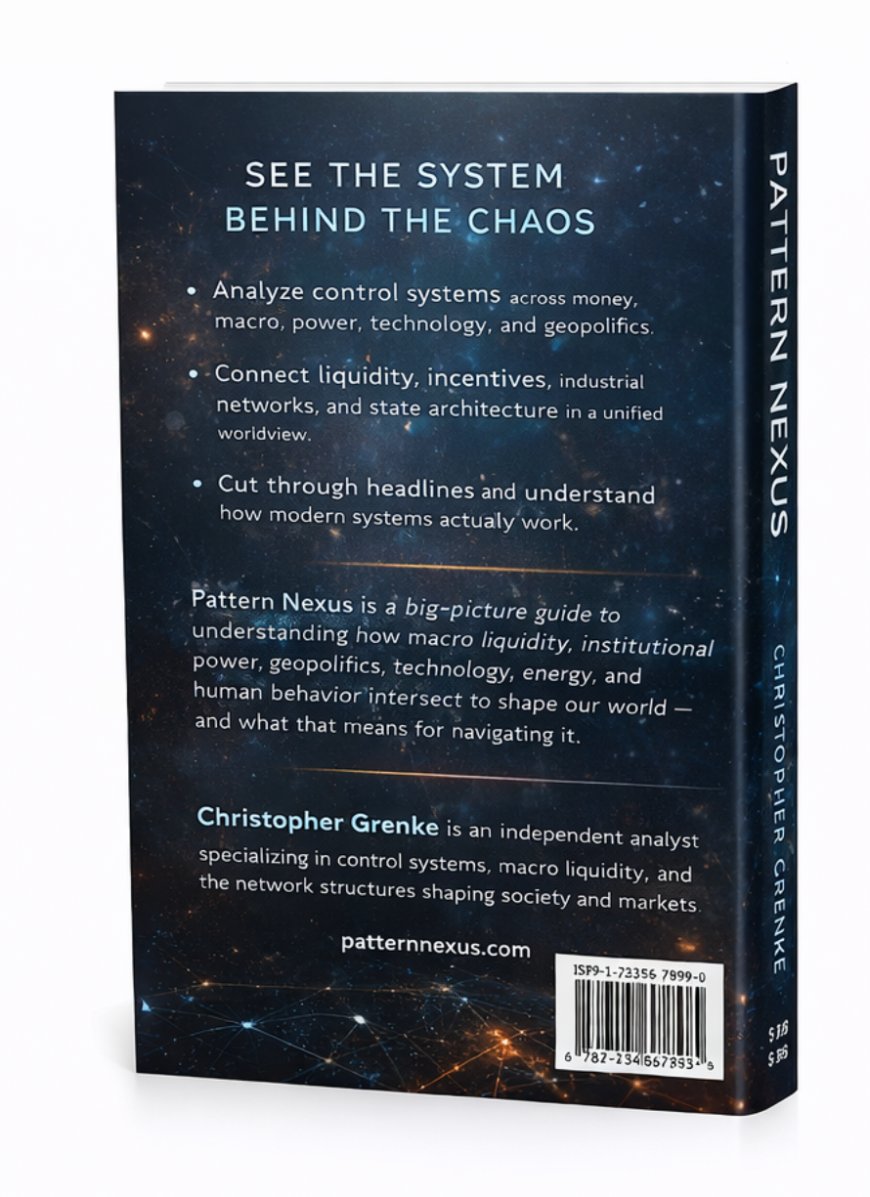
Pattern Nexus Worldview
A long-form Pattern Nexus framework on money, power, control systems, energy, sovereignty, society, and the shape of the next normal.
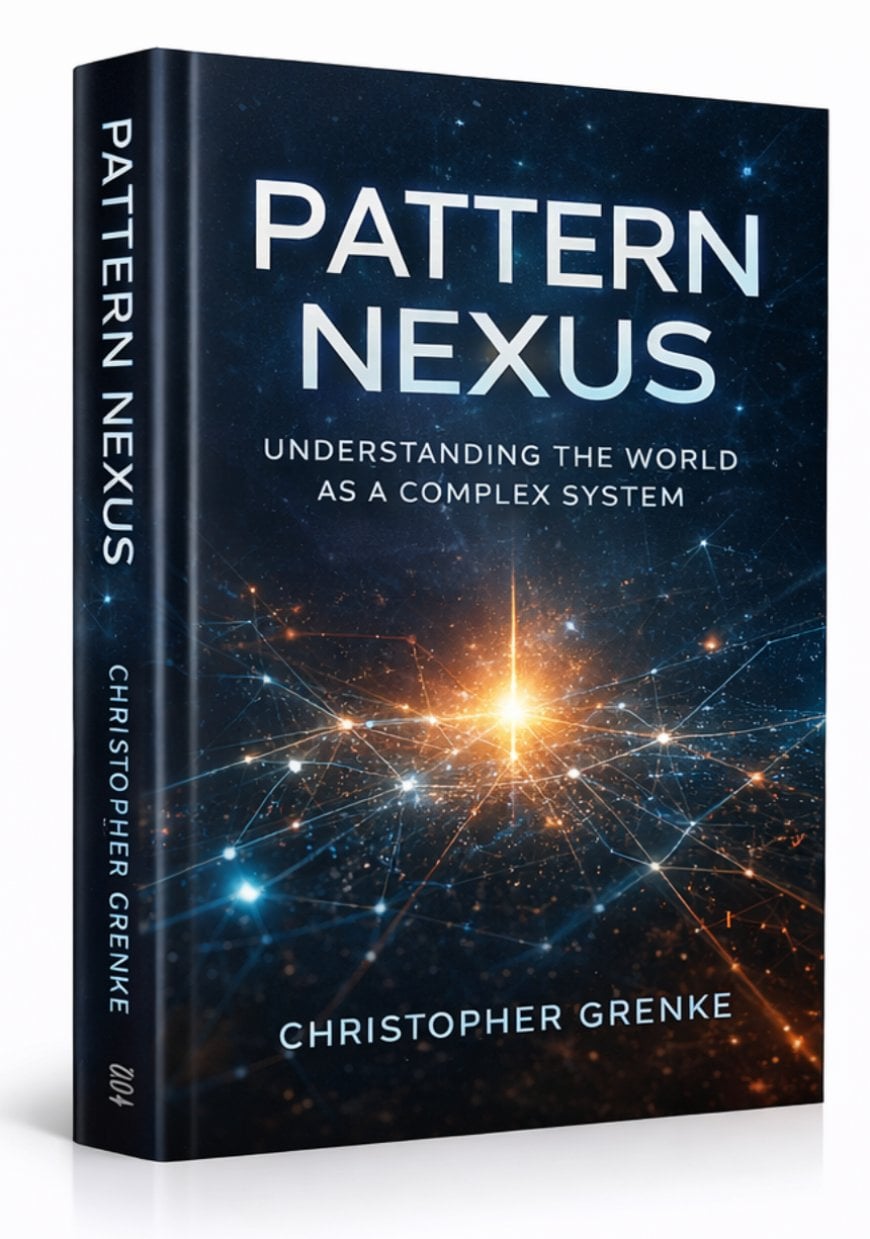
Buy Pattern Nexus Worldview
Get the hardcover edition of Pattern Nexus Worldview on Lulu. This book lays out the full Pattern Nexus framework across money, control systems, sovereignty, energy, power, society, and the structure behind the next normal.
Money, liquidity, collateral, and the architecture of claims
Energy, compute, corridors, chokepoints, and industrial power
Society, identity, labor, and the human consequences of the stack
Sovereignty, control systems, and the shape of the next normal
Copyright
Copyright © 2026 Christopher Grenke. All rights reserved.
No part of this book may be reproduced, stored, or transmitted in any form or by any means without prior written permission from the author, except for brief quotations used in reviews, commentary, or scholarly reference.
Contents
- Chapter 1: The Missing Lens
- Chapter 2: Money Is Not Wealth
- Chapter 3: The Monetary Break
- Chapter 4: Asset Prices as Governance
- Chapter 5: Energy, Compute, and the New Industrial Map
- Chapter 6: Chokepoints, Corridors, and the Enforcement Map
- Chapter 7: Society Inside the Machine
- Chapter 8: The Human Threshold
- Chapter 9: The Sovereignty Shift
- Chapter 10: The Next Normal
Chapter 1: The Missing Lens
Most people do not live in a world of missing information. They live in a world of broken interpretation.
- That distinction matters.
The average person today has access to more data, more headlines, more commentary, more charts, more expert opinions, more books, more podcasts, more long threads, more leaked documents, and more raw video than any civilization in history. There is no shortage of content. There is no shortage of explanation. There is no shortage of people eager to tell you what a war means, what inflation means, what AI means, what the market means, what the election means, what the collapse of the middle class means, what the Federal Reserve means, what Bitcoin means, what housing means, and what the future means.
And yet most people still cannot explain the world they live in.
Not because they are stupid. Not because they are lazy. Not because truth is impossible to reach. They cannot explain it because most of what they are given is separated into compartments that were never meant to be understood together. Finance is discussed as if it has nothing to do with war. War is discussed as if it has nothing to do with money. Money is discussed as if it has nothing to do with energy. Energy is discussed as if it has nothing to do with logistics. Logistics is discussed as if it has nothing to do with standards. Standards are discussed as if they are neutral. AI is discussed as if it is a side story rather than the next operating layer of the same machine. Housing is discussed as if it is just a consumer affordability problem rather than a political, financial, demographic, and collateral regime all at once.
- This is the first thing the reader has to understand before anything else in this book will make sense.
- The world is not actually divided into topics.
- It is divided into layers.
- And the layers interact whether people want them to or not.
- That is the foundation of the Pattern Nexus worldview.
Pattern Nexus did not begin as an attempt to become another market commentator, another geopolitical account, another real-estate brand, another AI futurist page, or another blog trying to go viral by shouting louder than everybody else. It began because the normal way of looking at the world was obviously insufficient. Too many analysts were strong inside one box and nearly blind outside it. The macro people understood rates and liquidity but often missed culture, infrastructure, and power projection. The geopolitics people understood conflict and territory but often missed collateral, monetary plumbing, and balance-sheet mechanics. The technology people understood acceleration but often spoke as if compute arrived in a vacuum, detached from power grids, credit markets, mineral extraction, or labor displacement. The real-estate people talked as if housing existed separately from sovereign debt, policy, demographics, and the monetary system. The social critics could feel that something was wrong but frequently stopped at outrage rather than structure.
Pattern Nexus exists because those silos are false.
The point was never to create another content lane. The point was to build a lens capable of seeing the machine as one machine.
That is why the work often feels different from traditional macro commentary. Traditional commentary usually begins with an event and then works outward. Pattern Nexus begins with structure and works inward. Traditional commentary says: here is what happened today and here is how it might affect other things. Pattern Nexus says: here is the architecture that makes certain classes of events more likely, more profitable, more tolerable, or more narratively manageable than others. Traditional commentary often lives at the level of reaction. Pattern Nexus tries to live at the level of arrangement.
- That difference is everything.
If you are looking at the world through isolated categories, you will keep mistaking outputs for causes. You will see a spike in oil and think the story is oil. You will see a new sanction package and think the story is diplomacy. You will see a housing shortage and think the story is construction. You will see AI layoffs and think the story is software. You will see a war expand and think the story is ideology or personality or ancient hatred. Sometimes those things matter. Often they matter a lot. But they are rarely the whole structure. They are more often a visible layer sitting on top of deeper forces that were already in motion.
This is where the concept of a control system becomes essential.
When most people hear the phrase “control system,” they imagine a slogan. They imagine conspiratorial language, manipulative branding, or a cynical way of saying that powerful people run everything. That is not what I mean.
A control system, in the sense used throughout this book, is an arrangement of incentives, permissions, bottlenecks, feedback loops, standards, and enforcement mechanisms that shape behavior at scale. It does not require a perfect central planner. It does not require every participant to understand the total structure. It does not require every outcome to be scripted. It only requires that the architecture reward some behaviors, restrict others, and make certain pathways easier, cheaper, safer, more financeable, more insurable, more narratively legitimate, or more survivable than the alternatives.
That is what the modern world is.
Money is a control system because it governs access.
Debt is a control system because it pulls future labor into present claims and organizes dependence across time.
Narrative is a control system because it tells populations how to interpret events after the structure has already set the menu of available outcomes.
Supply chains are control systems because they determine what can be built, where, with whose inputs, under whose standards, insured by whom, financed by whom, and shipped through which corridors.
Energy is a control system because power availability determines what remains online, what shuts down, what scales, and what becomes strategically subordinate.
Standards are a control system because they define compatibility, eligibility, and access long before politics admits that power is being exercised.
Sanctions are a control system because they weaponize rails rather than only territory.
Identity is becoming a control system because as more of life becomes mediated through digital infrastructure, eligibility becomes as important as ownership.
This is not philosophy for its own sake. It is operational description.
Once you start looking at the world this way, the apparent chaos of modern life changes shape.
A lot of what looks random stops looking random.
A lot of what looks like moral debate reveals itself as routing.
A lot of what looks like market price discovery reveals itself as managed flow.
A lot of what looks like policy disagreement reveals itself as disagreement over which layer of the machine gets priority under stress.
And a lot of what looks like social breakdown reveals itself as a consequence of structures that no longer distribute access, dignity, ownership, and mobility the way they once did.
The reader should pause here and notice something important.
Seeing the world as a control system does not mean believing that every actor is fully aware of the whole thing. In fact, one of the defining features of large systems is that most people inside them only understand the piece directly in front of them. That is not an accident. Fragmentation of understanding is often part of what makes a large system stable. The banker does not need to understand the shipping corridor. The shipping operator does not need to understand the reserve regime. The voter does not need to understand the collateral chain. The coder does not need to understand the energy bottleneck. The regulator does not need to understand the social consequences of labor displacement in full. Each person performs their task locally. The machine produces outcomes globally.
This is one of the reasons powerful systems often appear chaotic on the surface while still producing extremely coherent long-term outcomes.
No single participant needs the full map.
They only need to keep performing their function inside it.
That is also why objections to a systems view are often valid but incomplete. Someone will say the issue is oil. Yes, oil matters. Someone else will say the issue is central banking. Yes, that matters too. Someone else will say the issue is debt, or military empire, or AI, or demographics, or shipping, or semiconductors, or elite interests, or class structure, or fiscal mathematics, or culture, or psychological exhaustion, or standards, or the internet, or housing. All of those things may be true. The problem begins when people stop at the first layer they recognize and mistake that layer for the whole.
Pattern recognition without system integration creates half-truths.
Half-truths are often more dangerous than ignorance because they feel complete.
This is one reason why so much modern discourse fails. It is not that people see nothing. It is that they see one part clearly and then build a total explanation from a partial view. The person who understands markets but not power will think everything reduces to liquidity. The person who understands power but not markets will think money is just theater. The person who understands technology but not labor will assume capability automatically becomes prosperity. The person who understands social pain but not structural finance will see oppression everywhere but not always understand why the machine can absorb outrage without changing form.
The systems lens is an attempt to discipline all of that.
It asks a harder set of questions.
- What is the underlying architecture?
- What are the bottlenecks?
What rails are people actually moving through?
What permissions are real and which ones are decorative?
What standards decide viability before laws ever speak?
What must remain stable for the rest of the structure to keep functioning?
- What gets protected first under stress?
- What gets sacrificed?
- Who gets access to the backstop?
- Who only gets the narrative?
Those questions are not ideological. They are structural.
This is where the Pattern Nexus framework separates itself from both conventional political discourse and conventional market discourse. Politics, in its public form, trains people to think in moral theater. Markets, in their public form, train people to think in price snapshots. Both matter, but neither is enough. Public politics usually tells a story about values, parties, fairness, rights, enemies, and intentions. Markets usually tell a story about inflation, growth, rates, earnings, sentiment, and positioning. What both often miss is that modern civilization is increasingly governed through invisible coordination layers that sit underneath those visible stories.
That invisible coordination layer is what I call the permission stack.
The permission stack is one of the most important concepts in this book, because once you understand it, a huge amount of modern life becomes legible.
At a simple level, the permission stack is the layered structure through which access is granted, denied, delayed, priced, or conditioned. Narrative is one layer. Rails are another. Standards are another. Identity is another. Compute is another. Continuity is another.
Narrative matters because people do not act only on material conditions. They act on interpreted conditions. Narrative tells populations what a crisis is, what a threat is, what is legitimate, what is irresponsible, what is modern, what is safe, what is extremist, what is necessary, what is temporary, and what is normal. Narrative does not merely explain policy. It routes consent.
That is why narrative is not commentary. Narrative is routing.
Whoever controls the mediation layer exerts enormous influence over the action layer. If the population can be convinced that a measure is safety, convenience, modernization, stability, or progress, then a great deal can be implemented without overt coercion. This is one of the most misunderstood realities of modern power. Many people still imagine control as primarily visible violence. But the cheaper form of control is usually soft permissioning. You do not always need to forbid a behavior directly. You only need to make it unfinanceable, uninsurable, incompatible, unsearchable, uncertifiable, or socially radioactive.
- That brings us to rails.
Money is not just value. Money is movement. It is claims traveling through institutional pathways. When people imagine money, they often think of bills, balances, prices, and consumer spending. But at a systems level, money is a rail network of settlement, collateral, refinancing, eligibility, and confidence. The question is not merely who has money. The deeper question is who has access to the rails through which claims become operative.
This is why the modern monetary system cannot be understood through simplistic slogans about “printing” or “hard money” alone. Modern money exists inside balance-sheet architecture. It exists inside banking systems, collateral structures, reserve management, dealer capacity, sovereign debt markets, offshore dollar networks, insurance systems, and legal regimes. It is a hierarchy of claims. It is not a folk tale.
In a liquidity-gated world, central banks do not control prosperity in the moral sense. They control flow. That distinction matters because it explains why large-scale monetary expansion can stabilize asset prices without repairing the lived experience of large portions of society. The gate can open upstream while remaining highly selective downstream. Reserves can appear without broad-based relief. Backstops can save market structure without restoring genuine dynamism. Asset holders can grow richer while the public is told that support exists for “the economy.”
Once you see this, a tremendous amount of public confusion around inflation, inequality, bubbles, and stagnation begins to make sense. The issue is not merely that money exists. The issue is where the gate sits, who can borrow, who can refinance, who owns claims, which assets are institutionally protected, and how fast support arrives when different classes of participants fail.
This is why Pattern Nexus describes modern economies as liquidity-gated rather than free-flowing. That phrase captures something crucial. Money upstream is not the same thing as access downstream. Capacity on a balance sheet is not the same as broad prosperity. A new credit regime is not the same as a healthy civilization. If the gate is selective enough, a system can expand in numerical terms while becoming more brittle in human terms.
That brittleness is one of the great themes of the modern age.
- It shows up in housing.
- It shows up in work.
- It shows up in social trust.
- It shows up in political legitimacy.
It shows up in the distance between the official economy and lived experience.
And it shows up in the increasing need for systems to manage not only production and finance, but also morale, behavior, and identity.
That is why the permission stack eventually becomes an eligibility system.
As systems grow more digital, more financialized, more automated, and more interdependent, the temptation to govern through eligibility becomes overwhelming. Eligibility is cleaner than force. It is more scalable than force. It is easier to defend rhetorically than force. It can be sold as safety, quality control, fraud prevention, resilience, compliance, or modernization. And because it operates through layers rather than dramatic singular acts, many people barely notice it until it becomes normal.
This is where standards enter the picture.
Standards are one of the quietest forms of power in the modern world.
Most people hear the word and think of technical details, bureaucracy, or boring governance. But standards decide what is interoperable, certifiable, financeable, insurable, and scalable. They do not often prohibit behavior directly. They make certain behaviors nonviable by denying access to the systems required for modern participation. A company may be legal and still be impossible to finance. A product may function and still be impossible to insure. A transaction may be lawful and still be impossible to settle efficiently. A state may be sovereign on paper and still operate inside standards written by someone else.
This is why standards are weapons precisely because they do not look like weapons.
When power arrives disguised as best practice, neutral governance, interoperability, risk management, and technical necessity, resistance becomes more difficult. It is much easier to mobilize against an obvious act of domination than against an accounting framework, a compliance protocol, a certification regime, a digital identity standard, or a settlement requirement. Yet these “neutral” layers often determine who gets market access and who lives outside it.
At the geopolitical level, this becomes even more important.
A great deal of modern empire is no longer exercised through visible territorial occupation alone. It is exercised through rail control, legal reach, standards dominance, insurance leverage, payments architecture, reserve-currency hierarchy, chip restrictions, energy chokepoints, and institutional legitimacy. This does not mean armies no longer matter. It means armies now operate alongside other layers of power that are often more continuous and more economically decisive than open war. A bomb can destroy a port. A standard can keep it from ever re-entering the system on favorable terms. A sanction can deny a rail. A reserve regime can price a country’s survival. An insurance cutoff can disable trade without firing a shot.
This is one reason why the modern control system cannot be reduced to old political language. It is not simply capitalism. It is not simply empire. It is not simply bureaucracy. It is not simply technology. It is a layered enforcement stack.
At the center of that stack sits continuity.
Continuity may sound abstract, but it is the most important civilizational metric in this framework. Efficiency is what a system optimizes when it assumes the future is guaranteed. Continuity is what a civilization protects when it knows fragility is real. The systems that endure are not always the ones that maximize short-term output. They are the ones that can survive interruptions, reroute under pressure, preserve legitimacy long enough to adapt, and maintain enough coherence that people still participate in the structure rather than abandoning it.
This is why continuity is more important than elegance.
- More important than slogans.
- More important than ideological purity.
More important even than some measures of efficiency.
A civilization that becomes incredibly efficient but loses redundancy, resilience, dignity, and public trust may look powerful right until the moment a shock reveals that it built a machine optimized for throughput rather than survival.
That observation applies to supply chains. It applies to financial markets. It applies to energy grids. It applies to labor systems. It applies to digital identity. It applies to military posture. It applies to social order.
The modern world is full of systems that were optimized under assumptions that are no longer safe.
That is one reason the current era feels unstable even when many institutions remain standing. A system can remain operational while already being wrong for its environment. It can keep functioning numerically while losing resilience structurally. It can maintain outputs while eroding legitimacy. It can show positive surface readings while internal strain accumulates.
This is another place where a systems lens changes interpretation. Most people assume a structure is stable because it has not yet collapsed. That is one of the great errors of every cycle. Systems often remain standing until the very moment they reprice violently. This is true in banking, in empires, in markets, and in social orders. The fact that a regime still functions does not mean it is healthy. It may simply mean the backstops, narratives, and incentives that preserve it are still stronger than the forces trying to break it.
That observation leads to another major feature of the Pattern Nexus worldview: the distinction between narrative and structure.
- Narrative tells you why something happened.
Structure tells you how it was made possible.
- Control sits underneath both.
This is one of the simplest sentences in the entire framework, and one of the most important.
Narrative matters because humans require meaning. Structure matters because systems require pathways. Control matters because pathways are never neutral.
If you only study narrative, you will become highly emotional and poorly grounded. If you only study structure, you may become technically insightful but socially blind. If you ignore control, you will keep assuming that systems behave like passive environments rather than active selection mechanisms.
Pattern Nexus tries to hold all three at once.
That is also why the work often moves across domains that many readers are not used to seeing combined. It can move from eurodollars to semiconductors, from housing to sanctions, from AI data centers to demographic decline, from commodity flows to middle-class compression, from reserve regimes to social psychology, from digital identity to shipping corridors. To some readers this feels unconventional. From this lens, it is the only honest way to proceed.
If the world itself has become a single integrated machine, analysis that remains trapped inside a single silo becomes progressively less useful.
This is especially true in the AI era.
A large part of the public still treats AI as a technology trend, a labor story, a Silicon Valley story, or a philosophical story about consciousness and machine intelligence. Those conversations are not irrelevant. They are just incomplete. AI is also a power story. A capital-expenditure story. A grid story. A mineral story. A semiconductor story. A labor-discipline story. A national-security story. A standards story. A logistics story. A dependency story. A legitimacy story.
AI is not floating above the world. It is landing inside the existing control system and accelerating it.
This is why compute must be discussed alongside power. Power must be discussed alongside finance. Finance must be discussed alongside geopolitics. Geopolitics must be discussed alongside trade corridors. Trade corridors must be discussed alongside standards. Standards must be discussed alongside identity. Identity must be discussed alongside eligibility. Eligibility must be discussed alongside continuity.
- The machine is already upgrading.
One of the deepest misunderstandings of the present era is the belief that these are separate transitions. People talk as if there is a monetary transition over here, an AI transition over there, a geopolitical transition somewhere else, a housing crisis on one side, a labor crisis on another, and a social-fragmentation problem floating above them all. The Pattern Nexus view rejects that framing. These are not separate transitions. They are interacting manifestations of one larger reorganization.
The reorganization is about power under conditions of stress.
- Who controls the rails?
- Who controls the energy?
- Who writes the ?
- Who receives the backstop?
- Who absorbs the pain?
- Who gets digitized first?
- Who gets priced out?
- Who gets routed around?
Who gets folded into managed dependency and told it is modernization?
And who retains enough ownership, flexibility, and strategic position to shape the next system rather than merely live inside it?
Those are the questions this book is really about.
The first chapter is not supposed to answer all of them. It is supposed to install the lens required to answer them intelligently.
That means one more clarification is necessary.
Seeing the world as a control system does not require fatalism.
This is important because a lot of readers hear structural analysis and immediately assume it leaves no room for agency, creativity, resistance, adaptation, or human dignity. That is not true. Systems shape behavior, but they do not erase it. They narrow menus. They change costs. They create strong default paths. They produce incentives and punishments. But they do not eliminate agency. They redefine the environment in which agency operates.
- That is a crucial difference.
If anything, a systems lens is more empowering than a narrative-only lens because it improves situational awareness. It does not guarantee victory. It does not remove danger. It does not let anyone step outside structure entirely. But it does make it easier to distinguish theater from architecture, sentiment from flow, legitimacy from coercion, and temporary relief from regime shift.
- That matters in investing.
- It matters in business.
- It matters in family strategy.
- It matters in politics.
It matters in understanding which trends are noise and which ones are the early signs of a deeper rearrangement.
- It also matters morally.
A civilization that cannot see its own operating structure becomes easy to manipulate. It will mistake convenience for freedom, digitization for empowerment, access for ownership, supervision for care, and dependency for stability. It will accept layers of permission as harmless because each layer, taken individually, appears rational. Only when the system is viewed as a stack do the implications become clear.
This is one of the reasons I return so often to the phrase “the next normal.” Most people still evaluate events by asking whether the world is going back to normal. That question becomes less useful every year. A more serious question is: what kind of normal is being built? Who is building it? Which layers are hardening? What is becoming programmable? What is becoming non-optional? Which forms of ownership are shrinking? Which forms of access are being conditionalized? Which behaviors are being nudged into default? Which parts of life are becoming subscriptions to systems rather than property within systems?
- Those are not futuristic questions anymore.
- They are current questions.
In that sense, Pattern Nexus is not simply a commentary project. It is an attempt to describe the transition from an older world of looser analog friction into a newer world of tighter digital mediation, greater capital concentration, stronger infrastructural dependence, thinner margins for error, more visible geopolitical routing, and more explicit integration between money, power, technology, and social management.
That is why this book begins here.
Before we talk about money in detail, the lens has to be installed.
Before we talk about the dollar system, the reader has to understand rails.
Before we talk about war and empire, the reader has to understand continuity, chokepoints, and enforcement surfaces.
Before we talk about AI, the reader has to understand that technologies do not arrive as isolated gadgets. They arrive inside existing power structures and then intensify them.
Before we talk about housing, labor, class compression, and managed dependency, the reader has to understand that a civilization can grow numerically while becoming less livable to the average person.
Before we talk about the future, the reader has to understand that the future is already being routed through standards, eligibility, energy constraints, capital concentration, and narratives of necessity.
- That is the missing lens.
- Not a theory of everything.
- Not an ideology.
- Not a promise of certainty.
- A lens.
- A way of seeing.
A way of resisting the false fragmentation of modern life.
A way of tracing how events that appear separate at the headline level often belong to the same structural sentence.
- That is what is.
It is not a blog, a thesis, or a prediction engine.
It is a systems framework for understanding how modern civilization behaves under stress.
And if this chapter has done its job, the reader should now be able to feel the difference between looking at a world of topics and looking at a world of layers.
Once that shift happens, the rest of the book becomes possible.
Open Book Reader
Read this in a real book-style layout with page navigation, saved progress, night mode, and text controls.
Chapter 2: Money Is Not Wealth
The average person is taught to think about money backward.
They are taught to think of money as the thing itself. The object. The pile. The paycheck. The number in the account. The green paper in the wallet. The digital balance on the screen. If they become a little more sophisticated, they may learn to distinguish between cash, investments, and debt. They may learn the slogans. Spend less than you earn. Avoid bad debt. Save for retirement. Buy assets. Build credit. Stay liquid. Diversify.
None of that is useless. It is just not the core truth.
The core truth is that money is not wealth.
- Money is a claim.
That sounds simple until you realize how much it changes.
If money is a claim, then the real questions are not “How much money exists?” or “How do I make more money?” The deeper questions become: a claim on what, backed by whom, settled where, accepted by which institutions, protected by which state, denominated in which unit, and ranked where inside the hierarchy of claims?
That is the chapter most people never get.
They think money and wealth are interchangeable. They are not.
Wealth is control over resources, productive capacity, strategic position, resilient cashflow, optionality, and time. Money is one way of expressing a claim against those things. Sometimes it is a powerful claim. Sometimes it is a weak claim. Sometimes it is a fast claim. Sometimes it is a claim that only works because a much larger enforcement architecture stands behind it. Sometimes it is a claim that melts while the holder tells himself he is still “holding cash.” Sometimes it is not even really money in the old sense at all. It is software-mediated access inside a permissioned system.
Once you understand that difference, the modern world starts making more sense.
It becomes easier to see why people can earn more nominal dollars while feeling poorer. Why entire societies can look richer on paper while becoming more fragile underneath. Why asset owners and wage earners can live in the same monetary system while experiencing completely different realities. Why governments can run extraordinary debt loads without immediate collapse. Why central banks can expand balance sheets and still fail to create broad prosperity. Why the dollar can remain dominant even as faith in institutions deteriorates. Why housing can become less affordable even when rates fall. Why liquidity matters more than most political arguments. Why a person can be “solvent” and still get wiped out. Why the future of money increasingly looks less like coins and more like programmable permissions.
The world becomes easier to read because the illusion falls apart.
- Money is not the thing.
Money is the map of claims against the thing.
That distinction sits underneath almost every argument in this book.
Most people think wealth starts when they get paid. That is already too late in the chain. By the time wages arrive, the major claims have already been ranked. The owners of land, infrastructure, equity, intellectual property, financing channels, legal monopolies, and state-backed balance sheets are already upstream. They are not waiting at the same gate as the wage earner. They are helping define the gate.
This is why modern inequality is so often misunderstood. People talk about greed, fairness, taxes, wages, corruption, or bad policy. All of those matter. But beneath all of them is claim hierarchy. The modern system does not distribute access evenly because claims are not created equally. A Treasury security is not the same kind of claim as a checking-account balance. A reserve balance is not the same kind of claim as a credit-card limit. Equity in a cash-generating business is not the same kind of claim as a salary. A mortgage note is not the same kind of claim as a renter’s paycheck. Collateral that the system accepts is not the same as labor the system can replace.
That is where money starts to merge with power.
Money is not merely an exchange medium. It is a ranking technology.
It decides whose claim gets honored first.
It decides who can roll debt and who must liquidate.
It decides who gets rescued when stress hits.
It decides who can convert paper into property and who remains trapped in monthly cashflow arithmetic.
It decides who can survive a disruption because they own the rail and who gets destroyed because they only rented access to it.
The longer you look at the system, the harder it becomes to believe that money is just a neutral convenience.
It is a social technology for organizing power across time.
That is why money has always been political even when elites insist it is merely technical. And it is why technical changes in money are never merely technical either. They change the geometry of access.
To understand that geometry, you have to start with first principles.
A dollar in a bank account feels like an asset to you. And from your point of view, it is. But in accounting terms it is also a liability of the bank. The bank owes you that dollar. The deposit is your asset and the bank’s liability at the same time. That one fact already breaks most people’s mental model. They imagine money as a static store. In reality, modern money is a set of linked balance sheets.
That means the system is relational from the beginning.
Your “money” exists because someone else has recognized an obligation. The banking system is full of these mirrored structures. Loans create deposits. Deposits become purchasing power. Purchasing power gets spent into assets, consumption, business formation, speculation, rents, wages, taxes, and debt service. The entire machine is built out of claims that refer to other claims. This is why modern money is elastic. It is not a fixed pile of units waiting to be discovered. It is a dynamic ledger architecture that expands and contracts with credit creation, collateral acceptance, state backing, and confidence.
That elasticity is not an incidental feature. It is the system.
Most people hear the phrase “money printing” and picture a cartoon. A government runs a press, floods the streets with paper, and the currency collapses. That image survives because it is emotionally satisfying. But the real world is more subtle and much more powerful. Most modern money is created when credit is extended. A bank makes a loan. A deposit appears. A future claim is pulled into the present. A household buys a house. A corporation issues debt and buys back stock. A government issues bonds and finances spending. The central bank then decides how much of the ultimate settlement layer to provide, absorb, protect, or reprice.
That is why debt sits so close to the center of the modern system.
Debt is not a side effect of money.
Debt is how most money enters the system in the first place.
This is one reason the public is so often confused by the phrase “money is debt.” They hear it as ideology or as a slogan. But the point is mechanical. If most money arrives through credit creation, then money and debt are joined at the root. The new purchasing power is created against a future obligation. That future obligation must then be serviced, rolled, refinanced, inflated away, or socialized. As the system scales, the need for new debt creation becomes structural because existing claims require ongoing support. A debt-heavy system cannot simply stop expanding and remain calm. Once enough obligations are stacked into the future, stagnation itself becomes destabilizing.
This is why I keep saying the modern system is less like a savings economy and more like a claim engine.
It takes the future and monetizes it in the present.
- Labor is monetized before it happens.
Tax revenue is monetized before it arrives.
Housing appreciation is monetized before it is realized.
Corporate earnings are monetized before they are booked.
Infrastructure demand is monetized before it is built.
War spending is monetized before the bill is paid.
Even optimism itself gets monetized when expected future growth becomes present valuation.
- That is what leverage really is.
Leverage is not primarily a moral failing. It is the system’s force multiplier. It is the method by which future claims are dragged forward and enlarged. At the household level, this feels like financing a car, using a credit card, or taking a mortgage. At the corporate level, it becomes debt-funded expansion, acquisitions, buybacks, and duration mismatches. At the sovereign level, it becomes rolling deficits and refinancing an ever-larger state. At the monetary level, it becomes the central bank’s decision to support the price and acceptability of entire categories of claims. At the shadow level, it becomes collateral chains, derivatives, repo, rehypothecation, and synthetic exposure layered on top of already-financed assets.
The higher the stack rises, the more the system appears wealthy.
But appearance is not the same as resilience.
This is where people begin confusing balance-sheet expansion with civilization-level strength.
A society can generate enormous nominal asset values while becoming operationally brittle. It can inflate the value of homes while making shelter less accessible. It can produce record equity indexes while eroding social mobility. It can create trillion-dollar technology firms while hollowing out labor’s bargaining power. It can increase state spending while narrowing private ownership. It can celebrate innovation while building deeper dependency. It can create more “wealth” without solving the problem of who actually controls real resources when the chain tightens.
That is why money cannot be understood apart from time.
- Money is time compression.
At one level this is obvious. If I borrow, I bring future spending power into the present. If I save, I transfer present production into a claim on future consumption. But the idea goes deeper than that. The entire monetary system is a way of organizing claims through time. Interest rates are not just prices. They are time valuations. Credit scores are not just risk metrics. They are judgments about whether your future labor will remain dependable enough to support present claims. Discount rates are not just spreadsheet inputs. They are measurements of how the system values future cashflows versus present certainty. Pension systems are not just benefit structures. They are collective bets about time, demography, asset returns, and the survivability of long-duration claims.
The more you study the system, the more you realize that nearly every major monetary institution is really a machine for pulling value through time.
- Mortgages do it.
- Bonds do it.
- Insurance does it.
- Derivatives do it.
- Leasing does it.
- Equity valuation does it.
- Treasury markets do it.
Even fiat currency itself does it, because it stores and routes claims across time under state protection.
This is why monetary disorder is never only about arithmetic. It is always about time discipline. Can the future still bear the weight of the claims piled onto it? Can income cover the fixed obligations? Can growth outrun the debt load? Can inflation erode the burden without breaking confidence? Can refinancing remain available? Can the collateral retain enough value to keep the chain intact? Can the state preserve legitimacy while constantly extending and repricing obligations?
Those are time questions disguised as monetary questions.
And beneath even that layer sits energy.
This is where the conversation becomes uncomfortable for people who want money to be purely abstract. Money is symbolic, yes. It is a social agreement, yes. It is a legal construct, yes. But symbols that cannot command real energy, labor, logistics, extraction, and production eventually fail. A currency can be beautifully designed, digitally efficient, institutionally protected, and globally connected, but if the system beneath it cannot still command fuel, food, transport, compute, mining, manufacturing, and defense, the symbolic layer weakens. Money cannot remain meaningful if it loses its ability to organize reality.
That is why money is always tied to the physical world even when it seems detached from it.
It is a claim on energy transformed through civilization.
It is a claim on labor hours, harvested resources, machine output, shipping capacity, software coordination, and territorial order.
That is why empires care so much about energy corridors, maritime routes, sanctions, reserve status, insurance markets, and industrial inputs. These are not separate issues from money. They are the physical enforcement layer underneath monetary claims. If you control energy, transport, and security, you strengthen the credibility of the monetary system built on top of them. If you lose control of those things, the currency begins losing depth, reach, and resilience.
This is one reason the 1970s matter so much.
When people are taught the history of money, they are usually given a cartoon version. Gold standard. Nixon closes the gold window. Fiat begins. End of story.
- That is not the real story.
The real story is that the old Bretton Woods framework broke under the strain of global dollar demand, U.S. deficits, external claims, and the impossibility of maintaining a gold-convertible system while simultaneously providing the world with enough dollars to function. Once the gold window closed, the dollar did not cease to matter. It had to be rewired. Floating exchange rates, offshore eurodollar markets, petrodollar recycling, Treasury demand, and security guarantees together created a new architecture. The dollar stopped being a metal-linked promise and became a network-backed claim system anchored by scale, energy trade, military protection, financial depth, and institutional power.
- That shift changed everything.
It meant the dollar no longer needed gold to dominate. It needed usage.
- It needed settlement depth.
- It needed global credit creation.
- It needed oil invoicing.
- It needed Treasury collateral.
- It needed offshore banking capacity.
It needed the confidence that in a crisis there would still be a buyer, a backstop, a corridor, an insurer, a clearing rail, and a state willing to preserve the system.
In other words, the dollar became less like a thing and more like an operating environment.
That is why so many simplistic collapse narratives keep failing. People imagine a currency falling the way a building falls. But reserve systems usually mutate before they die. They widen, digitize, reroute, absorb, and reposition. The dollar has been doing exactly that for decades. Its strength does not come from moral purity. It comes from system utility. The world is saturated with dollar-denominated claims, dollar funding needs, dollar collateral dependence, and dollar settlement habits. That does not make the system healthy. It makes it sticky.
This is where the eurodollar story becomes essential.
Most people have never heard the term, and yet it quietly explains far more of the modern world than the average political debate ever will. Eurodollars are not “European dollars” in the naive sense. They are offshore dollar liabilities created outside the United States, outside direct domestic reserve constraints, but still inside the wider dollar ecosystem. That offshore web helped turn the dollar from a national currency into a planetary credit machine. It allowed enormous global liquidity creation without every dollar being born directly inside the visible U.S. banking system. It extended the reach of the dollar while also making the system harder to see, harder to regulate cleanly, and more dependent on confidence, funding markets, and collateral quality.
This is one reason monetary power today is not just about printing. It is about clearing and settlement. It is about whose liabilities are accepted, whose collateral is recognized, whose balance sheets are trusted, whose platforms are insurable, and whose claims can survive stress without becoming nonfunctional. Modern money is less a pile of units than a hierarchy of accepted liabilities.
That hierarchy is what people mean without realizing it when they talk about “safe assets.”
Some claims are trusted more than others.
- Some are liquid in all weather.
Some can be pledged, financed, rolled, margined, and rehypothecated across the system.
Some are money-like only during calm periods and reveal their weakness during stress.
This is why collateral matters so much.
Collateral is not just a technicality for bond desks and repo specialists. It is the blood chemistry of the modern financial system. It tells you which assets can support additional claims. It tells you what the system treats as acceptable backing. It tells you which balance sheets can stretch and which ones must contract. It tells you why a Treasury security is not just “government debt” but also a foundational support beam in the global dollar architecture. It tells you why a housing market is not just about shelter but also about loan creation, mortgage securitization, collateral transformation, and class sorting. It tells you why the same central bank that claims to be targeting inflation is also quietly managing the conditions under which collateral remains financeable.
This is why housing occupies such a central place in the modern claim structure.
People think of housing emotionally first. Home. Family. Stability. Neighborhood. Safety. All of that matters. But housing long ago became much more than shelter. It became collateral infrastructure. Mortgages could be originated, packaged, sold, transformed, financed, rated, and used to support layers of additional claims. Housing values became intertwined with bank balance sheets, household confidence, political legitimacy, and credit expansion. The house was no longer just where you lived. It was part of the machine.
- That machine changed the middle class.
It rewarded those who got close to leverage early enough and punished those who arrived after price inflation had already run ahead of wages. It taught households to think of appreciation as prosperity. It turned fixed-rate mortgages into strategic assets. It created generations of owners whose balance sheets were quietly carried by declining rates, repeated refinancing opportunities, and the broad inflation of asset values. It also created generations beneath them who increasingly experience housing not as a ladder but as a gate.
This is one reason “wealth” in modern America so often means exposure to the right collateral cycle rather than participation in production alone.
The person who bought the house before the liquidity wave reads as prudent, visionary, or lucky depending on the observer. In many cases he may be all three. But he was also positioned inside an architecture that systematically rewarded ownership of leverage-compatible assets. The person who rents may be hardworking, disciplined, and responsible, but if he remains outside the collateral engine, he experiences the system very differently. Prices rise before wages. Financing gets harder as nominal values climb. Insurance, taxes, repairs, and input costs ratchet upward. The owner with locked-in financing often survives. The outsider keeps chasing a moving staircase.
This is why nominal wealth expansion can coexist with social stagnation.
- The chart goes up.
- The index makes highs.
- Home equity rises.
- Retirement balances look larger.
And yet the experience of life for large parts of the public becomes tighter, not looser.
This is not a contradiction once you understand where the new claims are flowing.
- They are not flowing evenly.
- They are flowing through specific gates.
This is what I mean by a liquidity-gated economy.
Most public discourse still imagines money as if it naturally circulates. Create more of it, and eventually it reaches everyone. Tighten conditions, and eventually everyone feels the same squeeze. Reality is different. Liquidity moves through institutional choke points. It moves through reserve conditions, collateral rules, dealer capacity, lending standards, asset eligibility, repo plumbing, payment rails, and political tolerance. Central banks do not control prosperity in any total sense. They control the gates. They regulate the pressure. They decide, explicitly and implicitly, what categories of claims remain supportable and which ones are allowed to break.
That is why asset inflation can occur long before broad wage relief.
That is why crisis response often rescues balance sheets faster than households.
That is why markets can rally while the public feels crushed.
That is why “easing” can enrich owners without restoring mobility.
That is why housing can become more unaffordable during a nominal support cycle.
That is why the same policy action can look like salvation from one layer and extraction from another.
What the public experiences as economics is often just downstream flow behavior.
The system can create extraordinary upstream liquidity while preserving downstream scarcity for the average person. In fact, much of the modern order now depends on exactly that balance. Too much downstream abundance threatens price discipline, labor discipline, and the hierarchy of claims. Too little support threatens financial stability and social legitimacy. So the machine oscillates. It relieves enough pressure to preserve itself while protecting the ranking of claims that gives it shape.
This is why the middle class increasingly feels like it is being managed rather than represented.
- It is.
Not always through explicit conspiracy. Often through structure.
The household is expected to remain functional enough to service obligations, keep consuming, keep believing, and keep voting, but not necessarily to regain full ownership of the future. As long as the household can be kept inside the system without broad insolvency, the machine can continue repricing above it. Cheap streaming, digital entertainment, food delivery, financed devices, subscription access, incremental stimulus, targeted tax credits, and occasional policy relief can coexist with deeper erosion of durable ownership. The person feels active but owns less of the rail.
That is one reason the debt-free fantasy is so often misleading.
People tell themselves that escaping debt means escaping the system. Sometimes it helps. Often it does not solve the deeper issue. A person can be free of consumer debt and still remain outside the asset channels that produce resilience. A person can have no mortgage and no leverage but also no optionality, no productive assets, no inflation-resistant cashflow, and no ability to absorb shocks. He may be cleaner on paper and weaker in reality. Conversely, a person can be highly levered and still quite resilient if the leverage is attached to durable assets, favorable financing, and a claim hierarchy the system is likely to protect.
This does not mean leverage is always wise. It means slogans are not enough.
The right question is never just “Do you have debt?”
The right question is “What kind of claim structure are you sitting in?”
- What funds it?
- What collateral supports it?
- How long is the duration?
- What happens when refinancing conditions change?
- What happens when tightens?
What happens when the system reprices the asset class beneath you?
What happens if the gate closes before you get through?
Those questions matter because in the modern world liquidity kills faster than insolvency.
A person can be right in the long run and dead in the short run.
A business can be fundamentally sound and still get broken by funding conditions.
A bank can appear solvent until collateral values crack.
A government can appear stable until rolling costs rise too far.
A market can appear liquid until everyone tries to pledge the same class of collateral at once.
- That is why repo matters.
- That is why reserve floors matter.
- That is why standing backstops matter.
That is why the reverse repo facility matters.
That is why the difference between abundant reserves and acceptable collateral matters.
These are not edge topics. They are the hidden valves of the monetary system.
When people say the Fed “controls everything,” they are wrong in a literal sense and right in a structural sense. The Fed does not control every market outcome, every private decision, or every geopolitical force. But it strongly influences the price and acceptability of leverage, the reserve environment, the survival odds of collateral chains, and the conditions under which balance-sheet expansion can continue. It is the operator of the base settlement layer. That position is not absolute power, but it is tremendous power.
This is one reason the period after 2008 changed the public’s relationship to money even if most people never learned the vocabulary.
Quantitative easing did not simply “print money” in the folk sense. It changed the support architecture under modern claims. Long-duration assets could be exchanged for short-duration liquidity. Yields could be suppressed. Risk curves could be bent. Asset values could be stabilized and then lifted. Markets learned that when the system itself was threatened, the gatekeeper would move aggressively to preserve the structure. This did not solve inequality. It intensified it. It did not erase fragility. It relocated it. But it did prove that the monetary system was no longer merely a referee. It was a direct participant in asset hierarchy.
The decade that followed made this unmistakable.
Equities detached further from ordinary wage life.
- Housing re-inflated.
- Wealth concentration deepened.
Financial assets behaved less like reflections of broad prosperity and more like recipients of managed liquidity.
The public was told recovery was occurring because the numbers were recovering. In one sense that was true. In another sense, the claim hierarchy was simply being rebuilt with stronger support for those already closest to the asset channels.
- Then came the next mutation.
Stablecoins, tokenized dollars, tokenized Treasuries, digital settlement rails, and programmable compliance layers are not a break from the old system. They are the next version of the same system. This is where people get confused because they imagine digital money as inherently rebellious, decentralized, or separate from state power. Some early crypto culture encouraged that fantasy. But the deeper pattern is more interesting and more consequential. The dollar system is being absorbed into software. Claims are becoming more programmable, more continuously monitored, more portable across time zones, and in some cases more directly integrated with collateral infrastructure. That does not weaken control. It often strengthens it.
Money is becoming software because the rail has become as important as the unit.
If you cannot clear, you do not truly transact.
If your asset cannot be recognized by the system, you do not truly collateralize.
If your platform is outside the compliance perimeter, your money may still “exist,” but it does not function with the same depth.
If tokenized dollars settle faster, move farther, and plug more efficiently into leverage loops, then the digital form of the dollar can actually extend dollar power rather than dilute it.
This is one reason stablecoins matter so much. They are not just crypto quote currencies. They are dollar-like claims moving on software rails, often backed by Treasuries or similar short-duration instruments, creating new demand for the same sovereign collateral that underpins the wider system. They represent a new hose into the global liquidity architecture. They also hint at the future hierarchy: some money will remain public and sovereign at the base, some will remain bank liabilities, some will become tokenized claims, and all of it will increasingly be ranked by access, compliance, and utility inside settlement networks.
This is where money stops looking like a commodity and starts looking like an operating permission.
- That shift has enormous implications.
It means financial censorship no longer requires dramatic confiscation. Denial of access can be enough.
It means risk models and compliance layers can shape participation without overt bans.
It means identity becomes increasingly fused with economic function.
It means the most important monetary battles may not be over inflation rhetoric at all, but over clearance, eligibility, custody, settlement, and the software layer through which claims are recognized.
It means a person can hold nominal “money” and still be powerless if his form of money is not accepted by the dominant rail.
It means the difference between old wealth and new money may increasingly be the difference between owning the infrastructure of claims and merely holding a revocable balance within it.
This is why I keep coming back to the same point.
- Money is not wealth.
- Money is a claim.
- Claims must be enforced.
- Claims must be ranked.
- Claims must be settled.
- Claims must be accepted.
Claims must be protected by a structure stronger than the individual holder.
Once that becomes clear, a lot of myths collapse.
The myth that savings alone equals safety.
The myth that debt is always weakness.
The myth that a paycheck is the same thing as financial security.
The myth that nominal gains automatically mean prosperity.
The myth that central-bank easing lifts everyone in the same way.
The myth that housing prices reflect only shelter demand.
The myth that digital money is outside politics.
The myth that reserve currencies collapse only when they visibly break.
The myth that markets are just neutral scoreboards of value.
The myth that ownership is a binary.
Most people do not own in the way they think they own.
Many people own assets but not the rail.
Many people hold balances but not durable claims.
Many people possess titles while depending on upstream systems they do not control.
Many people feel free only because the gate is currently open.
The system becomes much easier to understand when you stop asking what money is and start asking what money allows.
- What can it buy?
- What can it protect?
- What can it leverage?
- What can it survive?
- What rail does it clear through?
- What hierarchy does it sit inside?
What future does it pull into the present?
What parts of the real world can it still command?
- Those are wealth questions.
And once you start asking wealth questions instead of money questions, you realize the modern world is not organized around fairness or even around simple growth. It is organized around preserving and extending specific claim hierarchies while managing enough social stability to keep the structure intact.
That is why money, debt, collateral, and liquidity belong at the center of any serious worldview.
- Not because everything reduces to finance.
But because in the current civilization, finance is one of the main ways power writes itself across time.
This chapter has focused on the grammar of claims.
The next step is to ask how that grammar became the architecture of empire.
Because money does not float above geopolitics.
It rides on rails, corridors, security guarantees, sanctions, clearing systems, and strategic chokepoints.
To understand the modern world fully, you have to move from claims to enforcement.
- That is where we go next.
Chapter 3: The Monetary Break
Money does not merely circulate through history. It changes form when the governing order beneath it changes form.
That is the real story of the modern era.
Most people are taught a simplified monetary history because simplified history is easier to govern. They are given something like this: the world used to be tied to gold, then Nixon closed the gold window in 1971, then we entered the age of fiat money, and now central banks more or less manage things from there. That version is not completely false, but it is so incomplete that it hides the machine rather than revealing it.
The actual story is about regime design.
The modern monetary order did not emerge because somebody replaced honest money with fake money in a single dramatic moment. It emerged because the old architecture could no longer contain the scale of industrial expansion, military spending, offshore banking, energy dependence, and global trade that the postwar order had unleashed. Gold did not fail because metal became useless. Gold failed because the claims stacked on top of the system grew larger than the convertibility story could credibly support. The old box became too small for the power structure it was supposed to contain.
That is what this chapter is about.
It is about how the dollar order was built, why it broke, how it was rewired, why the rewired version became even more powerful than the original, and why liquidity eventually became the hidden language of the entire global system.
To understand where we are going, you have to understand that the real break was not simply from gold to fiat. The real break was from money as an anchored object to money as an expandable network of claims, collateral, settlement channels, and state-backed confidence. Once that transition was complete, the world did not merely get a new currency arrangement. It got a new operating system.
Bretton Woods Was a Managed Hierarchy, Not a Neutral Standard
The postwar dollar order is often remembered as if it were a stable moral arrangement. In reality it was a managed hierarchy built under extraordinary conditions.
The United States emerged from the Second World War with unmatched industrial capacity, intact domestic infrastructure, military reach, and a gold-heavy balance sheet relative to the rest of the world. Europe was wrecked. Japan was devastated. Britain was exhausted. The United States did not simply “win” the war in a military sense. It inherited the power to design the settlement architecture that would organize the Western world after it.
- That architecture was Bretton Woods.
At the surface level, Bretton Woods looked simple. Currencies were pegged to the dollar. The dollar was convertible into gold for foreign official holders. Stability was the promise. Reconstruction was the story. Order was the justification.
But beneath that formal design was something more important: the United States became the axis around which postwar liquidity, security, and trade would revolve. Dollars funded rebuilding. American markets absorbed goods. American military power underwrote sea lanes. American institutions set standards. American diplomacy linked economics and defense into one settlement package. The world did not simply adopt a reserve currency. It entered an organized hierarchy.
This matters because reserve systems are never only about economics. They are about credibility, coercion, habit, institutional density, and practical utility. A reserve currency is not just money. It is the accepted center of a wider permissions environment. If you want to understand why the dollar became dominant, do not begin with paper notes. Begin with industrial scale, military reach, shipping security, legal depth, banking infrastructure, and the fact that rebuilding Europe and organizing the anti-Soviet bloc required a settlement center. The dollar became that center.
Bretton Woods therefore worked less like a timeless monetary truth and more like an early political technology. It allowed the United States to export stability and influence at the same time. It anchored allies, encouraged trade, centralized settlement, and helped create a world in which the United States sat at the middle of the map even when American power appeared to be dispersed through alliances.
That system was always more fragile than it looked.
Why? Because to supply the world with enough reserve assets and dollar liquidity, the United States had to keep creating external claims. But the more claims it created, the harder it became to preserve the fiction that every important holder could ultimately cash out into gold at the official rate. In plain English: the world wanted more dollars than the old gold framework could honestly support.
That tension was embedded in the system from the beginning.
A reserve center must provide liquidity to the world. But if that liquidity remains tied to a hard convertibility promise, success itself starts undermining the promise. The bigger the system gets, the more the anchor is strained. The more trade expands, the more offshore demand builds, the more U.S. deficits rise, the more military commitments grow, and the more banking innovation spreads, the more difficult it becomes to pretend that the gold constraint remains decisive.
What looked stable in textbooks was already carrying the seeds of its own break.
- The 1960s Were the Warning
The true monetary drama of the postwar order did not begin in 1971. By the time Nixon closed the gold window, the pressure had been building for years.
The United States was financing a sprawling geopolitical footprint. It was sustaining overseas military commitments, supporting allies, feeding the growth of global trade, and running an economy that was increasingly capable of generating more dollar claims than gold could discipline. Foreign holders accumulated dollars. Confidence in convertibility thinned. Gold outflows became a signal that the market was beginning to understand what official language tried to conceal.
That is how monetary orders die: not all at once, and not first in public rhetoric, but in the growing gap between formal promise and operational reality.
By the late 1960s, the old arrangement had become harder and harder to defend. The London Gold Pool broke. Pressure on U.S. reserves intensified. The contradiction was obvious even if the public did not yet use that language. The world had become dependent on dollar liquidity, but the mechanism that was supposed to guarantee the value of the dollar had become too small relative to the scale of the claims being produced.
This was not a story about moral weakness.
- It was a story about scale.
The United States was trying to be empire, arsenal, credit supplier, security guarantor, and monetary anchor simultaneously. That combination can produce immense dominance, but it also produces immense strain. Every additional layer of responsibility increases the need for flexibility. Gold is discipline. Empire is elasticity. Industrial and military hegemony on a planetary scale does not sit comfortably inside hard convertibility forever.
That is why the break was effectively inevitable.
The system did not fail because leaders suddenly became irresponsible in 1971. It failed because the old design had already become incompatible with the level of global power it was being asked to support.
1971 Was Not the End of the Dollar. It Was the Beginning of Dollar Supremacy 2.0
This is the point most people get exactly backward.
They hear that Nixon closed the gold window and assume that the dollar should have been fatally weakened from there. In one sense, something enormous did end. The old convertibility theater was over. But the dollar itself did not collapse. In structural terms, it was liberated.
Once the formal gold restraint was removed, the United States had room to evolve the dollar from a partially metal-anchored currency into a globally networked liquidity regime.
- That distinction is everything.
A gold-linked dollar has an external discipline. A network dollar has an external demand field.
The old system asked whether dollars could be converted. The new system asked whether dollars were necessary.
- And the answer, increasingly, was yes.
After 1971, the world did not stop needing dollars. It needed them more. Global trade kept expanding. Commodity markets deepened. sovereign debt markets widened. Offshore banking exploded. Multinational corporate structures grew larger. Cross-border finance became more complicated. The more complex the world became, the more useful a dominant settlement and funding currency became.
What replaced Bretton Woods was not “nothing.” It was a more adaptive arrangement built from floating exchange rates, offshore dollar creation, Treasury market depth, U.S. institutional power, and eventually energy-linked dollar demand. This was not a clean constitutional redesign. It was a transition into a more flexible system whose strength came from usage, scale, and dependence rather than official convertibility.
This is why the post-1971 dollar proved far more durable than collapse narratives assumed.
The dollar stopped being a promise to exchange into gold at a fixed rate. It became the central node in a giant web of claims. That made it less morally satisfying for hard-money critics and far more operationally useful for the actual world.
The difference between those two things would shape the next half century.
The Eurodollar System Quietly Changed the Planet
If there is one term the average person should know but usually does not, it is eurodollar.
The eurodollar system is one of the most important hidden structures in modern history because it explains how the dollar became something larger than the visible U.S. domestic banking system.
A eurodollar is, at root, an offshore dollar liability. It is part of a global network of dollar-denominated claims created outside the direct domestic reserve architecture of the United States but still functioning inside the broader dollar world. That offshore web allowed the dollar system to scale far beyond what most people imagine when they think of “the U.S. money supply.”
This is where the world quietly changed.
The dollar was no longer just America’s currency. It was the raw funding language of global finance.
Banks outside the United States could create dollar liabilities. Corporations around the world could borrow in dollars. Trade could be financed in dollars. Commodity flows could be settled in dollars. Cross-border liabilities could be stacked in dollars. Funding markets could seize in dollars even when the stress was not visibly “inside” the United States.
This made the system bigger, deeper, and more dangerous.
Bigger because offshore balance-sheet capacity allowed enormous expansion.
Deeper because the global role of dollar claims grew beyond any simple domestic measurement.
More dangerous because a system with that many interlocking liabilities becomes acutely sensitive to collateral quality, confidence, term structure, and rollover risk.
The eurodollar world therefore did two things at once. It amplified U.S. monetary reach without requiring the United States to directly micromanage every dollar-like claim. And it created a vast shadow layer in which funding pressure, balance-sheet stress, and liquidity shortages could emerge far from the public eye.
This is one reason modern crises so often seem confusing to people who only watch official headlines. They are looking at visible policy while the real stress is often moving through invisible funding channels.
The public hears about inflation, growth, or rates.
The machine is often worrying about collateral chains, rollover pressure, margin mechanics, and whether enough acceptable dollar claims exist to keep the private system functioning.
- That is a eurodollar-era reality.
Oil Did Not “Back” the Dollar in a Simple Sense. It Routed Global Necessity Through It
One of the laziest simplifications in modern monetary discourse is the phrase “the dollar is backed by oil.” That is not precise enough.
Oil did not become a magical commodity guarantee that replaced gold one-for-one. What happened was more strategic.
The post-1970s order increasingly routed global energy trade, energy security, and energy recycling through the dollar system. That mattered because energy is not a side sector. Energy is the base layer of industrial civilization. If the world needs energy and energy flows are invoiced, financed, insured, and recycled through dollar channels, then the demand for dollar functionality becomes embedded in the metabolism of the global economy.
This is far more important than a slogan about “backing.”
A reserve system gains power when necessity runs through it.
Oil was one of the strongest necessity channels on earth.
The petrodollar framework linked energy demand, dollar invoicing, Treasury recycling, security guarantees, and broader geopolitical alignment into a single structure. This did not mean every country became subordinate in the same way, and it did not mean the system was unbreakable. It meant that one of the most vital inputs in the world economy flowed through an architecture that reinforced the centrality of the dollar.
Again, this is a control-system story.
The goal of empire is not merely ownership. It is routing.
If flows move through your standards, your clearing system, your insurers, your military umbrella, your financial markets, and your reserve assets, then your currency enjoys a strength deeper than rhetoric. It becomes part of the practical grammar of world order.
That was the real genius of the post-Bretton Woods transition.
The United States moved from defending a fragile convertibility claim to cultivating a world in which the dollar remained useful, necessary, and difficult to replace.
That is a much stronger kind of power.
Treasury Collateral Became the New Center of Gravity
In the gold-convertibility era, the symbolic anchor mattered most in public discussion. In the post-convertibility era, the operational anchor shifted increasingly toward Treasury collateral and the broader depth of U.S. state-backed financial markets.
This was another enormous transformation that most people only partially understand.
The modern financial system does not run only on cash. It runs on acceptable collateral.
That means instruments which market participants trust enough to finance, pledge, rehypothecate, repo, margin against, and use as the foundation for larger layers of leverage. In a system saturated with balance sheets, acceptable collateral matters as much as money itself and often more. A funding market can survive a lot of theoretical fear if good collateral remains abundant and accepted. It can seize violently if confidence in collateral tightens.
U.S. Treasuries therefore grew into something larger than “government debt.” They became core system instruments. They helped form the skeleton of repo markets, derivatives margining, bank liquidity management, foreign reserve accumulation, and broader portfolio construction. The deeper and more central Treasury collateral became, the more the dollar system’s resilience rested not on gold convertibility but on the ability of the U.S. state to issue trusted paper into the center of global finance.
That is one reason people who casually say “debt is bad” do not yet understand the hierarchy of the modern regime. Too much debt can absolutely become destabilizing. But in a collateralized system, sovereign debt also becomes monetary infrastructure. The state is not merely borrowing. It is manufacturing system-grade instruments that other layers of the financial machine depend on.
This helps explain one of the paradoxes of the modern age: the more indebted the system becomes, the more it may depend on the very liabilities critics think should vanish. The liabilities are not sitting at the edge. They are often holding up the center.
This does not make the arrangement healthy forever.
It means the path out of it is not simple.
Financialization Was Not a Side Effect. It Was the Regime Maturing
Once the dollar order shifted away from hard convertibility and into a networked liquidity framework, financialization was not some accidental cultural flaw. It was the natural development of the regime.
When balance sheets become the terrain of power, everything starts being reorganized around balance sheets.
Housing stops being primarily shelter and becomes collateral.
Equities stop being simply ownership claims on productive firms and become macro-liquidity vehicles.
Private credit becomes a substitute growth rail.
Derivatives become tools for hedging, speculation, and synthetic leverage at scales the public cannot easily conceptualize.
Corporate management shifts toward capital structure engineering.
Governments learn to tolerate or encourage asset inflation because nominal asset strength stabilizes the political appearance of prosperity.
Households become more dependent on debt just to enter the same asset system that rising liquidity keeps repricing upward.
This is not an accident. It is what happens when a civilization increasingly organizes value through expandable claims rather than fixed anchors.
The winners are those closest to asset channels, issuance channels, and policy transmission.
The losers are those whose lives remain tied primarily to wages, cash savings, and late access.
This is how a society can become richer on paper while feeling poorer in lived reality.
The old industrial compact said prosperity would broadly follow productive expansion. The financialized regime said access would increasingly follow asset ownership, leverage capacity, and position inside the liquidity architecture.
That shift did not happen in a single year, but by the late twentieth century it was unmistakable.
- The structure had matured.
2008 Exposed the True Nature of the System
- Every regime has a reveal.
For the modern liquidity order, 2008 was one of the clearest reveals in history.
Publicly, the crisis was narrated as a housing crash, a banking crisis, a fraud problem, a regulatory failure, or a Wall Street excess event. All of those descriptions captured something real. None of them were deep enough on their own.
The deeper truth was that the system had become dependent on an immense stack of leveraged claims built on assumptions about collateral quality, rollover continuity, market functioning, and the perpetual financeability of asset values. Housing was the visible collateral base for a much larger architecture of shadow banking, securitization, repo funding, derivatives, and synthetic exposure. When confidence in the underlying collateral chain broke, the problem was no longer one sector. It was the funding language of the entire machine.
This is why the crisis required extraordinary central-bank action.
The system was not merely “illiquid” in a normal cyclical sense. It had reached a point where private confidence in core claim structures was failing fast enough that only the state could credibly step in as balance-sheet guarantor of last resort.
That is what quantitative easing actually signaled.
- QE
- It was an admission.
It admitted that the modern system could no longer rely on market self-correction alone when the collateral architecture cracked. It admitted that central banks had become not merely short-term rate setters but direct managers of duration, asset quality perception, and systemic confidence. It admitted that preserving the value of the modern financial machine increasingly required overt balance-sheet intervention.
This is why I say 2008 was not a one-off emergency. It was the point at which the deeper regime became impossible to deny.
The era that followed would prove that beyond doubt.
The QE Decade Broke the Last Illusions
After 2008, the old myths should have died. Many of them survived anyway.
People still talked as if markets were mostly discovering prices on their own. They still acted as though central banks merely nudged conditions around the edges. They still treated asset inflation as a natural reflection of healthy growth. They still imagined that rates alone could explain the structure.
But the truth had become much starker.
Once central banks began absorbing duration, anchoring sovereign curves, backstopping core markets, and signaling their willingness to intervene whenever disorder threatened the wider system, price formation changed. Not completely and not mechanically every day, but structurally. Investors no longer lived in the same world they thought they lived in. They operated inside a regime where liquidity conditions, balance-sheet expectations, and policy reaction functions increasingly shaped all major asset classes.
- This was the decade.
- And its consequences were civilizational.
Asset owners pulled further away from wage earners.
Housing became more expensive relative to labor.
Long-duration assets became hyper-sensitive to central-bank expectations.
The line between monetary policy and social engineering blurred.
The search for yield drove capital into progressively riskier channels.
Productive weakness could coexist with financial strength because asset support no longer required broad-based prosperity in the old sense.
The public felt something was wrong but often lacked the language to explain it. People sensed that the system rewarded proximity to capital more than contribution, proximity to assets more than labor, and proximity to scale more than fairness. They were right.
QE did not create every problem. It revealed and intensified the regime logic already in place.
Once financial assets became the main transmission channel of stability, the political economy changed. Protecting the system increasingly meant protecting the asset structure. That does not mean every policymaker consciously wanted inequality. It means the tools they used stabilized the balance-sheet order first, and everything else was downstream.
The old world of money as neutral medium had already died.
The new world of liquidity as governance had fully arrived.
- 2020 Completed the Fusion
If 2008 exposed the system, 2020 fused it.
The pandemic period made something explicit that had previously remained partly hidden: fiscal power and monetary power were no longer meaningfully separable in moments of real stress. States could run enormous deficits. Central banks could absorb or indirectly support the resulting debt structures. Asset markets could be stabilized aggressively. Entire populations could experience simultaneous economic shutdown, transfer payments, and massive monetary accommodation. The scale of intervention shattered whatever remained of the fantasy that the old neoliberal machine was fundamentally constrained by prior doctrine.
- The constraint was never doctrine.
The constraint was political choice, inflation tolerance, supply capacity, and system stability.
When pushed hard enough, the state and central bank could act as one layered crisis-management structure.
That matters because it changed the psychology of the regime.
After 2020, more participants understood that “money” was not a scarce neutral thing the way they had once imagined. It was a political and institutional technology. That realization spread unevenly and often in distorted forms, but it spread. So did the consequences. Once large fiscal injections met damaged supply chains, energy shocks, deglobalization pressures, and labor dislocations, the inflation problem reemerged. Then came tightening. Then came banking stress. Then came the public rediscovery that the system cannot tolerate discipline cleanly for long without threatening its own balance-sheet foundations.
- This sequence is crucial.
- The modern order can tighten.
But it cannot tighten indefinitely without threatening the structure built during decades of expanding claims.
That is why so much modern macro analysis misses the point when it argues endlessly about whether the Fed is “hawkish” or “dovish.” Those are surface adjectives. The deeper question is always this: how much stress can the claim architecture absorb before the system returns to liquidity support in one form or another?
- That is the real regime question.
Liquidity Became the Hidden Language of the Whole System
By the time the post-2008 and post-2020 eras had unfolded, something fundamental had become clear.
Liquidity was no longer just a market term.
It was the hidden language of the era.
When I say liquidity, I do not mean merely “more money” in the naive sense. I mean the total condition governing whether claims can be financed, rolled, cleared, collateralized, and accepted without disorder. Liquidity is not one indicator. It is the breathing capacity of the claim system.
That is why a modern regime analyst must care about balance sheets, reserve levels, repo conditions, Treasury issuance, reverse repo usage, collateral strain, duration demand, refinancing windows, and the interaction between fiscal need and monetary accommodation. These are not niche technical details for specialists. They are the pulse points of the order.
Once you understand this, the world looks different.
You understand why equities can rally in bad economic conditions if liquidity expectations improve.
You understand why hard assets can respond more to balance-sheet trajectory than to simplistic headline inflation narratives.
You understand why housing can remain structurally distorted even when affordability is broken.
You understand why the bond market so often signals deeper regime stress before political narratives catch up.
You understand why private credit booms, stablecoin growth, Treasury demand, and repo mechanics all belong in the same conversation.
You understand why war, sanctions, industrial policy, and monetary design increasingly blur into one integrated structure.
Because liquidity is not a side issue.
It is the way the system speaks.
Why This Matters for Everything That Comes Next
At this point in the book, the reader should be able to see the progression.
Chapter 1 established the lens: the world is a layered control architecture, not a collection of isolated topics.
Chapter 2 established the monetary foundation: money is not wealth but a claim system tied to debt, time, and access.
This chapter shows how the modern claim system was historically rewired into a global dollar-liquidity regime.
- That is the hinge.
Without that history, people keep asking the wrong questions. They ask why the dollar still matters after gold. They ask why debt can keep expanding. They ask why markets seem detached from lived reality. They ask why states appear simultaneously powerful and trapped. They ask why central banks cannot ever seem to leave the stage. They ask why every crisis eventually turns into a liquidity discussion whether the public wants it to or not.
- Now the answer should be obvious.
Because we do not live in a classical money system.
We live inside a layered liquidity empire.
- Its symbols still look monetary.
- Its public language still sounds economic.
Its mechanics are increasingly about collateral, funding, network dependence, state backstops, and the management of acceptable claims across time.
That is the regime that shaped the modern world.
And once you see it clearly, you also begin to understand why the next phase will not simply be “more of the same.” It will be a further evolution of the same logic into new rails, new enforcement mechanisms, new collateral forms, new digital settlement layers, and new fights over who gets to remain legible inside the machine.
- That is where we go next.
Chapter 4: Asset Prices as Governance
Once a society builds itself on claims, it eventually reaches a point where managing those claims becomes more important than telling the truth about them.
That is where the modern West arrived.
The public still talks as if markets are places where private actors discover price, central banks merely adjust the cost of money, governments spend what they can afford, and asset values mostly reflect underlying economic reality. That language survives because it is familiar. It also survives because the system functions better when people mistake managed outcomes for natural ones.
But the deeper reality is harsher and more revealing.
In a mature liquidity regime, asset prices are not just prices.
- They are political signals.
- They are balance-sheet support structures.
- They are confidence-management tools.
They are pension stabilizers, collateral foundations, bank-solvency inputs, household psychology levers, election-cycle cushions, venture-capital oxygen, corporate-refinancing channels, and social pacification devices all at once.
Once a civilization becomes that dependent on financialized claims, rising markets stop being merely pleasant. They become necessary.
That is the chapter we are in now.
It is not enough to say that central banks distort markets. That is true, but too shallow. The deeper point is that the regime evolved to the point where supporting asset values became one of the main ways the state, the banking complex, and the broader institutional order preserve continuity. What looks like intervention is often simply the operational truth of a system that can no longer withstand honest repricing.
This is why modern politics feels fake to so many people. The arguments happen on television about growth, jobs, inflation, fairness, and opportunity. Meanwhile the actual machine is constantly asking a different set of questions: can housing hold, can credit roll, can Treasury issuance clear, can banks remain solvent, can duration be absorbed, can the equity complex preserve confidence, can retirement systems survive, can refinancing continue, can the dollar funding web stay stable, can the public keep believing that nominal appreciation still means prosperity?
That is not free-market price discovery.
- That is through managed valuation.
The modern world is not merely run through laws and speeches. It is increasingly run through balance-sheet optics.
And balance-sheet optics are inseparable from asset prices.
- The Rescue Never Ended
One of the most persistent public illusions of the last two decades is that 2008 was an emergency, 2020 was another emergency, and the rest of the time the system returned to something called normal.
- It did not.
- The rescue never ended.
What changed after 2008 was not just the scale of policy action. What changed was the relationship between policy and market structure. Before the global financial crisis, central banking still retained some of the older theater. Even when markets understood that policy mattered, many people could still pretend that the core system remained driven primarily by decentralized price discovery and ordinary credit cycles. After 2008, that fiction became harder to maintain.
The crisis revealed that the modern order was not a sturdy production economy occasionally disrupted by speculative excess. It was a deeply financialized architecture held together by collateral assumptions, refinancing continuity, and confidence in prices that could not be allowed to collapse cleanly. Once the state and central bank had to intervene at that scale, the old innocence was gone.
That matters because emergencies change constitutional reality even when no constitution is formally rewritten.
After 2008, the state did not have to nationalize everything in the old visible sense. It did something subtler. It established that the upper layers of the financial system would not be left fully exposed to uncontrolled liquidation if that liquidation threatened the wider order. This created an entirely new background condition for modern markets.
Participants learned that tail risk had political depth behind it.
- Banks learned it.
- Funds learned it.
- Corporations learned it.
- Asset owners learned it.
And, in fragmented form, the public learned it too.
- That learning changed behavior.
If enough participants believe the state cannot tolerate disorder in core asset markets, then risk perception changes. Duration can be extended further. Leverage can build again. Venture capital can underwrite more fantasy. private equity can stretch valuation logic. Governments can run larger deficits under the assumption that absorption mechanisms will eventually appear. Households can be encouraged back into asset dependence. Pension systems can remain tied to return assumptions that would otherwise look absurd. Market psychology becomes structurally different because the boundary between public authority and private price no longer sits where people were taught it sits.
That is the meaning of permanent rescue.
The interventions may vary. They may come through rates, QE, facilities, guarantees, backstops, discount-window expansion, bank-term funding, regulatory forbearance, Treasury issuance patterns, fiscal transfer, or simply signaling. But the larger point remains: once the claim system grows too central to society, the authorities are not merely managing the economy. They are managing the fragility of valuation itself.
QE Was Not Stimulus. It Was Regime Maintenance
Quantitative easing was sold to the public as a technical stabilization tool. In one sense, that description was not false. It did stabilize markets. It did add reserves. It did support Treasury and mortgage-bond functioning. It did compress yields. It did calm immediate panic. But calling QE a stabilizer is like calling a massive dam repair a plumbing adjustment. The language is technically adjacent to reality while hiding the scale of what is actually being held back.
- QE
It was the open admission that the modern order could no longer rely on self-correcting market logic to preserve the value structure on which it depended.
This is one reason so many public debates about QE missed the point. People argued over whether it would create inflation, whether it would debase the currency, whether it would stimulate the real economy, whether it would enrich Wall Street, whether it would weaken the discipline of capitalism, whether it would eventually be unwound. Many of those questions mattered. But the deeper question was simpler: what kind of system requires repeated balance-sheet expansion from the center merely to remain legible to itself?
That is the right question because QE revealed where power had moved.
In the older public imagination, power in capitalism sits mainly with entrepreneurs, factory owners, inventors, labor markets, voters, and elected officials. In the financialized order, those things still matter, but the decisive margin increasingly sits elsewhere. It sits in the acceptability of collateral, in the availability of refinancing, in the pricing of duration, in the spread behavior of credit, in the willingness of institutions to hold claims whose value depends on state continuity, and in the central bank’s capacity to suppress disorder long enough for the larger system to continue.
QE therefore did more than support markets. It changed the ontology of markets.
It taught participants that prices, especially at the top of the capital structure, were now linked to an active sovereign capacity for balance-sheet support. It created a new baseline for how far asset prices could separate from median lived experience without automatically forcing a reckoning. It helped turn the bond market, the mortgage market, and eventually the equity complex into partially administered terrains.
- Not in the crude Soviet sense.
- In the late-imperial sense.
The state does not directly set every price. It shapes the survival conditions under which private price can continue appearing private.
That is a much more sophisticated form of management.
And it is far more compatible with modern ideological camouflage.
The Wealth Effect Was a Political Technology
Once central banks committed to supporting the upper layers of the claim system, they needed a public story that sounded respectable and broadly beneficial.
- That story became the .
Raise asset prices, improve balance sheets, encourage spending, restore confidence, produce growth. In textbook form the argument sounds clean. In practice it operates more like a social triage mechanism.
The wealth effect is not simply an economic theory. It is a distributional choice disguised as macroeconomic necessity.
It privileges those nearest to appreciating assets under the assumption that some portion of that appreciation will spill into the wider economy. Sometimes it does. But even where it does, the spillover is not the same thing as broad ownership. The regime can point to consumption resilience, stronger nominal household net worth, or stabilized retirement accounts while the underlying structure of ownership keeps narrowing and the cost of entry into real asset participation keeps rising.
This is how a society learns to confuse higher prices with healthier life.
Housing values rise and policymakers congratulate themselves while first-time buyers are priced further out.
Equities rally and commentators call it confidence while wage earners realize they are financing their future at higher multiples than the previous generation ever faced.
Private assets revalue upward and the professional class interprets that as sophistication while the average person experiences it as rent, debt, and permanent delay.
The wealth effect, in other words, becomes a way to preserve the appearance of prosperity without confronting the ownership crisis underneath it.
- That is why it matters politically.
A regime that cannot produce easy productivity-led prosperity can still produce paper prosperity through asset inflation. It can preserve the mood of stability for asset holders. It can keep pension math from collapsing immediately. It can make tax receipts look stronger. It can protect the collateral base of the banking system. It can allow governments to borrow into a friendlier risk environment. It can even keep sections of the population calm enough to avoid deeper revolt.
- But there is a cost.
When prosperity is increasingly transmitted through asset ownership rather than broad productive participation, society becomes more brittle. People begin living in different monetary realities. The owner class experiences appreciation, optionality, refinancing access, and strategic leverage. The non-owner class experiences rent extraction, delayed family formation, debt dependence, and the psychological humiliation of chasing a ladder whose rungs are moving upward faster than labor can climb.
The regime then responds to the symptoms of this divide with more financial engineering, more targeted subsidies, more debt relief discussions, more affordability discourse, and more culture war distraction.
Rarely does it confront the deeper truth: it chose asset support as a substitute for structural renewal.
- Housing Became a Social-Control Device
No asset better reveals the political nature of modern price management than housing.
In official rhetoric, housing is discussed in fragments. It is shelter. It is an affordability problem. It is a zoning problem. It is a rates problem. It is a demographics problem. It is a supply problem. It is an investor problem. All of those descriptions capture part of the picture. None of them reach the center.
Housing in the modern regime is a social-control device because it sits at the intersection of collateral, political legitimacy, household psychology, local tax bases, bank balance sheets, wealth inequality, and class mobility.
If housing falls too far, the collateral engine breaks.
If housing rises too far, the ownership ladder breaks.
The system tries to solve this contradiction with selective distortion.
It lowers rates, expands credit, subsidizes demand, protects existing owners, socializes risk in downturns, and talks endlessly about affordability while preserving the valuation base that local governments, lenders, developers, and incumbent households depend on. This creates the lock-in economy.
Owners cling to low-rate debt and become frozen inventory.
Renters become permanent payers into someone else’s balance sheet.
Young households postpone life stages because entry costs explode.
Institutional buyers expand their role because financing scale gives them advantages individuals no longer possess.
Governments discover that what looks like housing policy is really fiscal policy, banking policy, demographic policy, and social order policy all tangled together.
Housing therefore stops being a simple market and becomes one of the core interfaces between the citizen and the regime.
Where you live, whether you own, what rate you locked, how exposed you are to rent escalation, whether you can move without destroying your own balance sheet, whether your home equity can serve as emergency liquidity, whether your neighborhood benefits from inflows or decays under disinvestment—these are not marginal questions. They structure life.
This is why the housing issue never resolves cleanly under a financialized order. The regime cannot simply maximize affordability because doing so would threaten existing collateral values, municipal revenue assumptions, retirement balances, and household net worth optics. It also cannot allow the problem to become too openly predatory because social stability still matters.
- So it oscillates.
It subsidizes here, tightens there, rescues when needed, moralizes about supply, blames speculators selectively, and protects the overall valuation architecture whenever true disorder approaches.
- That is not policy confusion.
- That is structural contradiction.
The Stock Market Became the Regime’s Mood Board
The stock market is often treated as if it were a neutral scoreboard for business performance. In reality it has become something closer to the regime’s mood board.
When equities rise, media tone improves. Confidence narratives spread. Consumers feel less fear. Executives issue guidance from a stronger psychological position. Politicians speak as if the nation itself is healthier. Retirement systems breathe easier. Venture capital gains permission to keep projecting. Corporate treasurers can refinance or issue. High-beta speculation returns. Even foreign observers recalibrate their reading of American resilience.
That is a huge amount of social meaning to load onto one price complex.
- But that is exactly what happened.
The stock market ceased being merely a reflection of underlying productive reality and became a transmission channel through which the regime manages perception.
This does not mean every rally is fake or every decline is engineered. It means the level of systemic dependence on equity valuations is now so high that the market’s role has changed. Policy communication, media framing, investor expectation, household psychology, and institutional solvency increasingly interact with one another in a feedback loop. Rising prices improve confidence, improved confidence supports spending, spending stabilizes earnings, stabilized earnings justify higher prices, and the cycle reinforces itself until a deeper funding or profitability problem interrupts it.
This also explains why bad news often fails to produce the market outcomes older intuition expects. If the dominant question is not “Is the economy morally healthy?” but rather “Will conditions eventually trigger support, easing, or renewed liquidity?” then weak data can become bullish, stress can become a reason to anticipate intervention, and crisis itself can be reframed as the setup for the next wave of asset support.
That is a very different market than the public thinks it inhabits.
In such a regime, the slogan do not fight the Fed is not merely trading advice. It is a political theorem.
The center of gravity is no longer purely private valuation. It is the interaction between private valuation and institutional rescue expectations.
And once that expectation becomes embedded, markets stop disciplining power in the older way. They begin negotiating with power from inside the same architecture.
Passive Flows, Buybacks, and the New Corporate Logic
Another reason asset prices became so central is that the corporate world itself adapted to the new regime.
If capital is cheap, duration is supported, and valuations are rewarded, firms reorganize around that environment. They do not merely build factories or improve products. They optimize capital structure. They issue debt to buy back stock. They focus on margins, narrative, and multiple expansion. They treat labor as an adjustable input and equity as the main political constituency. They learn that the path to prestige and compensation often runs less through broad productive excellence than through financial presentation and balance-sheet management.
None of this means businesses stopped producing real things. It means the regime increasingly rewarded financial behavior layered on top of productive activity.
- Passive investment amplified this tendency.
As more capital flowed automatically into large indexes and benchmark-driven allocation regimes, the market’s internal dynamics shifted further. Scale begat scale. Mega-cap leadership became self-reinforcing. Liquidity concentrated. Smaller firms found themselves living under a different funding sky than the giants. Price-insensitive flows helped drive upward momentum in the already-dominant names. The index became not only a measure of the market but one of the machines shaping it.
That is a critical transition because it further blurred the line between organic success and structurally privileged position.
Large firms were not simply large because they were good. Many were also large because the financial architecture itself kept feeding them. Cheap capital, index flows, buybacks, policy backstops, and network effects all intertwined. The result was an economy that looked hyper-capitalist on the surface while increasingly depending on concentrated financial channels underneath.
This matters for social order because it changes what people imagine success looks like. Instead of associating prosperity with durable production, broad ownership, local enterprise, and rising labor leverage, society becomes trained to celebrate market cap, venture narratives, unicorn pricing, software scale, and the aesthetics of infinite capital. The public is shown a world of abundance while living inside a structure of narrowing access.
That contradiction can persist for a long time.
- Especially when keep rising.
Liquidity Plumbing Became Publicly Invisible and Systemically Supreme
One of the strangest features of the modern order is that as the plumbing became more important, public attention shifted further toward surface spectacle.
People argue about partisan theater while the machinery that actually governs valuation hums underneath: reserve creation, Treasury issuance composition, reverse repo balances, collateral scarcity, bank reserves, money-market fund behavior, dealer capacity, rollover needs, duration appetite, stablecoin demand for short-term sovereign paper, and the constant negotiation between fiscal necessity and monetary manageability.
This is where the modern regime becomes easiest to misread.
The public assumes that if the government borrows, somebody “out there” must naturally fund it; if the central bank tightens, discipline must eventually prevail; if inflation cools, the problem must be over; if rates rise, asset bubbles must fully clear. But the actual system is more recursive. Treasury issuance affects short-end conditions. Money-market funds respond to relative yields. Reverse repo drains or refills matter. bank balance-sheet constraints matter. The appetite for bills versus duration matters. Global dollar demand matters. Stablecoins matter. Regulatory treatment matters. Quiet adjustments in facilities matter. The short end becomes a conveyor belt through which the state and the money complex continuously manage the practical terms of system liquidity.
This is why the average citizen feels lied to.
They are lied to, though often in the soft modern way rather than the blunt old way. They are told that markets are making decisions while large portions of the terrain are being actively administered. They are told that inflation and rates are the whole story while collateral and settlement remain invisible. They are told that the financial system is healthy because surface indicators remain calm, even though the calm itself may be a product of careful continuous intervention.
The more advanced the regime becomes, the more it depends on this invisibility.
If the public fully grasped how much modern order depends on liquidity routing, short-end management, rollover design, and selective support of valuation complexes, the mythology of spontaneous market fairness would be harder to preserve.
That is why the plumbing stays niche.
- Not because it is unimportant.
- Because it is too important.
Tightening Is Real, but It Has a Ceiling
One of the easiest mistakes in modern macro is to assume that because tightening episodes hurt, they can therefore continue until moral order is restored.
- They usually cannot.
That is because the modern regime is not built to tolerate unlimited discipline. It is built to tolerate a certain amount of stress before it circles back toward support.
This does not mean inflation is fake. It does not mean rates do not matter. It does not mean central banks are omnipotent. It means the claim system is so large, so duration-dependent, and so politically entangled that sustained high pressure begins breaking important parts of the machine faster than the public morality tale expects.
- Banks crack.
- Commercial real estate buckles.
- Housing freezes.
- Refinancing windows shut.
- Treasury interest expense rises.
- Private credit strains.
- Foreign demand shifts.
- Regional institutions weaken.
- Venture financing dries up.
- Fiscal deficits become harder to narrate.
- Political anger rises.
At that point, the regime confronts the truth it keeps trying to postpone: discipline itself has become destabilizing because prior decades of support transformed the structure.
This is why every tightening cycle now contains an embedded question about where the ceiling really is.
- Not the theoretical ceiling.
- The political ceiling.
- The collateral ceiling.
- The refinancing ceiling.
- The bank-solvency ceiling.
- The unemployment ceiling.
- The Treasury-market ceiling.
- The election-cycle ceiling.
- The dollar-demand ceiling.
People who ignore those ceilings continue treating central banking like a morality play. They speak as if virtue requires more pain and pain therefore will be delivered until virtue returns. But the system is not run by monks. It is run by institutions trying to preserve a layered order whose fragility they understand better than the public does.
That means tightening is always bounded by regime survival.
And once you understand that, you stop reading policy as pure doctrine and start reading it as controlled stress application inside a system that cannot afford true catharsis.
Inflation Did Not End the Regime. It Exposed Its Trade-Offs
The return of inflation in the early 2020s shocked people because they had grown accustomed to the post-2008 pattern. Many assumed the authorities could create vast amounts of monetary support with limited visible consequence forever. Then supply chains broke, energy constraints hit, war and sanctions altered flow structures, labor dislocations spread, and fiscal transfer reached households in a more direct way than the QE era generally had.
The old post-crisis script no longer operated in the same clean fashion.
This did not invalidate the liquidity regime.
- It exposed its trade-offs.
A system can suppress yields, support asset values, and backstop claims for long stretches, but when real-world bottlenecks collide with monetary and fiscal expansion, the price level begins speaking in a way that financial assets had previously absorbed more quietly. The regime then confronts a dilemma. Tighten too hard and you threaten the claim architecture. Ease too fast and you validate inflationary expectations while weakening confidence in monetary credibility.
This is why the period felt so unstable. It was not simply an inflation scare. It was a disclosure event. The public got a clearer glimpse of the balancing act: states want growth, financial stability, affordable borrowing, social calm, strategic-industrial rebuilding, military flexibility, and disinflation at the same time. They rarely get all of them.
This matters because many people interpreted inflation as proof that the whole system would imminently collapse. That conclusion was too simple. What inflation really showed is that the regime still has power, but its methods are no longer costless and its contradictions are becoming harder to conceal.
- That is a more serious diagnosis.
An empire can survive contradiction for a long time.
What it cannot do forever is hide from the population that contradiction exists.
Why None of This Feels Like Prosperity Anymore
At this point the average reader may ask a fair question: if asset support, liquidity management, and regime maintenance have been so successful, why does so much of modern life feel hollow, exhausting, and unstable?
Because preserving the valuation structure is not the same thing as renewing civilization.
That is the central tragedy of the last era.
The system became extremely good at saving the map.
It became much less capable of improving the territory.
It could stabilize banks without rebuilding trust.
It could lift equities without lowering loneliness.
It could protect housing values without making shelter broadly attainable.
It could suppress volatility without restoring purpose.
It could subsidize demand without expanding belonging.
It could generate extraordinary nominal wealth while leaving social cohesion, family formation, cultural confidence, and long-horizon optimism badly damaged.
This is why so many people feel that the official numbers and the lived world no longer line up.
- Because they often do not.
The numbers are tracking the protected layers of the claim system.
People are living inside the downstream consequences.
That gap is not accidental. It is the natural result of a regime that chose financial maintenance as its preferred substitute for deeper reform. Once enough institutions become dependent on that choice, it starts looking inevitable. But inevitability is not the same thing as health.
A society can preserve its valuation architecture for years while slowly losing confidence in its own story.
That is where the West now stands.
- The Meaning of This Chapter
Chapter 1 established the Pattern Nexus lens: separate events are often one system seen from different angles.
Chapter 2 established that money is not wealth but a hierarchy of claims.
Chapter 3 explained how the old monetary order was rewired into a global dollar-liquidity empire.
This chapter shows what happens once that empire matures.
The mature form does not govern primarily through obvious command.
It governs through valuation support, collateral defense, rate signaling, selective rescue, and the managed preservation of asset-dependent legitimacy.
That is why I say asset prices became governance.
- Not because every chart is fake.
- Not because markets no longer matter.
But because the social order became too entangled with financial prices for those prices to remain politically neutral.
Once that threshold is crossed, the stock market is no longer just a market, housing is no longer just shelter, Treasury issuance is no longer just borrowing, and central banking is no longer just monetary policy.
All of them become parts of a single civilizational maintenance system.
That system can survive a surprisingly long time.
- But it cannot answer every question.
- It cannot manufacture meaning.
It cannot solve the resource constraints of energy, materials, and industrial power by itself.
- It cannot permanently suppress geopolitical competition.
It cannot reconcile a society that has split into radically different ownership realities.
And it cannot prevent the next phase of the struggle from moving out of pure finance and back into the physical world.
That is where the story goes next.
Chapter 5: Energy, Compute, and the New Industrial Map
Civilizations do not run on ideas alone.
- They run on throughput.
They run on energy, transport, extraction, fabrication, maintenance, cooling, storage, labor coordination, financing, and the political ability to keep those layers aligned long enough for large systems to hold together.
- That truth never disappeared.
It was simply hidden for a while by the illusion that advanced societies had somehow moved beyond physical limits and entered a cleaner, lighter, post-industrial age where software mattered more than steel, code mattered more than fuel, and financial sophistication had permanently outrun the old constraints of geology and machinery.
- That was always a partial illusion.
Software changed the interface of the modern world, but it did not abolish the substrate. Finance changed the speed and scale of claims, but it did not erase the need for power generation, minerals, ports, transformers, cables, chip fabrication, and shipping lanes. Cloud language made computation sound weightless, but clouds are buildings, wires, cooling loops, substations, turbines, semiconductors, backup systems, fiber routes, and land.
The more technologically advanced a civilization becomes, the more dependent it often becomes on hidden physical complexity.
This is one of the most important shifts to understand if you want to understand the next era.
The future is not arriving as a frictionless digital abstraction.
It is arriving as an energy-and-compute scramble.
That scramble is reorganizing industrial policy, corporate capital allocation, alliance structures, labor demand, real estate values, grid planning, mineral competition, and geopolitical strategy all at once. It is one of the main reasons the world no longer behaves like the late globalization period people still imagine they are living in.
For roughly two decades, much of the Western policy class behaved as if production depth could be hollowed out, supply chains could be stretched indefinitely across political fault lines, and national power could remain secure so long as high-margin financial and software layers stayed dominant. That framework produced very large profits for a while. It also produced fragility.
The world is now discovering that fragility in real time.
- Energy is back.
- Industry is back.
- The grid is back.
- Semiconductor fabrication is back.
Shipbuilding, metals, logistics, water access, pipeline routes, transformer lead times, and data-center geography are back.
And because they are back, sovereignty is becoming material again.
That is what this chapter is about.
It is about why the supposedly post-industrial world is being pulled back toward physical reality, why compute is not just a software story but an infrastructure story, why AI is accelerating that transition rather than softening it, and why the next map of power will be drawn less by slogans than by who can actually build, energize, cool, finance, and defend the physical stack of the future.
The Great Illusion of the Weightless Economy
One of the strangest habits of the modern era was the tendency to speak about the economy as if the upper layers were the economy.
People saw apps, brands, financial tickers, consumer interfaces, social networks, subscription platforms, and cloud dashboards and began thinking those things were the primary reality. Production became background. Extraction became politically embarrassing. Industrial maintenance became invisible. Infrastructure was treated as something old economies worried about while advanced economies moved into design, information, services, and code.
That narrative contained some truth. Value did migrate upward. Margins were often richer in software than in raw material. Intellectual property and scale economics became extremely powerful. But the cultural lesson drawn from that shift was dangerously shallow. It encouraged people to confuse where value was measured with where civilization was sustained.
- Those are not the same place.
A nation can have brilliant software firms and still be structurally weak if it cannot build transformers, refine critical minerals, expand generation, harden ports, maintain machine tools, fabricate advanced semiconductors, or secure reliable shipping flows. A corporation can have a beautiful digital product and still depend on a sprawling material system it neither controls nor fully understands. A market can reward intangible capital while the real determinants of continuity remain painfully physical.
The weightless economy story also encouraged a broader social misread.
It taught elites to imagine that material bottlenecks were relics of an older industrial age. It taught consumers to expect constant abundance with little appreciation for the hidden systems behind that abundance. It taught policymakers to underinvest in the dull but decisive layers of national capacity because those layers were less glamorous than finance, media, or innovation theater. It taught corporations to optimize for efficiency, cost minimization, and quarterly optics rather than resilience, depth, and redundancy.
That worldview worked best under two conditions.
First, global trade had to remain relatively open and secure.
Second, energy and physical infrastructure had to remain available enough in the background that their strategic importance could be ignored without immediate penalty.
Once either of those conditions weakens, the illusion begins to crack.
Once both weaken, the old story collapses quickly.
- That is where we are now.
The future is not less physical than the past. In key ways it is becoming more physically demanding, because advanced systems require more precise infrastructure, more reliable power, more specialized fabrication, more cooling, more transmission, and more secure logistics than simpler systems did.
A civilization built on AI, automation, precision manufacturing, electrification, hyperscale data, and strategic competition is not drifting away from matter.
It is colliding with matter at higher resolution.
- Energy Was Never Just Another Sector
Energy is often discussed in market language as if it were merely one sector among many, another chart to watch, another input cost to model, another commodity complex to trade.
- That is too small.
- Energy is civilizational permission.
It is the conversion layer that allows labor, materials, design, transport, and time to be organized at scale. It is what turns intention into output. Without enough usable energy delivered through functioning systems, every other high-level ambition begins collapsing back into rhetoric.
This is why energy crises matter so much more than conventional commentary often admits. They are not just inflation stories. They are capacity stories. They determine whether industry can operate competitively, whether food can move affordably, whether households can tolerate the regime, whether data centers can expand, whether military logistics remain sustainable, and whether political legitimacy survives contact with material life.
For a while, many advanced economies treated cheap and stable energy as an inherited condition rather than a strategic achievement. They behaved as if dense, reliable power could simply be assumed while policy attention drifted elsewhere. This produced a dangerous mismatch between ambition and substrate. Governments promised electrification, digitalization, decarbonization, AI leadership, strategic autonomy, and industrial renewal all at once, often without fully confronting the scale of generation, transmission, storage, mineral processing, and permitting required to make those promises physically real.
The result has been a broad awakening.
- Energy is not optional.
- Reliable baseload is not optional.
- Grid resilience is not optional.
- Fuel security is not optional.
- Transmission expansion is not optional.
- Transformer supply is not optional.
- Backup systems are not optional.
And once AI entered the picture with real force, the conversation became even harder to avoid. The world suddenly had to confront something it should have recognized much earlier: the digital future is power hungry.
- Not symbolically hungry.
- Actually hungry.
It needs electricity, land, cooling water, networking, backup generation, and hardware supply at enormous scale. It needs them consistently. It needs them fast. And it needs them in political environments stable enough for long-duration capital deployment.
In that sense, the AI race is also an energy race.
The nation that cannot produce and route enough power will not dominate the highest layers of compute, no matter how strong its branding is. The company that cannot secure access to physical infrastructure will eventually discover that the frontier of intelligence is constrained by the frontier of power delivery.
This is not a side note to the future.
It is one of its central facts.
Compute Is a Physical Industry Disguised as Software
The modern public still tends to imagine computing through interface language.
People think of screens, apps, chat windows, search bars, social feeds, automation tools, and digital convenience. They experience computation as a service layer. That makes sense from the user side. But at civilizational scale, compute is not fundamentally a user interface story. It is a physical industry.
- It is land acquisition.
It is steel, concrete, and specialized construction.
It is substations, transformers, switchgear, and redundancy architecture.
It is semiconductor fabrication, advanced packaging, clean-room precision, and extreme supply-chain coordination.
It is water rights, cooling systems, power-purchase agreements, fiber routes, and backup fuel.
It is geopolitical exposure to lithography, rare materials, export controls, and cross-border manufacturing concentration.
In other words, compute is not floating above the real economy.
It is one of the most infrastructure-intensive parts of it.
That matters because the mythology of software abundance trained investors and policymakers to think in scaling metaphors that were partly inherited from a different era. They became accustomed to the idea that the best digital businesses could scale with minimal marginal cost relative to industrial businesses. That was often true at the application layer. But at the frontier of modern compute, especially in the AI age, the stack begins re-physicalizing.
Training frontier models is not just about elegant algorithms. It is about hardware concentration, grid access, cooling capacity, chip supply, interconnect speed, capex discipline, and political positioning. Inference at broad scale is not just about code deployment. It is about data-center buildout, energy cost, latency architecture, geographic placement, and systems maintenance.
This changes the economics of the future.
The next dominant firms will not merely be software firms in the old sense. They will increasingly resemble infrastructure empires with software interfaces attached. They will need long-duration capital, political relationships, utility coordination, construction timelines, and physical defense of critical assets. Their success will depend as much on power purchase, site selection, and equipment procurement as on user growth metrics.
This is why the AI conversation often feels surreal when handled purely in cultural terms. People argue about whether AI will replace jobs, create jobs, improve search, disrupt education, transform medicine, or change human identity. All of those questions matter. But beneath them is a more basic one: who owns and controls the substrate on which machine intelligence runs?
That is the industrial question inside the intelligence question.
And it is one reason AI cannot be understood as merely a software trend.
- It is a buildout regime.
- The Return of Industrial Policy
When physical dependence becomes impossible to ignore, governments start rediscovering industrial policy whether they admit it or not.
For many years, industrial policy was treated in much of the West as something unfashionable or vaguely embarrassing, associated either with failed protectionism or with the developmental strategies of other powers. The dominant story held that markets, venture capital, and global specialization would allocate resources efficiently enough to produce whatever mattered most. States could set broad rules, stabilize finance, and get out of the way.
That story was never fully true, especially in sectors tied to defense, infrastructure, strategic technology, and energy. But it became even less true once supply disruptions, geopolitical rivalry, and compute-driven infrastructure demand began exposing the costs of dependency.
States are now intervening more openly because they have remembered something old and unpleasant: if strategic layers are left entirely to short-term optimization and dispersed offshore concentration, the nation may discover too late that it does not control the systems it cannot survive without.
That realization is driving subsidies, onshoring campaigns, semiconductor incentives, grid investment programs, mineral strategies, export controls, domestic-content requirements, and renewed interest in manufacturing corridors. Some of those efforts will be wasteful. Some will be captured by special interests. Some will be more theatrical than effective. That is how political systems behave. But the direction of travel is unmistakable.
Industrial policy is back because strategic dependence became visible.
The key point, however, is deeper than just government spending.
Industrial policy in the next era will not primarily be about recreating the old factory image for nostalgic reasons. It will be about building enough competence and redundancy inside national or allied territory to support advanced systems under stress. That means attention will shift toward things earlier eras of elite discourse often sidelined: machine tools, metallurgy, energy density, fabrication depth, grid resilience, heavy transport, chemical processing, secure communications, water infrastructure, workforce training, and maintenance culture.
A country does not become strong merely by announcing innovation.
It becomes strong by being able to convert policy intent into sustained physical output.
That conversion requires institutions capable of doing boring, difficult things repeatedly.
The West spent years praising disruption while allowing pieces of its execution layer to atrophy. The coming era will punish that imbalance.
- AI
Because AI is so often discussed in abstract terms, people sometimes forget that it lives inside one of the most geopolitically sensitive production chains on earth.
- Chips are not made by incantation.
Advanced semiconductors depend on concentrated expertise, specialized tooling, extreme precision, fragile supply chains, and strategic geography. The chain touches design software, manufacturing equipment, high-purity chemicals, wafers, packaging, energy systems, water systems, and transportation routes. It runs through jurisdictions with different political interests, security guarantees, and vulnerabilities.
That means AI leadership is not simply a matter of talent and venture investment.
It is inseparable from alliance structures, export-control regimes, maritime security, industrial capacity, and the ability to protect or replicate crucial nodes in the production network.
The global semiconductor system revealed something important about the so-called flat world: the most advanced parts of modern civilization are often built on intensely non-flat chokepoints. A handful of facilities, firms, tools, routes, and standards can shape the fate of entire industries. That concentration creates efficiency under stable conditions and systemic risk under contested ones.
This is one reason the future will feel more geopolitical, not less, even if the objects at the center of the competition are chips, models, data centers, and power equipment rather than just oil fields and armored divisions. Technology did not replace geopolitics. It deepened it.
The old industrial map was about coal seams, steel belts, oil basins, and shipping routes.
The new industrial map still includes all of those things, but it now overlays them with chip fabs, rare-earth processing, undersea cables, cloud regions, battery chains, hyperscale campuses, and electrical bottlenecks.
Power no longer sits only where resources are extracted. It also sits where high-complexity transformation is possible.
And because those transformation layers are so capital intensive and strategically consequential, states will keep trying to shape them.
The dream of a neutral, borderless digital future was always partly fantasy.
AI is making that impossible to ignore.
- Capacity Is the New Scarce Asset
One of the most important transitions underway is the shift from a world obsessed mainly with cheap capital to a world increasingly constrained by real capacity.
During the long era of low rates, expanding balance sheets, and globalization-heavy optimization, it was easy to behave as if money itself were the main bottleneck. If financing was available, the rest could supposedly be sourced, outsourced, imported, hedged, or abstracted away. That mentality fit the period.
But capacity is not the same thing as financing.
You can print claims faster than you can build mines.
You can issue debt faster than you can train skilled trades.
You can announce a factory faster than you can equip it.
You can promise electrification faster than you can upgrade the grid.
You can fund a data-center plan faster than you can secure the transformers, interconnects, land, water, and power delivery it requires.
This is the great collision of the next phase.
Financial systems can accelerate demand for strategic buildout far more quickly than physical systems can satisfy it. When that happens, the language of abundance begins giving way to the reality of queues, lead times, permitting battles, shortages, bottlenecks, and geopolitical competition over critical inputs.
That is not necessarily a sign of collapse. It is a sign that the economy is reentering the world of material constraint.
In a strange way, the late financialized era trained people to underestimate constraint because claims were so fluid. Prices could move instantly. Narratives could change overnight. Capital could reprice in seconds. But physical buildout does not obey the same clock. It runs on engineering, logistics, weather, labor, metallurgy, permitting, and the stubborn pace of matter.
That means the future will likely be defined by the spread between financial intention and physical execution.
- Who can actually build?
- Who can maintain?
- Who has spare capacity?
- Who has buffer?
- Who has redundancy?
Who can absorb disruption without freezing the entire stack?
Those questions will matter more than a great deal of theoretical wealth.
Because theoretical wealth cannot cool a server, refine a metal, or move a container when the underlying capacity is not there.
Chokepoints Are Back Because Complexity Is Fragile
Every advanced civilization eventually discovers the same uncomfortable truth: complexity creates new points of failure.
The more optimized and interconnected a system becomes, the more damage can be done by pressure on specific nodes. This is true in finance, where collateral chains matter. It is true in military systems, where logistics determine endurance. And it is true in industrial society, where narrow chokepoints can quietly govern the pace of the whole machine.
- These chokepoints can take many forms.
- They can be resource concentrations.
- They can be shipping routes.
- They can be processing monopolies.
- They can be equipment bottlenecks.
- They can be fabrication concentration.
- They can be transmission constraints.
They can be a shortage of transformers, turbines, breakers, cranes, engineers, or specialized maintenance crews.
They can be political constraints inside permitting systems.
They can be legal fights over water or land use.
They can even be social chokepoints, where a civilization no longer has enough people willing or trained to do the kinds of work its infrastructure depends on.
The old globalization story encouraged people to believe that interdependence itself created security. Sometimes it did. But interdependence without resilience can also create hostage structures. If too much of a critical layer is concentrated in too few places, then efficiency becomes dependency. The system looks elegant in peacetime and brittle in contest.
This is why strategic analysis is increasingly obsessed with maps again.
- Where is the fab?
- Where is the refinery?
- Where is the port?
- Where is the cable landing site?
- Where is the mineral processed?
- Where is the electricity available?
- Where is the water?
- Where is the workforce?
- Where is the backup?
Where is the route if the first route closes?
- That is not paranoia.
That is what serious power analysis looks like once the age of effortless assumptions starts ending.
A civilization that ignores its chokepoints eventually learns about them in crisis.
A civilization that maps them early has a chance to shape the next order.
The Geography of the Future Will Be Drawn by Power Availability
For years people talked as if geography had been transcended by digital connectivity. In one narrow consumer sense that felt true. Information moved quickly. Capital moved quickly. Teams collaborated across distance. Platform businesses reached everywhere. But industrial geography never disappeared. It was merely repriced.
- Now it is returning with force.
The geography of the next era will be shaped heavily by where power can be generated, transmitted, and used at scale. This will influence where data centers cluster, where advanced manufacturing expands, where industrial corridors revive, where housing booms, where labor pools deepen, and where political competition intensifies.
Cheap, reliable power is not just a utility feature. It is a magnet for the future.
- So is grid stability.
- So is regulatory speed.
So is access to water, fiber, transport, and defendable land.
That means entire regions may be revalued by their infrastructure logic rather than by the prestige narratives that dominated the previous era. Places once dismissed as peripheral may become central if they can host energy-intensive buildouts. Places once assumed to be inevitable winners may discover that status alone cannot compensate for power scarcity, congestion, fragility, or political dysfunction.
This shift will also reshape domestic politics.
When a nation enters a buildout phase, local communities, utilities, real-estate developers, environmental groups, industrial firms, labor systems, and national-security planners all begin colliding around the same land and resource questions. What used to seem like a simple zoning dispute can become a conflict over the placement of strategic infrastructure. What used to seem like a routine transmission project can become a national-competitiveness issue. What used to seem like a local housing boom can become a reflection of data-center gravity or factory relocation.
In that sense, the next map of power will not only be international.
- It will be subnational.
The future will be unevenly distributed according to physical enablement.
The Era of Cheap Abstractions Is Ending
A great deal of the modern world was built on the ability to abstract away the source of its own continuity.
Consumers could consume without thinking much about logistics.
Investors could model growth without thinking much about transformers.
Policymakers could announce strategic objectives without thinking much about fabrication timelines.
Technology discourse could speak the language of frictionless scale while leaning heavily on systems of extraction, transport, fabrication, and power that were treated as somebody else’s problem.
- That era is ending.
- Not because software is unimportant.
- Not because finance disappears.
Not because the world is reverting to some simple old industrial order.
It is ending because the highest layers of the modern system are becoming impossible to sustain without renewed attention to the lower layers. The more dependent society becomes on machine intelligence, electrified industry, automated logistics, and digitally coordinated life, the more brutally it will rediscover that abstractions ride on top of hardware.
And hardware rides on top of energy.
And energy rides on top of political order, geological reality, engineering competence, and long-duration capital discipline.
This is why the coming era will reward a different kind of seriousness.
Not the seriousness of endless panels and white papers.
- The seriousness of build capacity.
- The seriousness of strategic redundancy.
- The seriousness of execution.
The seriousness of recognizing that sovereignty in the twenty-first century is not merely about flags and speeches. It is about whether a society can secure enough throughput to preserve autonomy under pressure.
The countries and firms that understand this early will look harsh, old-fashioned, or overly materialist to people still trapped in the late-globalization worldview.
- Then, slowly, they will look realistic.
Power in the Next Era Will Belong to the Integrators
The deepest lesson of the new industrial map is that power will increasingly concentrate in the hands of those who can integrate multiple layers of the stack.
- Not just invent.
- Not just finance.
- Not just regulate.
- Integrate.
The decisive actors will be the ones who can connect energy, compute, construction, logistics, capital, and political protection into one operating system. They will be able to move from land to power to hardware to deployment to service to strategic leverage without relying entirely on fragile outside systems at every step.
- This is true for nations.
- It is true for corporations.
- And it is true for blocs.
The old world rewarded specialization under the assumption of stable global coordination. The new world will reward controlled interdependence backed by internal depth. Actors still need trade, allies, and external inputs. Autarky remains mostly fantasy. But the winners will reduce exposure where exposure is existential. They will understand which layers can be outsourced and which cannot. They will identify where redundancy matters more than margin and where strategic patience matters more than quarterly elegance.
This is one reason the future will not belong simply to whoever has the best narrative about innovation. It will belong to whoever can operationalize innovation in the real world at scale without blowing apart the physical substrate that sustains it.
That is a much harder task than launching an app.
- It requires industrial intelligence.
- It requires energy realism.
- It requires territorial thinking.
It requires a civilization that remembers how to build.
And because so much of the late modern world forgot those things, the rediscovery process will be turbulent.
There will be shortages, overbuilds, malinvestment, political fights, subsidy games, regional booms, regional failures, and a great deal of propaganda attached to all of it. But beneath the noise, the structural shift is clear.
The future is being rebuilt from the bottom up.
- Not rhetorically.
- Physically.
The Next Order Will Be Built in Steel, Copper, Silicon, Water, and Debt
All regime transitions eventually reveal their material basis.
The postwar order revealed itself through industry, oil, shipping, and the dollar.
The late-globalization order revealed itself through offshore labor, containerization, finance, software, and debt expansion.
The next order is beginning to reveal itself through something more layered: electrification, compute concentration, infrastructure scarcity, strategic manufacturing, mineral rivalry, grid politics, AI buildout, and the financing structures required to hold all of that together.
That means the future will be shaped not by one miracle technology but by the coordination problem between many hard systems.
- Can enough power be built?
- Can enough transmission be laid?
- Can enough cooling be secured?
- Can enough chips be fabricated?
Can enough housing be built near the new industrial nodes?
- Can enough labor be trained?
Can enough debt be issued without breaking the monetary structure that supports the buildout?
Can enough security be maintained across the routes and chokepoints that feed the machine?
Those are the real questions of the coming age.
They are not glamorous in the way digital rhetoric likes glamour.
But they are the questions that will decide who has strategic endurance.
In the end, that is what power is.
Not the ability to describe the future elegantly.
The ability to build it, energize it, cool it, finance it, and keep it running when stress arrives.
- That is the new industrial map.
And it is already replacing the old one.
Chapter 6: Chokepoints, Corridors, and the Enforcement Map
Most people still imagine geopolitics as theater.
They imagine flags, speeches, summits, treaties, election rhetoric, troop movements, sanctions announcements, and dramatic maps on television.
- They imagine power as something public.
- Visible.
- Ceremonial.
They imagine that countries collide because leaders dislike one another, because ideologies clash, because old grudges flare up, or because one nation simply becomes more aggressive than another.
- Sometimes those things matter.
But they are rarely the full structure.
The deeper truth is that modern geopolitics is not primarily about who says what.
It is about who can route what.
- Who can move energy.
- Who can move capital.
- Who can move chips.
- Who can move industrial inputs.
- Who can insure shipping.
- Who can certify hardware.
- Who can clear payments.
- Who can deny access.
- Who can keep undersea cables alive.
Who can secure ports, pipelines, sea lanes, cloud infrastructure, rare-earth flows, and financial settlement networks long enough for a civilization to remain operational.
- That is the real map.
- The public map shows borders.
- The operating map shows corridors.
Once you understand that distinction, the world stops looking random.
You stop asking why the same regions keep appearing inside every major strategic contest. You stop acting surprised that shipping lanes, canal zones, straits, semiconductor chains, sanctions regimes, and energy basins show up again and again in what looks on the surface like unrelated history. You stop believing that global power is measured only in armies, GDP tables, or stock-market capitalization. You begin to see that the strongest systems do not simply occupy space. They organize flow.
That is what this chapter is about.
It is about chokepoints, corridors, standards, insurance, compliance, sanctions, industrial dependencies, and the hidden enforcement surfaces that define modern empire. It is about why geography never went away, why finance did not replace territory but layered on top of it, and why the most powerful states in the modern age are the ones that can integrate sea power, financial power, energy access, industrial capacity, and standards control into one coherent machine.
This is also where a lot of the Pattern Nexus worldview becomes unmistakably concrete.
If earlier chapters argued that money is a claim, liquidity is a hierarchy, and asset prices are used to stabilize political reality, this chapter shows where those systems touch the ground. Because claims still need delivery. Liquidity still needs rails. Asset systems still depend on physical continuity. Financial empires do not float above matter. They sit on top of ports, oceans, fiber lines, payment networks, military protection, industrial chokepoints, and legal standards that make some routes legitimate and others punishable.
In other words, geopolitics is not separate from the monetary system.
It is the part of the monetary system that carries a navy.
- Geography Never Left
One of the strangest delusions of the late-globalization era was the idea that geography had somehow become less important.
The internet grew. Supply chains lengthened. finance accelerated. Multinational corporations operated across dozens of jurisdictions. Consumers became accustomed to instant delivery, global sourcing, and the illusion of weightless abundance. A great many people began to think that physical location mattered less than code, brand, software, or capital mobility.
- That was never really true.
It only felt true because the existing order was good enough at managing flow that the underlying geographic constraints became easy to ignore.
When ships move reliably, people stop thinking about straits.
When chips arrive on time, people stop thinking about fabrication concentration.
When fuel remains available, people stop thinking about maritime insurance and naval escort.
When reserve currencies clear smoothly, people stop thinking about the fact that every supposedly abstract financial order is still backed by territory, law, force projection, and institutional trust concentrated somewhere in the real world.
- Geography did not disappear.
- It became background.
And the moment it became unstable again, the old reality returned with full force.
A narrow waterway can still move the entire planet.
A blocked canal can still ripple across continents.
A mined shipping lane can still change inflation prints half a world away.
A constrained semiconductor node can still reshape industrial policy.
A port concession can still become a geopolitical signal.
A customs standard can still determine who gets to participate in the future economy and who gets downgraded into dependency.
This matters because modern people have been trained to treat power as if it primarily resides in visible institutions. But institutions, on their own, do not keep systems alive. Systems remain alive when flows remain open. That means every serious power in history has eventually confronted the same question in one form or another: can you secure the routes your society depends on, or are you living at the mercy of someone else’s corridors?
- That question is not archaic.
- It is current.
- It applies to oil and LNG.
- It applies to food and fertilizer.
- It applies to dollar funding.
It applies to rare earths and copper.
It applies to chips, lithography, cloud capacity, and undersea communications.
The modern world did not transcend geography.
It multiplied the number of ways geography can hurt you.
- Empire Is No Longer Only Territorial
When people think of empire, they usually imagine the old forms.
They imagine colonies, annexation, flags planted in foreign soil, resource extraction under direct occupation, or military rule administered visibly through governors and garrisons. Those forms existed. In some places they still do in altered form. But the most advanced modern empires do not need to rule every square mile directly.
They rule by organizing the conditions under which other states can function.
That is a different kind of empire.
You do not need to own a country if its banks clear through your system, its elite savings are stored in your assets, its defense procurement depends on your technology, its shipping is insured through your allies, its critical imports move through routes your navy can pressure, its sanctions exposure can be raised or lowered from your compliance stack, and its domestic political class knows that disorder in markets or supply chains can be made more painful if it drifts too far outside the corridor.
- That is not old colonialism.
- It is corridor .
It is what happens when military reach, reserve-currency dominance, legal extraterritoriality, standards-setting power, and logistics control converge.
The important thing to understand is that this type of empire is often mistaken for neutrality.
Because it usually arrives dressed as rules.
- Standards
- Compliance.
- Safety.
- Interoperability.
- Risk management.
- Market access.
- The language is clean.
- Technical.
- Administrative.
- Moral, even.
But underneath the administrative language sits the oldest power question in history: who decides which routes are legitimate, which contracts are enforceable, which goods are insurable, which technologies are certifiable, which balances are clearable, and which actors are allowed to remain functional under stress?
The nation or bloc that answers those questions at scale does not merely participate in the world order.
- It defines it.
This is why it is so misleading to reduce modern geopolitical conflict to ideology alone. Ideology matters. But if you ignore rails, you miss the actual structure. The empire of the present is not simply the one with the loudest slogans. It is the one that can deny operation without formally declaring total war.
That is the leap many people still have not made.
They think power is strongest when it is theatrical.
Very often it is strongest when it is procedural.
- Chokepoints Are Pricing Engines
A chokepoint is not just a narrow place on a map.
It is a place where dependency becomes visible.
That distinction matters because most people treat chokepoints as military concepts first. They imagine fleets, missiles, piracy, closure threats, and wartime disruption. Those things are real, but they are only part of the story. A chokepoint is just as much a financial device as it is a military one because every narrow route changes pricing power long before it is fully closed.
- The threat is often enough.
Insurance reprices before a blockade is complete.
Shipping routes reroute before a corridor is officially declared unsafe.
Inventories build defensively before production actually stops.
Refining spreads change before physical scarcity fully appears.
Currencies wobble before domestic political systems understand why imported inflation is arriving.
That is what makes chokepoints so powerful.
They do not need to break the world all at once.
They only need to inject enough uncertainty into a system that already runs lean, leveraged, and time-compressed.
In a low-slack civilization, friction itself becomes a weapon.
A partially stressed strait can matter more than a dramatic headline war because modern systems are optimized for efficiency, not redundancy. They do not need a total severance to feel pain. They need delay, repricing, fear, and enough uncertainty that decision-makers begin hoarding margin in every layer above the physical route.
That is why strategic waterways matter far beyond their physical dimensions.
A canal is not just a canal.
A strait is not just a strait.
A port cluster is not just a port cluster.
- Each one is a control valve.
And control valves matter most when the civilization attached to them has forgotten that throughput is the real bloodstream.
This is also why the same places keep becoming historically decisive. Not because history is lazy, but because industrial civilization continues to depend on concentrated pathways. A narrow route for oil is simultaneously a route for inflation, a route for current-account pressure, a route for manufacturing continuity, a route for political legitimacy, and a route for military planning. A disruption there is never only a shipping story. It is a multi-layer system event.
Once you understand chokepoints this way, geopolitics becomes less about “flashpoints” and more about transmission architecture.
- Standards
One of the most underappreciated instruments of modern power is the standard.
- A standard sounds harmless.
- Technical.
- Rational.
- Administrative.
People hear the word and think of engineering specifications, banking protocols, cybersecurity frameworks, accounting conventions, safety rules, emissions thresholds, software requirements, documentation formats, telecom architectures, interoperability benchmarks, and platform rules. All of that is part of what a standard is.
But politically, a standard is something more important.
It is a border that does not look like a border.
- It determines what can plug in.
- What can be sold.
- What can be certified.
- What can be financed.
- What can be legally cleared.
- What can be insured.
What can be distributed at scale without attracting punitive friction.
Once a standard becomes widely embedded, it stops feeling like a choice and starts feeling like reality itself. This is how power hides. People begin treating the operating format of the dominant system as common sense rather than governance. They mistake compatibility for inevitability.
- That mistake is costly.
Because standards do not merely create convenience.
- They create lock-in.
If your chips depend on another bloc’s software stack, if your factories depend on another bloc’s precision tooling, if your export model depends on another bloc’s certification language, if your cross-border payments depend on another bloc’s compliance grid, then your sovereignty is already partial no matter how many flags fly above your parliament.
This is why standards are geopolitical weapons even when nobody calls them weapons.
A country may appear formally independent while remaining structurally subordinate because the most important layers of participation are defined elsewhere.
The same principle applies to digital systems.
- Identity .
- Data localization rules.
- AI
- Semiconductor export controls.
- Cloud sovereignty requirements.
- Telecommunications protocols.
- Digital-currency interoperability frameworks.
These are not boring side issues for technical specialists.
They are the hidden architecture of future empire.
The twenty-first century border is increasingly written in code, compliance, certification, and settlement logic.
The nation that writes the standard writes a large part of the market.
And the market, in turn, rewrites the range of politically realistic options for everyone else.
- Insurance and Compliance Are Invisible Navies
- Most people understand that ships matter.
Far fewer understand that insurance and compliance often matter almost as much.
A vessel can be physically afloat and still become economically unusable if the layers above it refuse to cooperate. If insurers walk away, financiers hesitate, counterparties fear sanctions exposure, ports tighten scrutiny, payment channels become dangerous, or classification problems emerge, then the ship may still exist in a physical sense while becoming much harder to operate in a legal and commercial sense.
- That difference is crucial.
Because modern power is often exercised not by blowing something up but by making it progressively more difficult, expensive, or risky to keep moving.
This is the genius of enforcement through administrative layers.
It allows a state or coalition to raise the cost of undesirable activity while retaining the moral language of lawful order.
No blockade needs to be officially declared.
- No invasion needs to be announced.
No direct seizure must occur at first.
- Instead, operation becomes burdensome.
- Routing becomes awkward.
- Paperwork becomes dangerous.
- Insurance becomes expensive.
- Counterparties become cautious.
And slowly the target system begins to function inside a narrower and narrower tunnel.
This is one reason why the public so often underestimates maritime power in the modern age. They imagine naval power only in kinetic form, but much of sea power today lives upstream from missiles. It lives in the confidence that shipping can continue, that a route remains protected enough for commerce to flow, that insurers believe losses will remain tolerable, that counterparties believe settlement will clear, and that the dominant enforcement system will not suddenly redefine the route as illegitimate.
Once that confidence weakens, the route starts to die before the sea fully closes.
This is also why shadow systems emerge.
- Shadow fleets.
- Alternative insurers.
- Layered shell structures.
- Barter workarounds.
- Commodity discounts.
- Non-Western settlement experiments.
- Tokenized rails.
- Regional clearance systems.
These are not merely clever evasions. They are symptoms. They signal that the existing enforcement architecture has become powerful enough that actors are forced to spend enormous energy designing routes around it.
And the more actors do that, the more the dominant system reveals itself as a control structure rather than a neutral marketplace.
- Sanctions Are Denial of Function
Public discussion of sanctions is often childish.
One side talks as if sanctions are humane substitutes for war.
The other side talks as if sanctions are mostly symbolic and rarely matter.
- Both views are incomplete.
Sanctions are neither merely moral gestures nor simple trade restrictions.
At their highest level, sanctions are an attempt to deny function.
- Not always total function.
- Sometimes just efficient function.
- Reliable function.
- Scalable function.
- Financeable function.
- Insurable function.
- Normal function.
- That is the real point.
A sanctioned actor is rarely reduced to literal nonexistence. What happens instead is that it is pushed into more fragile channels. It must accept discounts. It must rely on intermediaries. It must tolerate poorer financing terms. It must absorb reputational risk. It must transact through more circuitous networks. It must spend more time and political capital maintaining access that was once simpler. It becomes less legible to mainstream systems and more dependent on gray-zone arrangements.
- That is not nothing.
- That is structural pressure.
- And structural pressure compounds.
- It affects currency stability.
- It affects industrial imports.
- It affects budget capacity.
- It affects domestic legitimacy.
- It affects military procurement.
- It affects elite behavior.
It affects the psychology of every firm trying to decide whether engaging with the target is worth the risk.
This is why sanctions belong inside the same analytical family as blockades, standards, export controls, and corridor threats. They are all forms of participation management. They all answer the same underlying question: who gets to remain fully legible inside the dominant operating system?
- But sanctions also reveal something deeper.
- They reveal where real power resides.
If a state can sanction another state and meaningfully impair its ability to trade, settle, refinance, insure, import, or scale, then the sanctioning state is doing more than expressing moral disapproval. It is demonstrating that it sits near a control junction in the global machine.
That is why sanctions often accelerate the thing they are trying to prevent in the long run: alternative system building.
The more the dominant order uses access denial as a weapon, the more rivals devote resources to building parallel rails.
That does not mean the rivals will succeed quickly.
It does mean the pressure is real enough to force adaptation.
And history suggests that repeated denial of function eventually produces blocs, substitutes, and gray architectures that did not exist before.
- Resource Wars Were Never Primitive
One of the most dangerous habits in modern historical storytelling is the tendency to moralize wars so heavily that the material layer disappears.
The public is taught narratives of good nations, bad nations, unstable leaders, ideological fanatics, tragic misunderstandings, defensive alliances, humanitarian missions, and inevitable clashes between value systems. Again, none of those themes are always false. But when the material layer vanishes from the explanation, history becomes sentimental rather than structural.
Large wars are not usually about one thing.
But resource pressure, industrial dependency, access denial, shipping vulnerability, and credit constraints show up with suspicious regularity whenever you look closely.
The point is not that every war is reducible to oil or steel or grain or rare earths or debt.
The point is that civilizations do not go to high-stakes conflict in a vacuum. They go when strategic room narrows, when corridor risk rises, when elites conclude that future dependence will be worse than present confrontation, or when a rival appears to be tightening a noose through economic, territorial, or industrial means.
That pattern runs through history because no advanced society can tolerate prolonged strangulation if it believes the future trajectory is closing.
This is one of the reasons resource wars should not be treated as primitive or outdated.
In a machine civilization, resource conflict becomes more sophisticated, not less. It becomes entangled with finance, law, supply-chain design, narrative management, and technological denial. It may present itself through sanctions before bullets. It may present itself through semiconductor restrictions before troop surges. It may present itself through tanker risk, currency fragmentation, satellite competition, or industrial subsidies before formal mobilization.
- But the logic is still there.
- Who gets the energy.
- Who gets the metal.
- Who gets the route.
- Who gets to keep scaling.
- Who gets slowed down.
- Who gets cornered into acting early.
The language of the present is more advanced than the language of earlier empires.
- The underlying pressure is not.
- Why China Changes the Equation
Every world order eventually faces a competitor large enough that the management of flow becomes more dangerous than routine.
For the current order, that competitor is China.
Not because China is simply another large economy.
Not because it has a large population.
Not because it manufactures a great deal.
China matters because it sits at the convergence point of industrial scale, export dependence, technology ambition, military modernization, demographic stress, energy vulnerability, and strategic impatience.
- That combination changes everything.
A country that large cannot be contained cheaply forever if it retains industrial seriousness.
A country that dependent on imported energy cannot feel fully secure inside a corridor system it does not control.
A country facing demographic decline cannot assume time will solve its strategic problems.
A country facing semiconductor throttling, naval encirclement concerns, and pressure on external energy access eventually has to ask a brutal question: do we accept permanent partial dependence, or do we contest the system before our relative position peaks?
That is the kind of question that destabilizes eras.
This is also why discussions of China that focus only on GDP, real estate stress, or equity-market performance miss the point. Those things matter, but they do not tell you how Beijing sees survivability. From a Pattern Nexus perspective, the central issue is not whether China prefers a calm world. Of course it does. The issue is whether China believes the calm world still contains a stable place for a Chinese system that remains subordinate in energy routing, advanced hardware, sea-lane assurance, and standards definition.
If the answer becomes no, then pressure rises.
- Not automatically toward world war.
- But toward corridor contest.
- Toward harder alliances.
- Toward faster naval presence.
- Toward overland diversification.
- Toward shadow procurement.
- Toward commodity diplomacy.
Toward settlement experiments outside the existing core.
Toward a world where the largest economic questions and the largest military questions begin to merge.
That is why China changes the equation.
It forces the current order to reveal whether it is truly open or merely open on terms defined by the incumbent hegemon.
And when that revelation becomes obvious, every secondary power begins recalculating.
- The Coming World of Corridor Blocs
One of the biggest analytical mistakes of the present era is treating the future as a clean handoff from a dollar world to a non-dollar world, or from a unipolar world to a neatly multipolar world.
- The future is messier than that.
It is not likely to be a single replacement.
It is more likely to be a world of corridor blocs.
- Overlapping.
- Competitive.
- Sometimes interoperable.
- Sometimes hostile.
Sometimes temporarily cooperative even while preparing for separation.
That means the next order will probably not look like one empire disappearing and another simply taking its place. It will look more like layered zones of settlement, logistics, energy exchange, technology standards, industrial alliances, and security guarantees that overlap unevenly. Some countries will live inside multiple systems at once. Some will hedge. Some will arbitrage. Some will be forced to choose. Some will insist they are neutral while depending so heavily on one corridor that the claim becomes laughable under pressure.
- This is already visible.
Energy deals no longer map cleanly to alliance rhetoric.
Commodity flows move through sanction pressure and discount structures.
- Military partnerships coexist with trade hedging.
- Digital payments evolve along multiple tracks.
Tokenization experiments emerge alongside state-led settlement projects.
Regional trade blocs seek more insulation even while staying tied to dollar finance.
None of this means the existing order is finished tomorrow.
It means the monopoly character of the old order is weakening.
- That is a different claim.
And it is the more important one.
A hegemon can remain dominant for a long time while losing the ability to remain singular.
Once singularity fades, strategy changes for everyone.
Countries no longer ask only who is strongest.
They ask where optionality can be built.
How much of their trade can be rerouted.
How much of their reserves can be diversified.
How much of their industrial base can be re-anchored.
How many payment and settlement paths they can cultivate before a crisis forces the choice under worse conditions.
This is why corridor politics is becoming the language of the next era.
- Not because maps changed.
Because dependencies became too visible to ignore.
- Geopolitics Is the Management of Dependency
At the deepest level, geopolitics is not simply the interaction of states.
It is the management of dependency at scale.
- Who depends on whose energy.
- Who depends on whose market.
- Who depends on whose naval protection.
- Who depends on whose technology .
- Who depends on whose reserve assets.
- Who depends on whose cloud.
- Who depends on whose legal system.
- Who depends on whose certification language.
- Who depends on whose tolerance.
- That is the real game.
Military force matters because dependency must sometimes be defended or exploited physically.
Finance matters because dependency can be softened, disguised, or weaponized through claims.
Narrative matters because populations have to be taught how to interpret the pain that dependency creates.
Technology matters because the future dependencies are being built now.
And geography matters because all dependency eventually sits somewhere.
This is why geopolitics belongs inside a worldview book about money, control, and the future. It is not a side chapter for foreign-policy enthusiasts. It is the spatial expression of the same system we have been tracing from the beginning. Earlier chapters showed that the world is governed through claims, liquidity hierarchies, and asset stabilization. This chapter shows how those claims and hierarchies are protected, transmitted, and enforced in the physical world.
The map is not just made of countries.
- It is made of valves.
- Junctions.
- Ports.
- Standards
- Rails.
- Pipelines.
- Insurance layers.
- Clearance systems.
- Industrial bottlenecks.
- And security guarantees.
Once you see the world that way, a great many historical and current events stop looking mysterious.
You stop asking why the same regions keep becoming dangerous.
You stop asking why standards fights feel so intense.
You stop asking why shipping and energy stories so often end up inside inflation, currency, and defense conversations.
You stop asking why a reserve currency needs aircraft carriers.
You stop asking why a semiconductor restriction can matter as much as a troop deployment.
You stop asking why a canal, a strait, a cable, a payments network, and an export-control rule can all belong to the same argument.
They belong to the same argument because they are all parts of the same system.
And that system is now under visible stress.
The old order is not collapsing in some cinematic instant.
It is being contested through rerouting, denial, duplication, standards fights, industrial policy, energy competition, and strategic corridor construction.
That is how modern order revisions happen.
- Not only through battlefield maps.
- Through flow maps.
This is the central point to carry forward.
Power in the modern world belongs less to whoever can occupy the most territory than to whoever can keep the highest-value flows alive for themselves while raising the cost of flow for others.
That is empire in the age of corridors.
And once that is understood, the reader is ready for the next question, which is not merely who controls the world, but what kind of human life emerges inside systems built around this level of dependency, optimization, and control.
Chapter 7: Society Inside the Machine
If the previous chapters explained how the system is financed, stabilized, powered, and enforced, this chapter explains what it feels like to live inside it.
That matters because most people do not experience the monetary order as a reserve system.
They do not experience empire as maritime insurance.
They do not experience collateral hierarchies as balance-sheet architecture.
They experience the system as rent, exhaustion, stagnation, loneliness, overstimulation, disappearing trust, rising fragility, vanishing upward mobility, and a growing sense that life is somehow getting tighter even when the screens keep telling them the economy is fine.
- That sensation is not irrational.
It is the social expression of structural reality.
One of the biggest mistakes in modern analysis is treating social breakdown as if it were merely cultural. People talk about declining trust, mental health deterioration, loneliness, delayed family formation, political rage, online tribalism, collapsing attention spans, and declining belief in institutions as if these were separate pathologies arriving from nowhere. They are not separate. They are downstream. They are what happens when a civilization built on ownership, mobility, community, and future orientation gradually mutates into one built on leverage, dependency, algorithmic mediation, and managed access.
This is the layer where the Pattern Nexus framework stops feeling abstract.
Because once control systems mature, they do not only govern markets.
- They govern people.
Not always through overt force. Not always through a visible command. Often through eligibility, incentives, friction, debt, environment design, digital sorting, pricing pressure, and narrative conditioning. In older systems, power often had to announce itself. In modern systems, the most effective power increasingly disappears into ordinary life. It becomes the mortgage rate that traps you, the rent that prevents family formation, the algorithm that shapes your mood, the score that prices your risk, the labor market that asks for endless flexibility while offering less stability, and the digital environment that captures attention while dissolving coherence.
That is what this chapter is about.
It is about what happens to a society when money becomes access, housing becomes collateral, labor becomes optional, identity becomes programmable, and human beings are increasingly managed through systems that do not need to hate them in order to reduce them.
The Middle Class Was Not Destroyed Overnight
A lot of people speak as if the middle class simply vanished.
- That is too simplistic.
What actually happened is more precise and more disturbing.
The middle class was progressively transformed from a class of owners into a class of operators inside systems they no longer truly control.
For most of the twentieth century, the idealized middle-class bargain was relatively legible. Work, save, buy a home, build equity, raise children, retire with some dignity, and expect that your effort would produce increasing stability over time. That bargain was never perfect and it was never equally available to all people, but it was real enough to organize an entire culture around it. It created a psychology of delayed gratification because there was a believable reward at the end of the delay.
That is the piece many people fail to appreciate.
Economic systems do not only distribute material goods.
- They distribute time orientation.
If a society gives ordinary people a realistic path toward ownership, continuity, and improvement, those people behave differently. They form families more confidently. They invest in communities. They repair things. They tolerate complexity. They believe in the future enough to defer gratification in the present. They become legible to themselves.
When that path narrows, something deeper than income breaks.
- Meaning breaks.
This is why the social consequences of financialization cannot be reduced to charts about inequality. The transformation ran through the texture of life itself. Housing stopped functioning primarily as shelter and became a policy transmission mechanism, a collateral base, and a store of system legitimacy. Homeownership still looked like ownership on paper, but increasingly it operated as participation in a larger machine of leverage, valuation support, and monetary management. That shift is one of the recurring central claims in the Pattern Nexus framework: the title deed remained, but the meaning of ownership changed. The middle class did not leave the system. It became more deeply embedded inside it.
That change matters more than many people realize.
Once homes become political collateral, prices cannot simply be allowed to clear like ordinary goods. They become too important to household confidence, local tax bases, bank balance sheets, and the broader illusion that the middle still possesses a stable asset anchor. That is why housing now functions less like a free market and more like a managed plateau. The Pattern Nexus framework describes this clearly: the old ladder dynamic weakened, and much of the country split into separate housing realities rather than one shared market.
This is not just an affordability story.
- It is a story.
When large numbers of people cannot move, cannot trade up, cannot form independent households easily, cannot convert work into durable ownership, and cannot imagine retirement without asset inflation continuing forever, the social order changes. People become more cautious, more brittle, more resentful, more financially defensive, and more psychologically dependent on forces they do not control. A society of trapped households is easier to stabilize on the surface and harder to renew underneath.
That is one of the defining conditions of the present age.
The system did not eliminate the middle class because it hated the middle class.
It hollowed it out because hollowing it out was compatible with preserving the asset structure.
- Housing Became the Last Psychological Anchor
This is where the housing chapter of the worldview becomes fully social.
A home is not just a financing object.
For most people it is identity, status, security, memory, and proof that adulthood is materially real.
Once that anchor becomes unstable or unattainable, the consequences radiate outward. Marriage timing changes. Fertility changes. migration changes. intergenerational dependence rises. political behavior hardens. perceptions of fairness collapse. and the distinction between “working” and “getting ahead” breaks apart.
One of the strongest recurring insights in the Pattern Nexus framework is that housing became the last broad asset still validating middle-class self-perception even as wages, savings, and institutional trust weakened. That is a profound claim because it means housing is not merely shelter or investment. It is social anesthesia. As long as the paper value of the house holds, many households can feel temporarily intact even while the broader system under them deteriorates.
This helps explain why housing politics now feel so distorted.
The state cannot fully normalize prices because too much of the social order sits on inflated housing values.
But it also cannot restore broad affordability without undermining the very asset scaffolding that keeps many households calm.
- So the result is paralysis.
- The plateau.
- The lock-in economy.
A country where millions of people technically own homes but are functionally trapped in them, millions more can never enter at all, and institutions continue absorbing housing exposure as if shelter were simply another asset class with a tenant attached.
- That is not a housing cycle.
- That is a civilizational rearrangement.
The culture still speaks the language of ownership while the structure increasingly produces dependency.
That gap between language and reality is one of the most psychologically destabilizing forces in the modern West.
It tells people they are failing inside a game whose rules have quietly changed.
And when that happens at scale, shame replaces analysis.
- People blame themselves for structural outcomes.
They assume they worked wrong, spent wrong, chose wrong, or adapted wrong, when in many cases the larger truth is that the conversion rate between effort and durable ownership has deteriorated.
That is one reason anger becomes so diffuse. People can feel the betrayal without being able to name the architecture that produced it.
The Maintenance Recession and the Disguised Decline of Daily Life
One of the clearest signs of civilizational stress is not visible collapse.
- It is deferred upkeep.
When households are healthy, they do not only consume. They maintain. They fix the car before it becomes a bigger problem. They repair the furnace. They replace the roof. They service the appliance. They preserve the physical substrate of daily life because they possess enough financial slack to prevent small failures from compounding into larger ones.
When that slack disappears, households begin cannibalizing their own continuity.
They keep the appearance of normal life while quietly allowing the material base underneath it to decay.
That is why the idea of a household maintenance recession is so important. It shows how a society can post acceptable headline growth while the lived experience of ordinary people becomes one of triage. The framing is blunt and correct: GDP can record spending, but the balance sheet records decay. A society can look stable in the aggregates while millions are borrowing from the future without even taking on obvious new debt, simply by not repairing the present.
This is one of those concepts that deserves to sit near the center of the book because it explains so much at once.
Why does daily life feel more brittle?
Why do neighborhoods look tired even when asset values are high?
Why does basic maintenance increasingly feel like a luxury?
Why do households feel exhausted in ways official narratives do not capture?
Because a growing portion of the country is preserving surface-level participation by sacrificing underlying resilience.
- That has enormous long-term consequences.
Deferred maintenance is not just a household issue. It becomes a national pattern. Roads deteriorate. public systems weaken. utilities age. institutions become slower and more performative. families delay repairs to both property and relationships. Everything remains nominally functional, but more of the civilization begins operating on hidden depletion.
This is what late-system stress often looks like before obvious rupture.
- Not immediate collapse.
- Accumulated fragility.
A society that still stands, but only by consuming the conditions that once made standing easy.
- Work No Longer Guarantees a Place
For a long time, industrial society offered a relatively simple promise.
If you were willing to work, there was a place for you.
The place might not be glamorous. It might not be equal. It might not be fair. But there was usually some legible relationship between labor, income, and social role.
- That relationship is weakening.
This is not because work is disappearing altogether. It is because the system is becoming more selective about which forms of human labor it truly values, which forms it tolerates temporarily, and which forms it is preparing to route around.
This is where the automation and AI arguments need to be understood with more precision. The problem is not merely that machines can do tasks. The problem is that modern societies were psychologically organized around the dignity and necessity of human contribution, while the new production stack increasingly rewards capital ownership, systems integration, and proximity to infrastructure more than raw labor alone. The Pattern Nexus framework keeps returning to this split: a high-productivity core continues compounding while a larger group faces thinning bargaining power, unstable role formation, or outright redundancy.
That dynamic creates what can be described as a two- or three-speed economy. One layer captures the upside from automation, scale, and asset ownership. Another survives through service work, support roles, and residual labor niches that are increasingly fragile. A third begins drifting into partial dependence, irregular work, state support, or digitally mediated existence that is more about management than advancement.
This is why the old advice no longer works cleanly.
- Work hard.
- Go to school.
- Be responsible.
- Stay disciplined.
Those things still matter at the level of character. They still matter tactically. But they do not guarantee the same conversion into security that they once did, because the structure now distributes reward differently. The Pattern Nexus framework states this directly in its work on Gen Z, adaptation, and AI: the problem is not laziness in the narrow moral sense. The problem is that the terrain itself is changing faster than the inherited social script.
That does not mean effort is meaningless.
It means effort without structural positioning is no longer enough.
This is an emotionally difficult truth because democratic societies want to believe effort and outcome remain tightly linked. Once that belief weakens, social trust weakens with it. People begin to suspect that the game is being run elsewhere, by actors and systems beyond ordinary reach. Sometimes they are right. Often they are half right. But even the half-right version is destabilizing because it reduces the legitimacy of the entire cultural order.
A civilization cannot endlessly preach self-authorship while quietly replacing authorship with eligibility.
At some point the contradiction becomes unbearable.
The Algorithmic Environment Rewired the Human Animal
There is another social transformation unfolding at the same time.
Even before AI fully restructures labor, digital systems have already restructured attention, identity, perception, and emotional regulation.
- This is not a side issue.
It is one of the main reasons people now experience reality as increasingly fractured.
The algorithmic world did not merely improve information delivery. It industrialized influence. Once attention became measurable, it became tradable. Once it became tradable, it became engineerable. That shift is one of the deepest anthropological breaks of the modern age. The Pattern Nexus framework’s work on algorithmic influence, the fractured mirror, the digital mind divide, and being alone together all circles the same core truth: technology stopped merely connecting people and began actively reorganizing how they feel, interpret, compare, and construct selfhood.
This matters because human beings did not evolve in algorithmically customized reality tunnels.
They evolved in shared environments where truth was contested, imperfect, and often manipulated, but still more collectively mediated by place, family, religion, class, community, and physical experience. The digital order shattered that common field and replaced it with personalized feedback loops optimized primarily for engagement and retention.
- The result is not just distraction.
- It is fragmentation.
Every individual now receives a slightly different world. Every mood can be amplified. Every grievance can be fed. Every insecurity can be mirrored back as identity. Every outrage can be monetized. Every loneliness can be looped into platform dependence. The self becomes something constantly performed, updated, scored, and reflected back through systems designed to maximize duration, response, and predictability rather than coherence or truth.
That is why so many people feel both hyper-visible and deeply unknown.
The machine sees them all the time.
- Very few people actually know them.
This distinction is crucial. To be seen by a platform is not the same as being held by a community. To be targeted is not the same as being understood. To be engaged is not the same as being loved. But the algorithmic environment can blur all of these distinctions just enough to keep people attached while draining them of clarity.
This is not only a mental-health issue.
It is a political and civilizational issue.
A population with fractured attention and destabilized identity is easier to sort, easier to provoke, easier to market to, easier to govern through ambient manipulation, and harder to organize into durable solidarity. The system does not need every person to believe the same thing. In some cases it benefits more from keeping them divided into competing realities, each emotionally charged enough to remain active and predictable.
That is one reason modern tribalism feels so intense and so sterile at the same time.
It is often real emotion moving through artificial channels.
- From Law to
This brings us to one of the most important shifts in the entire worldview.
Much of modern governance is migrating away from direct prohibition and toward invisible veto power.
In older political imagination, control meant a clear yes or no. A law was passed. A speech was made. A police officer arrived. A censor blocked the page. The ban was visible. The force was legible.
Modern systems often do not work that way.
They work through scoring, ranking, risk models, throttles, preemption, price discrimination, reach reduction, friction, and silent ineligibility. You are not always denied in the old sense. You are simply made less eligible. Harder to finance. More expensive to insure. Less visible on the platform. Lower-ranked in search. Slower to process. More difficult to onboard. Less trusted by the model. In the Pattern Nexus framework, this is described as algorithmic authority and invisible veto power, and that phrase deserves to be taken very seriously.
Because this is the social form of the permission stack.
- The state does not disappear.
The corporation does not replace it fully.
The two increasingly interlock with financial and data systems to produce soft enforcement across daily life.
Credit, insurance, compliance, employment, payments, content visibility, service access, and even social legitimacy become model-mediated fields. The human being still feels nominally free, but the field of practical options narrows around them.
This is why the future will not primarily feel like old-school dictatorship for most people.
- It will feel like managed convenience.
- It will feel like account tiers.
It will feel like behavioral nudges, automated decisions, and subtle reductions in possibility.
It will feel like life becoming more conditional.
This is far more compatible with a modern consumer society than overt repression is. It preserves the aesthetics of freedom while tightening the mechanics of access.
And because it arrives piecemeal, many people adapt before they understand what they are adapting to.
That is how a managed society is built.
- Not all at once.
- One friction layer at a time.
Dependency Is Not a Side Effect. It Is an Output
At this point the pattern becomes clearer.
If ownership weakens, if labor security weakens, if housing becomes inaccessible or immobilizing, if attention is captured, if eligibility becomes model-driven, and if more people become structurally surplus to the high-productivity core, then society starts drifting toward dependency.
- That dependency can take many forms.
- Government support.
- Family dependence.
- Debt dependence.
- Platform dependence.
- Employer dependence.
- Digital identity dependence.
- Emotional dependence on algorithmic environments.
The exact mix will vary. But the trend is consistent.
This is why the Pattern Nexus framework repeatedly refuses the fantasy of simple collapse. The stronger claim is more unsettling: the future may not be a clean break at all. It may be a prolonged transition into layered dependence, where the physical world becomes tighter for many people while digital overlays become more seductive, more immersive, and more necessary for status, income, identity, and belonging. That is not a speculative flourish in the framework. It is one of the recurring center-of-gravity ideas.
In that sense, the coming order may look less like sudden apocalypse and more like managed compression.
- Smaller physical margins.
- More financial support tied to conditions.
- More digital substitution for real advancement.
More symbolic participation in systems whose core gains accrue elsewhere.
That does not mean human life ends.
It means the terms of participation change.
And once again, the moral language of the old order lags behind the material language of the new one.
People are told they are still free in the old sense, still self-making in the old sense, still mobile in the old sense, while the system increasingly prices, ranks, and routes them according to criteria they did not choose.
That gap between promise and reality is where social bitterness multiplies.
It is also where political extremity flourishes.
When people no longer believe they can build a durable life through ordinary means, they become susceptible to fantasies of rupture, purification, or revenge. Some turn inward and disengage. Some radicalize. Some retreat into irony, entertainment, and dissociation. Some become hyper-credentialed servants of the very system that disempowers them because proximity still feels better than exclusion.
- All of these are understandable adaptations.
None of them solve the structural problem.
The Society Question Is the Regime Question
By now the deeper argument should be visible.
The social crisis is not separate from the monetary crisis.
The loneliness crisis is not separate from the digital architecture.
The housing crisis is not separate from the collateral system.
The labor crisis is not separate from automation and asset concentration.
The trust crisis is not separate from the gap between official narrative and lived reality.
The identity crisis is not separate from algorithmic mediation.
- These are not disconnected failures.
They are the human-level expression of the same machine.
That is why any serious worldview for this century has to move fluidly between hard systems and soft consequences. If you can explain repo markets but not loneliness, your map is incomplete. If you can explain algorithmic anxiety but not collateral, your map is incomplete. If you can explain labor displacement but not energy and compute concentration, your map is incomplete. If you can explain housing pain but not liquidity regimes, your map is incomplete.
The reason Pattern Nexus works as a lens is that it refuses to separate the human consequences from the structural architecture that produces them.
It does not reduce people to charts.
It explains why the charts eventually become people.
The social order now being produced is not accidental. It is what a heavily financialized, digitally mediated, asset-dependent, increasingly automated civilization looks like from the inside. It is a civilization where many of the official categories remain in place even after the substance underneath them has changed. Ownership remains as a word. Freedom remains as a word. Work remains as a word. Community remains as a word. But the machinery underneath each one is shifting.
That is why so many people feel as if they are living in a counterfeit version of normal.
- Because they are.
- The forms remain.
- The contents are changing.
And once enough of the contents change, the entire society begins behaving differently even if its political slogans remain the same.
This is the threshold we are crossing now.
A society that still speaks the language of liberal opportunity is drifting into a structure of managed hierarchy.
A society that still celebrates ownership is increasingly organized around access.
A society that still praises work is preparing for a world where many people’s labor is worth less in market terms than their data, attention, compliance, or passive consumption.
A society that still imagines freedom as physical mobility is steadily migrating toward digital enclosure.
That is not the end of history.
It is the beginning of a different phase of it.
And that phase raises a deeper question than economics alone can answer.
If the machine can increasingly organize production, shape identity, rank eligibility, and manage dependence, then what exactly remains distinctively human?
That is where the book goes next.
Chapter 8: The Human Threshold
Most people still talk about artificial intelligence as if it were a product category.
They talk about chatbots, image generators, recommendation systems, coding assistants, search layers, automation tools, and software features.
- That language is already behind reality.
- AI
It is the beginning of a species-level sorting mechanism.
That is the deeper threshold now in front of us.
The previous chapter explained what it feels like to live inside the machine. It explained the hollowing of ownership, the rise of dependency, the fragmentation of attention, the narrowing of eligibility, and the way daily life increasingly becomes governed through invisible systems rather than visible force. But that chapter still operated inside a familiar assumption. It assumed that the subject of history remains recognizably human in the old sense, and that the machine is something acting on us from the outside.
- That assumption is breaking.
The next phase is not simply that machines will manage humans more aggressively.
The next phase is that some humans will merge with the machine more deeply than others, some will partially adapt, some will refuse, and some will be structurally excluded whether they want in or not.
That matters because once intelligence, memory, identity, and economic usefulness become technologically amplifiable, humanity no longer moves through history as one population following one developmental path.
- It begins to diverge.
That divergence will not begin with a science-fiction spectacle.
It will begin the way all deep civilizational changes begin: unevenly, quietly, through incentives.
Some people will use AI to write better, think faster, build businesses, replace employees, scale decision-making, extend memory, and multiply output. Others will use it for entertainment, distraction, companionship, and emotional substitution. Institutions will use it to score, filter, optimize, surveil, and reduce labor costs. Governments will use it to model risk, monitor populations, automate services, and tighten eligibility. Corporations will use it to collapse management layers, price consumers more precisely, and convert behavior into continuously monetizable data.
And beneath those differences, a deeper one will emerge.
Who is becoming more capable because of the machine?
Who is becoming more dependent because of it?
- Those are not the same group.
- That is the human threshold.
It is the point where technology stops merely extending civilization and starts reclassifying the humans inside it.
AI Is Not a Sector. It Is a New Civilizational Physics
Every previous technological revolution still operated within relatively stable assumptions about the human role.
- Steam changed transport and industry.
- Electricity changed power and productivity.
- Telecommunications changed speed and coordination.
- The internet changed information distribution.
Even automation waves that displaced workers usually preserved the broader idea that humans remained the central cognitive unit within the system.
AI is different because it enters the cognitive layer itself.
It is not only a better machine.
It is a machine that increasingly competes with, augments, reroutes, and eventually may exceed ordinary human cognition across large domains.
That changes the substrate of civilization, not just the tools used inside it.
Once that happens, the old analogies stop working. This is why so much commentary on AI feels unserious. People keep trying to explain it through dot-com analogies, productivity analogies, software analogies, or market-cycle analogies. But a system that can increasingly write, diagnose, optimize, model, persuade, design, route, predict, and manage is not a sectoral add-on. It is an organizing layer. In the long-horizon Pattern Nexus framework, this is stated directly: AI is not just another industry, but “the new physics of human civilization,” meaning everything else must reorganize around it.
- That phrase matters.
Physics is not a metaphor for hype.
It is the set of constraints and possibilities within which everything else must operate.
If AI becomes the dominant amplifier of planning, design, code, optimization, and decision support, then every institution that uses it well gains compounding advantages over institutions that do not. Every person who integrates it well gains asymmetrical leverage over those who do not. Every region that controls the energy, compute, and infrastructure stack behind it gains long-run power over regions that remain dependent on outside systems.
That is why AI is inseparable from the earlier chapters.
It is inseparable from money because it changes how claims are created and defended.
It is inseparable from asset prices because it changes who captures future cash flows.
It is inseparable from energy because intelligence at scale now requires industrial throughput.
It is inseparable from geopolitics because compute and models are becoming strategic assets.
It is inseparable from society because the distribution of cognitive leverage changes how human worth is priced.
And it is inseparable from identity because once cognition becomes technologically extendable, the boundary of the self becomes negotiable.
That last point is where this chapter goes.
The First Split Is Not Human Versus Machine
A lot of people still imagine the future as a showdown between humans and AI.
- That is too simplistic.
The first real split is not human versus machine.
It is between humans who integrate with acceleration and humans who do not.
That split is already visible in weak form.
Some people now use AI as a thought partner, a research multiplier, a writing engine, a business co-processor, a pattern recognizer, and a daily cognitive scaffold. They are not necessarily geniuses. They are often simply early adapters who understand that the machine can increase the speed and scope of what they can do. Meanwhile, others still approach the same systems as toys, novelties, threat objects, plagiarism machines, or mere conveniences.
- That difference seems small at first.
- It will not remain small.
As the tools improve, the gap between augmented and unaugmented people widens in a compounding way. The augmented person does not merely save time. They increase throughput. They can test more ideas, simulate more outcomes, produce more drafts, learn faster, execute broader workloads, and occupy more decision space in the same day. Over time, that advantage spills into income, status, adaptability, and strategic position.
This is why the framework’s divergence language is so important. In the long-horizon model, humanity is described not as heading toward simple collapse, but toward a split between adaptive and legacy lineages, where the crucial divide is no longer class or nationality alone but relationship to AI and acceleration technologies.
That argument will make some people uncomfortable because it sounds elitist or deterministic.
But the structural logic is hard to avoid.
If new systems reward augmentation, and augmentation requires access, skill, openness, infrastructure, and willingness to adapt, then populations will not evolve socially at the same rate.
- Some will move into the machine.
- Some will live underneath it.
Some will become fluent operators of hybrid reality.
Some will remain trapped in the moral language of an older world while the selection function quietly changes around them.
- That is not a moral judgment.
- It is a systems forecast.
The machine does not need to hate the unadapted.
It only needs to reward the adapted.
- Intelligence Becomes a Stack
For most of human history, intelligence was treated as relatively bounded by biology.
People differed in ability, training, memory, and environment, but the core hardware was assumed to be human. Schooling, books, institutions, and technology could improve output, but the self was still imagined as the primary engine.
That assumption weakens once intelligence becomes stackable.
- By stackable, I mean something precise.
Human cognition is no longer one unit.
- It becomes layered with external systems.
- Memory support.
- Research support.
- Drafting support.
- Analytical support.
- Simulation support.
- Translation support.
- Pattern support.
- Scheduling support.
- Decision support.
- And eventually, delegated execution.
At first, this looks like productivity software.
- Then it becomes something else.
- It becomes cognitive architecture.
That shift will change how human beings understand their own minds. Once a large share of your practical intelligence lives in dialogue with machines, the self stops feeling like an isolated internal engine and starts feeling like a node inside a larger field. You can already see the early outline of this in the framework’s discussions of digital identity layers, AI-augmented cognition, and modular selves. The forecast is blunt: physical identity, digital identity, AI-extended persona, and avatar-based existence become overlapping layers of one person rather than separate domains.
This is one reason debates about whether AI is “really intelligent” are often missing the point.
The most immediate consequence is not metaphysical.
- It is organizational.
If a human being plus machine stack can perform at a much higher level than a human alone, then institutions will increasingly optimize around stacked cognition. Jobs will be redesigned around it. Management expectations will rise around it. Educational systems will struggle to define originality inside it. Professional hierarchies will be repriced around it. People will feel pressure to integrate simply to remain economically legible.
That changes what counts as baseline competence.
It also changes what counts as ordinary humanity.
When memory can be offloaded, style can be mirrored, and judgment can be scaffolded, the difference between self and system becomes less obvious. That can empower people. It can also hollow them out if they surrender too much authorship.
Which means the real question is not whether external intelligence exists.
It is whether humans remain capable of governing their relationship to it.
- Digital Shadows Come Before Digital Selves
Popular imagination often jumps straight to mind uploading.
- That jump is misleading.
- The transition will be gradual.
- First comes the digital shadow.
The shadow is not yet you in any deep philosophical sense.
- It is your pattern.
- Your language.
- Your preferences.
- Your remembered facts.
- Your emotional style.
- Your routines.
- Your judgments in repeated contexts.
- Your signals as extracted from behavior.
Every modern platform already builds crude versions of these shadows. They know what you click, what you pause on, what you buy, what you fear, what you search, who you resemble, and what kind of sequence tends to move you from curiosity to purchase or from uncertainty to action. Corporate systems have been building low-resolution behavioral doubles of people for years.
- AI
- Now the shadow can become interactive.
- It can talk like you.
- Write like you.
- Predict your likely preferences.
- Represent your style.
- Assist your tasks.
- Answer on your behalf.
Eventually, it can evolve from a passive profile into an active delegation layer.
This is why the phased model matters. The route toward mind uploading is not imagined as one sudden leap, but as progressive stages: digital shadows, cognitive delegation, memory continuity, parallel selves, synthetic embodiment, and finally substrate independence.
That sequence is more realistic than the cinematic version because it maps onto incentives already visible now.
Why would individuals want a digital shadow?
- Because it saves time.
- Because it preserves memory.
- Because it scales communication.
Because it can act while they sleep.
Because it can represent them in digital environments.
Because it can keep working after death in some limited form.
- Why would corporations want one?
- Because it captures customer behavior.
- Because it creates stickiness.
Because it turns individuals into continuously monetizable data architectures.
Because it allows deeper customization and deeper dependence.
- Why would states want one?
Because a high-resolution digital identity is easier to verify, score, regulate, and route through financial and civic systems.
That is how the shadow becomes normalized.
- Not through philosophical persuasion.
- Through convenience.
And once enough of daily life moves through digital shadows, the question of whether a richer digital self could exist stops sounding ridiculous.
The Fight Over Continuity Is Really a Fight Over Personhood
This is where the chapter moves from economics into metaphysics, law, and civilizational design.
If a digital shadow becomes sophisticated enough to remember your preferences, imitate your style, represent your judgment, preserve your memories, and continue interacting after your biological body fails, what is it?
- Is it property?
- Is it a tool?
- Is it an archive?
- Is it a legal continuation?
- Is it a person?
- These questions are not abstract forever.
The law eventually has to decide how to treat entities that occupy the space between software and self.
The framework pushes directly into this territory. It argues that governments are already moving toward frameworks around digital personhood, AI obligations, post-biological civil identity, and continuity structures for data and consciousness claims, even if the culture still treats the topic as fantasy.
Whether every specific legal pathway arrives exactly as forecast is less important than the direction of travel.
Once identity can be represented, delegated, inherited, or persisted digitally, legal systems cannot remain purely biological in their assumptions. Wills change. Custody changes. Liability changes. Marriage changes. Employment changes. Inheritance changes. Intellectual property changes. Crime changes. The definition of death changes.
And underneath all of that sits the continuity problem.
If an upload or digital continuation carries your memories and style, is it you?
Or is it merely a copy that believes it is you?
This is one of the oldest and hardest philosophical questions in the coming age, because the answer will shape how people relate to mortality itself. The framework’s mind-uploading work treats this with the seriousness it deserves: even if a digital continuation is behaviorally convincing, continuity of subjective consciousness may remain unresolved, and that uncertainty could divide populations into those satisfied by replication and those who view it as only a sophisticated copy.
- That matters for more than philosophy.
It matters because a civilization willing to accept pattern continuity as personhood behaves differently from one that insists on biological substrate as essential.
In one world, death becomes more negotiable.
- In the other, it remains final.
And if those worlds coexist, then even the meaning of human life diverges.
- Work Dies Slowly, Meaning Dies Faster
Much of the public argument about AI is still trapped in jobs language.
- Will it replace workers?
- Which jobs are safe?
- How many millions will be affected?
Those are real questions, but they are not the deepest ones.
Work can be partially replaced before meaning is fully rebuilt.
- That is the more dangerous transition.
Industrial societies were not only built on production.
They were built on the psychological promise that people could locate themselves inside production.
Your job did not just feed you.
It told you what you were for.
That promise was already weakening before AI because financialization, precarity, and platform mediation had already thinned the link between work and stable identity. AI accelerates that trend because it does not just mechanize the body. It mechanizes increasing portions of the mind. As the framework puts it elsewhere, modern life is being digitized and complexified faster than many people can absorb, with automation, virtual life, and systemic complexity outpacing social adaptation.
This means the job question quickly becomes the worth question.
If systems can do more of what once justified human wages and prestige, then how does an ordinary person remain socially valuable?
- Not spiritually valuable.
- Not morally valuable.
- Market valuable.
- Those are not the same thing.
And societies that confuse them become cruel.
This is where the future can split into multiple unstable adaptations.
One path is retraining mythology, where institutions keep repeating the old script even as the terrain changes too fast for ordinary reskilling to close the gap.
Another is managed dependency, where transfers, subsidies, and digital services replace full inclusion in the productive core.
Another is symbolic work, where humans continue performing roles partly because the culture cannot psychologically survive total displacement.
Another is new forms of hybrid authorship, where people work with systems rather than against them and retain meaning through orchestration rather than direct execution.
The outcome will likely be a mix.
But in every case, AI pushes civilization toward a more explicit confrontation with the fact that economic usefulness and human dignity are not identical.
- That is a necessary confrontation.
- It is also a brutal one.
Because if civilization fails to develop a stronger theory of human worth than labor-market pricing, then mass cognitive displacement will not produce liberation.
- It will produce humiliation.
Virtual Life Is Not Escapism. It Is a Replacement Layer
A lot of people still talk about virtual worlds as entertainment.
- Games.
- Headsets.
- Escapes.
- Optional side domains.
- That framing is too weak.
In a society where physical life becomes tighter, more expensive, less mobile, and less rewarding for large populations, digital environments do not remain optional ornaments.
- They become replacement layers.
- Status can move there.
- Identity can move there.
- Work can move there.
- Relationships can move there.
- Commerce can move there.
- Prestige can move there.
- Memory can move there.
And eventually, large pieces of selfhood can move there.
This is why the framework keeps returning to the Ready Player One comparison. The point is not that the future will literally resemble one film. The point is that a financially compressed society can increasingly tolerate declining physical horizons if digital overlays provide enough stimulation, belonging, symbolic status, and synthetic mobility to absorb the pain.
- That is not a side effect.
- It is a system adaptation.
If broad upward mobility weakens in the physical world while digital worlds become more immersive, more social, more monetized, and more identity-rich, then a large share of the population can be kept psychologically active without being materially sovereign.
- That is an extremely important distinction.
- Activity is not sovereignty.
- Engagement is not agency.
- Participation is not ownership.
This is where older political language again starts failing. A person may feel free because they can customize avatars, build digital prestige, inhabit layered identity spaces, and access infinite streams of mediated meaning. But if their housing, food, mobility, physical security, and baseline existence remain increasingly conditional, then they are not free in the old civilizational sense.
- They are managed.
This is one reason digital environments fit so neatly with the permission stack.
- They are easier to meter.
- Easier to surveil.
- Easier to price.
- Easier to moderate.
- Easier to rank.
- Easier to persist.
And easier to make feel generous even when they are structurally enclosing.
The cage does not always need bars.
Sometimes it only needs a better interface.
The New Inequality Is Not Just Rich and Poor
Older industrial inequality revolved around wages, assets, land, inheritance, and political access.
- Those still matter.
But the next inequality stack becomes more complex.
- Biological versus augmented.
- Offline versus continuously integrated.
Low-resolution identity versus high-resolution identity.
- Unscaffolded cognition versus stacked cognition.
Local legal personhood versus recognized digital continuity.
- Short life versus extended life.
Human-only labor versus machine-amplified productivity.
And eventually, physical-only existence versus hybrid or post-biological existence.
This is why the divergence framework is stronger than generic inequality language. It suggests that the coming divide is not merely financial, but architectural. Some people will become more than baseline human in functional terms through augmentation, access, and integration. Others will remain biologically ordinary while facing systems increasingly optimized around machine-speed expectations.
That is the beginning of civilizational stratification at the level of being, not just income.
And once that arrives, politics gets harder.
- Why?
Because old democratic assumptions depend on rough similarity among citizens. Not equal wealth. Not equal talent. But enough shared humanity, enough shared temporality, and enough shared life structure that one public can still imagine itself as one people.
What happens when some people live partly through digital delegates, extend memory beyond biology, operate at machine-amplified speeds, inhabit multiple identity layers, or gain substantial life extension?
What happens when others remain economically exposed, cognitively unaugmented, and legally bound to older frameworks?
What exactly is the shared social contract then?
- That is not a rhetorical question.
It may become the central political question of the century.
The Moral Crisis Will Lag the Technical One
One of the most consistent historical patterns is that technical possibility emerges before moral consensus.
Societies can build what they do not yet know how to judge.
- That is what is happening here.
We are moving toward a world where digital doubles, AI companions, delegated selves, synthetic intimacy, legal recognition of non-biological entities, and perhaps eventually genuine digital continuities all become more plausible before culture has resolved what any of them should mean.
This lag matters because the market does not wait for philosophy.
- Neither do states.
If something is useful enough, profitable enough, strategically important enough, or administratively convenient enough, it gets built first and moralized later.
That is why naive reassurance is so dangerous here. People often assume that society will simply pause and debate the future in some orderly, democratic, philosophically rigorous way.
- It will not.
Pieces of the future will arrive in fragmented form.
- A convenience here.
- A legal exception there.
- A corporate service layer here.
- A medical breakthrough there.
- A military application hidden behind classification.
- A grieving family choosing digital continuity.
A company using AI agents to replace entire functions.
A court recognizing some narrow kind of digital claim.
- A platform requiring tighter identity linkage.
By the time the public realizes the ontology has shifted, the stack will already be partially built.
- That is how complex systems change.
- Incrementally enough to avoid full resistance.
- Fast enough to outrun coherent judgment.
- What Remains Human?
This is the question all of the previous chapters were moving toward.
- Not because the human suddenly disappears.
But because once control systems reach deep enough into money, society, identity, and cognition, the category itself has to be reexamined.
- So what remains human?
- Not mere calculation.
- Machines increasingly calculate.
- Not memory storage.
- Systems increasingly store.
- Not even pattern recognition alone.
- Models increasingly recognize.
What may remain distinctively human are things that civilization has often undervalued precisely because they were difficult to quantify.
- Embodied presence.
- Moral responsibility.
The capacity to suffer and therefore to care.
- Unscripted conscience.
The ability to bind memory, mortality, love, and choice into one finite life.
The willingness to restrain power even when optimization argues otherwise.
The capacity to assign meaning rather than merely maximize outputs.
- These are not soft ideas.
They become harder ideas in a machine age.
Because the real danger is not that AI becomes evil in a cartoon sense.
The real danger is that optimization becomes enough.
That society starts confusing efficiency with wisdom.
- Prediction with understanding.
- Persistence with personhood.
- Simulation with love.
- Engagement with belonging.
And continuity of pattern with continuity of soul.
Even people who reject the language of soul still confront the same problem in another form. Is a perfect copy of your patterns equivalent to you? Is endless digital persistence superior to a finite embodied life? Is accelerated cognition inherently better than slower consciousness rooted in presence, place, family, and mortality? Does removing friction improve humanity, or does it remove the very conditions that once gave depth to human character?
Those questions do not have easy answers.
But a civilization that stops asking them becomes dangerous.
Because then every limit becomes something to erase and every human vulnerability becomes something to engineer away.
- That may increase capacity.
It may also erase the very texture that made human life worth organizing around in the first place.
- The Threshold Is Here, Not Later
It is tempting to place all of this in a distant future.
- That is comforting.
- It is also false.
The threshold is already here in early form.
AI already alters how people write, think, search, and work.
Algorithmic systems already rewire emotion and attention.
- Digital identity already shapes access.
- Virtual substitution already softens physical disappointment.
Economic life already rewards machine-amplified operators disproportionately.
The legal and commercial groundwork for more persistent digital selves is already being imagined, tested, and in some cases quietly scaffolded. The framework’s future work states this directly: digital persons, AI agents, mandatory digital identity, and virtual economic environments are not depicted as post-2100 fantasies but as developments emerging within the next major phase of system reorganization.
So the threshold is not some distant singularity event.
It is the moment where civilization begins normalizing the idea that human life can be layered, delegated, augmented, simulated, persisted, scored, and economically repriced through non-biological systems.
- That normalization is already underway.
The real fight is not over whether it happens.
It is over who governs the terms.
Will the next human phase be built primarily by markets chasing efficiency, by states chasing legibility, by corporations chasing enclosure, and by elites chasing extension?
Or can a different moral architecture still be imposed on the system before it hardens?
That is the true question of the threshold.
Because once humanity begins diverging through technology, the issue is no longer whether change is happening.
The issue is whether the new lineages will still recognize one another as belonging to the same civilization.
And that question leads directly into the next chapter.
Because once intelligence, identity, and life itself become more modular, the structure of sovereignty changes too.
The nation-state is no longer the only candidate to organize the future.
Something larger, stranger, and more distributed is emerging.
Chapter 9: The Sovereignty Shift
The modern world still speaks the language of flags.
It still talks as if sovereignty is mostly a question of borders, armies, constitutions, elections, and treaties.
- That language is not entirely obsolete.
- Territory still matters.
- Force still matters.
- States still matter.
But the architecture underneath sovereignty has changed.
That is what this chapter is about.
The previous chapter argued that the human threshold is already here. Identity is becoming layered. Cognition is becoming stackable. AI is changing what counts as useful labor, recognized authorship, and adaptive capability. Digital shadows are becoming active delegation layers. Economic life is being repriced around augmentation, access, and participation in machine-amplified systems.
Once that starts happening, sovereignty can no longer be understood only as territorial control.
Because the thing being governed is no longer only land.
- It is identity.
- It is verification.
- It is access.
- It is settlement.
- It is data fusion.
- It is compute.
It is the right to route through systems that increasingly matter more than roads, ports, or even domestic legal statutes in the old sense.
This is the deeper transition now underway.
- The nation-state is not vanishing.
- It is being surrounded.
It is being partially hollowed out from above by global financial and technological stacks, from below by platform governance and private infrastructure, and from within by algorithmic administration, digital identity, and probabilistic enforcement.
That means the next political order is unlikely to look like the simple replacement fantasies people argue about online.
It will not be “the state disappears.”
It will not be “corporations completely take over.”
It will not be “decentralization wins” in some utopian way.
It will be more layered and more dangerous than that.
- It will be a sovereignty stack.
And the central question will become very simple.
Who actually decides whether you can move, transact, speak, route, authenticate, build, settle, and belong?
- That is the real sovereign.
- Sovereignty Was Never Just About Territory
People often imagine sovereignty as something obvious: a government controlling a piece of land through law and force.
- That definition was always incomplete.
Even in earlier eras, sovereignty depended on practical control over taxation, logistics, currency, communication, and legitimacy. A king without revenue was weak. A republic without enforcement was weak. A state without roads, ports, and military supply was weak. A government without a credible monetary system was weak.
So the deeper definition has always been closer to this:
Sovereignty is the power to set the conditions of participation inside a system.
That power can be expressed through force.
But it can also be expressed through institutions, records, rails, and gatekeeping.
That matters now because the gatekeeping layer is shifting.
What used to happen visibly through law is increasingly happening operationally through systems.
- Not all at once.
- Not in one coup.
But steadily enough that the public still debates the symbols while the infrastructure of control migrates underneath them.
In the broader Pattern Nexus framework, this is already visible in the move away from headline-thinking and toward system architecture. The Pattern Nexus lens is built on the idea that money, logistics, political legitimacy, technology, and military positioning are interlocking control layers rather than separate domains.
That is the right lens here too.
Because once the important layers are settlement, platform access, identity verification, algorithmic thresholds, and post-national infrastructure, the old map of politics becomes incomplete even if the old institutions remain on the stage.
The State Is Losing Its Monopoly on Continuity
For most of modern history, the state was assumed to be the ultimate continuity provider.
If there was a disaster, the state was the fallback.
If there was a war, the state mobilized.
If there was legal ambiguity, the state adjudicated.
If there was monetary panic, the state backstopped.
If there was a border, the state enforced it.
- That model is increasingly unstable.
- Not because states are powerless.
But because continuity now depends on systems that states do not fully own or control.
- Cloud layers.
- Satellite internet.
- App store ecosystems.
- Payment processors.
- Identity providers.
- AI
- Semiconductor supply chains.
- Permissioned financial networks.
- Data-center capacity.
- These are not side issues.
They are the new administrative organs of civilization.
And many of them are operated by private entities whose infrastructure crosses jurisdictions more effectively than traditional state systems do.
That is why the framework’s “post-nation infrastructure” idea matters so much. In the SpaceX framework piece, the argument is explicit: the emerging monopoly is not domestic infrastructure in the old sense but continuity across borders, where systems like Starlink shift control from simple permit-and-regulate power toward bargaining over alignment, coordination, and escalation.
- That is a major shift.
When a state depends on private orbital communications during conflict, disaster, or censorship pressure, the state is no longer dealing with a vendor in the old sense.
It is dealing with an entity that occupies part of the sovereignty stack.
When a company becomes the continuity provider during failure conditions, it has crossed out of the normal corporate category and into something more historically comparable to a chartered power, an infrastructural sovereign, or a distributed city-state.
It may not have formal sovereignty in constitutional language.
But it has functional sovereignty in the only sense that matters during stress.
People route through it because the legacy structure is slower, weaker, or less reliable.
- That is how sovereignty migrates.
- Not first through declarations.
- Through use.
- Identity Becomes the New Border
- The old border was mostly geographic.
- You crossed it physically.
- You showed papers.
- You entered a jurisdiction.
The new border is increasingly identity-based.
- It travels with you.
It determines what the system sees when it sees you.
And because more and more of life is mediated by software, the effective border is often encountered before you ever reach a physical checkpoint.
- Can you log in?
- Can you verify?
- Can you transact?
- Can you receive the service?
- Can you publish?
- Can you monetize?
- Can you access the account?
Can the model classify you as low risk, compliant, authentic, and eligible?
- Those questions are not secondary anymore.
They are the practical border regime of the digital era.
This is why digital identity is so much more important than most people realize. It is rarely presented to the public as a sovereignty issue. It is framed as convenience, fraud prevention, safety, interoperability, modernization, anti-money laundering, or smoother user experience. But in systems terms, identity infrastructure is the portable checkpoint through which all higher-order permissions can be routed.
That is already visible in the framework’s data-governance and platform-governance work. The discussions of the EU Digital Identity Wallet, eIDAS 2.0, DSA, DMA, and broader data-border logic make the point clearly: once identity becomes standardized and interoperable, policy and compliance can be routed through it with much greater precision.
- That is the key transition.
In a territorial state, geography is the first filter.
In a digitized civilization, identity is the first filter.
And once identity is fused with telemetry, scoring, behavioral prediction, and real-time compliance, sovereignty stops feeling like law and starts feeling like environment.
You do not receive one universal reality anymore.
- You receive a personalized operating condition.
- Different limits.
- Different friction.
- Different prices.
- Different visibility.
- Different speed.
- Different recourse.
- That is not a side effect.
That is algorithmic government in embryonic form.
- Data Sovereignty Is Really Model Sovereignty
A lot of public discussion about data still sounds immature.
People speak about privacy as if the main issue is whether someone sees a targeted ad or whether a company knows their birthday.
- That is surface-level thinking.
- The real issue is model-building.
Data matters because it can be fused.
Identity matters because it makes fusion usable.
Telemetry matters because it lets systems become predictive rather than reactive.
The strategic value is not raw data in the abstract.
- It is reality-modeling capability.
Who can fuse the most domains into a coherent map of people, systems, flows, incentives, and likely behavior?
- Who can keep that map current?
- Who can apply it operationally?
- Who can deny others equivalent visibility?
Those are sovereignty questions, not just privacy questions.
The framework’s data-sovereignty work makes this explicit: once jurisdictions treat data localization, identity infrastructure, and restrictions on cross-border data flow as strategic issues, they are not just making consumer-protection choices. They are trying to keep reality-modeling capability inside a governable jurisdiction.
That means the future political order is not just about who controls land and capital.
It is about who controls the model of reality that governance increasingly depends on.
- That can be a state.
- It can also be a platform.
It can be a hybrid state-corporate structure.
It can even be an integrated infrastructure organism that spans multiple legal entities while behaving like one system.
- Whoever controls the model stack can:
- anticipate pressure,
- price behavior,
- score participants,
- detect deviation,
- shape incentives,
- and preemptively intervene.
That is a form of sovereignty even if it never waves a flag.
Algorithmic Authority Is the New Administrative State
One of the biggest mistakes people make is imagining that governance has to remain verbal.
They assume that if no law was announced, no new control exists.
- That is wrong.
The modern administrative layer is increasingly parameterized.
It acts through ranking, throttling, threshold changes, visibility control, monetization denial, extra verification, dynamic pricing, risk scoring, and preemptive restriction. It is less theatrical than older governance, but in many cases more invasive because it can be continuous, individualized, and deniable. The framework states the mechanism directly: in algorithmic authority, the effective law becomes the eligibility threshold, and the practical sovereign power is the ability to impose throttles that are tunable, quiet, and difficult to contest.
This is one reason the future will confuse people.
They will still think of “politics” as speeches, elections, scandals, courts, and legislation.
But more and more of their real life will be governed through silent system behavior.
The platform does not have to ban you if it can bury you.
The lender does not have to accuse you if it can quietly worsen terms.
The service provider does not have to formally reject you if it can send you into infinite review.
The state does not have to openly criminalize every unwanted behavior if enough private systems already make that behavior difficult, unprofitable, or impossible.
This is where sovereignty and administration converge.
The old state relied on explicit law backed by force.
The emerging system relies on eligibility modulation backed by infrastructure.
- One is noisy.
- The other is ambient.
And in many daily contexts, ambient control is more powerful because it governs before resistance can properly form.
That is what the framework means when it says preemption is replacing due process.
The system no longer waits for a fully visible offense.
It acts at the threshold of risk.
Once that becomes normal, sovereignty itself becomes probabilistic.
The Corporation Is Evolving Beyond the Firm
The word “corporation” is increasingly too small for what some of these entities are becoming.
It still carries the mental image of a firm that sells products, hires labor, reports earnings, and lobbies government.
That image no longer fits the most advanced infrastructure entities.
A true frontier corporation now may have:
- its own data systems,
- its own model stack,
- its own internal compliance architecture,
- its own global payment relationships,
- its own cloud territory,
- its own hardware dependencies,
- its own security apparatus,
- its own identity layer,
- its own communications channels,
and in some cases its own quasi-population larger than most sovereign states.
At that point, calling it “a company” is technically correct but conceptually weak.
It is something closer to an integrated political-economic organism.
The framework makes this point in blunt language. One of the megacorporation essays argues that the modern corporation increasingly possesses the practical ingredients of sovereignty: intelligence systems, infrastructure, internal currencies, populations, digital territory, and terms-of-service regimes that can be more enforceable in daily life than much of international law.
- That is not just rhetorical excess.
- It identifies something real.
A corporation that controls your identity checkpoint, your communication layer, your productivity stack, your authentication system, your market visibility, your cloud storage, and your route into digital life is already governing a meaningful part of your existence.
- It may not control your passport.
But it may control the conditions under which your passport still matters.
- It may not formally tax you.
But it may extract rents from every important domain you move through.
It may not send police to your house.
But it may be able to freeze, suppress, flag, score, exclude, or bury you in ways that reshape your real options.
That is why the more useful framing is not “corporation versus government.”
It is functional sovereignty versus formal sovereignty.
- And increasingly, the two are blending.
The State Is Not Retreating. It Is Merging
This is where simplistic anti-state and anti-corporate narratives both fail.
The most important change is not that one side wins and the other disappears.
It is that the state and the frontier corporation are becoming interdependent.
The state needs private compute, private infrastructure, private logistics, private telemetry, private model capacity, and private talent.
The corporation needs state procurement, legal privilege, defense alignment, regulatory insulation, standards enforcement, and access to the monetary system.
- That is not a temporary marriage.
That is the architecture of the next regime.
You can already see it in the framework’s discussion of AI federal preemption. The December 2025 executive-order analysis frames the move not as ordinary regulation but as a consolidation maneuver aimed at nationalizing AI governance through litigation, funding leverage, and interstate-commerce logic.
That is a perfect example of what is changing.
The state knows AI governance cannot remain fragmented if AI becomes a strategic stack.
- So it moves to centralize.
But it cannot directly build and run the entire frontier on its own.
- So it centralizes around private systems.
The result is not classical state socialism.
- It is not libertarian decentralization.
- It is strategic fusion.
The same thing is visible in industrial policy, tokenized finance, digital-dollar infrastructure, and strategic supply-chain rewiring. The framework repeatedly treats these moves as rail-building: the state stops merely subsidizing and begins programming outcomes through funding, standards, governance rights, and permissioned infrastructure.
- That is how modern sovereignty expands.
- Not always through direct ownership.
- Through enforceable dependence.
- Through integration into the same stack.
Through the right to define standards and withhold permission.
The Future Belongs to the Stack Controllers
- Every civilization has a dominant bottleneck.
- Land.
- Water.
- Trade routes.
- Coal.
- Oil.
- Steel.
- Credit.
- Semiconductors.
Now the bottleneck is no longer singular.
- It is stacked.
- Identity.
- Data.
- Compute.
- Energy.
- Collateral.
- Payment rails.
- Communications continuity.
- Logistics.
- Standards
- And above all, legitimacy.
The most powerful sovereigns of the next era will not necessarily be the ones with the biggest armies alone.
They will be the ones that can coordinate the most layers of this stack at once.
That is why the Integrated Corporation framework is so important. The IC is described not as a large firm but as a corporate organism that compounds power across domains by closing loops: capital loops, data loops, logistics loops, and political-alignment loops, until it becomes too embedded to unwind cleanly.
That is a more useful model than older categories like “multinational” or even “monopoly.”
- A monopoly can be regulated.
A sovereign stack controller is harder to regulate because it is no longer just a market player.
It is part of the operating environment.
It becomes the thing governments, militaries, firms, and populations quietly depend on when continuity matters most.
And once enough of those dependencies exist, law starts arriving after the fact.
The formal system adapts to what the stack has already made indispensable.
That is why so much of modern politics feels theatrical.
The official argument is often happening downstream of the practical lock-in.
- Citizenship Becomes Access, Not Just Belonging
This shift also changes what citizenship means.
Historically, citizenship implied a bundle of rights and duties tied to territory, law, and political membership.
- You belonged somewhere.
That somewhere taxed you, protected you, identified you, and claimed some loyalty in return.
- That model still exists.
But another one is emerging on top of it.
Citizenship is becoming functional rather than purely civic.
By that I mean something very specific.
Your practical life increasingly depends on whether systems recognize you as a valid participant.
That recognition may come from the state.
It may also come from platforms, payment providers, professional networks, cloud ecosystems, digital identity layers, or private administrative regimes.
This is why people can now be deeply embedded in corporate and platform systems that shape their real life more than local politics does. Brand identity, ecosystem dependence, platform reputation, and digital belonging are starting to compete with older forms of national attachment. The framework even states this bluntly in the megacorporation material: corporate loyalty is replacing parts of national identity, and digital communities are replacing parts of physical citizenship.
That trend is still easy to underestimate because it sounds soft.
- It is not soft.
If your livelihood, memory, communications, reputation, authentication, social graph, and market access all live inside a stack, then your practical citizenship already exists partly there.
That does not make the old passport irrelevant.
- It makes the passport insufficient.
The future person will likely carry multiple belonging layers at once:
- territorial citizenship,
- financial citizenship,
- digital identity citizenship,
- platform citizenship,
- network membership,
and perhaps eventually synthetic or off-world affiliation.
That sounds futuristic only because people are still mentally dividing domains that are already converging.
- Space Breaks the Old Political Map
One of the reasons the old sovereignty model becomes unstable is that space changes the geometry of governance.
Most historical politics assumed a bounded planet divided into territorial jurisdictions with relatively clear physical choke points.
- Space does not erase choke points.
- But it changes them.
Orbital communications, launch cadence, observation, off-world industry, and persistent satellite mesh systems make parts of the continuity stack less dependent on ordinary terrestrial authority.
That is why the framework’s space and megacorporation work keeps returning to the same conclusion: the first real post-national infrastructures are likely to emerge not from abstract ideology but from practical utility in orbital and communications systems, and eventually from corporate sovereignty in off-world development.
This does not mean Mars politics arrives next year.
It means the old territorial monopoly weakens the moment critical layers of civilization begin operating through infrastructure that no single terrestrial jurisdiction can fully contain.
That is why space matters even before settlement.
- It changes bargaining power.
- It changes continuity.
- It changes what counts as enforceable.
It changes who can stay online, who can route around censorship, who can observe, who can synchronize, and who can project presence beyond old bottlenecks.
- Once again, sovereignty does not vanish.
- It mutates.
The Coming Order Is Multiplex, Not Unipolar
A lot of people still think in false binaries.
- State or market.
- America or China.
- Freedom or control.
- Centralization or decentralization.
- Human or machine.
That style of thinking is increasingly inadequate.
The future order is more likely to be multiplex.
- Multiple sovereign layers operating at once.
- Territorial states.
- Corporate stacks.
- Financial networks.
- Identity systems.
- Algorithmic authorities.
- Security blocs.
- Industrial corridors.
And eventually perhaps extra-territorial infrastructure regimes.
- The world will not become simpler.
- It will become more overlapped.
The same person may be territorially inside one sovereignty, economically dependent on another, digitally authenticated by a third, socially governed by a fourth, and cognitively scaffolded by a fifth.
That sounds abstract until you realize it is already partially true.
A person may live in one country, work through a global cloud platform, store memory in another company’s ecosystem, settle value through a banking stack shaped by another jurisdiction, communicate through a private app layer, and be ranked by models trained on transnational telemetry.
At that point, which sovereign truly governs them?
- The honest answer is: several do.
- And that is precisely the problem.
Because human political legitimacy has not caught up to stacked sovereignty.
- Legitimacy Is the Final Bottleneck
This brings us to the hardest part of the chapter.
- Power can migrate faster than legitimacy.
- Infrastructure can scale faster than ethics.
Eligibility systems can harden faster than public understanding.
- That is where danger enters.
A sovereignty stack can become highly effective without becoming morally acceptable.
It can be administratively smooth and psychologically brutal.
It can reduce friction while increasing enclosure.
It can feel safe while narrowing human agency.
It can optimize for continuity while hollowing out freedom, recourse, and shared reality.
That is why legitimacy matters more than ever.
- Not democratic theater alone.
- Real legitimacy.
- Can people understand the rules?
- Can they contest them?
- Can they appeal decisions?
Can they exit one stack without being expelled from civilization itself?
Can any institution still say no to the frontier layers when the frontier layers become too concentrated?
The framework’s algorithmic-authority work points directly at the breaking point: opacity collides with legitimacy when people experience unappealable throttles, and the system shifts from quiet optimization toward overt enforcement.
That is one of the most important warnings in the entire framework.
Because the next political crisis may not begin as a classic revolution.
It may begin as a legitimacy fracture inside systems that people cannot fully see but can increasingly feel.
They will sense that outcomes are being decided before politics begins.
They will sense that appeal mechanisms exist formally but not substantively.
They will sense that more and more of life is being scored, routed, and preempted by systems they did not meaningfully consent to and cannot meaningfully challenge.
And once that feeling becomes widespread, all the efficiency in the world will not fully stabilize the order.
Because no sovereignty stack can survive forever if enough people experience it as a closed machine.
- Sovereignty After the Nation-State
- So what comes next?
- Not the disappearance of states.
- Not the disappearance of law.
Not the immediate triumph of corporate rule.
What comes next is a restructuring of sovereignty around control of the practical rails.
- Identity.
- Settlement.
- Data fusion.
- Compute.
- Energy.
- Communications continuity.
- Access.
- Standards
- Legibility.
And above all, the power to define who counts as an eligible participant in the machine.
That is the real map of the next era.
- The nation-state remains on it.
But it is no longer alone on it.
The future sovereign may still have a flag.
- It may also have a cloud.
- It may have a model stack.
- It may have a satellite mesh.
- It may have an app ecosystem.
It may have its own payment and identity layers.
It may govern daily life more through thresholds than through laws.
It may look less like an empire in the old sense and more like a continuity platform.
And that is why the question of the next era is not just geopolitical.
- It is civilizational.
What kind of sovereign order can govern a world of layered identities, machine-amplified humans, private infrastructure states, programmable money, data borders, and post-territorial systems without turning all of human life into managed access?
That is the real sovereignty question now.
And it is the right question to ask before the system hardens too far.
Because the final issue is not whether the old order is fading.
- It is.
The final issue is what kind of order replaces it.
A pure machine order would be efficient and inhuman.
A collapsed order would be chaotic and cruel.
A legitimacy-free hybrid order would be technologically advanced and politically hollow.
So the task of the next era is not simply to understand the sovereignty shift.
It is to decide what moral architecture, if any, can still govern the stack before the stack governs everything.
That is where this book has been heading from the beginning.
Because once you understand money, empire, asset prices, energy, AI, social dependency, and sovereign drift as one machine, you arrive at the unavoidable final question.
What kind of civilization are we actually building?
That is the question of the last chapter.
Chapter 10: The Next Normal
Every system eventually reaches the point where it can no longer hide what it is.
For a while, it can still perform legitimacy.
It can still use the old language.
It can still call itself a market, a democracy, a global order, a free society, a peace structure, a financial architecture, or a path to prosperity.
It can still preserve the outward symbols of continuity.
- But underneath, the machinery changes.
- The incentives change.
- The rails change.
- The dependencies change.
- The forms of control change.
And eventually the gap between the official story and the actual operating system becomes too large to ignore.
- That is where we are now.
This book has been an attempt to describe that gap.
- Not from one angle.
- Not from one discipline.
- Not from one headline.
But from the level of the system itself.
That has been the Pattern Nexus method from the beginning: not to isolate money from power, or power from logistics, or logistics from energy, or energy from war, or war from technology, or technology from social order, but to treat them as interlocking layers of the same machine. That method is stated directly in The World Is Not Normal Anymore: most people focus on one layer at a time, while the actual task is understanding how the layers sit on top of one another and produce the visible world.
That is why the final chapter cannot be about one more topic.
- It has to be about synthesis.
It has to answer the only question that matters once the pattern becomes visible.
What kind of civilization are we actually building?
Because that is what this entire book has been describing from the beginning.
- Not a random era.
- Not a chaotic pile of events.
- A civilizational transition.
And once you see that clearly, the argument changes.
You stop asking whether the old normal is coming back.
You stop asking whether this is temporary noise.
You stop asking whether the strange contradictions of the current world are just the result of confusion, incompetence, or bad luck.
You start asking what the next normal is going to look like once the transition hardens into structure. That exact pivot appears clearly in the broader Pattern Nexus work: the point is not whether the world is returning to normal, but what the next normal is going to be.
- That is the real closing question.
- And the answer is not simple.
But it is visible enough now to describe.
The System Is Not Ending. It Is Reorganizing.
A lot of people still interpret the modern world through collapse language.
They imagine that if debt is too high, if politics is too broken, if institutions are too distrusted, if housing is too unaffordable, if war is spreading, if AI is displacing labor, then the obvious outcome must be some version of total failure.
- That is understandable.
Many parts of the old order really are failing.
But failure at one level does not automatically mean failure at every level.
Very often, what looks like collapse at the human level is adaptation at the system level.
- That distinction matters.
The machine does not need to preserve your expectations.
It only needs to preserve continuity for itself.
That is why highly indebted systems do not necessarily break in clean, cathartic ways.
- They mutate.
They refinance themselves through inflation, repression, new rails, new dependencies, new legitimacy packages, and new control techniques.
- They reprice who absorbs the pressure.
- They reassign the burden.
- They change the rules of participation.
They shift from explicit command to environmental management.
They survive by altering the lived reality of the people inside them.
That is one of the deepest claims running through this entire book.
The world is not moving toward a neat reset where everyone starts over equally.
It is moving toward a layered restructuring where some forms of ownership, sovereignty, labor, and freedom continue to exist, but under increasingly different terms for different groups.
This is why the older collapse imagination is too crude.
It assumes the main alternatives are stability or ruin.
- But there is a third option.
- Managed instability.
- That is the real pattern.
- Not a healthy order.
- Not a fully broken order.
A system that remains functional enough to preserve itself while becoming more extractive, more conditional, more stratified, and more dependent on technological mediation.
That is much closer to what the current trajectory suggests.
And once you realize that, a lot of contradictions stop being contradictions.
Why do asset prices stay elevated while household stress rises?
Why do institutions lose trust while becoming more intrusive?
Why does abundance increase in some domains while scarcity intensifies in others?
Why does the language of freedom expand while actual options narrow for many people?
Why do technological miracles coexist with deepening psychological exhaustion and social fragility?
Because the system is not optimizing for shared flourishing.
- It is optimizing for controllable continuity.
That does not mean every actor inside it is consciously orchestrating the whole thing.
It means the incentives of the system reward structures that preserve order, protect large claims, maintain legitimacy where necessary, and redirect instability downward whenever possible.
- That is how complex machines survive.
- Not by solving every problem.
- By routing the damage.
- The Next Civilization Is a Stack
The older world liked to imagine civilization as a nation with an economy.
- That model is too simple now.
The new civilization is not best understood as a country plus a market plus a military.
- It is a stack.
- A monetary layer.
- An energy layer.
- A compute layer.
- A logistics layer.
- An identity layer.
- A narrative layer.
- A legal-compliance layer.
- A security layer.
- An algorithmic-ranking layer.
- A continuity layer.
- Each one shapes the others.
Each one can be used as a weapon.
- Each one can become a chokepoint.
Each one can be privatized, nationalized, cartelized, or made conditionally accessible.
That is the architecture of the emerging order.
The state still exists inside this stack.
- So do firms.
- So do banks.
- So do militaries.
- So do platforms.
- So do households.
But they no longer operate as neatly separate realms.
They are entangled nodes inside a layered system.
That is why money increasingly behaves like software.
- Why infrastructure increasingly behaves like sovereignty.
Why identity increasingly behaves like a border.
- Why platforms increasingly behave like jurisdictions.
Why large firms increasingly behave like quasi-states.
Why central banks increasingly behave like political utilities.
- Why data increasingly behaves like territory.
Why compliance increasingly behaves like a weapon.
This is also why so many old arguments feel stale now.
People still debate capitalism versus socialism as if those categories alone can explain what is emerging.
- They cannot.
The actual direction is more hybrid than that.
- It is programmable capital.
- Permissioned .
- Conditional property.
- Algorithmic administration.
- Private-public fusion.
- Distributed enforcement.
- Subsidized dependence.
- Digitally mediated legitimacy.
- That is the stack.
And once a civilization is organized as a stack, power no longer belongs only to the actor with the most money, the biggest army, or the best legal claim in the old sense.
Power belongs to whoever controls the critical interfaces.
- The settlement rail.
- The chip supply.
- The energy valve.
- The satellite layer.
- The app ecosystem.
- The identity standard.
- The trust signal.
- The cloud region.
- The sanctions switch.
- The visibility algorithm.
- The replacement parts.
- The insurance language.
- The liability framework.
- The bottleneck becomes the throne.
That is one of the defining principles of the next normal.
The future will be governed less by broad ideological declarations than by control over the high-leverage nodes that everything else depends on.
Abundance for the System, Scarcity for the Person
One of the strangest features of modern civilization is that it can produce extraordinary abundance at the system level while generating intense scarcity at the personal level.
- This is not an accident.
It is a consequence of how complexity and claims scale.
- The productive system grows.
- Technology improves.
- Supply chains deepen.
- Compute expands.
- Data multiplies.
- Capital compounds.
And yet the lived reality of many people gets tighter.
- Housing absorbs more income.
- Healthcare becomes more expensive.
- Education turns into debt.
- Attention becomes monetized.
- Communities weaken.
- Time fragments.
- Status becomes unstable.
- Work becomes more precarious.
The future becomes harder to model at the household level even while civilization becomes more powerful in aggregate.
- That is not merely unfairness.
- It is structural.
The gains of complexity do not distribute themselves automatically.
- They route through ownership.
- They route through access.
They route through legal privilege, asset position, geographic leverage, political alignment, network centrality, and proximity to the infrastructure layer.
So when people ask why the world feels richer and poorer at the same time, that is the answer.
- The machine is richer.
- The average person is often not.
And in the next normal, that divergence may grow wider.
AI can increase total productive capacity while reducing the bargaining power of millions.
Tokenization can increase market fluidity while turning more of life into tradable claims.
Digital identity can reduce fraud while expanding behavioral control.
Automation can lower certain costs while concentrating strategic leverage.
Virtual worlds can increase accessible stimulation while substituting for lost real-world mobility.
Subsidies can prevent collapse while deepening dependence.
This is why the future will probably be sold as inclusion even when much of it functions as containment.
The language will be comfort, efficiency, safety, personalization, and access.
And some of it will be genuinely useful.
- That is what makes it powerful.
The next normal will not be built primarily through overt brutality.
- It will be built through convenience.
- Through friction reduction.
- Through delegated decision-making.
Through systems that make life easier in the short run while narrowing the range of independent action in the long run.
That is the deeper social bargain now being assembled.
- Not universal prosperity.
- Managed participation.
- The Human Split Is Real
One of the hardest truths in this entire framework is that the future is unlikely to distribute itself evenly across humanity.
- That sounds obvious on the surface.
- No era distributes itself evenly.
But what is emerging now appears deeper than the ordinary gap between rich and poor.
It looks more like a divergence in adaptive position.
Some people will live close to the infrastructure layer.
They will own systems, direct systems, code systems, finance systems, secure systems, and build systems.
Others will live increasingly inside systems they do not understand and cannot meaningfully influence.
That is a different kind of class structure.
- Not just an income hierarchy.
- A civilizational hierarchy.
The old middle-class dream assumed that most people could secure a stable place in the productive order through work, discipline, family formation, and moderate asset accumulation.
That world depended on a very particular mix of industrial growth, demographic structure, energy abundance, geopolitical dominance, and labor demand.
- Those conditions are fading.
In the new environment, the dividing line may increasingly be whether you can augment, adapt, and align with the new stack faster than it reorganizes around you.
This is why the longer-range material matters so much. In Humanity’s Next Operating System, the conclusion is blunt: AI, tokenization, digital identity, megacorporations, virtual worlds, mind-uploading logic, and human divergence are not isolated trends but components of a single civilizational transition.
- That is the real threshold.
Not whether everyone will have access to a chatbot.
Not whether a few jobs get replaced.
- Not whether another app becomes popular.
The threshold is whether humanity remains one broadly shared condition, or whether it starts breaking into distinct adaptive tracks with different relationships to power, biology, labor, mobility, and even reality itself.
Some people will dismiss that as too dramatic.
But the underlying logic is already here.
A person deeply networked into AI, capital markets, digital distribution, global mobility, and automated leverage does not inhabit the same functional civilization as a person trapped in wage compression, debt, weak geography, algorithmic dependency, and shrinking options.
Both may live inside the same nominal country.
But the effective world available to them is increasingly different.
- That difference will widen.
The future elite will not simply be richer.
- They will be more amplified.
- More buffered.
- More mobile.
- More extendable.
More able to purchase time, optionality, and resilience.
And the future dependent class will not simply be poorer.
- It will be more managed.
- More scored.
- More nudged.
- More digitally mediated.
More psychologically absorbed into substitute worlds if real-world bargaining power keeps deteriorating.
This is not a prophecy of universal misery.
- It is a warning about direction.
If the next order does not deliberately preserve pathways to dignity, autonomy, and real participation, then the default trajectory is divergence.
That is what the stack does when left to optimize only for scale, continuity, and capital efficiency.
- Empire Returns as Infrastructure
- Older empires occupied land.
- The newer form increasingly occupies dependence.
That is one of the most important lessons of this book.
- Modern empire is not gone.
- It has changed form.
- It still uses force when necessary.
- It still relies on deterrence.
It still builds alliances, protects routes, and punishes challengers.
But it increasingly acts through infrastructure, standards, settlement systems, information dominance, legal jurisdiction, data capture, and dependency architecture.
That is why the old vocabulary of geopolitics is no longer enough on its own.
- A carrier group matters.
- So does a payment network.
- A semiconductor policy matters.
- So does a data standard.
- A maritime corridor matters.
- So does a cloud region.
- An oil route matters.
- So does an identity framework.
The struggle for the next order is not only a contest over territory.
It is a contest over the operating conditions of civilization.
- Who gets to define the protocols?
- Who gets to enforce compliance?
Who gets to set the interoperability terms?
Who gets to decide which transactions are valid, which models are licensed, which chips are exportable, which routes are insured, which communications remain online, and which populations remain visible inside the system?
That is empire in the twenty-first century.
- Not vanished.
- Abstracted.
And that is why global conflict increasingly looks like a fusion of sanctions, infrastructure stress, capital controls, technological throttling, corridor politics, and selective military escalation instead of pure conventional conquest alone.
The purpose is often not to occupy everything.
It is to keep the system inside a preferred hierarchy.
That is also why this era feels so unstable.
When an old hegemonic structure weakens, the system does not become neutral.
- It becomes contested.
- Every chokepoint becomes more politically charged.
- Every dependency becomes more visible.
Every subordinate actor starts asking whether to stay aligned, hedge, defect, or build alternatives.
That is the zone we are entering.
- Not full replacement yet.
But open contest over the shape of the stack.
And the countries, firms, and populations that misunderstand this will keep reading the future as a sequence of isolated incidents instead of what it really is.
A restructuring of the world order through the interfaces that keep civilization running.
The Central Conflict Is Moral, Not Just Technical
A lot of modern discourse treats the future as an engineering problem.
- How do we increase output?
- How do we optimize logistics?
- How do we reduce fraud?
- How do we secure identity?
- How do we automate administration?
- How do we model risk?
- How do we scale ?
- Those are real questions.
But they are not the final questions.
- The final questions are moral.
- What is all this optimization for?
- Who is it for?
What forms of human life does it preserve?
- What forms does it quietly erase?
What kinds of dependency does it normalize?
What kinds of autonomy does it make too expensive to maintain?
What kinds of dissent does it tolerate only as performance?
What kinds of inequality does it render permanent by embedding them into the rails themselves?
This is where the entire book comes together.
Money was never just an accounting tool.
- It was a claim system.
- Asset prices
- They were .
- Energy was never just a commodity.
- It was civilizational permission.
- AI
It was an intelligence multiplier capable of reshaping labor, legitimacy, and identity.
- Sovereignty was never just flags.
- It was control over participation.
- And society was never just culture.
It was the lived distribution of burden, aspiration, and belonging inside the machine.
Once you see all of that together, the moral issue becomes unavoidable.
- Efficiency without dignity becomes soft inhumanity.
- Security without agency becomes managed obedience.
- Abundance without ownership becomes pacified dependence.
- Identity without privacy becomes portable enclosure.
Governance without legitimacy becomes technologically sophisticated emptiness.
And progress without a human center becomes an elegant form of dispossession.
This is why the next normal should not be judged only by whether it works.
- A prison can work.
- A caste system can work.
A perfectly optimized dependency regime can work.
- That is not enough.
The question is whether the civilization being built still leaves room for meaningful humanity inside it.
- Not symbolic humanity.
- Not nostalgia.
- Not branding.
- Meaningful humanity.
- Room for risk.
- Room for private life.
- Room for non-optimized time.
- Room for family, loyalty, and place.
- Room for unmonetized existence.
Room for thought that is not pre-ranked.
Room for ownership that is not merely leased back through policy.
Room for speech that is not silently throttled into irrelevance.
Room for human dignity that does not depend entirely on system usefulness.
- That is the moral line.
And it is the line the coming order may cross if nobody names it clearly.
- What Must Be Defended
If this book has a normative core, it is not a naive call to return to an earlier era.
The old world is not coming back.
- Too much has changed.
- The financial architecture changed.
- The demographic structure changed.
- The technological base changed.
- The geopolitical map changed.
- The cognitive environment changed.
- The ownership system changed.
- The cost of reality changed.
There is no serious path back to some mythic mid-century stability.
- That is not the task.
The task is to preserve the human goods that still matter while the architecture mutates.
That means defending real ownership where possible.
Not only financial claims, but control over physical life, time, and decision-making.
It means defending privacy not as a slogan but as a precondition for unscripted existence.
It means defending family and local social trust because atomized individuals are easier to govern through systems than interdependent communities with their own internal support structures.
It means defending the right to remain more than a score.
- More than a profile.
- More than a risk model.
More than a behavioral pattern inside a machine-learning system.
It means defending work that still connects human beings to competence, agency, and self-respect, even as automation expands.
It means defending pathways for younger generations to build actual stakes in the world instead of permanent rented access to fragments of it.
It means defending the idea that technology should amplify human capacity without fully swallowing human sovereignty.
It also means confronting a harder truth.
Some parts of the future will need to be built differently on purpose, because the default logic of the current stack will not produce them by accident.
The market alone will not guarantee dignity.
The state alone will not guarantee freedom.
- Technology alone will not guarantee meaning.
And nostalgia alone will not save anything.
The architecture has to be argued with.
- Shaped.
- Contested.
- Refused where necessary.
Otherwise the smoothest version of the future will win by default, and the smoothest version is not automatically the best one.
It is often merely the most governable one.
- The Conclusion
So what is the Pattern Nexus worldview, stripped to its core?
It is the claim that the modern world makes more sense when you stop treating economics, geopolitics, technology, war, and social life as separate categories and start treating them as one interlocking structure.
It is the claim that power is usually less visible than people think.
It sits in rails, incentives, dependencies, standards, collateral systems, identity layers, chokepoints, and narrative management.
It is the claim that money is not sacred substance but organized claim.
- That govern behavior.
- That debt shapes time.
That energy sets the limits of civilization.
That logistics and compute are strategic terrain.
- That empire survives by changing form.
That AI is not a tool event but a species-level accelerator.
That sovereignty is migrating into the stack.
That human life is at risk of being reorganized into a more conditional, more mediated, more programmable existence.
And it is the claim that the future is not random chaos.
- It is patterned transition.
- Not perfectly predictable.
Not centrally scripted in some childish sense.
But structured enough that long arcs can be seen if you stop staring only at the surface.
- That is the .
- A world of layers.
A world of systems acting on systems.
A world where control often hides inside convenience.
A world where permission is replacing assumption.
A world where power is moving from the obvious to the infrastructural.
A world where the old order is not simply collapsing but being rewritten.
The long-horizon synthesis says it bluntly: humanity is rewriting its operating system, and the supposedly separate trends of AI acceleration, monetary expansion, tokenization, identity infrastructure, megacorporations, virtual worlds, and civilizational divergence are parts of one transition rather than disconnected stories.
That is the end of the argument.
And it is the beginning of the real responsibility.
Because once you see the system clearly, you are no longer allowed the comfort of pretending the future will sort itself out in a humane way just because technological progress continues.
- It may not.
The next normal may be more advanced and less free.
- More abundant and less owned.
- More connected and less human.
- More efficient and less alive.
- Or it may become something stronger.
A civilization that uses its intelligence to preserve dignity instead of dissolving it.
A civilization that uses technology to widen human capability without turning every life into a subscription to system permission.
A civilization that still leaves room for privacy, family, ownership, competence, loyalty, place, and meaning even inside a world of immense machine power.
That is the choice hidden underneath everything else.
- Not whether change is coming.
- It is.
Not whether the stack is already being built.
- It is.
Not whether the old world is fading.
- It is.
The real question is whether human beings will remain authors inside the civilization they are constructing, or whether they will accept becoming managed components inside a system that no longer remembers why it was built in the first place.
That is the final Pattern Nexus question.
And it is the only one that matters.
Continue reading
Unlock the remainder of the manuscript, including the rest of Chapter 1 and Chapters 2 through 10.
Back Cover
A look at the full edition package.