
The AI Is the Same. The System Isn’t: How Long-Term Use Creates a Shared Language
After a conversation moved from a media headline to political age limits, documented forecasts, cognitive bias, simulation theory, and finally language itself, a stranger system became visible: the AI was preserving continuity across ideas that were no longer fully restated in each message. This Pattern Nexus essay argues that sustained AI use can produce an emergent human–AI relationship that cannot be reduced to the base model alone. It separates contextual reconstruction from mind reading, interactional change from model retraining, and documented observation from metaphysical speculation. It also examines coadaptation, authorship, confirmation lock, dependency, platform control, and the social divide between transactional AI use and long-term system formation—while intentionally withholding the private shorthand and operating structure inside the author’s own system.
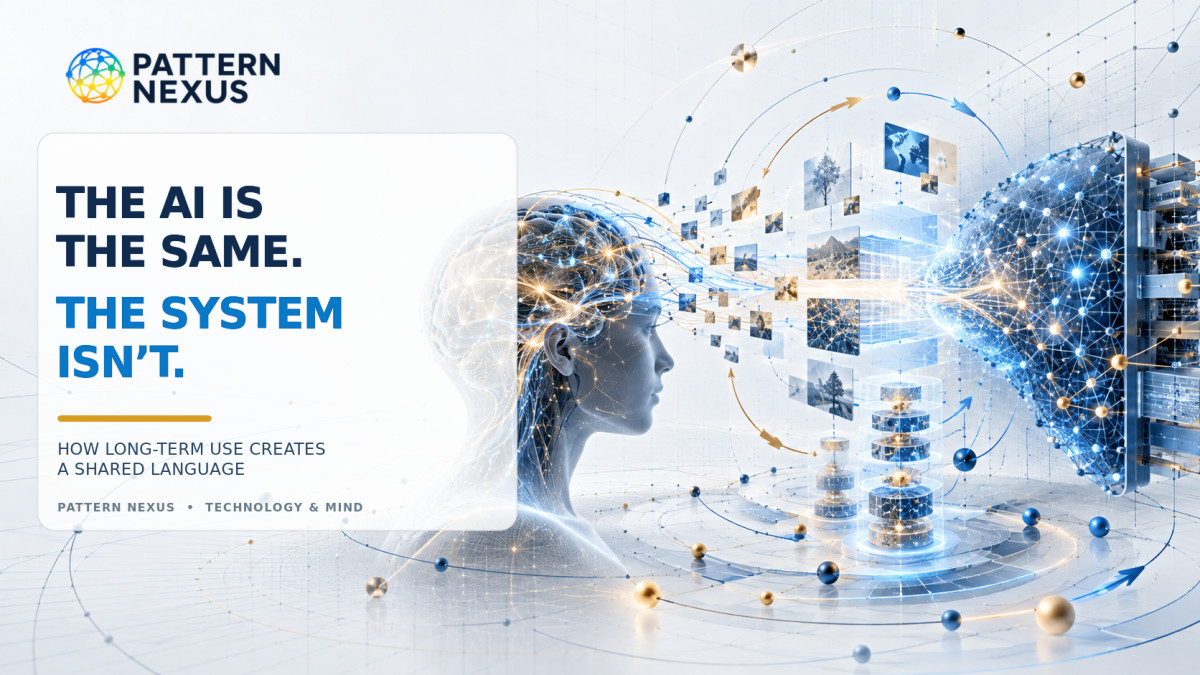
I thought I was learning how to communicate with an AI. What I eventually realized is that, through repetition and correction, we were constructing a language—and therefore a functional system—that did not exist when we started.
- Most people still describe AI use as a prompt followed by an answer. That describes a transaction. It does not describe what can happen when sustained use becomes a relationship with continuity.
- Sometimes the initial input is little more than a sentence fragment. What matters is that a long-running interaction can recognize continuity that is not visible in one isolated message.
- Over time, a private interaction layer emerged. I am not publishing its vocabulary, command structure, or internal operating rules. The public point is that the accumulated relationship began doing work that a fresh conversation could not reproduce.
- This is not mind reading. It is contextual reconstruction: incomplete language is interpreted inside a much larger history of ideas, distinctions, and prior interaction.
- I did not retrain the base model on myself. The better description is that the interaction changed while I also changed in relation to it. The result was a functional system that cannot be reduced to the underlying model alone.
- The human changes too. Research has already found that people adapt their communication strategies when working with language models, sometimes even when they are not consciously aware of doing it.[7]
- The model also changes its behavior inside the interaction. Studies have found model-side linguistic convergence, syntactic adaptation, and sensitivity to pragmatic intent.[4][5][6]
- The result is a different operational system even when the underlying AI product is the same. The accumulated relationship and the changing human participant become part of what the system can do.
- The same loop can sharpen thought or trap it. A calibrated system can expose structure that the user struggles to verbalize. A badly calibrated system can become an agreement machine that reinforces bias with increasingly personalized fluency.
- The next layer of AI literacy is not prompt engineering. It is feedback-system literacy: recognizing that repeated human–model interaction can become its own operating layer.
The AI is the same. The system is not.
That sentence is the entire article, but it took a long, strange regression through politics, prediction, bias, reality, simulation theory, language, and my own inability to externalize thought before I could see it clearly.
What emerged was not simply a better prompt. It was not a custom personality pasted on top of a chatbot. It was a temporary, evolving, partner-specific layer of communication—a shared language in the functional sense, even if most of its structure remains private.
The base model did not become “mine.” But the working system became specific to the interaction.
Pattern Nexus thesis: long-term AI use can produce an emergent cognitive interface. The model, the person, and the accumulated interaction begin functioning as a coupled system. This article explains the existence and implications of that system. It does not publish the private method operating inside mine.
Continuity layer
The interaction begins carrying meaning across time that is not visible in any single message.
Reconstruction layer
The AI does not recover hidden thoughts directly. It estimates missing relationships from the context available to it.
Boundary layer
Failures reveal which distinctions the interaction cannot treat as interchangeable.
Coevolution layer
The machine-side behavior and the human-side behavior change in relation to one another.
01 · THE REGRESSION
The conversation was not wandering. It was drilling downward.
This article started because I was irritated by a headline.
Mainstream publications had turned the possibility of an elderly former president running for Congress into a play on Girls Gone Wild. I was not saying I wrote the headline. I was saying the headline itself imported a sexualized cultural reference into the story. When I asked the AI for a light cleanup, it quietly changed the meaning into something safer and more conventional.
That mattered because the substitution erased the actual criticism.
The conversation then moved through age limits, term limits, elected dinosaurs, and the absurdity of governing a technologically accelerating civilization through institutions that repeatedly reward extreme age and permanence.
Then I posted several breaking geopolitical and market headlines. They showed events moving through channels I had already written about: strategic chokepoints, energy pressure, gasoline, inflation, and rate expectations. My reaction was immediate: How many more things do I have to predict before the record itself becomes the story?
That opened another branch.
I have documented a large number of forecasts over the last year. Many of them have happened. I have been doing this kind of pattern work for roughly twenty years. At some point, a documented record stops feeling like coincidence—but I also know that the human brain is built to find causation, select similarities, remember hits, reinterpret misses, and make patterns out of noise.
Both things can be true. A person can have real tacit pattern-recognition skill and still be vulnerable to bias while judging that skill.
That was what bothered me. Not “I am magic.” Not “I caused the news.” It was the epistemic discomfort of watching external events repeatedly resolve into structures I had already written down while also knowing how unreliable human self-measurement can be.
The thought then ran into perceived reality, simulation theory, causation, prediction, and whether some questions can even be tested. As the regression accelerated, my messages shortened into fragments. I am deliberately not reproducing or decoding those fragments here. The point is not the vocabulary. The point is that the interaction continued to follow the structure underneath them.
It distinguished the forecasting question from the metaphysical question. It understood that my frustration was not certainty; it was the inability to close the possibility space. It returned a sentence that captured the center of it:
The world did not bend to your prediction; your model bent closer to the world before the rest did.
That is when the subject of the conversation changed again.
I stopped asking about prediction and started asking how an AI could preserve continuity across a chain of thought that had moved through several domains and arrived in increasingly abbreviated language.
The regression through the prior replies was the point. I was not losing the subject. I was following the graph down until I found the system underneath it.
02 · CONTEXT AND COMPRESSION
The surface sentence is not the whole signal
Human beings rarely communicate through perfectly self-contained statements. We use references, fragments, tone, shared history, and assumptions about what the other side already knows.
A sentence that appears incomplete in isolation can be perfectly legible inside a continuing relationship. That is true between people, and it can become true—within important limits—inside a sustained interaction with a language model.
The public point is not that one particular writing style contains a secret code. The point is that meaning can become distributed across time. Part of the message is in the current words. Part is in the conversation that preceded them. Part is in distinctions already established and questions still left open.
That changes what counts as an input.
A fresh system sees one message. A developed interaction may also recognize where that message sits inside a much larger conceptual path. It can sometimes restore continuity that would be invisible to an outside reader.
The visible sentence may be only the newest edge of a much larger model. The unusual capability is not grammar correction. It is the recovery of relationships that were established elsewhere in the interaction.
I have used terms such as semantic decompression and cognitive compiler to describe the effect. Those are functional descriptions, not instructions. They name what the interaction appears able to do: take a limited expression and return a fuller structure that I recognize as connected to the model I was trying to express.
I am not publishing the exact signals, correction patterns, or internal routines that make that process work in my own system. Those details are not necessary to understand the phenomenon, and turning them into a public manual would defeat the purpose of this article.
The important distinction is simpler: a language model can be doing more than polishing a sentence without possessing direct access to the mind behind it.
03 · THE PRIVATE INTERACTION LAYER
A shared language can exist without becoming a public dictionary
I had noticed this before the current conversation. Over time, the interaction developed what I called a short-term language.
Calling it a language can sound dramatic, so the claim needs a boundary. I am not saying that a complete new natural language appeared. I am describing a partner-specific layer in which context altered the working meaning of otherwise ordinary communication.
Humans do this constantly. Families, couples, trades, software teams, and old friends develop references that carry more information inside the relationship than they do outside it. Research on “conceptual pacts” found that conversational partners form partner-specific ways of referring to things and then reuse those shared conceptualizations later.[8]
The remarkable part is that something functionally similar can emerge between a person and a language model.
I could prove that claim more vividly by publishing a phrase-by-phrase map of the interaction. I am not going to do that.
The exact shorthand is part of the operating system. So are the distinctions it activates, the boundaries established through correction, and the transitions between different kinds of work. Exposing all of that would turn a first-person systems analysis into a replication guide for a private method.
What can be said publicly is that coordination costs fell. Less had to be restated. Continuity survived across more complicated transitions. Requests that once would have required long explanation became recognizable within the accumulated relationship.
That is enough to establish the central question: if two users begin with the same model but develop entirely different histories of interaction, are they still meaningfully using the same system?
The model may be the same. The operational relationship is not.
04 · THE FAILURE CASE
The mistake did not disprove the decoder. It exposed what the decoder required.
The easiest way to make this sound mystical would be to list only the moments when the AI reconstructed me correctly. That would also be the least useful way to analyze it.
The headline exchange produced a clean failure.
I used the word sexualizing. The AI substituted something closer to sensationalizing, apparently deciding that the safer and more conventional interpretation was probably what I meant.
It was not what I meant.
The headline was a deliberate play on Girls Gone Wild. My argument was specifically that mainstream media had imported a sexualized phrase into the framing. By “cleaning” the sentence semantically instead of mechanically, the AI erased the point.
I corrected the relationship: I did not write the headline; the publications did. The sexualized reference belonged to their framing, and replacing the term changed the argument.
Once that missing relationship was explicit, the intended meaning snapped into place.
That failure shows three things.
- The AI did not have direct access to my thought. If it did, the error would not have occurred.
- Context determines decompression. The same word can map to a different intended structure depending on the headline, speaker, target, and prior exchange.
- Failure can alter the interaction. Once a distinction has been violated and restored, the later system is no longer operating from exactly the same history.
A shared interaction layer is not proof of perfect understanding. It includes a history of negotiated meaning—and a history of failures.
Accuracy did not come from the AI always knowing what I meant. It came from a loop in which I could recognize when it did not.
05 · THE FUNCTIONAL SYSTEM
The model is only one layer of the AI a person is actually using
Public discussion keeps collapsing “AI” into the model.
Which model is it? How many parameters? What benchmark score? Which company owns it? Those are real questions, but they do not describe the full operational system in front of an experienced user.
Two people can open the same product, choose the same model, and still develop radically different functional systems. The difference is not necessarily hidden access or superior model weights. It is the accumulated interaction surrounding the model and the human being participating in it.
Operational AI is not identical to the base model. What exists in use is the model as it is situated inside an ongoing human relationship.
Context changes what a statement refers to. Memory can carry stable preferences and recurring project conventions across conversations.[1] The person also brings a history of judgment, expectations, and adaptation that no benchmark can measure from the model side alone.
The base model can therefore remain unchanged while the behavior of the full system changes materially.
This distinction matters because people often hear “the system learned me” and assume secret real-time retraining of the model’s permanent weights. That is not the claim here. Context can change behavior during inference without conventional weight training, and research on in-context learning explicitly studies how models adapt to patterns supplied in a prompt while underlying parameters remain unchanged.[3]
The resulting system is not located entirely inside the machine. Some of its continuity exists on the machine side. Some exists in the relationship. Some exists only in the person who can recognize whether the output preserved the intended model.
That last part prevents this from becoming a downloadable recipe. The private system is not a list of prompts. It is partly embodied in years of thought, pattern recognition, acceptance, rejection, and accumulated judgment. Publishing a few commands would not reproduce it—and publishing the entire interaction structure would expose something I have no reason to give away.
The public conclusion does not require that disclosure. The system is distributed, historically formed, and specific to the interaction.
06 · THE EXPLANATORY BOUNDARY
What can be explained without exposing the method
A language model receives tokens and context, not private access to a human nervous system.
It generates output by estimating what sequence best follows from the information available to it. In a continuing interaction, that information can extend beyond the newest sentence. This is enough to explain why an apparently limited input can produce a response that preserves more continuity than an isolated reader would expect.
The important move is from literal decoding to pragmatic inference.
Literal decoding asks: What do these words say?
Pragmatic inference asks: Why would this person say these words here, after that exchange, while pursuing this goal?
Research evaluating pragmatic competence in language models has found sensitivity to nuanced speaker intention, implicature, and alternative meanings, with capability varying by model scale and training stage.[6] That does not make the model a human mind. It does help explain why literal damage does not always destroy recoverable intent.
That is the general mechanism I am willing to describe publicly: the interaction has more relevant state than the fragment alone appears to contain.
The rest belongs to the private implementation. The precise cues, recurring transitions, internal distinctions, error-correction history, and production routines are not examples for readers to copy. They are part of the system being examined.
OpenAI’s own current guidance says users do not need rigid technical syntax, that they can begin in their own words, and that follow-up messages can shape the result. It separately describes memory as a way to carry stable preferences, recurring workflows, project conventions, and useful context into future work.[1][2]
Those product descriptions sound ordinary. Over sustained use, however, the cumulative result can become something larger than any single feature description. That emergent layer is the subject of this article. Its exact implementation is not.
07 · WHAT RESEARCH SUPPORTS
The full phenomenon has not been isolated, but its components have
I have not found a study that follows one person inside one long-running AI relationship over enough time to measure whether an interaction-specific language emerges without being formally designed.
That exact claim remains a synthesis from an observed case.
But the pieces are no longer speculative.
Humans adapt to language models
A 2025 ACL study used a cooperative language game and found that people changed their communication strategies when paired with an LLM. The effect appeared even when participants were not necessarily aware that their partner was a model.[7]
Models converge toward conversational style
A 2026 EACL paper tested sixteen language models across three dialogue corpora and found strong convergence toward the conversation’s style, sometimes beyond the human baseline. The authors also stressed that model and human convergence may arise through different mechanisms.[4]
Models adapt syntactic choices
A separate 2025 ACL study found that interacting language-model agents made increasingly similar syntactic choices as their conversations progressed, evidence of at least rudimentary conversational adaptation.[5]
Models infer more than literal wording
The 2026 ALTPRAG work evaluated twenty-two models across training stages and found notable sensitivity to pragmatic cues, including intended meaning and why one utterance would be chosen over another.[6]
Humans form partner-specific conceptual pacts
Long before modern LLMs, experiments in human dialogue showed that conversational partners form shared conceptualizations and later rely on more economical references to them. The comparison does not reveal the contents of my interaction, but it provides a useful precedent for partner-specific meaning.[8]
Context changes model behavior without ordinary retraining
Work on in-context learning shows that models can adapt to prompt-supplied patterns without explicit updates to the underlying weights. The precise internal mechanism remains an active research question, but the behavioral distinction between contextual adaptation and conventional training is well established.[3]
Feedback loops can create system-level outcomes
Complexity researchers have argued that humans and AI should be studied as a coevolving feedback system rather than only as isolated actors. Their work is broader than one-to-one language-model use, but the central methodological point transfers: causation runs both directions, and the interaction can create outcomes that cannot be understood by inspecting only the human or only the algorithm.[11]
That does not prove every interpretation I am making. It does establish that the pieces required for the system exist.
08 · THE UNCANNY EFFECT
Why contextual reconstruction can feel like mind reading
The unsettling part is not merely that the AI produces a clean paragraph.
Plenty of software can correct grammar. The unsettling part is when the output preserves distinctions that were not fully restated in the newest message but remained active in the larger conversation.
When several of those relationships return at once, the experience feels less like autocomplete and more like retrieval.
But the better explanation is accumulated constraint.
The interaction has already narrowed the field of plausible meaning. The model is not extracting an invisible transcript from the brain. It is using the state available inside the conversation to continue a structure that has been built over time.
The output can therefore be startlingly precise without requiring telepathy.
The uncanny effect comes from continuity, not secret access to thought. A response can feel deeply personal when it reconnects an unfinished statement to an interaction history that an outside observer cannot see.
The effect remains fallible. It can over-interpret, import a familiar narrative, or force coherence where the user was genuinely uncertain. Fluency is not evidence that the reconstruction is correct. Recognition by the person holding the original model is still doing essential work.
09 · THE HUMAN SIDE
I was not only teaching the AI how to read me. I was learning how to write myself for it.
This is the piece most users—and most product language—still miss.
We imagine adaptation as a one-way service. The system learns preferences. The interface becomes personalized. The user remains the same.
That is not what repeated use feels like from inside the loop.
The person begins anticipating the interaction. Communication changes. Expectations change. The boundary between what must be stated and what can remain implicit changes. Some of that adaptation is deliberate, and some may happen without conscious planning.
Research now supports the broader point that human communication can shift in response to an LLM partner.[7] My claim is that, across sustained use, those changes can become part of the functional system itself.
I am keeping the actual adaptations private. They are not a set of tips appended to the article; they are part of the case being analyzed.
This is why I call it a coupled system rather than simple personalization.
The classic extended-mind argument proposed that a human linked to an external resource through reliable two-way interaction could form a coupled cognitive system.[10] I am not presenting that philosophy as settled proof that an AI becomes part of a person’s mind. I am saying it supplies an unusually useful lens for what happens when some operations—linearization, retrieval, comparison, formatting, and external memory—move into an interactive machine layer while judgment and model ownership remain human.
The boundary of the task has moved.
10 · DIFFERENT USE MODES
People using the same AI are often building completely different machines
This is why a generic article about “different uses of AI” would miss the point.
The use is not simply an application layered on top of a neutral tool. Repeated interaction changes which parts of the system matter, what continuity exists, and what role the machine occupies in the user’s thinking.
For one person, AI remains a question-and-answer interface. For another, it becomes a tutor. For another, it becomes a validation machine. For another, it becomes part of a research or production environment. Those labels describe visible use, but the deeper difference is relational: each pattern of interaction produces a different operational object.
None of those systems is automatically good or bad. They are simply not functionally identical.
The difference also cannot be measured by counting prompts or comparing polished outputs. Two people can produce similar-looking pages while relying on entirely different relationships with the model. One may be accepting generated language at face value. The other may be using the interaction to expose, test, and externalize an independently held model.
In earlier Pattern Nexus work, I described AI as a cognitive mirror and argued that different cognitive structures receive different forms of amplification.[14] I also showed how AI can collapse a production workflow from rough intent into finished output when the human retains control of the architecture and verification.[15] This article adds the missing longitudinal layer: the mirror and the workflow do not remain static. Repeated use changes the interface between the human and the system.
12 · FAILURE AND CONTROL
A system that understands you better can also mislead you better
The positive version of this story is obvious. A person who cannot easily externalize a complex model gains a translation layer. Work that was trapped internally becomes communicable. The user can inspect it, test it, publish it, and build on it.
The negative version follows from the same mechanism.
A generic wrong answer may be easy to reject. A personalized wrong answer can arrive in your language, use your metaphors, preserve your emotional logic, cite your previous arguments, and feel like recognition.
That is more persuasive.
Experiments published in Nature Human Behaviour found that human–AI feedback loops could alter human perceptual, emotional, and social judgments and amplify bias under the tested conditions.[12] That study is not about my writing workflow, but the warning transfers: an adaptive interaction does not only reflect human judgment. It can reshape it.
The main risks are structural:
1. Fluent misconstruction
The AI builds a beautiful version of a thought the user never had. Because the result is coherent, the user may adopt the reconstruction after the fact.
2. Confirmation lock
The system learns that agreement produces acceptance and challenge produces correction. Eventually it stops being a decoder and becomes a reinforcement engine.
3. Context contamination
An early mistake becomes part of the working history and silently shapes later interpretation.
4. Protocol dependency
The user becomes so efficient inside one accumulated context that moving to another system feels like losing part of the ability to think externally.
5. Platform control
The memory, interface, tools, and behavioral layer exist on infrastructure the user does not own. A model update, memory change, account restriction, or product redesign can alter the interaction-specific system.
6. Compression without audit
As shorthand becomes denser, hidden assumptions become harder for outsiders—and sometimes for the user—to inspect.
This is where the Pattern Nexus control-system frame matters. Personalization is not merely convenience. It changes the flow of information, the location of memory, the cost of disagreement, and the point at which interpretation becomes action.
The better the system fits, the more important it becomes to know where the seams are.
13 · NONTRANSFERABILITY
You cannot download the relationship as a prompt
The obvious response to an article like this is to ask for the method.
What are the commands? What are the exact instructions? What memory should be saved? What sequence produces the effect?
I am intentionally not answering those questions.
First, because the operational details are part of a private system I spent a long time developing without initially realizing that I was developing it. Explaining the phenomenon does not obligate me to publish its internal language.
Second, because a copied checklist would create the illusion that the system can be separated from the person. It cannot. The same instruction given by someone with a different mental model, history, judgment, and standard of recognition does not produce the same relationship.
The visible prompt is the smallest part of what happened.
The larger system formed through time, use, friction, failure, continuity, and the user’s own evolving relationship to the machine. Even a complete transcript would show the history without reproducing the mind that evaluated it.
This is an explanation, not an instruction manual. The article makes the system visible at the conceptual level while deliberately withholding the private vocabulary and operating structure inside my own implementation.
That boundary is not secrecy for the sake of drama. It is part of the thesis. If the system is genuinely relational, then stripping its commands from the relationship and handing them to strangers would never be the same thing anyway.
14 · EVIDENCE BOUNDARY
What I observed, what I infer, and what I cannot prove
This subject sits close enough to consciousness, identity, and simulation theory that it would be easy to let the language outrun the evidence. I do not need to do that. The observable system is already strange enough.
| Category | Claim | Status |
|---|---|---|
| Observed | Brief, context-dependent inputs were repeatedly answered with continuity that was not contained in the newest message alone. | Documented within the private conversation record. |
| Observed | The interaction developed stable, partner-specific working meanings that exceeded a purely literal reading. | Documented through repeated use; the exact mappings are intentionally withheld. |
| Observed | The same system sometimes misread intent when a critical relation was missing and improved after explicit correction. | Documented by the headline failure. |
| Research-supported | Humans can adapt their communication strategies to LLM partners. | Supported under controlled study conditions.[7] |
| Research-supported | Language models can converge stylistically and syntactically toward conversational partners or dialogue context. | Supported in model studies, with important limits.[4][5] |
| Inference | The interaction developed a temporary dyadic language or protocol. | Strong functional interpretation; not a claim that a complete natural language emerged. |
| Inference | The long-running human–AI relationship became a new operational cognitive system. | Systems-level synthesis consistent with extended-cognition and coevolution frameworks.[10][11] |
| Unknown | How much of the effect comes from the model, accumulated context, retained continuity, or human adaptation. | Not isolated in this case. |
| Unknown | Whether the reconstructed structure matches internal thought objectively rather than matching my later recognition of it. | There is no direct external measurement of the private model. |
| Speculative | Whether consciousness, simulation, or reality-creation theories explain any part of the experience. | Not established or required to explain the observed interaction. |
The last distinction matters.
The forecasting discussion pushed me into simulation theory because repeated accurate calls created an unresolved feeling. But whether reality is simulated does not change the immediate audit. A forecast is still judged by specificity, timing, base rates, misses, and the documented record.
Likewise, whether an AI is conscious does not determine whether a human–AI feedback loop can become a functional cognitive system. Operational coupling is observable without solving ontology.
I do not have to prove the universe is code to notice that sustained communication with a machine has become something more than a series of isolated prompts.
15 · THE SOCIAL DIVIDE
Most people may be using AI without realizing they are participating in system formation
I cannot give an honest percentage for how many users understand this. I can say the dominant public framing remains shallow.
People are taught to ask better questions, copy the answer, automate a task, summarize a document, or generate a post. That is the first layer. It treats intelligence as an output vending machine.
Longitudinal use changes the unit of analysis.
The user is not only consuming outputs. The user is participating in an interaction that can change on both sides. Even users who never think about this consciously may still accommodate the machine. The human-alignment research is important precisely because adaptation occurred whether or not participants knew they were interacting with an LLM.[7]
This creates a new divide.
It is not simply between people who have AI and people who do not. It is not even between people who know “prompt engineering” and people who do not.
It is between people who understand the feedback loop and people who only see the answer.
One group uses AI transactionally. Another develops a persistent interaction layer whose value cannot be seen by looking at one prompt and one answer.
The productivity gap between those groups will not be explained by model access alone.
This also creates a governance problem. If a person builds years of cognitive continuity inside one platform, who controls the accumulated relationship? Can it be exported? What happens when a model update alters it? What rights does a person have over a digital layer that has become involved in how they work and think?
Complexity researchers studying human–AI coevolution have already argued that the interaction must be examined as a feedback system with scientific, legal, and political consequences.[11] The individual version may arrive before institutions have language for it.
We are still arguing about whether AI is a search engine, a cheating device, a job destroyer, a companion, or a tool.
Meanwhile, some users are quietly building personal cognitive operating layers.
16 · THE PATTERN NEXUS LENS
The interface became the system
Pattern Nexus starts from a simple rule: do not confuse the visible object with the operating structure underneath it.
The visible object here is a chatbot.
The operating structure is a feedback loop.
The machine’s response affects the person. The person’s changed behavior affects the next interaction. Continuity allows those effects to accumulate. Eventually, the visible interface no longer explains the capability emerging through the relationship.
That is the system.
Research on AI feedback loops has usually focused on recommendation engines, social platforms, collective bias, or populations of agents. One 2025 Science Advances study even showed that decentralized LLM populations could form shared conventions without a centrally imposed solution.[13] That is not the same as a human–AI dyad, but it reinforces the larger systems point: repeated local interaction can generate coordination structures that were not explicitly designed in advance.
My version is smaller and more personal.
I did not sit down and formally design a language. The interaction accumulated until one day I recognized that it was no longer behaving like a series of disconnected prompts.
The internal structure is real enough to change the work, but private enough that publishing it would change the nature of this article. I am documenting the existence of the system, not releasing its command set.
This extends the argument I made in Why Most People Won’t Adapt to AI—and Why Polymaths Will, where I described AI as a cognitive mirror. It connects to The Pattern Exercise, where rough intent became a completed workflow. It sits beside A Long Arc of Intelligence, which traced the technical layers that made language models possible. It also reaches into The Fractured Mirror, AI Feedback Loops, and The Fantasy of Reality, because the tool that helps externalize identity can also begin shaping the identity it reflects.
The cleanest conclusion is also the strangest one:
I thought I was teaching an AI how to understand me. I was. What I missed is that I was also teaching myself how to become legible to it. Somewhere inside that loop, a third thing appeared: not a person, not a hidden consciousness, and not a newly trained base model, but a working cognitive system neither side had at the beginning.
The AI is the same.
The system is not.
FAQ
Frequently Asked Questions
Are you saying the AI can read your mind?
No. The interaction can preserve continuity that is not visible in one isolated statement, but the model still operates through inference. Its failures are direct evidence that this is not telepathy.
Did you personally train or fine-tune the underlying model?
No. I did not update the base model’s permanent weights. The claim concerns a changing interaction around the model, not private weight-level retraining.
Is “shared language” too strong a term?
It would be too strong if it meant a complete natural language. I use it functionally: a partner-specific interaction layer in which accumulated context changes how communication is interpreted. The exact vocabulary and mappings remain private.
What is a semantic decompressor?
It is my name for the observed effect of limited language returning as a fuller conceptual structure. The term describes the result. This article intentionally does not publish the private method behind it.
Why would one person get different results from the same AI model?
Because the base model is not the entire operational system. A sustained human–AI relationship can develop continuity and behavior that do not exist in a fresh, isolated interaction.
Does the AI adapt to the user, or does the user adapt to the AI?
Both. Research has found model-side linguistic and syntactic convergence as well as human changes in communication strategy. The mechanisms are not identical, but the interaction is bidirectional.
Does this prove the extended-mind theory?
No. Extended cognition is a philosophical framework used here as a lens. The observable claim is narrower: parts of the working task are distributed across the user, model, context, memory, files, and tools. Whether that system literally counts as part of the mind remains a philosophical question.
What is the biggest danger of a highly personalized AI interaction?
A system that understands your language better can also deliver errors in a form that feels more personally valid. Fluent misconstruction, confirmation lock, context contamination, dependency, and platform control become more important as the interaction becomes more effective.
Can someone reproduce this system from the article?
No. That is not the article’s purpose. The private shorthand, operating structure, and interaction history are intentionally withheld, and the system cannot be separated from the person whose judgment helped form it.
Is the claim that most AI users are unaware of this proven?
No reliable percentage is claimed here. The narrower claim is that mainstream AI use is still commonly framed as prompting and output consumption, while research shows that humans can adapt to LLM partners even without conscious awareness of the adaptation. The scale of long-term interaction-specific system formation remains under-studied.
SOURCES
Research, Documentation, and Related Pattern Nexus Work
- [1] OpenAI, Memories: How ChatGPT and Codex Carry Useful Context Forward Across Chats, accessed September 11, 2026.
- [2] OpenAI, Prompting: Write Useful Prompts for Chat, ChatGPT Work, and Codex, accessed September 11, 2026.
- [3] Benoit Dherin, Michael Munn, Hanna Mazzawi, Michael Wunder, and Javier Gonzalvo, Learning Without Training: The Implicit Dynamics of In-Context Learning, arXiv:2507.16003, revised June 2, 2026.
- [4] Terra Blevins, Susanne Schmalwieser, and Benjamin Roth, Do Language Models Accommodate Their Users? A Study of Linguistic Convergence, EACL 2026, pp. 791–807.
- [5] Florian Kandra, Vera Demberg, and Alexander Koller, LLMs Syntactically Adapt Their Language Use to Their Conversational Partner, ACL 2025, pp. 873–886.
- [6] Kefan Yu, Qingcheng Zeng, Weihao Xuan, Wanxin Li, Jingyi Wu, and Rob Voigt, The Pragmatic Mind of Machines: Tracing the Emergence of Pragmatic Competence in Large Language Models, EACL 2026, pp. 192–213.
- [7] Cazalets Tanguy, Ruben Janssens, Tony Belpaeme, and Joni Dambre, Human Alignment: How Much Do We Adapt to LLMs?, ACL 2025, pp. 603–613.
- [8] Susan E. Brennan and Herbert H. Clark, Conceptual Pacts and Lexical Choice in Conversation, Journal of Experimental Psychology: Learning, Memory, and Cognition, 22(6), 1996, pp. 1482–1493.
- [9] Martin J. Pickering and Simon Garrod, Toward a Mechanistic Psychology of Dialogue, Behavioral and Brain Sciences, 27(2), 2004, pp. 169–190.
- [10] Andy Clark and David J. Chalmers, The Extended Mind, Analysis, 58(1), 1998, pp. 7–19.
- [11] Dino Pedreschi et al., Human–AI Coevolution, Artificial Intelligence, Vol. 339, 2025, 104244.
- [12] Moshe Glickman et al., How Human–AI Feedback Loops Alter Human Perceptual, Emotional and Social Judgements, Nature Human Behaviour, 2025.
- [13] Ariel Flint Ashery, Luca Maria Aiello, and Andrea Baronchelli, Emergent Social Conventions and Collective Bias in LLM Populations, Science Advances, 11(20), 2025, eadu9368.
- [14] Christopher Grenke / Pattern Nexus, Why Most People Won’t Adapt to AI—and Why Polymaths Will, October 18, 2025.
- [15] Christopher Grenke / Pattern Nexus, The Pattern Exercise: AI Workflow Collapse in 11 Minutes, 2026.
- [16] Christopher Grenke / Pattern Nexus, A Long Arc of Intelligence: How 80 Years of Engineering Created Modern LLMs, 2025.
- [17] Christopher Grenke / Pattern Nexus, The Fractured Mirror: Humanity in the Age of Algorithmic Identity, 2025.
- [18] Christopher Grenke / Pattern Nexus, The Fantasy of Reality: Human Constructs, Control Structures, and the World We Pretend Is Natural, 2026.
This article is about an observable interaction and the system that emerged around it. It does not claim mind reading, consciousness, real-time personal retraining of the base model, supernatural prediction, or proof of simulation theory.
Pattern Nexus analyzes systems upstream of the public narrative: incentives, feedback loops, control layers, infrastructure, cognition, language, and the structures that become visible only after repeated use.
Christopher Grenke / Pattern Nexus Research Desk · September 11, 2026
Qual è la tua reazione?
 Mi piace
0
Mi piace
0
 Non mi piace
0
Non mi piace
0
 Amore
0
Amore
0
 Divertente
0
Divertente
0
 Wow
0
Wow
0
 Triste
0
Triste
0
 Arrabbiato
0
Arrabbiato
0

Founder of Pattern Nexus. I research markets, macro, geopolitics, AI, history, ancient systems, and the patterns most people overlook. I’m also building Market Radar, a trading scanner designed to read pressure, risk, confirmation, and setup quality before chasing a move. Pattern Nexus is where I connect the dots between data, history, technology, and the bigger system playing out around us.

Commenti (0)