
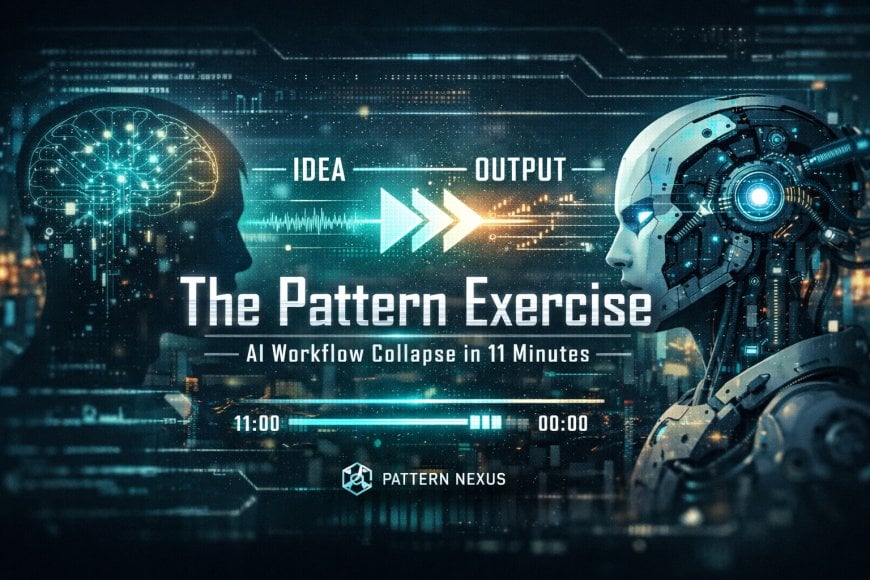
The Pattern Exercise: AI Workflow Collapse in 11 Minutes
A Pattern Nexus exercise demonstrating AI workflow collapse: idea to finished, indistinguishable output in ~11 minutes. Not about music—about latency, compression, and intent-driven systems.

Latency is now the primary constraint. When execution takes minutes, advantage shifts to whoever can frame and iterate fastest.
Friction collapses as handoffs disappear: fewer tools, fewer roles, fewer dependencies.
Quality gates get hit sooner than cultural adoption admits. “Good enough” scales instantly.
Provenance becomes a policy layer. Operationally, indistinguishable outputs shift competition to speed and distribution.
Risk migrates upward: trust, verification, enforcement, and governance become the bottlenecks.
Workflow collapse is not “automation.” It’s removal of steps, handoffs, and time. The stack gets thinner.
Once outputs become indistinguishable, provenance moves from “obvious” to “enforced.” Verification becomes a control layer.
Intent becomes the scarce input. Clear framing beats perfect execution when execution is cheap and fast.
Gatekeepers don’t disappear. They relocate: distribution rules, platform policy, watermarking, compliance.
The visible demo is media. The real battleground is ops, code, research, sales, and decision loops.
The Exercise
I’m publishing this as a Pattern Nexus “pattern exercise,” not as a music release. I usually write the article first, then I build the Facebook post around it. The point of doing it this way was to show you the inversion happening in real time: the creation step is collapsing into minutes, while the explanation step still takes real time.
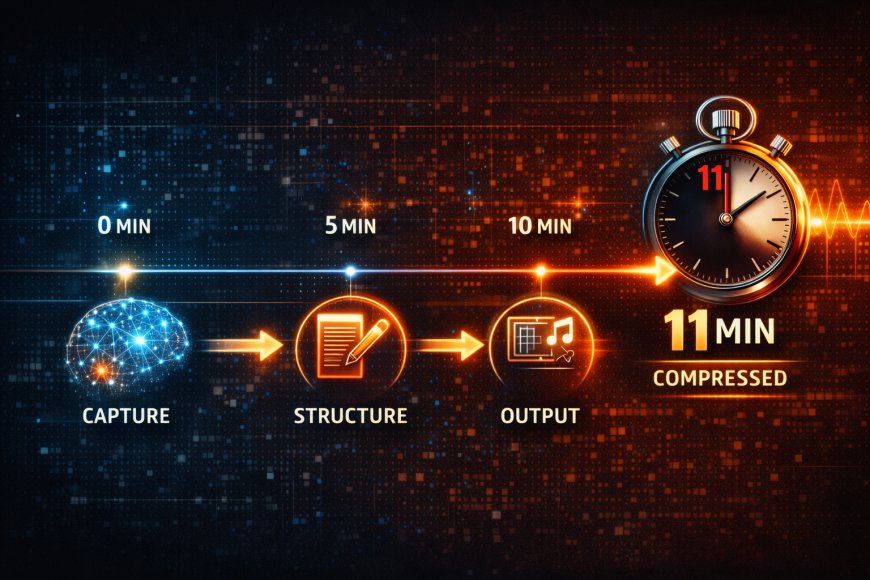
The demo output was a three-minute track. The pipeline to produce it was roughly an 11-minute loop:
- Capture an idea in raw text
- Refine structure twice using a language model
- Paste the structured output into a generator
- Provide minimal instruction (genre/style)
- Click generate
Total elapsed time end-to-end: approximately 11 minutes.
And here’s the part people miss: that 11 minutes produced something that most casual listeners cannot reliably identify as “AI made.” The artifact clears the baseline gate. That’s the signal. If the gate is cleared, the system moves on.
The output is not the story. The story is what disappeared: coordination, specialized tooling, handoffs, and time. That disappearance is the pattern.
Workflow Collapse Mechanics
Traditional creative pipelines exist for one reason: each step used to be expensive in either skill, time, tools, or coordination. AI changes the economics of steps. Once steps become cheap and fast, the pipeline collapses into a loop.
This is the core mechanical shift: linear workflow → iterative loop. The old model was “plan, produce, revise, publish” with long delays between phases. The new model is “prompt, render, evaluate, re-render” in minutes.

What actually collapses is not “the work,” it’s the handoff chain. In old workflows, you paid for separation: writer, producer, vocalist, engineer, editor, distribution. In compressed workflows, one operator can traverse stages because the tooling bridges the gaps.
The chain in this exercise compressed into a short cycle:
- Capture: raw intent recorded as text (not a production spec)
- Structure: a couple passes for rhythm/causality/clarity (not endless polishing)
- Render: generator receives structure + style hint, returns a usable artifact
- Ship: output is immediately shareable because quality clears baseline gates
In a systems sense, this is the same pattern you see everywhere AI touches: it collapses “time-to-first-output,” and it makes iteration cheap enough that trial becomes the default. You don’t need certainty to start. You can start and converge.
The lever is not “AI creativity.” The lever is removing time between thought and execution. That shift propagates into every domain that relies on slow loops.

The takeaway is not “look what AI can make.” The takeaway is “look how little time it takes to traverse stages that used to be gated.” That is why this is a Pattern Nexus post: it’s a structural change, not an entertainment clip.
Compression vs Communication
The most honest part of this exercise is the mismatch: the artifact took ~11 minutes; the article took almost an hour. That’s not a failure of AI. That’s a map of where the bottleneck moved.
AI compresses execution. But public communication still has friction because it has to be: coherent, defensible, and readable. It has to do something the artifact doesn’t need to do: carry claims.
If you strip it down, “making the thing” is now easy. “Explaining the thing” is still work. That’s why I write the article first and the Facebook post second. The post is distribution. The article is structure.
And it gets more important as AI scales, because abundance creates a new fight: attention and trust. When everyone can generate output, distribution and credibility become the scarce inputs.
AI makes production cheap. That pushes value into framing, verification, and distribution. The bottleneck relocates upward.
Indistinguishability Threshold
“You can’t even tell it’s AI-produced” is not a vibe. It’s a threshold. Once outputs clear “human-believable,” provenance stops being a sensory judgment and becomes a policy decision.
That threshold changes the system:
- Quality becomes assumed instead of rare
- Iteration becomes cheap instead of expensive
- Distribution becomes the choke point, not production
- Trust becomes a governance layer, not a perception
Most debates get stuck on “real vs fake.” Control systems don’t care about the argument. They care about what can scale. When believable output scales, believable manipulation scales too. That’s why verification and labeling intensify.
Cheap believable output expands fraud, impersonation, and influence ops. The system responds by hardening verification and distribution controls.
Permission Stack Meets Compression
In Pattern Nexus terms, this is a Permission Stack event. Creation used to be gated by tooling, skill, time, and coordination. AI collapses those gates. New gates form higher in the stack.
The new choke points look like this:
- Platform policy: what is allowed, promoted, demonetized, downranked
- Provenance enforcement: watermarking, labeling, detection, authenticity claims
- Distribution economics: ads, reach, paid boosts, algorithmic access
- Compliance layers: copyright, licensing, brand risk, regulatory rulesets
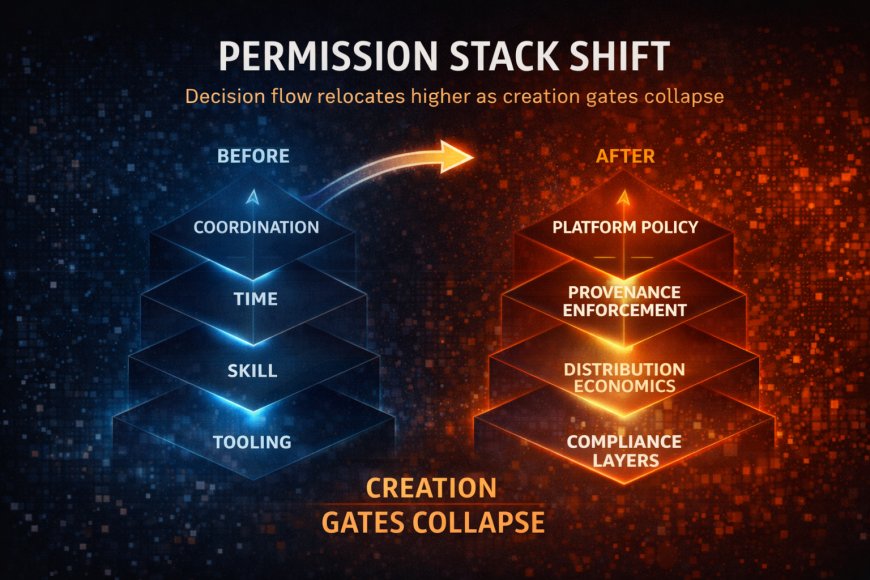
This is why “it’s just a song” misses the pattern. The demo is small. The implications are structural. The control plane moves upward because the creation plane just got massively cheaper.
What This Does to Work Models
This is the part that matters beyond music: AI is compressing the model of work itself. Not just “jobs,” but how tasks get organized, how teams coordinate, and where time gets spent.
The old model assumed expensive production and slow iteration. That created roles, departments, and timelines. The new model assumes cheap production and fast iteration. That pressures everything: planning cycles, approval chains, hiring logic, and even how people learn.
You can already see the shape:
- Role compression: fewer specialists needed for first-pass output
- Decision compression: faster loops punish slow organizations
- Abundance stress: more output forces harder filtering
- Trust stress: verification becomes a first-class function
The winners are not “the best producers.” The winners are the fastest correct framers, the best operators of the loop, and the ones who understand where the control gates moved.
We’re moving from process-driven systems to intent-driven systems. Execution gets cheap. Framing, verification, and distribution become the scarce layer.
Pattern Nexus Lens
AI is a compression engine. It collapses workflows by making “time-to-output” dramatically smaller, and by making retries cheap. That forces a structural shift: the value migrates upward into control layers—verification, policy, distribution, and governance.
The 11-minute creation is the demo. The hour-long article is the proof that the bottleneck moved. When outputs are easy, interpretation and trust become the hard part. That’s where platforms and institutions will tighten control.
Creation gates are collapsing. Control gates are relocating upward. The next fight is provenance enforcement and who gets to decide what counts at scale.
FAQ
Is this article about music?
No. Music is a clear demo because the ear is a fast quality judge. The pattern is workflow collapse and indistinguishability, which transfers into many domains.
Why does “indistinguishable” matter?
Because once normal users can’t reliably tell provenance, authenticity becomes an enforcement problem. That relocates power into policy, labeling, ranking, and distribution.
Why did the article take longer than the output?
Because publishing claims requires framing, clarity, and trust discipline. AI compresses execution first. Communication and governance compress later.
What should I watch next?
Watch provenance policy, platform enforcement, and identity/verification layers. That’s where control systems tighten once creation gets cheap.
Sources
Background references for generative media workflows, provenance, and authenticity/labeling. Includes the exact tool used in this exercise.
- LyricsIntoSong.ai — Create (tool used in this workflow)
- OpenAI — ChatGPT / language-model tooling used for drafting and refinement
- C2PA — Coalition for Content Provenance and Authenticity (provenance standard)
- NIST — AI Risk Management Framework (risk and governance)
What's Your Reaction?
 Like
0
Like
0
 Dislike
0
Dislike
0
 Love
0
Love
0
 Funny
0
Funny
0
 Wow
1
Wow
1
 Sad
0
Sad
0
 Angry
0
Angry
0

Founder of Pattern Nexus. I research markets, macro, geopolitics, AI, history, ancient systems, and the patterns most people overlook. I’m also building Market Radar, a trading scanner designed to read pressure, risk, confirmation, and setup quality before chasing a move. Pattern Nexus is where I connect the dots between data, history, technology, and the bigger system playing out around us.
















Comments (2)