

Bill Cooper and the Historical Record
I followed Bill Cooper from a Paris hotel in 1919 to the records behind Yalta, the Council on Foreign Relations, and his prediction of nuclear war around 1996.

SOURCE RECORDING
Watch the video alongside the investigation
This is an edited compilation. The article distinguishes Cooper’s statements, the modern narrator and the interviewer. Open the timestamp index
- Cooper’s Paris roster holds up. I found all nine directors he names. When I followed the allegation that Edmond de Rothschild approved the founders, the quotation marks around the supposed handbook passage closed before the allegation began. [1] [2] [3] [4]
- A private grant reached wartime policy planners. The Rockefeller Foundation recorded $44,500 for the Council on Foreign Relations in 1939. The Council reports 682 memoranda for the State Department. For a particular policy, I’d still want to see which memorandum an official acted on. [6] [50] [49]
- The secret agreement at Yalta survives. Japan’s National Diet Library has the terms for Soviet entry into the war against Japan. I looked in the same conference record for Cooper’s separate claim that the leaders chose Stalin to play the postwar enemy. [71] [72] [76]
- The longer recording changes how the 1996 prediction reads. Cooper names Saddam Hussein and allows for Americans to intervene. The edited video drops the named actor. Those seconds matter when you line the forecast up with what actually happened. [16] [15] [114] [115]
The 90:05 Video Advice upload matches the captions from Cooper’s first sentence to the dinner-table analogy. Watch the compilation
The archived interview preserves the named actor in the nuclear forecast and the exchange about five media owners. Watch the longer interview
The index identifies 232 passages from Cooper, 60 from the narrator and five questions from the interviewer. Open the searchable index
Historical investigation
Following Bill Cooper through the historical record
I started with a hotel, a set of directors’ names and a claim about who approved those men. I could find the hotel meeting in a history of Chatham House. I could find nine directors with terms beginning in 1921, including two men whose names the captions nearly turn into one. Then I found the passage about Baron Edmond de Rothschild in Gary Kah’s book. His endnotes led back to Eustace Mullins. I went to the page in Mullins and looked at the quotation marks. They close after the street address of the institute in Paris. The assertion about Rothschild begins after that. In the space of two paragraphs I had a meeting, a verifiable roster and an allegation with a traceable author. Those three discoveries called for three different kinds of evidence. [1] [2] [3] [4] [5]
That is the problem I kept running into with Bill Cooper. He can give you a name that belongs exactly where he put it. He can then carry it into a claim about motive, and from motive into a theory spanning several thousand years. Sometimes another document carries you with him. A Rockefeller Foundation annual report puts a dollar amount beside the CFR’s wartime work. An ancient religious text really does let the serpent in Eden speak as a teacher. At other points there is a gap the size of a civilization between the two things on the page. I wanted to show the reader exactly where each of those changes takes place. [6] [7] [8] [9]
The recording I followed is a 90-minute production by Video Advice. It circulated in September 2026 as Bill Cooper Said These 3 Events Would Come Next… Decades Ago. A later channel index gives the same YouTube ID under Why Bill Cooper’s Predictions Are Coming True Right Now. A mirror of the description credits Video Advice with the script and narration. The listing runs 1:30:05. The caption track I reviewed ends at 1:29:56 with music. At 00:34 the modern speaker introduces Cooper. At 1:25:28 the interviewer raises physical immortality. In the final minute Cooper tells his story about who gets to complain about dinner. Those independent matches identify the upload more precisely than its changing title does. [10] [11] [12] [13] [14]
Several generations of material sit inside those ninety minutes. There is a longer video circulated as Cooper’s 1992 CNN interview, a 1991 first edition of his book, an independently indexed 1996 broadcast that repeats parts of the lecture, and an archival video of a 1993 Wembley presentation. The longer interview contains exchanges cut out of the compilation. The radio text and book let me repair individual captions. I have not established which camera original supplied each lecture clip, or authenticated a CNN network master. The production credit for the interview is disputed. The William Cooper Institute labels it a CNN interview filmed in an Atlanta hotel. A 2020 upload credits Exposure magazine. A separate repost quotes a person who says they own a studio VHS and attributes filming to the producer of a proposed cable show called Exposure in Marietta, Georgia. The last account is secondhand here. I found no production slate, commission or broadcast log settling which organization made it. A record of Cooper saying something is evidence about his position. Its truth or historical origin has to come from somewhere else. [15] [16] [17] [9] [18] [19] [20] [21] [22] [23]
Recordings, transcripts and archival comparisons
The upload matched to the supplied transcript. Watch the 90-minute compilation
A 1992 interview with disputed production credits. It preserves statements removed from the compilation. Watch the longer Cooper interview
The opening, mid-film cues and final dinner analogy match the recording. Read the time-coded index
Searchable record for the Saddam Hussein answer and the request to name five media owners. Read the longer interview transcript
A separate recording for comparison. Its existence does not identify every lecture clip in the edit. Watch the archived Wembley presentation
Chapter 1 · Watch 00:00–08:20
A secret society with a name and a law
Cooper opens with the largest possible claim. Across governments that look like enemies, there is one organization, and at the highest level everybody belongs. One way to investigate a proposition that large is to start with a small case where the thing alleged actually happened. Italy gives us one. Its parliament investigated a lodge called Propaganda Due, or P2. On January 25, 1982, Italy enacted Law No. 17. The name of the lodge appears in the law dissolving it. Whatever a reader thinks about Freemasonry generally, there is an identifiable organization here, a jurisdiction, an investigation and an act of state directed at that organization. [24] [25]
The question that follows is how far that evidence travels. It establishes the existence of a secret network with political consequences inside a modern state. Suppose a second country has a politician who attended a private meeting. That document adds a person, a time and a place. To join the two cases I would have to find a participant acting in both capacities, money moving with conditions attached, or instructions received and acted on. A repeated emblem can tell me where to start looking. By itself it cannot tell me which person had authority over another. The P2 case makes that distinction unusually concrete because an investigator can see the kind of record a concealed network can leave. [25] [24] [26]
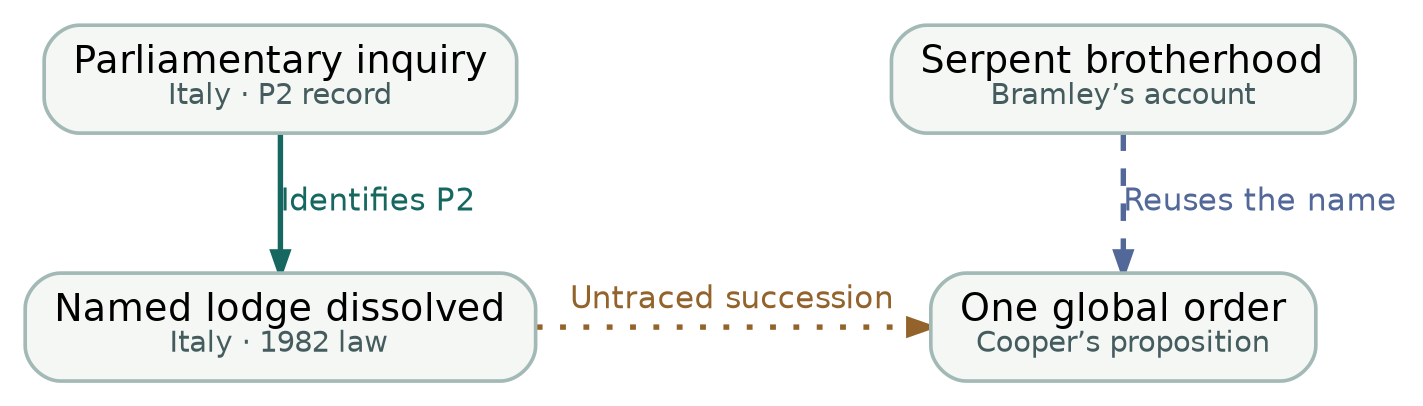
Read the evidence for the arrows in Figure 1
- Parliamentary inquiry → Named lodge dissolved. Documented link. The parliamentary inquiry and the act of dissolution identify the organization by name. They establish a political and legal action in Italy. [24] [25]
- Serpent brotherhood → One global order. Interpretation. A modern account uses the name. Cooper gives it much wider institutional reach. Similar wording identifies a source tradition without identifying an ancient founder. [30] [9] [18]
- Named lodge dissolved → One global order. Link unverified. No membership or command record in the Italian proceeding extends the lodge’s authority to every national government. [24] [25] [9]
Influence can also be unequal without its participants meeting in a lodge. Gilens and Page compared preferences and policy outcomes on 1,779 issues in the United States. In their model the independent effects of economic elites and business groups were substantial. Omar Bashir revisited how the model handled disagreement and argued that it understated the position of middle-income citizens. I included both because they turn a loose argument about who rules into questions a reader can actually examine. Whose preferences are measured? How often do people want the same thing? What counts as a loss? Neither study can settle the identity of a fraternity. Each shows why access, influence and total control are different claims. [27] [28]
Cooper also describes his listeners’ angry letters as evidence that he struck a nerve and told the truth. That claim is testable on its own. Researchers who studied accusations found that people falsely accused can become especially angry. The same visible reaction can therefore follow from two opposite conditions. I carried that problem into the rest of the recording. If every objection is counted as confirmation, how would a genuine error ever turn up? Cooper’s own insistence that listeners check him is one answer. There are plenty of opportunities to do that in the next eighty minutes. [29] [16]
Open the 29 indexed passages · Read the subject records · Contents
Chapter 2 · Watch 08:21–16:45
Franklin’s printing press and Washington’s cornerstone
Benjamin Franklin gives me an unusually good starting point because he left a physical product. In 1734 he printed James Anderson’s Constitutions of the Free-Masons in Philadelphia, a reprint of the London work of 1723. We can identify the printer, the author and the route by which a text traveled across the Atlantic. Franklin later presided over Les Neuf Sœurs in Paris. Cooper calls it the Nine Muses. Its name translates as the Nine Sisters and refers to the Muses. There is a real intellectual and social network here. We know enough about it to discuss meetings and officeholding without first deciding what all of its participants secretly believed. [31] [32] [33]
Washington left a different trail. His lodge records establish his membership. The account of the Capitol cornerstone ceremony describes him actually participating. A silver plate gives both the civil year and the Masonic year. The Society of the Cincinnati left its constitution, too. Its founders adopted it in May 1783, and its hereditary provisions are unusually explicit. Here is a historical answer to one of Cooper’s recurring questions about how membership passes through families. It passed under a written rule in this particular body. The Knights of the Golden Circle, which Cooper folds into it, belonged to a nineteenth-century proslavery project. A legitimate example of hereditary membership survives the correction of the second name. [34] [35] [36] [37] [38]
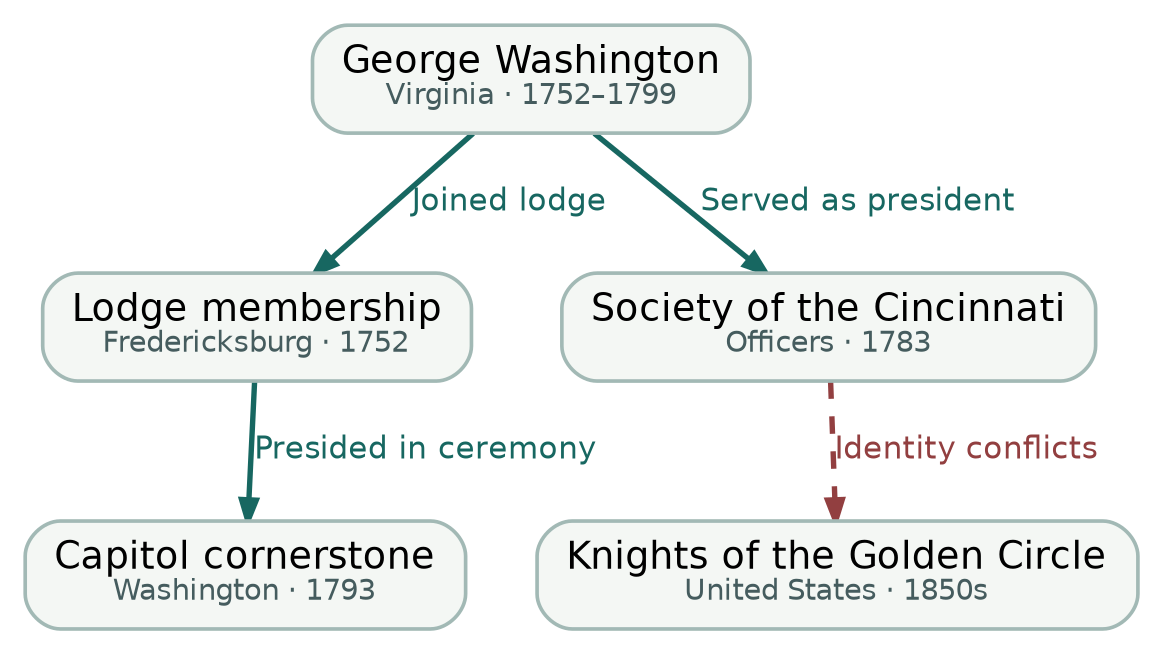
Read the evidence for the arrows in Figure 2
- George Washington → Lodge membership. Documented link. Evidence collected by Mount Vernon identifies Washington’s initiation at Fredericksburg. [34]
- George Washington → Society of the Cincinnati. Documented link. The institution and society record document the Revolutionary officers’ organization and Washington’s role. Knox helped organize it. [36] [47]
- Lodge membership → Capitol cornerstone. Documented link. The ceremony and plate explicitly connect Washington and Masonic lodges with the Capitol foundation. [35] [34]
- Society of the Cincinnati → Knights of the Golden Circle. Conflicting record. The Golden Circle has its own nineteenth-century origins and proslavery objectives. The Cincinnati society’s 1783 identity continues independently. [36] [37] [38]
Jefferson left a book a person can inspect and a letter in which he explained himself. What he did to the Gospels can be seen in the paper and paste. He selected passages across languages and created a narrative centered on the life and teachings of Jesus. In his 1803 letter to Benjamin Rush he also explained the sense in which he considered himself a Christian. A modern reader is free to disagree with Jefferson’s definition. The interesting historical question is how that definition could coexist with his rejection of orthodox claims. Calling the whole thing hatred of Christianity loses a dispute Jefferson took considerable trouble to express precisely. [39] [40]
Then there is the federal question. The Declaration invokes a Creator. Article VI bars religious tests for federal office. Madison argued against religious assessments in Virginia. France’s declaration of 1789 framed rights in natural terms and protected religious opinions subject to public order. Britain had wrestled with restraints on royal power in the Petition of Right in 1628. I cannot reduce all those commitments to a single theology, even before accounting for enslaved people who did not share in the freedom the American language announced. And I cannot use Brumidi’s fresco painted in 1865 to assign a private intention to men debating a constitution in 1787. The fresco does give us the later republic choosing to place Washington among classical allegories. That is a substantial historical fact in its own century. [41] [42] [43] [44] [45] [46]
Open the 30 indexed passages · Read the subject records · Contents
Chapter 3 · Watch 16:46–25:47
A private grant reaches the State Department
One of the best examples in the entire investigation comes from following Cooper’s question about the Council on Foreign Relations past his answer. He says to read its journal because its ideas generally happen about two years later. I looked for a route by which someone writing about a policy could actually reach the people deciding it. In its 1939 annual report the Rockefeller Foundation recorded a $44,500 grant to the Council on Foreign Relations for studies related to the war. In the grants schedule the project carries the identifier RF 39110. A critical reconstruction puts the initial funding in December and describes contact with State Department officials. The grant and the contacts give us a more specific mechanism than the claim that a magazine can predict the future. [6] [48] [49]
The Council’s own institutional history describes the larger wartime project as backed by $350,000 in foundation funding. On printed page 25 it reports that over five years its experts held 362 meetings and produced 682 memoranda for the State Department. The $44,500 in the donor’s report is an initial grant. Treating the two figures as separate pots to add together would overstate what the sources establish. Treating all 682 memoranda as adopted policies would introduce another error. We can document access, money, research and delivery of advice. To demonstrate adoption of a particular recommendation, we would still want the memorandum, the corresponding decision and, ideally, the official’s response. [6] [48] [50] [51] [49]
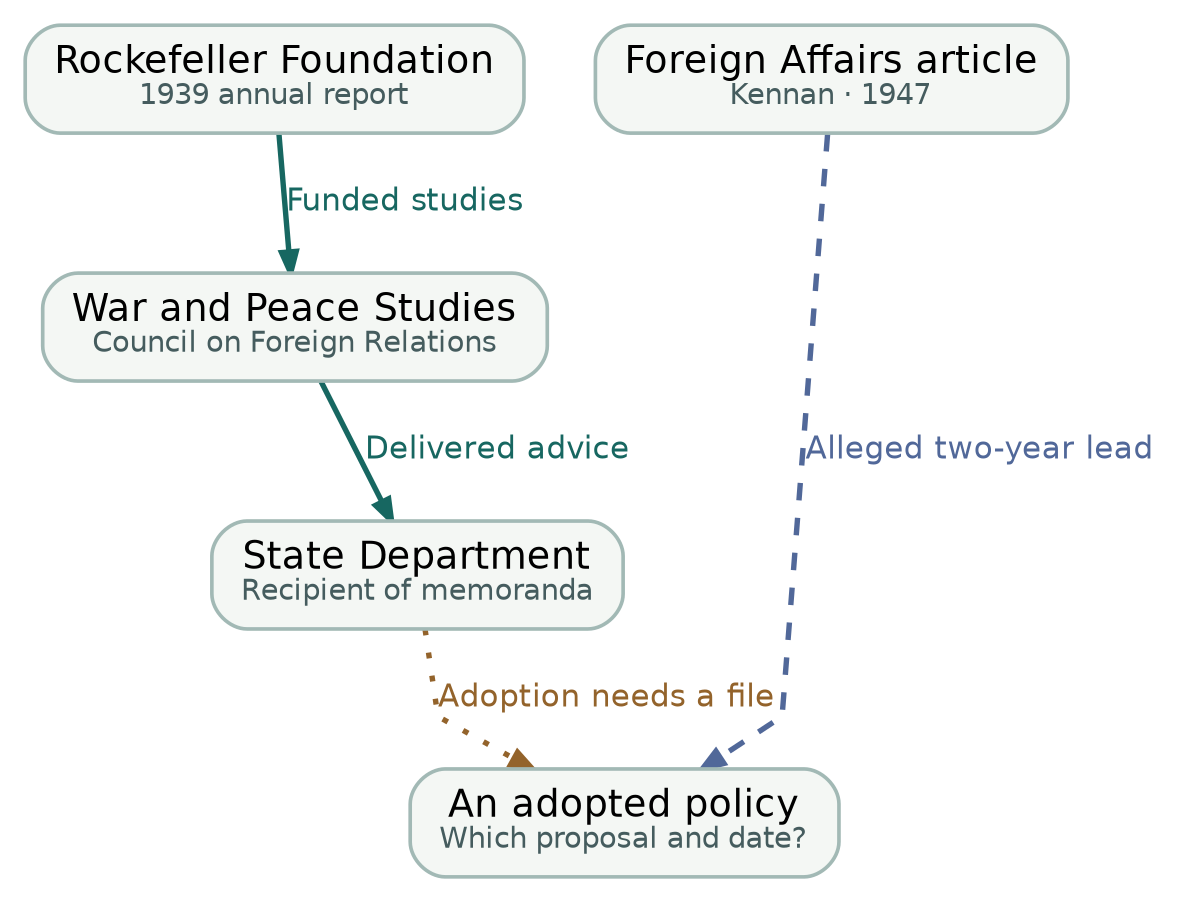
Read the evidence for the arrows in Figure 3
- Rockefeller Foundation → War and Peace Studies. Documented link. The donor’s 1939 report records $44,500 for the Council’s wartime studies. The CFR later describes a larger overall grant. [6] [48] [50]
- War and Peace Studies → State Department. Documented link. The Council records 682 memoranda over five years. The project illustrates substantial access to officials. [50] [49]
- State Department → An adopted policy. Link unverified. For a specific policy one would want its decision record, the relevant memorandum and contemporary evidence connecting the two. [49] [51]
- Foreign Affairs article → An adopted policy. Interpretation. Cooper describes a general forecasting rule. The chronology of Kennan’s cable and Truman’s address shows why publication dates alone can mislead. [52] [53] [54]
Kennan provides an example of why chronology matters. His Long Telegram went to Washington in 1946. Truman’s March 1947 address asked Congress for assistance to Greece and Turkey. Kennan’s famous article under the signature X appeared in Foreign Affairs later that year. A reader looking from the article forward could see an extraordinary correspondence with government policy. A reader looking backward as well finds officials already engaged with the problem. Other writers were plainly advocating change. Richard Gardner’s 1974 essay argued that narrower international arrangements could achieve transfers of authority that sweeping plans for world government could not. Readers can inspect the argument and judge its implications without decoding the words. [52] [53] [54] [55]
Cooper then quotes Alvin Toffler describing the collision of industrial and emerging social orders. The word hidden is doing almost all the work in Cooper’s reading. In the surrounding pages Toffler is explaining how an analyst can distinguish patterns amid events that appear chaotic. That does not by itself identify someone directing them. The media segment immediately afterward offers a practical control for the same error in reverse. An outlet may use identical wording because it subscribes to the same wire service as somebody else. Sinclair also supplied scripts to stations it owned. One repeated sentence, two possible routes. The difference appears when you ask who distributed the language and whether the outlet had a choice. [56] [57] [58] [59]
Open the 24 indexed passages · Read the subject records · Contents
Chapter 4 · Watch 25:48–42:38
What a fire can tell us about a king
Cooper imagines a human being in the dark, a tree struck by lightning, and somebody brave enough to carry off a burning branch. That person learns to keep a fire alive, offers warmth and protection, attracts followers and becomes the first king, priest and scientist. It is an intelligible account of how unequal access to useful knowledge might produce authority. Archaeology lets me follow parts of it much farther than a written history of kings could. Burned bone and plant remains deep inside Wonderwerk Cave in South Africa put burning in an archaeological context around a million years ago. The excavators’ evidence concerns fire inside the cave. It does not record the name, office or intentions of the person beside it. [60]
Barnham in England supplies a different piece. Researchers reported heat-altered sediment, flint and iron pyrite at a site around 400,000 years old. They argue the combination supports deliberate fire-making there. Keeping an existing flame and being able to produce one are different technological achievements. Neither result identifies the first use worldwide. By the time of Hammurabi, there is a monument we can read and a king we can name. The relief places him before Shamash, the sun god associated with justice. Centuries later the Cyrus Cylinder ascribes the Babylonian god Marduk’s favor to Cyrus. Those objects show rulers using sacred authority to explain political legitimacy. The intervening hundreds of thousands of years contain no documentary chain from the keeper of Cooper’s flame to either court. [61] [62] [63] [64]
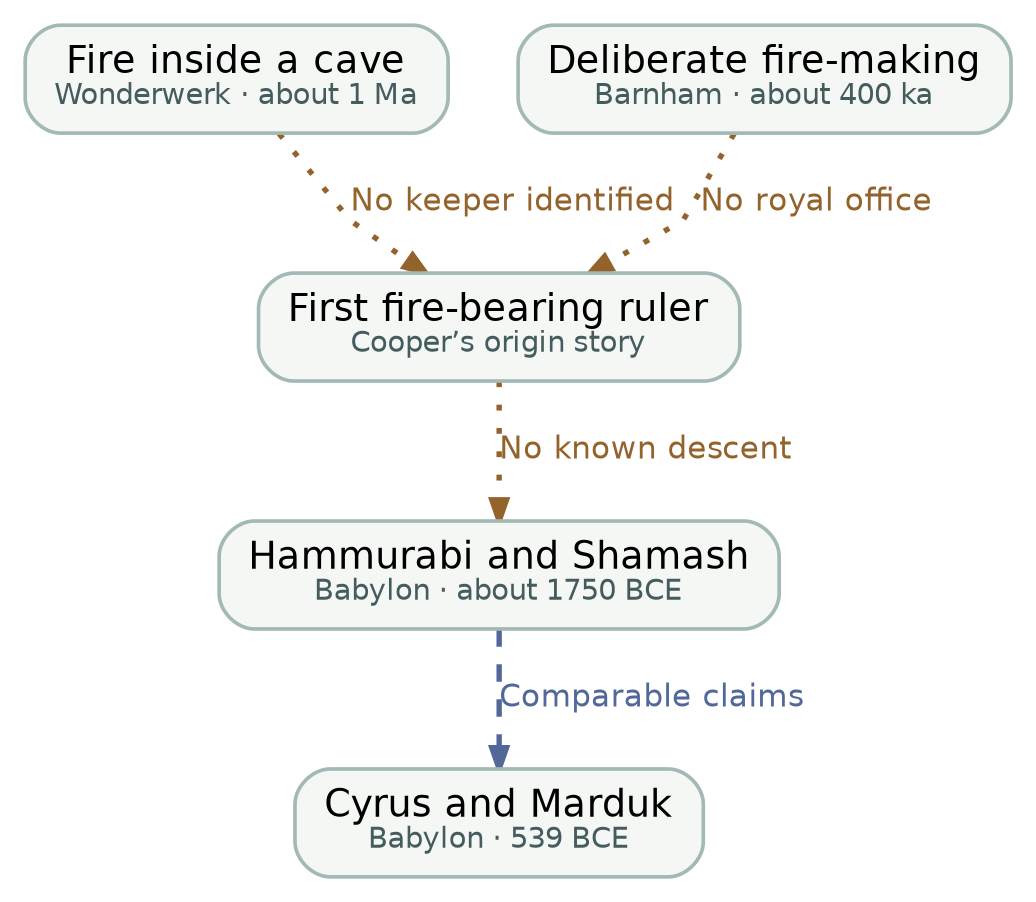
Read the evidence for the arrows in Figure 4
- Fire inside a cave → First fire-bearing ruler. Link unverified. The deposits support ancient burning in a hominin context. They preserve no identity, monopoly or royal office. [60]
- Deliberate fire-making → First fire-bearing ruler. Link unverified. Heated clay, flint and pyrite strengthen an argument about making fire. They do not establish that one person ruled the group. [61] [62]
- First fire-bearing ruler → Hammurabi and Shamash. Link unverified. The stele places Hammurabi before a deity. Nothing on it links the ruler to an ancestral fire keeper. [63]
- Hammurabi and Shamash → Cyrus and Marduk. Interpretation. The two monuments give distinct Mesopotamian examples of kings invoking divine legitimacy. This comparison is about political language, not documented succession between the two men. [63] [64]
His account of Eden offers a different comparison. Genesis gives the humans a task before they eat from the tree. Afterward their eyes open, they recognize their nakedness and they lose access to the tree of life. In The Reality of the Rulers, preserved at Nag Hammadi, a spiritual agency speaks through the serpent. The rulers have tried to keep something from the humans, and the serpent discloses it. Somebody following Cooper’s curiosity about a sympathetic serpent really can find an old text with that feature. The same work also recognizes a higher divine reality. That detail matters when Cooper tells his audience that the adherents of the alternative story must have been strict atheists. [65] [66] [7]
Greek poets give us still another relationship between a god and a technology. Prometheus steals fire in Hesiod. Fred Gettings later draws a comparison between Prometheus and Lucifer as givers of independent thought. Checking Gettings recovered part of the lecture’s genealogy. The modern author describe that interpretation and restricted it to some occultists. He is evidence for the comparison circulating in modern occult writing. To put the same doctrine in every ancient Greek sanctuary or every American lodge would require many additional documents. The branch from text to text is visible. Who carried it from a text into a particular institution is a different kind of historical question. [67] [68] [69] [8] [70]
Open the 41 indexed passages · Read the subject records · Contents
Chapter 5 · Watch 42:39–57:58
The bargain at Yalta that survived in writing
Cooper says Roosevelt, Churchill and Stalin met at Yalta, selected Stalin to play the postwar enemy and staged the Cold War for the benefit of the populations on both sides. There actually was a secret bargain at Yalta. Japan’s National Diet Library reproduces the agreement of February 11, 1945. It sets Soviet entry into the war against Japan at two or three months after Germany’s surrender and the end of the war in Europe. Its terms include southern Sakhalin, the Kuril Islands and the Port Arthur naval lease. The agreement also says some arrangements require Chiang Kai-shek’s concurrence and assigns Roosevelt the job of seeking it. The signatories and conditions are visible. For the people affected by the disposition of territory, diplomats bargaining over them behind closed doors was a concrete reality. [71] [72]
I set that document beside the conference’s language on liberated Europe and the later disagreement over Poland. The Allied leaders made promises about political choice. The successive alliances of 1949 and 1955 then put actual commitments in writing. The North Atlantic Treaty and the Warsaw Treaty identify who undertook obligations toward whom. The private Kennedy–Khrushchev exchanges of October 1962 show the two sides trying to step back from a dangerous confrontation. One can document propaganda, exaggerated threat estimates and the political uses of an enemy without treating the risks as wholly invented. To add Cooper’s particular Yalta claim would take a record of the three leaders agreeing to manufacture the rivalry. The actual secret Far East agreement is a good example of how specific such a record could be. [72] [73] [74] [75] [76] [77]
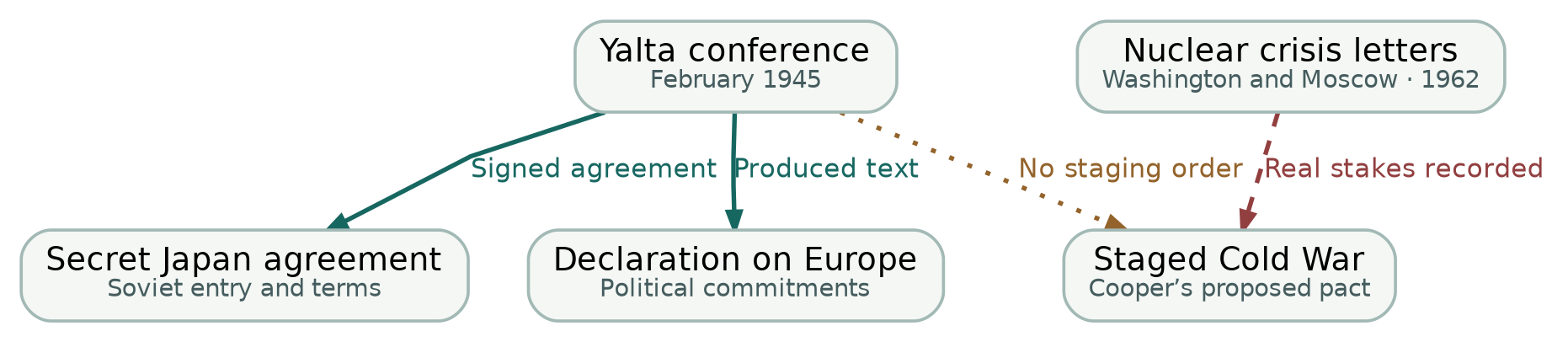
Read the evidence for the arrows in Figure 5
- Yalta conference → Secret Japan agreement. Documented link. The leaders agreed to conditions for Soviet entry into the war against Japan after Germany surrendered. [71]
- Yalta conference → Declaration on Europe. Documented link. The published protocol and working draft show negotiations about postwar political arrangements, including Poland. [72] [73]
- Yalta conference → Staged Cold War. Link unverified. Neither the located secret agreement nor the protocol records an agreement to make Stalin a fictional enemy. [71] [72]
- Nuclear crisis letters → Staged Cold War. Conflicting record. The correspondence shows active bargaining under nuclear risk. It weighs against treating the rivalry as wholly staged without providing access to every private conversation. [76] [74] [75]
His example of church and state raises a similar issue. A cross and crown can be found on Templar insignia. Christian Science uses the same pair and gives it a religious explanation of its own. In contrast, a formal agreement regulating church–state relations has parties, articles and obligations. The 1933 concordat between the Holy See and Germany gives us that sort of text, including the political interests and unequal enforcement surrounding it. The fact that two institutions display a Christian emblem cannot stand in for the kind of evidence a treaty actually provides. [78] [79] [80]
From there Cooper goes to his own press, then the oaths that allegedly bind other people. His newspaper survives. Its survival tells me that he could publish. It tells me very little about the trust for his children, the finances of his broadcasts or whether a member of Congress feared an issue on arrival. In the initiation argument the boundary falls farther along. Experiments have examined how effortful entry changes attachment to a group. Other research finds associations between reflection on difficult shared experiences and identification with a group. That supplies a plausible mechanism for loyalty in some settings. It would take people’s records and subsequent actions to show them advancing the same political plan across generations. A laboratory result cannot supply the missing names. [81] [82] [83] [84] [85]
Open the 44 indexed passages · Read the subject records · Contents
Chapter 6 · Watch 57:59–1:03:58
A pyramid, a calendar and a pulsar
The pyramid argument initially looks as if three independent measurements arrive at the same year. A Freemason adds four thousand years to a civil date. An astronomer detects radio pulses. A pyramid is said to commemorate a star that exploded in 4000 BCE. I went back to the things being measured. The first is a dating convention. On the silver plate recorded at the Capitol cornerstone ceremony, 1793 is also the year of Masonry 5793. In his book, Cooper correctly gives 5990 for the civil year 1990. The attached captions produce the wrong sum. Correcting that error improves the case for his attention to the convention. It supplies no new measurement of a star. [35] [86] [9] [18]
The pulse belongs to a different historical record. At Cambridge in 1967 Jocelyn Bell recognized the repeating signal during the work of Antony Hewish’s team. The 1974 Nobel went to Hewish and Martin Ryle. A pulsar’s repetition is the rotation of a neutron star. Naming the discovery and the award correctly is already different from knowing when a particular remnant formed. Cooper’s book points toward George Michanowsky’s interpretation of a possible ancient observation. A. Ralph Epperson also circulated the Hewish–4000 BCE claim with a reference to Richard Noone. Duane Hamacher examined the proposed identification with Vela and the assumptions needed to date it to about six thousand years ago. The modern age estimate is substantially older. NASA describes the supernova light as reaching Earth about eleven thousand years ago. The historical Crab supernova of 1054 is another object altogether. [87] [88] [9] [89] [90] [91] [92]
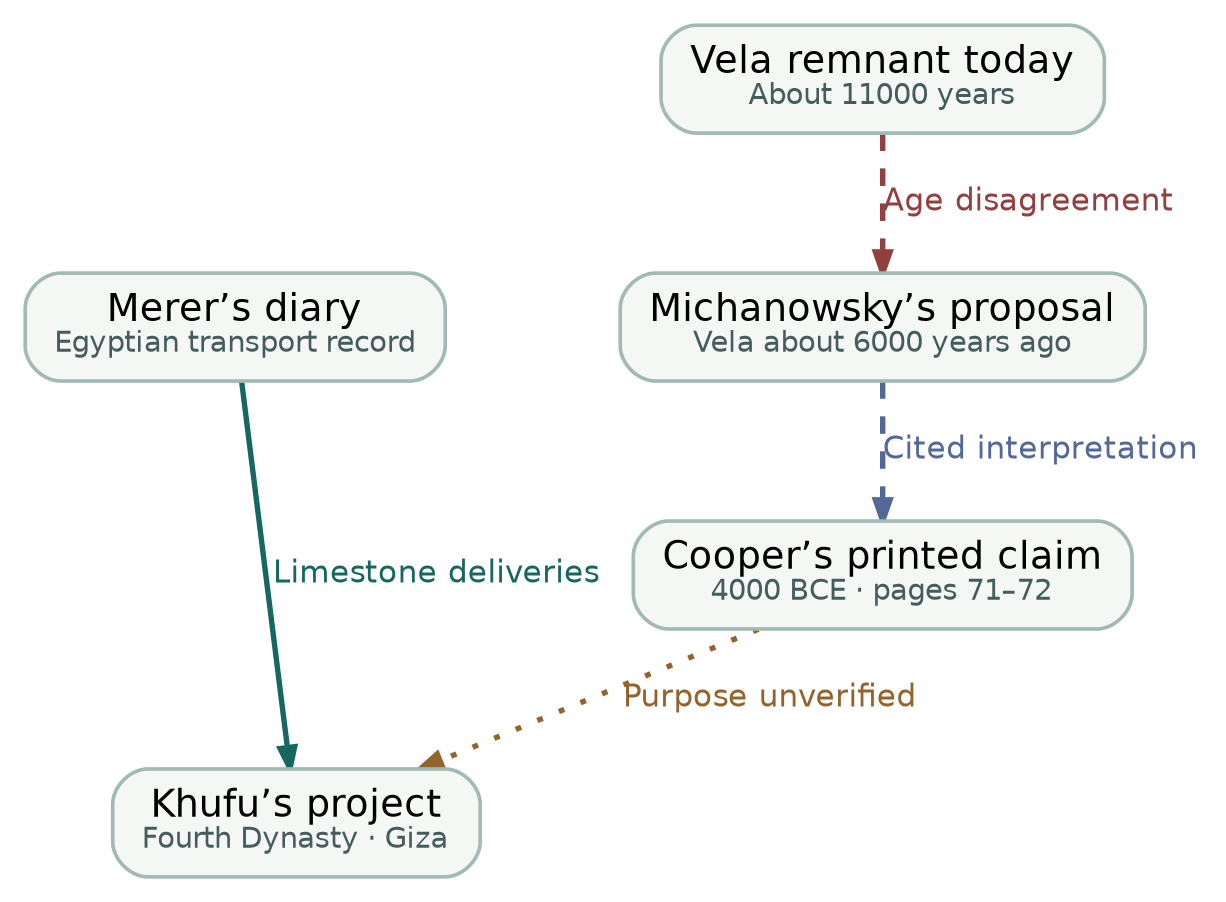
Read the evidence for the arrows in Figure 6
- Michanowsky’s proposal → Cooper’s printed claim. Interpretation. Cooper’s book cites Michanowsky. Epperson separately reproduces the Hewish pairing through Noone. [9] [89] [90]
- Vela remnant today → Michanowsky’s proposal. Conflicting record. The review addresses the six-thousand-year estimate directly. Modern estimates put the remnant more than ten thousand years old. [90] [91]
- Cooper’s printed claim → Khufu’s project. Link unverified. No located contemporary Egyptian construction text names a 4000 BCE supernova as the reason for the pyramid. [93] [95] [9]
- Merer’s diary → Khufu’s project. Documented link. The logs record the work of a named official and transport connected to Khufu’s monument. [93] [94]
Egypt offers a contemporary document of its own. The journal attributed to Merer survives in papyri recovered at Wadi al-Jarf and edited by Pierre Tallet. It records a working crew, limestone transport and the destination associated with Khufu. This is a powerful piece of evidence for the organization of a building project. It is quite a different source from Manly P. Hall writing about what later esoteric readers considered the purpose of the Great Pyramid. The ancient word for a pyramid and the name of Khufu’s individual monument also need separate treatment. A name meaning Khufu’s Horizon is not a translation of every Egyptian word for pyramid. [93] [94] [95] [96] [97] [98]
The question about initiation is older than Hall. The Homeric Hymn to Demeter explicitly restricts disclosure of the rites. Plato uses the language of initiation in a philosophical argument. Neither gives a date on which Plato spent three days inside the Great Pyramid. I can show a reader ancient secrecy, a philosopher’s idiom, an Egyptian transport diary and a modern author’s interpretation. If a participant’s account of an initiation at Giza turned up, I would place it beside those records and ask about its date and authorship. It would bring a new kind of evidence to a particular part of the argument. [8] [99] [100] [98] [95]
Open the 24 indexed passages · Read the subject records · Contents
Chapter 7 · Watch 1:03:59–1:08:22
Who was in the room in Paris?
On May 30, 1919, British and American participants in the Paris Peace Conference gathered at the Hôtel Majestic. Lionel Curtis wanted the expertise mobilized during the war to have a permanent place in the making of foreign policy. He also came out of a particular British imperial and reform tradition. Chatham House’s historian Katharina Rietzler treats that background as part of the explanation. Jo-Anne Pemberton reconstructs the diplomatic and intellectual disputes in more detail. An expressly critical history by Laurence Shoup and William Minter approaches the same institutions through the interests of an American business and policy elite. All three give the reader more to investigate than a bare membership list. [1] [5] [51]
I started crossing off names. Tasker Bliss was there and is identified as chair. Calling him the serving U.S. Army chief of staff on the meeting date carries an office past the end of his term. Shotwell and Coolidge appear on the committee that prepared a proposal, together with James Brown Scott. On the American side a preexisting New York organization also mattered to the outcome. On the British side an institute was founded in 1920. On July 29, 1921, the American CFR took its resulting institutional form. In its inaugural roster I found Isaiah Bowman, Archibald Cary Coolidge, John W. Davis, Norman H. Davis, Stephen P. Duggan, Otto H. Kahn, William R. Shepherd, Whitney H. Shepardson and Paul M. Warburg. Cooper gives them as examples, so the additional directors on the list do not count against him. [5] [101] [102] [50] [2]
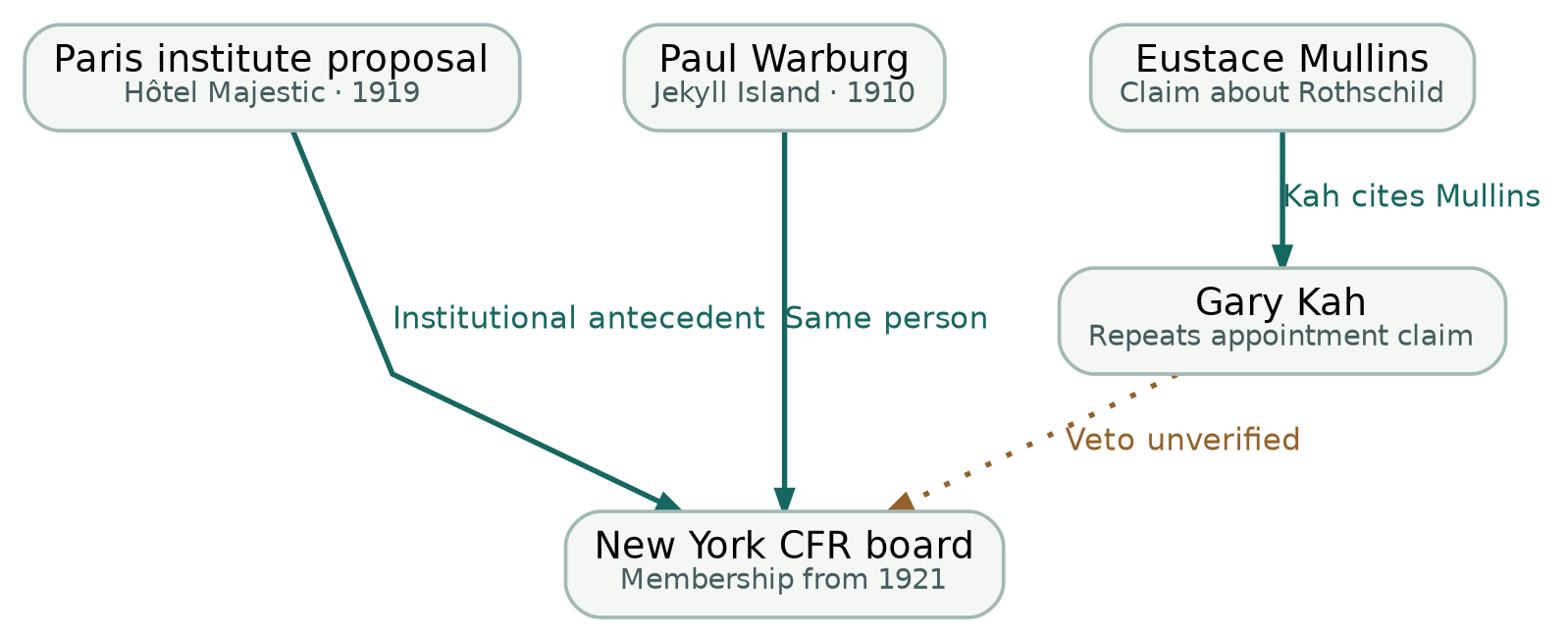
Read the evidence for the arrows in Figure 7
- Paris institute proposal → New York CFR board. Documented link. The Paris discussions were one antecedent. An existing New York group also helped produce the resulting CFR. [5] [50] [1]
- Paul Warburg → New York CFR board. Documented link. Warburg appears in the 1910 conference and the 1921 board roster. The link is a person with documented roles. [108] [2]
- Eustace Mullins → Gary Kah. Documented link. Kah’s notes 16–17 refer to Mullins. The appointment allegation in Mullins follows the end of the attributed handbook quotation. [3] [4]
- Gary Kah → New York CFR board. Link unverified. The 1921 roster confirms directors’ names. An appointment list subject to Edmond de Rothschild’s approval, or correspondence demonstrating a veto, has not been located. [3] [2] [105]
The Balfour Declaration gave me a way to test the next claim without treating an entire banking family as one historical actor. The 1917 letter was addressed to Walter Rothschild in Britain. Edmond de Rothschild in France did finance settlements and agricultural activity in Palestine. The family foundation has an archival collection for that undertaking. Those are two people with distinguishable roles. I found the allegation that Edmond approved the founders of the institutes in Gary Kah and found Kah’s citation to Eustace Mullins. In Mullins the quoted handbook passage closes after a Paris street address. The claim of Rothschild domination follows in the author’s voice. Reprinting a statement preserves its wording. It does not add another independent witness to what happened in the room. [103] [104] [105] [3] [4]
The proposed funding list also deserves individual treatment. Schiff died in 1920. J. Pierpont Morgan Sr. died in 1913. Money could have come from an estate, a firm, a son or an earlier pledge, so those dates do not disprove every conceivable version. They do make a bare list of surnames insufficient as an account of a 1921 cash transaction. There is a useful comparison here. Paul Warburg appears by name at the 1910 Jekyll Island banking meeting and in the 1921 CFR roster, while the original Federal Reserve Act establishes what Congress actually enacted between those dates. In Honolulu, the first Institute of Pacific Relations proceedings let Pacific participants speak in their own institutional setting. Neither a surname nor an institution’s English name can tell us who exercised voting power in all three places. [106] [107] [108] [109] [2] [110] [111]
I also pulled the League of Nations Covenant from the peace settlement. Its language on collective security sits alongside a general rule requiring agreement by all represented members for many decisions. Someone trying to build international institutions was working against sovereign vetoes and domestic politics as well as with the resources of wealthy participants. That tension is a more interesting starting point for the history than assuming every foundation, national institute and government took the same instructions. [112] [113] [55]
Open the 32 indexed passages · Read the subject records · Contents
Chapter 8 · Watch 1:08:23–1:18:09
A prophecy with a date and a named man
At 1:08:38 the interviewer asks Cooper what Israel’s role was supposed to be. Cooper answers with a sequence that can be followed sentence by sentence. Israel is created for a purpose. A nuclear war begins around 1996. The horror drives the public to seek peace at any price. People then accept the end of national sovereignty. At 1:40:47–1:41:15 in the archived audio, he also names Saddam Hussein as the man he expects to bring it about. He says Hussein would be presented as the Antichrist. That name drops out of the compilation. So does part of what made this a risky and relatively specific forecast. Cooper’s qualification that Americans could intervene belongs beside the date and named actor. [16] [15] [114] [115] [116]
I worked backward from 1948 through documents representing people who wanted different futures. The 1897 Basel Program describes a Zionist political objective. Britain’s 1917 letter supports a Jewish national home while setting out qualifications relating to the rights of other communities. In September 1947 the Arab Higher Committee put its rival proposal for an Arab state in all of Palestine before the United Nations. In November the General Assembly recommended partition, including both an Arab and a Jewish state and a special arrangement for Jerusalem. Israel’s May 1948 declaration proclaimed statehood. The displacement and dispossession experienced by Palestinians in the Nakba belong to that history, too. Religious readings of those events also have a documented political life. None of those distinct records authorizes me to ascribe identical intentions to all the participants. [117] [103] [118] [119] [120] [121] [122]
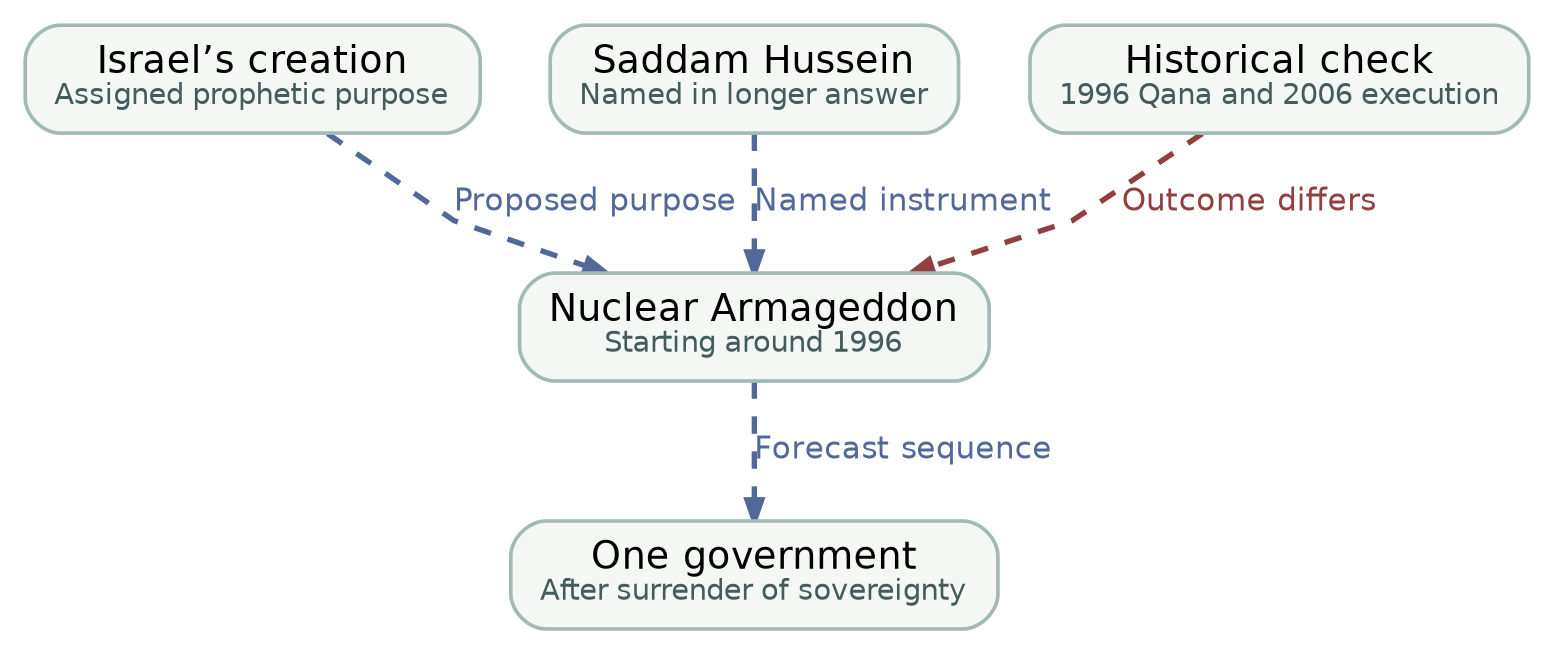
Read the evidence for the arrows in Figure 8
- Israel’s creation → Nuclear Armageddon. Interpretation. Cooper links a state’s founding to a future war. The Basel program, partition documents and declarations record diverse purposes. [16] [117] [118] [119] [120]
- Saddam Hussein → Nuclear Armageddon. Interpretation. The full interview names Hussein and adds the condition that Americans might intervene. [16] [15]
- Nuclear Armageddon → One government. Interpretation. Cooper says devastation would move the public to demand peace and accept political unification. [16] [123]
- Historical check → Nuclear Armageddon. Conflicting record. Qana was a real 1996 conflict incident. The specific nuclear sequence did not occur and Hussein was executed in 2006. [114] [115] [116]
Qana in 1996 is pertinent because the UN investigated an actual episode of lethal violence in the Middle East in Cooper’s forecast year. It is possible to place that violence, Hussein’s subsequent career and his execution in December 2006 on one chronology. The sequence Cooper specified included nuclear weapons and a political surrender of sovereignty. Those events do not appear in that chronology. Invoking an unspecified intervention to explain their absence leaves a further historical question. Who acted, when, by what means, and which decision changed? His conditional wording leaves that route logically open. No such intervention is identified in the sources reviewed here. [114] [115] [116] [123] [16]
Cooper proposes two readings of Revelation. People with power might use it as a script because other believers would hesitate to resist, or God might be bringing prophecy about. There are actual, contemporary documents addressing use of prophetic language. In March 2026 members of Congress asked the Defense Department inspector general to investigate complaints about religious messages concerning war with Iran. An oversight letter records that the complaint was made and taken up by lawmakers. It does not establish that the allegation was substantiated or that leaders brought about a war for that purpose. The biblical references can be checked more directly. The pale horse is in chapter 6, the trading restriction in chapter 13, and the name Armageddon in chapter 16. The longer interview confirms that the chapter error came from Cooper. [124] [125] [126] [127] [16]
Orwell’s records and Cooper’s own biography offer one more comparison. A 1949 contact with a British Foreign Office unit is real enough to have produced a later question in Parliament naming the file. Orwell also left his own account of what he wrote against and for. No supplied identifier connects the papers he saw to documents Cooper said he saw decades later. On Cooper’s personal injury, the amputation is independently recorded, and the family account in the FBI file differs from his account about what caused it. The file gives us a record of what a relative told an investigator. It does not settle every fact of the accident. A 1989 symposium publication and a 1991 book give a firmer check on his statement that he stayed silent for sixteen years after 1976. [128] [129] [130] [131] [132] [133]
Open the 34 indexed passages · Read the subject records · Contents
Chapter 9 · Watch 1:18:10–1:29:56
Who owned the outlet, and who gave the order?
The interviewer gives Cooper an opportunity the compilation removes. At 1:49:23 in the archived audio, after Cooper says that five corporations own American media, the interviewer asks him to name them. Cooper says he cannot do it accurately from memory and directs the interviewer to trace the parent companies. That is a perfectly workable starting point. Following ownership produces results. In 1996 the FCC acted on a statutory change to national and local radio ownership limits. In 2018 a single company’s script appeared at numerous local television stations. Studies of acquisitions have examined how local coverage changed under common ownership. These documents identify an actual mechanism connecting a business decision with what a particular audience heard. [16] [134] [58] [59]
The corporate example introduced by the modern narrator can also be dated unusually precisely. The Paramount–Skydance merger closed on August 7, 2025. CBS named Bari Weiss editor in chief on October 6 of that year. On October 6, 2026, one year later, the Warner Bros. Discovery acquisition closed. The resulting group included CBS and CNN. The company’s November filing distinguishes the family’s pre-closing holding of about 77.5 percent of voting Class A shares from its 35.0 percent share of combined voting and nonvoting stock at closing. Those percentages describe different denominators. They do not establish a 42.5-point loss of voting power. Nor can the October 2026 transaction have caused an editorial appointment made in October 2025. The dates do some of the analytical work for us. [135] [136] [137] [138]
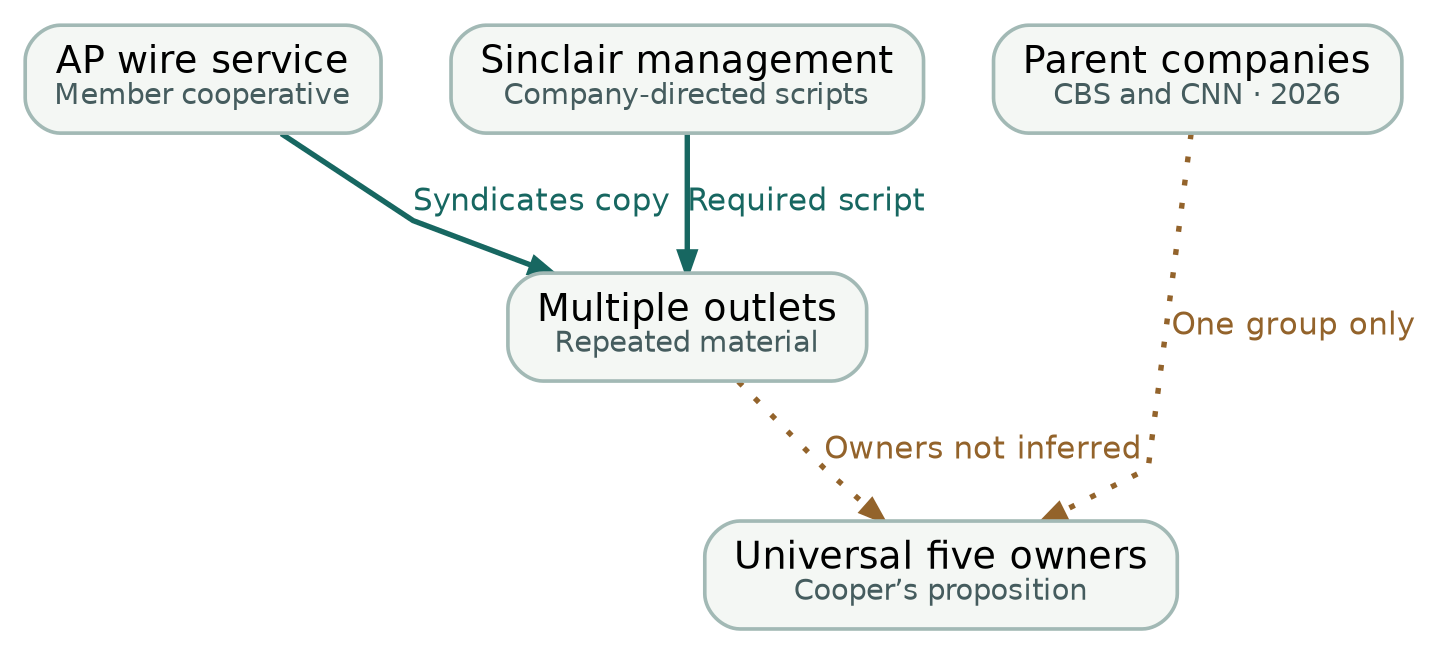
Read the evidence for the arrows in Figure 9
- AP wire service → Multiple outlets. Documented link. A cooperative provides the same report to numerous outlets. Common wording can therefore coexist with separate editorial ownership. [57]
- Sinclair management → Multiple outlets. Documented link. The 2018 promotion is an identifiable case of company management directing wording used by local presenters. [58] [59]
- Parent companies → Universal five owners. Link unverified. The completed 2026 acquisition documents a large combined parent. It cannot count every publisher, newsroom and broadcaster nationwide. [137] [138] [57] [153]
- Multiple outlets → Universal five owners. Link unverified. Matching text without routing information cannot identify how many owners exist or who gave a particular order. [57] [58] [16]
The Rome comparison also improves when both sides get a voice. Augustus recorded his gifts, distributions and games. Juvenal later lamented the Roman public’s loss of political agency. One speaker was an emperor describing his achievements. The other was a satirist criticizing what citizens had come to expect. In modern research, competition from major sports coverage has been associated with how much attention overseas disasters receive and whether the United States sends relief. That is genuine evidence of one of Cooper’s intermediate mechanisms. Competition for attention can affect which events make the news. The study did not test whether someone deliberately set the price of a baseball contract to suppress political questions. [139] [140] [141] [142]
For Baden-Baden we have a dated roster. The 1991 Bilderberg report places 110 participants at the German meeting, including Bill Clinton, then governor of Arkansas, and Henry Kissinger. It describes the meeting and summarizes discussion. The organizers’ account that they take no votes is compatible with private exchanges having political value. To establish that an attendee acted because of an exchange there, I would want a dated conversation, correspondence or a later decision in which the participant identifies the connection. The narrator’s comparison with Davos changes both the meeting and the country. WEF reported nearly three thousand participants in January 2026. It is possible to ask hard questions about access at either gathering while keeping the two rosters straight. [26] [143] [144] [145] [146]
By the end of the film the interviewer and Cooper are discussing immortality, and the modern narrator is discussing a man playing computer chess through an implant. An individual selecting a move by controlling a cursor gives us an observed capability. A clinical trial on particular eye diseases gives us a registered intervention with a safety endpoint. A mouse experiment can actually restore function under its stated conditions. None measures decades added to a human life. Cooper’s larger statement would also require identifying the same sponsors across coercive eugenics, immortality advocacy and modern research. The contemporary trials have sponsors and protocols. Those are the places a future documentary connection would have to attach. [16] [147] [148] [149] [150] [151] [152]
Open the 39 indexed passages · Read the subject records · Contents
Pattern Nexus Lens
Where the documents leave an opening
The last time Cooper speaks, he is talking about a meal. If somebody else decides what to cook while you sit in the living room, he says, you have given up your say about dinner. It is an argument for participation, with the vote and public education explicitly named a few minutes earlier. I wanted to leave that ending attached to his opening. The same speaker begins by saying that a small group already controls everything and ends by saying ordinary voters can still change what happens without bloodshed. The tension belongs to his account. A reader can decide what to make of it after seeing both statements in context. [16] [10] [154]
The open files are quite specific. An authentic page from the alleged CFR handbook could fix its wording. Contemporaneous selection correspondence could test a veto. A membership or funding ledger could close a specific gap between two bodies. A side-by-side record of editorial instructions and coverage could show a particular owner intervening. A construction text naming an astronomical event could alter the pyramid inquiry. An authenticated directive quoting prophecy in an actual policy decision would leave a different record from an allegation about a speech. Each discovery would change a specific connection in this investigation. It would leave the other connections available to be judged on their own documents. [49] [51] [59] [94] [124]
Historical chronology
When the records appear
Some entries compare independent records from the same era. I have arranged them by the dates of the events or objects. In the chapters I explain what connects them and which links would need more evidence.
-
About 1 million years ago · Wonderwerk Cave, South Africa. Burned material inside a cave gives evidence of early fire use in an archaeological context. [60]
-
About 400,000 years ago · Barnham, England. Heated clay, flint and pyrite support an argument for fire-making. This is a different claim from early fire use. [61] [62]
-
Fourth Dynasty, about 2550 BCE · Giza and Wadi al-Jarf, Egypt. Khufu’s monument and Merer’s operational journal locate a royal project in a named reign. [95] [93] [94]
-
Second millennium BCE · Mesopotamia, present-day Iraq. The Sumerian King List and Hammurabi’s stele preserve different ideas about royal succession and divine legitimacy. [155] [63]
-
Archaic Greece · Eleusis and Greek poetic traditions. The Hymn to Demeter limits disclosure. Hesiod makes a separate story of Prometheus and fire. [8] [67]
-
539 BCE and its aftermath · Babylon. Cyrus’s conquest is framed in an Akkadian royal inscription as approved by Marduk. [64]
-
Fourth century BCE · Greek philosophical world. Plato uses the vocabulary of initiation. A datable text is available for comparison with the much later story about his stay inside a pyramid. [99] [100] [98]
-
Early Roman Empire · Rome and the provinces. Augustus records distributions and games. Juvenal’s later satire criticizes public priorities. The speakers and purposes differ. [139] [140]
-
Late antiquity · Nag Hammadi Codex II, Egypt. The surviving Coptic manuscript transmits a religious retelling of Eden with a teaching serpent. Manuscript date and date of composition need not coincide. [7]
-
August 1308 · Chinon, France. Papal delegates examine leading Templars. Trial evidence and retrospective interpretations of the head or skull have different origins. [156] [157]
-
1628 / 1723 / 1734 · England and colonial Philadelphia. The Petition of Right records restraints sought on royal power. Later Anderson’s lodge book crossed the Atlantic in Franklin’s printed edition. [45] [31]
-
1752 / 1783 / 1793 · Virginia, New York and Washington. Washington’s lodge membership, presidency of the Cincinnati and role at the Capitol cornerstone each have separate records. [34] [36] [35]
-
1785–1791 · Virginia, Philadelphia and Paris. Madison’s remonstrance, the federal Constitution, France’s rights declaration and the U.S. First Amendment address religion and authority in different ways. [43] [42] [44]
-
About 1820 / 1850s / 1865 · United States. Jefferson’s Gospel compilation, the Knights of the Golden Circle and Brumidi’s fresco belong to different generations. [39] [37] [46]
-
1897 / 1917 · Basel and London. The Zionist congress adopted the Basel Program. Balfour’s letter later stated the British government’s policy to Walter Rothschild. [117] [103]
-
1910 / 1913 · Jekyll Island and Washington. A private banking group prepared proposals. The eventual law was passed by Congress. Warburg later appears in the CFR roster. [108] [109] [2]
-
1919–1925 · Paris, London, New York and Honolulu. A proposal at the Hôtel Majestic preceded distinct institutions. Honolulu’s first Pacific conference left its own published proceedings. [5] [102] [50] [110]
-
1933 / 1939–1945 · Germany / New York and Washington. A sterilization statute identifies the coercive eugenic mechanism. A separate wartime grant and CFR policy memoranda document U.S. private policy advice. [152] [6] [50]
-
1945–1955 · Yalta, Japan, the UN and the two blocs. The Yalta agreements, rival arguments about Palestine, Israel’s declaration and alliance treaties record distinct commitments. [71] [118] [119] [120] [74] [75]
-
1949 / 1962–1963 · Britain, Washington, Moscow and Dallas. Orwell’s Foreign Office contact, missile-crisis letters and records of the Kennedy assassination have different documentary histories. [128] [129] [76] [158] [159]
-
1967 / 1974 · Cambridge and Stockholm. Pulsars were discovered and a Nobel Prize followed. Neither date is the age of Vela or the date of Egyptian construction. [87] [88] [91]
-
1976–1992 · Cooper’s autobiographical chronology. The claimed disclosure and attack begin in 1976. A 1989 publication and 1991 book predate the interview circulated as 1992. [131] [132] [133] [16]
-
1982 / 1991 · Italy and Germany. Italian law dissolves P2. In Germany a separate Bilderberg report names its participants. Neither record establishes continuity between the two organizations. [25] [26]
-
1996 / 2006 · Lebanon and Iraq. A UN investigation documents Qana. Saddam Hussein’s death was confirmed in 2006. These are dated checks on the named forecast. [114] [115] [116]
-
2015 / 2019 / 2020 · UN and World Economic Forum. Member states adopt the UN agenda. A UN–WEF partnership follows, then WEF promotes the Great Reset. The three instruments have different authors and powers. [160] [161] [162]
-
2024–November 2026 · Clinical studies, media filings and the film. An assistive chess demonstration, two corporate closings and an early human ocular safety trial can be checked separately from an older claim about immortality. [147] [135] [137] [149] [12]
Timestamp index
The recording, passage by passage
Select a timestamp to hear the passage. Each subject record follows the claim elsewhere in the film. Expand the caption cues to open any of the 729 distinct timestamps. When entries share a starting cue, the first entry contains the caption links. Search the index by name, speaker or subject
- 00:00 · A secret society with a name and a law
- 08:21 · Franklin’s printing press and Washington’s cornerstone
- 16:46 · A private grant reaches the State Department
- 25:48 · What a fire can tell us about a king
- 42:39 · The bargain at Yalta that survived in writing
- 57:59 · A pyramid, a calendar and a pulsar
- 1:03:59 · Who was in the room in Paris?
- 1:08:23 · A prophecy with a date and a named man
- 1:18:10 · Who owned the outlet, and who gave the order?
Chapter 1. A secret society with a name and a law · 29 passages
Chapter 1. A secret society with a name and a law · Read the chapter
Passage 1 · Cooper · 00:00
There has always been a plan.
Cooper makes continuity part of the claim from his first sentence. One proven plan would establish one period. The proposed continuity requires links across changes in language, membership and government. [9] [25]
Caption cues (1)
Passage 2 · Cooper · 00:02
The Great Work, Great Plan and Lost Word name the same undertaking.
Cooper groups the expressions together. A ritual phrase can circulate without the authority of the body that first used it. Each claimed equivalence needs a dated use with its meaning intact. [9] [163]
Caption cues (1)
Passage 3 · Cooper · 00:07
Members meet privately, swear binding oaths and face consequences for betrayal.
Private oaths appear in published ritual exposures. The consequence and enforcing authority in this sentence are unclear in the caption. A ceremonial penalty and a documented act against an individual are different records. [163] [24]
Caption cues (1)
Passage 4 · Cooper · 00:15
Members infiltrated social institutions, the military and government in major and smaller countries.
Italy’s P2 inquiry offers an identifiable membership investigation. Extrapolation to the countries and services Cooper leaves unnamed has no membership or event series here. [24] [25]
Caption cues (1)
Passage 5 · Cooper · 00:23
The organization now exercises total control.
This is stronger than infiltration. An official might be a member, an influential adviser, a decision maker or a subordinate under orders. Finding any one status does not establish the other three. [24] [50] [27] [28]
Caption cues (1)
Passage 6 · Modern narrator · 00:34
This may be Cooper’s most complete presentation, making previously unseen connections.
The credited upload is a modern compilation assembled from different recordings. A superlative about Cooper’s work would require a defined comparison across the archive. [10] [11] [12]
Passage 7 · Cooper · 00:52
The Brotherhood of the Snake or Dragon was its oldest name.
Bramley gives a modern written version. An Egyptian protective serpent is historically attested. Neither source identifies an ancient foundation charter bearing the name Cooper supplies. [30] [164]
Caption cues (1)
Passage 8 · Cooper · 00:59
Groups using different names, even apparent opponents, are the same organization.
An alias can be documented through records such as a change of name or the same officers issuing instructions. A snake appearing in two unrelated settings does not supply that link. [18] [165] [24]
Caption cues (1)
Passage 9 · Modern narrator · 01:08
Institutions and symbols change while one underlying structure persists.
The narrator proposes continuity. The organizations, reformations and dates need to be identified before the proposition can be tested across two successive periods. [10] [25] [165]
Passage 10 · Cooper · 01:26
The leaders of all countries belong to one club.
The Bilderberg roster provides a bounded test of cross-border contact. Its names and countries do not cover every national leader or demonstrate that attendees take orders there. [26]
Caption cues (1)
Passage 11 · Cooper · 01:34
He has been deceived before, learned from it and is harder to deceive than his audience.
We can compare his claims with records. The comparative psychological judgment would require information about the speaker and audience that attendance alone cannot supply. [16] [9]
Caption cues (1)
Passage 12 · Cooper · 01:42
He spends 99 percent of his time researching and has investigated more thoroughly than anyone present.
His published book and broadcasts are tangible work. The percentage, access to particular material and comparison with each listener are autobiographical estimates. [9] [18]
Passage 13 · Modern narrator · 02:06
Researchers who followed him found that his method was to follow filed documents.
No researchers are named here. The Paris passage later in the film lets a reader test the method directly by finding the book, its endnotes and the boundary of the quotation. [3] [4]
Passage 14 · Cooper · 02:45
Truth can be uncertain, and people should test his material themselves.
This is his stated standard. Restoring an omitted answer and checking a cited author against the actual passage are ways to apply that standard to this film. [16] [56]
Passage 15 · Cooper · 03:11
Certainty can cut off inquiry even for someone who has learned from past mistakes.
Cooper states a practical limit on his own authority. A claim can be retested against independent records even when the lecturer and the audience initially agree. [16] [166]
Passage 16 · Modern narrator · 03:25
AI media and deepfakes blur the distinction between authentic and fabricated material, perhaps deliberately.
NIST documents technical problems in authenticating synthetic content. Identifying who made a given item and why requires evidence about that item and its production. [167]
Passage 17 · Cooper · 03:42
Refusing to hear opposing views makes people vulnerable to manipulation.
Motivated reasoning provides a plausible mechanism for selective evaluation. A listener’s disagreement or refusal, standing alone, does not identify an outside manipulator. [166]
Passage 18 · Modern narrator · 04:14
The narrator applies Cooper’s warning about blind loyalty to Cooper himself and says most people have already chosen a side.
The warning can be heard in the edit. Work on motivated reasoning offers an explanation for selective listening. Whether most listeners had already decided would require evidence about the particular audience. [10] [166]
Passage 19 · Cooper · 04:55
True accusations offend their targets and false ones leave people unmoved.
Research on accusations reports that innocent people can become particularly angry. Anger cannot distinguish true and false accusations as Cooper proposes. [29]
Caption cues (1)
Passage 20 · Cooper · 05:04
He regularly used a derisive term on air and angry correspondents proved he had described them accurately.
He reports receiving letters. The letters could document a response if produced. Reading the writers’ character or the truth of the accusation from their anger is a further inference. [10] [29]
Passage 21 · Modern narrator · 05:42
Strong reactions expose buried truths and online outrage may be manufactured to distract.
Social feedback can reward expressions of outrage. An organized distraction would additionally require a sponsor, a message and an observable change in attention. [168] [29]
Passage 22 · Cooper · 06:07
Listeners wrote complaining that he spent too much time on symbolism, history and mystery religions.
The radio archive corroborates the subject matter. The correspondence and how representative it was remain his description. [18]
Passage 23 · Cooper · 06:31
Ignorance of history allows the same play to be performed repeatedly.
Historical knowledge can change how a person reads a symbol or a document. To show a deliberate replay one has to identify who knew the earlier episode and how they used it. [24] [112]
Caption cues (1)
Passage 24 · Cooper · 06:38
The builders, controllers and puppet masters are different descriptions of the same actors.
These names are Cooper’s descriptions. Matching them to a specific person in different settings would require evidence external to the labels themselves. [9] [24]
Caption cues (1)
Passage 25 · Cooper · 06:47
The builders or puppet masters build people and seek to make a perfect race.
Germany’s 1933 compulsory sterilization statute records a real institutional campaign to direct reproduction. Its officials and enforcement can be identified. The statute does not establish descent from an ancient fraternity. [152] [169]
Passage 26 · Cooper · 07:11
Withholding truth and substituting lies allows the builders to control the public.
Specific covert information operations appear in the Church Committee record. Extending those cases to a continuing monopoly requires documentation of production, dissemination and effects in each setting. [170] [171]
Passage 27 · Modern narrator · 07:21
Repeated symbols and rituals reveal deliberate historical repetition and make future behavior predictable.
A forecast can be dated and compared with its outcome. The narrator supplies no sample of symbol-based forecasts or failed calls. The 1996 prediction later in this film does supply a test. [16] [9]
Passage 28 · Modern narrator · 07:55
Once a listener recognizes the alleged structure, it loses its power over that listener.
Identifying an instruction or correcting a misattribution can change what a listener knows. Influence through employment, law or finance could persist after a listener learned about it. The promised protection has no measure in the video. [25] [27]
Chapter 2. Franklin’s printing press and Washington’s cornerstone · 30 passages
Chapter 2. Franklin’s printing press and Washington’s cornerstone · Read the chapter
Passage 30 · Cooper · 08:21
The United States was never intended to have a Christian federal government.
Article VI barred religious tests for federal office. The First Amendment later prohibited Congress from establishing a religion. Virginia’s religious-assessment debate shows contemporaries disagreeing about state support for religion. [42] [43] [172]
Passage 31 · Cooper · 08:32
Christians comprised most who originally came, built the country and shaped laws and traditions.
European colonies had substantial Christian institutions, including established churches. The population under discussion changes the claim. Indigenous inhabitants and Africans forcibly brought to North America also built that society. [173] [172]
Passage 32 · Cooper · 08:48
Many founders belonged to secret societies.
Washington and Franklin are individually documentable. A proportion requires defining the founders and checking affiliations across the whole list, including people for whom membership is sometimes asserted without evidence. [34] [32] [174]
Caption cues (1)
Passage 33 · Cooper · 08:57
Jefferson hated Christianity.
Jefferson’s 1803 letter to Benjamin Rush explains his esteem for Jesus’s moral teaching and his own unusual use of the word Christian. His criticism of orthodox doctrines is documented. A blanket statement about hatred erases the position he actually described. [40] [39]
Caption cues (1)
Passage 34 · Cooper · 09:04
Jefferson cut up a Bible and made his own because he rejected what it said about God.
The surviving volume shows physical cutting and rearrangement of Gospel texts. Its selections and letters can establish his editorial method and some intentions. Cooper gives a specific explanation about the King James depiction of God without identifying a matching quotation. [39] [40]
Passage 35 · Modern narrator · 09:35
The surviving book eliminated miracles, the supernatural and claims to Jesus’s divinity.
The Smithsonian displays Jefferson’s arrangement of Gospel passages. Readers can see what he retained, including the ethical teachings, and how the account ends. It is a compilation from multiple editions and languages. [39]
Passage 36 · Cooper · 10:02
Franklin led Freemasons in Philadelphia.
Pennsylvania records and his 1734 printing of Anderson put him directly inside organized Masonry. The offices of a local master and a provincial grand master are distinct titles. [32] [31]
Caption cues (1)
Passage 37 · Cooper · 10:09
He led the lodge Cooper calls the Nine Muses in France.
The Paris lodge was Les Neuf Sœurs, the Nine Sisters, a reference to the Muses. Franklin served as its presiding officer. Its intellectual and diplomatic contacts help explain why the affiliation mattered. [32]
Passage 38 · Cooper · 10:18
People resist revising learned beliefs because it costs them psychological comfort.
Research shows selective evaluation can protect a desired view. Discomfort cannot establish that a particular listener’s earlier history lesson was false. [166] [29]
Passage 39 · Cooper · 10:43
Washington was a Freemason.
Mount Vernon dates his initiation at Fredericksburg to 1752. The 1793 Capitol ceremony supplies an independently documented public action consistent with that membership. [34] [35]
Caption cues (1)
Passage 40 · Cooper · 10:49
Membership in Freemasonry makes Christianity impossible.
Catholic teaching explicitly rejects Masonic membership. An American Masonic Templar body explicitly requires Christian belief. That is an actual disagreement among institutions over compatibility, including who gets to define it. [175] [176] [177]
Caption cues (1)
Passage 41 · Cooper · 10:58
Washington founded a secret military order of senior Revolutionary officers.
The Society of the Cincinnati’s institution dates to May 13, 1783. Henry Knox promoted it, officers organized it, and Washington became president general. The instrument lets a reader inspect eligibility and governance. [36] [47]
Passage 42 · Cooper · 11:14
That organization was also called the Knights of the Golden Circle.
The Golden Circle appears in the nineteenth-century record as a proslavery expansionist organization associated with George Bickley. Its period, named organizers and aims differ. The resemblance between Cincinnati the city and the society’s name can obscure the error. [37] [38] [36]
Caption cues (1)
Passage 43 · Cooper · 11:22
Those who study history can lead people who neglect it wherever they choose.
This is a proposed asymmetry in knowledge. Identifying a person who influenced an outcome still leaves open their leverage, the choices of others and the alternatives they faced. [27] [28]
Passage 44 · Cooper · 11:55
The founders were deists, and some publicly pretended to be Christians.
Franklin and Jefferson described their views in letters. Other founders held different commitments. An accusation of masquerading requires a discrepancy between one person’s private words and public profession with dates and context. [33] [40] [172]
Passage 45 · Cooper · 12:08
They came to make a new world and called the project a great or grand experiment.
The Declaration sets out political grounds for independence. Several leading signers were born in the colonies. Cooper gives no author, document or date for the particular label or a shared concealed intention. [41] [174]
Passage 46 · Cooper · 12:31
They escaped a world governed by kings, popes and nobles and emancipated the population for the first time.
European hereditary power was real, and earlier republics and restrictions on royal authority were real. The 1628 Petition of Right predates U.S. independence. Slavery continued in the new republic. [45] [178] [42]
Passage 47 · Cooper · 12:56
The founders wrote a contract to guarantee freedom.
The Constitution allocates powers and remedies. The Bill of Rights added specified protections. The original document’s compromises over slavery spell out who remained exposed to coercion. [42] [154]
Caption cues (1)
Passage 48 · Cooper · 13:05
The founders knew Americans would surrender freedom and repeatedly explained how.
Federalists and Anti-Federalists debated concentration of power and remedies for it. A warning records a risk the writer perceived. It does not establish certainty or one intention shared by all the writers. [179] [180]
Passage 49 · Cooper · 13:25
They understood human nature better than virtually any other group in history.
That is praise whose comparison has no defined participants or measure. Their arguments about ambition and institutional restraints can be read directly in the Federalist essays. [179]
Caption cues (1)
Passage 50 · Modern narrator · 13:34
Most people eventually trade vigilance for comfort, as the founders supposedly understood.
Founders’ debates document fear of concentrated power. They provide no population-wide measurement showing that most people eventually make the same trade. [179] [180]
Passage 51 · Cooper · 13:53
Franklin told a questioner at the Convention that keeping the republic was up to the people.
James McHenry’s record is the textual basis for the exchange. Cooper’s colloquial rendition of the question goes beyond what the note says. The note documents a warning, not a prediction that the republic must fail. [181]
Passage 52 · Cooper · 14:15
The fight over federalism was designed to leave a central government able to seize control later.
Brutus openly feared consolidation. Federalists openly argued for a stronger center with checks. Their public disagreement establishes competing designs. A common hidden intention would require evidence from the actors on both sides. [180] [179] [42]
Passage 53 · Cooper · 14:54
Washington’s city plan is entirely Masonic and has no Christian design elements.
L’Enfant’s plan survives. Diagonals and ceremonial vistas organize the site. Identifying any particular coded intention requires a contemporary design instruction, drawing annotation or architect’s explanation. [182] [35]
Caption cues (1)
Passage 54 · Cooper · 15:02
Deists, Jacobins and Illuminati all expressed their beliefs in the design.
The Jacobin club in Paris and Weishaupt’s Bavarian Illuminati have separate histories. Shared late-eighteenth-century intellectual themes establish possible influence. A chain to a particular Washington street needs individual and documentary links. [183] [184] [182]
Passage 55 · Cooper · 15:18
Washington appears in heaven riding Apollo’s chariot.
The fresco is genuine. Brumidi puts Washington on clouds with Liberty and Victory/Fame. The Architect of the Capitol identifies Ceres with a McCormick reaper in a different group. Its catalog identifies no chariot of Apollo carrying Washington. [46] [185]
Caption cues (1)
Passage 56 · Cooper · 15:27
Washington himself has become Apollo or God in the Capitol image.
The fresco’s title refers to apotheosis, an elevation to divine status. An allegorical representation of Washington as exalted is documented. A claim that the artist specifically depicts him as Apollo conflicts with the inventory of figures. [46] [185]
Caption cues (1)
Passage 57 · Cooper · 15:35
Mercury, Zeus, Prometheus and all the Roman gods surround him, confirming the founders’ religion.
Mercury appears. The fresco has six allegorical groups, not the entire pantheon. Zeus is a Greek name. Brumidi painted the work in 1865, so the commission records how a later generation depicted Washington. [46] [185]
Passage 58 · Modern narrator · 16:00
The government is currently spending about $60 million and repairing over 1,000 cracks to preserve the dome and its imagery.
Those figures concern a cast-iron dome restoration completed in 2016. Structural repair and preservation of a painting are different expenditures. The narrator’s present tense also changes the apparent date. [186] [187] [46]
Passage 59 · Modern narrator · 16:22
Contemporary Christian nationalism is rewriting the history of the founding, and federal decoration answers the dispute.
No author or example of a historical revision is identified. A painting, an early federal religious practice and a constitutional restriction each answer a different question. [46] [172] [42]
Chapter 3. A private grant reaches the State Department · 24 passages
Chapter 3. A private grant reaches the State Department · Read the chapter
Passage 60 · Cooper · 16:46
Kissinger and other insiders know what comes next because they participate.
Kissinger’s dated memoranda on Chile place him inside actual policy decisions. Such access can explain foreknowledge without conferring foresight about unrelated decisions. [188]
Passage 61 · Cooper · 17:12
Almost everyone who met Kissinger liked him, and he was a great traitor.
The first is an unmeasured impression. The second is a political accusation without a specified act of treason in the passage. The declassified memoranda permit narrower judgments about actions he took. [188] [42]
Passage 62 · Cooper · 17:29
CFR publishes a subscription journal whose proposals usually happen about two years later.
Its name is Foreign Affairs. Kennan’s containment article appeared after his diplomatic cable and after Truman’s public address. A project already in motion can appear prophetic on publication. Cooper supplies no count of comparable hits and misses. [54] [53] [52] [50]
Passage 63 · Cooper · 17:44
Almost everybody in government is in CFR, the Trilateral Commission, or both.
Carter’s appointments drew contemporary congressional scrutiny. Rosters and a definition of the government to be counted are needed for a percentage. An overlap with the Carter administration does not provide a national denominator. [189] [190] [2]
Caption cues (1)
Passage 64 · Cooper · 17:53
Insiders communicate in code ordinary readers cannot understand.
One can inspect Gardner’s explicit proposals for delegating functions to international institutions. Demonstrating a code requires a stable decoding key or independently documented interpretation by recipients. [55]
Passage 65 · Cooper · 18:10
The concealed message is a plan to control how people think, work and live.
The wartime CFR study group delivered advice to officials. The archive identifies that path of influence. Cooper gives no corresponding directive over the daily behavior he describes. [50] [49]
Passage 66 · Modern narrator · 18:25
WEF’s 2030 scenarios, the UN’s 2030 Agenda and the Great Reset are parts of one centrally directed blueprint.
The UN adopted an agenda, WEF published scenarios and a reset initiative, and the two publicly entered a partnership. Civil-society critics documented their reasons for objecting. A WEF prediction and a UN member-state resolution have different authors and authority. [191] [162] [160] [161] [192]
Passage 67 · Modern narrator · 19:03
International initiatives become policy year after year through an organized long-range plan.
One can match a named initiative to an implementing decision issued by a body with authority. The video provides no complete list of initiatives, rejected proposals or policies that arose elsewhere. [160] [161] [55]
Caption cues (1)
Passage 68 · Modern narrator · 19:10
WEF controls the message, and CFR and Trilateral set the strategy beneath it.
Published memberships establish associations. A division of labor of this precision would ordinarily leave a mandate, tasks, funding conditions or communications showing who could overrule whom. [193] [49] [161]
Passage 69 · Cooper · 19:33
Ordo ab chao means order out of chaos and is the motto of the 32nd degree.
The phrase is used by the Scottish Rite Supreme Council of the 33rd Degree. A symbol used throughout a jurisdiction can appear in other settings without originating in the specific degree Cooper names. [194] [195]
Passage 70 · Cooper · 19:48
The group creates disorder so people will surrender liberty in return for security.
The Patriot Act and later surveillance reforms document an expansion and subsequent political conflict. Showing that an institution gained power after a crisis leaves a distinct question about who caused the crisis. [196] [170]
Passage 71 · Cooper · 20:11
Toffler said that the collision of the second and third waves produces new coalitions across class, race, sex and party.
The opening of The Third Wave supplies the passage and its setting. The categories describe successive social and economic transformations. Page numbering can differ across editions. [56]
Passage 72 · Cooper · 20:37
Toffler admitted on the next page that a hidden plan exists.
His next lines describe a pattern discoverable by distinguishing social changes associated with different waves. An organized plan needs an agent with an objective. The quoted page identifies an analytical pattern and does not name such an agent. [56]
Passage 73 · Cooper · 21:03
The Great Work and Lost Word describe the plan now under way.
This repeats the opening proposition. Comparison with his book establishes that he developed this interpretation elsewhere. Toffler’s wording does not independently identify those names. [9] [56]
Passage 74 · Modern narrator · 21:18
Pandemics, war, inflation and division illustrate the same crisis-and-centralization strategy.
The examples cover different kinds of events. Each would need its own sequence from cause to response, evidence that the claimed beneficiary induced the cause and a comparison with cases where authority dispersed. [196] [160]
Passage 75 · Cooper · 21:50
Stations and newspapers run the same stories with the same words and slant, which independent owners could never do.
AP syndication can reproduce the same language among independent outlets. Sinclair’s required promotion supplies a contrasting documented case of one company directing many outlets. Distinguishing the two requires tracing the particular wording. [57] [58] [59]
Passage 76 · Cooper · 22:39
Two independent people would never give the same event the same importance and slant unless someone handed them the story.
Independent judgments can converge, and a wire cooperative can distribute one account to several owners. A directive from a parent company is a third route. The origin of a particular sentence can sometimes distinguish the three. [57] [58] [59]
Passage 77 · Modern narrator · 22:52
CNN, Fox and MSNBC sounded alike on short-term pain for consumers, and independent journalism is harder to find and pays less.
The supplied captions contain a phrase without dates, programme names or a set of clips. Named independent newsrooms exist. Testing pay or availability over time would require a defined labor and audience dataset. [10] [153] [57]
Passage 78 · Cooper · 23:22
Rights must come from a creator or someone can take them away.
The Declaration uses creator language. The Constitution specifies legal powers and protections. France’s 1789 declaration and the UN’s 1948 text show additional formulations. Enforceability and ultimate moral origin are different questions. [41] [42] [44] [197]
Passage 79 · Cooper · 23:40
Even unbelievers need faith to stay free, because power needs an authority higher than people.
This is Cooper’s philosophical inference. Madison appealed to conscience and the Creator against state religious assessments. Article VI protects access to federal office without a religious test. [43] [42]
Passage 80 · Cooper · 24:07
Power can corrupt even someone who recognizes his own temptations.
Cooper uses himself as a hypothetical example. Madison’s Federalist No. 51 supplies an institutional response to fallibility through divided powers. Neither establishes what Cooper himself would do in office. [179]
Passage 81 · Modern narrator · 24:26
The narrator broadens Cooper’s higher authority to include nature and says rights granted by a state could be withdrawn by it.
The Declaration invokes natural law and a Creator. The Constitution and amendments prescribe legal procedures and limits. A claim about a moral entitlement outlasting government is distinguishable from its enforceability in a particular court. [41] [42] [44]
Passage 82 · Cooper · 24:53
He and his listeners were fools for much of their lives and personal self-correction is necessary for change.
This is self-assessment and an appeal to an audience. A document can show what a person changed their view about. It cannot rank the intelligence or private judgment of everyone listening. [10] [16]
Passage 83 · Modern narrator · 25:18
The narrator describes Cooper as risking everything to speak and personal admission of error as the first step to change.
The footage documents the exhortation. Records of injury and publication can test narrower claims about his life. The narrator supplies no independent evidence for everything he says Cooper put at risk. [10] [131] [132]
Chapter 4. What a fire can tell us about a king · 41 passages
Chapter 4. What a fire can tell us about a king · Read the chapter
Passage 84 · Cooper · 25:48
The orders cultivate a small elite skilled at control and make outsiders want initiation by promising secrets.
A society can restrict entry and knowledge. Ancient accounts of Eleusis and later lodge manuals identify rites. Establishing recruitment for political control would require instructions to recruits and resulting actions. [8] [163]
Passage 85 · Cooper · 26:28
Humanity is young against Earth’s history, and its historical turning point was the first original thought.
The Smithsonian places our species in Africa around 300,000 years ago. Tools, fires and images record activities at particular times. None preserves the first occurrence of an original thought. [198] [199] [60]
Passage 86 · Cooper · 27:28
Humans formerly lived on instinct alone, as other animals do, without moral knowledge.
Wild chimpanzee tool behavior gives evidence of planning. Archaeology can compare behavior through time. It cannot determine the moment an early individual first recognized moral responsibility. [200] [199]
Passage 87 · Cooper · 27:57
Genesis says the first humans were forbidden to think, were innocent and were assigned work in Eden.
Genesis 2 describes tending the garden, naming animals and a prohibition about a particular tree. Those are separable statements. The prohibition is narrower than a command against thinking. [65] [66]
Passage 88 · Cooper · 28:22
Acquiring knowledge revealed nakedness, created moral discernment and brought expulsion.
Genesis 3 narrates newly perceived nakedness and expulsion and discusses the trees of knowledge and life. Moving from the story to the cognitive prehistory of humans introduces a new claim. [66] [198]
Passage 89 · Cooper · 28:42
People always know right from wrong and rationalize bad choices because those choices feel better.
Psychologists have documented motivated reasoning. Its existence cannot establish whether a particular person knew a decision was wrong or why that person asked a moral question. [166]
Passage 90 · Modern narrator · 29:12
The interpretation about to be given comes directly from the mystery schools and underlies the entire video.
The later sources turn out to include Genesis, a Nag Hammadi work with a partial parallel, modern occult writers and Cooper himself. A transmission history requires distinguishing who wrote each passage. [7] [68] [9]
Passage 91 · Cooper · 29:35
The Luciferian philosophy and the Christian Fall refer to the same change, but their adherents differ over belief in God.
The Reality of the Rulers reinterprets Eden and also describes higher divine realities. That ancient text simultaneously supplies the parallel and demonstrates a third possibility beyond the proposed division. [7] [66]
Passage 92 · Cooper · 30:15
Satan tempted Eve, and God threatened death for eating the fruit.
Genesis calls the immediate speaker a serpent. A later passage in Revelation explicitly connects an ancient serpent with Satan. Reading those texts together is a later theological identification. [65] [66] [201]
Passage 93 · Cooper · 30:37
Lucifer acted through Satan as a separate agent and promised divinity through knowledge.
The serpent says the humans’ eyes will open and they will know good and evil like divine beings. Genesis supplies no separate commissioning scene between Lucifer and Satan. Cooper later acknowledges more than one usage. [66] [201]
Passage 94 · Cooper · 31:02
Disobedience caused the Fall and changed woman from partner into a subordinate because she brought about man's downfall.
Genesis narrates the exchange and the husband ruling over the woman. A doctrinal system of inherited blame adds interpretation beyond the narrative sequence. [65] [66]
Passage 95 · Cooper · 31:34
The rival reading treats Eden as imprisonment by an unjust ruler and the serpent as a liberator.
A spirit speaks through the serpent in the Nag Hammadi account. Its account of ignorant rulers gives the comparison real textual weight. Who transmitted this reading into a given modern organization remains a separate historical question. [7] [66]
Caption cues (1)
Passage 96 · Cooper · 31:43
There is no god other than humanity in this philosophy. Becoming Christed and perfecting the inner temple can make a human God.
Cooper describes deification as a symbolic philosophy. Published lodge constitutions disclose differing conditions of religious belief. None of the cited constitutions makes the resulting doctrine binding on every lodge. [70] [202] [31] [176]
Passage 97 · Cooper · 32:14
In the counter-reading Cooper attributes to the mysteries, Eden was a prison ruled by a cruel god.
The Reality of the Rulers gives a close ancient comparison with malevolent rulers and a teacher in the serpent. The retelling has its own cosmology and distinguishes the rulers from a higher reality. It cannot identify the creed of every society Cooper groups together. [7] [65] [66]
Passage 98 · Cooper · 32:30
Intellect will allow humanity to master nature and become God, as taught in every lodge, brotherhood and occult society.
A national Masonic jurisdiction requiring belief in a Supreme Being and a Christian Templar order each test the word every. Claims of a concealed teaching overriding published requirements would need evidence from a specific lodge. [70] [177] [202]
Passage 99 · Modern narrator · 32:58
All the symbols reverse religion and the institutions conceal their true meaning in plain view.
An inversion can be established where two texts use the same story differently. A declaration that all symbols are coded makes conflicting examples indistinguishable unless there is an independent decoding rule. [66] [7]
Passage 100 · Cooper · 33:39
They are strict atheists and humanists, neither devil worshippers nor believers in a literal Lucifer.
This qualification matters when attributing his allegation. Humanist declarations state ethical obligations. The English Grand Lodge’s admission requirements differ, and French Masonic principles protect freedom of conscience. [203] [204] [70] [202]
Passage 101 · Modern narrator · 34:09
The commentary treats religion as a lever people who believe only in themselves use on others.
A ruler or a group may use religious language instrumentally. The same ritual act can also express a participant’s sincere belief. Lodge religious requirements and competing confessions give cases to test the claim about all participants. [70] [7]
Passage 102 · Cooper · 34:32
Two competing world philosophies account for the conflict.
He offers an interpretive division. The traditions in the source texts include polytheists, monotheists, religious humanists and nonbelievers with incompatible views. They cannot be assigned to two camps without additional assumptions. [165] [7] [203] [202]
Caption cues (1)
Passage 103 · Cooper · 34:38
Prometheus gave humans fire, and Prometheus was Lucifer; the fire meant intellect.
Hesiod gives the theft of fire. Gettings documents a later occult comparison to the gift of intellect. The date and genre of that comparison matter when assigning a belief to ancient Greeks. [67] [68]
Passage 104 · Cooper · 34:53
Fire was necessary for industry, society, culture and science, and none of those could exist without it.
Physical traces establish early fire use and, at Barnham, evidence of deliberate making. The proposed necessity of fire for every kind of social organization is a counterfactual far beyond the excavated material. [60] [61] [62] [199]
Passage 105 · Cooper · 35:15
Lucifer’s fall is represented by lightning striking a tree. Cooper says this is his opponents’ teaching.
Isaiah’s morning-star image, a Greek fire theft and an imagined lightning strike are three different records. None of those texts describes the complete scene and lineage in the lecture. [205] [67] [9]
Passage 106 · Modern narrator · 35:36
The narrator explains the first priest or king as somebody who discovered that knowledge gave him ownership over others.
Fire evidence can date an archaeologically visible capacity. No words survive from the first person to make such a political calculation, and the person’s identity is not recoverable from the deposit. [60] [61]
Passage 107 · Cooper · 35:57
One frightened human seized a burning branch, learned to preserve fire and acquired a monopoly on the skill.
Wonderwerk in South Africa and Barnham in England preserve different kinds of evidence about fire. Neither site identifies an inventor, a lightning-struck tree, a first branch or a monopoly. [60] [61]
Passage 108 · Cooper · 36:26
The individual became the first king, priest and scientist, and drew followers who needed warmth and protection.
A guarded flame would have practical value. Later evidence for sacral kingship includes the Sumerian King List, the Hammurabi relief and the Cyrus Cylinder. None identifies a fire keeper as the origin of those offices. [155] [63] [64] [60]
Passage 109 · Cooper · 36:50
Fire repelled predators; sunrise then became a resurrected child or savior who defeated darkness.
Cooper offers a reconstruction of experience and myth. A Greek hymn explicitly personifies the sun. A later written solar hymn cannot identify the beliefs of the much earlier people who left evidence of fire. [206] [60]
Passage 110 · Cooper · 37:06
Morning sunlight was understood as a resurrected savior who died the previous night.
Ancient hymns and Egyptian texts do connect the sun with deities, daily renewal or the underworld. They document particular religious ideas long after early fire use. Cooper does not date his imagined community. [206] [207] [208]
Passage 111 · Cooper · 37:22
A general who does not understand the enemy is doomed, and the audience must study these beliefs to understand its enemy.
The military analogy is advice. It does not identify an enemy organization or demonstrate that groups with a common symbol act under the same command. [10] [24]
Passage 112 · Modern narrator · 37:36
The narrator makes the fire story a necessary premise for interpreting recognizable modern political events.
A narrated origin story can organize subsequent examples. A later political decision can also have a well-documented local cause. Establishing descent would require evidence joining the origin to the event. [60] [63] [25]
Passage 113 · Cooper · 38:03
Secret knowledge, organized ceremonies and the prestige of the fire keeper produced the priesthood at the dawn of humanity.
Hammurabi’s monument shows royal justice depicted with divine sanction. The Cyrus Cylinder connects rule to a god’s selection. Both show how rulers justified authority at known places and times. Neither supplies an eyewitness to the birth of priesthood. [63] [64]
Passage 114 · Cooper · 38:23
The fire keeper alone knew a technology and turned watching the fire into ceremonies that impressed others.
Maintaining a fire, restricting another person’s access and inventing a ceremony are three different acts. Combustion remains can record the first under suitable conditions. They do not identify a ritual organizer or exclude collective transmission of the skill. [60] [61]
Passage 115 · Cooper · 38:45
No king ever ruled without priestly permission and priests retained the power behind every throne.
The English Act of Supremacy made the king head of the Church of England. The direction of formal authority varied by polity and period. A royal claim of divine favor is not proof of a priest’s legal veto. [209] [64] [63]
Passage 116 · Cooper · 39:07
Priests poisoned or replaced kings, and some kings were sacrificial.
Assyrian records document a substitute-king ritual connected to ominous signs. The substitute and the reigning king occupied different positions. This does not establish systematic priestly assassination across monarchies. [210]
Passage 117 · Cooper · 39:23
JFK was a sacrificial king and Dealey Plaza was a temple of the sun.
Dallas records identify the plaza and its civic origin. The Warren Commission, House investigation and later acoustic review disagree on material points about the assassination. None supplies a ritual instruction, commission or participant identifying such a purpose. [211] [158] [159] [212] [213]
Passage 118 · Cooper · 39:50
The controllers teach pleasure as life’s only end and deny an afterlife.
Compare texts that explain their aims in their own words. Some ancient mystery cults promised benefits after death. Humanist declarations discuss responsibility and service as well as happiness. [165] [8] [204]
Passage 119 · Cooper · 40:13
They oppose restrictions on sexual behavior because they want marriage and families dismantled.
The recording supplies no named campaign, voting record, target law or directive connecting all three intentions. Support for changing a law does not by itself disclose a wish to abolish family relationships. [203] [204]
Passage 120 · Cooper · 40:29
The public is losing this struggle because it cannot recognize the weapons used against it, and he knows who is winning.
His statement claims privileged knowledge without a time series or a criterion for winning. A specific policy, a vote or a financial change would be independently measurable. [10] [27] [28]
Passage 121 · Modern narrator · 41:00
Present-day confusion and subliminal symbolism reflect historical inversion.
The editor names no message or receivers for a test of subliminal influence. A reader can compare two texts with inverted roles without presuming every later social change has that source. [7] [66]
Passage 122 · Cooper · 41:24
Orders entice outsiders by promising secrets. The secret reserved for the top is how to control other people.
Duncan describes degrees and rituals. A structured initiation establishes restricted access. It takes instructions on the exercise of power and records of compliance to establish what senior members subsequently do. [163] [214]
Passage 123 · Cooper · 42:05
Most members never pass the third step. All higher initiates are carefully chosen, taught and nurtured.
Craft Masonry’s three degrees and later bodies’ separate degree systems make the denominator essential. Cooper gives no distribution of promotions or cited recruitment rules for a single umbrella organization. [214] [163]
Passage 124 · Modern narrator · 42:22
Lower ranks are kept loyal by giving members status while withholding decisive knowledge.
Belonging and costly initiation can alter attachment under certain conditions. Those results do not document an upper rank deliberately calibrating how much any particular member knows. [215] [84] [85]
Chapter 5. The bargain at Yalta that survived in writing · 44 passages
Chapter 5. The bargain at Yalta that survived in writing · Read the chapter
Passage 125 · Modern narrator · 42:39
Nations were supplied a false enemy while the same organization operated behind the scenes.
The narrator introduces the thesis before Cooper names Yalta. The conference records include substantive public and secret agreements that can be compared with his proposed hidden one. [72] [71]
Passage 126 · Cooper · 42:53
Stalin, Roosevelt and Churchill chose Stalin at Yalta to play the postwar enemy.
The secret Far East agreement bears the three leaders’ authority and names the conditions for Soviet entry against Japan. The conference protocol addresses Poland and Europe. Neither gives Stalin the role Cooper assigns. [71] [72] [73]
Passage 127 · Cooper · 43:08
The Cold War was staged to deceive Soviet people as well as Americans and everyone else.
The 1949 and 1955 alliance texts and the Kennedy–Khrushchev correspondence document conflict, commitments and bargaining. Propaganda and unreliable threat estimates are themselves documented. They do not establish a bilateral instruction to fake the conflict. [74] [75] [76] [77]
Caption cues (1)
Passage 128 · Cooper · 43:16
The hidden enemy is ordinary relatives who belong to fraternal orders; their upper degrees combine into a named order.
The order’s name is lost at the cut near 43:33–43:42. Guessing its name would manufacture a connection. Membership in a particular association is distinct from knowledge of, or compliance with, a hidden senior body. [10] [24] [163]
Passage 129 · Cooper · 43:42
The order aims to eliminate all other governments and religions.
This assigns a shared objective to numerous institutions. Historic religious restrictions and secret political associations can be documented separately. A common program requires a directive, signatories and evidence of receipt. [25] [80] [123]
Caption cues (1)
Passage 130 · Cooper · 43:50
Permanent debt, dependence on computers and propaganda will bind people while persuading them they are happy.
These are three outcomes that can occur independently. The ILO defines forced labor through coercion and involuntariness. Debt size, digital dependence and measured consent would need separate evidence for the sequence Cooper proposes. [216] [217] [9]
Passage 131 · Cooper · 44:10
The program is already succeeding because Americans do not know their enemy.
Cooper treats the audience’s recognition of the description as confirmation. A measured change in debt, restrictions or exposure to a campaign would address an outcome. The identities and intention of the actors remain additional questions. [10] [216]
Passage 132 · Cooper · 44:37
A cross and crown seen on Trinity Network or in connection with Pat Robertson is a Templar emblem.
The symbol appears in modern Masonic Templar insignia and in Christian Science. Trinity Broadcasting Network and Robertson’s Christian Broadcasting Network are distinct organizations. The particular broadcast image was not supplied. [78] [79] [218] [219]
Passage 133 · Cooper · 44:52
The emblem signifies a unification of church and state over the population.
Christian Science gives its emblem a different religious explanation. The 1933 Reich Concordat is a comparison that names parties and obligations when church–state relations actually were negotiated. [79] [80]
Caption cues (1)
Passage 134 · Cooper · 45:00
Whenever a church gains power over government, the people suffer.
History includes persecution and coercive settlements. A universal claim requires determining who controlled whom, a defined harm and a comparison. A signed concordat on its own does not make the church sovereign. [80] [209] [43]
Caption cues (1)
Passage 135 · Cooper · 45:10
Freedom is what permits Christian or Buddhist worship, business ownership and ordinary travel, and defines America.
His examples express a political principle. The Universal Declaration treats religion, movement and property in separate articles. United States constitutional protections also evolved separately, often amid disputes over who enjoyed them. [197] [42] [154]
Passage 136 · Modern narrator · 45:33
From the first fire keeper through modern lodges there has always been one system built on silence.
The narrator presents the entire sequence as one inheritance. The early fire deposits, ancient ritual text and later lodge constitution can each be dated. None by itself crosses the enormous gaps separating their makers. [60] [8] [31]
Passage 137 · Modern narrator · 46:17
Cooper paid a personal price for speaking and the viewer’s continued attention signals unusual independence.
Cooper’s injuries and public activity are documented separately. A causal link between the two requires independent evidence. Completing a video is no measure of a viewer’s political independence. [131] [132]
Passage 138 · Cooper · 46:36
Press freedom belongs to the publisher, who can refuse other people’s submissions.
Miami Herald v. Tornillo struck down a compulsory right of reply for newspapers. Lovell v. Griffin protected individual distribution. Both the publisher’s discretion and the citizen’s own publishing rights have legal support. [82] [83]
Passage 139 · Cooper · 46:56
He objects to blaming Jews for press ownership and asks who sold the outlets.
The objection is explicit in the recording. Actual ownership is a matter of companies, voting rights and transfers. To attribute ownership collectively to an ethnic or religious group substitutes an identity for a transaction. [16] [57] [138]
Passage 140 · Cooper · 47:11
Anyone can start a press or seek a place on radio; owners owe no duty to print a stranger’s words without a contract.
Print publication, access to somebody else’s pages and broadcasting over a regulated frequency present different legal questions. Tornillo concerns compelled reply. It does not resolve every possible contractual or regulatory duty. [82] [83] [134]
Passage 141 · Cooper · 47:50
He owns a newspaper and says legislators and adversaries fear it.
A surviving Veritas issue documents publication. A change in legislators’ behavior would require a reaction from an identified official. He names none in this passage. [81]
Passage 142 · Cooper · 48:02
The Harvest Trust was for his children; he lacked personal and family wealth.
The book’s imprint and his description are inspectable. A trust instrument, accounts and settlor or beneficiary records would be needed for the financial and family claims. No such records are supplied here. [9] [81]
Passage 143 · Cooper · 48:13
Readers paid in advance for the book, his radio paid him nothing, and Veritas always lost money.
A first edition and a surviving issue establish that the products existed. Deposits, invoices and accounts for particular years would test the financing, his pay and the operating result independently. [9] [133] [81]
Caption cues (1)
Passage 144 · Cooper · 48:24
He says his readers’ support was all the wealth he needed and that his newspaper would probably continue losing money.
The first statement is a judgment about value. Testing an operating forecast needs accounts after the talk as well as the baseline. The existence of an issue supplies neither balance sheet. [81] [16]
Passage 145 · Cooper · 48:42
Ownership gave him unusually strong personal freedom over what his own press printed.
The surviving paper and signed book show an independent publishing operation. They do not establish that readers or correspondents lacked an equal legal right to publish independently. [81] [83] [82]
Passage 146 · Cooper · 48:56
The Brotherhood has hoarded technology since the beginning of human history.
Specific technologies and restricted records can be identified for specific periods. He names no device, repository, chain of transfer or dates linking a prehistoric keeper to a modern order. [18] [30] [60]
Caption cues (1)
Passage 147 · Cooper · 49:03
The group recognizes Lucifer as its only true God while treating the name symbolically.
He immediately qualifies his language about worship. He means the deification of human intellect, and elsewhere calls members atheists. That is his reading, which can be compared with what the bodies affirm publicly. [18] [9] [70]
Passage 148 · Cooper · 49:34
Satan acted for Lucifer to liberate humanity through intellect. Some people identify the two.
Genesis names the serpent, Revelation offers a later identification, and the Nag Hammadi narrative assigns the instruction to a spiritual agency. None contains the entire hierarchy Cooper describes. [66] [201] [7]
Passage 149 · Cooper · 50:00
A Templar skull represented the brain and its worship was really the worship of intellect.
Templar depositions describe inconsistent alleged objects under coercive conditions. The 1308 Chinon record identifies who questioned whom. Neither the examination nor the later interpretation by itself establishes what all Templars believed about a skull. [157] [156] [220]
Passage 150 · Cooper · 50:14
A powerful group’s beliefs could affect other people regardless of their own convictions.
This conditional proposition is plausible. A demonstrated example requires a particular belief, an actor who held it and an action that affected somebody else. The 1933 sterilization law supplies such a comparison. [152]
Passage 151 · Cooper · 50:43
Exclusivity draws people into groups and keeps them there, from lodges to teams and clubs.
Belonging and costly initiation are well-studied mechanisms. The motives of any one member require individual evidence. A common psychological mechanism can arise independently in unrelated organizations. [215] [84]
Passage 152 · Cooper · 51:15
Most members are insecure or lack affection and may stay after learning uncomfortable truths to avoid losing friends.
The need for affiliation is documented. Cooper gives no representative personality assessment, exit survey or comparison group establishing his claim about most members. [215] [85]
Passage 153 · Modern narrator · 52:01
The desire to belong drives people into fraternities, religions, political movements and online groups and makes leaving them hard.
Research on initiation and group identification gives a way to test one kind of attachment. The claim spans different motives for entry and different costs of exit. The narrator provides no comparative sample across all four groups. [84] [85]
Passage 154 · Cooper · 52:21
Insiders use signs and passwords and display their real intentions where outsiders misread them.
Published ritual manuals establish the use of signs in designated settings. A hand movement in an ordinary broadcast requires authentication, context and evidence of the intended recipient to count as a coded message. [163]
Passage 155 · Modern narrator · 52:37
Viewers have seen apparently meaningful television gestures and reactions.
No dated clip or participants are supplied. Without the actual footage and a predetermined decoding rule, the observation cannot discriminate between routine gestures and deliberate signals. [10] [163]
Passage 156 · Cooper · 53:00
Lodges’ stated benevolent purposes usually conceal their actual objectives.
Public constitutions name purposes and rules. P2 shows that concealed political objectives can be investigated with separate evidence. Cooper does not establish how often stated objectives have been false across other associations. [31] [24]
Passage 157 · Cooper · 53:17
Meetings impose oaths tied to degree. Comrade, fellow traveler and questions about eastward travel identify members.
Duncan describes directional language and degree rituals. A word in common social or political use has low identifying value outside its specified exchange. The passage supplies no independent test of its error rate. [163]
Passage 158 · Modern narrator · 53:54
Generational political influence requires keeping plans secret.
The editor asserts secrecy is necessary. The published constitutions, federal statute and open Gardner essay show people can also pursue lasting institutional change openly. [31] [109] [55]
Passage 159 · Cooper · 54:14
Shared hardship produces comradeship in military service, as he experienced himself.
Studies address attachment after shared experience, including settings outside lodges. His memory establishes how he describes his own service. It cannot establish a lifelong effect for every recruit. [85] [84] [16]
Passage 160 · Cooper · 54:31
Boot camp destroys the old personality, standardizes appearance and creates a permanent new identity. He calls this brainwashing.
Training can standardize behavior and foster attachment. Claims about complete loss of personality and permanence require individual measurements before and after training and long-term follow-up. [85] [215]
Passage 161 · Cooper · 55:04
All branches of the alleged society require symbolic rebirth.
Some mystery rites and modern degrees include death or renewal themes. A shared motif has to be checked against each group’s ritual without treating all groups as branches in advance. [165] [8] [163]
Passage 162 · Modern narrator · 55:17
Rites have been written down and recorded, and their similarity across continents needs explaining.
A published ritual handbook does give access to parts of one tradition. Showing a ceremony in an image does not establish how participants interpreted it or that another society copied it. [163] [8] [165]
Passage 163 · Cooper · 55:40
Initiation aligns daily behavior with the group’s goals and transmits those goals into the next generation without members knowing.
Experiments demonstrate effects on attachment in particular conditions. Whether recruits then performed specific political acts in response to that training is a distinct outcome for which the film gives no cohort or records. [84] [85]
Passage 164 · Cooper · 56:18
Initiation changes members’ political behavior even when they never consciously learn the organization’s goal.
A difference in behavior could reflect selection into a group, persuasion after joining or an explicit order. Demonstrating an unconscious effect on political action needs evidence of baseline behavior, exposure and later choices. [84] [85]
Caption cues (1)
Passage 165 · Cooper · 56:25
The change always benefits the leaders or adepts, just as a soldier may be wounded or die pursuing a commander’s objective.
The soldier is an analogy for obedience. U.S. military law refers to lawful orders. It does not establish automatic obedience, benefit to every commander or a secret identity shared by military and lodge leaders. [221] [163]
Caption cues (1)
Passage 166 · Cooper · 56:34
The leaders are called adepts, and the soldier obeys without thinking.
Adept is part of Cooper’s description of the senior level. Military law defines obligations concerning lawful orders. Establishing what a given soldier thought requires separate evidence. [9] [221]
Passage 167 · Cooper · 56:46
Initiation rewards ambitious, trusted men. Higher degrees always have fewer members and a handful control those below.
Membership requirements and the distinction between the 32nd and honorary 33rd degrees can be checked. Degree systems, enrollment and governing power vary by organization. Fewer people in a category alone cannot establish what they control. [214] [177]
Passage 168 · Modern narrator · 57:30
Priests, intelligence networks, armed forces and corporations all reproduce that same pyramid.
A narrowing hierarchy is compatible with many mechanisms, including specialization, delegation and command. A common ultimate authority would require an identifiable chain connecting the actual organizations. [163] [221] [24]
Chapter 6. A pyramid, a calendar and a pulsar · 24 passages
Chapter 6. A pyramid, a calendar and a pulsar · Read the chapter
Passage 169 · Cooper · 57:59
Ancient societies built temples of worship and sacrifice for many gods.
Named sanctuaries and cult texts document particular gods, patrons and rites. An Egyptian royal tomb, a temple of Demeter and a Roman civic sanctuary had different functions. [165] [95] [8]
Caption cues (1)
Passage 170 · Cooper · 58:07
Priests reserved an esoteric teaching and gave ordinary people only an exoteric version.
The Hymn to Demeter says the sacred rites could not be disclosed. It supports actual ancient secrecy at Eleusis. The content supposedly concealed by every priesthood is a much larger claim. [8] [165]
Passage 171 · Cooper · 58:25
Temples hosted philosophers and mystics who formed exclusive schools collectively known as the mysteries.
Ancient Greek mysteries were cults with particular rites. Philosophers also used initiation language. That relationship does not assign every sanctuary or philosophical school to one organization. [99] [165] [8]
Caption cues (1)
Passage 172 · Cooper · 58:33
The most important order was the Snake or Dragon. Both symbols meant wisdom and Lucifer was its father.
Bramley and Cooper transmit this interpretation in modern books. Egyptian cobra imagery could protect a ruler. Meaning and even the identity of the creature vary with the object and text. [30] [164] [9]
Passage 173 · Cooper · 58:55
Christ’s and Lucifer’s association with light confuses people and allows darkness to look like goodness.
Revelation calls Jesus the morning star. Isaiah uses an astral image in a taunt against Babylon’s king. The cross-text resemblance is real. A deliberate deception of a particular audience requires evidence of an author or campaign using it. [222] [205]
Caption cues (1)
Passage 174 · Cooper · 59:04
People can believe themselves aligned with good while following a concealed opposite meaning.
The ambiguity of light metaphors is real. Unless the authority giving a symbol its meaning is named, the lecture supplies no independent way to recover the meaning a particular participant assigned. [205] [222] [68]
Passage 175 · Modern narrator · 59:28
Modern societies celebrate conduct once condemned and deliberately market vice as virtue.
Values can change in identifiable places and eras. The editor supplies no defined practice, population or campaign. A change in judgment does not by itself identify its designer. [10] [204]
Passage 176 · Cooper · 59:59
Sun worship unified the mysteries under names including Baal, Ra, Osiris and Lucifer.
At Ugarit Baal is depicted as a storm deity. Egyptian sources distinguish solar Ra from Osiris, while also showing traditions in which they come together. The overlap deserves examination without assigning every name to one object. [223] [208] [207] [224]
Caption cues (1)
Passage 177 · Cooper · 1:00:06
Lucifer was the most knowledgeable angel, fell to Earth and became its master.
Isaiah 14 and Revelation 12 are relevant to the later theological tradition. The texts have different immediate subjects and do not supply a measurable ranking of angelic intelligence. [205] [201]
Passage 178 · Cooper · 1:00:24
A morning star vanished, and its fall was the world’s first UFO sighting.
To test a physical observation one needs an observer, place, date and phenomenon. The poem supplies a fall image. A later unidentified craft and a first sighting cannot be inferred from it. [205] [18]
Passage 179 · Cooper · 1:00:40
Pike said Osiris was represented by the sun, and the fall verse was Isaiah 14:12.
Pike provides a nineteenth-century comparative interpretation. The scriptural reference is recoverable. Egyptian evidence also gives Osiris functions in death and renewal. A quotation from Pike establishes Pike’s reading. [224] [205] [207]
Passage 180 · Cooper · 1:00:50
The author captioned as Fred Giddings said the fallen Lucifer gave human beings the power of thought.
Fred Gettings’s Secret Symbolism in Occult Art connects Prometheus and Lucifer through this motif and attributes the reading to some occultists. The restriction on whose belief it was matters. [68] [69]
Passage 181 · Cooper · 1:01:04
Most of the greatest thinkers underwent dangerous or cruel initiations, with Osiris, Isis, Sabazius, Cybele and Eleusis among the names.
His book repairs the garbled list. It mixes divinities and the place of a cult. There is no defined list of great thinkers or initiations from which to calculate most. A final clipped name remains uncertain. [9] [18] [165]
Passage 182 · Cooper · 1:01:23
Plato described his own initiation and its secrets in his writings.
The Phaedrus uses initiation language. A speaker inside a philosophical dialogue cannot simply be read as Plato giving his itinerary. An autobiographical passage naming an Egyptian event would make a different kind of evidence. [99] [100]
Caption cues (1)
Passage 183 · Cooper · 1:01:28
Plato spent three days in the Great Pyramid, died symbolically, was reborn and received secrets to preserve.
No located passage in Plato supplies the place, duration or ceremony. Hall shows that a later esoteric tradition read the monument in this way. Its antiquity remains a separate question. [99] [98] [95]
Passage 184 · Cooper · 1:01:41
Manly P. Hall said initiates entered as men and emerged as gods.
Hall’s text can be checked directly. It records a twentieth-century interpretation of the Great Pyramid. It is not a Fourth Dynasty witness to the ceremony he reconstructs. [98] [93]
Passage 185 · Cooper · 1:01:55
Khuti was the ordinary Egyptian word for pyramid and meant glorious light.
The lexical entry for pyramid is mr. The proper name Akhet-Khufu refers to Khufu’s Horizon. A monument’s name and the ordinary word for its type answer different questions. [96] [97] [94]
Caption cues (1)
Passage 186 · Cooper · 1:02:00
The pyramids were temples of initiation and were never tombs.
Cooper’s longer parallel text helps recover a gap in the caption. Royal complexes and associated funerary structures in the archaeological record support a mortuary function. Later ritual interpretations document how others understood them. [9] [98] [95]
Passage 187 · Cooper · 1:02:16
The Great Pyramid or pyramids commemorated and observed a supernova around 4000 BCE.
Cooper’s published citation leads toward Michanowsky’s Vela proposal. Merer’s journal records the logistics of Khufu’s project. Neither a transport log nor an astronomical age by itself identifies a dark-sky commemoration as its purpose. [9] [90] [93]
Caption cues (1)
Passage 188 · Cooper · 1:02:25
Antony Hewish discovered the pulses, won the Nobel Prize and proved the star exploded around 4000 BCE.
Jocelyn Bell recognized the signal during the 1967 research. Hewish and Martin Ryle shared the 1974 prize. Repetition measures a pulsar’s spin. It does not date an explosion to a particular calendar year. Vela’s estimated age is roughly 11,000 years. [87] [88] [91] [90]
Caption cues (1)
Passage 189 · Cooper · 1:02:32
Masons add 4,000 years for Anno Lucis, the year of light. The caption gives a bad sum.
His book and 1996 broadcast both give 5990 for the conventional year 1990. Washington’s 1793 cornerstone inscription gives 5793. These are independent ways to test the convention without using it as an astronomical clock. [9] [18] [86] [35]
Passage 190 · Cooper · 1:02:57
Buildings with Masonic foundation ceremonies carry these dates, including most British buildings.
The U.S. Capitol supplies an identifiable inscription. A claim about most buildings in Britain would require a census or representative sample with a geographic and historical denominator. [35] [86]
Caption cues (1)
Passage 191 · Modern narrator · 1:03:04
Later orders’ long fascination with pyramids is evidence that the monuments meant more than burial to their builders.
Hall is evidence for later reception. The earlier building records address the builders. A later symbolic use can be genuine without fixing the intention of an earlier society. [98] [95] [93]
Passage 192 · Modern narrator · 1:03:26
Cornerstones across Britain, continental Europe and the United States bear a Masonic year-of-light date four thousand years ahead of the civil year.
The Capitol plate provides a publicly transcribed American example. The formula is documented separately. The narrator names no representative European inventory against which to test how frequent the practice was. [35] [86]
Chapter 7. Who was in the room in Paris? · 32 passages
Chapter 7. Who was in the room in Paris? · Read the chapter
Passage 193 · Cooper · 1:03:59
A 1936 CFR handbook establishes that Freemasons founded the listed institutions.
In Kah and Mullins the material attributed to a handbook is set apart from the writers’ narration. A bibliographic record exists for A Record of Fifteen Years, covering 1921–1936. An original page confirming Cooper’s entire passage has not been identified. [3] [4] [51] [50]
Caption cues (1)
Passage 194 · Cooper · 1:04:10
Peace delegates met at the Hôtel Majestic in Paris on May 30, 1919.
Chatham House’s historical account and Pemberton’s research locate the meeting. These people discussed a permanent role for expertise in public affairs. That declared intention is historically important on its own terms. [1] [5] [50]
Caption cues (1)
Passage 195 · Cooper · 1:04:10
The hotel supplied the name of an official operation meant to persuade the public aliens exist.
The caption garbles the name. Cooper uses a variant of Majestic Twelve elsewhere. The National Archives discusses weaknesses in the supposed Cutler–Twining memo. No naming memorandum or record of transmission from the hotel is identified. [225] [226] [1]
Passage 196 · Cooper · 1:04:18
The delegates intended to create an organization to advise governments on international affairs.
The proposed Anglo-American institute is documented. National bodies eventually emerged with their own histories. Advisory access and binding authority require different instruments. [5] [1] [49]
Caption cues (1)
Passage 197 · Cooper · 1:04:26
The U.S. delegation included Tasker H. Bliss, whom Cooper calls Army chief of staff.
Bliss chaired the meeting according to Pemberton. The Army chronology places his chief-of-staff term earlier. His presence and his office on that date are separately checkable. [5] [101]
Caption cues (1)
Passage 198 · Cooper · 1:04:34
Edward M. House and Whitney H. Shepardson represented the Americans.
The printed passage recovers the names. House’s role in organizing the Inquiry and Shepardson’s later CFR role are documentable. The material available here does not constitute a signed attendance roll for every individual. [3] [50] [5]
Caption cues (1)
Passage 199 · Cooper · 1:04:38
James T. Shotwell and Archibald Cary Coolidge belonged to that American group.
Pemberton identifies both on the group charged with drafting the scheme, together with James Brown Scott. A committee assignment is stronger evidence of participation than a later list alone. [5] [3]
Caption cues (1)
Passage 200 · Cooper · 1:04:38
Britain was unofficially represented by Robert Cecil, Lionel Curtis, Eustace Percy and Harold Temperley.
Curtis’s organizing role is independently documented. The printed list identifies Cecil, Percy and Temperley. I could not verify every listed British attendee on an original roll for the hotel meeting. [1] [3] [4] [5]
Passage 201 · Cooper · 1:04:47
The proposed body was to be called the Institute of International Affairs.
The early plan contemplated an Anglo-American institution. Later national organizations’ names changed. A preliminary designation does not by itself establish the legal relationship that ultimately emerged. [5] [102]
Caption cues (1)
Passage 202 · Cooper · 1:04:55
A June 5, 1919 meeting decided upon independent but cooperating national bodies.
Kah and Mullins repeat this exact sequence. Pemberton describes negotiations and a later move toward separation. Signed June 5 minutes with this specific decision would resolve the procedural discrepancy. [3] [4] [5]
Caption cues (1)
Passage 203 · Cooper · 1:05:04
New York acquired the CFR and London the Royal Institute of International Affairs, known as Chatham House.
The British institute dates to 1920. The American organization incorporated in 1921 through convergence with an existing New York group. Their kinship is genuine; the dates and mechanisms for each body differ. [102] [50] [49]
Caption cues (1)
Passage 204 · Cooper · 1:05:12
The Institute of Pacific Relations was a subsidiary of the Anglo-American undertaking.
The 1925 Honolulu conference proceedings identify its own assembly and work. Hawaiʻi’s archive traces its formation through YMCA-linked organizers and Pacific participants. Evidence of a parent’s binding appointment or budget power is still required. [110] [111]
Caption cues (1)
Passage 205 · Cooper · 1:05:20
Hamburg’s Institute for Foreign Politics was another branch.
The Hamburg institution and its founder Albrecht Mendelssohn Bartholdy are identifiable. An exchange of ideas or personnel would establish contact. It would take a charter or governance record to establish subsidiary status. [227] [3]
Caption cues (1)
Passage 206 · Cooper · 1:05:29
The French Centre d’études de politique étrangère was the Paris branch.
French records identify a centre founded in 1935 with a journal appearing in 1936. The chronology alone does not settle its formal relationship to the 1919 proposal. [228] [229] [3]
Passage 207 · Cooper · 1:05:44
Baron Edmond de Rothschild dominated the peace conference.
The PICA archive documents actual financing of communities in Palestine by Edmond. The Balfour Declaration was sent to Walter Rothschild, another person. The diplomatic conference record identifies multiple governments negotiating competing interests. [105] [103] [113] [4]
Caption cues (1)
Passage 208 · Cooper · 1:05:44
Every founder of the British institute had to meet Edmond’s approval.
Kah gives the allegation, and his endnotes lead to Mullins. In Mullins, the earlier quotation attributed to a handbook has already closed. The records located show no sign-off or veto exercised by Edmond. [3] [4] [102]
Passage 209 · Cooper · 1:05:52
Edmond also approved the CFR founders.
A verified list of appointed directors gives names and dates. None of its entries records that Edmond selected them. Letters among the appointing parties or a record of a rejected nominee could test that claim directly. [2] [3] [4]
Caption cues (1)
Passage 210 · Cooper · 1:05:52
The American organization was formally established on July 29, 1921.
The CFR’s history gives that date. The proposal discussed in Paris and the already existing American group both belong in the chain leading to it. [50] [51]
Passage 211 · Cooper · 1:06:01
J. P. Morgan, Bernard Baruch, Otto Kahn, Jacob Schiff, Paul Warburg and John D. Rockefeller supplied the founding money.
Kah prints this list. Kahn and Warburg were directors. Schiff died in 1920 and J. P. Morgan Sr. in 1913. Firm, son, estate, pledge and personal donation are different possibilities. A dated founding ledger would have to identify each payer and recipient. [3] [2] [106] [107]
Caption cues (1)
Passage 212 · Cooper · 1:06:08
Isaiah Bowman and Archibald Cary Coolidge were original directors.
Both terms start in 1921 on the roster. Coolidge’s presence in the planning group additionally documents continuity of a named person across the Paris and New York episodes. [2] [5]
Caption cues (1)
Passage 213 · Cooper · 1:06:08
John W. Davis, Norman H. Davis and Stephen P. Duggan were original directors.
The 1921 entries confirm all three. The two Davises are separate people. A shared surname gives no basis here for inferring a single vote or family mandate. [2]
Passage 214 · Cooper · 1:06:08
The same circle was involved in the formation of the Federal Reserve.
Paul Warburg is a documented overlap with Jekyll Island in 1910. The meeting produced a private proposal. Congress enacted a revised law in 1913. Neither the roster nor the statute makes every CFR founder a founder of the Fed. [108] [109] [2]
Passage 215 · Cooper · 1:06:19
Otto H. Kahn, William R. Shepherd, Whitney H. Shepardson and Paul M. Warburg were original directors.
All four appear in the 1921 entries, including both Shepherd and Shepardson. A named office is documentary support for the board claim even while the funding and appointment claims remain separately open. [2]
Caption cues (1)
Passage 216 · Cooper · 1:06:19
The center of power was associated with the Golden Circle and Cincinnati.
Two organizations with distinct origins are involved in Cooper’s telling. One has a surviving 1783 institution, the other a nineteenth-century proslavery record. The alleged transfer of central authority between them is undocumented. [36] [37] [38]
Passage 217 · Cooper · 1:06:29
Genealogy is his chief research method because membership passes from father to son and families intermarry.
The Cincinnati institution provides a real hereditary membership rule. Marriage or descent can be demonstrated without demonstrating inheritance of a particular directorship, voting right or command. No comparable blanket rule is shown for the CFR. [36] [2] [108]
Passage 218 · Cooper · 1:06:29
Intermarriage between influential families helps preserve power.
The Aldrich–Rockefeller marriage is a documented kinship link in the banking history. The financial or political decision allegedly transmitted through that marriage needs its own dated evidence. [108] [230] [2]
Passage 219 · Cooper · 1:06:44
He gives a name to the preceding arrangement and turns to a Masonic initiation legend.
The caption gives an uncertain word sounding like Oliver. The following craftsman story fits Hiram Abiff, but that does not recover the preceding word. I leave that term open at the timestamp. [10] [9] [163] [231]
Passage 220 · Cooper · 1:06:58
Solomon’s Temple in the Masonic story is allegorical, with the master mason as builder.
The biblical craftsman Hiram works in bronze in 1 Kings 7. Later Masonic ritual develops a narrative of its own. The comparison identifies the textual borrowing and its transformation. [232] [163] [231]
Passage 221 · Cooper · 1:07:10
Solomon’s Temple means the sun’s temple, the Templars are the builders and the temple represents the human body.
The medieval Templars took their name from their headquarters on the Temple Mount. An architectural or bodily allegory has to be checked against a specific ritual. The historical name supplies no solar etymology or common construction organization. [220] [232] [163]
Passage 222 · Cooper · 1:07:23
Perfected humanity is designated by 666, which explains the New Age movement.
Revelation identifies a number associated with the beast. Competing ancient readings include 616, and a name-number interpretation involving Nero helps explain the variants. The lecture’s reading of 666 is a modern interpretation. [126] [233]
Caption cues (1)
Passage 223 · Cooper · 1:07:30
It took him years to uncover this interpretation.
His published work sets an outside date for part of his thinking. The length of his private investigation or the moment of discovery remains his own account. [9] [16]
Caption cues (1)
Passage 224 · Modern narrator · 1:07:39
Following the patterns changes what viewers see, even if individual claims are uncertain.
This marks an apparent ending in the compilation. The central interview section starts immediately afterward. The change of voice matters when dating the forecasts. [11] [10] [15]
Chapter 8. A prophecy with a date and a named man · 34 passages
Chapter 8. A prophecy with a date and a named man · Read the chapter
Passage 225 · Cooper · 1:08:23
The group is building its preferred world while the population fails to notice.
He describes the public as passive and the elite as effective. Measuring this would require a named project, a target group and observed changes in awareness or action. [16] [27] [28]
Passage 226 · Interviewer · 1:08:38
The interviewer asks what role Israel plays in Cooper’s explanation of the Middle East.
The question introduces the topic. Cooper supplies the specific founding-purpose and nuclear-war allegations in his answer. The longer interview preserves more of that response. [16] [15]
Caption cues (1)
Passage 227 · Cooper · 1:08:43
Israel was created in order to bring about biblical Armageddon.
The 1897 Basel Program, 1917 Balfour letter, Palestinian Arab presentation, UN partition recommendation and 1948 Israeli declaration preserve different actors’ objectives. Christian Zionists also documented prophetic commitments. No identified founding directive makes a nuclear apocalypse the state’s purpose. [117] [103] [118] [234] [120] [122] [119]
Caption cues (1)
Passage 228 · Cooper · 1:08:51
Nuclear weapons in that war would terrify Americans and others into begging for peace.
This is a forecast of a military event followed by a psychological response. For the chain to be observed one would need both the specified event and evidence that it produced the predicted demand. [16] [116]
Caption cues (1)
Passage 229 · Cooper · 1:09:00
The public would then be offered an end to national sovereignty and one government as the only guarantee against war.
UN Charter article 2 recognizes sovereign equality. Treaties can delegate specific functions while preserving statehood. The forecast posits a much more comprehensive constitutional transfer. [123] [112] [16]
Caption cues (1)
Passage 230 · Cooper · 1:09:09
The nuclear Armageddon sequence would begin around 1996 unless Americans stopped it.
The extended answer names Saddam Hussein and says he would be portrayed as the Antichrist. Qana records actual violence in 1996. Hussein was executed in 2006. The contemporary and retrospective records do not establish the nuclear sequence he forecast. [16] [114] [115] [116]
Passage 231 · Modern narrator · 1:09:21
Cooper laid out everything happening today and identified who is behind it.
That is the editor’s retrospective judgment. The original’s approximate date, named actor, nuclear weapons and proposed political result constrain any comparison with later wars. [16] [11] [116]
Caption cues (1)
Passage 232 · Cooper · 1:09:31
The men actively bringing events about are using Revelation as a script.
Actual prophetic political traditions can be researched. Specific command intent would require authenticated documents, orders or corroborated testimony linking a given decision to the text. [122] [124] [127]
Passage 233 · Cooper · 1:09:53
He explicitly rejects collectively blaming Jews, Catholics or Black people.
The words belong to Cooper and materially qualify his allegation. His 1991 book also reproduces the forged Protocols in chapter 15 and reframes its attribution. Both records belong in an account of how he handled the subject. [16] [9] [235]
Passage 234 · Cooper · 1:10:04
The real decision makers belong to a secret group across races, nationalities and public religions.
Mixed backgrounds among conference participants are documentable. They disclose no concealed identity shared by every leader. The composition of a meeting cannot supply a uniform creed. [16] [26]
Passage 235 · Cooper · 1:10:34
Political rivalry is a drama staged for the public. The rulers need workers to make goods and mine ores.
Dependence on workers is common in complex economies. For the larger claim one needs evidence identifying the producers of the political spectacle. Forced labor has a specific evidentiary definition involving coercion. [216] [16]
Passage 236 · Modern narrator · 1:11:08
The narrator attributes to Cooper the judgment that anyone who does not watch and understand his warning participates in the deception.
The narrator makes the attribution in a transition. The longer interview gives Cooper’s direct statements about responsibility and participation. Declining to watch one edited video is a different act from knowingly helping a specific deception. [10] [16]
Passage 237 · Cooper · 1:11:35
Orwell was a low-level British intelligence member promoted far enough to see the same documents Cooper saw.
Orwell’s 1949 contact with a Foreign Office information unit appears in parliamentary and historical records. His writing, journalism and earlier police service have their own chronology. No personnel appointment or shared document identifiers were located for Cooper’s version. [128] [129] [236] [237]
Caption cues (1)
Passage 238 · Cooper · 1:11:43
Orwell wrote Nineteen Eighty-Four as fiction because he wanted to warn people but would not risk speaking openly.
Orwell wrote openly about opposing totalitarianism. A novel can warn without deriving from intelligence papers. Ranking his personal willingness to take risks is Cooper’s judgment. [130] [236] [129]
Passage 239 · Cooper · 1:12:04
Readers were unsettled because they privately knew Orwell was describing the future.
The novel’s reception and individual reactions could be studied; one cannot assign a private belief to all readers from the work’s success. The film names no survey or contemporary reader archive. [236] [130]
Passage 240 · Modern narrator · 1:12:17
Power first distracts and divides, then changes the rules until people lose the ability to recognize control.
This describes a proposed order of events. To establish it for a society, the actors, messages, rule changes and changes in public understanding would each have to be dated independently. [11] [171]
Passage 241 · Interviewer · 1:12:49
The interviewer asks how Cooper remained free to speak given what he alleged.
This is a question about survival, not independent corroboration of a threat. Cooper replies with his own account of two attacks and a hospital visit. [16] [15]
Passage 242 · Cooper · 1:12:59
He began disclosing information in 1976 and was physically attacked twice.
His description supplies a date and sequence. The FBI file contains a family account of a motorcycle crash differing from his account of intention. A later interview in a case file is testimony rather than an accident reconstruction. [16] [131]
Caption cues (1)
Passage 243 · Cooper · 1:13:04
His skull was injured and he lost a leg in the second attack.
The amputation is documented. Distinguishing crash, deliberate attack and injuries on the two alleged occasions would require contemporary accident and medical records. Scars alone cannot identify an assailant. [238] [131] [239]
Caption cues (1)
Passage 244 · Cooper · 1:13:13
Two men visited him in hospital to intimidate rather than kill him.
He describes identification cards and a threat. Names, visitor logs and independent witnesses are absent from the reviewed material. The claim about what they intended is his interpretation of the encounter. [16] [131]
Passage 245 · Cooper · 1:13:31
The visitors’ Defense Investigative Service was really the Defense Intelligence Agency.
The DIA dates to 1961. The personnel-security investigative service was established separately and began operating in 1972. Their official histories permit an institutional check without resolving who visited him. [240] [241]
Caption cues (1)
Passage 246 · Cooper · 1:13:36
Their warning made him promise silence, which he maintained for sixteen years.
Sixteen years from 1976 reaches 1992. A contemporary MUFON publication places him speaking publicly in 1989, and his book appeared in 1991. A narrower kind of silence would need to be specified. [132] [133] [242] [16]
Passage 247 · Modern narrator · 1:13:53
People ridicule conspiracy talk, but retaliation starts when someone reveals forbidden information.
The editor extends Cooper’s claim about his own experience to a general rule. A documented reprisal requires an identified disclosure, an actor who knew of it and independent evidence of the response. [10] [131]
Passage 248 · Cooper · 1:14:19
Believers who think a prophecy is inevitable may decline to resist actions that bring it about.
This is a proposed psychological and political mechanism. It allows a test involving what a believer understood and what decision changed. Prophetic belief can also motivate action, as histories of Christian Zionism show. [122] [127] [16]
Passage 249 · Cooper · 1:14:57
The alternative is that God exists and is directly fulfilling Revelation.
This is a theological interpretation Cooper himself offers alongside manipulation. The existence of these two proposed explanations does not establish that they exhaust all political or historical explanations. [16] [127]
Caption cues (1)
Passage 250 · Cooper · 1:15:04
His book title refers to the fourth, pale horse and he places it in Revelation 13.
Revelation 6:8 identifies the pale horse and Death. The longer interview also gives the wrong chapter. Revelation 13 concerns the beast and its mark. This error belongs to Cooper, unlike the calendar arithmetic. [16] [125] [126] [9]
Passage 251 · Cooper · 1:15:17
Death and Hades receive authority over a fourth of Earth, using violence, hunger and beasts.
The wording he paraphrases can be checked in Revelation 6:8. The earlier riders have distinct images. These verses record what a text says, independently of claims about current events. [125]
Passage 252 · Modern narrator · 1:15:35
The horses’ colors are white, red, black and pale green. Famine and price pressure may be approaching.
The Greek word chlōros can denote green and is used of grass elsewhere. The text gives prices for measured grain. Assigning a future date, currency crisis or contemporary war is a separate interpretive choice. [125] [243]
Passage 253 · Modern narrator · 1:16:00
Revelation links buying and selling to a mark, and modern central bank digital currency could implement it.
Revelation 13 contains the trade restriction. The BIS survey distinguishes wholesale from retail work. ECB design materials discuss limits on programmability. Research, pilot, legal implementation, identity linkage and universal coercion are different stages. [126] [244] [245] [217]
Passage 254 · Modern narrator · 1:16:17
Commanders quote Revelation and leaders invoke Scripture.
A March 2026 congressional letter requests investigation of complaints about religious messages concerning war with Iran. It documents the complaints and the inquiry request. A national directive or confirmed finding would be a different document. [124] [122]
Passage 255 · Cooper · 1:16:30
All the documents in Behold a Pale Horse are public and everything in it can be substantiated.
The original book can be compared with sources. Its reproduction of a known forgery demonstrates that public circulation cannot guarantee authenticity. The origin and truth of each document must be evaluated independently. [9] [235]
Passage 256 · Cooper · 1:16:44
He deliberately wrote from public material despite possessing much more that was private.
His stated selection policy is attributable to him. A claim about the extent or authenticity of private holdings cannot be audited through the published book alone. [16] [9]
Passage 257 · Cooper · 1:17:01
Public libraries contain the necessary proof; people fail to assemble it. All the pieces are parts of one puzzle.
Public archives do allow independent reconstruction, including of his nine directors. A finding aid can identify documents and their creators. The fact that documents are accessible does not establish that they are causally related. [49] [2] [9]
Passage 258 · Modern narrator · 1:17:39
Work, stress and scrolling produce numbness that helps control persist.
Studies of social reinforcement help explain some patterns of online behavior. The video supplies no individual exposure histories or comparison that connects them to a specific political outcome. [168] [166]
Chapter 9. Who owned the outlet, and who gave the order? · 39 passages
Chapter 9. Who owned the outlet, and who gave the order? · Read the chapter
Passage 259 · Cooper · 1:18:10
All American radio, television and print media are ultimately owned by five corporations.
When the interviewer asks him to name the five, Cooper declines to guess from memory. Bagdikian’s changing counts concern dominance in a defined media market. AP’s cooperative and Cooper’s own newspaper test the literal universal. [16] [246] [57] [81]
Caption cues (1)
Passage 260 · Cooper · 1:18:16
These parent companies are controlled by insiders, with CFR members serving on their boards.
Katharine Graham’s membership documents a real publisher–CFR overlap. Establishing the position, voting power and common instructions of a member on every relevant board would require contemporaneous company-by-company records. [247] [2] [138]
Passage 261 · Cooper · 1:18:30
Ownership can be traced through layers of corporate parents until the five ultimate owners emerge.
This is a workable research method up to a point. Ownership filings distinguish shares, voting rights and control. A cooperative or nonprofit has a different endpoint. Counting five requires a defined sector and date. [138] [57] [153]
Passage 262 · Cooper · 1:18:46
All journalists know subjects that will cost them their jobs.
Research on ownership and coverage, and reporting about mandatory Sinclair scripts, identifies concrete editorial pressure. Neither tests universal knowledge or a single forbidden list across employers. A personnel case would require a policy or an employment record. [59] [58] [171]
Caption cues (1)
Passage 263 · Modern narrator · 1:18:58
CNN belonged to Warner Bros. Discovery and an acquisition by Paramount worth about $110 billion was pending.
The corporate filing says the transaction closed October 6, 2026. The September compilation was describing the deal before it closed. The November record updates the outcome without making this a 1992 forecast by Cooper. [137] [248] [12]
Passage 264 · Modern narrator · 1:19:26
Skydance’s merger with Paramount placed David Ellison, son of Oracle founder Larry Ellison, in the controlling company’s leadership.
The Paramount–Skydance transaction closed August 7, 2025. The later combination brought CNN and CBS under one parent. The filings distinguish management, family voting stock and combined economic ownership. [135] [138] [137]
Passage 265 · Modern narrator · 1:19:40
CBS News appointed Bari Weiss editor in chief following the earlier Skydance deal.
CBS dates the appointment to October 6, 2025. One year separates that appointment from the Warner Bros. Discovery closing. Conflating the dates would give the later merger causal power over an earlier appointment. [136] [135] [137]
Passage 266 · Modern narrator · 1:19:58
Tracing any network or platform ends with a billionaire and ultimately the same concentration of power.
The CNN/CBS example is demonstrable. AP is a news cooperative and ProPublica a nonprofit. Concentration can be measured through audience share, revenue or voting control. Cooper and the editor supply no common denominator for all media. [138] [57] [153]
Passage 267 · Cooper · 1:20:25
A player had just signed for six million dollars per year.
Historical major-league contracts make that amount plausible for the period. He identifies no athlete, league, team, date or currency qualifier beyond dollars, so the exact contract cannot be recovered from his description. [249] [16]
Passage 268 · Cooper · 1:20:40
Roman emperors provided spectacles to divert restless citizens from questions about policy.
Augustus’s own account lists distributions and spectacles. Juvenal later characterized the public’s concern with food and games. Their different perspectives document provision and criticism. They do not establish the purpose of every spectacle. [139] [140] [250]
Passage 269 · Cooper · 1:20:52
The emperor built a colosseum, held chariot races and threw Christians to lions.
Roman arenas and circuses hosted different events. Physical evidence and later traditions about Christian martyrdom must be tied to a particular site. Football and basketball are Cooper’s modern analogies within the story. [250] [251]
Passage 270 · Cooper · 1:21:14
High salaries in American sport are deliberately paid to prevent people from questioning government.
Economics supplies mechanisms for salary growth through bargaining, free agency and revenue. Research also shows sports coverage can crowd out other news. Displacement of attention alone does not establish who set a salary or their motive. [142] [141] [249]
Passage 271 · Cooper · 1:21:40
He knows fans who can identify the Mets third baseman but know little else.
This is his account of acquaintances and a judgment about their priorities. Without an identified sample, it cannot tell us how much sport affects civic knowledge in the wider population. [16] [141]
Passage 272 · Modern narrator · 1:22:08
Juvenal described bread and circuses roughly two thousand years ago, and today’s paycheck and game serve the same purpose.
Satire X supplies the ancient passage in a discussion of lost political agency. The analogy between grain distributions and a modern paycheck belongs to the narrator. One is a public distribution and the other normally payment for labor. [140] [139] [142]
Passage 273 · Modern narrator · 1:22:39
A society focused on entertainment becomes easier to control because watching and cheering displace political questioning.
Research on sports-driven crowding out can measure lost coverage of another event. It does not measure every viewer’s political engagement or identify someone orchestrating the loss. Those outcomes would need their own evidence. [141] [140]
Passage 274 · Cooper · 1:22:55
Some 150 powerful men and women met privately in Baden-Baden, Germany.
The conference’s own report identifies June 6–9, 1991 and 110 participants, including Bill Clinton and Henry Kissinger. Cooper got the existence, private setting and city right. The count can be corrected against the list. [26]
Caption cues (1)
Passage 275 · Cooper · 1:23:04
They plotted the fate of billions, while nobody cared.
The full interview clarifies the captions’ billionaires as billions. The report identifies its discussion topics, while the organizers describe a no-vote practice. Informal influence is plausible. A binding decision affecting billions needs a decision trace and subsequent implementation. [16] [26] [143]
Caption cues (1)
Passage 276 · Cooper · 1:23:14
Six football players having lunch received national headlines, showing a society headed for self-destruction.
No players, outlets or date are given. The coverage comparison cannot be counted as stated. The prediction of self-destruction also lacks a defined outcome or deadline. [16] [141]
Passage 277 · Interviewer · 1:23:30
The interviewer asks whether elites might be responding to a genuine pattern in public behavior. Cooper agrees.
Cooper takes public distraction as evidence his critics of the public are partly right. That is a judgment, not additional testimony from conference participants about a decision. [16]
Caption cues (1)
Passage 278 · Cooper · 1:23:35
Public indifference in his own time was proving the elite’s account of the public correct.
His example is a comparison of the attention paid to a meeting and a sports story. The meeting is identifiable, the football lunch is not. The broader public attitude remains unmeasured. [16] [26]
Passage 279 · Modern narrator · 1:23:45
The same question applies to 150 powerful people meeting at Davos while everyone else scrolls.
Davos is WEF’s meeting in Switzerland. The January 2026 meeting had nearly 3,000 participants. The 1991 meeting was Bilderberg in Germany. An analogy about access does not make their rosters or procedures interchangeable. [144] [145] [146] [26]
Passage 280 · Cooper · 1:24:27
Viewers should distrust his assertions and George Bush’s alike until they have proof in hand.
He explicitly invites independent checking. The public record helps here because it sometimes confirms his numbers and sometimes corrects them without assuming either speaker is always reliable. [16] [2] [26]
Passage 281 · Modern narrator · 1:24:53
Viewers should do their own research, trust an inner moral compass and act on it.
This is the editor’s advice. It makes no separately testable assertion about historical membership, funding or conduct. [10] [11]
Passage 282 · Interviewer · 1:25:28
The interviewer introduces elite interest in physical immortality, referring to an earlier exchange.
The order of speakers matters. This is the prompt, and Cooper then endorses and expands it. Advocacy of technological longevity existed decades before the interview. [16] [151]
Passage 283 · Cooper · 1:25:40
Reason and technology will allow people to become gods and engineer an immortal superior population.
The historical eugenics movement and modern longevity research have distinct objectives and records. Cooperation or a common sponsor requires a documented transfer of funding, personnel or instructions between the particular programs. [152] [151] [149]
Caption cues (1)
Passage 284 · Cooper · 1:25:49
This is the same conception, and the same people, as Hitler’s racial project.
The longer interview helps restore the clipped reference. The German statute identifies real coercion. No records here trace those officials to a specific modern protocol promising immortality. [16] [152] [169]
Passage 285 · Modern narrator · 1:26:05
Several people have received Neuralink implants; one played chess using thought.
Noland Arbaugh publicly demonstrated moving a cursor to play chess. The system translated intended movement into computer input. The clinical program tests assistive control. The example measures neither general mind reading nor immortality. [148] [252] [147]
Caption cues (1)
Passage 286 · Modern narrator · 1:26:14
Harvard and MIT researchers are working on reversing aging.
Harvard-associated research tested aspects of visual-function restoration in mice. MIT research addressed aging biology in yeast. Organisms, interventions and endpoints matter when combining two institutions into one claim. [150] [253]
Caption cues (1)
Passage 287 · Modern narrator · 1:26:21
Human trials are underway for interventions that could add decades of life.
The ER-100 registration names the eye conditions and safety objectives of a human study. A trial of an optic condition does not measure lifespan extension in healthy humans. Sponsor observations and controlled outcome evidence have different weight. [149] [254] [255] [256]
Caption cues (1)
Passage 288 · Modern narrator · 1:26:21
OpenAI’s chief executive predicted human-level AI within a few years.
Altman’s identifiable 2024 essay speculated about superintelligence on a scale of thousands of days and allowed that it could take longer. The narrator gives no exact source matching its wording and threshold. [257]
Passage 289 · Modern narrator · 1:26:30
Merging human intelligence with machines is the logical next step and developments are faster than anyone predicted.
A brain–computer interface already links a person to an external device for a defined purpose. A merger of general intelligences is a different capability. Faster than anyone predicted requires a baseline of dated forecasts. [148] [257]
Passage 290 · Cooper · 1:26:44
Real events are following Revelation to the last detail.
His own example mislocates the horse in the text and supplies a dated nuclear sequence. Other people’s real use of religious language does not resolve either historical test. [16] [125] [126] [124]
Caption cues (1)
Passage 291 · Cooper · 1:26:52
People can avert the outcome without bloodshed or bondage by exercising the constitutional vote.
The right to vote and the history of amendments expanding it are documentable. The proposed outcome depends on voters’ actual authority, institutions and other countries’ choices. He expressly advocates a peaceful response here. [154] [42] [16]
Passage 292 · Interviewer · 1:27:10
The interviewer asks what one viewer can do. Cooper says an individual can make a difference.
The question elicits Cooper’s proposed mechanism of change. It contains no independent demonstration that one viewer altered the projected outcome. [16]
Caption cues (1)
Passage 293 · Cooper · 1:27:17
Educating family and others spreads awareness, and voters can shape the country and the world.
Information can pass from person to person, but educational reach, turnout, election results and policy are separate events. His claim of near-unlimited civic power also sits beside his opening assertion of total elite control. [154] [42] [16]
Passage 294 · Cooper · 1:27:46
Good and bad must coexist, and people must maintain a balance.
This is a moral or theological premise. There is no historical measurement in the talk that would make its necessity testable. [16]
Passage 295 · Modern narrator · 1:28:05
People who stay attentive and share verified knowledge can wake others up.
This restates the practical appeal in the editor’s own voice. The showing of a video can be counted. A change in someone’s beliefs or political actions requires separate evidence. [10] [11]
Passage 296 · Cooper · 1:28:37
Abdicating responsibility and forsaking grace lets people behind closed doors determine the outcome.
This offers a civic mechanism in which absence leaves discretion to participants. The political and theological parts are separable. Records of a specific decision can identify who could have participated and who actually did. [16] [42]
Passage 297 · Cooper · 1:29:04
People who do not participate forfeit their right to complain, like those declining to help prepare a meal.
His closing analogy expresses a moral view of responsibility. It does not describe a legal loss of speech or petition rights. The analogy is also an independently recognizable fingerprint of the compilation’s ending. [16] [42] [11]
83 subject records
The extended historical record
A claim can appear several times in the recording. I brought those passages together here, laid out the steps each claim requires, and linked the historical records that bear on them. The timestamp links underneath each entry return to the corresponding passages.
- 1. A secret society with a name and a law
- 2. Franklin’s printing press and Washington’s cornerstone
- 3. A private grant reaches the State Department
- 4. What a fire can tell us about a king
- 5. The bargain at Yalta that survived in writing
- 6. A pyramid, a calendar and a pulsar
- 7. Who was in the room in Paris?
- 8. A prophecy with a date and a named man
- 9. Who owned the outlet, and who gave the order?
Chapter 1. A secret society with a name and a law · 6 subject records
Chapter 1. A secret society with a name and a law
Subject record 1 · One organization controls rival governments, militaries and schools
00:00–01:26 · 06:31–08:21 · 48:56–50:21 · 1:10:04–1:11:03
Proposed chain. Private association → placements in rival institutions → common command. Italy’s P2 file identifies a lodge and a state response. Extending its reach requires comparable personnel and orders in each additional jurisdiction.
Cooper’s proposition has three parts. There is an organization, it survives changes of name, and its senior members control leaders who appear to oppose one another. Secret political networks are historically demonstrable. Italy’s parliament investigated the P2 Masonic lodge, and Italy dissolved it by name in 1982. The P2 investigation identified the lodge, its records, its people and the jurisdiction where it operated. Cooper supplies no equivalent roster, succession record or set of enforceable orders covering the governments he names collectively. A hidden association in one country and total control across countries are distinct claims. [24] [25] [16]
Indexed passages. 00:00 · 00:07 · 00:15 · 00:23 · 01:08 · 01:26 · 07:55 · 08:09 · 1:08:23
Subject record 2 · The Brotherhood of the Snake or Dragon, the Great Work and the Lost Word
00:02–01:15 · 25:48–26:23 · 58:33–59:19
Proposed chain. Names for a secret or a task → names for a fraternity → one enduring organization. The modern books transmit vocabulary. Institutional descent would require dated handoffs between identifiable groups.
William Bramley’s The Gods of Eden contains a recognizable modern telling of a Brotherhood of the Snake. It presents an interpretation of Mesopotamian religion. Earlier sources show the serpent had several meanings. The rearing Egyptian cobra could protect a ruler, and a serpent in Genesis plays a different role. The ancient evidence for the cults of Demeter, Isis and Dionysus also identifies different rites, places and purposes. The recurrence of an animal, the idea of a lost secret, or a modern writer’s decision to group traditions together does not identify an ancient umbrella organization. No founding text bearing the alleged organization’s name or demonstrable chain of custody emerged. [30] [164] [66] [165] [163] [8]
Indexed passages. 00:02 · 00:52 · 00:59 · 06:38 · 21:03 · 58:33
Subject record 3 · Research credentials, critics’ letters and the injunction to question Cooper himself
01:34–04:47 · 06:07–06:38 · 24:53–25:48
Proposed chain. Published work → reputation for research → authority for the next assertion. Cooper’s output is visible. His working hours, audience comparisons and private letters are personal testimony.
Cooper says he has made mistakes, spends 99% of his time researching, outworks everyone in the room and receives complaints about his focus on symbolism. His broadcasts and books establish a body of work. They cannot verify his time allocation, the contents of unpublished letters or comparisons with everyone present. The narrator calls him a document-led investigator and labels this possibly his most complete presentation. The upload supplies neither a comparison with his other talks nor an original programme or reel. His injunction to hear opposing arguments is advice. It is consistent with checking his own quotations against the originals. [18] [16] [242] [81]
Indexed passages. 00:34 · 01:34 · 01:42 · 02:06 · 02:45 · 03:11 · 03:42 · 04:14 · 06:07 · 24:53 · 25:18 · 1:07:39
Subject record 4 · Deepfakes, manufactured outrage and exhaustion make manipulation easier
03:25–03:42 · 05:42–06:07 · 1:17:39–1:18:10
Proposed chain. Synthetic media and social rewards → emotional responses → reduced scrutiny. Research addresses the first mechanisms. Identifying an operator requires a message, an audience and a measured response.
The deepfake and social-media references belong to the newer voice. NIST documents the difficulty of authenticating synthetic content. Experimental and observational work by William Brady and colleagues shows that social feedback and network norms can reinforce expressions of moral outrage. Neither result identifies who manufactured any particular dispute. The assertion that work, scrolling and confusion have numbed the audience to a particular covert operation would need evidence about that audience, the messages and the operator. [167] [168]
Subject record 5 · Someone offended by an accusation has recognized an unwelcome truth
04:55–06:07
Proposed chain. Accusation → anger → inference of guilt. Experimental work supplies a competing path from a false accusation to the same visible reaction.
Cooper treats angry letters about the word “sheeple” as confirmation that he described their writers accurately. His narrator appeals generally to research. In controlled studies, people who faced false accusations also became angry, sometimes more so. A reaction can tell you that an accusation matters to someone. It cannot establish whether the accusation is true. This bears directly on Cooper’s proposed way of identifying who is deceived. [29]
Subject record 6 · The “builders” withhold knowledge and engineer a perfect race
06:31–08:21 · 39:50–42:22 · 1:25:28–1:26:00
Proposed chain. Control of information → selection of an elite → engineered population. Eugenic laws supply names, dates and coercive powers for particular regimes. Connecting the regimes to Cooper’s builders needs continuity of personnel or directions.
Governments have deliberately managed information. Historical eugenicists also explicitly sought to control reproduction. Nazi racial hygiene and compulsory sterilization left laws, institutional files, victims and identifiable officials. Cooper proposes a much older order simultaneously directing education, moral change and selective human development. He supplies no transfer of authority or personnel from the ancient cults through the eugenics movement to modern researchers. His broader claim that seeing a recurring pattern permits reliable forecasts can be tested against his dated 1996 forecast below. [170] [169] [165] [16] [152]
Chapter 2. Franklin’s printing press and Washington’s cornerstone · 10 subject records
Chapter 2. Franklin’s printing press and Washington’s cornerstone
Subject record 7 · Colonial Christianity and a Christian federal government
08:21–08:48 · 11:33–12:08 · 16:22–16:42
Proposed chain. Religious composition of colonies → founders’ beliefs → constitutional authority. Census estimates, individual writings and the federal text answer three different questions.
Christian churches shaped British colonial life, law and education, and several colonies supported churches. Saying that most settlers were Christians also depends on whom “came here” includes. Indigenous peoples already lived here, and many Africans were brought involuntarily. On the federal question, Article VI prohibits religious tests for federal public trusts. The First Amendment bars Congress from establishing religion and protects its free exercise. Early public religious observances and state establishments coexisted with those restrictions. The English text of the 1797 Treaty of Tripoli, ratified under John Adams, also disclaims a Christian foundation for the U.S. government. These records leave room for a Christian cultural reading and a federal nonestablishment reading at the same time. [173] [172] [42] [258] [44]
Subject record 8 · Jefferson hated Christianity, cut up the Bible and made his own
08:48–10:02
Proposed chain. Jefferson cuts and recombines Gospel texts → a work centered on Jesus’s teaching → inferred hostility to Christianity. The book survives. His correspondence supplies a first-person account of his intentions.
Jefferson cut and pasted passages from printed Gospels in several languages to construct The Life and Morals of Jesus of Nazareth. The surviving volume ends with the burial and omits the Resurrection. Calling it an edited life of Jesus is more precise than saying he rewrote the whole Bible. His 1803 letter to Benjamin Rush both attacks doctrines he regarded as corruptions and explicitly claims a form of Christian identity grounded in Jesus’s teachings. A test of Nicene orthodoxy yields a different answer from a question about Jefferson’s own identification. Neither his artifact nor the letter establishes Cooper’s specific King James explanation as Jefferson’s stated reason for the entire project. [39] [40]
Subject record 9 · Benjamin Franklin led Masons in Pennsylvania and Paris
10:02–10:43
Proposed chain. Franklin prints a Masonic book → holds office in two countries → ideas can circulate through a named member. His actual roles give a route to investigate for any particular idea.
Franklin belonged to Philadelphia’s St. John’s Lodge and was elected Grand Master of Pennsylvania in 1734. In Paris he led Les Neuf Sœurs, the Lodge of the Nine Sisters, in 1779 and 1780. The name evokes the Muses. The precise Pennsylvania office matters because a provincial grand master and the master of a particular lodge are different offices. His 1790 letter to Ezra Stiles praises Jesus’s moral system while expressing doubts about divinity. Both the lodge leadership and his unorthodox religious views have independent textual support. [32] [33] [31]
Subject record 10 · George Washington was a Freemason
10:43–11:14
Proposed chain. Lodge initiation → recorded membership → public ceremony. Washington can be followed by name through all three events.
Mount Vernon documents Washington’s Masonic associations. A contemporary account of the federal Capitol’s cornerstone ceremony records the Masonic participants, the inscription and Washington’s part. Affiliation and participation are established facts. Inferring that a lodge controlled his conduct as president would require a specific instruction and a corresponding decision. [34] [35]
Indexed passages. 10:43
Subject record 11 · A Freemason cannot be a Christian
10:49–10:58 · 31:34–34:24
Proposed chain. Masonic obligation → church judgment of incompatibility → claim about each member’s faith. Catholic authorities, lodges and individual members answer different parts of that sequence.
The Vatican’s 1983 declaration says Catholic membership in Masonic associations is forbidden and their principles are incompatible with Catholic doctrine. In the other direction, the U.S. Grand Encampment of Knights Templar requires a profession of Christian faith. English regular Masonry requires belief in a Supreme Being and accepts more than one faith. The Grand Orient de France takes a different position on liberty of conscience. These are actual institutional differences. A Catholic teaching on religious compatibility, a member’s self-identification, and a rule for admission answer three different questions. Cooper universalizes one answer across all three. [175] [176] [70] [202]
Indexed passages. 10:49
Subject record 12 · Washington founded the Knights of the Golden Circle
11:06–11:33 · 1:06:19–1:06:44
Proposed chain. Washington helps lead a hereditary officers’ society → the name is replaced by that of a later secret order. Separate constitutions, dates and founders locate where the proposed identification breaks.
Revolutionary officers founded the Society of the Cincinnati at Newburgh in 1783. Henry Knox had a principal role, and Washington served as its first president general. Eligibility included many officers below general rank. Hereditary succession prompted contemporary criticism that the society could create an aristocracy. The Knights of the Golden Circle emerged in the 1850s, associated with George W. L. Bickley and a project to expand slavery. Washington died in 1799. Cooper has a real hereditary military society, a real later secret order and the name Cincinnati. The dates rule out his identification of Washington as founder of the latter. [47] [259] [37] [38] [36]
Subject record 13 · The founders posed as Christians, built a “new world” and freed people for the first time
11:55–13:53
Proposed chain. Religious language in public → possible political persuasion → alleged hidden plan to dismantle belief. Public rhetoric is preserved. Private coordination and the effect on particular audiences need further evidence.
The founders differed on religion. John Witherspoon was a Presbyterian minister and Charles Carroll of Carrollton a Catholic. Both signed the Declaration. Evidence about Washington and Franklin cannot establish how many privately believed one thing and publicly professed another. The Declaration explicitly establishes independent states. The Federalist papers also present the American undertaking as an experiment with implications for people elsewhere. Earlier republics, including Rome, existed. The original U.S. Constitution accommodated slavery and assigned House-elector qualifications by reference to state law. Many of the leading founders were born in North America. Cooper’s description of founders arriving from Europe and giving everyone freedom compresses settlement, independence, suffrage and emancipation into one event. [41] [42] [179] [178] [172] [174] [45]
Subject record 14 · Franklin’s republic warning and a planned federal takeover
13:05–14:54
Proposed chain. A founder warns about retaining a republic → citizens lose vigilance → federal power expands. Franklin’s remark and the ratification debates locate the warning. Particular transfers of power can be dated and tested separately.
Convention delegate James McHenry recorded the substance of Franklin’s answer about keeping a republic. The familiar doorstep dialogue has a more complicated evidentiary history, including later identification of Elizabeth Willing Powel. Madison’s Federalist No. 51 describes institutional checks on ambition. Anti-Federalists feared consolidation and said so. Those incompatible prescriptions are evidence of a genuine public dispute. A warning that liberty can be lost establishes awareness of risk. It does not show that the delegates agreed to engineer that loss or knew the outcome in advance. [181] [179] [180]
Subject record 15 · Washington’s street plan is entirely Masonic, deist, Jacobin and Illuminist
14:54–15:18
Proposed chain. Surveyor draws a street → later viewer recognizes a shape → designer intended a political code. The planner’s documents address the design. The last step requires contemporary evidence for his intention.
L’Enfant’s 1791 plan used a grid, diagonals, vistas and sites for public buildings. A reader can trace geometrical figures in that arrangement. A historical demonstration of a particular code would identify the points and drawing rules in advance and find a contemporary design key or matching correspondence. There is independent evidence of Masonic ritual at the Capitol cornerstone. The Paris Jacobin club arose in the French Revolution in 1789. Adam Weishaupt’s Bavarian Illuminati began in Ingolstadt in 1776. Deism is a religious position. The names designate different things even where members of intellectual networks overlapped. [182] [35] [183] [184]
Subject record 16 · Washington rides Apollo’s chariot among all the Roman gods, and the government is restoring the dome now
15:18–16:42
Proposed chain. A commission → Brumidi paints Washington among classical figures → later audiences interpret the federal republic. Date, artist and inventory identify the scene. Dating restoration requires its own project records.
Constantino Brumidi painted The Apotheosis of Washington in 1865, decades after Washington died. Washington sits among clouds with Liberty and Victory/Fame. Around him are six allegories of war, science, marine affairs, commerce, mechanics and agriculture. Mercury appears. Ceres sits on a McCormick reaper. The federal catalog does not identify Washington as Apollo or place him in Apollo’s chariot. Zeus is the Greek name, and the work does not depict the entire pantheon. Classical civic symbolism is plainly visible. The narrator’s approximately $60 million and 1,000-plus cracks fit the cast-iron dome restoration reported in 2014 and completed in 2016. That was a structural preservation project. [46] [185] [186] [187]
Chapter 3. A private grant reaches the State Department · 8 subject records
Chapter 3. A private grant reaches the State Department
Subject record 17 · Kissinger knew policy in advance and was a traitor
16:46–17:29
Proposed chain. Official access → ability to anticipate policy → alleged betrayal. Access is documented. An allegation of betrayal requires an act, an obligation and evidence of a breach.
As national security adviser and secretary of state, Henry Kissinger had direct access to decisions. Declassified memoranda on Chile go further than a roster does. They connect his own advice to Nixon to the administration’s efforts against Salvador Allende’s government. A senior official can know what is coming because he helps decide it. Cooper supplies neither a specified act of treason here nor evidence that Kissinger took orders from the ancient organization. His account of Kissinger’s charm and others’ personal impressions is anecdotal. [188]
Subject record 18 · The CFR journal’s proposals usually come true about two years later
17:29–18:18
Proposed chain. Article appears → policy follows → writer shaped or predicted it. Earlier official deliberations can generate both. A test of the two-year rule also has to count failed forecasts.
The subscription journal is Foreign Affairs, founded in 1922. It is easy to find consequential articles. George Kennan’s 1947 “X” article popularized containment, but his Long Telegram had already gone to Washington in 1946 and the Truman Doctrine was announced in March 1947. Officials sometimes describe policies already under development. The CFR’s wartime work with the State Department provides a stronger example of an actual advisory channel. Its history reports 362 meetings and 682 memoranda for the department. To measure Cooper’s “usually,” one needs a dated set of articles, predictions stated before the results, a time window and the misses. He supplies no denominator. Influence, privileged foresight and predictive accuracy can yield the same individual hit. [50] [52] [54] [51] [6] [49] [48]
Indexed passages. 17:29
Subject record 19 · Almost everyone in government belongs to CFR or Trilateral, and a WEF–CFR–Trilateral hierarchy sets strategy in code
17:44–19:27
Proposed chain. Overlapping memberships → privileged discussions → alleged common instructions to officeholders. Rosters record overlap. Recommendations, their recipients and subsequent decisions would trace actual direction.
The Trilateral Commission dates to 1973. Its leadership and membership are published. Carter drew several appointees from its ranks, and the overlap attracted open congressional criticism at the time. Richard Gardner’s 1974 Foreign Affairs essay openly advocated transferring some powers to specialized international institutions to overcome national resistance. He also argued that immediate world government was infeasible. That is direct evidence that at least one contributor publicly desired a gradual transfer of authority. CFR’s historical roster includes people from finance, governing institutions and journalism. A membership list is evidence of access. Proving “almost everyone” requires defining the administration and offices, a denominator and contemporary rosters. Establishing the proposed hierarchy or code requires instructions passing between the bodies, financing with conditions, or independent evidence that the same coded language drove a decision. The video provides no such set. [193] [190] [189] [2] [55]
Subject record 20 · The Great Reset, the 2030 Agenda and WEF scenarios are one blueprint
18:25–19:27
Proposed chain. Institutions publish proposals → sign a partnership → governments adopt selected measures. Constitutive documents name different authors. The implementation of each measure needs a jurisdiction and an act.
UN member states adopted the 2030 Agenda in 2015. The WEF published scenarios for 2030 and publicly promoted a Great Reset in 2020. In 2019 the UN and WEF announced a strategic partnership of their own. Hundreds of civil society groups objected that such arrangements risk increasing corporate influence at the UN. That is an identifiable disagreement about a documented agreement. None of those texts establishes a command hierarchy in which CFR or the Trilateral Commission directs all three projects. The later initiatives are the editor’s comparison, not names Cooper supplied in this recording. [160] [191] [162] [161] [192]
Subject record 21 · Ordo ab chao is the 32nd-degree motto and a strategy of deliberately producing crises
19:33–21:50
Proposed chain. Ritual motto → organizational aim → alleged deliberate manufacture of a crisis. Ritual evidence can establish the expression. Demonstrating an operation requires contemporary planning and a dated event.
The Scottish Rite’s account places the motto, meaning order from chaos, at the creation of the Supreme Council of the 33rd Degree in 1801, in a context of competing degree systems. It also appears on Supreme Council documents. Cooper’s assignment to the 32nd degree is imprecise. The post-9/11 expansion of surveillance powers and subsequent disputes over Section 215 give a concrete example of his political concern. An institution can gain authority after an emergency it neither created nor anticipated. Evidence for deliberate manufacture would have to predate the particular crisis and connect its origins to the beneficiary. The narrator’s pandemic, inflation and war examples supply no such record. [194] [195] [196]
Subject record 22 · Alvin Toffler admitted the plan on pages 9 and 10
20:11–21:13
Proposed chain. Toffler describes patterns within upheaval → Cooper reads intent into the patterns. Reading the surrounding argument identifies who is supposed to discern a pattern and whether a planner is named.
The passages about social conflict and an underlying pattern appear in the opening of The Third Wave. Toffler’s agricultural, industrial and emerging postindustrial “waves” are a way to explain why people and institutions realign. The word transcribed as “collection” is “collision.” Cooper reads a coordinated planner into Toffler’s description of a pattern generated when forms of social organization overlap. The paragraphs name the waves and explain the mechanism. They do not identify a lodge or an authority intentionally causing the transition. Pagination varies by edition. [56]
Subject record 23 · Similar wording across news outlets proves unified control
21:50–23:22
Proposed chain. Identical wording → distribution route → responsible editor. Wire syndication and mandatory company scripts both leave records. The words alone cannot distinguish their routes.
Shared ownership can matter. Martin and McCrain compared local stations after Sinclair acquisitions against other stations and found a shift toward national coverage and a rightward change in content. Covert influence also has a documentary record. The Church Committee identified approximately 50 CIA relationships with U.S. journalists or personnel of U.S. media organizations when its inquiry began. Identical stories also reach independent outlets through wire services such as AP, and several reporters can quote the same official statement. Those mechanisms predict different patterns. Compare the original source, timestamps, syndication credits and same-market competitors before and after an acquisition. The narrator’s “short-term pain” clip supplies no complete outlet list, original reports or dates for an exact comparison. [59] [57] [171]
Subject record 24 · Only creator-endowed rights can sustain freedom
23:22–25:48
Proposed chain. Creator-endowed rights → limits on government → continued freedom. The source documents establish the authors’ formulations. The final causal proposition also rests on moral and political premises.
The Declaration invokes a Creator as the source of unalienable rights. Its next step grounds governments’ just powers in the consent of the governed. Cooper’s argument is that a higher moral authority limits what rulers may legitimately do. A competing public formulation, the Universal Declaration of Human Rights, starts from inherent human dignity without requiring belief in a deity. Both distinguish moral legitimacy from a government’s practical ability to violate a right. Whether a population must believe in God to remain free is a philosophical and comparative historical question. The Declaration gives one political justification and no proof of necessity. [41] [197] [44]
Chapter 4. What a fire can tell us about a king · 10 subject records
Chapter 4. What a fire can tell us about a king
Subject record 25 · Early humans lived by instinct until the first original thought
25:48–29:12
Proposed chain. Instinctive survival → first independent thought → human social development. Artifacts can establish acts and developed techniques by a date. They cannot identify one individual’s first inner thought.
Our species is young relative to the Earth. Archaeologists can date tools, burned material and other traces of planning. No artifact records the first original thought or the instant at which humans knew good from evil. Stone-tool traditions extend back millions of years, and field observations document planning in some nonhuman primates. The simple ladder from exclusively instinctive animals to one thinking human sits poorly with that evidence. Cooper’s separate assertion that people always know right from wrong and merely rationalize wrongdoing is a claim about conscience. Neither archaeological remains nor the Genesis story establish it for everyone. [199] [200] [65] [66]
Subject record 26 · Genesis describes people forbidden to think, a serpent’s promise of divinity, nakedness and the subordination of women
27:57–31:30
Proposed chain. Prohibition → eating → opened eyes, changed relations and expulsion. Genesis supplies the narrative sequence. A ban on thinking assigns a further purpose to the prohibition.
Genesis 2 gives the human work to do and describes him naming animals before he eats the fruit. The prohibition concerns a tree. Genesis 3 describes opened eyes, awareness of nakedness, an exchange about death and becoming like divine beings in knowledge of good and evil, hardship and male rule over the woman. The humans also lose access to the tree of life. The text therefore supports several details Cooper recalls. A ban on thinking, a fully articulated Christian doctrine of the Fall, and a universal judgment about women’s culpability are separate interpretations. The Genesis narrator calls the tempter a serpent. Revelation 12 later identifies an ancient serpent with the Devil and Satan. [65] [66] [201]
Subject record 27 · Some traditions see the serpent as a liberator and the creator as unjust
29:35–34:32 · 48:56–50:14
Proposed chain. A different creation account → serpent imparts knowledge → later reader recognizes a liberator. A late-antique text gives a direct comparison. Tracing its teaching into a specific modern lodge would require transmission evidence.
The Nag Hammadi text The Reality of the Rulers provides a remarkably close parallel. In it a spiritual instructor speaks through the serpent and challenges the rulers’ efforts to keep the humans ignorant. The tract also describes a higher divine reality. Its account differs from Cooper’s claim that the people holding this view are strict atheists. Cooper himself distinguishes literal devil worship from the symbolism he attributes to adherents. That qualification matters. The surviving text establishes a particular religious reinterpretation of Eden. Transmitting that reading to every Masonic lodge would require a separate historical trail. [7] [66] [70] [202]
Indexed passages. 29:12 · 29:35 · 30:37 · 31:34 · 32:14 · 49:34
Subject record 28 · Every lodge teaches that intellect makes the initiate God, and all secret societies are atheist humanists
31:43–34:38 · 48:56–50:21
Proposed chain. Initiate receives instruction → claims divine status → all initiates are atheists. Published religious requirements and theologies supply counterexamples to the universal last step.
Cooper says the believer perfects an inner temple, becomes “Christed” and ultimately deifies humanity. He distinguishes symbolically honoring Lucifer from believing in a personal supernatural being. English and French Masonic bodies and the explicitly Christian Templar organization give different answers on belief. Historical mystery cults made offerings to different gods and at times promised benefits in an afterlife. Religious humanists did sometimes use the word religion, and organized humanists have set out ethics, responsibility and concern for others. These positions cannot accurately be collapsed into one atheist doctrine that sanctifies the intellect. [165] [70] [202] [176] [203]
Indexed passages. 31:43 · 32:30 · 32:58 · 33:39 · 34:09 · 34:32
Subject record 29 · Prometheus, Lucifer, lightning, the morning star and Christ’s light express one identity
34:38–35:36 · 58:41–1:00:56
Proposed chain. Light or fire gives knowledge → separate religious figures become comparable → they are deemed identical. The first comparison survives in modern occult writing. The identities depend on the original language and cult.
In Hesiod, Prometheus steals fire for humanity from Zeus. It is perfectly possible to read that as an allegory of technology and connect it to later literary uses of a light-bringer. In Isaiah 14 the morning-star image appears in a taunt directed at the king of Babylon. Latin translation and later Christian interpretation helped give Lucifer its familiar meaning. Revelation calls Jesus the morning star in a different context. Fire, Venus, lightning, divine light and intellect are different referents. The cited ancient texts never identify the Greek Titan as a historical Lucifer or specify that Lucifer ordered a separate Satan to enlighten Adam and Eve. [67] [205] [201] [222] [66] [68]
Indexed passages. 34:38 · 35:15 · 37:06 · 58:55 · 59:04 · 1:00:50
Subject record 30 · One man saved fire from a lightning-struck tree and became the first king, priest and scientist
34:53–38:45
Proposed chain. Lightning starts a fire → a person preserves it → neighbors depend on that person → kingship. Archaeology reaches fire use and later fire-making. The individual and his political career belong to Cooper’s reconstruction.
Cooper argues that someone who controls a scarce, indispensable skill can attract followers. Fire did provide warmth, protection and new uses for food and materials. At Wonderwerk Cave, researchers found in-place evidence of burning about one million years ago. It preserves neither the identity of a first fire-keeper nor his political authority. Earlier stone-tool production also makes a single technological origin for all human culture implausible. The dying and returning solar child in the morning is Cooper’s interpretation of mythology. He provides no early witness to the scene or original ceremony. [60] [199] [165] [61] [62]
Indexed passages. 34:53 · 35:36 · 35:57 · 36:26 · 36:50 · 37:36 · 38:23
Subject record 31 · No king ever ruled without priestly permission, and priests routinely removed unhelpful kings
38:45–39:23
Proposed chain. Priest claims divine authority → legitimates a ruler → can remove every ruler. Royal monuments establish instances of sacred legitimation. Appointment, accession and removal vary by polity.
Religion has legitimized rulers, and there is real ancient evidence for a substitute-king ritual in Assyria. A temporary substitute could take on the danger predicted for the reigning king. That is a specific institution with recoverable rules. The power relationship between actual monarchs and clergy varied. In 1534 the English Parliament declared Henry VIII supreme head of the Church of England after his break with Rome. Secular rulers could reorder religious institutions too. A claim about a particular poisoning or priestly veto could be examined if Cooper supplied a reign, a claimant and an independent account. He gives a universal rule instead. [210] [209] [63] [64]
Subject record 32 · JFK died as a sacrificial king in a sun temple at Dealey Plaza
39:15–39:50
Proposed chain. An assassination takes place in a public square → architectural features are read as solar → ritual intent is inferred. The investigations examine responsibility. The proposed intention requires evidence from the perpetrators.
Dallas city records identify Dealey Plaza as a civic site named for George Bannerman Dealey. The Warren Commission attributed the killing to Lee Harvey Oswald and reported no evidence of a conspiracy. The later House Select Committee thought a conspiracy probable, relying materially on acoustic evidence. The National Research Council subsequently rejected the timing and evidentiary value of those recordings for that inference. A ritual reading also circulated in the work known as King-Kill/33°. These are genuinely different lines of argument. The disagreement about a possible additional gunman supplies no evidence of a consecrated sun temple, sacrificial rite or an order from priests. [211] [158] [159] [212] [213]
Indexed passages. 39:23
Subject record 33 · Controllers promote pleasure, dismantle marriage and invert virtue
39:50–41:57 · 58:55–59:59
Proposed chain. Pleasure becomes an incentive → conduct changes → an elite intended to invert morality. Judgments about right and wrong differ. Demonstrating deliberate change calls for identifiable interventions and effects.
Cooper links sexual permissiveness, loss of belief in an afterlife, opposition to families and the celebration of pleasure to one educational programme. The narrator adds assertions about vice, weakness and discarded traditions. There are genuine public positions to compare. Humanist Manifesto II, for example, favors personal sexual choice while also emphasizing responsibility, mutual respect and harm to others. Ancient initiates sometimes sought a better fate after death. Cooper supplies no chain of decisions linking changes in family law or sexual norms to his alleged order. Calling a change moral decline expresses a judgment. It does not identify who caused it. [203] [165]
Subject record 34 · The third step excludes most members, while selected adepts privately learn how to control everyone
41:24–42:39 · 50:43–57:54
Proposed chain. Rank determines access → higher members know more → a few direct political action. Grade systems document restricted access. Orders and subsequent conduct would identify what that access enabled.
The first three degrees lead to Master Mason in Craft Masonry. A Master Mason can choose appendant bodies. In the Scottish Rite a qualified member can progress through its degrees to the 32nd. The 33rd is selectively conferred. Membership, administrative rank, ritual degree and authority over other lodges are different things. Cooper provides no dated counts for how many stop at three or why, no cross-jurisdiction sample, and no authenticated upper-degree directive to control society. The existence of selective honors alone would also describe many unrelated organizations. [214] [194] [70]
Indexed passages. 25:48 · 41:24 · 42:05 · 42:22 · 56:34 · 56:46
Chapter 5. The bargain at Yalta that survived in writing · 10 subject records
Chapter 5. The bargain at Yalta that survived in writing
Subject record 35 · Stalin, Churchill and Roosevelt picked Stalin as the enemy at Yalta and staged the Cold War
42:39–43:50
Proposed chain. Secret negotiations at Yalta → a division of interests → alleged agreement to stage the Cold War. Signed Far East terms verify a secret bargain. The proposed enemy-selection pact is a different object of inquiry.
The leaders met in February 1945. Public and secret agreements concerned Germany, Poland, the United Nations and conditions for Soviet entry into the war against Japan. They traded concessions that affected people absent from the room. Cooper’s stronger claim is that all three knowingly manufactured an enemy to fool their own populations. The published protocols contain no such agreement. The Kennedy–Khrushchev correspondence from October 1962 records genuine fear, private bargaining and efforts to prevent escalation. U.S. records also show that the supposed missile gap was exaggerated. Secrecy, propaganda and dangerous rivalry all operated within the same period. [72] [260] [76] [77] [71] [75]
Subject record 36 · Secretly affiliated relatives, permanent debt and dependence on computers form one system of servitude
43:16–44:23 · 1:10:34–1:11:08
Proposed chain. Political kinship plus household debt and computer dependence → less autonomy → permanent servitude. Each dependence can be investigated in a defined setting. A common controller and inevitability are additional claims.
Cooper’s alleged order needs workers to produce goods and wants to abolish rival governments and religions. He pictures debt, computerized dependence and propaganda making servitude tolerable. Digitization of finance and the possibility of exclusion have material significance. A programmable form of payment can concentrate control under some designs. To test Cooper’s whole assertion one would need an owner, membership evidence, a debt mechanism, an authority able to enforce it across states, and a date or threshold for fulfillment. The text cuts off immediately after he starts to name the secret order at 43:33. Its missing name cannot count as identification. [16] [244] [245] [123]
Subject record 37 · The cross and crown symbolizes Templar church–state rule, including on Christian television
44:37–46:26
Proposed chain. The same heraldic elements appear on different institutions → common origin or present authority is inferred. Institutional descriptions can identify how each adopted and interpreted its emblem.
Modern Masonic Templars use cross-and-crown imagery. Christian Scientists have used a cross-and-crown device on publications and as a trademark since 1915. For Christians it can signify fidelity through suffering and a reward or victory. The medieval Templars were a religious military order. Cooper mentions Trinity Network and Pat Robertson together. Paul and Jan Crouch founded TBN, while Robertson founded CBN. The upload has no dated frame establishing which broadcaster or logo he saw. A shared motif can establish iconographic borrowing. A pledge to unify church and state would require an actual explanation from the user of the emblem. [78] [79] [220] [218] [219] [80]
Subject record 38 · When churches control governments, people suffer, and freedom makes worship and ordinary business possible
44:52–45:33
Proposed chain. A church controls state power → restrictions on belief or trade → fewer choices. Historical regimes and legal protections give cases to compare. A moral defense of freedom also runs through Cooper’s argument.
Historical church–state establishments and religious coercion give the concern substance. The First Amendment protects free exercise and prohibits congressional establishment. It is still possible to hold or practice a faith under persecution, and religious and commercial liberty have varied independently. The examples about travel and owning a shop convey how much discretionary authority Cooper thinks government should have. They are not independent historical findings about a particular Templar programme. [172] [42] [209]
Subject record 39 · The person who owns the press decides what to print
46:36–47:49
Proposed chain. Ownership of a publication → editorial discretion → ability to decline a submission. Constitutional cases locate that authority and its limits. The right to publish independently also belongs to other speakers.
The Supreme Court’s Miami Herald v. Tornillo struck down a state law requiring a private newspaper to print a political candidate’s reply. An individual generally cannot demand publication by somebody else’s newspaper. In Lovell v. Griffin the Court also protected noncommercial pamphlet distribution against government licensing. Press freedom extends beyond people who own a printing plant. Ownership creates editorial leverage subject to applicable law. Cooper pushes back on collective blame for press control, although one of his retorts momentarily accepts the premise that a group owns it. The defensible ownership question is about a particular outlet’s legal owners and editorial decisions. [82] [83] [57]
Subject record 40 · Veritas, the Harvest Trust, subscriber financing and losses
47:49–48:56
Proposed chain. Subscriptions and purchases → operating income → money for broadcasting and a family trust. Issues of the paper establish publication. Ledgers or trust accounts would be needed for the financial path.
An actual June 1995 issue of Veritas and the book’s publication history establish that Cooper operated channels outside the large networks. He says preorders financed his book, the Harvest Trust was for his children, his family supplied no money, he personally made nothing from his show and Veritas always lost money. Those are distinct claims. A masthead or publisher’s listing proves publication, but cannot verify a private trust’s beneficiaries, household wealth, sales, revenue, costs or personal withdrawals. I found no contemporaneous accounts or trust instrument establishing them. His account of Congress being frightened is likewise his assessment. [81] [133] [242]
Subject record 41 · The Brotherhood hoards ancient technology, and the Templars’ skull meant the brain
48:56–50:30 · 58:33–59:28
Proposed chain. A head or skull appears in testimony → reinterpreted as intellect → alleged ancient technology survives. Trial testimony, the circumstances of interrogation and later occult readings belong to different stages.
Cooper treats Lucifer as a symbol of intellect and the skull as its container. The garbled words around 50:00 likely evoke Baphomet and the Templars. Medieval trial records indeed include accusations involving a head or idol. The descriptions are inconsistent, and coercive interrogations complicate their use. Historians can establish that an accusation was made without accepting it as a uniform secret practice. An allegory of the brain appears in Cooper’s reading. No verified Templar explanation in the sources reviewed links that alleged object to a continuous ancient technology archive. [157] [220] [18] [165] [156]
Subject record 42 · Exclusivity, hardship and belonging produce loyalty
50:30–52:21 · 54:14–56:34
Proposed chain. Costly entry → a stronger sense of belonging → greater loyalty. Experiments give limited support under specified conditions. Political obedience to a particular command is a further outcome to demonstrate.
Research on belonging supports the idea that people value durable social bonds. In Aronson and Mills’s classic experiment, people who underwent a more embarrassing initiation rated a deliberately dull group more favorably. This gives a plausible mechanism for rationalizing an initiation. It does not tell us how many members of a particular lodge lack affection, why a given member stayed, or whether the aim was intergenerational political control. Cooper’s account of his own boot-camp experience is first-person evidence about his experience. His claim about most initiates would require data on both members and comparable nonmembers. [215] [84] [16]
Subject record 43 · Passwords, oaths, gestures, “fellow traveler” and travel toward the east identify insiders
52:21–54:14
Proposed chain. A word or gesture is taught → one initiate recognizes another → hidden allegiance inferred. Published ritual supplies examples. Ordinary usage and another organization’s terminology can produce false matches.
Printed nineteenth-century Masonic ritual guides describe signs, obligations and symbolic travel from west toward east. Their existence is directly checkable. A published guide also gives nonmembers access to that language. The ordinary word “comrade,” an expression about travel, a televised gesture or an oath of confidentiality cannot identify a covert official without authentication. The narrator offers no dated exchange, alternate camera view or independently confirmed membership for the television examples. A private rite and a hidden political purpose are separate claims. [163] [70]
Subject record 44 · Boot camp destroys the previous personality, and all hierarchies direct people toward the same few adepts
54:14–57:59
Proposed chain. Training imposes hardship and shared rules → stronger group identity → alleged direction by the same upper echelon. The first mechanism can recur in independent groups without shared leadership.
Uniformity, shared stress, training and a chain of command can reshape identity and promote cohesion. Cooper compares this with initiation as symbolic death and rebirth. Evidence of bonding supports part of that analogy. U.S. military law specifies obedience to lawful orders. The legal standard is narrower than the claim that a soldier must obey without thought. A pyramid-shaped organization chart can arise wherever supervisory authority is delegated. To link two hierarchies historically one must show shared officers, financing, communications or some other connection outside the shape of the charts. [84] [221] [165] [214]
Indexed passages. 54:14 · 54:31 · 55:04 · 55:17 · 55:40 · 56:18 · 56:25 · 57:30
Chapter 6. A pyramid, a calendar and a pulsar · 8 subject records
Chapter 6. A pyramid, a calendar and a pulsar
Subject record 45 · Temples taught the public one story and reserved esoteric truths for initiates
57:59–59:28
Proposed chain. A cult reserves rites for initiates → insiders possess information outsiders lack. The Hymn to Demeter documents restricted disclosure in one setting. The content and institutional reach vary across cults.
The record is especially strong at Eleusis. Initiation restricted access to rites associated with Demeter and Persephone. The Met distinguishes these rites from the mysteries of other deities and notes evidence from buildings, inscriptions and objects. Some ancient philosophers and initiates discussed hidden teachings. This does not make every temple a philosopher’s lodge, prove every priest disbelieved the public religion, or identify the Brotherhood of the Snake as the most important historical body. Confidentiality explains why some details remain unknown. It cannot supply those details. [165] [7] [164] [8]
Subject record 46 · Baal, Ra, Osiris, the sun and Lucifer were the same object of mystery worship
59:59–1:01:04
Proposed chain. Similar solar attributes → gods compared or merged in particular periods → all names treated as one deity. Ancient identifications have dates and locations. A modern comparison cannot supply them.
The caption roughly renders two names as “balls, Rob.” Baal and Ra are plausible readings. At Ugarit, Baal’s imagery is associated with thunder and rain. Ra is associated with the sun. Osiris is principally a ruler and judge of the dead, with important connections to the sun god’s passage through the underworld. Historical syncretism allows genuine associations without making all those gods equivalent. Albert Pike’s 19th-century comparative account offers evidence of how a Mason interpreted Egyptian religion. Cooper also cites Fred Gettings. In Secret Symbolism in Occult Art, Gettings actually describes an occult reading connecting Prometheus, phosphorus, Lucifer and the gift of independent thought. He attributes it to some occultists. That qualifier preserves a genuine intellectual tradition and directly limits Cooper’s claim that every lodge teaches it. [223] [208] [207] [224] [68] [9] [18]
Subject record 47 · The wisest angel fell, a morning star vanished and this was the first UFO sighting
1:00:06–1:00:56
Proposed chain. Prophetic and poetic descriptions → a falling luminous figure → a specific astronomical sighting. The texts have literary settings. No independent observation date, location or object is supplied.
Isaiah 14 is poetry about a ruler’s fall, using a celestial image. Later traditions read it in relation to Satan. A belief about the highest angel or ruler of the earthly realm is theology. The text supplies no observer, dated sky position, trajectory or anomalous craft. A first sighting would require both evidence for that event and a defensible comparison with earlier observations. The modern term UFO cannot, by itself, convert Isaiah’s poetry into a historical astronomical report. [205] [201] [18]
Subject record 48 · Most great thinkers underwent dangerous rites, and Plato spent three days entombed in the Great Pyramid
1:01:04–1:01:41
Proposed chain. A philosopher uses initiation imagery → reportedly undergoes a rite → spends three days in Khufu’s pyramid. Plato’s use of the imagery survives. A source placing him at that rite is missing.
Plato uses the language of initiation and purification in the Phaedrus and Phaedo. Those are philosophical dialogues, not a first-person itinerary of three nights at Giza. Ancient rites could be demanding, and secret rituals are directly documented in particular cults. Cooper’s 1991 book, printed pp. 71–72, recovers the garbled list as Osiris, Isis, Sabazius, Cybele and Eleusis. These names include divinities as well as the place of a cult. The last syllable in the video remains unclear. Neither the claim about “most” great minds nor Plato’s individual entombment was verified. Hall gives a later esoteric account of initiation, which establishes the existence of the tradition. [99] [100] [165] [98] [9] [18]
Subject record 49 · Hall says initiates came out as gods, and the pyramids were temples rather than tombs
1:01:41–1:02:16 · 1:03:04–1:03:50
Proposed chain. Hall recounts an initiation tradition → describes the initiate’s transformation → assigns the pyramid a ritual purpose. The author’s view is traceable. Egyptian building records and the funerary complex test intended use independently.
Hall’s The Secret Teachings of All Ages does interpret the Great Pyramid as an initiation temple and describes transformation of the entrant. His book dates to 1928. The Great Pyramid belongs to Khufu’s Fourth Dynasty funerary complex, about 2550 BCE. Merer’s work log records deliveries of limestone to Akhet-Khufu during Khufu’s reign. Together with the chamber, stone coffer, associated cemeteries and temples, the complex provides affirmative evidence for a royal funerary function. Merer documents construction logistics. He does not describe initiation or record a burial. Later spiritual use or symbolism is compatible with an earlier funerary purpose. A parallel Cooper broadcast makes his categorical denial of tomb use explicit. [98] [95] [94] [18] [93]
Subject record 50 · The ancient Egyptian word for pyramid was Khuti, meaning glorious light
1:01:55–1:02:00
Proposed chain. A proposed Egyptian word → an English translation about light → evidence for a building’s purpose. Dictionaries distinguish a common noun from the proper name of Khufu’s monument.
The parallel broadcast spells the claimed word K-H-U-T-I. The Thesaurus Linguae Aegyptiae lists mr for “pyramid,” also attested in a Middle Egyptian dictionary. Akhet-Khufu, the proper name of Khufu’s complex, is commonly rendered “Horizon of Khufu.” A generic noun, a named monument and a later symbolic gloss cannot be substituted for one another. Light and the horizon have perfectly real places in Egyptian religious thought. They do not establish Cooper’s proposed dictionary definition. [18] [96] [97] [94]
Indexed passages. 1:01:55
Subject record 51 · Hewish proved a star exploded around 4000 BCE, and Giza commemorates it
1:02:16–1:02:41
Proposed chain. Radio pulses → remnant and explosion date → Egyptians commemorate it at Giza. Each step changes the object of inference. Timing a pulsar, estimating remnant age and establishing a builder’s intention need different evidence.
In 1967 Jocelyn Bell, then a graduate student on Antony Hewish’s team at Cambridge, recognized the first pulsar signal. The 1974 Nobel in Physics went to Martin Ryle and Hewish. A pulsar is a rotating neutron star. Repeating pulses measure rotation and do not by themselves give a calendar date for its birth. Cooper names no source object in this clip. Cooper’s 1991 book and a parallel broadcast point to George Michanowsky’s Vela hypothesis. A. Ralph Epperson repeats the Hewish and 4000 BCE pairing, crediting Richard Noone. A peer-reviewed review traces Michanowsky’s choice of roughly 6,000 years and explains why the Vela remnant is older than 10,000 years. NASA gives about 11,000 years. The Crab, with a historical observation in 1054 CE, is a different object. No cited Egyptian construction text links Khufu’s pyramid to an explosion in 4000 BCE. [9] [18] [89] [90] [91] [88] [87] [92] [94]
Subject record 52 · Anno Lucis adds 4,000 and appears on cornerstones throughout Britain
1:02:32–1:03:50
Proposed chain. A lodge adds 4,000 to a civil year → an inscription records the result → the epoch becomes a supposed physical event. An actual foundation plate verifies the notation. Its arithmetic supplies no astronomical measurement.
The Masonic dating convention is real. The historical account of the U.S. Capitol inscription gives its 1793 event the Masonic year 5793. Applied to 1990 the rule gives 5990. The uploaded caption gives 5598. Both Cooper’s book (p. 72) and his parallel radio version give the correct sum, so the caption error should not be scored against him. The convention shows how the calendar was used. It supplies no independent astronomical date. A claim about most British buildings would need a building census with a representative denominator. The transcript provides examples in general terms and no survey. [86] [35] [9] [18]
Chapter 7. Who was in the room in Paris? · 11 subject records
Chapter 7. Who was in the room in Paris?
Subject record 53 · British and American delegates met at the Hôtel Majestic on May 30, 1919
1:03:59–1:05:12
Proposed chain. A conference assembles experts → participants meet on May 30 → propose a continuing institute. Institutional history and independent scholarship identify the meeting and its participants.
About thirty officials and scholars from the British and American peace delegations met at the Hôtel Majestic in Paris. Lionel Curtis advocated a permanent role for specialists in international affairs. The American Inquiry had assembled scholars under Colonel Edward House. Chatham House historian Katharina Rietzler explicitly connects Curtis’s thinking to reform of the British Empire. The critical history Imperial Brain Trust develops the links to the Round Table movement and the interests of economic elites. The sponsorship of internationalist policy and the presence of an imperial worldview are both serious historical propositions with documentation. [1] [50] [51]
Subject record 54 · The named delegates and a June 5 decision to create separate organizations
1:04:26–1:05:04
Proposed chain. Delegates form a committee → prepare a plan → two national institutions emerge. Recoverable names strengthen the first steps. The exact date and terms of a claimed decision need the minutes of that decision.
The printed passage behind the talk names Americans Tasker H. Bliss, Edward M. House, Whitney H. Shepardson, James T. Shotwell and Archibald Coolidge. Its British names are Robert Cecil, Lionel Curtis, Eustace Percy and Harold Temperley. These recover several caption errors. Bliss was a former U.S. Army chief of staff by the May 1919 meeting. Historian Jo-Anne Pemberton identifies Bliss as the chair and Shotwell, Coolidge and James Brown Scott as the three Americans on the committee charged with preparing a scheme. She places the move toward two fully independent organizations after the conference, a more complicated sequence than Cooper gives. I did not authenticate a signed May 30 attendance roll confirming every name, or original minutes for the particular June 5 decision with the words Cooper uses. The dated claim recurs in texts that quote one another. Treat its exact procedural history accordingly. [3] [4] [1] [101] [5]
Indexed passages. 1:04:26 · 1:04:34 · 1:04:38 · 1:04:38 · 1:04:55
Subject record 55 · The two institutes became Chatham House and the American CFR on July 29, 1921
1:04:55–1:05:20 · 1:05:44–1:06:01
Proposed chain. Paris proposal and an existing New York circle → separate British and American institutions. Founding dates and their own constitutional histories give a narrower and more detailed institutional genealogy.
The British Institute of International Affairs was established in 1920 and became the Royal Institute of International Affairs. Chatham House is its familiar name. On the U.S. side, the American participants eventually joined forces with an existing New York foreign-affairs group dating to 1918. The resulting CFR was founded on July 29, 1921. Thus the Paris initiative was a direct antecedent, and the two national institutions had distinct organizational histories. The date is an unusually clean hit for Cooper. A surviving common command or foundation by people acting on Masonic instructions is a separate assertion. [102] [50] [51] [5]
Subject record 56 · The hotel gave its name to an official Majestic-12 alien deception
1:03:59–1:04:26
Proposed chain. Hotel name → supposed name of a classified project → alleged government deception. Verifying a hotel and investigating contested project papers leave the naming decision untraced.
The caption’s “Operation Webest 12” apparently refers to the family of claims known as Majestic-12 or MJ-12. Cooper used the spelling “MAJESTYTWELVE” in a 1997 statement. The hotel’s name and the later document controversy are real. The U.S. National Archives explains why the supposed Cutler–Twining memo is problematic, including classification terminology and the absence of the corresponding meeting in the relevant records. Finding a copy in an archive does not authenticate its origin or contents. Neither the Paris records nor the UFO records here establish who borrowed the name, an official operation to persuade people aliens exist, or a line of command from the 1919 meeting. A naming memo or authenticated participant correspondence would directly address the link. [225] [1] [16] [226]
Indexed passages. 1:04:10
Subject record 57 · Honolulu’s Institute of Pacific Relations, Hamburg and Paris were subsidiaries or branches
1:05:12–1:05:36
Proposed chain. Institutions share interests across countries → participate in conferences → supposed parent–subsidiary control. Proceedings document collaboration. A charter, appointment power or audited accounts would establish governance.
The University of Hawaiʻi archive traces the IPR to a proposed YMCA conference, an expanded international gathering and its first formal session in Honolulu in 1925. Contributions came from several Pacific countries and territories. The University of Hamburg identifies Albrecht Mendelssohn Bartholdy as founder of its Institute for Foreign Politics in 1923. France’s Centre d’études de politique étrangère was founded in 1935 and began publishing Politique étrangère in 1936. Collaboration, common donors or participation in international conferences can connect these institutions. To call them subsidiaries requires a charter, appointments or accounts showing who controlled whom. The independent institutional histories do not establish Cooper’s organization chart. [111] [227] [228] [229] [51] [110]
Subject record 58 · A “1936 CFR handbook” supports the passage he reads, including Rothschild control
1:03:59–1:06:29
Proposed chain. A handbook is quoted → an author adds a sentence → later writers repeat both. The closing quotation mark locates a change of authorship with direct consequences for the alleged source.
Compare the talk with Gary H. Kah’s En Route to Global Occupation, around printed pages 31–33. The order of the institutions, the names, the Rothschild approval allegation and the funding list closely match. Kah’s endnotes 16 and 17 point to Eustace Mullins. In Mullins’s The World Order, the purported quotation from a CFR handbook ends with the Paris institute’s address. Mullins then advances the assertion about Rothschild’s domination. Even if every word inside those quotation marks were authenticated, that would still leave the domination claim outside the quoted passage. A retrospective covering 1921–1936 appears in bibliographies as A Record of Fifteen Years, published in 1937. I did not authenticate the wording against an original handbook page. The textual overlap identifies a source tradition, not which physical book Cooper had in his hands. [3] [4] [51] [50] [5]
Indexed passages. 1:03:59
Subject record 59 · Baron Edmond de Rothschild dominated the peace conference and approved each founder
1:05:44–1:06:08
Proposed chain. A banker finances settlements → another family member receives a political declaration → alleged personal veto over institute appointments. The people and actions differ. Minutes or selection correspondence would establish the veto.
The Paris negotiations gave extraordinary power to the leaders of the major victorious states, particularly Wilson, Lloyd George, Clemenceau and Orlando. Their conflicts and compromises are documented. Edmond financed early Jewish agricultural settlements and land purchases in Palestine. A different member of the family figured in British diplomacy. The 1917 Balfour Declaration was addressed to Walter Rothschild in Britain. That letter did not go to Baron Edmond in France. The sourced allegation here is specifically that Edmond dominated Paris and vetted each founder in London and New York. The accessible chain leads to Kah and Mullins. I found no veto list, correspondence directing the appointments or selection record supporting that assertion. A family name in a related diplomatic episode cannot stand in for such a record. [113] [103] [104] [3] [4] [105]
Subject record 60 · Morgan, Baruch, Kahn, Schiff, Warburg and Rockefeller provided the founding money
1:06:01–1:06:29
Proposed chain. Prominent names appear in banking history → money reaches an organization → donors direct its formation. Dates, personal identities and payment records matter. Estate, firm and individual are different possible donors.
The parallel printed passage supplies Bernard Baruch, Otto Kahn, Jacob Schiff, Paul Warburg, J. P. Morgan and John D. Rockefeller. Kahn and Warburg are documented on the founding board. Later Rockefeller Foundation support, including wartime work, is documented. A critical study of CFR finances found that early dues and member contributions together provided about half its income. Schiff died in 1920 and J. Pierpont Morgan Sr. in 1913, raising a chronological question about the 1921 list. Earlier pledges, estates, Morgan Jr. or the firm could be meant. No dated ledger located here establishes a personal founding contribution from each of the six. Nor are a director’s term and a cash gift the same piece of evidence. [3] [2] [50] [51] [106] [107]
Indexed passages. 1:06:01
Subject record 61 · His list of founding directors matches actual CFR records
1:06:08–1:06:29
Proposed chain. Cooper recites a director → caption renders the name imperfectly → a dated roster confirms the person. Comparing office terms repairs several captions and identifies where his list is illustrative.
All nine discernible names in this portion appear on CFR’s roster with terms beginning in 1921: Isaiah Bowman, Archibald Cary Coolidge, John W. Davis, Norman H. Davis, Stephen P. Duggan, Otto H. Kahn, William R. Shepherd, Whitney H. Shepardson and Paul M. Warburg. Shepherd and Shepardson are two different people. The roster also lists other directors, including Paul D. Cravath, John H. Finley and Edwin F. Gay. Cooper describes examples, so the additional names do not invalidate his list. The public roster corroborates nine appointments. The same page assigns no Rothschild veto or Masonic chain of command. [2] [3]
Subject record 62 · The same people founded the Federal Reserve, and family ties transmit power
1:06:01–1:06:44
Proposed chain. A participant in a banking conference appears on the CFR board → overlap can move information → common control is inferred. Warburg establishes one real overlap. The content and effect of any exchange need a decision record.
Paul Warburg was both a 1921 CFR director and a participant in the secret November 1910 Jekyll Island meeting about banking reform. Henry P. Davison represented a genuine J. P. Morgan connection there. Senator Nelson Aldrich’s daughter married John D. Rockefeller Jr. The Aldrich proposal went through political opposition and revision before Congress enacted the Federal Reserve Act in 1913. These overlaps give substance to Cooper’s interest in genealogy. They do not make the two groups identical. Hereditary membership is documented for the Society of the Cincinnati. To extend it to CFR, the Fed or a claimed world order would require rules of succession or documented transfers for those bodies. [108] [230] [2] [47] [51]
Subject record 63 · Hiram, Solomon’s Temple, Templars, the perfected body and 666 form a single code
1:06:44–1:07:39
Proposed chain. Temple story enters ritual → the body becomes an interpretive symbol → 666 is assigned a numerical meaning. Ritual texts and Revelation locate the ingredients. The last correspondence is Cooper’s synthesis.
The caption’s “story of Pyramid” fits Hiram Abiff, the craftsman in the Masonic Master Mason legend. A craftsman named Hiram appears in 1 Kings 7, which describes his metalwork. Much of the later ritual narrative goes beyond that account. The historical Knights Templar took their name from their headquarters on Jerusalem’s Temple Mount. A lodge may use temple building as a moral allegory. None of these sources establishes that the Temple of Solomon literally means a sun temple or that human perfection has the number 666. Revelation 13 calls it the number of the beast. A much-discussed historical interpretation links it to Nero Caesar by letter values and helps explain the ancient variant 616. A missing word near 1:06:44 remains unresolved. [231] [163] [232] [220] [126] [233]
Indexed passages. 1:06:44 · 1:06:58 · 1:07:10 · 1:07:23 · 1:07:30
Chapter 8. A prophecy with a date and a named man · 10 subject records
Chapter 8. A prophecy with a date and a named man
Subject record 64 · Israel was created to fulfill Armageddon
1:08:38–1:10:22
Proposed chain. Statehood → fulfillment of prophecy → alleged purpose held by founders. Zionist, British, Palestinian Arab, UN and Israeli records specify political aims. Prophetic interpretations have a separate political history.
The Balfour Declaration, the end of the British Mandate, the UN partition recommendation of 1947 and Israel’s declaration on May 14, 1948 document a process involving Zionist state-building, British policy, international diplomacy, the aftermath of the Holocaust and war. The Palestinian record includes mass displacement and dispossession in the Nakba. There is also a documented Christian Zionist tradition in which Israel has prophetic significance, with substantial internal variation. A belief held by some supporters can affect their political activity. Establishing that the whole state was created for a future nuclear war would require evidence from the people with decisive authority across those distinct events. Cooper supplies none. [117] [103] [261] [121] [122] [118] [119] [120]
Subject record 65 · Nuclear Armageddon would begin around 1996 and lead people to seek one government
1:08:43–1:09:47 · 1:26:44–1:27:10
Proposed chain. Israel’s founding → war involving Saddam Hussein around 1996 → nuclear devastation → acceptance of one government. Cooper allows for intervention. Dated outcomes permit testing the named sequence and its conditions.
The long interview preserves Cooper’s own qualifications. He says “starting in about 1996” and allows that Americans might intervene. In a part of his answer omitted from the edit, Cooper identifies Saddam Hussein as the man who would bring it about and says Hussein would be portrayed as the Antichrist. Hussein was executed in 2006. His forecast includes nuclear use, public demand for an end to war, surrender of national sovereignty and one government. Israel and Lebanon experienced serious violence in 1996, including the shelling of Qana investigated by the UN. Those events did not produce the predicted nuclear war or political outcome. A 2026 Nuclear Non-Proliferation Treaty review-conference working paper reiterates the record of wartime nuclear nonuse since 1945. The UN continues to be organized around states and their sovereign equality. The caveat makes a claim of successful prevention possible in principle. I found no identified intervention that can be credited with preventing this specific sequence. [16] [114] [116] [123] [115]
Subject record 66 · He rejects blaming Jews, Catholics or Black people collectively
1:09:53–1:11:16 · 46:46–47:23
Proposed chain. Blame is assigned to an entire population → prejudice and distraction follow → an alleged network evades scrutiny. The interview records Cooper’s rejection of collective blame. Responsibility for a specific act calls for named actors and evidence.
He explicitly rejects the accusation that Jews as a people are subverting the world. He also rejects collective blame for Catholics and Black people and alleges a secret order drawn from many populations. In the original book, chapter 15 reproduces The Protocols of the Elders of Zion and directs readers to reinterpret its actors as the Illuminati. The Protocols have a documented history as a forgery, including plagiarism of a prior political satire. Changing the people blamed does not make the document authentic. Both parts belong in an accurate account of what Cooper said and what evidence he used. [16] [9] [235]
Subject record 67 · Orwell worked for British intelligence and saw the same documents as Cooper
1:11:35–1:12:49
Proposed chain. Orwell shares material with a Foreign Office contact → writes about totalitarianism → supposedly saw Cooper’s files. The contact can be dated. No common file identifier links the two men’s claimed knowledge.
Orwell served with the Indian Imperial Police in Burma, broadcast for the BBC, fought in Spain, and in 1949 supplied names to a contact in the Foreign Office’s Information Research Department. British security agencies also maintained files on Orwell. These facts make his relationship to propaganda and state institutions more interesting than a simple outsider story. They do not establish appointment as a British intelligence reader of the same dossier Cooper saw decades later. Orwell’s own Why I Write identifies opposition to totalitarianism and support for democratic socialism as motives. Nineteen Eighty-Four appeared in 1949. No shared document title, file number or record of access was located. [236] [130] [129] [237] [128]
Subject record 68 · Two attacks beginning in 1976, skull injuries, an amputation and a hospital warning
1:12:49–1:13:53
Proposed chain. Cooper discusses a disclosure → reports two attacks → loses a leg → attributes a warning to officials. His injury and a relative’s rival account survive separately. Sequence and intention have different witnesses.
The long interview confirms that he told this story and that the object cut from the end of the clip was a UFO magazine. A redacted FBI case file records his artificial leg and his claim of being run off the road. It also records a relative’s competing account that, to their knowledge, the amputation followed an ordinary road accident. That relative’s account is testimony too. Neither establishes the occupants’ identity. No hospital visitor log, contemporaneous crash investigation demonstrating an assault, verified identification cards, second eyewitness to the threat or independent record establishing his account of the skull injury was located. The loss of a leg is a different factual question from the alleged reason for it. [16] [238] [131] [239]
Indexed passages. 46:17 · 1:12:49 · 1:12:59 · 1:13:04 · 1:13:13 · 1:13:53
Subject record 69 · The Defense Investigative Service was really the DIA, and he remained silent for 16 years
1:13:22–1:13:53
Proposed chain. A visitor allegedly names an agency → Cooper equates it with another → says he stayed quiet for sixteen years. Agency histories test identity. Dated public appearances and publications test the silence claim.
The Defense Intelligence Agency began operating in 1961. The Defense Investigative Service was separately established in 1971 and began operations in 1972, with a personnel-security investigative mission. That organizational history rules out a simple identity between the agencies. It does not identify his visitors. Sixteen years after 1976 is 1992. Cooper’s publisher dates his decision to speak out to 1988, and the contemporaneous MUFON journal describes a public Las Vegas appearance in 1989 at a separate, paid session outside the official agenda. His book appeared in 1991. Unless “silent” refers to a narrower subject or a different start date, the literal chronology fails. [240] [241] [242] [132] [133] [16]
Subject record 70 · Powerful people use Revelation as a script, or God is fulfilling it
1:14:19–1:15:04 · 1:16:17–1:16:30
Proposed chain. Leaders read Revelation → deliberately arrange events → believers decline to resist. Cooper also entertains divine fulfillment. An instruction could test human policy intent. The theological alternative uses different criteria.
Cooper himself allows for either staging by people who want believers to stand aside or divine fulfillment. The narrator supplies a modern analogy involving commanders. On March 6, 2026, members of Congress asked the Defense Department inspector general to investigate reports that personnel had been told the war in Iran fulfilled biblical prophecy. The document establishes an allegation and an oversight request. Its authors explicitly made their conclusions conditional on verification. It is evidence that apocalyptic language is a live political issue. It cannot establish why a state was founded in 1948, that a command decision was taken for prophetic reasons, or divine intent. [16] [124] [122]
Indexed passages. 1:09:31 · 1:14:19 · 1:14:57 · 1:16:17 · 1:26:44
Subject record 71 · The book title, the four horsemen, famine and the mark on buying and selling
1:15:04–1:16:17
Proposed chain. A biblical passage supplies imagery → Cooper titles his book and identifies verses → a later policy is read through those verses. Chapter numbers can be checked independently of the application.
Cooper locates the pale horse in chapter 13. The long recording repeats that chapter number, which makes this different from the calendar caption error. The fourth horse and Death are in Revelation 6:7–8. The four horses appear in the order white, red, black and pale or greenish. Greek chlōros can describe a pale green color. The third horse’s scales and grain prices evoke scarcity. The restriction on buying and selling is in Revelation 13:16–18, and Armageddon is named in 16:16. The narrator gets the first two chapter numbers straight. Matching red to a current war or black to an approaching famine is an application of the text with no unique time or event specified. [16] [125] [126] [127]
Subject record 72 · Central-bank digital currencies make a biblical mark technically possible
1:16:00–1:16:24
Proposed chain. Digital payments can be conditional → an authority could exclude a buyer → a prophecy is fulfilled. Payment design and legal powers differ by system. The theological identification is a further step.
The BIS’s 2024 survey found 85 of 93 responding central banks exploring a retail CBDC, a wholesale CBDC or both. Exploration includes research and pilots. A wholesale system used between financial institutions cannot by itself govern an individual’s grocery purchase. Retail systems have launched in several jurisdictions, including the Bahamas, Jamaica and Nigeria. The ECB’s proposed digital euro includes offline functionality and a role alongside cash. Privacy, access rules and state power are concrete design questions. Revelation also identifies worship, a name or number, and a mark. The existence of digital settlement does not identify any currency as that mark. [244] [217] [245] [126]
Indexed passages. 1:16:00
Subject record 73 · Everything in Behold a Pale Horse is publicly substantiable
1:16:30–1:18:10
Proposed chain. A document can be obtained → a copy is published → all assertions in it are authenticated. An accessible reproduction establishes what readers could see. Provenance, authorship and outside corroboration are separate checks.
Readers can verify the Masonic cornerstone ceremony, the existence of CFR and its named directors, and the wording of Revelation. A decisive test of the word “everything” is chapter 15 of the first edition. Its reproduced Protocols can be located publicly, but the supposed record of secret proceedings is a forgery. His personal account also invokes materials he says he saw and has not produced. “Public domain” in this conversation means accessible to readers. Legal copyright status would present an additional, different question. This review tests his all-documents claim using a concrete counterexample, without treating the rest of the book as part of the supplied transcript. [9] [235] [35] [2] [16]
Chapter 9. Who owned the outlet, and who gave the order? · 10 subject records
Chapter 9. Who owned the outlet, and who gave the order?
Subject record 74 · Five corporations own all U.S. media, with CFR members directing coverage
1:18:10–1:18:58
Proposed chain. Several outlets share a parent → executives can affect coverage → five corporations direct all U.S. media. Individual acquisitions and editorial interventions are documented. Universal ownership requires an inventory for a defined date and market.
In the long recording, at 1:49:23, the interviewer asks Cooper to name the five companies. Cooper declines to guess from memory. The edited transcript skips from the claim to his instruction to trace ownership. Media consolidation was being documented during his lifetime. In 2004 Ben Bagdikian described five conglomerates dominating much of the media business. That estimate depended on the sectors covered and its date. AP is an independent news cooperative. ProPublica is a nonprofit newsroom. Cooper’s own newspaper is a contemporary counterexample to the literal statement. CFR’s public history identifies Washington Post publisher Katharine Graham among its first female members. That is a real overlap between media power and the Council. It does not establish that the Council owned the Post, that a CFR member sat on every parent board, or that all journalists face dismissal over the same topics. The latter would require named instructions, personnel decisions or independently documented newsroom cases. [16] [246] [57] [153] [81] [247] [2] [59] [134]
Subject record 75 · CNN and CBS lead back to the Ellison family
1:18:58–1:20:19
Proposed chain. A transaction changes control → particular outlets share a parent → an earlier editorial appointment is attributed to the transaction. The filings and appointment date establish which causal order is possible.
Paramount Global and Skydance completed their merger on August 7, 2025. CBS named Bari Weiss editor-in-chief on October 6, 2025. The subsequent approximately $110 billion acquisition of Warner Bros. Discovery closed on October 6, 2026. The September upload describes a signed deal as pending. The closing came the next month. The November 9 filing makes the ownership test unusually precise. Before closing, the Ellison family held about 77.5% of voting Class A stock. Its Class A holdings were unchanged at closing, when its share of combined voting and nonvoting stock was 35.0%. CEO David Ellison is Larry Ellison’s son. CNN and CBS therefore give a concrete example of common corporate control. Share ownership and voting rights are measurable. A common owner alone does not establish identical instructions to both newsrooms or control of other media groups. [135] [136] [137] [138] [248]
Subject record 76 · Sports contracts fund a modern version of Roman bread and circuses
1:20:25–1:22:55
Proposed chain. Sports compete for attention → other events receive less coverage → athlete compensation was designed for political distraction. Research addresses competition for attention. Deliberate contract-setting needs evidence from the negotiating parties.
The phrase comes from Juvenal’s Satire X, lines 77–81. In context he laments the Roman public’s lost political role. Rulers funded games, and Roman spectacles had political and social functions. Arena executions occurred, while the later Christian commemoration of Rome’s Colosseum does not document every familiar lions story at that particular site. Cooper moves from that analogy to an explanation of modern salaries. Baseball records make a figure around $6 million plausible for the period, but he supplies no player or contract. Free agency, bargaining over revenue and the market for scarce talent are independently documented explanations. There is even research linking competition for television attention during the Olympics to coverage of disasters and U.S. relief. That evidence supports displacement of attention without requiring anyone to set salaries for political control. [140] [250] [251] [249] [142] [141] [139]
Indexed passages. 1:20:25 · 1:20:40 · 1:20:52 · 1:21:14 · 1:21:40 · 1:22:08 · 1:22:39
Subject record 77 · 150 powerful people secretly met in Baden-Baden while football dominated the news
1:22:55–1:23:45
Proposed chain. An invitation-only meeting occurs → participants can exchange views privately → an unrelated sports meal dominates the headlines. The roster tests the place and count. The competing sports story has no identified player or news sample.
The 39th Bilderberg meeting took place at the Steigenberger Hotel Badischer Hof in Baden-Baden, Germany, June 6–9, 1991. The conference report counts 110 participants from 18 European countries plus the U.S. and Canada. The published roster includes Arkansas governor Bill Clinton and former secretary of state Henry Kissinger, alongside leaders in finance, journalism and diplomacy. The report says it was distributed to past, present and prospective participants and summarizes discussion without a full public transcript. The organizers say they do not vote or pass resolutions. Informal influence is compatible with that rule. The record reviewed does not establish a binding decision to determine the fate of billions. The upload’s “billionaires” changes his meaning. In the longer interview he says “billions.” The six football players at lunch have no names, dates or measurable coverage sample. [26] [143] [16]
Indexed passages. 1:22:55 · 1:23:04 · 1:23:14 · 1:23:30 · 1:23:35
Subject record 78 · The German meeting can be understood as 150 people at Davos
1:23:45–1:24:27
Proposed chain. A modern narrator invokes Davos to explain Baden-Baden → audiences may merge two events. Programs, countries, dates, attendance and sponsoring organizations identify the difference.
The annual WEF meeting in Davos, Switzerland in 2026 ran January 19–23. WEF reported nearly 3,000 attendees from 130 countries. Public panels and a published programme coexist with private conversations. The 1991 Bilderberg meeting took place in Germany and had a different organization, roster and reporting practice. Both give selected participants unusual access. Substitution of one for the other makes the headcount, location and degree of public visibility wrong. Whether audiences paid more attention to sport is measurable in principle, but it cannot be inferred from the narrator’s impressions. [26] [144] [145] [146]
Indexed passages. 1:23:45
Subject record 79 · Elites seek bodily immortality and an engineered superior population
1:25:28–1:26:44
Proposed chain. Elites desire prolonged life → fund research → use it for biological hierarchy. Documented eugenic coercion and modern research have identifiable actors and endpoints. A common sponsor or directive would link a particular pair.
The interviewer introduces physical immortality. Cooper agrees and claims a connection to the same people behind Hitler’s ambitions, a name clearer in the long recording than in the caption. Public racial-hygiene programmes had coercive aims and identifiable sponsors. Other people openly advocated overcoming death through technology well before Cooper’s interview. Robert Ettinger’s The Prospect of Immortality circulated in the 1960s. Longevity research, cryonics, eugenics and belief in human divinity are distinct commitments. The transcript supplies no documented succession of people, money or instructions connecting all these projects. No human case establishing physical immortality is offered. [16] [169] [151] [256] [152]
Subject record 80 · Brain implants in several patients have let a person play chess using thought
1:26:00–1:26:39
Proposed chain. Neural activity is measured → an interface moves a cursor → a participant plays chess. The recorded demonstration supports the functional sequence. It measures assistive control under specific conditions.
Neuralink’s PRIME work involves implanted interfaces designed to translate intended movement into control of external devices for people with paralysis. Noland Arbaugh publicly demonstrated playing online chess in 2024. He selected the moves and used the implant to control a computer cursor. The company reports additional clinical participants and trials. The capability matters in its own right. It establishes neither reading arbitrary private thoughts nor merging a person’s general intelligence with AI. Cooper himself did not name Neuralink or predict that demonstration here. [148] [252] [147]
Indexed passages. 1:26:05
Subject record 81 · Harvard and MIT are studying aging, and clinical drugs could add decades to human life
1:26:14–1:26:30
Proposed chain. An intervention affects aging-related biology → improves an animal outcome or a measured human endpoint → adds decades to human lives. The protocol, species, endpoint and follow-up determine which transition was tested.
Harvard-associated research reported restoration of aspects of visual function in mice. MIT has investigated biological mechanisms of aging, including work in yeast. A 2026 phase 1 study of ER-100, NCT07290244, concerns safety in people with specified optic neuropathies. The sponsor has reported interim observations. Study registration, biomarkers, changes in an eye and survival in an animal have different meanings from decades added to the lives of otherwise healthy people. I found no completed controlled human study demonstrating the claimed lifespan benefit. The narrator provides no intervention, dose, trial identifier or longevity endpoint for that extrapolation. [150] [253] [149] [254] [255] [256]
Subject record 82 · OpenAI’s CEO predicted human-level AI and the next step is human–machine merger
1:26:21–1:26:44
Proposed chain. An executive forecasts powerful AI → an industry develops tools → a narrator predicts merger with the human body. The first is attributable to a speaker. The last is a separate extrapolation with no date or demonstrated inevitability.
Sam Altman publicly suggested in September 2024 that superintelligence might arrive within a few thousand days and immediately allowed that it might take longer. The upload supplies no interview, date or operational definition for its separate wording about human-level AI “within a few years.” A forecast from the head of a company is evidence of his expectation. It supplies neither a measured achievement nor a requirement to merge a human brain with a machine. The proposed next step and claim that progress is faster than anyone predicted belong to the modern narrator. [257] [148]
Subject record 83 · Voting and education can avert the plan without bloodshed
1:24:27–1:25:28 · 1:26:44–1:29:56
Proposed chain. People obtain information → participate or vote → collective choices may change. Cooper offers his dinner-table analogy for this civic argument. The impact of an intervention can be examined in a specific election or policy decision.
Cooper tells viewers to demand evidence even from him, teach people around them, vote and participate in decisions. He expressly advocates a peaceful response in this passage. The Constitution and later suffrage amendments give elections a real institutional role. Whether a particular vote can achieve his promised outcome depends on offices, law, coalitions and actual choices. His assertions about moral balance, grace and a nonparticipant’s right to complain are ethical positions. His own claim of total control at the opening sits in tension with the claim that ordinary voters retain decisive power. The transcript supplies no condition that would decide between them. [16] [154] [42]
Indexed passages. 1:11:08 · 1:24:27 · 1:24:53 · 1:26:52 · 1:27:10 · 1:27:17 · 1:27:46 · 1:28:05 · 1:28:37 · 1:29:04
Methodology
How I traced the claims
I indexed substantive assertions, examples, forecasts and questions in the video captions. A passage can contain closely related clauses. Repetitions point back to the same subject record. Greetings, music and verbal fillers have no separate entry. Timestamps cue the beginning of the relevant passage, and some sentences continue into the next caption.
The 90-minute compilation contains 232 indexed passages from Cooper, 60 from its modern narrator and five interviewer prompts. The 83 subject records collect claims that recur in different parts of the film. All nine figures identify the type of connection and cite the evidence for each arrow.
The figures use four kinds of connections. A documented link has a recorded act or relationship. An interpretation identifies a reading of a text or an analogy. An unverified link marks a missing intermediate step. A conflicting record gives dated evidence against a stated identification or forecast.
Evidence that could change the record. Recheck the relevant connection if an authenticated handbook page, selection correspondence, policy instruction, network master or contemporary Egyptian text becomes available. Record the author, date and chain of custody. For a forecast, retain the stated actor, outcome, time window and conditions.
Limits of the recording. The 90-minute upload is an edited compilation. Its title changed. Archived copies disagree on who produced the 1992 interview. Some lecture dates and venues remain unresolved. Related clauses sometimes share one entry. Repetition across books or uploads can come from one earlier author.
The research cutoff is November 23, 2026. All sources are numbered consistently across the article, figures, data and print edition.
Download the research data (ZIP) · Download the illustrated print edition (PDF) · Open the searchable edition
FAQ
Questions about the recordings and sources
Which video is the article following?
The Video Advice upload runs 1:30:05 and ends with Cooper’s dinner-table story. The same YouTube ID appears under two titles. The interview inside it also circulates separately. Different uploaders credit CNN and Exposure. I could match the exchanges across copies. A production slate or commissioning record would settle the credit. [10] [13] [11] [16] [22] [21]
How can I find something Cooper actually said?
The timestamp index identifies the speaker on each entry. Select a timestamp to open the recording at the start of that passage. The numbered subject record collects the other places he returns to the idea. The searchable edition can show only Cooper, only the narrator or only the interviewer. [10] [11] [16]
What does an arrow on a connection map establish?
The text beneath the figure says what the arrow represents and links the supporting records. An appointment documents an officeholder. A citation can document a sentence moving from one book to another. A grant can identify a payer and a recipient. Each establishes a different relationship. [2] [3] [4] [6]
What could change one of these findings?
A contemporary appointment letter showing a veto would change the Paris inquiry. A decision file identifying the memorandum an official relied on would change the policy inquiry. An Egyptian construction text naming the star would change the pyramid inquiry. Each would bear on a particular link. [5] [49] [93] [90]
Research sources
The 261 documents, studies and recordings
Each citation number leads here. Select the title to open the record. The directory includes original documents, institutional histories, scholarship, critical accounts, and copies of Cooper’s own work. Some sites provide catalog records or abstracts.
Sources 1–30 · 30 records
- SOURCE 001Katharina Rietzler, The Hotel Majestic and the Origins of Chatham House · chathamhouse.org
- SOURCE 002Council on Foreign Relations, historical roster of directors and officers · cfr.org
- SOURCE 003Gary H. Kah, En Route to Global Occupation, Paris passage and chapter endnotes, scan · attfinnasanningen.se
- SOURCE 004Eustace Mullins, The World Order, second edition, Paris passage · fbcoverup.com
- SOURCE 005Jo-Anne Pemberton, The Story of International Relations, Part One, chapter 1, especially pp. 79–86 · link.springer.com
- SOURCE 006Rockefeller Foundation, Annual Report 1939, Council on Foreign Relations grant of $44,500 · rockefellerfoundation.org
- SOURCE 007The Reality of the Rulers, Nag Hammadi Codex II,4. Full text with manuscript references, The Gnostic Library · thegnosticlibrary.com
- SOURCE 008Homeric Hymn to Demeter, lines 473–482. Center for Hellenic Studies, Harvard University · www-current.chs.harvard.edu
- SOURCE 009William Cooper, Behold a Pale Horse, original 1991 edition, especially chapter 2 (pp. 68–72) and chapter 15 · fightingmonarch.com
- SOURCE 010Video Advice, 90 minute compilation, YouTube video 9JrnAV6d3-g · youtube.com
- SOURCE 011Time-coded index for the same YouTube upload, including opening and closing material · videohighlight.com
- SOURCE 012September 15, 2026 contemporary listing of the Video Advice compilation under its earlier title · wakeupsheeple.net
- SOURCE 013Video Advice channel index, alternate title and duration of 1:30:05 · open.subsub.io
- SOURCE 014Mirror carrying the Video Advice credits for script and narration and the same YouTube source ID · rumble.com
- SOURCE 015Archival video upload labelled Bill Cooper Interview CNN Uncut 1992 original FULL · youtube.com
- SOURCE 016Long-form interview attributed to CNN, 1992. Audio reissue and time-coded transcript, The Fact Hunter · iheart.com
- SOURCE 017Archival presenter’s attribution of the interview to March 5, 1992, with discussion of later rebroadcasts · spreaker.com
- SOURCE 018William Cooper, Hour of the Time, “Brotherhood of the Snake.” Broadcast archive indexed February 23, 1996 · fight.fudgie.org
- SOURCE 019Archival video identified as Cooper’s Wembley Global Deception Conference presentation, 1993 · youtube.com
- SOURCE 020Alexander Baron, Global Self-Deception, attendee’s retrospective on the Wembley conference, January 1993 · infotextmanuscripts.org
- SOURCE 021William Cooper Institute, archival upload attributing the Atlanta hotel interview to CNN · rumble.com
- SOURCE 0222020 preservation upload attributing the March 1992 interview to Exposure magazine · old.bitchute.com
- SOURCE 023Repost preserving a commenter’s account of an Exposure production in Marietta and a claimed VHS studio copy · rumble.com
- SOURCE 024Italian Parliament, commission of inquiry into the P2 Masonic lodge, parliamentary record · senato.it
- SOURCE 025Italy, Law No. 17 of January 25, 1982, dissolution of the P2 association · gazzettaufficiale.it
- SOURCE 026Bilderberg Meetings, 1991 Baden-Baden conference report, participant list and introduction · info.publicintelligence.net
- SOURCE 027Gilens and Page, “Testing Theories of American Politics,” Perspectives on Politics, 2014 · doi.org
- SOURCE 028Omar Bashir, “Testing inferences about American politics,” Research & Politics, 2015 · ifs.org
- SOURCE 029Leslie John and colleagues, “Anger Damns the Innocent,” Psychological Science, 2021 · pubmed.ncbi.nlm.nih.gov
- SOURCE 030William Bramley, The Gods of Eden, alternative scan of the Avon edition · fiveseasonsmedicine.com
Sources 31–60 · 30 records
- SOURCE 031James Anderson, The Constitutions of the Free-Masons, London 1723, Philadelphia edition printed by Benjamin Franklin, 1734, Nebraska digital edition · digitalcommons.unl.edu
- SOURCE 032R. William Weisberger, “Benjamin Franklin: A Masonic Enlightener in Paris” · journals.psu.edu
- SOURCE 033Benjamin Franklin to Ezra Stiles, March 9, 1790 · louisiana-anthology.org
- SOURCE 034George Washington’s Mount Vernon, “Masonic Associations” · mountvernon.org
- SOURCE 035Architect of the Capitol, “First Cornerstone” · aoc.gov
- SOURCE 036Original Institution of the Society of the Cincinnati, May 1783, Society archives · societyofthecincinnati.org
- SOURCE 037National Archives, “A Seal of Guilt,” George Bickley and the Knights of the Golden Circle · archives.gov
- SOURCE 038Texas State Historical Association, account of the Knights of the Golden Circle · tshaonline.org
- SOURCE 039Smithsonian National Museum of American History, Jefferson’s Bible · amhistory.si.edu
- SOURCE 040Thomas Jefferson to Benjamin Rush, April 21, 1803, with syllabus, Library of Congress · tile.loc.gov
- SOURCE 041National Archives, Declaration of Independence, 1776 · archives.gov
- SOURCE 042National Archives, Constitution of the United States, 1787 · archives.gov
- SOURCE 043James Madison, Memorial and Remonstrance Against Religious Assessments, Virginia, 1785 · press-pubs.uchicago.edu
- SOURCE 044France, Declaration of the Rights of Man and of the Citizen, 1789. Élysée · elysee.fr
- SOURCE 045United Kingdom Parliament, Petition of Right, 1628 · parliament.uk
- SOURCE 046Architect of the Capitol, The Apotheosis of Washington, 1865 · aoc.gov
- SOURCE 047George Washington’s Mount Vernon, “Society of the Cincinnati” · mountvernon.org
- SOURCE 048G. William Domhoff, Who Rules America, the wartime policy planning process and access to officials, UC Santa Cruz · whorulesamerica.ucsc.edu
- SOURCE 049Roosevelt Institute for American Studies, archival guide to the records of the Council on Foreign Relations · roosevelt.nl
- SOURCE 050Council on Foreign Relations, A Short History. Includes the 1939–45 War and Peace Studies · static.cfr.org
- SOURCE 051Laurence Shoup and William Minter, Imperial Brain Trust, critical history of the CFR · swprs.org
- SOURCE 052U.S. Department of State, Kennan and Containment, 1947 · history.state.gov
- SOURCE 053Truman Presidential Library, President’s March 12, 1947 message on Greece and Turkey · trumanlibrary.gov
- SOURCE 054George Kennan, “The Sources of Soviet Conduct,” original 1947 article · cfr.org
- SOURCE 055Richard N. Gardner, “The Hard Road to World Order,” Foreign Affairs, April 1974, pp. 556–576 · readkong.com
- SOURCE 056Alvin Toffler, The Third Wave, opening chapters. Full-text PDF · era.gov.kh
- SOURCE 057The Associated Press, cooperative ownership and distribution · ap.org
- SOURCE 058Los Angeles Times, Sinclair’s scripted local station promotion and newsroom objections, 2018 · latimes.com
- SOURCE 059Gregory Martin and Joshua McCrain, “Local News and National Politics” · web.stanford.edu
- SOURCE 060Berna et al., evidence of in situ fire at Wonderwerk Cave, PNAS, 2012 · doi.org
Sources 61–90 · 30 records
- SOURCE 061Davis and colleagues, Earliest evidence of making fire, Nature, 2025, Barnham archaeology · nature.com
- SOURCE 062Natural History Museum, Barnham fire-making evidence, heated flint and iron pyrite, 2025 · nhm.ac.uk
- SOURCE 063Musée du Louvre, Hammurabi’s stele, Babylonian relief, law and kingship · louvre.fr
- SOURCE 064Amélie Kuhrt, Encyclopaedia Iranica, Cyrus Cylinder. Akkadian text, context and translation · iranicaonline.org
- SOURCE 065Genesis 2, text and notes, USCCB · bible.usccb.org
- SOURCE 066Genesis 3, text and notes, USCCB · bible.usccb.org
- SOURCE 067Hesiod, Works and Days, Harvard Center for Hellenic Studies · chs.harvard.edu
- SOURCE 068Fred Gettings, Secret Symbolism in Occult Art, text on Prometheus, phosphorus and independent thought · scribd.com
- SOURCE 069Bibliographic record for Fred Gettings, Secret Symbolism in Occult Art, 1987 · openlibrary.org
- SOURCE 070United Grand Lodge of England, Freemasonry FAQs · ugle.org.uk
- SOURCE 071National Diet Library of Japan, Yalta agreement on Soviet entry into the war against Japan, February 11, 1945 · ndl.go.jp
- SOURCE 072Yalta Conference protocol, February 1945, Yale Avalon Project · avalon.law.yale.edu
- SOURCE 073U.S. Department of State, Foreign Relations of the United States, amended draft of the Yalta declaration on liberated Europe, February 1945 · history.state.gov
- SOURCE 074North Atlantic Treaty, Washington, April 4, 1949, articles 5 and 11, NATO · nato.int
- SOURCE 075United Nations Treaty Collection, Warsaw Treaty of Friendship, Cooperation and Mutual Assistance, May 14, 1955 · treaties.un.org
- SOURCE 076National Security Archive, Kennedy–Khrushchev letters, October 1962 · nsarchive.gwu.edu
- SOURCE 077Foreign Relations of the United States, declassified records on the missile gap · history.state.gov
- SOURCE 078Grand Commandery, Knights Templar, uniform regulations and insignia · pagrandcommandery.org
- SOURCE 079Mary Baker Eddy Library, history of the Cross and Crown emblem · marybakereddylibrary.org
- SOURCE 080Reich Concordat between the Holy See and the German Reich, July 20, 1933, German History in Documents and Images · germanhistorydocs.org
- SOURCE 081Veritas, June 5, 1995, issue scan · img1.wsimg.com
- SOURCE 082U.S. Supreme Court, Miami Herald Publishing Co. v. Tornillo, 418 U.S. 241 (1974) · tile.loc.gov
- SOURCE 083U.S. Supreme Court, Lovell v. Griffin, 303 U.S. 444 (1938) · tile.loc.gov
- SOURCE 084Elliot Aronson and Judson Mills, initiation severity and liking for a group, 1959 · web.mit.edu
- SOURCE 085Jong and colleagues, Shared Negative Experiences Lead to Identity Fusion via Personal Reflection, PLOS ONE, 2015 · journals.plos.org
- SOURCE 086Masonic Book of Constitutions, usage in affixing dates and Anno Lucis · grandlodgeofkentucky.org
- SOURCE 087University of Cambridge, Jocelyn Bell Burnell and the discovery of pulsars · cam.ac.uk
- SOURCE 088Antony Hewish, 1974 Nobel lecture, “Pulsars and High Density Physics” · nobelprize.org
- SOURCE 089A. Ralph Epperson, The New World Order, chapter 13, citing Richard Noone on the Great Pyramid · retell.no
- SOURCE 090Duane Hamacher, Journal of Astronomical History and Heritage, 2014, section 5.2 on Michanowsky and Vela · aboriginalastronomy.com.au
Sources 91–120 · 30 records
- SOURCE 091NASA, optical view of the Vela supernova remnant and estimated age · science.nasa.gov
- SOURCE 092NASA, The Crab Nebula and its historical supernova observation · science.nasa.gov
- SOURCE 093Pierre Tallet, Le Journal de Merer, P. Jarf A and B, French archaeological edition, 2017 · orient-mediterranee.com
- SOURCE 094Mark Lehner, “Lake Khufu,” Merer’s logbooks and the Fourth Dynasty building project · ancientportsantiques.com
- SOURCE 095Harvard University, Digital Giza, people and places of the royal necropolis · giza.fas.harvard.edu
- SOURCE 096Thesaurus Linguae Aegyptiae, Egyptian noun mr, pyramid · tla.digital
- SOURCE 097R. O. Faulkner, reworked Concise Dictionary of Middle Egyptian, entry mr · de.cdn-website.com
- SOURCE 098Manly P. Hall, The Secret Teachings of All Ages, including “The Initiation of the Pyramid” · gnosticlibrary.org
- SOURCE 099Plato, Phaedrus, with Stephanus section numbers · forage.com
- SOURCE 100Scholarly study of initiation language in Plato’s dialogues · bibliotekanauki.pl
- SOURCE 101U.S. Army historical roster, dates of service of Tasker Bliss and Peyton March · 314th.org
- SOURCE 102Chatham House, institutional history and founding chronology · chathamhouse.org
- SOURCE 103Text of the Balfour Declaration, November 2, 1917, UN document collection · un.org
- SOURCE 104The Rothschild Archive, Walter Rothschild and the Balfour letter · rothschildarchive.org
- SOURCE 105PICA Archive, Rothschild Foundation, Edmond de Rothschild’s Palestinian settlements and their records · rothschildfoundation.org.uk
- SOURCE 106American National Biography, Jacob H. Schiff, 1847–1920 · academic.oup.com
- SOURCE 107Library of Congress, contemporary newspaper report of J. Pierpont Morgan’s death, March 1913 · tile.loc.gov
- SOURCE 108Federal Reserve History, “The Meeting at Jekyll Island” · federalreservehistory.org
- SOURCE 109Federal Reserve Act, Public Law 63-43, signed December 23, 1913, FRASER original statute · fraser.stlouisfed.org
- SOURCE 110Institute of Pacific Relations, proceedings of the first Honolulu conference, June 30–July 14, 1925, facsimile · fbcoverup.com
- SOURCE 111University of Hawaiʻi archives, Institute of Pacific Relations historical note · manoa.hawaii.edu
- SOURCE 112Covenant of the League of Nations, articles 5 and 10, Yale Avalon Project · avalon.law.yale.edu
- SOURCE 113U.S. Office of the Historian, Paris Peace Conference and Treaty of Versailles · history.state.gov
- SOURCE 114UN Secretary-General, investigation of the Qana shelling, 1996 · un.org
- SOURCE 115ABC News, December 30, 2006, Iraqi government confirmation of Saddam Hussein’s execution · abc.net.au
- SOURCE 1162026 NPT Review Conference working paper, record of nuclear weapons use in armed conflict · digitallibrary.un.org
- SOURCE 117Posen Library, the Basel Program of 1897 · posenlibrary.com
- SOURCE 118United Nations, Arab Higher Committee presentation to the Ad Hoc Committee on Palestine, September 29, 1947, GA/PAL/3 · un.org
- SOURCE 119United Nations Mandate Registry, full General Assembly partition resolution, A/RES/181(II), 29 November 1947 · mandates.un.org
- SOURCE 120State of Israel, Declaration of Independence, May 14, 1948, official English edition in Facts About Israel · gov.il
Sources 121–150 · 30 records
- SOURCE 121United Nations, history of the Nakba · un.org
- SOURCE 122Oxford Research Encyclopedia of Religion, Christian Zionism in the United States, 1930–2020 · academic.oup.com
- SOURCE 123Charter of the United Nations, Article 2 · un.org
- SOURCE 124Members of Congress to the Department of Defense inspector general, March 6, 2026 · huffman.house.gov
- SOURCE 125Revelation 6, text and notes, USCCB · bible.usccb.org
- SOURCE 126Revelation 13, text and notes, USCCB · bible.usccb.org
- SOURCE 127Revelation 16, text and notes, USCCB · bible.usccb.org
- SOURCE 128UK House of Commons, Hansard, question about the documents withheld in Foreign Office file FO 1110/189, July 3, 2003 · hansard.parliament.uk
- SOURCE 129Orwell’s 1949 contact with the Information Research Department and his list · orwell.ru
- SOURCE 130George Orwell, “Why I Write,” 1946, Orwell Foundation · orwellfoundation.com
- SOURCE 131FBI Cooper case file, searchable facsimile. Family interview concerning the motorcycle crash · upload.wikimedia.org
- SOURCE 132MUFON UFO Journal, 1989. Contemporary Las Vegas symposium coverage, “An Alternate Agenda” · projectaquarius.mufon.com
- SOURCE 133Behold a Pale Horse. First-edition bibliographic description, 1991 · carpetbaggerbooks.com
- SOURCE 134Federal Communications Commission, FCC 96-90, implementation of section 202 radio ownership limits, March 1996 · docs.fcc.gov
- SOURCE 135Paramount, completed Skydance–Paramount Global merger, August 7, 2025 · ir.paramount.com
- SOURCE 136CBS News, appointment of Bari Weiss, October 6, 2025 · cbsnews.com
- SOURCE 137SEC, Skydance shareholder letter dated November 9, 2026, recording the October 6 acquisition · sec.gov
- SOURCE 138Skydance Corporation, Form 10-Q, November 9, 2026, ownership disclosures · paramount.gcs-web.com
- SOURCE 139Augustus, Res Gestae Divi Augusti, sections 15, 18 and 22–23, York University text · yorku.ca
- SOURCE 140Juvenal, Satire X, lines 77–81, Latin text and commentary · 38thscroll.com
- SOURCE 141Eisensee and Strömberg, “News Droughts, News Floods, and U.S. Disaster Relief,” Quarterly Journal of Economics, 2007 · academic.oup.com
- SOURCE 142Lawrence Kahn, “The Sports Business as a Labor Market Laboratory” · pubs.aeaweb.org
- SOURCE 143Bilderberg Meetings, published rules, privacy and decisions · bilderbergmeetings.org
- SOURCE 144World Economic Forum, Davos Annual Meeting 2026 · weforum.org
- SOURCE 145WEF, 2026 Annual Meeting dates in Davos · weforum.org
- SOURCE 146World Economic Forum, Davos 2026 programme and public sessions · events.weforum.org
- SOURCE 147Reuters, video of Noland Arbaugh playing online chess, March 2024 · yahoo.com
- SOURCE 148Neuralink, PRIME first participant’s update, assistive cursor and games · neuralink.com
- SOURCE 149ClinicalTrials.gov, NCT07290244, phase 1 ocular ER-100 trial · clinicaltrials.gov
- SOURCE 150Lu et al., restoring visual function in mice, Nature, 2020 · drperlmutter.com
Sources 151–180 · 30 records
- SOURCE 151Robert Ettinger, The Prospect of Immortality, Cryonics Institute edition · cryonics.org
- SOURCE 152German law on hereditary disease and compulsory sterilization, July 14, 1933, German History in Documents and Images · germanhistorydocs.org
- SOURCE 153ProPublica, nonprofit status and organization · propublica.org
- SOURCE 154National Archives, voting rights and the Constitution · archives.gov
- SOURCE 155Ashmolean Museum, the Sumerian King List, Weld-Blundell prism · ashmolean.web.ox.ac.uk
- SOURCE 156Chinon proceedings, August 1308. Translation of the papal examination of Templar dignitaries · royalarchmasonsalberta.com
- SOURCE 157Andrea Nicolotti, historical analysis of Templar trial testimony about an idol · publikationen.uni-tuebingen.de
- SOURCE 158Report of the President’s Commission on the Assassination of President Kennedy · govinfo.gov
- SOURCE 159House Select Committee on Assassinations, findings published by the National Archives · archives.gov
- SOURCE 160UN General Assembly, Transforming Our World, A/RES/70/1, 2015 · mandates.un.org
- SOURCE 161WEF announcement of the UN–WEF Strategic Partnership Framework, 2019 · weforum.org
- SOURCE 162World Economic Forum, The Great Reset initiative · imf.org
- SOURCE 163Malcolm Duncan, Duncan’s Masonic Ritual and Monitor, Master Mason degree · spiritmaji.com
- SOURCE 164Metropolitan Museum of Art, ancient Egyptian protective uraeus cobra · metmuseum.org
- SOURCE 165Metropolitan Museum of Art, “Mystery Cults in the Greek and Roman World” · metmuseum.org
- SOURCE 166Ziva Kunda, The Case for Motivated Reasoning, Psychological Bulletin, 1990 · pubmed.ncbi.nlm.nih.gov
- SOURCE 167NIST, Reducing Risks Posed by Synthetic Content, 2024 · nist.gov
- SOURCE 168Brady and colleagues, “How social learning amplifies moral outrage …,” Science Advances, 2021 · pmc.ncbi.nlm.nih.gov
- SOURCE 169US Holocaust Memorial Museum, “Eugenics” · encyclopedia.ushmm.org
- SOURCE 170U.S. Senate, Church Committee investigation of intelligence activities · senate.gov
- SOURCE 171U.S. Senate, Church Committee, Book I, pp. 455–456, covert relationships with U.S. media · upload.wikimedia.org
- SOURCE 172Library of Congress, Religion and the Federal Government · loc.gov
- SOURCE 173Library of Congress, America as a Religious Refuge · loc.gov
- SOURCE 174U.S. Congress, Signers of the Declaration of Independence, biographical records · govinfo.gov
- SOURCE 175Vatican, Declaration on Masonic Associations, November 26, 1983 · vatican.va
- SOURCE 176Grand Encampment of Knights Templar, USA, membership requirements · usagekt.org
- SOURCE 177Grand Encampment of Knights Templar USA, Constitution, Statutes and Disciplinary Rules, 2022 edition · usagekt.org
- SOURCE 178Metropolitan Museum of Art, The Roman Republic · metmuseum.org
- SOURCE 179Library of Congress, The Federalist Papers, full texts · guides.loc.gov
- SOURCE 180Anti-Federalist writing on consolidation, primary text · edsitement.neh.gov
Sources 181–210 · 30 records
- SOURCE 181Library of Congress, Franklin, James McHenry’s account and Elizabeth Willing Powel · blogs.loc.gov
- SOURCE 182Library of Congress, L’Enfant’s original plan of Washington · loc.gov
- SOURCE 183City of Paris, the Jacobin Club and revolutionary republicans · parcoursrevolution.paris.fr
- SOURCE 184Ludwig Maximilian University of Munich, Adam Weishaupt and the founding of the Illuminati · lmu.de
- SOURCE 185U.S. Capitol Visitor Center, The Apotheosis of Washington · visitthecapitol.gov
- SOURCE 186Washington Post, reporting on the cast-iron dome restoration, 2014 · washingtonpost.com
- SOURCE 187DCist, completion of the Capitol dome restoration, November 2016 · dcist.com
- SOURCE 188National Security Archive, Kissinger and Chile, declassified memoranda · nsarchive2.gwu.edu
- SOURCE 189Congressional Record, January 19, 1977, discussion of Carter’s Trilateral appointments · govinfo.gov
- SOURCE 190Trilateral Commission, leadership, members and fellows · trilateral.org
- SOURCE 191World Economic Forum, eight scenarios and predictions for 2030 · 5d-geld.nl
- SOURCE 192Civil society organizations’ public criticism of the UN–WEF partnership · tni.org
- SOURCE 193Trilateral Commission, history and institutional purpose · trilateral.org
- SOURCE 194Scottish Rite, Honolulu, history of the Supreme Council and its motto · honoluluscottishritebodies.org
- SOURCE 195Scottish Rite, 1921 Supreme Council document bearing Ordo ab Chao · targetedindividualscanada.com
- SOURCE 196Congressional Research Service, surveillance, Section 215 and subsequent reforms · everycrsreport.com
- SOURCE 197United Nations, Universal Declaration of Human Rights, 1948 · un.org
- SOURCE 198Smithsonian Human Origins Program, Homo sapiens, fossil range and evidence · humanorigins.si.edu
- SOURCE 199Smithsonian, Human Origins Facts and early stone tools · si.edu
- SOURCE 200Field study of planning in wild chimpanzee tool use, PubMed · pubmed.ncbi.nlm.nih.gov
- SOURCE 201Revelation 12, text and notes, USCCB · bible.usccb.org
- SOURCE 202Grand Orient de France, English-language guide and constitutional principles · godf.org
- SOURCE 203American Humanist Association, Humanist Manifesto II · americanhumanist.org
- SOURCE 204Humanists International, Declaration of Modern Humanism, 2022 · humanists.international
- SOURCE 205Isaiah 14, text and notes on Babylon and the morning star, USCCB · bible.usccb.org
- SOURCE 206Homeric Hymn 31 to Helios, English translation, Perseus Digital Library · atlas.perseus.tufts.edu
- SOURCE 207UC Berkeley, Ancient Egyptian Ideas on the Reunion of Soul and Body · gradlectures.berkeley.edu
- SOURCE 208Australian Museum, Egyptian underworld and Osiris · australian.museum
- SOURCE 209UK Parliament, Act of Supremacy, 1534 · parliament.uk
- SOURCE 210The Substitute King, Assyrian ritual, Assyriological study · iris.uniroma1.it
Sources 211–240 · 30 records
- SOURCE 211Warren Commission Exhibit 877, Dallas city records on Dealey Plaza · aarclibrary.org
- SOURCE 212National Research Council, Report of the Committee on Ballistic Acoustics, 1982 · nationalacademies.org
- SOURCE 213James Shelby Downard, “King-Kill/33°,” proponent’s symbolic interpretation · michaelhoffman.substack.com
- SOURCE 214Scottish Rite, Northern Masonic Jurisdiction, FAQs on membership and degrees · scottishritechicago.org
- SOURCE 215Baumeister and Leary, “The Need to Belong,” Psychological Bulletin, 1995 · scholar.harvard.edu
- SOURCE 216International Labour Organization, Convention No. 29 and the definition of forced labour · ilo.org
- SOURCE 217International Monetary Fund, Central Bank Digital Currency: Progress and Further Considerations · imf.org
- SOURCE 218Trinity Broadcasting Network, institutional history · tbn.org
- SOURCE 219Christian Broadcasting Network, institutional history · cbn.com
- SOURCE 220Malcolm Barber, The New Knighthood, Cambridge University Press · assets.cambridge.org
- SOURCE 221U.S. Code, 10 U.S.C. § 892, Article 92 · uscode.house.gov
- SOURCE 222Revelation 22, text and notes, USCCB · bible.usccb.org
- SOURCE 223Louvre Museum, Baal stele from Ugarit and the storm god’s imagery · collections.louvre.fr
- SOURCE 224Albert Pike, Morals and Dogma, text of his comparative treatment of ancient religion · gutenberg.org
- SOURCE 225National Archives, Majestic 12 reference report · archives.gov
- SOURCE 226William Cooper, “MAJESTYTWELVE,” 1997, archived statement of his own position · bibliotecapleyades.net
- SOURCE 227University of Hamburg, Albrecht Mendelssohn Bartholdy and the Hamburg institute · jura.uni-hamburg.de
- SOURCE 228Bibliothèque nationale de France, record on the Centre d’études de politique étrangère · catalogue.bnf.fr
- SOURCE 229Politique étrangère, inaugural editorial for the French Centre, 1936 · persee.fr
- SOURCE 230Federal Reserve Bank of Minneapolis, Paul Warburg and banking reform · minneapolisfed.org
- SOURCE 231Church History Topics, Masonry and the story of Hiram Abiff · churchofjesuschrist.org
- SOURCE 2321 Kings 7:13–47, Hiram’s metalwork in the biblical temple · biblegateway.com
- SOURCE 233Journal of Early Christian History, “The Number of the Beast in Revelation 13 in Light of Papyri, Graffiti, and Inscriptions” · tandfonline.com
- SOURCE 234United Nations, collection on the history of the Palestine question, including Resolution 181 (II) · un.org
- SOURCE 235US Holocaust Memorial Museum, provenance of The Protocols of the Elders of Zion · encyclopedia.ushmm.org
- SOURCE 236Orwell Foundation, George Orwell’s life and work · orwellfoundation.com
- SOURCE 237Guardian reporting on declassified Special Branch and MI5 files on Orwell · theguardian.com
- SOURCE 238FBI Vault, William (Bill) Milton Cooper case file · vault.fbi.gov
- SOURCE 239Arizona Republic investigation, “How William Cooper and his book … planted seeds of QAnon.” Reprint · libertyinternational.news
- SOURCE 240DCSA, institutional history of the Defense Investigative Service · dcsa.mil
Sources 241–261 · 21 records
- SOURCE 241Defense Intelligence Agency, establishment and operations from 1961 · dia.mil
- SOURCE 242Light Technology Publishing, Behold, a Pale Horse, publisher’s account of Cooper’s timeline · lighttechnology.com
- SOURCE 243William Mounce, Greek New Testament lexicon, chlōros and its occurrences · billmounce.com
- SOURCE 244Bank for International Settlements, survey of central-bank digital currency work, 2024 survey · bis.org
- SOURCE 245European Central Bank, digital euro FAQs · ecb.europa.eu
- SOURCE 246Fordham University Press, discussion of Ben Bagdikian’s five-conglomerate estimate · business.columbia.edu
- SOURCE 247CFR timeline, admission of Washington Post publisher Katharine Graham · cfr.org
- SOURCE 248Skydance, announcement of the completed Warner Bros. Discovery acquisition · cms-corp.paramount.com
- SOURCE 249ESPN, historical record of leading Major League Baseball salaries · a.espncdn.com
- SOURCE 250Metropolitan Museum of Art, Roman theater, amphitheaters and political spectacles · metmuseum.org
- SOURCE 251Parco archeologico del Colosseo, history of the Colosseum as a Christian shrine · colosseo.it
- SOURCE 252Neuralink, registered clinical studies and their aims · neuralink.com
- SOURCE 253MIT, research on aging processes in yeast · news.mit.edu
- SOURCE 254Life Biosciences, October 2026 interim report, sponsor account · lifebiosciences.com
- SOURCE 255Geroscience trial design, peer-reviewed discussion of endpoints and limitations · nature.com
- SOURCE 256Nature Medicine, “Anti-aging interventions need less hype and more clinical evidence,” 2026 · nature.com
- SOURCE 257Sam Altman, “The Intelligence Age,” September 2024 · ia.samaltman.com
- SOURCE 258Treaty of Tripoli, English text transmitted to Congress, 1797 · usmuslim.org
- SOURCE 259“The Society of the Cincinnati: Conspiracy and Distrust in Early America,” JSTOR · jstor.org
- SOURCE 260U.S. Department of State, Yalta Conference and its disputes · history.state.gov
- SOURCE 261U.S. Department of State, the creation of Israel, 1948 · history.state.gov
Christopher Grenke / Pattern Nexus. Research through November 23, 2026. Return to contents
あなたの反応は?
 いいね
0
 嫌い
0
 愛
0
 面白い
0
 ワオ
0
 悲しい
0
 怒っている
0

Nexus (Christopher)
Founder of Pattern Nexus. I research markets, macro, geopolitics, AI, history, ancient systems, and the patterns most people overlook. I’m also building Market Radar, a trading scanner designed to read pressure, risk, confirmation, and setup quality before ch…
Related research

What Happens Next? What Do You Actually Want to Know—and Why?
People ask me what happens next. I want to know what they intend to do with the answer. A personal reflection on the research, the work, th…
1 shared topic, 1 shared asset, same research avenue.
From Liquidity Storm to Chokepoint War: Auditing 472 Pattern Nexus URLs — What Landed, What Missed, and What Comes Next
I audited the public Pattern Nexus record across 472 unique URLs and the saved full-text article export, then rebuilt the major calls from …
1 shared topic, 1 shared asset.
Gold Was Right. The 10-Year Was Early. The War Premium Changed the Rate Path.
The original Pattern Nexus gold call hit the structural move: gold was not just trading inflation, it was repricing liquidity, policy failu…
1 shared topic, 1 shared asset.
The World Is Not Normal Anymore
A broad system-level look at the Middle East war, markets, money, Bitcoin, AI, control systems, and why the world order now appears to be s…
1 shared topic, 1 shared asset.
Silver Isn’t Wrong — But the Risk Regime Has Shifted
Silver can be structurally bullish while becoming tactically dangerous. This Pattern Nexus analysis breaks down four historical and modern …
1 shared topic, 1 shared asset.
Shenzhen Turns the Trump-Xi-Putin Trilateral Into a Great-Power Bargaining Test
Donald Trump, Xi Jinping, and Vladimir Putin met in Shenzhen on November 19, 2026, on the sidelines of the APEC summit, in what multiple ou…
2 shared topics.
War, Backlash and Build‑Out: The 2026 AI Data Center Report
The year 2026 has been unprecedented for AI infrastructure. A global conflict disrupted supply chains and even targeted data centers; nearl…
2 shared topics.
We Are Going to Fight Each Other Over AI
I showed how people on both sides react to an edited clip. Now apply the same test to AI, the humanoid robots going into workplaces, and th…
1 shared asset.
コメント (0)
Security Check
Please complete the captcha to verify you are human.