
From Pearl Harbor to Petrodollar: Surrender Calculus, Cold War Plumbing, and the Energy Enforcement Era
Part Two continues from Pearl Harbor to Japan’s surrender and beyond. It challenges the simplified “bombs ended the war” narrative by centering Japan’s surrender calculus under multi-pressure collapse and the decisive Soviet Manchuria shock, then tracks how that transition hardens into the Cold War, Vietnam, the post-1971 monetary pivot, and the energy-settlement enforcement patterns that run through the modern era into 2026.
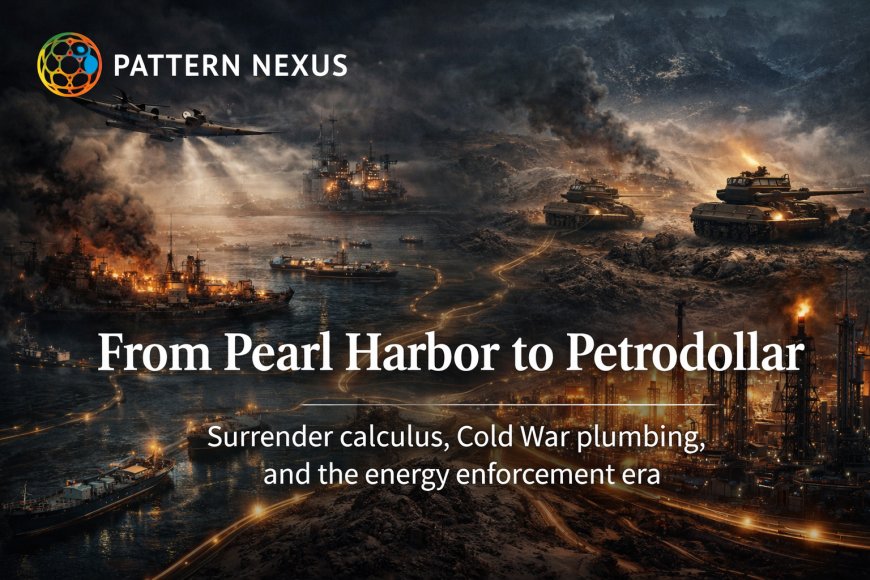
![[HERO_IMAGE_ALT: dark composite map linking Japan, Manchuria, and global oil lanes into a single 'valves and rails' visual]](https://patternnexus.com/uploads/images/202601/image_870x_6972d43188fbd.jpg)

Part 1 : WWII Was a Resource War Built on Credit: Oil, Steel, Sanctions, and the Narrative Layer
History is narrative. The record is plumbing. If you want causality, follow constraints, deadlines, and who controlled the valves.
When you cut an industrial state off from inputs, you don’t “send a message.” You start a clock. Clocks compress options into gambles.
Japan’s surrender wasn’t “subdued by bombs” in a vacuum. It was outcome selection: who occupies us, what survives, and what happens if the Soviets arrive.
Where Part One Left Off: Pearl Harbor as a Time-Buying Strike
Part One framed Pearl Harbor as a timing strike, not a morality play. Japan didn’t hit Pearl Harbor because it “hated freedom.” It hit Pearl Harbor because the resource clock was running and the industrial math was brutal. A fuel-starved empire either accepts humiliating retreat or seizes a new resource base fast enough to survive long-term pressure. Pearl Harbor was the attempt to delay U.S. response while Japan moved on the Southeast Asian resource zone and tried to lock in a defensive perimeter.
That framing matters because it sets how we read the end of the war. Wars don’t end simply when a side is “tired.” They end when the losing side’s option set collapses. The public narrative is built to feel moral. The record is built to show what decisions were possible and which outcomes were survivable.
That’s the mistake most readers make when they look back at Pearl Harbor from the safe side of victory: they interpret an attack as a confession of madness, not as a move inside a shrinking box. But the box matters more than the speeches. By the end of 1941, Japan had already committed itself to a continental war in China that it could not “unwind” without political collapse. It had an industrial machine that could not run without imported inputs. And it had a growing awareness that the United States could outproduce it over time by orders of magnitude. So Pearl Harbor was not a plan to defeat America; it was a plan to buy a window before America became fully awake.
Once you accept that premise, the rest of the Pacific War becomes easier to read. Every island campaign is not just a battle, it’s a step in a compression algorithm. The U.S. keeps building basing density. Japan keeps losing route control. The outer perimeter shrinks. Then the “war” stops being a contest over expansion and becomes a contest over endgame conditions: how long can Japan keep the U.S. out, and can it make the cost high enough to negotiate something better than unconditional surrender.
Part Two, then, is not about relitigating which side was “right.” It’s about the physics of how great wars end. Endings are not moral conclusions. They are forced decisions made under broken options, competing occupiers, collapsing logistics, and internal factional conflict. That is why this section matters: it sets the lens for everything that follows—Japan’s surrender, the Cold War’s constraint model, and the later evolution of “valves” from shipping lanes to financial rails.
The moment you stop reading WWII as “good vs evil” and start reading it as “valves, deadlines, and outcome selection,” the end of the Pacific War becomes legible in a way most people never see.
| Node / region | Primary value | Why it’s a lever (what constraint it controls) | Japan’s objective (clock logic) | U.S./Allied counter (how the valve closes) |
|---|---|---|---|---|
| Pearl Harbor / Hawaii | Fleet base, repair, logistics hub | Controls response time and forward sustainment; a Pacific “reset switch” for U.S. power projection | Cripple/slow the fleet to buy a window to seize the resource zone and harden a perimeter before the industrial gap becomes fatal | Rapid repair + carrier-centric adaptation; rebuild at U.S. industrial scale and push the base network forward island by island |
| Dutch East Indies (Borneo/Sumatra/Java) | Oil (fields/refining), tanker routes | Fuel is the gating variable for navy/air force tempo; without it, defense and training collapse | Seize production fast, then defend the lanes back to Japan long enough to “outlast” embargo pressure | Submarine interdiction + air/sea denial; convert the oil win into a transport-loss problem Japan cannot solve |
| Malaya / Singapore | Rubber, tin, port control, choke geography | Industrial inputs + logistics hub; controls access between the Indian Ocean and South China Sea routes | Secure the gateway into the resource basin and deny the Allies a staging complex in Southeast Asia | Rebuild basing depth elsewhere and later collapse the perimeter by taking key islands that control air/sea cover |
| Philippines | Route-control node; interdiction platform | Sits across the lanes between Japan and the Southeast Asian resource zone; whoever holds it can cut the artery | Neutralize U.S. forward bases and protect the oil-and-cargo pipeline north | Recapture + basing; use it as a knife edge to sever Japanese shipping and tighten the blockade |
| Formosa (Taiwan) / Ryukyu chain access | Forward air/sea cover node | Extends air cover over routes and approaches; a shield for the inner defensive belt and convoy movement | Maintain the “inner gate” so the perimeter doesn’t collapse into the home islands too early | Air superiority + progressive base capture; reduce Japan’s usable airspace and escort protection on lanes |
| Truk Lagoon (Caroline Islands) | Major fleet logistics/anchorage hub | Sustainment node for operations across the central Pacific; repairs, resupply, staging | Keep a forward sustainment heart to avoid retreating into the home islands too soon | Neutralize by air/naval strikes + bypass; turn it into a stranded asset and starve its usefulness |
| Solomons / Guadalcanal | Airfield control over approaches to Australia | Controls the lane geometry and air cover between the U.S. supply chain and the South Pacific; a pivot for perimeter integrity | Threaten Allied lines and prevent a stable forward platform that enables a systematic roll-up | Win the attrition fight, secure the airfield, and start the slow compression of the outer perimeter |
| Marianas (Saipan/Tinian/Guam) | B-29 basing node | Turns Japan into a reachable industrial target; forces air defense exhaustion and accelerates urban/industrial collapse | Hold perimeter to keep the home islands out of bomber range as long as possible | Capture and build; shift from perimeter contests to direct industrial strangulation |
| Iwo Jima | Fighter escort / emergency landing node | Extends escort range and sortie effectiveness; reduces bomber losses; tightens the air-power vise | Deny the U.S. a mid-point air node that increases bombing tempo and survivability | Seize to raise bombing throughput and reduce attrition; accelerate Japan’s industrial/urban breakdown |
| Okinawa | Invasion staging + airfields | Closes distance to Japan; enables sustained air pressure and makes the invasion clock credible in operational terms | Inflict maximal costs to influence U.S. political tolerance and force better terms | Capture staging node; tighten blockade/air dominance and compress decision time toward surrender |
| Home Islands (industrial core) | Industrial production + legitimacy core | Where the war must end; once inputs and protection fail, the state faces outcome selection (occupation, continuity, partition risk) | Delay collapse long enough to secure conditions that preserve kokutai and avoid regime liquidation | Air/sea strangulation + bombing; force decision under option collapse before a competing occupier outcome becomes likely |
Late Pacific War: Attrition, Blockade, and the Invasion Clock
The Pacific war after Pearl Harbor is not a single drama. It’s a long, grinding logistics collapse. The U.S. progressively takes or neutralizes island nodes that matter for basing, repair, fuel, and air cover. As those nodes fall, Japan’s perimeter becomes an overextended chain that can’t be supplied, repaired, or defended at scale.
By late 1944 and into 1945, the gap isn’t just territorial—it’s operational tempo and replacement capacity. Japan can still field forces, but it increasingly can’t sustain them. A modern military isn’t “people with weapons.” It’s fuel, maintenance cycles, training hours, spare parts, radar reliability, convoy protection, and the ability to recover from losses faster than the enemy can impose them. When those loops break, you get the most dangerous kind of endgame: a force that still exists and still fights, but has fewer rational options left, so it becomes more desperate, more brittle, and more inclined toward catastrophic gambles.
This is also where the reader should pause and separate two concepts that get conflated in American memory. Japan’s industrial and logistical position was collapsing, yes. But collapse does not automatically produce surrender. States often fight on when the perceived surrender outcome is worse than continued war. That’s why the “they were subdued” framing doesn’t fit the record. Japan’s leadership was trying to navigate a narrow corridor: end the war before invasion and starvation destroy state coherence, but end it in a way that preserves continuity—especially the imperial institution—and avoids a multi-occupier future.
| Period | Node / campaign | What changes operationally | Strategic effect | What it “closes” (lost option) |
|---|---|---|---|---|
| Dec 1941–Mid 1942 | Pearl Harbor → early expansion | Japan attempts rapid perimeter build while U.S. shifts to a long industrial war posture | The “time-buying strike” becomes a race against U.S. production, not a decisive knockout | Japan’s hope of a short war / negotiated settlement from a position of strength |
| Jun 1942 | Midway (inflection) | Carrier balance shifts; initiative and operational tempo begin migrating to the U.S. | Japan can no longer reliably choose where to concentrate decisive force | The “quick-win” pathway; ability to force the U.S. into an early war-termination bargain |
| Aug 1942–Feb 1943 | Guadalcanal (attrition gate) | Sustained attrition burns pilots, ships, and maintenance capacity; U.S. learns offensive logistics in theater | Japan’s perimeter becomes expensive to hold; the U.S. proves it can keep pushing | Perimeter stability and the assumption that island garrisons can be resupplied indefinitely |
| 1943–1944 | Central Pacific drive (Gilberts/Marshalls) + bypass logic | U.S. basing network thickens; Japan’s outposts get isolated and become “stranded assets” | The war becomes an engineered compression rather than a series of equal battles | Japan’s ability to force repeated set-piece defenses; loss of “depth” through island chains |
| Jun–Aug 1944 | Marianas (Saipan/Tinian/Guam) | B-29 basing becomes feasible; the home islands enter sustained bomber range | Japan shifts from “defend perimeter” to “absorb industrial siege” | Strategic depth; the idea that Japan proper can be insulated from continuous industrial attack |
| Late 1944 | Philippines / Leyte Gulf (artery exposure) | U.S. gains a position to cut the Japan↔resource-zone route; Japan’s fleet risks increase sharply | Oil victory turns into an oil-transport crisis; fuel starvation becomes structural | Reliable convoy movement from Southeast Asia; ability to sustain air/naval training cycles |
| Feb–Mar 1945 | Iwo Jima | Fighter escort / emergency landing capacity rises; bombing throughput becomes more sustainable | Air-power vise tightens; Japan’s air defense and repair capacity erodes faster | Any remaining buffer that limits continuous high-tempo strikes on Japan proper |
| Apr–Jun 1945 | Okinawa (staging + credibility) | U.S. obtains a major staging node; invasion planning becomes operationally credible | Decision time compresses: blockade + bombing + invasion clock converge | “Last buffer layer” before the home islands; space to delay outcome-selection decisions |
| Summer 1945 | Endgame stack converges | Blockade/inputs collapsing + bombing tempo + invasion threat + diplomatic maneuvering attempts | The war becomes a choice between postwar outcomes under option collapse | The “we can still negotiate from strength” posture (especially once Soviet entry closes mediation) |
One-line model:
Nodes fall → U.S. basing density rises → bombing/interdiction tempo rises
            + Japan route control falls → fuel/repair/training fall
= option set collapses (endgame becomes outcome selection)
By 1945, Japan is being hit through overlapping pressure vectors: strategic bombing, naval blockade, industrial starvation, loss of trained forces, and the looming invasion question. The invasion was not hypothetical; the U.S. had concrete invasion planning under Operation Downfall.
In practice, the pressure vectors didn’t arrive in sequence. They arrived as a stack. The bomber campaign imposed physical destruction and psychological compression. The blockade imposed slow-motion mechanical failure. The invasion planning imposed a credible end-state threat. And inside Tokyo, these external pressures collided with internal governance physics: military veto power, cabinet deadlock, and a legitimacy structure that made “surrender” politically explosive unless it could be framed as preservation rather than liquidation.
That’s why the invasion clock matters here, even before we talk about Hiroshima or Manchuria. When both sides are operating with clocks, the war is no longer just about battles; it becomes bargaining through time. Japan’s clock says: delay and impose costs to force better terms. America’s clock says: tighten the blockade, expand basing, accelerate bombing, and make invasion inevitable. But then a third clock enters—the Soviet clock—and it changes what “delay” actually buys.
| Lever (valve) | Mechanism | What breaks downstream | Visible symptom | Endgame result |
|---|---|---|---|---|
| Shipping losses (hull + convoy collapse) | Interdiction + mining + route denial reduces inbound cargo volume and reliability | Fuel shipments, food imports, metals, machine tools, spare parts, chemicals | Port throughput falls; factories idle; distribution delays compound | Industrial contraction + transport paralysis (the war machine becomes brittle) |
| Fuel access (the gating constraint) | Oil can exist “in the ground” or “in tanks,” but blockade determines whether it becomes usable operational fuel | Naval sorties, air patrols, convoy escort, pilot training hours, rapid redeployment | Fewer flights, fewer patrols, less interception, declining readiness cycles | Loss of operational tempo; air/navy become “mostly present, rarely usable” |
| Repair capacity (maintenance starvation) | Spare parts shortage + skilled labor strain + damaged facilities reduce repair throughput | Fleet readiness, aircraft readiness, radar/AA upkeep, engine overhaul cycles | Backlogs grow; cannibalization increases; “paper strength” diverges from real strength | “Hollow force” syndrome: units exist, but cannot perform at scale or repeatedly |
| Training pipeline (experience drain) | Fuel + aircraft availability constraints reduce flight hours and live training; combat losses remove veterans | Pilot proficiency, damage-control competence, replacement quality | Higher loss rates; tactical mistakes compound; morale degrades | Defense becomes one-shot and desperate; capacity for sustained resistance collapses |
| Food availability (civil stability lever) | Imports fall; distribution breaks; rationing tightens; transport constraints worsen shortages | Workforce health, factory output, civil order, state legitimacy | Malnutrition, unrest risk, black markets, weakened labor productivity | Internal stability strain; regime decision pressure rises (time becomes hostile) |
| Industrial inputs (metals/chemicals/machines) | Loss of critical imports and machine tools constrains replacement production | Aircraft/ship output, munitions, infrastructure repair, refinery throughput | Output declines even if factories exist; bottlenecks dominate | No “rebuild loop”: losses become permanent; time-to-recovery exceeds time-to-defeat |
Conceptual cascade (not to scale)
Input flow:     ████████████▇▆▅▄▃▂▁
Fuel usable:    ███████████▇▆▅▄▃▂▁
Maintenance:    ██████████▇▆▅▄▃▂▁
Training hrs:   █████████▇▆▅▄▃▂▁
Air defense:    ████████▇▆▅▄▃▂▁
Civil stability ███████▇▆▅▄▃▂▁

Translation:
When the input valve closes, the state can still “exist,” but it can’t operate like a modern war machine.
That’s why blockade belongs in the same analytical bucket as later-era sanctions: both are denial tools applied to a system that runs on inputs and routing.
WWII blockade logic is the ancestor of modern “rail denial.” Then it was shipping lanes and fuel. Now it’s correspondent banking, insurance, compliance, and settlement access. Different infrastructure, same physics: cut the inputs, start the clock, collapse the option set.
| Plan | Timeline target | Operational objective | Bargaining logic | Primary risk |
|---|---|---|---|---|
| Operation Olympic (U.S.) | Nov 1945 (planned) | Invade Kyūshū; seize airfields + ports; establish staging base | Credible threat of occupation-by-force: “we can land, we can stay, we can scale” | High casualties + prolonged occupation campaign; time favors defenders |
| Operation Coronet (U.S.) | Spring 1946 (planned) | Invade Honshū (Tokyo plain); seize the political/industrial core | Decapitation pressure: “the regime can’t survive the core being taken” | Escalation + humanitarian catastrophe; destruction of state capacity |
| Ketsugō (Japan) | 1945 endgame posture (defense clock) | Mass defense of likely invasion points; concentrated attrition at the beachhead | Casualty leverage: “make the price so high the U.S. negotiates terms” | If mediation fails and USSR enters, time flips against Japan (partition/occupier risk) |
Japan’s best remaining lever was time: delay + casualties → force better terms. The U.S. counter-lever was time: blockade + bombing + invasion prep → collapse Japan’s capacity. When the USSR enters, the clock flips. Delay no longer buys bargaining power. Delay increases the probability of a fragmented, multi-occupier outcome.
| Outcome axis | Japan wants | U.S. wants | Clock lever |
|---|---|---|---|
| Regime continuity (kokutai survival pathway) | Preserve the imperial institution; avoid “total liquidation” framing | Unconditional surrender terms in principle; controllable transition in practice | Japan: delay for better terms • U.S.: threaten invasion to remove bargaining room |
| Occupier map (single vs multi-occupier) | Prefer U.S.-led, unified occupation over USSR-influenced fragmentation risk | Primary occupier control; prevent rival sphere expansion | USSR entry collapses mediation and converts delay into partition risk |
| Destruction vs transition | Stop industrial/civil collapse before the state becomes ungovernable | End the war decisively with minimal future insurgency risk | Bombing/blockade compress time; invasion makes “end” credible |
Clock summary (systems view)
U.S. clock (Downfall): blockade + air power + invasion readiness → remove Japan’s bargaining space
Japan clock (Ketsugō): concentrate defense + impose casualties → create bargaining space
Geopolitical clock (USSR): closes mediation + changes occupier map → turns delay into outcome risk
Bomb Narrative vs Decision Reality: The Multi-Pressure Record
The mainstream American story is clean: Japan refused to surrender, the U.S. dropped atomic bombs, Japan surrendered to avoid invasion, therefore the bombs saved lives. That story does two jobs at once: it explains the end of the war, and it morally justifies the use of nuclear weapons.
But systems don’t end in single-cause arcs. They end when the option set collapses. Japan’s leadership wasn’t choosing between “peace” and “war” in August 1945. It was choosing between postwar outcomes, under intense multi-vector pressure.
The narrative is engineered for legitimacy. The record is engineered for causality. Single-cause explanations are social glue — not systems analysis.
The decisive distinction is between shock and option collapse. Shock changes emotions. Option collapse changes outcomes. Endgame decisions are made on outcomes.
Here’s the key: the bomb narrative is clean because it allows the U.S. to explain the end of the war as a single moral decision—one lever pulled to save lives. But Japan’s leadership did not live inside a clean story. They lived inside a collapsing state machine. If you are inside that machine, you are not asking, “What would make a compelling narrative for future textbooks?” You are asking, “If we wait two more weeks, what changes on the ground? What changes in the occupation map? What changes in whether we remain a unified country or become a partitioned ruin?”
That’s why a multi-pressure model is not “revisionism.” It’s simply realistic decision analysis. The bombs added shock, urgency, and a new category of repeatable annihilation. The blockade and bombing campaign had already been degrading the machine for months. The invasion clock created a credible terminal event. And the Soviet factor didn’t just add pressure—it changed the set of possible endings. That last piece is the part most people never learn, because it complicates the moral closure of the bomb story.
So the proper question isn’t “Were the bombs decisive or not?” The proper question is “What combination of pressures collapsed the option set, and what did Japan’s leadership believe was the least catastrophic postwar outcome?” Once you reframe it that way, the argument becomes less emotional and more mechanical. You can see why different factions in Tokyo could rationally disagree. You can see why delay was simultaneously a weapon and a trap. And you can see why the week of August 6–15 is better read as a system breaking in real time than as a single-cause epiphany.
Japan’s Surrender Problem: Kokutai, Terms, and the Mediator Strategy
Japan’s surrender problem wasn’t “we can’t fight.” Japan’s surrender problem was “what survives.” The regime wanted to preserve national continuity — especially the imperial institution — and avoid an outcome that looked like total annihilation of the state.
This is why leadership factions can continue a war even when industry collapses: if surrender equals regime liquidation, the state will keep rolling the dice. The mediator strategy is the attempted exit ramp: if a third party can broker terms, the regime can surrender without disintegrating.
The reason the kokutai question matters so much is that it’s not a philosophical footnote; it’s the regime’s survival equation. If leadership believes surrender equals total liquidation—abolition of the imperial institution, humiliation without continuity, potential trials and executions, potentially a fractured homeland—then even a strategically lost war can be “rational” to prolong. It becomes a terrible bargaining attempt: impose enough pain to force the enemy to accept a settlement that preserves the core of the state. That is why the internal debate doesn’t resolve simply because cities are burning. Burning cities are not the only variable. What survives afterward is the variable.
This is also why the mediator strategy is so central. When a losing state wants terms but the victor wants unconditional surrender, the losing state looks for a third party that can create an off-ramp. Japan’s logic was not that the USSR was benevolent. It was that the USSR might be useful: a broker who could translate Japan’s need for continuity into a settlement the U.S. would accept without appearing to “reward aggression.” In other words, the USSR was the last valve Japan thought it could pull to avoid a binary endgame.
And that is the part that becomes devastating once Soviet entry occurs. Once Moscow is not a mediator but a belligerent, Japan loses not just territory or troops—it loses the negotiation architecture it was hoping to use. The endgame becomes more brutal because it becomes simpler: not “how do we negotiate terms,” but “who occupies us if we don’t end this immediately.”
START STATE (mid–late 1945):
- Material situation: war is strategically lost (blockade + bombing + fuel/starvation constraints)
- Political requirement: preserve kokutai (continuity/legitimacy constraint)
- External threat: invasion clock (Downfall) + emerging Soviet factor
- Decision problem: choose the least catastrophic postwar outcome

DECISION TREE (outcomes, not emotions):

Path A — FIGHT ON (Ketsugō / “cost imposition” strategy)
  Goal:
    - Impose catastrophic U.S. casualties to force negotiated terms (especially kokutai protections)
  Tools:
    - Concentrated homeland defense, kamikaze/attrition tactics, delay
  Intended bargaining outcome:
    - “Conditional surrender” with safeguards (avoid perceived regime liquidation)
  Failure modes:
    - Invasion succeeds anyway (occupation-by-force with reduced bargaining room)
    - Internal collapse before external resolution (civil strain, breakdown of governance)
    - USSR enters → partition / rival-occupier dynamics become credible
  Net assessment (systems lens):
    - Time is leveraged as a weapon — until Soviet entry converts time into outcome risk

Path B — MEDIATED SETTLEMENT (USSR as broker / “valve strategy”)
  Goal:
    - Use Moscow to broker terms that preserve kokutai and soften occupation severity
  Why it exists:
    - Direct acceptance of Allied terms is politically costly without continuity assurances
  Dependencies:
    - USSR remains outside the war and willing to mediate
  Failure modes:
    - USSR refuses mediation or delays strategically
    - USSR flips (declares war) → mediation valve closes instantly
  Net assessment:
    - Path B is the preferred “face-saving exit ramp” — but it is structurally fragile

Path C — DIRECT ACCEPTANCE OF ALLIED TERMS (Potsdam acceptance / rapid termination)
  Goal:
    - Stop destruction fast; prevent total state breakdown; preserve what can be preserved through orderly transition
  Bargaining focus:
    - Preserve kokutai in practice (even if language is ambiguous)
  Political risk:
    - Military hardliners interpret surrender as regime liquidation → coup/fragmentation risk
  Net assessment:
    - Requires a legitimacy override mechanism to prevent internal fracture (Emperor intervention)

TRIGGER EVENTS THAT REWRITE THE TREE (Aug 6–9, 1945):
- Hiroshima (Aug 6): shock + repeatability signal → compresses decision time
- USSR declares war (Aug 8) and attacks Manchuria (Aug 9): closes Path B (mediation) + rewrites occupation map
- Nagasaki (Aug 9): additional shock under shrinking time window

ENDGAME REALITY (after Soviet entry):
- Path B collapses (valve closed)
- Path A becomes more dangerous (delay increases partition/occupier risk)
- Path C becomes the least catastrophic “continuity” path if internal deadlock can be broken

OUTCOME SELECTION (simplified):
- Surrender to U.S.-led occupation → higher probability of unified Japan + continuity pathway
- Delay under Soviet entry → rising probability of fragmented/dual-occupier outcome + regime liquidation risk
This is the prototype pattern for everything that follows in the piece: under constraint, states don’t choose “good stories.” They choose survivable outcomes. In 1945 the variable is occupation and regime continuity. After 1971 the variable becomes settlement access and reserve-system survival.
| Path | Constraint focus | Objective | Primary risk | What changes after USSR entry |
|---|---|---|---|---|
| A: Fight-on | Continuity via leverage (casualties) | Force negotiated terms | Invasion + internal collapse | Delay now increases partition risk |
| B: Mediate via USSR | Continuity via third-party terms | Softer occupation outcome | USSR refusal or strategic delay | Valve closes immediately (path collapses) |
| C: Accept terms | Continuity via orderly transition | Stop destruction; preserve unity | Internal hardliner rupture | Becomes “least catastrophic” if deadlock breaks |
The Soviet Shock: Manchuria and the Collapse of Options
On August 8, 1945, the Soviet Union declared war on Japan. In the early hours of August 9, Soviet forces launched a massive offensive into Manchuria. This wasn’t a symbolic move. It was an operational shock that broke Japan’s position on the Asian mainland and destroyed Japan’s last diplomatic exit strategy.
The key point isn’t just losses. The key point is option collapse. Once the USSR entered the war, Japan could no longer use Moscow as mediator. The last valve closed, and the outcome map changed: Soviet occupation dynamics became a near-term risk rather than an abstract fear.
Manchuria matters because it collapses strategic illusion at speed. Japan’s mainland position was not just a holding; it was a buffer and a bargaining chip. The Kwantung Army’s reputation had long outpaced its late-war reality, but reputations still shape leadership expectations. The Soviet offensive exposed, in days, what Japan’s leadership could not afford to admit: the empire’s external structure was now mechanically indefensible against a fresh, massed, multi-front advance. That wasn’t merely “losing.” It was a forecast of what a Soviet occupation dynamic could look like if the war continued and the USSR gained more leverage.
And there is a second-order effect that echoes into the Cold War: the Soviet offensive in Northeast Asia helped determine the postwar partition geometry. Once Soviet forces are moving across Manchuria and into the region, you don’t just get a military event—you get a future political boundary. That is how wars shape the next war. Borders become the artifacts of movement, and movement becomes the artifact of timing. In other words, Japan’s surrender timing was not only about stopping destruction; it was about limiting how much of the postwar map the USSR could touch.
This is why your “outcome selection” framing is not a rhetorical flourish. It’s the actual decision logic. Surrender to the U.S. implied a unified occupation framework with a path—however painful—toward continuity. Surrender with the USSR advancing implied a nontrivial risk of a divided Japan, competing occupation zones, and a different ideological future. You don’t need to romanticize America to see why Japanese leadership would treat that as the least-bad option under the new map.
| Vector / axis | Operational aim | Immediate result | System effect (why it changes surrender calculus) |
|---|---|---|---|
| Northern / western thrust (deep penetration / defense depth break) |
Shatter Manchurian defense depth; collapse Kwantung Army’s coherence | Rapid overruns and dislocation of key formations; command/control disruption | Ends the “mainland buffer” illusion. Japan’s strategy of buying time to improve terms loses its last external pillar. Manchuria becomes proof that the USSR isn’t a mediator — it’s an advancing occupier. |
| Korea / coastal approach (access + corridor control) |
Cut exits, seize coastal access, widen Soviet reach into Northeast Asia | Occupation dynamics expand beyond Manchuria into a wider “postwar shaping” zone | Makes partition risk concrete. If the USSR is physically positioned to shape adjacent zones, Japan can plausibly become “Germany/Korea-like” in outcome: split control, competing authorities, long-tail division. |
| Sakhalin / northern approaches (approach pressure toward Japan proper) |
Seize northern positions; establish forward pressure toward Japan’s home approaches | Northern threat becomes immediate; Japan’s “who occupies us?” problem becomes urgent | Converts surrender timing into occupier selection. The longer Japan waits, the more plausible it becomes that Soviet forces gain leverage in the postwar settlement — and with it, the probability of multi-occupier outcomes. |
| Simultaneity (the hidden weapon) (multi-vector shock) |
Strike across multiple axes so Japan cannot reallocate reserves fast enough | Collapse cascades faster than Tokyo can stabilize or negotiate | This is why it’s “option collapse” rather than “incremental loss.” The system’s internal debate gets forced by the pace of events. The mediator strategy dies and the war-ending choice becomes binary. |
        [USSR]
          |
          |  multi-front shock (simultaneous vectors)
          v
   (Manchuria / Kwantung collapse)
        /      |        \
       /       |         \
  Korea/coast  |     Sakhalin/Kurils
 (access zone) |     (northern approach)
       \       |         /
        \      |        /
         v     v       v
   Occupation map rewrites → mediation valve closes → partition risk rises → surrender timing becomes “choose occupier”
Hiroshima is shock. Manchuria is map change. Shock compresses time; map change collapses options. The key output is not simply “Japan is losing” — it is “Japan can no longer delay without risking a fundamentally worse postwar outcome.
| Date | Event | What it communicates | Decision implication (systems lens) |
|---|---|---|---|
| Aug 6 | Hiroshima (atomic) | Instant annihilation + repeatability; no meaningful defense | Shock compression. The cost of delay rises sharply. But shock alone does not finalize the occupier-outcome map. It accelerates debate; it does not resolve the mediation strategy. |
| Aug 8 | USSR declares war | Mediator is now belligerent; spheres-of-influence logic activated | Mediation valve closes. Path B (USSR as broker) collapses. Occupation outcomes shift from “bad” to “potentially partitioned.” Delay now carries a different risk profile: not just destruction, but state-structure outcomes. |
| Aug 9 | Manchuria offensive begins Nagasaki (atomic) |
Operational proof of Soviet intent + second atomic signal | Option collapse becomes visible. Manchuria is the map-change event: the “choose the occupier” logic hardens. Nagasaki reinforces shock/time compression, but Manchuria destroys the benefit of delay. |
| Aug 10 | Tokyo begins formal move toward conditional acceptance (Potsdam pathway) | A “terms” attempt centered on continuity (kokutai) | Outcome selection in motion. The state attempts to end the war while preserving the continuity constraint. This is the first visible pivot from war-making to postwar-shaping. |
| Aug 11–13 | Internal deadlock persists; Allied position clarifies (terms framing) | War-ending “yes” still contested inside the regime | Legitimacy bottleneck. Even when the strategic logic points to surrender, factions can block it. This is where many states fail and fracture. Japan avoids that via a legitimacy override. |
| Aug 14 | Emperor decision / intervention (tie-break) | The system chooses the least catastrophic outcome | Legitimacy override resolves deadlock. This is the “state stays coherent” mechanism: surrender becomes executable rather than theoretical. |
| Aug 15 | Termination broadcast (public execution of surrender) | Central authority asserts compliance pathway | Compliance propagation. A surrender must be distributed through military and civilian hierarchies. The broadcast is the control signal that reduces splinter risk and stabilizes the transition. |
(control-systems framing)

Hiroshima = shock/time compression
USSR entry + Manchuria = option collapse / occupier-outcome rewrite
Emperor intervention = legitimacy override that makes surrender executable
The bombs increase the cost of delay. The Soviet shock destroys the benefit of delay. The Emperor resolves the internal execution problem. That sequence explains timing and outcome better than any single-cause story.
The key distinction is between shock and option collapse. Hiroshima is shock. Manchuria is option collapse. Shock changes emotions. Option collapse changes outcomes. Endgame decisions are made on outcomes.
From Tokyo’s perspective, that week is the sound of doors shutting. Hiroshima signals a new category of repeatable destruction and compresses time. Soviet entry shuts the mediation door and turns delay into geopolitical risk. Nagasaki reinforces that the shock isn’t a one-off. Meanwhile, the invasion clock continues to tick, the blockade continues to starve the machine, and the internal cabinet structure continues to jam. This is what system collapse looks like: multiple independent constraints begin reinforcing each other until the state can no longer sustain “strategic ambiguity.” It must choose.
That is also why the public argument about “what ended the war” never resolves. People argue as if there was one cause because that is how we prefer to narrate endings. But internally, the decision is rarely one cause. It is a convergence. And the reason we are being precise here is because this same convergence pattern repeats later: sanctions plus alternative rails plus corridor pressure plus internal instability—different era, same physics.
Hiroshima and Nagasaki Inside the Decision Matrix
Hiroshima and Nagasaki were unprecedented catastrophes and introduced the reality of repeatable annihilation. They mattered. They altered urgency, internal debate, and the sense of time. But treating them as the sole cause of surrender ignores the context: Japan had already experienced mass city destruction from conventional bombing. The strategic novelty is not merely “a city can be destroyed,” but “a city can be destroyed instantly, repeatedly, with no defensive counter.”
The bombs also exist inside a geopolitical frame. They are not just military events; they are messages embedded in the transition to the postwar order. This is why the single-cause story is inadequate: it strips out the fact that Japan’s decision wasn’t made in a vacuum — it was made while the postwar system was being shaped in real time.
There’s another subtle point most narratives skip: by August 1945, Japan’s leadership was not deciding in a calm environment where information flows freely and institutions behave like a modern boardroom. They were deciding inside a damaged communications environment, under fear of coup dynamics, under propaganda expectations, and under collapsing civil stability. In that environment, “shock” is not just emotional; it alters the internal probability that the state fractures before it can implement surrender. That is why the time dimension becomes central. If surrender is delayed too long, you risk internal rupture. If surrender happens too soon without legitimacy cover, you risk the same rupture. The decision is not simply strategic; it is structural.
So the bombs are best understood as accelerating the urgency and making the cost of delay explicit, while Soviet entry eliminates the strategic benefit of delay. That combination is powerful because it attacks the state from two directions at once: it raises the pain of waiting and removes the leverage of waiting. In game terms, it narrows the “play space.” In control-systems terms, it pushes the system out of a stable operating region and forces a state transition.
And that is what matters for the rest of this article. The Cold War doesn’t begin as ideology floating in air. It begins as a postwar map shaped by timing, occupation zones, and competing superpower reach. The bombs are one part of that. Manchuria is another part of that. The occupation outcome is the part most people never integrate into their mental model.
The bomb-only story provides moral closure and national cohesion. Systems analysis doesn’t get closure — it gets causality.
Deadlock to Surrender: Emperor Override and Regime Continuity
Surrender happens through legitimacy mechanics. In Japan’s political structure, the leadership deadlocked. Factions existed that preferred continued resistance, even under catastrophic conditions. What breaks deadlock is the Emperor’s intervention — a legitimacy override that allows the state to pivot without collapsing into internal fragmentation.
| Bloc (Big Six archetype) | Preference | Core demand / constraint | Strategic logic (why it’s “rational”) | What breaks it |
|---|---|---|---|---|
| Fight-on faction (hardline) | Continue war | Preserve autonomy by forcing costs; avoid “regime liquidation” | If surrender equals annihilation of the state form, then continued resistance is a bargaining instrument. This faction is optimizing terms, not battlefield victory. | Option collapse (USSR entry + Manchuria) + loss of credible delay benefits + legitimacy override that prevents a military veto. |
| Conditional peace faction (terms-first) | Surrender with protections | Preserve kokutai; limit occupation severity; avoid partition dynamics | The “win” is continuity: end the war while retaining a survivable postwar structure. Prior to Aug 8–9, mediation via USSR is an attempted exit ramp. | Mediation valve closes (USSR becomes belligerent) + clarified Allied endgame posture + emperor as tie-break that makes the choice executable. |
| Immediate peace faction (stop-loss) | End war now | Terminate destruction; accept material reality; reduce civilian/system damage | When the production system is collapsing (fuel, shipping, repair, food) the rational move is to stop compounding losses. This faction optimizes damage minimization. | Authority to override holdouts—otherwise “peace” remains a preference, not a decision. |
Deadlock state: 2–2–2 split → no majority → paralysis

Inputs that destabilize deadlock:
- Shock compression (atomic) increases urgency and raises delay costs
- Option collapse (USSR entry + Manchuria) rewrites the occupier-outcome map and destroys the mediation strategy
- Legitimacy override (Emperor) converts “preferred outcome” into an executable command that propagates through the hierarchy

Output:
Surrender selected as the least catastrophic continuity path under the new outcome map.
States don’t “decide” as single minds. They decide through authority graphs. In August 1945, the authority graph was jammed. The Emperor functions as a top-layer control signal that prevents internal fragmentation and forces a coherent transition.
The simplified narrative says “Japan was subdued.” The record reads like a contested internal system that required a legitimacy override to avoid splinter dynamics. In this framework, Japan moves not because it is merely psychologically broken, but because the option set collapses, the Soviet factor changes occupation outcomes, and surrender to the U.S. becomes the least-catastrophic continuity path.
The simplified narrative says “Japan was subdued.” The record says “Japan was contested internally, and surrender required a legitimacy override to prevent internal unraveling.” In this framework, Japan surrendered not because it was simply psychologically broken, but because the option set collapsed, the Soviet factor changed occupation outcomes, and surrender to the U.S. became the least catastrophic path for continuity.
In practical terms, the execution problem is everything. A surrender that cannot be executed is not a surrender; it’s a trigger for fragmentation. That is why legitimacy mechanics matter more than moral speeches at the end of wars. The broadcast is not just symbolism—it is a distribution protocol. It tells the armed forces and the public which authority graph is still valid and what the state’s next instruction is. Without that propagation, you get splinter units, local commanders defecting to their own logic, or internal actors attempting to salvage “honor” by prolonging conflict.
This is also why endgames often look “irrational” to outsiders. Outsiders assume the state is a unified actor. In reality, the state is a network of factions and institutions. When those institutions disagree, the question becomes: who has the authority to force convergence? Japan had a top-layer legitimacy node that could impose convergence. Many states do not. That difference determines whether wars end cleanly or bleed into chaos, coups, and civil breakdown.
WWII Transforms into the Cold War: Bipolarity and Proxy Logic
WWII doesn’t end into peace. It ends into a new board configuration. Britain and France are exhausted, Germany and Japan are defeated and occupied, and two superpowers emerge with independent industrial capacity, military reach, and ideological ambition: the United States and the Soviet Union.
Nuclear weapons convert direct war into unacceptable risk. But they don’t eliminate conflict. They displace it. This is the structural reality of the Cold War: great-power competition continues, but it routes itself through proxies, influence contests, and economic pressure.
The Cold War begins, structurally, because the victors inherit the system and immediately disagree about what the system should be. The U.S. emerges with industrial dominance, financial depth, and naval reach. The USSR emerges with massive land power, ideological ambition, and a security fear that its borders will be encircled. Both interpret the postwar world through their own survival logic. And both understand that nuclear weapons change the cost function of conflict. When direct war becomes suicidal, you don’t stop competing—you compete through architecture: alliances, basing rights, aid, coups, propaganda, and proxy wars.
That matters because it explains why the postwar period never truly “settled.” It stabilized into a tense equilibrium. Japan becomes a key node inside that equilibrium: an occupied and reconstructed industrial platform in the Pacific, positioned as a pillar against Soviet and later Chinese expansion. Western Europe becomes another pillar, rebuilt and bound through economic integration and military alliance. This is not just history; it is the origin of the modern permission layer. When the U.S. becomes security provider and settlement core at the same time, it gains a dual advantage: it can protect routes and it can control access to the clearing system.
And once you see that dual advantage, the later transitions stop being mysterious. When the monetary system changes, the security system doesn’t disappear. It reorients. When the enforcement tool changes, the strategic logic persists. That’s why you can draw a line from “who occupies Japan” to “who controls energy settlement” without jumping across unrelated eras. The toolkits differ, but the underlying imperative—control the operating system—stays constant.
Bretton Woods as Operating System: Dollar-Gold and Institutions
The postwar order isn’t just military bases and alliances. It’s monetary protocol. Bretton Woods creates a fixed-but-adjustable exchange rate system pegged to the U.S. dollar, with the dollar pegged to gold at $35/oz, and it establishes the IMF and World Bank as institutional pillars.
This is where the U.S. becomes the core of global settlement. Britain’s empire fades not primarily because it loses a battle, but because it loses the operating system role. The U.S. becomes the creditor, the industrial supplier, the security provider, and the settlement core.
Bretton Woods is often taught as a technical conference. In your lens, it should be taught as a victory artifact. The U.S. didn’t just win militarily; it gained the privilege of designing the postwar settlement architecture because it was the only major power whose industrial base was intact, whose financial system could scale, and whose security reach could underwrite global trade routes. That design choice locked in a pattern: countries could rebuild and grow faster by integrating into the U.S.-anchored system than by resisting it. Integration becomes the default because it is economically rational, not because everyone suddenly shares ideology.
But there’s a built-in tension that matters later: the more the world uses the dollar system, the more it needs dollars. The more it needs dollars, the more the U.S. must supply dollars through deficits and banking expansion. Over time, that creates a credibility problem for a gold-anchored promise. Bretton Woods is stable until the system outgrows the anchor. When it does, you don’t “choose” to end it because you want chaos. You end it because the alternative is worse: contraction on a global scale. That sets up the 1971 pivot as a structural necessity, not a political whim.
In Pattern Nexus terms: empires are operating systems. Sometimes they die in battle. Sometimes they get replaced in accounting.
| Component | Mechanism | Why it’s power (valve) | Stress / failure mode | Observable symptoms |
|---|---|---|---|---|
| USD ↔ Gold ($35/oz) | Dollar convertible to gold for official holders; other currencies peg to USD within bands. | Makes USD a global reserve asset by design: hold dollars to hold a gold claim + settle trade. | External USD claims grow faster than the U.S. gold stock → convertibility becomes mathematically fragile. | Gold outflows pressure; repeated “confidence” episodes; rising incentive to convert USD → gold. |
| Fixed-but-adjustable FX | Pegs with bands; occasional devaluations/revaluations; central banks intervene to defend parity. | Stabilizes trade and reconstruction; reduces FX risk; keeps the “system graph” coherent. | Persistent trade/price imbalances make pegs brittle; defending parity drains reserves or forces controls. | Currency crises; speculative attacks; emergency rate changes; tightening/loosening cycles to defend pegs. |
| IMF | Balance-of-payments support + conditionality; provides liquidity against policy reforms. | Enforces “rules of the road” under stress; crisis lending becomes governance by constraint. | Conditionality legitimacy backlash; domestic politics reject external constraints; compliance becomes unstable. | Political blowback; reform reversals; recurring crisis cycles; “IMF stigma” formation. |
| World Bank | Reconstruction/development lending; capital allocation into infrastructure and productivity. | Capital allocation sets development path; credit terms become soft control of policy priorities. | Debt cycles; dependency narratives; governance disputes over what “development” should be. | Debt distress; renegotiations; donor fatigue; legitimacy disputes over outcomes. |
| Capital controls (common early) | Restrict “hot money” to preserve peg stability; manage cross-border flows to maintain policy autonomy. | Keeps the OS stable: limits destabilizing flow-driven shocks that would otherwise break pegs. | Controls erode over time; capital mobility rises; peg defense becomes harder; arbitrage pressure increases. | Offshore routing grows; enforcement leakage; recurring balance-of-payments strain. |
| U.S. industrial + security surplus | U.S. supplies goods, capital, and security guarantees; protects sea lanes; anchors allied confidence. | This is the non-monetary enforcement layer: route protection + credible backstop makes USD settlement convenient and safe. | Overextension + deficits + war costs + domestic constraints; the “issuer” must export dollars to supply the system. | Rising deficits; inflation pressure; allied doubts; convertibility stress accelerates into the 1960s/early 1970s. |
Bretton Woods in one chain:
Gold anchors USD → USD anchors FX pegs → IMF/World Bank enforce stability → U.S. provides security + liquidity

Where it breaks (systems view):
Global growth + trade expansion need more USD liquidity
→ the U.S. exports dollars (deficits + banking expansion)
→ external USD claims grow faster than the gold backing
→ convertibility becomes a fragile promise
→ the system faces a binary: shrink global liquidity (depression risk) or break the gold promise (1971)
This is the bridge from WWII to the petrodollar era. Bretton Woods is the first postwar “operating system.” Once the gold promise becomes unsustainable, the system still needs an anchor and an enforcement logic. That pivot is where energy and rails enter the story.
Bretton Woods in one line:
Gold anchors USD → USD anchors FX pegs → IMF/World Bank enforce rules → U.S. supplies security + capital
Break point:
External claims on USD exceed gold anchor → convertibility fails → system must find a new anchor
Containment Machine: NSC-68, Nuclear Constraint, Proxy Wars
The Cold War is not a vibe. It’s a constraint system. Once two superpowers hold nuclear weapons, direct war becomes existentially risky. That does not create peace; it displaces conflict into proxy theaters, influence contests, covert operations, and economic pressure. The United States formalizes its posture through the Truman Doctrine and hardens it through the systemic framing of NSC-68. The USSR responds with its own bloc logic, and the world becomes a map of proxy nodes.
The key Pattern Nexus point is simple: when the cost of direct war is infinite, great powers fight indirectly. That is the physics of the Cold War.
Containment is important to this article because it becomes a template for how the U.S. thinks about system threats. It trains policymakers to treat credibility as a resource and to treat peripheral theaters as tests of whether the core power will enforce its commitments. Once credibility becomes a resource, proxy wars become a spending mechanism. You spend credibility to deter expansions, but the spending itself can create blowback, domestic strain, and legitimacy erosion. That is why Cold War history cannot be separated from later monetary history: long commitments and global posture have budgetary and inflationary consequences over time.
And the nuclear constraint doesn’t just generate proxy wars. It generates an obsession with “controlled escalation.” Everything becomes an escalation ladder. That mindset carries forward into energy and sanctions. The modern enforcement toolkit is often designed to punish without triggering a shooting war: deny access, constrain routing, create internal economic pain, force negotiation. That is containment logic reborn in financial form. It is the same strategic instinct applied to new infrastructure.
| Theater node | Why it mattered (the lever) | Containment function (what it “does”) | Constraint (what limits action) | End-state logic (what “success” looks like) |
|---|---|---|---|---|
| Korea | First major Asian frontier of bloc competition; tests credibility of the U.S. security guarantee model. | Hold the line; prevent a fast domino; normalize “limited war” doctrine under nuclear shadow. | Nuclear threshold management; risk of superpower escalation; Chinese/Soviet involvement constraints. | Not “total victory,” but a stable boundary that preserves alliance confidence and denies a precedent of easy expansion. |
| Berlin / Central Europe | Industrial core + symbolic legitimacy node; Europe is the prize terrain of postwar order. | Keep Western Europe inside the U.S.-led security + monetary system; demonstrate resolve at the “front door.” | Alliance cohesion; domestic tolerance for prolonged standoffs; escalation risk in the most nuclear-sensitive theater. | A defended perimeter with institutional lock-in (NATO + economic integration + settlement dependence). |
| Vietnam / Indochina | Credibility theater + “domino” narrative; a test of whether ideology can be blocked via military power. | Signal commitment; deny perceived expansion; maintain alliance confidence in Asia. | Local legitimacy gap; domestic U.S. tolerance limits; escalation ceiling vs China/USSR. | “Success” becomes preventing wider collapse of alliance posture, even if local political outcome is unfavorable. |
| Afghanistan (late Cold War) | Eurasian placement; a pressure point to impose costs and drain rival bandwidth without direct war. | Indirect attrition: raise the cost of occupation and reduce Soviet strategic flexibility elsewhere. | Blowback risk; long-tail instability; proxy control problems; moral hazard of arming non-state actors. | A degraded rival position (time + money + legitimacy drain), even if the theater remains unstable afterward. |
| Middle East chokepoints | Energy valve + sea-lane chokepoints + regime lattice; this theater becomes increasingly “system-critical.” | Secure flow stability; deny rival access/placement; protect route governance and producer alignment. | Oil shock volatility; regime fragility; proxy spillover; escalation risk around chokepoints. | Stable flow + predictable pricing regime + maintained basing rights—because energy becomes a monetary event after 1971. |
| Latin America / Caribbean | Near-field control zone; ideology + insurgency contest close to U.S. territory; signals matter disproportionally. | Deny rival footholds; maintain regional alignment; prevent precedent of successful hostile placement. | Legitimacy costs of intervention; covert vs overt tradeoffs; domestic blowback; long-term governance fragility. | “Success” = no durable rival basing/alignment nodes; the region stays inside the U.S. security-permission envelope. |
| Africa (decolonization belt) | Resource nodes + UN votes + corridor positioning; post-colonial states become swing nodes. | Compete via aid, advisors, coups, and proxy alignments; deny rival access to critical commodities and ports. | Governance fragility; faction complexity; limits of external control; risk of reputational costs. | “Success” is often partial: resource access + alignment bias + corridor permissions, not a clean ideological conversion. |
How to read the table (PN translation rule):
If the cost of direct war is infinite, then “credibility” becomes a resource.
Proxy theaters become the places where credibility is spent, defended, or replenished.
That machine persists until the enforcement toolset shifts from bombs and bases to banking rails and access denial.
Vietnam: Containment Meets Legitimacy and Cost Structure
Vietnam is not an isolated tragedy that happened because one administration “made a mistake.” It is a system output. Once containment becomes doctrine, the U.S. inherits conflicts it cannot fully control, because credibility pressure and alliance signaling become strategic drivers. Vietnam exposes the limit case: conventional dominance does not substitute for political legitimacy in the local domain.
The deeper lesson is cost structure. Even superpowers have domestic tolerance limits. When the bill exceeds perceived strategic value, the system chooses withdrawal — not because every battle was lost, but because legitimacy and political budget collapse.
Vietnam also matters because it reveals the limit of force when the political substrate isn’t aligned. That lesson repeats later in the Middle East and beyond: you can topple a regime, but you cannot easily “install” legitimacy. When legitimacy fails, governance becomes expensive, and expensive governance becomes politically unsustainable back home. The result is a recurring pattern of intervention followed by long-tail instability—sometimes intentional, sometimes accidental, but always consequential. Those long tails matter because instability at energy nodes and corridors is not just local tragedy; it becomes a pricing and settlement event in a post-1971 order.
So when you move into the 1970s, you’re not changing subjects from war to money. You’re watching the same system hit a new constraint. The U.S. is carrying global security posture, domestic political commitments, and external settlement responsibilities all at once. Bretton Woods works until it doesn’t. When it doesn’t, the replacement anchor must be something that scales with modern life. That is why energy becomes the center of gravity.
Vietnam is one of the bridges between postwar monetary order and the later monetary rupture. Long wars, deficits, and legitimacy strain are part of the background pressure that makes the 1971 break comprehensible.
1971–1975: Gold Dies, Oil Becomes the Anchor
In 1971 the U.S. suspends gold convertibility. Bretton Woods begins to die operationally. This is a structural rupture: the reserve currency loses its commodity anchor. Once gold backing ends, the system needs a new demand anchor, because reserve currency status is not moral prestige — it is enforced demand.
Most people hear “Nixon Shock” and think it’s just a policy memo. In systems terms it’s a protocol break: the world was holding dollars as a claim on gold at a fixed rate. The moment convertibility ends, the dollar becomes a fiat instrument backed by the U.S. state and its institutional network, not a commodity promise. That changes the entire incentive structure. It does not automatically end dollar dominance, but it forces the system to solve a new problem: why should everyone keep holding and using the core settlement unit if it is no longer anchored to gold?
Two things happen at once. First, currencies move toward floating regimes and periodic realignments, which means FX volatility becomes a permanent feature rather than a wartime anomaly. Second, the “dollar shortage / dollar surplus” problem becomes cyclical: the world needs dollars for trade and finance, and the U.S. supplies them through deficits and banking expansion. That is the core reserve-currency paradox: the world’s demand for the core unit forces the issuer to export it, and exporting it creates periodic credibility stress.
The 1973–74 oil embargo and price shock make the energy valve visible. Energy is the non-optional input for modern economies. In a post-gold world, energy becomes the anchor. The system’s response is to harden security-energy-finance linkage in ways that later get labeled “petrodollar,” whether or not any single public treaty exists.
In Pattern Nexus framing: gold was a hard anchor with a hard limit. Once the hard limit is gone, the anchor becomes behavioral and infrastructural. Energy becomes the high-gravity commodity because it is universal, unavoidable, and pricing it in the core unit creates constant demand for that unit. That demand doesn’t need to be ideological. It can be mechanical.
When the gold claim dies, monetary power shifts from “convertibility” to “connectivity.” The reserve issuer wins by owning the settlement network: the banks, the market depth, the legal infrastructure, the security umbrella, and the choke points.
| Period | Core event | Anchor / rule | What changes in the plumbing | System implication (PN lens) |
|---|---|---|---|---|
| 1944–45 | Bretton Woods implemented | Gold → USD (USD convertible to gold at fixed price) | Fixed-but-adjustable FX + institutional support (IMF/World Bank); capital controls common early | U.S. becomes settlement core: reserves, trade invoicing, reconstruction finance, and route security stack together |
| 1950s–1960s | System scales under Cold War commitments | USD demand expands globally (reserves + trade + security umbrella) | External USD claims grow faster than gold stocks; offshore dollar markets deepen; pegs become brittle | Reserve-currency paradox becomes visible: global demand for USD forces USD export; export pressures the gold promise |
| 1971 | Gold window closes (convertibility suspended) | Anchor breaks (USD becomes fiat settlement core) | FX volatility becomes structural; “confidence” shifts from gold promise to network depth: banks, Treasuries, legal system, and route protection | Monetary power shifts from convertibility → connectivity: own the rails, own the permission layer |
| 1973–74 | Oil embargo / price shock | Energy becomes the visible gravity well | Energy pricing and settlement become macro events; producer surpluses scale; banking intermediation expands | When the anchor becomes energy, chokepoints and producer alignment become “system stability” variables |
| Mid-1970s+ | Recycling era hardens | USD demand reinforced through energy flows + asset sink | Surplus dollars recycle into banks/markets; Treasuries become global collateral reservoir; offshore USD liquidity deepens | Enforcement becomes doctrine: protect lanes, discipline nodes, and preserve pricing/settlement gravity |
Anchor logic (PN compression):
Gold anchor (1944–71) → breaks (1971) → system needs a new gravity well
Energy shock (1973–74) makes the non-optional input visible → energy pricing/settlement gravity rises
Surpluses recycle into USD assets → USD balance sheets become “native” → rails become enforceable
After 1971, the system is no longer “backed” by a commodity promise. It is stabilized by infrastructure: market depth, settlement rails, legal enforcement, and security coverage. That’s why later foreign policy starts looking like corridor control and rail enforcement.
| Candidate anchor | Pros | Cons | Mechanism test (does it create recurring USD demand?) | Why it loses / wins (systems logic) |
|---|---|---|---|---|
| Gold (restore) | Hard constraint; credibility symbol; limits over-issuance | Liquidity-constraining; politically incompatible with flexible war/deficit financing; deflation risk | Creates confidence, but caps growth and forces contraction in crises | Loses because it re-imposes the hard limit the system just chose to escape |
| Industrial metals basket | Physical utility; links money to production inputs | Cyclical; fragmented markets; not universal “must-buy” for all economies at all times | Demand spikes in booms, fades in recessions; not a constant global flow | Loses because it cannot generate continuous, universal cross-border demand |
| Energy (oil) | Non-optional input; continuous global demand; large, centralized trade flows; chokepoints are governable | Geopolitical volatility; producer leverage; inflation transmission | Yes: importers must buy routinely; pricing in core unit forces persistent settlement demand | Wins because it is universal and unavoidable: the highest-gravity, recurring demand engine that can be routed through the core unit |
| Financial depth (Treasuries + banks) | Scales globally; provides collateral and safe-asset reservoir; convenient settlement sink | Requires a steady inbound flow (“why hold it?”) | Demand exists, but is strongest when paired with a recurring flow source (trade/energy) | Becomes the “reservoir,” but needs the “river”: energy trade creates recurring demand; market depth absorbs/recycles it at scale |
| Pure network effects (standards + messaging) | Convenience, trust, installed base; hard to dislodge; lowers transaction friction | Still vulnerable to “why hold it?” questions in crisis moments; can be challenged by parallel rails over time | Creates stickiness, but not an unavoidable global purchasing obligation | Amplifier, not anchor: network helps dominance persist; energy helps dominance become non-optional |
Why energy wins:
If the system needs a universal, recurring cross-border demand engine for the core unit,
the non-optional input (energy) is the highest-gravity candidate.
This does not require a single “petrodollar treaty” to be true. Systems lock by incentive alignment: energy’s non-optional role creates recurring demand, market depth absorbs surpluses, and security/route stability reinforces the loop.
Anchor logic (simplified):
Gold anchor (1944–71) → breaks (1971)
System must replace “convertibility trust” with “infrastructure trust”
Energy shock (1973–74) makes the non-optional input visible → pricing/settlement gravity rises → recycling deepens → enforcement logic hardens
Once you see the pivot that way, the next forty years stop looking random. The system isn’t “doing foreign policy.” It’s maintaining the post-1971 settlement architecture under stress: inflation, oil shocks, recession, and later, the weaponization of the banking rails.
Petrodollar as Emergent System: Security, Recycling, Enforcement
The petrodollar is best understood as emergent behavior: oil is predominantly priced in dollars because the dollar is the deepest settlement pool and because U.S. security architecture stabilizes the routes and regimes that keep energy flowing. Oil revenues recycle into dollar assets because U.S. capital markets can absorb scale and provide liquidity. That loop becomes self-reinforcing.
But “recycling” is not just a story about buying Treasuries. It’s a structural loop that includes banks, offshore markets, and the eurodollar system. When oil prices rise, surplus producers accumulate large dollar balances. Those balances get deposited, invested, or intermediated through global banking. That expands global dollar liquidity outside the U.S. domestic base, deepens dollar collateral usage, and makes the dollar even harder to replace because the world’s balance sheets become dollar-native.
Enforcement follows naturally once the system is anchored to a non-optional input. The system cannot allow a credible challenger to normalize alternative pricing and settlement conventions at scale, because normalization is how monopoly power dies. You don’t need to believe in a secret committee to see that. You only need to understand precedent risk. If one major node successfully sells outside the dominant settlement regime, others will test it. If enough nodes test it, buyers build workflows around it. Once workflows exist, the system loses the ability to punish without paying an internal cost. That is why enforcement tends to be aggressive at nodes, even when the public narrative focuses on moral justification.
And enforcement does not always mean invasion. Sometimes enforcement means keeping regimes inside an alliance lattice. Sometimes it means arms, basing, and route guarantees. Sometimes it means sanctions and financial exclusion. Sometimes it means “license control,” where compliance becomes a dial rather than a switch. The point isn’t that every action is identical; the point is that the system has a consistent objective: preserve the stability of the anchor loop and protect the settlement network that makes the anchor valuable.
That matters because it turns energy pricing into a constant demand stream and turns U.S. financial markets into the global sink. Energy creates the inbound river. Treasuries, banks, and capital markets are the reservoir. If you control the reservoir and the security lanes, you don’t need a conspiracy — you have a stable system.
Once energy becomes the anchor, enforcement becomes rational. Threats to settlement discipline or to the stability of key producers become system threats, and the tools of response evolve over decades: diplomacy, covert pressure, kinetic action, sanctions, secondary sanctions, and “access denial” to rails.
This is also where the Middle East becomes the permanent board. Not because policymakers are bored and want sand wars. Because chokepoints and producers are literal valves in a post-gold order. Whoever can protect the lanes, stabilize (or destabilize) regimes, and keep pricing in the core unit is effectively protecting the monetary operating system.
“Emergent system” doesn’t mean “secret conspiracy.” It means incentives + liquidity + security architecture create a stable behavioral cage without needing a single public treaty to explain it.
Oil importers (need energy)
   → pay in USD (pricing gravity)
      → producers hold USD surpluses
         → deposits / investments / reserves
            → banks + markets intermediate (eurodollars, Treasuries, credit)
               → global dollar liquidity deepens
                  → USD becomes harder to replace
                     → enforcement power increases (rail control)
                        → pricing gravity reinforced
After the 1970s, the system learns a lesson it never forgets: when energy is the anchor, energy shocks are monetary events. Inflation becomes geopolitical. Monetary tightening becomes geopolitical. Sanctions become geopolitical. This is why later decades feel like the same movie with different props.
2000–2011: Euro Signals, Gold Claims, Corridors, and Enforcement
The 2000s harden the enforcement era. Alternative settlement signals appear (euro), alternative anchor narratives appear (gold), and corridor contests intensify (pipelines and ports). The point is not monocause certainty. The point is motive stacks: settlement + corridors + regime alignment + great-power positioning.
To understand this period, you have to remember what happened in the 1980s and 1990s: the dollar system globalized. Capital controls weakened. Banking rails consolidated. Messaging systems and compliance regimes matured. The IMF and World Bank became structural levers for some states, and U.S. market depth became the default reservoir for global savings. By 2000, the system is not just a currency. It’s a legal and institutional environment embedded in every major transaction chain.
So when a major commodity node signals “non-USD settlement,” the system doesn’t treat it as symbolism. It treats it as a precedent risk. Not because one country can end the dollar, but because precedents spread. The fear is not the first defection. It’s the normalization of defection.
| Element | What happened (clean version) | Why it matters structurally | How to phrase it (credibility) |
|---|---|---|---|
| Settlement signal | Iraq explored / implemented non-USD invoicing for some oil sales (often cited as euro pricing) as a visible “alternate settlement” signal | In a post-1971, energy-anchored order, visible non-USD settlement at an energy node creates precedent risk (normalization of defection), even if it’s small in volume | Say “signal + precedent risk,” not “the cause.” Keep scope and confidence labeled |
| Energy node value | Iraq sits on major reserves and occupies strategic geography between Gulf production, Levant corridors, and regional basing routes | Even without settlement issues, it’s a “valve node”: reserves + routing + regional influence. Energy nodes attract enforcement because they can stress the anchor | Use “node value stack”: reserves, corridors, basing geometry, regional balance |
| Public narrative | WMD / terrorism / democratization framing dominates public justification | High-legitimacy wrappers are how large actions get sold domestically and internationally. Systems often require a wrapper even when the structural motives are multi-layered | Distinguish “wrapper” from “structure.” Don’t pretend only one layer exists |
| Enforcement logic | At key nodes, enforcement can escalate across the spectrum: diplomacy → sanctions → kinetic action → occupation / regime change outcomes | Anchor defense is not one tool. It’s a menu chosen by feasibility + deniability + escalation risk. The pattern is repeated across later decades (sanctions, corridors, rails) | Use “pressure stack” language: settlement + energy + geopolitics + regime alignment |
| Precedent containment | Post-action, the system re-stabilizes node behavior and re-aligns flows within the dominant settlement architecture | The goal of enforcement (in this framework) is not moral closure; it’s restoring predictable routing: commodity flows, settlement discipline, and corridor control | Frame outcomes as “flow-control effects,” not “storybook endings” |
Motive-stack
Not “X caused the war.”
Rather: settlement signals + energy node value + corridor topology + regime alignment + credibility needs
→ create an enforcement-attraction stack at specific nodes.
If you want this to read as “Pattern Nexus” and not internet folklore: never claim the euro signal was the lone driver. Treat it as a visible precedent inside a larger node-control story — exactly the same logic you later apply to sanctions and rail-building.
Corridors matter because settlement isn’t only currency. It’s routing. Pipelines and ports are physical routing. Banking and messaging are financial routing. If you can’t cut off the commodity physically, you cut off the payment path. If you can’t cut off the payment path, you cut off the shipping insurance. If you can’t cut off the insurance, you cut off the spare parts and refining inputs. Everything becomes a valve if you control enough layers.
| Adjacency / ring | Touches / connects | Strategic value (routing logic) | Valve function (what can be enabled/denied) |
|---|---|---|---|
| Ring 0 | Afghanistan interior: passes, valleys, road chokepoints, airfields | Terrain amplifies control. Small forces can shape large flows because routes concentrate through a few viable corridors | Basing, ISR reach, denial zones, corridor taxation, disruption of transiting logistics |
| Ring 1 | Pakistan (Arabian Sea exits) + Iran (Gulf proximity) + northern approaches | This is the “exit ring.” Eurasian interior access becomes meaningful only if it can reach ports, pipelines, or secure land corridors | Enable/deny maritime access pathways, constrain regional supply lines, shape sanctions evasion routes |
| Ring 2 | Central Asia (resource basins) + overland corridors (north/south/east/west) | The “basin ring.” Central Asia holds energy/minerals and sits in the rail/road lattice between Russia, China, and the Middle East | Influence over extraction routing, pipeline politics, rail corridors, and buffer-zone stability |
| Ring 3 | China’s westward corridor pressure + Russia’s near-abroad security arc + U.S./NATO influence perimeter effects | This is the “great-power geometry” ring: who gets strategic depth, who gets denial, and who gets corridor redundancy | Containment/anti-containment geometry, corridor redundancy vs chokepoint exposure, proxy leverage |
In corridor conflicts, the question is rarely “how rich is the place?” It’s “what does controlling this place do to routing?” Topology turns geography into leverage: it creates chokepoints, exits, and buffer zones that can be activated or denied.
Topology sketch (conceptual)
[Russia] — [Central Asia basins] — (overland corridors) — [Afghanistan seam] — [Pakistan exits] — (Indian Ocean)
                                 \                      \
                                  \                      — [Iran proximity] — (Gulf)
                                   \
                                    — [China westward corridors / BRI pressure]
Corridor “valve” checklist (use in the article text)
If a state can’t be cut off at the commodity layer, target the route.
If it can’t be stopped at the route, target the payment path.
If the payment path reroutes, target insurance + shipping services.
If shipping adapts, target parts, maintenance, and upstream inputs.
Control enough layers and everything becomes a valve.
| Tier | What you can say cleanly | How it fits the framework | How to phrase it (avoid overclaim) |
|---|---|---|---|
| Tier 1 (hard / documented) | 2011 intervention → regime change → prolonged instability, fragmentation, militia economy, and contested oil governance | A classic node-disruption outcome: a strategic energy node becomes unstable and therefore governable through fragmentation | “Whatever the motive stack was, the observable system output is node disruption and long-tail instability.” |
| Tier 2 (plausible / contextual) | Monetary sovereignty narratives and pan-African finance ideas existed broadly in the region; Libya was a visible sponsor of continental initiatives | This is how “alternate-anchor” narratives enter: not as sole causes, but as motive layers that can amplify perceived threat to the order | “It’s plausible that monetary-sovereignty signaling was one factor in a larger stack, but it is not required to explain the intervention.” |
| Tier 3 (contested / variable sourcing) | Specific “gold dinar” claims as a primary driver vary heavily in sourcing, timeline precision, and evidentiary quality | Useful only as a labeled hypothesis inside the framework’s “precedent risk” lens (challenge narratives can be used, exaggerated, or weaponized) | “Some claims argue X; evidence is mixed; treat as hypothesis, not monocause.” |
| Tier 4 (framework takeaway) | The enforcement era often produces the same pattern regardless of public justification: remove a defiant node leader → destabilize governance → reshape flows under new conditions | Aligns with “valves and rails”: energy nodes are never only energy; they are settlement, corridors, alliances, and legitimacy | “The system cares about node behavior and precedent risk more than it cares about the public story.” |
You do not need a “gold dinar smoking gun” for the Pattern Nexus framework to work. The framework is about repeatable system behavior: chokepoints + nodes + settlement discipline + enforcement tools. Monetary narratives can be present, but they should be labeled correctly.
“Libya is best treated as a motive-stack case: energy node + regime alignment + precedent risk.
The ‘gold dinar’ story may exist as a narrative layer, but the observable output is node disruption and long-tail instability.”
| Layer | What it means | Why it attracts great powers (valve logic) | What “control” changes |
|---|---|---|---|
| Pipeline / energy routing | Competing visions for gas/oil routes that bypass or reinforce rival influence arcs (Gulf ↔ Levant ↔ Turkey/Europe dynamics) | Corridor control affects who supplies, who prices, and who gains leverage over downstream importers | Supplier power, transit leverage, and the ability to deny competitors a route |
| Ports / Mediterranean access | Coastal access + sustainment nodes + maritime adjacency to Europe’s southern flank | Ports are physical valves: they shape sustainment, influence, and the ability to project power without overflight dependence | Basing endurance, logistics resilience, and the ability to hold a permanent regional foothold |
| Alliance lattice | Iran corridor vs Gulf bloc vs Turkey’s role vs Russia’s positioning vs U.S./coalition objectives | Syria is an alignment hinge: who wins here changes the regional network graph of influence and supply lines | Denial/enablement of land corridors, proxy reach, and “who can move” across the map |
| Regime survival / state cohesion | Whether Syria remains a coherent state, fractures into cantons, or becomes a managed instability zone | Fragmentation is a governance tool: it can deny a rival a stable corridor even if it doesn’t create a stable alternative | Corridor reliability, reconstruction leverage, sanctions leverage, and long-tail control via dependency |
| Financial rails / sanctions layer | Sanctions regimes, de-risking, banking exclusion, and reconstruction finance as conditionality | Even if territory can’t be fully controlled, flows can be controlled by denying payment, insurance, and capital access | Who can rebuild, who can trade, and which corridors can become “real” without financial permission |
Syria isn’t “about one pipeline.” It’s a multi-layer corridor stack where physical routing, alliance routing, and financial routing overlap. That is why the conflict persists and why external powers treat it as a long-duration board position.
Stack logic
Physical corridors (pipelines/ports) + alliance corridors (who can move) + financial corridors (who can pay)
= “routing control.” The more layers you control, the more the corridor becomes a valve.
In this framework, the 2000–2011 decade is a hinge: it blends old-world kinetic enforcement with new-world financial enforcement. You get the full spectrum: wars, sanctions, corridor contestation, and the early hints of payment rail fragmentation. The next decade makes that fragmentation explicit.
The simplest way to read the 2000–2011 era is as a transition from overt power to hybrid power. The post-Cold War unipolar moment gave the U.S. freedom of action, but it also produced two long-term consequences: rivals learned they could not beat the U.S. symmetrically, and the world’s financial plumbing became more centralized and enforceable. That centralization made sanctions more powerful, but it also made rail-building more valuable for any state that expected to be targeted in the future. The system’s enforcement success planted the seeds of its later erosion.
This is why your pressure-stack framing is so important. If you try to explain Iraq, Libya, or Syria with one cause, you lose credibility and you lose the real mechanism. The mechanism is always layered: settlement signals, energy node value, corridor topology, regime alignment, and great-power positioning. The wrapper changes. The tool changes. The stack remains. Once the reader sees that stack, they can stop arguing about which single headline was “the reason” and start watching which layer is being pressured in real time.
2010–2026: Sanctions Weaponization, Alternative Rails, Stablecoins, CBDCs
The 2010s are where the enforcement model upgrades again. Instead of relying primarily on kinetic action, the U.S. increasingly relies on denial: banking access, insurance access, shipping services, capital markets, and compliance-permission layers. Sanctions become a spectrum tool—scalable, persistent, and often politically easier than war. The logic is simple: if the modern economy is a network of inputs and routing, then the most efficient way to punish a node is to deny it the ability to clear, insure, finance, and maintain those flows.
But the moment you weaponize the rails, you create a new global incentive: build exits. This is the part most people still don’t internalize. Sanctions are powerful precisely because the legacy system is convenient, deep, and globally adopted. Yet the more that convenience is converted into coercion, the more every non-aligned state quietly asks the same question: what happens to us if we are next. That question becomes a capital allocation decision. Redundancy becomes rational. Parallel rails move from fringe concept to national strategy.
China’s approach is the cleanest example of rail-building as strategy. The objective isn’t an overnight replacement of the dollar; it’s optionality at the margin—local currency settlement on select corridors, swap lines and liquidity backstops, alternative messaging and clearing pathways, commodity pricing references, and platform settlement pilots. Optionality doesn’t need to dominate globally to matter. It only needs to be credible enough that coercion loses its monopoly edge.
This is also where stablecoins enter the narrative in a way most mainstream history still doesn’t know how to process. Stablecoins are not “crypto culture.” They are non-bank dollar plumbing. They allow dollar settlement to occur outside traditional correspondent banking pathways. That produces a paradox: stablecoins can reinforce dollar dominance globally while simultaneously undermining the ability of states to control settlement within their borders. In other words, the dollar can spread even as control fragments. That’s a very modern kind of empire problem.
Finally, tokenization and CBDC bridge experiments hint at what comes next: settlement platforms that are stateful, programmable, and governed by membership rules. If SWIFT is messaging, platforms are governance. That’s why this era matters. It’s the beginning of a shift from “money as currency” to “money as protocol.” And once money is protocol, geopolitics becomes infrastructure warfare: who can join, who can be excluded, and which rails become the default for energy and commodity flows.
| Rail component | Function | Strategic point (valve logic) | What it changes in practice |
|---|---|---|---|
| Bilateral swap lines | Liquidity backstop for partner central banks in local currency | Reduces “USD-only” emergency dependence; creates an alternate lender-of-last-resort channel | Trade can continue during stress without forcing immediate USD sourcing |
| Cross-border payment/messaging pathways | Route messages and instructions outside legacy Western chokepoints where possible | Messaging is the first “permission layer” in rail conflict; if you can’t message, you can’t settle | Creates redundancy for sanctioned counterparties and reduces single-point failure risk |
| Trade invoicing + settlement in local currency | Invoice/settle bilateral trade in CNY or partner currency where feasible | Moves demand from “mandatory USD” to “optional USD” on specific corridors | Reduces FX conversion points that are vulnerable to sanctions and compliance friction |
| Offshore liquidity hubs (CNH ecology) | Create pools of offshore RMB liquidity for trade and finance | Liquidity matters more than ideology; without liquidity, parallel rails stall | Improves “can we actually use this currency at scale?” for targeted corridors |
| Commodity pricing references | Local pricing benchmarks for key commodities (a pricing “gravity” project) | Pricing is upstream of settlement; if pricing shifts, settlement can follow | Creates incremental legitimacy for non-USD invoice conventions in specific markets |
| Platform settlement experiments (CBDC bridges) | Cross-border settlement on shared platforms (state-backed “ledger rails”) | If SWIFT is messaging between banks, platforms are stateful settlement environments that can route around correspondent risk | Prototype of a post-bank, post-correspondent settlement channel for selected counterparties |
| Capital market access + collateral ecosystem | Offer instruments and access channels that let foreigners hold RMB assets | Reserve status requires a “parking lot” for scale; without a collateral sink, settlement gains don’t persist | Increases the ability to recycle surpluses without immediately returning to USD-only safe assets |
Sanctions weaponize the permission layer of legacy rails. The predictable system response is redundancy. China’s rail stack is one version of “build exits before you need them.” The result is not the death of the dollar overnight. The result is erosion of monopoly power and a growing menu of routing choices.
“Rail conflict doesn’t require replacing the dollar. It only requires making USD dependence optional on enough corridors.
Optionality is how the coercive edge decays.”
| Layer | Legacy system advantage | Parallel system requirement | Failure mode if missing |
|---|---|---|---|
| Messaging + standards | Global interoperability, high trust, and universal adoption | Standards + participants + operational reliability under stress | No adoption, or fragmentation into incompatible islands |
| Clearing + settlement | Deep correspondent networks and established clearing rules | Credible clearing entities (state or regulated private) + finality guarantees | Counterparty risk spikes; “nobody trusts finality” |
| Liquidity + FX conversion | USD liquidity everywhere + deep FX markets | Swap lines, market makers, and reliable FX conversion at scale | You can message and clear, but spreads explode and trade stalls |
| Collateral + safe-asset reservoir | Treasury market depth; “safe asset” parking lot for scale | Large collateral pool + credible custody + repo-like liquidity mechanics | Settlement can’t scale because surplus holders have nowhere to park safely |
| Legal enforcement + dispute resolution | Contract confidence, predictable courts, enforceable judgments | Arbitration, governance, and enforceable settlement rules across jurisdictions | High political risk premium; participants revert to legacy rails |
| Compliance + identity layer | AML/KYC standards embedded in banking; de-risking tools | Credible identity + compliance regime that counterparties accept | Parallel rail gets labeled “sanctions evasion,” loses mainstream access |
| Security umbrella + route protection | Protection of key maritime lanes and stability guarantees for major nodes | Alternative guarantees, neutral corridors, or hardened physical routing | Even if you can pay, you can’t ship; physical chokepoints override finance |
A parallel system becomes usable when it can do three things reliably: move messages, achieve settlement finality, and provide liquidity. It becomes durable when it can also enforce contracts, survive compliance pressure, and operate under physical route stress.
Weaponize rails → the world builds exits → exits start as niche corridors → stress accelerates adoption → monopoly power fades at the margin.
| Loop step | Action | Immediate effect | System response | What changes over time |
|---|---|---|---|---|
| 1 | Rail denial (banking, correspondent access, messaging, capital markets) | Payment friction spikes; counterparties fear compliance risk; trade slows | Target seeks non-bank paths and third-party intermediaries | Legacy rails become visibly weaponized → optionality becomes valuable |
| 2 | Trade routing workarounds (front companies, re-flagging, barter, triangulation) | Some flows resume but with higher cost and lower scale | Enforcement expands to intermediaries; compliance tightens | “Shadow routing” professionalizes; evasion becomes an industry |
| 3 | Non-bank settlement (stablecoins, commodity swaps, offshore channels) | Reduces seizure risk on bank rails; increases speed for certain corridors | Regulatory/issuer pressure rises; on/off-ramp targeting becomes a tool | “Rails competition” becomes explicit (not ideology, survival routing) |
| 4 | Third parties internalize the lesson (build optionality) | Non-target states invest in redundancy before they are targeted | Parallel rails gain participants; pilots become production corridors | Coercive edge erodes at the margin as alternatives become normal |
| 5 | Enforcement upgrade (secondary sanctions, extraterritorial pressure, insurance/ship/parts denial) | Cost of helping targets rises; “de-risking” spreads | Parallel systems harden: local clearing, alternative insurers, corridor protection | Loop repeats at higher sophistication and higher geopolitical stakes |
Denial creates adaptation → adaptation creates rails → rails reduce monopoly power → enforcement escalates → repeat.

Key point:
Sanctions are siege warfare with spreadsheets — and they train the world to build exits.
rail weaponization is a catalyst for rail construction. The key is not “dollar collapse.” The key is “optional routing” — which reduces coercive leverage over time.
| Rail type | What moves | Best at | Primary chokepoint | Vulnerability profile | Where it fits in the article |
|---|---|---|---|---|---|
| Legacy banking (SWIFT + correspondents) | Messages + bank balances + correspondent credit lines | Scale, deep liquidity, global commercial adoption, legal clarity | Access permission (correspondent accounts + compliance) | High sanctions leverage; “deplatforming” risk; insurance/capital market linkage | Core of post-1971 connectivity power; main enforcement surface |
| Stablecoin rails (tokenized fiat) | Tokenized claims (often USD) on public/private networks | Speed, 24/7 routing, cross-border reach, bypassing some bank friction | Issuer + on/off ramps (custody, redemption, exchanges, banking touchpoints) | Issuer/regulatory pressure; blacklist risk; dependency on liquidity venues | A “workaround rail” born from sanctions pressure; survival routing |
| Platform settlement (CBDC bridges / tokenized settlement) | State money on shared ledgers; programmable settlement rules | Direct settlement, reduced correspondent reliance, configurable governance | Interoperability + politics (who is allowed on the platform) | Fragmentation into blocs; standards fights; adoption hurdles | The “next OS” direction: rails become infrastructure governance |
| Hybrid rails (bank + tokenization) | Tokenized deposits, tokenized Treasuries, regulated on-chain settlement | Keeps legal/compliance benefits while increasing speed/automation | Regulatory perimeter + custody + platform governance | Re-centralization risk; permissioning disputes; vendor/platform concentration | How the legacy system modernizes without surrendering control |
If SWIFT is “messages between banks,” then platforms are “stateful ledgers with governance.”
That shift changes what enforcement looks like — from denying messages to denying membership and settlement permissions.
It’s not that every conflict is “one invoice currency.” It’s that the post-1971 order treats credible challenges to energy settlement, corridor routing, and payment rails as system threats. Different tools get chosen (diplomacy, sanctions, kinetic action) based on feasibility, deniability, and escalation risk — but the enforcement logic stays consistent.
This is not “one cause.” It’s a pressure stack. Sanctions shrink options. Shrunk options force routing innovation. Routing innovation triggers enforcement upgrades. Eventually, the system resolves by changing who controls the node.
| Phase / window | Primary tool | Mechanism (what gets denied) | Adaptation (how flows reroute) | System outcome / why it matters |
|---|---|---|---|---|
| Baseline framing 2015–2016 |
Sanctions architecture “bootstraps” | Designation authorities establish future leverage: asset freezes, transaction prohibitions, and the ability to expand targets. | Early routing via friendly banks, intermediaries, and opaque trade channels. | Sets the permission layer: once the legal plumbing exists, pressure can scale without “war.” |
| Financing choke 2017–2018 |
Financial sanctions | Access to U.S.-linked capital markets and refinancing narrows; funding paths become brittle; counterparty risk spikes. | Higher reliance on prepayment, barter-like structures, off-balance-sheet intermediaries, and risk-tolerant trading houses. | Moves pressure upstream: you don’t just hit barrels, you hit the ability to finance the barrels. |
| Asset-freeze regime 2019–2021 |
Broader blocking + secondary pressure | Deplatforming risk becomes the core threat: banks, insurers, shippers, and buyers face escalating compliance exposure. | “Shadow routing” expands: re-flagging, ship-to-ship transfers, blended cargos, document laundering, third-party invoicing. | Rail conflict emerges: enforcement is less about territory and more about who can clear and insure. |
| Selective relief as leverage 2022–2023 |
Licenses / conditional access | A controlled “on-ramp” appears: limited, authorized channels (e.g., specific firms/transactions) while the broader denial regime stays intact. | Venezuela optimizes around whichever channel is open: authorized barrels + shadow barrels in parallel. | This is governance-by-permission: compliance becomes a dial, not a switch. |
| Temporary opening, then wind-down Late 2023–2024 |
Time-boxed sector authorizations | Partial relief for certain oil/gas-related activities is granted, then narrowed/ended via wind-down mechanics — signaling “behavioral compliance or the valve closes.” | Exporters and buyers accelerate activity during open windows; counterparties harden contingency routing for when permissions snap back. | Trains the market: permissions are political and revocable, so routing optionality becomes mandatory. |
| Rail workaround goes mainstream 2024 |
Stablecoin settlement (USDT routing) | Bank exposure and seizure risk become the constraint; dollar access exists, but clearing pathways are hostile. | Some payments route through stablecoins to reduce friction, bypass correspondent bottlenecks, and avoid funds being trapped mid-rail. | This is the tell: once commodity trade starts using alt-rails, sanctions stop being “policy” and become a market for new plumbing. |
| Enforcement upgrades 2024–2025 |
Secondary sanctions + license tightening | Pressure shifts to buyers, shippers, insurers, and service layers; authorized channels can be narrowed to increase bargaining leverage. | More obfuscation: intermediaries, blending, jurisdiction shopping, non-bank settlement tools, alternative corridor reliance. | Feedback loop intensifies: enforcement upgrades cause routing upgrades, which require enforcement upgrades. |
| Political/operational endgame event Jan 2026 |
Direct control claim / transitional governance move | The campaign resolves at the leadership/node level: the dispute shifts from “deny transactions” to “who runs the node” and under what authority. | Routing response becomes state-level: defiance messaging, internal consolidation, alliance signaling, and emergency continuity measures. | This is the enforcement era in its pure form: control the government, and you inherit the valves (oil contracts, buyers, routing, settlement permissions). |
| Flow-control outcome 2026 forward |
“Node control” resolution | The deciding layer is governance: who is authorized to sell, who can buy, what currency/rail clears, and who can be denied. | Market participants normalize optionality: multi-rail settlement, multi-jurisdiction counterparties, and programmable compliance hedges. | Venezuela becomes the case study: sanctions do not just punish; they reshape the settlement ecosystem and force new rails into existence. |
Control-systems translation (Venezuela model)
1) Deny access (finance, clearing, insurance, services)
2) Force adaptation (intermediaries, shadow routing, new payment rails)
3) Upgrade enforcement (secondary sanctions, license toggles, extraterritorial pressure)
4) Endgame: change who controls the node (governance → contracts → flows)
5) Side effect: the world learns to build exits (stablecoins, platforms, parallel settlement)
- Geometry: narrow passage with tightly constrained shipping lanes (it can’t “absorb” chaos like open ocean routes).
- Flows: large share of global oil & fuels transit; LNG is especially exposed (Qatar routes the bulk of exports through this corridor).
- Transmission: disruption → insurance/freight spikes → delivered energy price spikes → inflation impulse → policy reaction.
- Settlement link: energy pricing and delivery risk feed directly into the reserve-currency demand loop (dollars, collateral, liquidity).
| Ring | Trigger / action (what changes) | Energy flow impact (physical layer) | Market / financial impact (pricing layer) | Settlement / rail impact (plumbing layer) | Typical policy toolkit (response layer) |
|---|---|---|---|---|---|
| Ring 0 | Rhetoric, threats, parliamentary signaling, IRGC messaging, missile drills, “we could close it” framing. | No material flow disruption. Operators stay alert; routing/convoys may be reviewed. | Risk premium creeps in: higher implied vol, fatter tails, tighter prompt spreads, energy equities bid. | “Precaution phase”: counterparties tighten terms, shorten payment windows, increase collateral/LC usage, widen compliance buffers. | Deterrence signaling, naval presence, diplomatic warnings, quiet backchanneling to prevent miscalculation. |
| Ring 1 | Harassment and friction: vessel shadowing, inspections/seizures, GPS spoofing, drone overflights, near-miss incidents, limited interdiction. | Delays and throughput friction. Some carriers slow-roll transits; convoy behavior emerges; marginal diversion increases. | War-risk insurance rises; tanker freight spikes; spot premiums jump. Delivered price rises even if benchmark is stable. | Rail stress begins: higher insurance documentation, more de-risking by banks, tighter sanctions screening, more use of intermediaries and “shadow routing” behaviors. | Maritime security operations, targeted sanctions, seizure/boarding responses, escalation-control messaging (“keep it below threshold”). |
| Ring 2 | Partial disruption: mines, missile/drone strikes on tankers or terminals, credible closure attempt, temporary lane denial, coordinated proxy attacks. | Real flow loss risk. Transit rates drop; ships queue; some carriers halt. LNG becomes acute (few substitutes, timing sensitive). | Benchmarks gap higher; inflation expectations jump; risk assets reprice; central banks face “tighten vs stabilize” dilemma. | Settlement hardens: emergency collateral calls, higher margin, stronger USD bid, safe-asset demand rises, sanctions/secondary sanctions expand, trade finance tightens. | Mine-clearing/escort operations, targeted strikes, strategic stock releases, emergency shipping/insurance backstops, intensified diplomatic off-ramps. |
| Ring 3 | Regional war / sustained closure dynamics: repeated interdiction, broad strikes, extended denial, multi-front Gulf escalation. | Sustained supply shock. Global energy rationing risk. Long-duration LNG dislocation. Second-order disruptions to refining and petrochem chains. | Systemic risk: recession odds rise, inflation spikes, volatility regime shift. “Policy coherence” breaks (inflation fight vs crisis management). | Protocol-level conflict: payment fragmentation accelerates, emergency controls expand, sanctions become maximal, and new rail adoption jumps because survival overrides ideology. | Full-spectrum military ops, coalition enforcement, emergency economic measures, broad settlement restrictions, and forced rerouting through limited bypass valves. |
Physical valve (lane throughput)
  → Insurance valve (war-risk premium + coverage availability)
     → Freight valve (tanker rates, delays, demurrage)
        → Delivered price valve (benchmark + basis + premiums)
           → Inflation valve (CPI impulse + expectations)
              → Policy valve (rates vs liquidity support)
                 → Settlement valve (collateral demand, USD bid, de-risking, sanctions posture)
- Marine layer: seizures/boardings, GPS spoofing reports, mine warnings, escort advisories, traffic slowdowns/queues.
- Insurance layer: war-risk premium jumps, coverage exclusions, underwriter guidance changes.
- Market layer: front-month spikes, backwardation steepening, implied vol blowouts, crack spreads widening.
- Rail layer: trade-finance tightening, more intermediary routing, compliance “over-blocking,” collateral/margin stress.
- Policy layer: emergency stock release rhetoric, naval posture upgrades, new sanctions/secondary sanctions language.
Valve logic
Energy chokepoint control → delivered-price shock → inflation impulse → policy reaction → escalation ladder
So when we say “any country that sold oil or threatened to sell oil for gold was wiped out,” the clean way to write it is: the post-1971 order reacts aggressively to credible challenges at energy nodes, corridor nodes, and settlement nodes. Sometimes the challenge is real and explicit. Sometimes it’s a narrative layer used to justify a move that is already desired for other reasons. Either way, the outcome pattern keeps repeating.
One more connective point before you zoom out into the Lens section: what looks like “regional conflict” from the surface often functions as “system management” underneath. Chokepoints like Hormuz, settlement experiments like stablecoin oil flows, and platform pilots like CBDC bridges are not separate stories. They are competing methods of routing the same non-optional inputs through different permission layers. The 2010–2026 era is where those permission layers stop being invisible and start being fought over directly.
Pattern Nexus Lens
The thread from Pearl Harbor to modern sanctions is not a metaphor. It’s a continuous pattern: inputs, rails, enforcement, rewrite. WWII begins as a resource-denial and time-gamble story. It ends as an outcome-selection story: Japan chooses surrender to preserve continuity under a changed occupation map. The Cold War turns direct war into proxy war under nuclear constraint. Bretton Woods formalizes a postwar monetary operating system. When gold backing ends, the system must find a new anchor, and energy becomes that anchor. Once energy is the anchor, enforcement follows.
The critical upgrade after 1971 is that monetary power becomes network power. If your currency is the core settlement unit, you can deny access. If you can deny access, you can discipline nodes without firing a shot. That is why sanctions became the default tool in the modern era: it’s coercion that looks “clean,” is scalable, and can be layered through compliance systems.
The second upgrade is that enforcement breeds alternatives. Weaponized rails create an exit-building incentive. Stablecoins, tokenization, and CBDC bridges are not curiosities. They are route construction. They are the same structural story expressed in new infrastructure.
Stop watching speeches. Watch valves and rails. If you can see what’s being denied, what’s being rerouted, and who controls settlement, you can see the order shift before the headlines do.
FAQ
Did the atomic bombs alone force Japan to surrender?
They mattered. But a bomb-only model doesn’t explain the timing and direction of surrender as well as a multi-pressure model where Soviet entry collapses Japan’s mediation route and changes occupation outcomes. Shock compresses time. Option collapse changes the map.
Was a U.S. invasion of Japan real or a postwar justification?
Invasion planning was real and concrete, and Japan planned to defend against it. That’s why “avoid invasion” became such a powerful moral narrative after the war, regardless of the additional pressures operating in August 1945.
What actually changes in 1971 — symbolism or structure?
Structure. Convertibility ends and the system must find a new demand anchor. After that point, monetary power becomes increasingly about network control: markets, banks, settlement, and the ability to deny access.
Are modern conflicts “about oil”?
Energy is the non-optional input and a system anchor in a post-gold regime, but monocause explanations fail. Use pressure stacks: settlement, corridors, alliances, domestic regime survival, and great-power positioning.
If alternative rails are growing, does that mean the dollar is “done”?
No. It means the world is building optionality. Optionality reduces the coercive edge of the core system over time. That’s different from an overnight replacement.
Sources
References supporting the endgame timeline (Potsdam, surrender instruments, Soviet entry), postwar monetary architecture (Bretton Woods, 1971 break, 1973 embargo), Cold War doctrine (Truman Doctrine, NSC-68, Tonkin), and modern settlement-rail developments (stablecoins, CBDCs, tokenization) and Venezuela 2026 reporting.
- Potsdam Declaration (text)
- Imperial rescript / termination broadcast documentation
- U.S. National Archives: Surrender of Japan milestone document
- Federal Reserve History: Bretton Woods system creation
- Nixon 1971 address announcing new economic policy
- Office of the Historian: 1973–74 oil embargo
- National Archives: Truman Doctrine milestone
- Office of the Historian: NSC-68 milestone
- National Archives: Tonkin Gulf Resolution milestone
- Reuters (Jan 16, 2026): mBridge cross-border CBDC platform surge
- IMF: stablecoins and implications for the dollar and payments
- BIS: tokenization and next-generation finance
- Reuters (Apr 22, 2024): Venezuela shifts oil trade payments toward USDT
- Reuters (Jan 22, 2026): U.S. claims control of Venezuela oil sales after Maduro removal
What's Your Reaction?
 Like
0
Like
0
 Dislike
0
Dislike
0
 Love
0
Love
0
 Funny
0
Funny
0
 Wow
0
Wow
0
 Sad
0
Sad
0
 Angry
0
Angry
0

Founder of Pattern Nexus. I research markets, macro, geopolitics, AI, history, ancient systems, and the patterns most people overlook. I’m also building Market Radar, a trading scanner designed to read pressure, risk, confirmation, and setup quality before chasing a move. Pattern Nexus is where I connect the dots between data, history, technology, and the bigger system playing out around us.
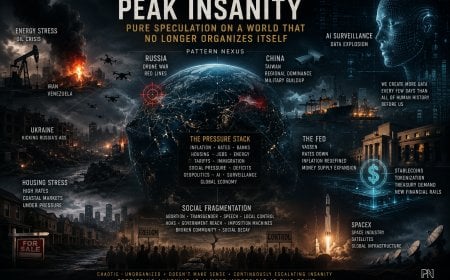


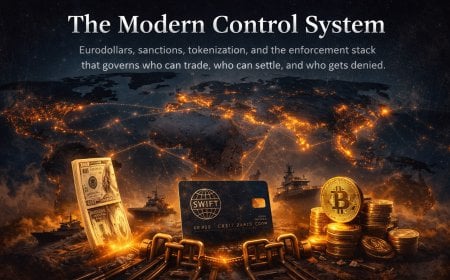


Comments (0)