 Editor-written summary
The U.S. and Iran traded warnings before a planned Monday sanctions announcement by Treasury Secretary Scott Bessent. Reuters, AP and Bloomberg report that Washington is preparing a wider secondary-sanctions push that could reach Iran’s remaining trading partners, including China, while Strait of Hormuz oil flows remain heavily constrained. The Pattern Nexus read: this is no longer just Iran policy; it is a wartime test of U.S. financial enforcement against energy flows that Asia still needs.
Inside this report
- Washington Turns Iran Sanctions Into a China Oil-Flow Loyalty Test
- Quick Read
- Table of Contents
 Editor-written summary
Securitize and Neuberger launched the Neuberger Securitize High Income Tokenized Fund, or HINC, on August 18, 2026, with exposure to high-yield bonds, CLOs, leveraged loans and related fixed-income assets across Avalanche, Ethereum, Solana and Sui. Separate reports say Securitize filed an Aave Horizon ARFC the same day to make HINC supply-only collateral, allowing approved holders to borrow USDC, GHO or RLUSD if governance, risk and implementation steps clear. The test is whether institutional tokenization can move beyond Treasury-like cash products without creating a new liquidation bottleneck.
Inside this report
- Aave Turns Tokenized Junk Credit Into a Stablecoin Collateral Test
- Quick Read
- Table of Contents
 Editor-written summary
AI data centers are moving from economic-development trophy to midterm liability. AP reported that President Donald Trump continues to champion data centers as strategic infrastructure while candidates in competitive races back away from the issue. Axios and The Washington Post separately show the backlash spreading across states and campaigns, making power, water and ratepayer protection a new control surface for AI industrial policy.
Inside this report
- AI Data Centers Turn Into a Midterm Control Surface
- Quick Read
- Table of Contents
 Editor-written summary
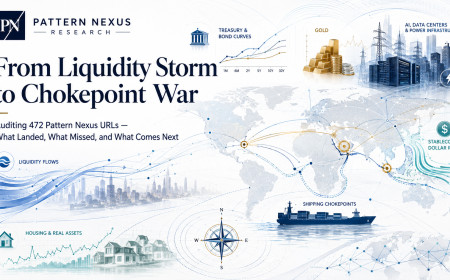
I audited the public Pattern Nexus record across 472 unique URLs and the saved full-text article export, then rebuilt the major calls from the original wording. This long-form report scores the liquidity/QT pivot, gold, the sub-3% 10-year miss, housing, stablecoin/Treasury rails, Venezuela, Iran/Hormuz, China/Taiwan, Greenland, AI power, robotics and the war economy, and finishes with a falsifiable map of what comes next.
Inside this report
- From Liquidity Storm to Chokepoint War: Auditing 472 Pattern Nexus URLs — What Landed, What Missed, and What Comes Next
- The framework got the direction of the system more right than it got every price path.
- The archive looks less like 472 separate opinions and more like one system being discovered in public.
 Editor-written summary
Amazon says Prime Air plans to expand to nearly 500 U.S. cities and towns by the end of 2026, a sixfold increase from its current footprint. The verified story is bigger than 30-minute delivery: FAA environmental records show drone delivery centers, MK30 operating envelopes, delivery-area maps, hours of operation, and local approvals becoming part of the physical retail stack.
Inside this report
- Amazon’s Drone Delivery Push Turns Suburbs Into Retail Airspace
- Quick Read
- Table of Contents
 Editor-written summary
Marvell disclosed that it entered a July 29, 2026 commercial agreement with Google to develop custom semiconductor products tied to the TPU ecosystem. The August 19 filing also says Marvell issued Google a warrant for up to 58,970,907 shares at $206.58 per share, with most vesting tied to Custom Products revenue through Marvell’s fiscal 2033. The structure turns Google’s AI chip demand into a potential equity position while giving Marvell a long runway into TPU-adjacent infrastructure.
Inside this report
- Google Turns Custom AI Chips Into a Marvell Equity-Control Deal
- Quick Read
- Table of Contents
 Editor-written summary
PJM’s proposed Interim Resource Adequacy Service framework would treat some new 50 MW-plus data centers and other large loads as curtailable unless they secure qualifying capacity. The move follows a 6,831 MW capacity shortfall for the 2028/2029 delivery year and rising forecasts for large-load demand across PJM’s footprint. The system read: AI compute is being recast from passive load growth into a reliability obligation.
Inside this report
- PJM Turns AI Data Centers Into Interruptible Grid Load
- Quick Read
- Table of Contents
 Editor-written summary
Japan's 2026 yen intervention was enormous, but Federal Reserve balance-sheet data show FIMA was not used to fund it. That may be the more important finding. FIMA sits behind the global dollar system as a mechanism allowing approved foreign monetary authorities to temporarily turn U.S. Treasury collateral into newly supplied dollars instead of selling those Treasuries into the market. This report examines what FIMA actually does, why it is a form of temporary central-bank dollar creation rather than QE, what Japan's reserve structure looks like, and why another serious yen crisis could migrate directly into U.S. Treasury-market plumbing.
Inside this report
- The Yen's Hidden Backstop: FIMA, Dollar Creation and the Treasury Market
- FIMA Does Not Fix the Yen. It Changes What Japan—or Another Reserve Holder—May Have to Sell to Obtain Dollars.
- The Yen Problem Becomes Much More Important Once It Touches the Treasury Market
 Editor-written summary
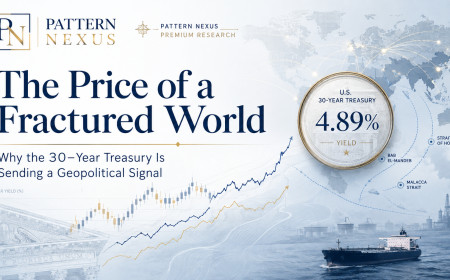
Something about the global system feels uncomfortable, and the last month of data suggests that feeling has a measurable foundation. The U.S. 30-year Treasury has pushed above 5.3%, real long-term yields are above 3%, the Strait of Hormuz remains severely constrained, U.S. missile inventories are being consumed across multiple theaters, Russia and Ukraine are attacking the commercial infrastructure of the Black Sea, China continues pressure around Taiwan and the South China Sea, new regional defense blocs are forming, tariffs are fragmenting trade, and governments and AI companies are simultaneously competing for enormous amounts of capital. This Pattern Nexus investigation asks whether the long end of the Treasury market is becoming one of the cleanest aggregate prices of a more fragmented world—and separates that thesis from the much weaker claim that the Treasury market itself is failing.
 Editor-written summary
I rebuilt the solar-recession thesis around the dominant global financial core instead of a modern U.S. sample: Amsterdam and the guilder, London and sterling, then New York and the dollar. Across 375 years, the data reveal a narrow combined turning-year anomaly and a strange six-year lead. The deeper pass separates minima from maxima, tests six contraction thresholds and shock exclusions, reconstructs 54 reserve handoffs, deletes every historical block and contraction event, and adds lagged liquidity-interaction models. The effect is not a solar-minimum law, disappears for severe contractions, concentrates in 1850–1899, and does not validate through crops, famine or liquidity interactions. Solar timing may overlay a vulnerable system. Liquidity remains the engine.
Inside this report
- The Sun, Money and the Global Core: What Survived a 375-Year Test
- The data found a pattern. It did not find a clock.
- The Sun may load the timing. Liquidity still pulls the trigger.
 Editor-written summary
AP reported on August 17, 2026, that Trump again threatened Oman while Iran said it had reached an understanding with Muscat over a Strait of Hormuz transit route. A separate AP analysis said the 60-day U.S.-Iran deadline expired the same day with the sides still far apart over reopening Hormuz, lifting the U.S. blockade and defining Iran’s role. Reuters reported that Iran was threatening a more offensive posture in the strait if diplomacy failed, making the escalation a live maritime-control crisis rather than a routine diplomatic delay.
Inside this report
- Washington Turns the Hormuz Deadline Into an Oman Strike Threat
- Quick Read
- Table of Contents
 Editor-written summary
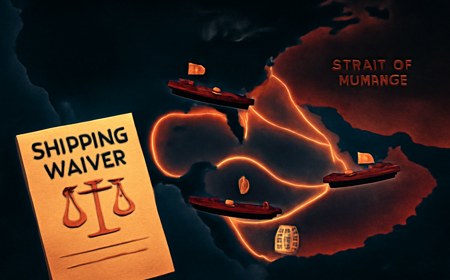
President Trump extended a Jones Act waiver for another 90 days, with the new window taking effect on August 17, 2026, after the prior waiver period expired on August 16. The waiver allows foreign-flagged vessels to move covered energy and agricultural commodities between U.S. ports as the Iran war and Strait of Hormuz disruption keep pressure on fuel logistics. The policy is now a live energy-security workaround, but maritime-state lawmakers and domestic shipping advocates warn it could weaken the U.S.-flag fleet and shipbuilding base.
Inside this report
- Washington Turns the Jones Act Waiver Into an Iran-War Fuel Bypass
- Quick Read
- Table of Contents

