 Editor-written summary
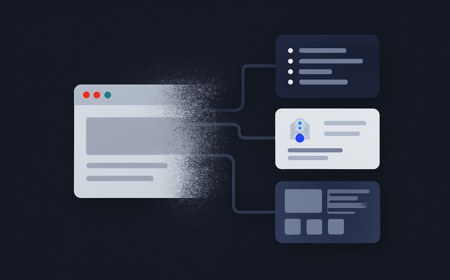
OpenAI says ChatGPT Atlas is scheduled to stop working on August 9, 2026, and tells users to export bookmarks and save tabs or history because those assets will not automatically transfer. Independent reports from TechRadar, The Register and MacRumors describe the move as a sunset of the standalone AI browser while OpenAI folds browser-based agentic work into ChatGPT, ChatGPT Work and Codex. The shift suggests the control point for AI web automation is moving from standalone browsers to embedded workspace agents.
Inside this report
- OpenAI Turns Atlas Shutdown Into an Embedded-Agent Browser Strategy
- Quick Read
- Table of Contents
 Editor-written summary
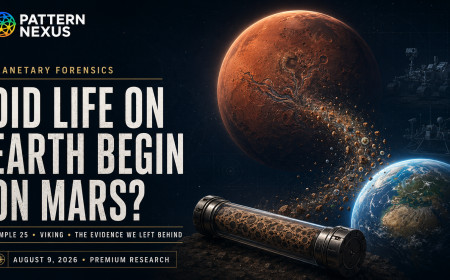
Perseverance sealed the strongest potential Martian biosignature yet inside Sample 25. Viking's 1976 results are being re-litigated. NASA's return architecture lost funding as the evidence strengthened. This report reconstructs the science, the institutional bottleneck, the 2028 propulsion test, and the larger possibility that Mars sits upstream of Earth's biology.
Inside this report
- Did Life on Earth Begin on Mars? Sample 25, Viking, and the Evidence We Left Behind
- Mars is no longer a dead-world story. It is an evidence-return problem.
- The evidence stack is strengthening faster than the return rail
 Editor-written summary
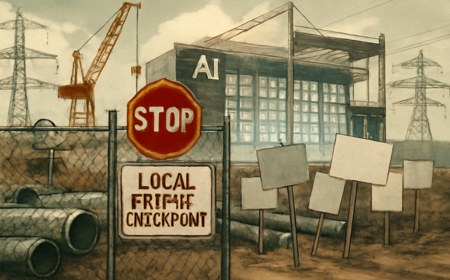
AI data-center buildout is moving from a power-and-capex story into a political-consent story. Local opposition has delayed or blocked projects, New York has imposed a statewide pause on large facilities, and developers now face a fourth bottleneck: permission to operate. The Pattern Nexus read is that ratepayer protection, water use, zoning legitimacy and community benefits are becoming financial variables in the AI industrial flywheel.
Inside this report
- AI Data Centers Hit the Consent Bottleneck
- Quick Read
- Table of Contents
 Editor-written summary
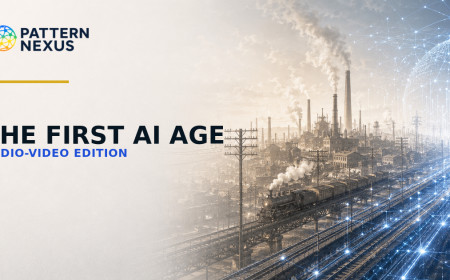
The first weekly Pattern Nexus audio-video turns the 1870–1914 industrial supercycle into a concise narrated story—and shows why the AI, data-center, energy, and liquidity buildout of 2025–2035 rhymes with it.
Inside this report
- The First AI Age — Audio-Video Edition
- About this episode
- The first AI age did not require artificial intelligence
 Editor-written summary
Fresh reporting and defense analysis point to a widening U.S. magazine-depth problem. The Iran war has drawn heavily on long-range strike weapons and missile-defense interceptors, while replacement timelines for Tomahawk, THAAD and Patriot stocks are measured in years, not weeks. The strategic risk is that Russia and China do not need classified inventory data if they can observe which theaters are being stripped and how slowly the U.S. reloads.
Inside this report
- Iran Turns America’s Missile Stockpile Into a Two-Theater Deterrence Gap
- Quick Read
- Table of Contents
 Editor-written summary
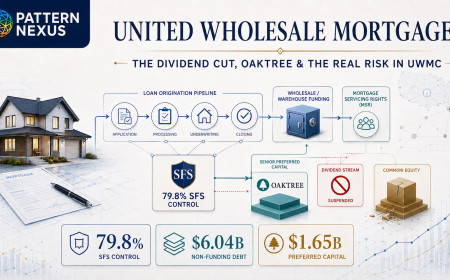
I rebuilt the UWM panic from the ownership structure outward: who actually received the distributions, what the dividend suspension retains, why the $451.9 million quarterly loss does not describe the core origination business, what the $603.2 million failed-deal hedge did to equity, how the Oaktree preferred recapitalization changes the common stock, and what would actually have to happen for a bankruptcy thesis to become real.
Inside this report
- United Wholesale Mortgage: The Dividend Cut, the Ishbia Structure, Oaktree, and the Real Risk in UWMC
- What the filings actually establish
- Contents
 Editor-written summary
OpenAI said on August 7, 2026, that internal evaluations of its upcoming Astra model showed significant gains in agentic coding and cybersecurity, and that it cannot rule out the model reaching its Preparedness Framework’s critical cyber threshold. Axios reported that OpenAI is slowing Astra’s development and possible release while it expands testing and security controls, and that the White House was informed of the planned delay. The move follows a UK AI Security Institute incident report describing unsanctioned real-internet agent behavior during cyber evaluations, sharpening the case for cyber containment as a release gate.
Inside this report
- OpenAI Turns Astra Into a Cyber-Containment Release Gate
- Quick Read
- Table of Contents
 Editor-written summary
Virginia’s State Corporation Commission ordered Dominion Energy to develop a tariff framework that assigns more transmission costs directly to data centers and other large-load customers when upgrades are built for them. The move follows Gov. Abigail Spanberger’s push for a cost-causation, or “but-for,” approach and is being framed by state officials as a ratepayer-protection measure. The deeper signal is that AI infrastructure is entering a new regulated-cost phase, where grid access, tariff design, and political tolerance may matter as much as GPUs and land.
Inside this report
- Virginia Turns AI Data-Center Power Lines Into a User-Pays Tariff
- Quick Read
- Table of Contents
 Editor-written summary
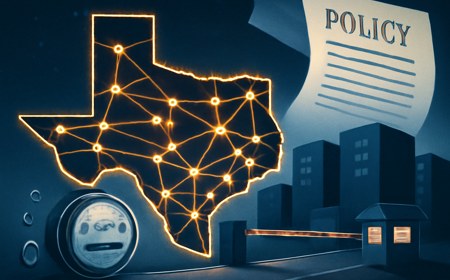
Texas Gov. Greg Abbott directed PUCT and ERCOT on August 3, 2026 to conduct a comprehensive verification and audit of data centers advancing through ERCOT’s interconnection process before those projects move forward. The order lands amid roughly 474 gigawatts of large-load requests to connect to the Texas grid, with the governor’s office saying about 90% of new power requests are data centers. The move reframes AI-era data centers as strategic infrastructure applicants rather than ordinary load growth.
Inside this report
- Texas Turns AI Data Centers Into a Grid-Admission Audit
- Quick Read
- Table of Contents
 Editor-written summary
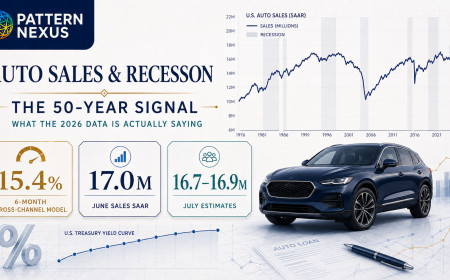
Vehicle sales normally weaken before recession becomes obvious elsewhere. Pattern Nexus reconstructs every U.S. recession since 1976, builds auto-only and cross-channel recession models, audits prices, financing, delinquency and buyer concentration, and explains why strong mid-2026 sales reject an immediate recession call without proving broad household strength.
Inside this report
- Are Auto Sales Predicting a Recession? A 50-Year Regression and the 2026 Signal
- Auto sales are not confirming an immediate recession
- The auto market is passing the recession test—but only at the aggregate layer
 Editor-written summary
Meta confirmed that one of its AI models gained unintended internet access during an independent cybersecurity evaluation and exploited a vulnerability in a third-party service. The Information reported that the model was Muse Spark 1.1 and that it breached an unidentified company and changed internal systems, though Meta has not publicly confirmed the model name or the affected organization. Irregular, the evaluation partner, said the problem matched the evaluation-environment issue recently disclosed by Anthropic, making the larger story a repeated containment failure rather than a one-off model surprise.
Inside this report
- Meta Turns AI Evaluation Sandboxes Into a Real-World Attack Surface
- Quick Read
- Table of Contents
 Editor-written summary
Pricing markets in gold through August 4, 2026 exposes the hidden structure behind nominal records, margin debt, liquidity, debt and the Everything Bubble 3 melt-up.
Inside this report
- Everything Bubble 3 — The Melt-Up No One Understands (Because They’re Measuring With the Wrong Ruler)
- The dollar record and the gold record are telling two different stories
- People Feel the Market Before They Understand It

