 Editor-written summary
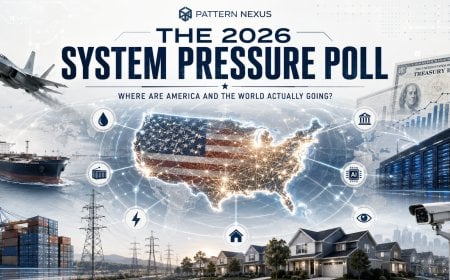
This is not another left-versus-right approval poll.
The Pattern Nexus System Pressure Poll examines the deeper structures shaping current events: war, energy, shipping corridors, debt, interest rates, tariffs, artificial intelligence, surveillance, housing, automation, institutional trust, and the emerging global order.
The daily headlines are downstream. The objective is to identify which systems people believe are actually driving events—and where those systems are taking the United States and the rest of the world.
 Editor-written summary
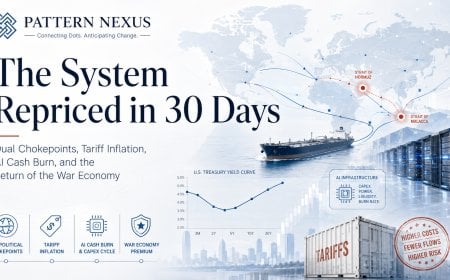
In thirty days, the operating assumptions underneath the global system changed. Two maritime chokepoints came under pressure, the United States expanded war financing and rebuilt its tariff architecture, inflation moved back upstream, long-term yields repriced, AI infrastructure crossed into cash-burn territory, strategic minerals became permissioned leverage, and political command structures began cracking. This Pattern Nexus analysis maps those events as one connected system rather than separate headlines.
 Editor-written summary
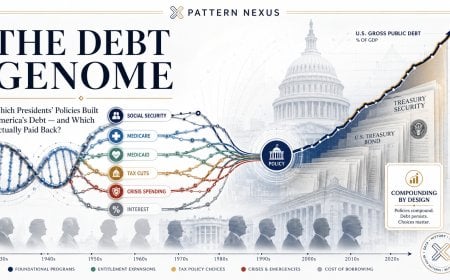
A 70-year counterfactual audit of presidential policy, inherited law, tax cuts, entitlements, crisis packages, and the compounding interest tail. The analysis separates who originated a policy from who expanded, extended, financed, or weakened it—and distinguishes Treasury cost from social return.
Inside this report
- The Debt Genome: Which Presidents’ Policies Built America’s Debt—and Which Actually Paid Back?
- The answer changes by debt mechanism
- Why This Is Premium
 Editor-written summary
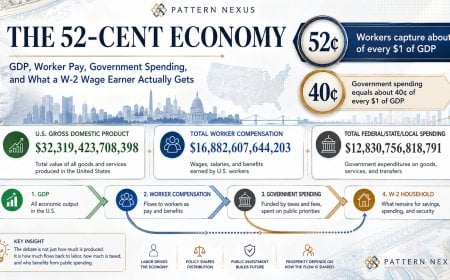
America produces nearly $32 trillion a year, but the median W-2 worker experiences only a fraction of the aggregate output. This Pattern Nexus report maps GDP, total employee compensation, cash wages, government purchases, total government current expenditures, taxes, transfers, and the after-tax worker-capture problem. It tests the claim that only 10 cents of each productivity dollar returns to the people producing the system—and replaces the slogan with a defensible multi-layer accounting model.
Inside this report
- The 52-Cent Economy: Where the American Output Dollar Actually Goes
- The Three Numbers and the First-Pass Math
- The Ratios Embedded in the Image
 Editor-written summary
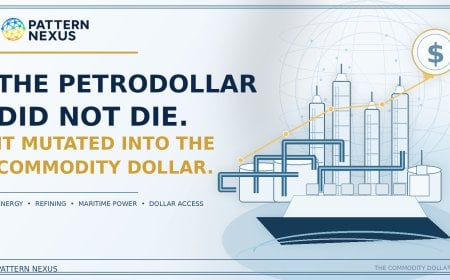
The old petrodollar was built around imported oil, dollar invoicing, military protection, and the recycling of global surpluses into American assets. The emerging commodity-dollar system is more direct: the United States produces record volumes of oil and gas, operates enormous refinery and export infrastructure, protects strategic waterways, controls critical financial rails, and can restrict access to global markets through sanctions, insurance, banking regulation, export controls, and maritime enforcement.
Inside this report
- The Petrodollar Did Not Die. It Mutated Into the Commodity Dollar
- The Export Surge Is Not a Side Story
- The Petrodollar Was Always Shorthand
 Editor-written summary
A deep Pattern Nexus regression and data analysis mapping where net worth levels from $100 to $1 trillion place an individual within the global and American wealth distributions. The research separates actual net worth from liquidity, accessible credit, gross capital control, leverage, and daily capital-producing capacity.
Where do you actually sit within the global wealth system—and how does that position change when we measure not only what you own, but how much capital you can access?
This research maps wealth levels from $100, $500, and $1,000 through $1 million, $1 billion, $100 billion, and the theoretical $1 trillion threshold. Global and American wealth distributions are analyzed separately using regression models, percentile estimates, Federal Reserve household data, international wealth-distribution research, and 17 original charts and visualizations.
The analysis distinguishes net worth from liquid wealth, available credit, collateral-backed borrowing capacity, and gross capital controlled. It then models how productive leverage can accelerate wealth growth, how destructive leverage can erase equity, and how much daily capital output different levels of wealth may generate.
Net worth measures ownership. Liquidity measures deployability. Credit measures reach. Leverage amplifies the result. Capital efficiency determines whether that amplification creates wealth or debt.
Inside this report
- The Capital Ladder: Where $100 to $1 Trillion Places You in the Global and American Wealth System
- The Four Wealth Hierarchies
- Hierarchy One: Net Worth
 Editor-written summary
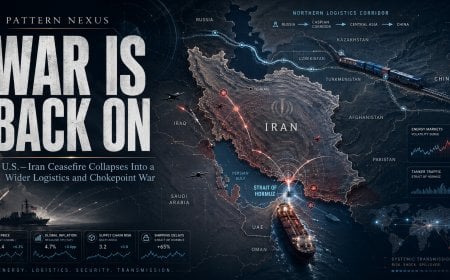
The United States is striking Iranian military, port, power, transportation, and logistics infrastructure. Iran is retaliating against the American Gulf basing network. Israel is ready to reenter. The conflict is evolving from a Hormuz chokepoint war into a wider campaign over Iran’s maritime and Eurasian connections.
Inside this report
- The War Has Entered an Attritional Enforcement Phase
- What Has Happened Since the Original Article
- The Original Thesis Was Confirmed—but It Needs to Be Refined
 Editor-written summary
Humanity crossed another threshold. We are no longer only reading life or editing life. We are moving toward building life from defined parts, programming DNA as biological code, and combining synthetic cells with AI-designed proteins, automated labs, and synthetic genomes. This Pattern Nexus deep research article breaks down SpudCell, synthetic biology, programmable DNA, artificial species, biosecurity risks, mirror life, and where built biology could go next.
Inside this report
- The Synthetic Cell Threshold: Programmable DNA and the Beginning of Built Life
- Quick Read
- On This Page
 Editor-written summary
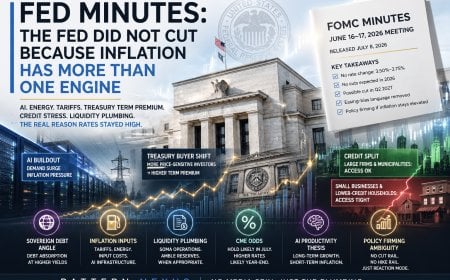
The June 16–17 FOMC minutes, released July 8, show a Fed that held rates steady but removed the easy easing bias. The deeper signal is that inflation pressure is now coming from multiple rails at once: tariffs, Middle East energy shock risk, AI infrastructure demand, Treasury term premium, and uneven consumer credit stress.
Inside this report
- Fed Minutes: Inflation Has More Than One Engine
- No Clean Cut Rail
- The Buyer Base Changed
 Editor-written summary
A Pattern Nexus article on the surveillance state after AI, asking whether humanity’s old fear of Orwellian control changes once artificial intelligence, task-specific systems, biotech, chemistry, and decentralized tools make individual actors far more dangerous than they were in the old world.
Inside this report
- The Surveillance State: Does Humanity Need a Nanny?
- The Orwellian Mindset
- The AI Lens
 Editor-written summary
The American Revolution was not won at sea by matching Britain ship-for-ship. Britain had the dominant navy. America had small schooners, converted merchantmen, privateers, coastal raids, prize law, and one brutal strategic insight: you do not have to sink the empire’s battle fleet if you can break the logistics system feeding it.
Inside this report
- The War Beneath the War: How America Beat Britain at Sea Without Beating the British Navy
- Quick Read
- The Clean July 4th Story Is Not the Whole Story
 Editor-written summary
A Pattern Nexus research article on the forgotten civilizational structure behind stable societies: male executive power often existed beside a female legitimacy layer. Across Haudenosaunee, Palau, Asante, Igbo, Yoruba, Cherokee, Chaco, Minangkabau, Kush, Egypt, Rome, Sparta, Neolithic China, and Iron Age Britain, the pattern repeats. Men often held the public office, but women frequently controlled the deeper gate: clan, land, succession, property, market, ritual, household, and generational continuity.
Inside this report
- The Female Logic Gate: How Coherent Societies Checked Male Power
- The claim
- Why the modern framing gets this wrong

