 Editor-written summary
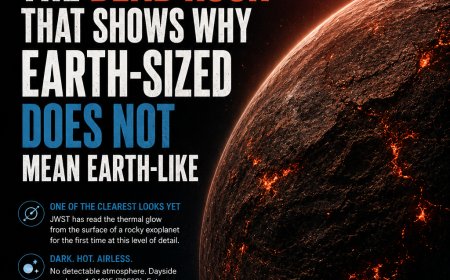
JWST has given astronomers one of the clearest looks yet at the surface of a rocky exoplanet, LHS 3844 b, also called Kuaʻkua. The result is not alien life, not oxygen, and not a second Earth. It is a dark, hot, likely airless super-Earth orbiting a red dwarf star every 11 hours, with a basalt-like or space-weathered surface and no detectable atmosphere. The discovery matters because it shows that the exoplanet era is moving from planet detection into planet interpretation, and it forces a harder lesson: Earth-sized does not mean Earth-like.
Inside this report
- LHS 3844 b: The Dead Rock That Shows Why Earth-Sized Does Not Mean Earth-Like
- Quick Read
- Inside This Article
 Editor-written summary
Scientists directly detected atomic oxygen in Venus’ atmosphere on both the day side and night side, but this is not breathable oxygen and it is not proof of life. The real story is more important than the headline: Venus shows how oxygen can appear through planetary chemistry, solar radiation, and atmospheric circulation without biology, which matters deeply for how we interpret future biosignatures on exoplanets.
Inside this report
- Oxygen on Venus: The Discovery That Is Not Life, but Still Changes the Search
- Quick Read
- Inside This Article
 Editor-written summary
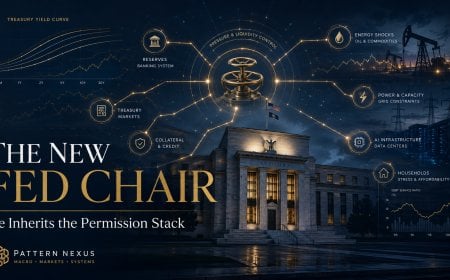
Kevin Warsh is not simply inheriting the Federal Reserve. He is inheriting the control layer where inflation, debt service, Treasury funding, energy shocks, AI infrastructure demand, repo plumbing, collateral stress, political pressure, and liquidity permission all collide.
The public will debate whether the new Fed chair cuts, hikes, pauses, or changes the balance sheet. That is the surface story. The deeper Pattern Nexus story is that the Fed chair is now the public face of the permission stack. He helps decide where credit flows, where pain lands, which markets get oxygen, which sectors get squeezed, and what kind of crisis or cover event makes the next liquidity intervention politically acceptable.
This is not a normal Fed transition. It is the next chapter in the liquidity-cover framework.
Inside this report
- LifeLog Died. Facebook Launched. The Surveillance Internet Was Born.
- This Is Not Just a Coincidence Story
- Evidence Board: What Is Actually Known
 Editor-written summary
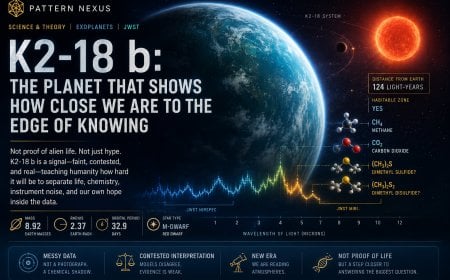
K2-18 b is not proof of alien life, but it may be one of the most important exoplanets ever studied because it shows how the search for life is shifting from imagination to contested atmospheric chemistry. JWST has detected methane and carbon dioxide in its atmosphere, while disputed DMS and DMDS claims show how difficult it will be to separate biology, chemistry, instrument noise, media hype, and human hope.
Inside this report
- K2-18 b: The Planet That Shows How Close We Are to the Edge of Knowing
- Quick Read
- Inside This Article
 Editor-written summary
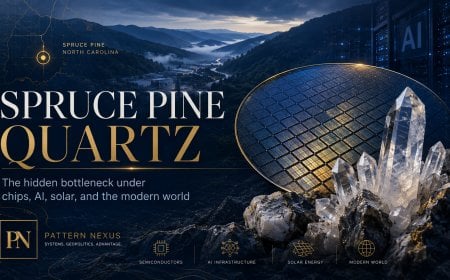
Spruce Pine, North Carolina may be one of the most strategically important locations on Earth because its high-purity quartz sits underneath silicon wafers, semiconductor manufacturing, AI infrastructure, solar panels, optical fiber, and the modern digital control layer.
Inside this report
- Spruce Pine Quartz: The Hidden Bottleneck Under Chips, AI, Solar, and the Modern World
- Quick Read
- Inside This Article
Federal Reserve Board announces approval of related applications by Columbia Bank MHC, and Columbia Financial, Inc.
Editor-written summary
Federal Reserve Board announces termination of enforcement actions with F & M Holding Company, Inc. and Thread Bancorp, Inc.
Editor-written summary
Federal Reserve Board issues Economic Well-Being of U.S. Households in 2025 report
Editor-written summary
Federal Reserve Board releases results from two surveys of senior financial officers at banks about their views on discount window operating days and their strategies and practices for managing reserve balances
Editor-written summary
Stephen I. Miran submits his resignation as a member of the Federal Reserve Board, effective when or shortly before his successor on the Board is sworn in
Editor-written summary
Federal Reserve Board announces termination of enforcement actions with UBS Group AG, Credit Suisse AG, Credit Suisse Holdings (USA), Inc., and Credit Suisse AG, New York Branch
Editor-written summary
Federal Reserve Board announces approval of application by the Stephen M. Calk 2025 Trust

