 Editor-written summary
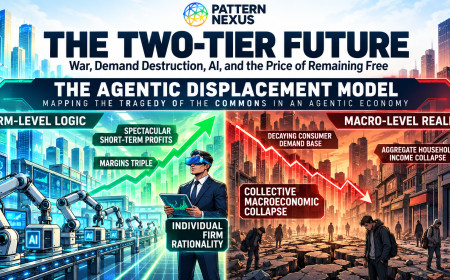
For years, I followed pieces of a possible two-tier economic future, then moved away from believing they would come together. In September 2026, the Iran oil shock, Ukraine refinery attacks, demand destruction, long-rate pressure, AI, robotics and the ownership of physical infrastructure have forced me to put the entire argument into one place: who retains access to the real world if an increasingly automated economy makes ordinary people dependent on the systems they do not own?
 Editor-written summary
The Federal Reserve requested public comment on two GENIUS Act proposals that would establish a regulatory framework for Board-supervised payment stablecoin issuers. The package would require full backing with permissible reserve assets such as short-term Treasury bills and other high-quality liquid assets, add capital and risk-management standards, set reserve-custody rules, and create an application process for banks seeking to issue stablecoins through subsidiaries.
Inside this report
- Fed Turns Stablecoin Issuance Into a Treasury-Backed Bank Rulebook
- Quick Read
- Table of Contents
 Editor-written summary
New research published September 22, 2026 documents the first two preserved burial contexts at Göbekli Tepe, containing at least four individuals in PPNB contexts dated around 8700–8000 BCE. Pattern Nexus examines the graves, 928 other bone fragments, the earlier modified-skull evidence, postmortem damage, erosion and slope failure, the site's domestic activities, regional funerary practices and unresolved research questions.
Inside this report
- The discovery was published this week. The excavation happened years ago.
- This is a 10,000-year-old question, not an 8,000-year-old one
- Three people beneath a floor—and maybe a fourth
 Editor-written summary
Oracle issued a force-majeure notice tied to Project Jupiter, a New Mexico AI data-center campus being developed by Blue Owl-owned STACK Infrastructure to support OpenAI. Reuters reported the notice is reverberating through AI-infrastructure financing discussions, while other reports point to power delivery, gas-pipeline permitting, community opposition and energy-supply timing as the pressure points. The system read is that AI infrastructure risk is moving downstream from GPUs to enforceable megawatts, permits and project-finance documents.
Inside this report
- Oracle Turns Project Jupiter Into an AI-Infrastructure Force-Majeure Test
- Quick Read
- Table of Contents
 Editor-written summary
CFTC Chairman Michael S. Selig told the 2026 U.S. Treasury Market Conference that U.S. markets need to prepare for mass tokenization, onchain finance, AI adoption and potential 24/7 trading. The official conference agenda also put stablecoins, tokenized deposits and short-term funding directly inside the Treasury-market-functioning debate. The signal is less about crypto speculation than about the next collateral, margin and settlement layer for the dollar system.
Inside this report
- CFTC Turns Tokenized Collateral Into a 24/7 Treasury-Market Plumbing Test
- Quick Read
- Table of Contents
 Editor-written summary
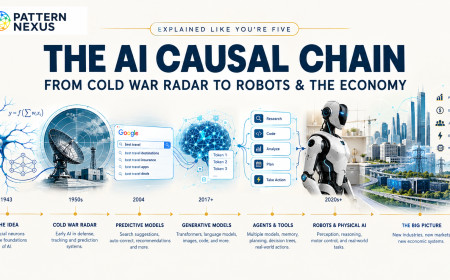
AI did not begin with ChatGPT. This accessible, fully sourced Pattern Nexus research map follows the 1943 artificial-neuron paper, Cold War radar computers, predictive internet systems, transformer models, agents, embodied AI and humanoid robots into the real questions about jobs, energy, productive ownership, wages and the economy.
Inside this report
- What I Mean When I Tell You to Follow the Causal Chain
- The 1940s: We Were Modeling Artificial Neurons Before Your Grandparents Had a Home Computer
- The Cold War Radars Were Already Part of a Machine-Assisted Decision System
 Editor-written summary
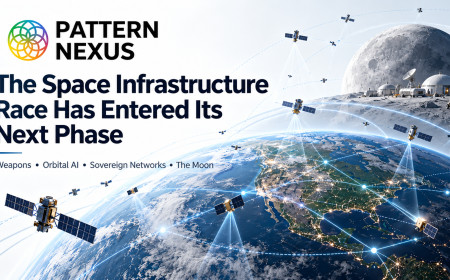
From September 4–23, space infrastructure accelerated on almost every front. Isar Aerospace reached orbit from continental Europe. India positioned EOS-05 for geosynchronous imaging. Stoke raised $1 billion toward fully reusable launch. China launched four rockets in roughly 45 hours and put a spacecraft with 5G, AI, and planned 100-Gbps optical communications into orbit. Europe allocated major IRIS² and OneWeb production contracts while Planet expanded satellite manufacturing in Germany. The U.S. acknowledged on-orbit space-control weapons, practiced multi-orbit maneuver operations, and funded new target-tracking architectures; Britain created a space-effects squadron. NASA and ESA delivered new lunar, planetary, and Earth-observation science while commercial downmass and crew-transport contracts extended the orbital logistics chain. The Pattern Nexus conclusion: space is becoming an industrial, computational, and contested operating system, and continuity is its critical threshold.
Inside this report
- The Space Infrastructure Race Has Entered Its Next Phase: Weapons, Orbital AI, Sovereign Networks, and the Moon
- The system is building capacity, control, compute and continuity all at once.
- I have been tracking these developments one by one. Together, they tell a much bigger story.
 Editor-written summary
Alibaba announced a full-stack AI roadmap at its Apsara Conference on September 22, 2026, including the Zhenwu V900 AI processor, Qwen 4 training, future Qwen models planned at 5 trillion to 10 trillion parameters, and a target for Alibaba Cloud global data-center capacity to exceed 20GW by 2032. The verified facts point to a vertically integrated strategy spanning chips, cloud infrastructure, models and agents. The system read is that Alibaba is turning compute sovereignty into an operating layer for China’s AI industrial flywheel.
Inside this report
- Alibaba Turns Zhenwu V900 Into a 20-Gigawatt AI-Sovereignty Map
- Quick Read
- Table of Contents
 Editor-written summary
South Korea has identified a Texas gas-fired power project as the first investment under its $350 billion U.S. package, according to Yonhap, KBS, Kyunghyang and Reuters reporting. The project is tied to rising Texas electricity demand from AI data centers and semiconductor facilities, while Seoul is also discussing U.S. nuclear and Alaska LNG follow-ons. The system read: tariff diplomacy is being converted into firm-power infrastructure for the AI industrial stack.
Inside this report
- Seoul Turns Texas Gas Power Into an AI-Compute Alliance Rail
- Quick Read
- Table of Contents
 Editor-written summary
Greenland wasn't sold or annexed. The September 22, 2026 U.S.–Denmark–Greenland security agreement expands Pituffik, provides for defense areas at Narsarsuaq and Mestersvig, establishes broad U.S. military access, limits non-NATO military presence and sensitive foreign investments, and seeks continuity even if Greenland becomes independent. Pattern Nexus places the signed treaty inside its earlier Monroe Doctrine and Arctic control-plane coverage—and separates what was signed from what remains to be approved, funded and built.
Inside this report
- September 22 is a treaty day, not just another Trump announcement
- The signing ceremony and UN remarks: listen to what each government says the deal is
- Trump: permanent security authority, two new bases, and the American continent
 Editor-written summary
On September 21, 2026, Governor Greg Abbott directed the Texas Commission on Environmental Quality to halt permits sought by data centers until ERCOT completes its audit. The order broadens Texas’s data-center slowdown from grid connections into environmental and water approvals, making AI infrastructure growth conditional on state findings about reliability, water use, local impacts, ownership, tax incentives, and who pays for supporting infrastructure.
Inside this report
- Texas Turns Data-Center Permits Into a Grid-Audit Gate
- Quick Read
- Table of Contents
 Editor-written summary
British Prime Minister Andy Burnham has approved limited defensive air-to-air refueling support for Saudi Arabia after Riyadh requested help countering intensified Houthi attacks. Reporting from AP, Reuters, The Guardian and Bloomberg says the mission is expected to involve one RAF Voyager for a time-limited deployment measured in weeks. The move links Yemen’s renewed escalation directly to oil-route security, allied burden-sharing and the cost-of-living politics of keeping maritime chokepoints open.
Inside this report
- London Turns RAF Tankers Into a Red Sea Energy-Security Backstop
- Quick Read
- Table of Contents

