 Editor-written summary
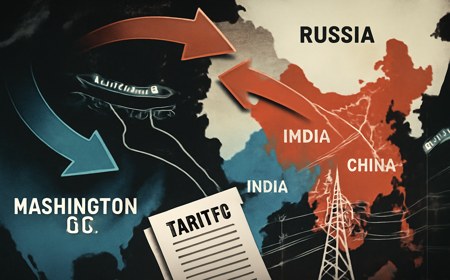
The U.S. House passed a sweeping Russia sanctions package in a 262-159 vote and sent it to President Donald Trump. The bill targets Russian officials, banks, sanctions-evasion networks and the shadow fleet, while authorizing duties on countries that buy Russian-origin crude oil or natural gas or facilitate evasion. India responded on September 17 that it would protect energy security, diversified sourcing, trade interests and the bilateral relationship.
Inside this report
- Washington Turns Russian Oil Sanctions Into an India-China Tariff Lever
- Quick Read
- Table of Contents
 Editor-written summary
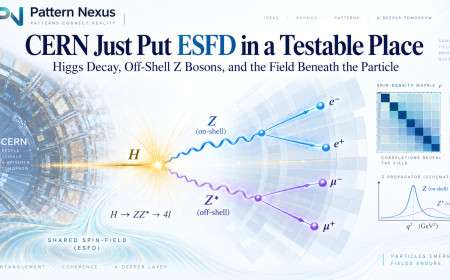
CERN’s ATLAS and CMS experiments have found strong evidence for entanglement in the spin structure of Higgs → ZZ* → 4ℓ decays. The result is real, but the off-shell Z* changes the way the process should be understood: the detectors measure four leptons and reconstruct the intermediate quantum-field state rather than directly watching two ordinary Z particles become entangled. This article converts the 6-3 Electromagnetic Spin-Field Dynamics framework into a Pattern Nexus analysis, separates established collider physics from ESFD hypotheses, corrects the Bell-locality overclaim, and defines the measurement ESFD now needs to calculate: the q²-dependent ZZ* spin-density matrix.
 Editor-written summary
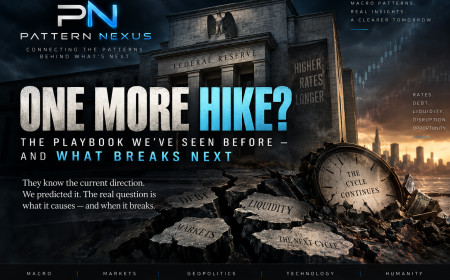
The Federal Reserve just raised the federal-funds target to 3.75%–4.00% while the 10-year Treasury closed at 5.01%, the 30-year at 5.35%, and the real 30-year at 3.09%. Pattern Nexus correctly identified the September hike risk and the developing QE/liquidity cycle, but underestimated the Fed’s willingness to raise rates against an already enormous debt and refinancing burden. This report asks the question almost nobody asks after a rate decision: what does the hike eventually break? It connects the September decision to the $40-trillion-plus federal debt structure, more than $1 trillion of annual federal net interest expense, Treasury issuance, long-end buybacks, Federal Reserve reserve-management purchases, hedge-fund leverage, the Treasury basis trade, private credit, housing, commercial real estate, household cashflow and the 2019 repo-market precedent. The conclusion is not that the Fed has deliberately chosen to create a crash. It is that monetary architecture now allows the Fed to tighten the price of credit while separately protecting reserves and market plumbing. The hike therefore does not invalidate the Pattern Nexus QE thesis. If long rates remain near current levels, it accelerates the transmission mechanism that can eventually force the next phase of liquidity support.
Inside this report
- The Fed finally used the hike option
- What we got right—and what I got wrong
- The most important sentence was in the implementation note
 Editor-written summary
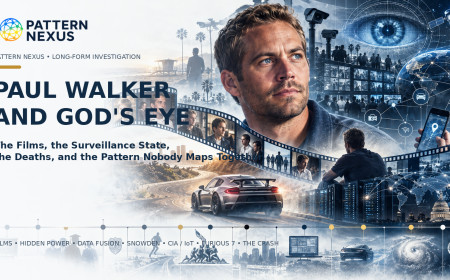
I started with one question about God’s Eye in Furious 7 and ended up with a much larger map. This report rebuilds Paul Walker’s complete film chronology, explains what each movie was actually about, traces the recurring themes of secret institutions, undercover identities, corrupt authority, coerced operatives, controlled evidence and people choosing conscience over orders, and gives extra weight to the independent films Walker produced or executive-produced himself. Then it places that career beside the real surveillance timeline: DARPA’s Total Information Awareness program, its all-seeing-eye imagery, David Petraeus’s 2012 Internet-of-Things remarks, the CIA’s 2013 big-data strategy, Snowden’s disclosures, license-plate tracking databases and James Wan’s own statement that God’s Eye was deliberately designed to feel realistic. It also puts the deaths identified around Walker’s professional orbit in chronological order, examines the unresolved Tokyo Drift lead, and closes with Roger Rodas, the Carrera GT, the official crash evidence and the exact point where the documented chain ends and the unanswered question begins.
Inside this report
- God's Eye Was the Door Into a Much Larger Question
- Pattern Is Not Proof, but Pattern Is Still Data
- Every Paul Walker Film in Order — and What Each Story Was Actually Talking About
 Editor-written summary
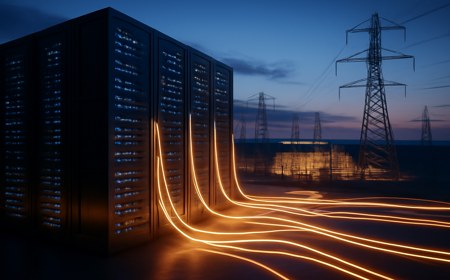
Google, Nvidia and Emerald AI have launched the AI Energy Management Alliance to promote flexible AI data centers that can adjust electricity demand in response to grid conditions. The coalition is pushing utilities, grid operators and regulators to treat verifiable flexibility as a reason to accelerate large-load interconnection. The Pattern Nexus read: AI compute demand is being converted from a fixed grid burden into a dispatchable power-market asset.
Inside this report
- Google and Nvidia Turn Flexible Load Into an AI-Data-Center Fast Lane
- Quick Read
- Table of Contents
 Editor-written summary
China has brought border control into the same strategic-security frame as chips, AI, export controls, state secrets and technology transfer. The new rules do not merely regulate passports; they create a legal channel for treating engineers, researchers, executives and sensitive-sector workers as part of the national-security perimeter. The system read is that talent mobility is becoming another control surface in U.S.-China technology competition.
Inside this report
- China Turns Exit Controls Into a Tech-Talent Firewall
- Quick Read
- Table of Contents
 Editor-written summary
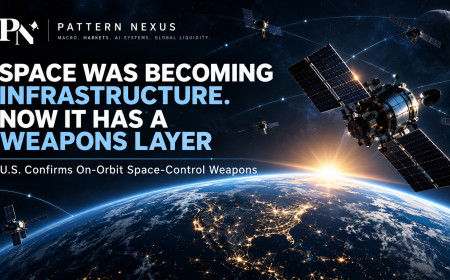
For the first time, the United States has publicly acknowledged that it operates "on-orbit space control weapons." The hardware remains classified, but the surrounding architecture is not: Space Force doctrine already defines orbital warfare, electromagnetic warfare, cyber operations, reversible denial, degradation and destruction as parts of space control; ground-based counterspace systems are already operational; and China, Russia and other states are developing the same wider capability stack. This Pattern Nexus report separates what is confirmed from what remains unknown, explains the Outer Space Treaty, maps the counterspace technology families, and ties the disclosure directly into earlier Pattern Nexus work on space infrastructure, "Launch. Control. Network.", cislunar logistics, and Control Stack 2.0. The central thesis: space becoming infrastructure was phase one; infrastructure becoming an explicitly armed control layer is phase two.
Inside this report
- The United States Did Not Announce a Future Program. It Acknowledged a Capability Already on Orbit.
- The First Is the Admission, Not the Beginning of Military Competition in Space
- The Space Force Told Us the Operating Logic in 2025
 Editor-written summary
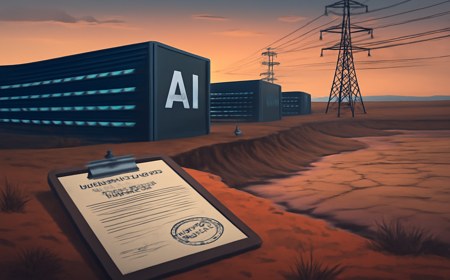
Texas is ordering the Texas Water Development Board to pursue penalties and legal consequences against major water users, including data centers, that fail to complete required water-use surveys. Abbott’s directive also links water reporting to TCEQ permitting and ERCOT coordination, making resource disclosure a practical gate for AI data-center expansion in the state.
Inside this report
- Texas Turns Data-Center Water Reporting Into a Permit-Blocking AI Infrastructure Test
- Quick Read
- Table of Contents
 Editor-written summary
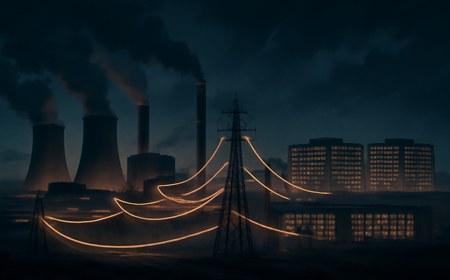
EPA Administrator Lee Zeldin signed a final partial repeal of the 2024 Carbon Pollution Standards for fossil-fuel power plants and paired it with a proposal to rescind remaining greenhouse-gas standards for the sector under Clean Air Act Section 111. EPA frames the action as an energy-abundance and cost-saving measure worth more than $300 billion, while major news reports say environmental groups expect legal challenges. The AI angle is not that EPA regulated AI directly, but that rising data-center and industrial load is becoming a justification for fossil-basaload deregulation.
Inside this report
- EPA Turns AI Power Demand Into a Fossil-Baseload Deregulation Test
- Quick Read
- Table of Contents
 Editor-written summary
Trump dismissed AI catastrophe warnings as a hoax and framed pressure for AI guardrails as hostile to U.S. leadership, AI companies and data centers. The clash follows calls from Anthropic’s Dario Amodei, OpenAI’s Sam Altman and Elon Musk to pace frontier-model development and expand safety oversight. The bigger pattern is a political operating system that treats AI safety, permitting, energy demand and China competition as one acceleration problem.
Inside this report
- Trump Converts AI Safety Warnings Into a China-Race Doctrine
- Quick Read
- Table of Contents
 Editor-written summary
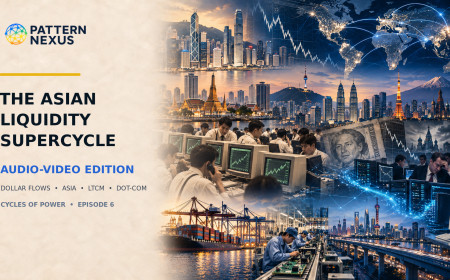
Episode 6 of the weekly Pattern Nexus audio-video series turns Part 6 of Cycles of Power into a shorter story about how liberalized capital flows, dollar borrowing, currency pegs, the Asian Financial Crisis, Russia, LTCM, the dot-com boom, and China's WTO entry created the modern global liquidity supercycle between 1994 and 2001.
Inside this report
- The Asian Liquidity Supercycle — Audio-Video Edition
- About this episode
- The leverage machine went global—and liquidity learned to reverse instantly
 Editor-written summary
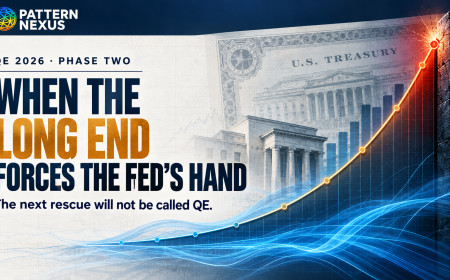
The Fed already ended QT and expanded Treasury holdings through bill-focused reserve-management purchases, but that repaired the reserve layer without suppressing the long end. With the 10-year Treasury at 4.95%, the 30-year at 5.37%, real long yields near the Pattern Nexus red zone, Treasury doubling long-end buybacks, and August CPI limiting conventional easing, this report calculates the probability that QE 2026 moves into a second phase. It maps the likely program, the names it may use, the dates when it could expand, and the exact yield, reserve, auction, repo, leverage, and credit conditions that could force direct duration absorption.

