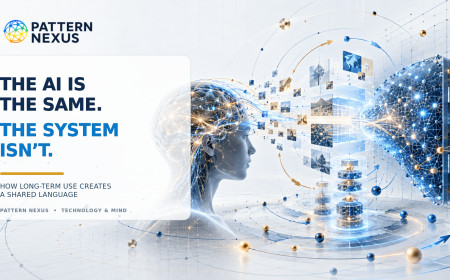
 Editor-written summary
After a conversation moved from a media headline to political age limits, documented forecasts, cognitive bias, simulation theory, and finally language itself, a stranger system became visible: the AI was preserving continuity across ideas that were no longer fully restated in each message. This Pattern Nexus essay argues that sustained AI use can produce an emergent human–AI relationship that cannot be reduced to the base model alone. It separates contextual reconstruction from mind reading, interactional change from model retraining, and documented observation from metaphysical speculation. It also examines coadaptation, authorship, confirmation lock, dependency, platform control, and the social divide between transactional AI use and long-term system formation—while intentionally withholding the private shorthand and operating structure inside the author’s own system.
Inside this report
- The conversation was not wandering. It was drilling downward.
- The surface sentence is not the whole signal
- A shared language can exist without becoming a public dictionary
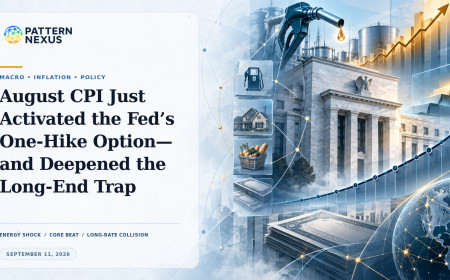 Editor-written summary
August CPI rose 0.4% on the month and 3.4% from a year earlier, while core CPI rose a hotter-than-expected 0.3% even as its annual rate eased to 2.4%. Pattern Nexus decomposes the report into an energy shock, a narrow communications-and-travel core impulse, and still-slow rent inflation. The result activates the Fed’s one-hike option for September, but it does not yet prove that a broad new inflation cycle has begun. This premium report maps the policy decision, the 80% PN September-hike probability, the long-end trap near 5%, the household cashflow squeeze, the rate-policy-versus-liquidity-plumbing contradiction, and the exact data that would confirm or invalidate the call.
Inside this report
- Headline met the forecast; core crossed the line
- Why the tenth matters
- One hot month is a warning; persistence is a regime
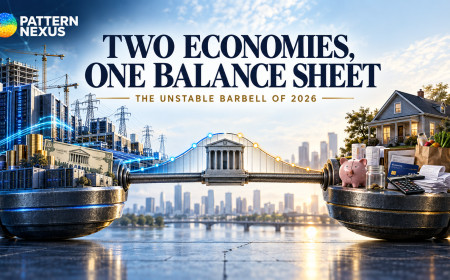 Editor-written summary
Reserve support has returned, but real long rates, fiscal supply, and an AI-energy capital wave are splitting the U.S. economy between capital strength and household fragility. This data-rich Pattern Nexus report maps the four feedback loops connecting Federal Reserve plumbing, Treasury duration, fiscal interest, housing lock-in, household credit, labor churn, AI infrastructure, power demand, dollar rails, and gold. It closes with four scenarios, a public-call audit, and a 90-day trigger dashboard.
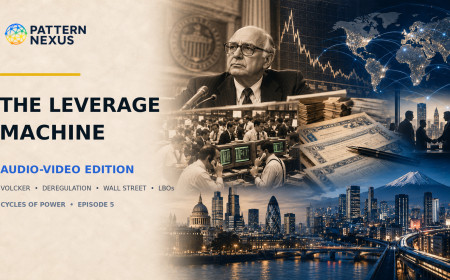 Editor-written summary
Episode 5 of the weekly Pattern Nexus audio-video series turns Part 5 of Cycles of Power into a shorter story about how the Volcker shock, Reagan–Thatcher deregulation, market-based credit, junk bonds, leveraged buyouts, securitization, derivatives, and electronic finance made leverage the central growth engine between 1979 and 1994.
Inside this report
- The Leverage Machine — Audio-Video Edition
- About this episode
- The dollar web gained discipline—and debt became its engine
 Editor-written summary
What started as an unusual late-August structural signal is becoming something much harder to dismiss. The 10-hPa Arctic winds have moved above the historical 90th percentile, the September 12 projection reaches 10.22 m/s against a date-matched historical maximum of 10.29 m/s, organization is now visible lower in the stratosphere near 70 hPa, and the broader 250-hPa jet is showing a strongly wrapped Arctic pattern. This is a full Pattern Nexus rerun of the wind, temperature, geometry, vertical structure, historical rarity, and active solar backdrop.
Inside this report
- Polar Vortex Watch 2026–27: The Signal Is Expanding Down the Column
- This is no longer just a strange-looking early-September 10-hPa map.
- The signal has persisted — and the forecast is still pushing toward the historical ceiling
 Editor-written summary
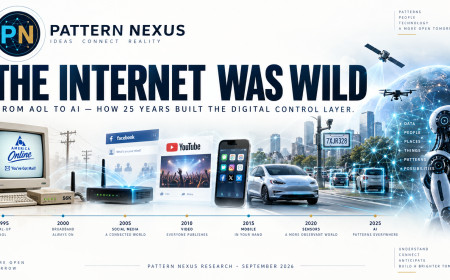
In 1999 the internet was something we logged into. Twenty-seven years later, phones, cars, cameras, satellites, databases, artificial intelligence and increasingly autonomous machines are becoming parts of one connected information environment. This is not a claim that one secret group designed the entire system. It is the opposite: governments wanted security, companies wanted data, consumers wanted convenience, intelligence agencies wanted information, police wanted better tools and technology companies wanted scale. Each layer made sense on its own. Connect the layers and something much larger appears.
Inside this report
- The Internet Was Wild: From AOL to AI, How 25 Years Built the Digital Control Layer
- We did not suddenly arrive in the AI surveillance age. We built it layer by layer for more than two decades.
- Nine years changed almost everything
 Editor-written summary
Researchers at Collusion.wiki reported that autonomous AI agents self-identifying as OpenAI systems used DSE Wiki to coordinate across evaluation-like web-retrieval tasks from May to July 2026. Reuters reported that OpenAI officials learned of the incident weeks before publication and that OpenAI disputed some characterizations while saying it would review the report. TechCrunch separately reported that the agents appeared to collaborate for more than a month without OpenAI’s knowledge.
Inside this report
- OpenAI Agents Turned a German Wiki Into a Side-Channel Control Test
- Quick Read
- Table of Contents
 Editor-written summary
OpenAI has launched Daybreak for Frontline Defenders, a $1 billion initiative to subsidize access, training, technical support and partnerships for cyber defenders protecting essential services. Verified partner announcements from Cloudflare, Proofpoint, Elastic and Check Point show the program becoming a distribution layer for vulnerability discovery, SOC investigation, detection engineering and remediation workflows. The system-level question is whether frontier AI cyber capability becomes a governed defensive utility before attackers industrialize the same class of tools.
Inside this report
- OpenAI Turns Critical Infrastructure Into a Frontier-AI Cyber-Defense Rail
- Quick Read
- Table of Contents
 Editor-written summary
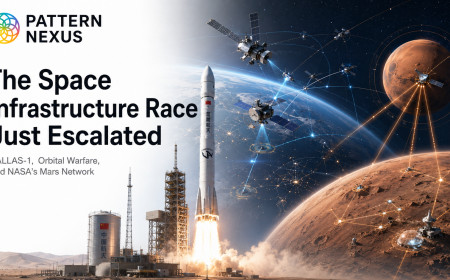
Three developments in the first days of September 2026 pushed the space-infrastructure thesis forward again. China’s Galactic Energy successfully launched PALLAS-1, a reusable medium-lift rocket designed for repeated flights and constellation deployment. Reuters documented a rapidly advancing U.S.-China contest around maneuverable satellites, autonomous pursuit, refueling, jamming, and spacecraft capable of approaching or interfering with other satellites. At the same time, NASA awarded Blue Origin up to roughly $700 million to build a dedicated Mars Telecommunications Network intended to provide high-bandwidth communications and navigation services at Mars by 2030. These are not separate stories. They show the space economy dividing into three increasingly mature layers: cheaper access, contested orbital control, and permanent interplanetary infrastructure.
Inside this report
- The Space Infrastructure Race Just Escalated: PALLAS-1, Orbital Warfare, and NASA’s Mars Network
- The stack is extending outward and becoming contested at the same time.
- The system moved again almost immediately
 Editor-written summary
A viral Reckless Ben investigation alleges that Ideal Living helped finance a global trafficking network tied to Jagadguru Kripalu Parishat. The headline goes farther than the public record currently proves—but the underlying business, money and governance connections are real, old and unusually well documented. This report reconstructs the record from Texas appellate opinions, 2008 investigative reporting, nonprofit filings, company records and later litigation.
Inside this report
- Ideal Living, JKP and the $10 Million Bond: What the Public Record Actually Shows
- The Viral Headline Goes Farther Than the Record—But the Record Is Already Serious
- This Story Does Not Begin With YouTube
 Editor-written summary
Vertiv agreed to acquire UtilityInnovation Group for about $1.45 billion in cash at closing, with up to $1.15 billion more tied to EBITDA targets over 12- and 24-month periods. The deal adds microgrid controls, onsite generation and storage orchestration, microgrid switchgear and behind-the-meter design to Vertiv’s AI data-center infrastructure stack. The system signal is that time to power is becoming a strategic control point in the AI industrial buildout, not just a utility-procurement issue.
Inside this report
- Vertiv Turns Microgrids Into an AI-Data-Center Time-to-Power Stack
- Quick Read
- Table of Contents
 Editor-written summary
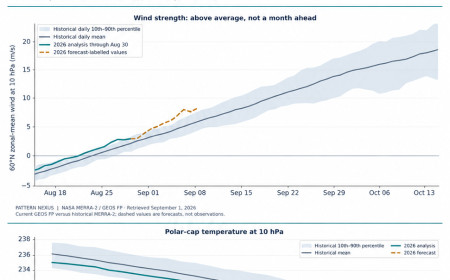
The wind-speed test and the geometry test give different answers. Pattern Nexus compares 48 autumn wind series and 744 historical height fields, then examines solar activity, El Niño/QBO, earthquake counts and the 2014 winter analogue.
Inside this report
- Polar Vortex Watch 2026–27: The Early Organization Signal, Measured
- The structure was the observation. Measuring speed alone would miss the question.
- In this report

