 Editor-written summary
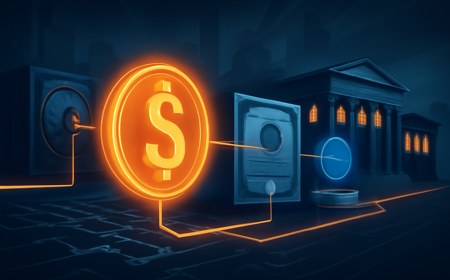
Twenty-one international financial institutions announced on September 1, 2026 that they plan to establish a new company in the second half of 2026 to support a stablecoin solution. The effort is expected to begin with a U.S. dollar-denominated token targeted for market launch in the first half of 2027, with stated ambitions to comply with the GENIUS Act and MiCA where applicable. The pattern is not simply banks adopting crypto rails; it is incumbent finance trying to control the issuance layer before crypto-native stablecoin issuers harden the default dollar network.
Inside this report
- Wall Street Turns Stablecoins Into a Bank-Owned Dollar Rail
- Quick Read
- Table of Contents
 Editor-written summary
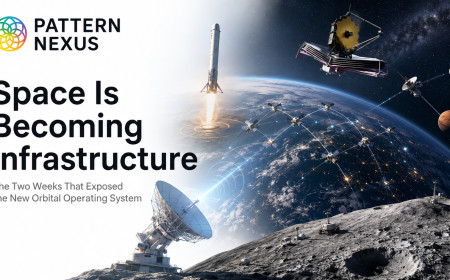
Roman launched, Falcon 9 hit 100 flights, China landed Zhuque-3, NASA expanded the Deep Space Network and autonomous spacecraft navigation, and orbital infrastructure accelerated.
Inside this report
- Space Is Becoming Infrastructure: The Two Weeks That Exposed the New Orbital Operating System
- The real story is not one rocket. It is the stack becoming continuous.
- I initially thought this was a launch story. It is much bigger than that.
 Editor-written summary
SLB said on August 31, 2026 that it agreed to acquire Kelvion, a German thermal-management and heat-exchange company, for about $3.4 billion in cash plus roughly $0.7 billion of assumed debt. The deal expands SLB’s Data Center Solutions business and positions cooling, modular construction and industrial reliability as core bottlenecks in the AI buildout.
Inside this report
- SLB Turns Data-Center Cooling Into a $4.1 Billion AI-Industrial Beachhead
- Quick Read
- Table of Contents
 Editor-written summary
U.S. forces struck two Iranian launchers on Larak Island near the Strait of Hormuz on August 30 after U.S. officials said IRGC personnel were preparing rockets carrying sea mines for the waterway. Iran claimed retaliatory strikes on bases hosting U.S. forces in Jordan, the UAE reported dealing with a drone from Iran over its territorial waters, and Brent crude moved back above $90 as traders repriced disruption risk. The immediate question is whether this remains a limited counter-mining action or becomes a broader contest over who can keep Hormuz usable.
Inside this report
- Larak Strike Turns Hormuz Into a Mine-War Energy Shock
- Quick Read
- Table of Contents
 Editor-written summary
Residents protested outside an August 29 Effingham County work session as officials fielded questions about OpenAI’s Project Camellia. The dispute now centers on whether Georgia’s large-load framework can truly keep AI megacampus costs off ordinary ratepayers while managing water, grid-reliability and public-transparency concerns.
Inside this report
- OpenAI Turns Effingham County Into a 3.2-Gigawatt Ratepayer-Firewall Test
- Quick Read
- Table of Contents
 Editor-written summary
Episode 4 of the weekly Pattern Nexus audio-video series turns Part 4 of Cycles of Power into a shorter story about how silver redemption, the Nixon Shock, floating currencies, Eurodollars, oil shocks, petrodollar recycling, and offshore banking transformed the gold-linked dollar fortress into a global dollar web between 1968 and 1979.
Inside this report
- The Monetary Break — Audio-Video Edition
- About this episode
- The gold promise died—and the dollar network expanded
 Editor-written summary
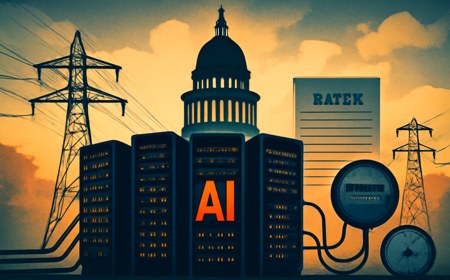
California lawmakers reached a late-August compromise on data-center energy legislation as AI infrastructure growth collides with utility-bill politics. Official Aug. 28 amendments to SB 886 and AB 2383 show the core mechanism: CPUC tariffs and updated electric rules for large participating data-center customers, with cost-shift protections for nonparticipating ratepayers. The bills remain active, not enacted, and the next fight is how the CPUC would translate legislative guardrails into actual interconnection, generation, and demand-response rules.
Inside this report
- California’s AI Data Center Fight Moves to the Utility Bill
- Quick Read
- Table of Contents
 Editor-written summary
The Ninth Circuit affirmed in part the dissolution of Kalshi’s injunction against Nevada, holding that Kalshi had not shown the Commodity Exchange Act preempts Nevada gaming law for sports-event contracts. The panel treated the sports products as sports bets rather than CFTC-protected swaps, while remanding the election-contract issue. The decision conflicts with the Third Circuit’s April ruling favoring Kalshi’s preemption theory, increasing the odds of Supreme Court review.
Inside this report
- Ninth Circuit Turns Prediction Markets Into a State-Gambling Control Fight
- Quick Read
- Table of Contents
 Editor-written summary
Kevin Warsh’s Jackson Hole speech gave markets a hawkish Fed signal, with AP reporting a jump in the two-year Treasury yield after the remarks. Warsh tied the policy debate to persistent inflation, strong AI-related investment, and a less guidance-heavy central bank communication regime. Pattern Nexus reads the speech as a liquidity-regime shift: inflation credibility now sits above market comfort.
Inside this report
- Warsh Turns Jackson Hole Into a Rate-Hike Liquidity Shock
- Quick Read
- Table of Contents
 Editor-written summary
A U.S. District Court judge ruled for Anthropic after the Pentagon labeled the company a supply-chain risk over its refusal to permit unrestricted military uses of Claude. The decision found the government’s actions unlawful and framed the dispute as a constitutional, procurement, and AI-safety fight. The Pattern Nexus read: the ruling does not settle whether the military may demand more permissive AI systems, but it limits how national-security procurement tools can be used against vendors that publicly resist those demands.
Inside this report
- Federal Court Turns Anthropic’s Pentagon Blacklist Into an AI-War Powers Test
- Quick Read
- Table of Contents
 Editor-written summary
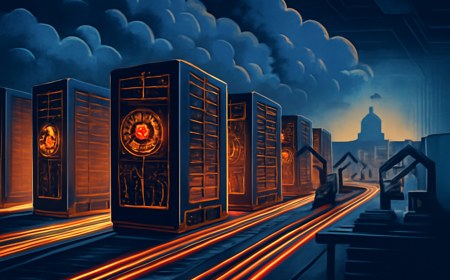
AWS and Nvidia plan to deploy 2 million additional Nvidia GPUs across AWS global infrastructure in 2027 and 2028, including Blackwell Ultra, Rubin, and Rubin Ultra systems. The collaboration also reaches into Vera CPUs, NVLink Fusion with Nvidia custom high-bandwidth memory for Trainium, U.S. government AI factories with 100,000 GPUs, and physical-AI tooling for robotics. The Pattern Nexus read: AWS is converting GPU access into a control layer across cloud, federal, and embodied AI markets.
Inside this report
- Amazon Turns Nvidia GPUs Into a 2028 AI-Factory Supply Line
- Quick Read
- Table of Contents
 Editor-written summary
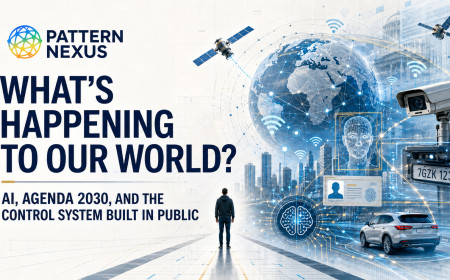
I was reading these documents twenty years ago, when most people thought the warnings were insane. Now the architecture is everywhere. This personal systems essay connects humanity’s inability to absorb accelerating change with Agenda 21, Agenda 2030, post-9/11 legal infrastructure, Klaus Schwab’s own books, digital identity, smart-home surveillance, Wi-Fi sensing, Starlink passive radar, Flock cameras, connected cars and the AI layer that can finally fuse it all together.
Inside this report
- What’s Happening to Our World? AI, Agenda 2030, and the Control System Built in Public
- The world is not merely changing faster. Its control layers are finally converging.
- What is happening to our world?

