 Editor-written summary
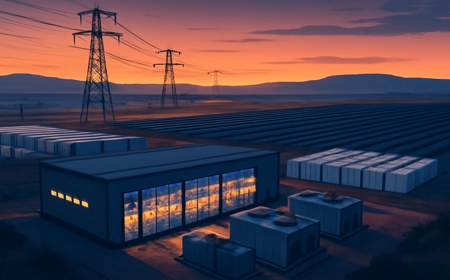
EPA has proposed removing minimum federal public-participation requirements for minor New Source Review permits and leaving those choices to state and local air agencies. Advocates are now framing the rule as an AI data-center transparency fight because backup generators and onsite power sources can be permitted as minor or synthetic-minor sources. The policy question is no longer only how fast AI infrastructure can get power, but who gets to see and contest the air permits attached to that buildout.
Inside this report
- Washington Turns AI Data-Center Air Permits Into a Disclosure-Off Switch
- Quick Read
- Table of Contents
 Editor-written summary
Lancium announced a strategic collaboration with Nvidia on August 24, 2026, including an undisclosed Nvidia investment and planned deployment of Nvidia’s full-stack AI factory platform across Lancium campuses. The portfolio includes 4 GW of leased capacity and a development pipeline exceeding 15 GW of powered land. The Pattern Nexus signal is that Nvidia is attaching its platform and capital to power-ready sites while DSX MaxLPS and DSX Flex position power utilization and grid responsiveness as part of the AI factory stack.
Inside this report
- Nvidia Turns Powered Land Into a Grid-Responsive AI Factory Pipeline
- Quick Read
- Table of Contents
 Editor-written summary
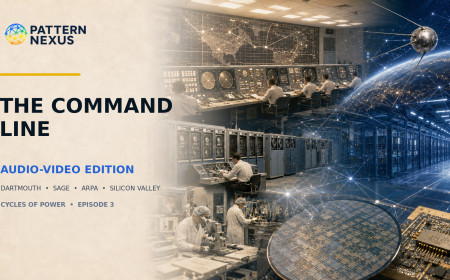
Episode 3 of the weekly Pattern Nexus audio-video series turns Part 3 of Cycles of Power into a shorter story about how Dartmouth, integrated circuits, ARPA, SAGE, Fairchild Semiconductor, Silicon Valley, and IBM built the first compute–defense–industrial command layer—and why today's AI–defense–cloud complex is its direct descendant.
Inside this report
- The Command Line — Audio-Video Edition
- About this episode
- Information became infrastructure—and infrastructure became power
 Editor-written summary
RUM Group disclosed a six-year GPU-services agreement with an unaffiliated U.S.-based cloud customer, tied to its Maysville, Georgia site that is still under development. The contract carries an approximately $13.7 billion three-tranche order value and is paired with a warrant for up to 50,808,408 Class A shares at $0.01 per share. The key Pattern Nexus signal is that AI compute demand is being converted into equity-linked financing and dilution risk before the underlying data-center capacity exists.
Inside this report
- RUM Group Turns AI Compute Into a Penny-Warrant Financing Test
- Quick Read
- Table of Contents
 Editor-written summary
XPeng said on August 24, 2026 that its robotics business entered share-purchase agreements to raise more than $900 million at a post-money valuation above $6.3 billion. The financing gives Dogotix a standalone capital structure for humanoid robot R&D, physical-AI model training, data collection, mass-production capacity and commercialization. The system signal is that China’s EV stack is being repurposed as a humanoid-robot manufacturing and data flywheel.
Inside this report
- XPeng Turns Humanoid Robots Into a $6.3 Billion Physical-AI Spinout
- Quick Read
- Table of Contents
 Editor-written summary
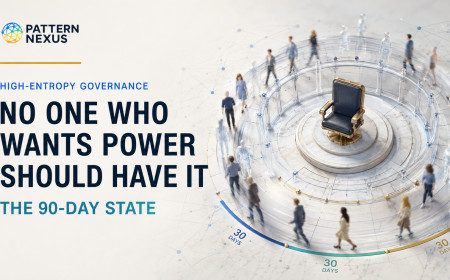
Elections reward the people best adapted to campaigning, fundraising, party advancement and self-promotion—not necessarily the people best suited to govern. This full Pattern Nexus framework proposes High-Entropy Governance: a universal civic competency path, stratified public sortition, a 600-person assembly serving staggered 90-day terms, lifetime non-repeatability, a rotating civic executive, adversarial evidence, permanent merit-based operations, independent courts and random audit juries. It also confronts the system's largest dangers: discriminatory qualification gates, nonresponse bias, lobbying, bureaucratic capture, emergency power and legitimacy without reelection.
Author: Christopher Grenke / Pattern Nexus Research Desk
Inside this report
- No One Who Wants Power Should Have It: The 90-Day State
- Stop Looking for Better Rulers. Make Rulership Unable to Persist.
- A Better World Cannot Depend on Everyone Becoming Wise
 Editor-written summary
Hyundai Motor’s union in South Korea staged its first full-day strike in a decade on August 21, 2026, as wage talks stalled and demands expanded into job protections against AI and automation. The dispute now intersects with Hyundai Motor Group’s plan to deploy Boston Dynamics’ Atlas humanoid robots at its Georgia plant from 2028, turning humanoid robotics from a demo-stage technology into a collective-bargaining issue.
Inside this report
- Hyundai Turns Humanoid Robots Into a Factory-Labor Control Fight
- Quick Read
- Table of Contents
 Editor-written summary
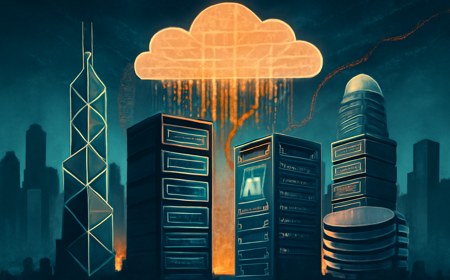
Alibaba announced the pricing of a HK$80 billion placement of 710 million new ordinary shares at HK$112.70 each, with closing expected on August 26, 2026, subject to customary conditions. The company said 100% of net proceeds will go toward full-stack AI capabilities, including expansion and enhancement of AI infrastructure. Reuters, Bloomberg and South China Morning Post reported the deal as roughly US$10.2 billion and tied it to Alibaba’s broader push across chips, cloud infrastructure, AI models and applications.
Inside this report
- Alibaba Turns Hong Kong Equity Into an AI-Compute War Chest
- Quick Read
- Table of Contents
 Editor-written summary
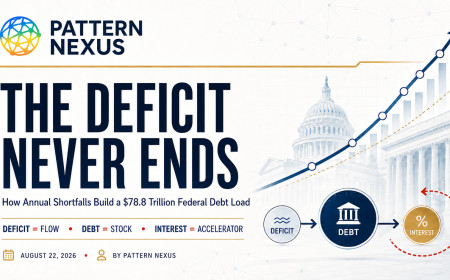
Most people use “deficit” and “debt” as if they mean the same thing. They do not. This report uses two Pattern Nexus infographics and official CBO and Treasury data to map the annual federal deficit and total federal debt from 2020 through 2040, explain why interest creates a self-reinforcing feedback loop, and show why the 10-year and 30-year Treasury yields—not a political debt-clock slogan—are the market constraint that matters.
Inside this report
- The Deficit Never Ends: How Annual Shortfalls Build a $78.8 Trillion Federal Debt Load
- The deficit is the flow. The debt is the stock. Interest connects them.
- The pandemic spike is not the main story. The failure to return to balance is.
 Editor-written summary
Treasury said it will raise maximum liquidity-support buybacks in the 10-to-20-year and 20-to-30-year nominal coupon sectors from $2 billion to at least $4 billion per operation beginning September 9, 2026. Follow-up reporting from AP, Reuters and Axios shows the market treated the move as an attempted long-end yield intervention, but the initial relief faded quickly. The Pattern Nexus read: this is not formal yield-curve control, but it is a live test of whether Treasury plumbing can absorb stress that monetary policy credibility and fiscal math are failing to contain.
Inside this report
- Treasury Turns Long-Bond Buybacks Into a Yield-Control Test
- Quick Read
- Table of Contents
 Editor-written summary
The United States can arm Ukraine while temporarily easing pressure on Russian oil, convert stockpile transfers into new procurement, court North Korea while Pyongyang supplies Russia, and fight Iran while Russia and China-linked systems help Tehran. The contradictions resolve when the wars are mapped as one connected system of energy, munitions, intelligence, shipping, sanctions and leverage.
Inside this report
- One System, Many Flags: Ukraine, Iran, North Korea and the Illusion of Separate Wars
- The wars are separate on the map and connected in the machinery.
- Andrews → Riga → Moscow: another connection appears
 Editor-written summary
The U.S. and Iran traded warnings before a planned Monday sanctions announcement by Treasury Secretary Scott Bessent. Reuters, AP and Bloomberg report that Washington is preparing a wider secondary-sanctions push that could reach Iran’s remaining trading partners, including China, while Strait of Hormuz oil flows remain heavily constrained. The Pattern Nexus read: this is no longer just Iran policy; it is a wartime test of U.S. financial enforcement against energy flows that Asia still needs.
Inside this report
- Washington Turns Iran Sanctions Into a China Oil-Flow Loyalty Test
- Quick Read
- Table of Contents

