
Disclosure Theater: Aliens, Declassification Power, and the Royal Arrest Signal
Three headlines hit the same control layer: Obama’s “aliens are real” quip, Trump’s declassification posture, and the arrest of Andrew Mountbatten-Windsor. This is not random. It’s information authority, legitimacy management, and institutional discipline playing out in public.
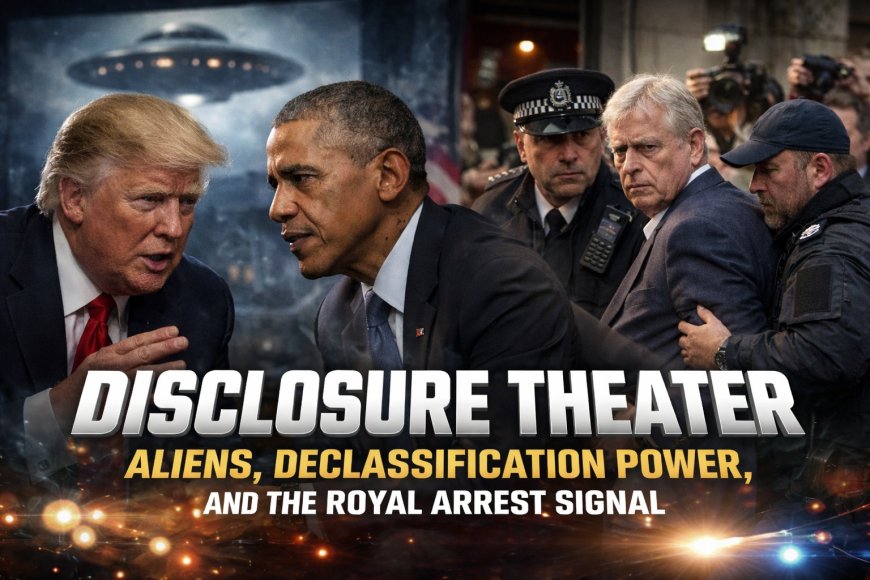


If you treat today as random “clown world,” you miss the mechanism. Obama’s viral alien clip, Trump’s declassification rhetoric, and the arrest of Andrew Mountbatten-Windsor are all about control of information and legitimacy. Who can say what is “real,” who can reclassify or declassify it, and which institutions still enforce discipline when reputational debt comes due. The throughline is not aliens. The throughline is authority.
“Disclosure” is a permission lever. The state doesn’t just classify secrets, it classifies trust. Declassification is governance, not trivia.
Risk: spectacle crowds out process. Viral clips convert complex classification, legal procedure, and evidentiary standards into a meme economy.
Institutions are still capable of discipline, but they increasingly do it in public, through statements, optics, and procedural theater designed to preserve legitimacy.
The Tape: What Happened Today
Three events stacked on top of each other, and the timeline matters.
First, a clip from Barack Obama’s interview with Brian Tyler Cohen made the rounds: asked about aliens, Obama said “they’re real,” then clarified that he saw no evidence during his presidency of extraterrestrials making contact. The clip is designed for virality because the question is framed as a binary, while the real world is statistical uncertainty, incomplete evidence, and classification boundaries.
Second, Donald Trump responded by accusing Obama of disclosing classified information and publicly suggested he could “get him out of trouble” by declassifying records. Separately, reporting indicates Trump directed the Pentagon and other agencies to release any files they have on UFOs or unidentified anomalous phenomena.
Third, in the UK, Andrew Mountbatten-Windsor (formerly Prince Andrew) was arrested on suspicion of misconduct in public office tied to allegations connected to Jeffrey Epstein-era disclosures. He was later released under investigation, and statements from police and the King emphasized process, restraint, and the integrity of an ongoing investigation.
These are all “authority events.” They are not primarily about aliens, not primarily about gossip, and not primarily about one person. They are about who is allowed to define reality, disclose information, enforce norms, and preserve institutional credibility when the public is watching.
Declassification as a Control Lever
In Pattern Nexus terms, “disclosure” sits on the permission stack. It’s an access control system for reality claims. Classification is a gate. Declassification is a key. The person who holds the key can move the boundary between “you’re not allowed to know this” and “this is officially true.”
That’s why UAP narratives keep returning. They are uniquely useful for control-systems politics because they combine high public interest with a natural fog-of-war. The evidence is contested, the data is classified, and the audience is primed to treat any official release as either confirmation or cover-up. Either way, attention flows.
The move today is not the claim itself. The move is the posture: “I can declassify anything.” That’s a statement about executive authority and institutional hierarchy. It reframes the story away from “what is true” toward “who controls the archive.”
- Attention capture: aliens are a universal hook that cuts across political tribes.
- Authority signaling: declassification rhetoric signals power over the boundary of official truth.
- Selective transparency: releases can be partial, curated, timed, and narrative-shaped.
If agencies release documents, the public will treat the release as definitive. But a release is still a policy decision made inside a control system: what to publish, what to redact, what to frame, what to deny, and when. The artifact is not the truth. The artifact is the permitted slice of the truth.
The Royal Arrest and Institutional Discipline
The Andrew Mountbatten-Windsor arrest is the other side of the same system: not disclosure as spectacle, but procedure as legitimacy repair. When institutions face long-running reputational debt, they eventually pay it in one of two currencies: accountability or collapse. The public wants the first. Bureaucracies resist both until pressure overwhelms them.
The “released under investigation” framing matters. It is legal process, but it is also optics management. Police statements, royal statements, and media restraint language are all part of a choreography designed to preserve the integrity of the case and the credibility of the institutions around it.
The most important signal is not celebrity. It is precedent. A system willing to enforce process against a high-status node is demonstrating it still has enforcement capability. Whether that capability is evenly applied is a different question. But capability itself is a signal.
When trust is low, institutions overcommunicate process. When trust is high, institutions can undercommunicate and still be believed. Watch the ratio of “process statements” to “substance statements.” It tells you where legitimacy is leaking.
Pattern Nexus Lens
Today is one pattern, expressed through three stories. The pattern is control of narrative rails via control of information gates. “Aliens” is the payload because it spreads. “Declassify” is the mechanism because it asserts hierarchy. “Arrest” is the enforcement signal because it demonstrates the system can still impose cost.
In a high-noise environment, governance increasingly happens through attention. The public isn’t just being informed, they’re being steered. This is not conspiracy. It’s a structural reality of modern media, political incentives, and institutional survival.
If you want to understand the next phase of politics, stop asking “what’s the headline” and start asking “what control lever is being pulled.”
FAQ
Did Obama “confirm aliens exist” in a literal sense?
The viral clip is a compressed moment. Obama later clarified he saw no evidence of extraterrestrials making contact during his presidency. Treat the clip as a meme-format artifact, not a scientific claim.
Can Trump actually declassify anything?
The executive branch has broad declassification authority, but the real-world path runs through agencies, classification guidelines, redactions, and legal constraints. “I can declassify anything” is a power posture, not a detailed workflow.
What does “released under investigation” mean in the Andrew case?
It generally indicates a person was arrested and questioned, then released while the investigation continues. It is not a charge and not a conviction. Watch for charging decisions, court filings, and official updates.
Sources
Primary reporting used to support the timeline and statements referenced in this brief.
- Reuters (Feb 19, 2026): Trump, Obama, and UFO files
- CBS News (Feb 19, 2026): Trump directs release of UFO/UAP files
- TIME (Feb 2026): Obama “they’re real” clip and context
- The Guardian (Feb 19, 2026): Arrest, statements, and release
- AP (Feb 19, 2026): Background and significance of the arrest
- CBS News (Feb 19, 2026): Arrest details and investigation framing
Care este reacția ta?
 Îmi place
0
Îmi place
0
 Dezaprobat
0
Dezaprobat
0
 Iubire
0
Iubire
0
 Amuzant
0
Amuzant
0
 Wow
0
Wow
0
 Tristețe
0
Tristețe
0
 Înfuriați
0
Înfuriați
0

Founder of Pattern Nexus. I research markets, macro, geopolitics, AI, history, ancient systems, and the patterns most people overlook. I’m also building Market Radar, a trading scanner designed to read pressure, risk, confirmation, and setup quality before chasing a move. Pattern Nexus is where I connect the dots between data, history, technology, and the bigger system playing out around us.














Comentarii (0)