
Middle East Force Posture Update: 82nd Airborne, Marine Lift, and the Iraq Drawdown
A Pattern Nexus breakdown of the last week’s Middle East force-posture changes: the 82nd Airborne preparing to move, Marine expeditionary forces already deploying, and NATO and Spain thinning advisory footprints out of Iraq.
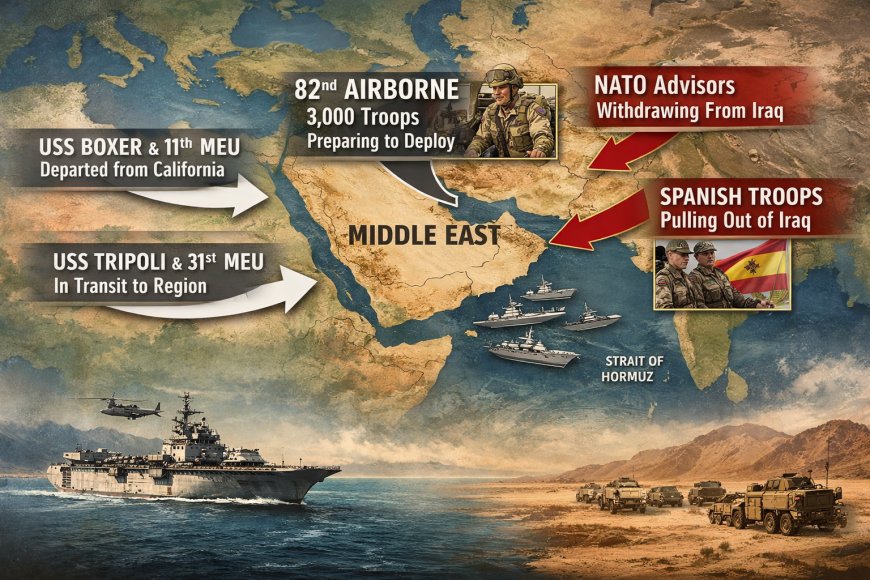

The United States is building a layered reinforcement stack rather than making one single blunt move. One Marine expeditionary formation is already in transit from the Indo-Pacific. Another has just deployed from California ahead of schedule. The 82nd Airborne is now the visible ground-force layer being prepared behind that maritime stack. At the same time, Spain and NATO are reducing advisory exposure in Iraq. That does not contradict the buildup. It shows different mission types being treated differently under stress. Mobile, scalable combat-adjacent options are being thickened. Static advisory exposure is being reduced. That is the real signal.
The reporting mistake right now is treating “considering,” “ordered,” “departed,” “in transit,” and “relocated” like the same thing. They are not.
A pair of MEUs plus a ready airborne package is not symbolic posture. That is the system building layered options for deterrence, extraction, reinforcement, raids, route security, and escalation insurance.
The U.S. is thickening mobile combat layers while NATO and some European actors are reducing static advisory exposure in Iraq. That divergence is the point.
What Actually Moved This Week
The clean picture over the last seven days breaks into four real buckets. First, the 31st Marine Expeditionary Unit package tied to USS Tripoli was confirmed in transit through the Strait of Malacca on the way toward the Middle East. Second, the Boxer Amphibious Ready Group with the 11th Marine Expeditionary Unit deployed from California, effectively feeding a second Marine response layer into the theater pipeline. Third, the 82nd Airborne shifted from rumor and internal discussion into an active preparation phase, but with the publicly reported troop count still split between a lower confirmed floor and a higher expected ceiling. Fourth, Spain and NATO moved in the opposite direction in Iraq by relocating or withdrawing advisory personnel.
That means the real story is not “everyone is sending more troops.” It is more selective than that. The United States is thickening expeditionary and rapid-reaction options. NATO and at least one European ally are reducing exposure in fixed advisory positions. Those are not contradictory moves. They are different responses to the same stress environment.
- March 18: Tripoli / 31st MEU transit through the Malacca route becomes visible.
- March 18: Spain says it will relocate troops out of Iraq, after already moving a special forces element.
- March 19: Trump publicly says he is not putting troops anywhere, even as reinforcement planning remains live.
- March 20: Boxer, Comstock, Portland, and the 11th MEU deploy from California.
- March 20: NATO confirms it is adjusting its Iraq mission posture.
- March 24: 82nd Airborne package becomes the visible next-wave ground-force move.
The Marine Lift Layer
The Marine side of the posture change is deeper than one headline. The first layer is the Japan-based 31st MEU and the Tripoli package. What matters here is precision. Public reporting had to be corrected because not all of the ships people were casually lumping together actually made the same transit. The corrected picture is that USS Tripoli and USS New Orleans transited the Strait of Malacca and entered the Indian Ocean, while USS San Diego did not transit with them and was in Sasebo as of March 20. That matters because one of the themes running through this whole story is that loose reporting keeps overstating or blurring the actual movement picture.
The 31st MEU package also matters because it was not just a random ship movement. It was a forward-deployed force being redirected toward the Middle East from the Indo-Pacific side of the map. The force is roughly 2,200 Marines, and the embarked air wing on Tripoli includes F-35B fighters, Ospreys, and helicopters. In other words, this is not just lift. It is a self-contained expeditionary combat package with its own aviation, mobility, and limited strike utility already built in.
The second Marine layer is the Boxer ARG / 11th MEU deployment out of California. Boxer left first, then Comstock and Portland followed, with the 11th MEU already embarked after certification exercises. Reuters reported the package was departing roughly three weeks ahead of schedule. USNI’s reporting gives the structure more clearly: the MEU itself usually carries about 2,200 Marines and sailors, while the three amphibious ships add roughly another 2,000 sailors. AP’s lower-resolution summary gets to the same strategic point from another angle: the pair of MEUs together add about 5,000 Marines and thousands of sailors to the region.
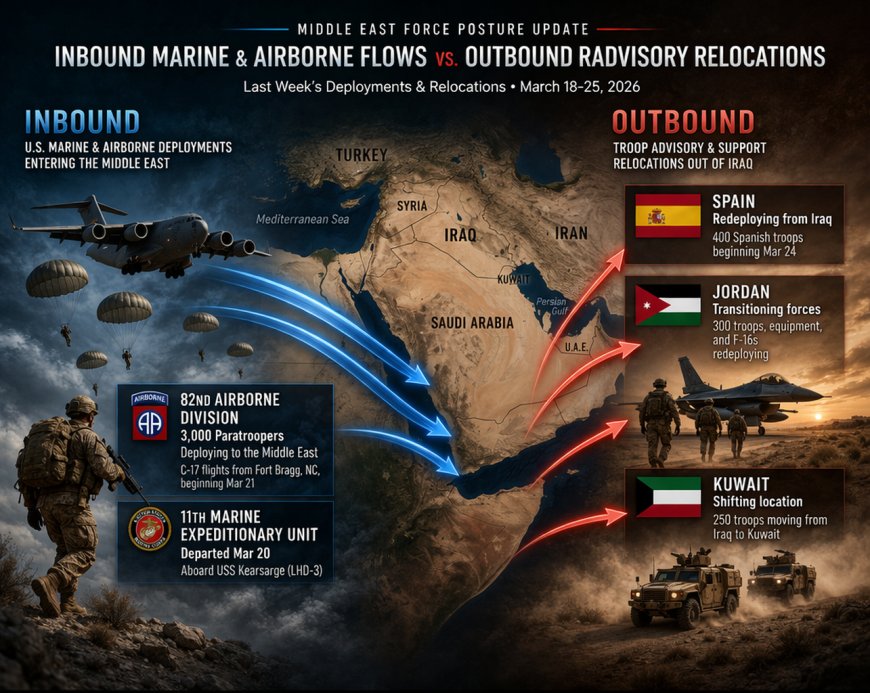
This is the point where the structure becomes visible. One MEU is already coming from the Indo-Pacific lane. Another is now feeding in from the U.S. West Coast. That is a two-source Marine reinforcement pattern, not a one-off shipment. It gives the system maritime mobility, vertical lift, aviation, embassy support options, extraction options, coastal raiding utility, and the ability to land forces if the mission set broadens. Even if the White House never uses the most aggressive option, the option set is being assembled anyway.
- 31st MEU / Tripoli package: already in transit through the Indo-Pacific route
- Boxer ARG / 11th MEU: deployed from California ahead of schedule
- Combined effect: two separate Marine expeditionary formations feeding the theater
The 82nd Airborne Layer
The 82nd Airborne piece is where the story shifts from maritime flexibility toward ground-force optionality. Reuters first reported on March 18 that the administration was considering sending thousands of troops as options around Hormuz and even limited operations against Iran’s shoreline or Kharg Island were being discussed. One day later, Trump publicly said he was not putting troops anywhere. Then by March 24 the reporting tightened into something real: Reuters said the Pentagon was set to send 3,000 to 4,000 soldiers from the 82nd Airborne, while AP reported a lower-bound package of at least 1,000 troops.
That discrepancy does not necessarily mean one source is wrong. It more likely reflects a difference between a confirmed initial tranche and a broader package under preparation. AP’s version is useful because it adds the composition detail Reuters did not: the force would include a battalion from the 1st Brigade Combat Team plus Maj. Gen. Brandon Tegtmeier and division staff. That means the move is not just bodies. It includes command-and-control architecture, which matters if the package is meant to be scalable.
The capability difference also matters. Marine expeditionary units are highly flexible and useful for littoral and crisis-response missions, but the 82nd Airborne brings a different type of coercive geometry. It is the Army’s emergency response force. It specializes in rapid entry, parachute assault, and the seizure of terrain or airfields under hostile or contested conditions. That does not prove an invasion is coming. It does prove the U.S. is building an option set that goes beyond airstrikes and ship presence.
A MEU is a flexible expeditionary instrument. The 82nd is a rapid ground-entry instrument. Once both are in the same posture stack, Washington is no longer relying on one operational shape.
The Iraq Advisory Drawdown
The Iraq piece is just as important as the inbound U.S. movements because it tells you what kinds of presence other actors no longer want to carry. Spain said it was evacuating and relocating its troops from Iraq due to the conflict and the broader Gulf security situation. Around 300 Spanish troops were in Iraq across Operation Inherent Resolve and the NATO advisory mission, and Spain had already temporarily relocated a 71-man special forces unit after training activities became impossible to sustain. Spain did not specify the final destination, but it did make the direction clear: out of Iraq, not deeper into the exposure zone.
NATO then confirmed it was adjusting its Iraq mission posture. The most important detail is not the initial vague phrasing. It is what the alliance’s own Iraq mission page now says plainly: all NATO Mission Iraq personnel were relocated from Baghdad to Allied Joint Force Command Naples in Italy, where the mission continues from Europe. That means the drawdown is not just press noise or partial repositioning. It is a full relocation of that advisory footprint out of Baghdad.
This is one of the most important distinctions in the entire article. Spain and NATO are not leaving Iraq because the region is calming down. They are leaving because fixed advisory footprints inside Iraq are more exposed, less flexible, and less useful under widening regional attack conditions. They are not the same thing as mobile amphibious formations, airborne packages, or carrier-linked strike support.
There is also a political layer here. Spain has criticized the offensive and banned U.S. aircraft from using jointly operated bases in southern Spain. So the divergence is not just military. It is political and strategic as well. Washington is thickening options. Some allies are instead narrowing their exposure and limiting how much of their own infrastructure gets folded into the war.
The Naval and Access Layer
The troop story gets stronger once you stop looking only at headcount and start looking at the naval and basing architecture around it. Reuters reported on March 20 that the carrier USS George H.W. Bush would replace USS Gerald R. Ford after Ford’s onboard fire forced it toward Souda Bay for repairs. That matters because it shows the U.S. is trying to preserve carrier continuity instead of allowing a gap to open in the theater. Even with Ford impaired, the intent is to keep the carrier layer alive.
USNI’s March 23 fleet tracker gives the posture snapshot more clearly. Ford was in Souda Bay, Crete, after leaving the Red Sea and transiting the Suez Canal. The Abraham Lincoln Carrier Strike Group was operating in the Arabian Sea. Independently deployed U.S. destroyers in the eastern Mediterranean included Roosevelt, Bulkeley, and Oscar Austin. Ford had entered the Red Sea earlier with Winston S. Churchill, Bainbridge, and Mahan. In other words, the naval side of the posture did not disappear just because one carrier went to port. It redistributed and persisted.
Then there is the basing layer. Britain authorized U.S. use of RAF Fairford and Diego Garcia for defensive strikes on Iranian missile sites threatening ships in the Strait of Hormuz, but explicitly said Akrotiri in Cyprus would not be used for offensive operations. That is not a troop deployment in the narrow sense, but it is still part of the posture stack. It tells you which bases are being opened, for what kind of missions, and with what political boundaries.
This is exactly why the article should not stop at “thousands of troops.” The real shape is multi-domain. Marine lift, airborne preparation, carrier continuity, destroyer coverage, and access to specific bases all work together. That is how a system builds a modular campaign posture without openly declaring the most escalatory option in advance.
What Did Not Happen
A lot of commentary is now treating every European military move around the eastern Mediterranean as if it were part of the same last-week troop surge story. That is sloppy. Some of the European posture shifts were earlier in March and were primarily naval and air-defence measures tied to Cyprus, not a fresh, large, last-seven-days ground-force insertion into the Middle East. That matters because once people start throwing every destroyer, frigate, Patriot battery, and fighter detachment into the same bucket as the 82nd or the MEUs, the picture gets distorted fast.
So the clean answer is this: the real seven-day troop and force-posture story is mainly a U.S. expeditionary reinforcement wave plus Iraq advisory relocation by NATO and Spain. The eastern Mediterranean European moves are part of the broader backdrop, but they are not the same thing as the specific new ground and Marine movements that changed the posture over the last week.
Pattern Nexus Lens
The real frame here is not troop count. It is posture architecture. A Marine expeditionary package is a mobile control layer. An airborne brigade package is a rapid shock layer. A carrier and destroyer screen is a persistence and strike layer. A base-access agreement is a permissions layer. A static advisory mission inside Iraq is an exposure layer. When pressure rises, the system tends to expand the first four and reduce the last one.
That is why this week’s pattern matters more than the headline noise around it. The U.S. is not simply “sending troops.” It is thickening modular options across sea, air, ground, and access. NATO and some European actors are not simply “retreating.” They are cutting back the parts of their footprint that are least flexible under widening attack conditions. The stack is being reorganized around utility.
The important shift is not “more troops.” It is mobile optionality in, static exposure out, with carrier and base-access continuity preserving the wider strike and response architecture.
FAQ
Is the 82nd Airborne already on the ground in the Middle East?
Public reporting points to the package being prepared or expected to deploy, not fully arrived and established in-theater at the time of writing. The count is still being reported in a range, which usually means the movement is real but the final scope is still settling.
Did USS San Diego go through the Strait of Malacca with Tripoli?
No. That point was corrected in later reporting. Tripoli and New Orleans transited the strait, while San Diego did not transit with them and was in Sasebo as of March 20.
Are Spain and NATO relocating from Iraq to Iran?
No. Spain said it was evacuating and relocating its troops from Iraq without publicly naming the destination. NATO’s own Iraq mission page says all of its personnel were relocated from Baghdad to Allied Joint Force Command Naples in Italy.
Does this mean a U.S. ground invasion is coming?
Not automatically. What it proves is that Washington is no longer leaving itself with only ship- and air-based options. The posture now includes a clearer rapid ground-entry layer than it did before.
Why can the U.S. reinforce while NATO and Spain pull back from Iraq?
Because those are different mission types with different risk profiles. Expeditionary Marine and airborne packages are flexible tools. Static advisory missions inside Iraq are more exposed and less useful once regional attacks widen.
Sources
These sources support the troop, ship, posture, and Iraq relocation details summarized above.
- Reuters — Exclusive: US weighs military reinforcements as Iran war enters possible new phase (March 18, 2026)
- Reuters — Trump says US is not putting troops in Middle East region (March 19, 2026)
- Reuters — US to deploy thousands of additional troops to the Middle East, officials say (March 20, 2026)
- Reuters — US expected to send thousands more soldiers to Middle East, sources say (March 24, 2026)
- AP — At least 1,000 US troops from 82nd Airborne set to deploy to Mideast, AP sources say (March 24, 2026)
- USNI News — UPDATED: Tripoli ARG, 31st MEU Transit Malacca Strait En Route to the Middle East (March 18, 2026)
- USNI News — Boxer Amphibious Ready Group, 11th MEU Deploy from California (March 20, 2026)
- USNI News — Fleet and Marine Tracker: March 23, 2026
- Reuters — Spain to move Iraq troops over risks from Iran war, defence minister says (March 18, 2026)
- Reuters — NATO says it is adjusting mission in Iraq after report of withdrawal of personnel (March 20, 2026)
- NATO — NATO Mission Iraq
- Reuters — Britain says Cyprus base will not be part of UK-US self-defence deal (March 21, 2026)
- Reuters — UK looks to provide more support to Gulf allies amid Iranian attacks (March 18, 2026)
- Reuters — Western nations step up military presence in Eastern Mediterranean during Iran conflict (March 10, 2026)
మీ ప్రతిస్పందన ఏమిటి?
 ఇష్టం
0
ఇష్టం
0
 ప్రతికూలం
0
ప్రతికూలం
0
 ప్రేమ
0
ప్రేమ
0
 కలుకలు
0
కలుకలు
0
 అబ్బా
0
అబ్బా
0
 దురద
0
దురద
0
 కోపంగా
0
కోపంగా
0

Founder of Pattern Nexus. I research markets, macro, geopolitics, AI, history, ancient systems, and the patterns most people overlook. I’m also building Market Radar, a trading scanner designed to read pressure, risk, confirmation, and setup quality before chasing a move. Pattern Nexus is where I connect the dots between data, history, technology, and the bigger system playing out around us.
















కామెంట్లు (0)