
Humanity’s Next Operating System: AI, Divergence, and the 100-Year Transformation of Civilization
A deep-dive into the next 100 years of human evolution — AI acceleration, monetary expansion, tokenization, megacorporations, VR worlds, mind uploading, and the rise of interplanetary civilizations. The complete Pattern Nexus forecast (2025–2125).
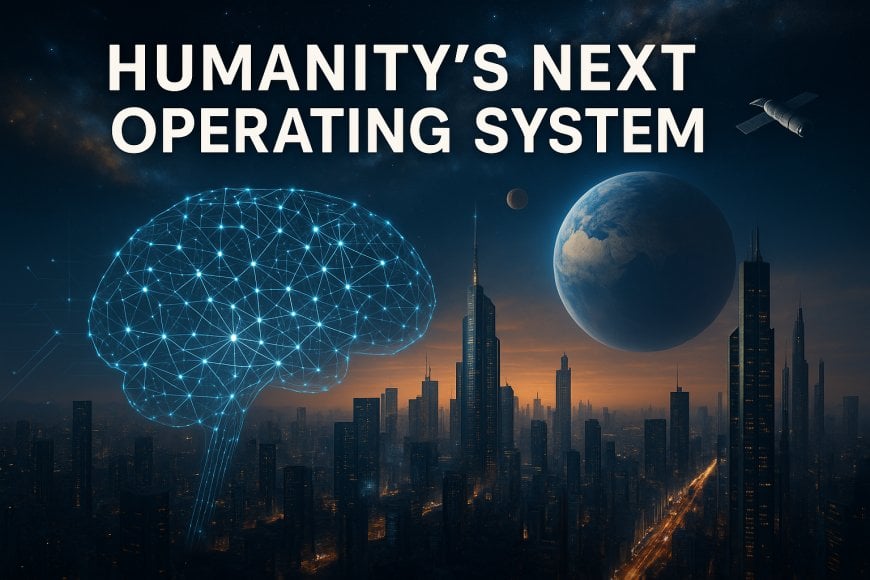
Every framework most people still use to explain the future is too small for what is unfolding. AI is not dot-com 2.0, not just another productivity cycle, and not a narrow tech theme. It is the first technology in human history that scales cognition itself, which means it changes the tempo of economics, governance, money, warfare, medicine, identity, and even the definition of being human. This article lays out the full Pattern Nexus model: persistent monetary expansion as a function of rising complexity, tokenization as the new rail for global value absorption, megacorporations as proto-sovereigns, human divergence into adaptive and legacy lineages, digital persons and continuity-of-consciousness systems, VR economies as the primary habitat of billions, and space industrialization as the final layer that fractures humanity into multiple civilizational branches.
AI is not just another industry. It is the first recursive intelligence amplifier at civilizational scale.
The real danger is not collapse. It is divergence: one branch of humanity accelerates with AI while another becomes economically buffered, digitally housed, and structurally dependent.
The next financial war is not really about reserves. It is about rails. Whoever controls tokenized settlement and programmable liquidity controls the flow of global value.
SECTION 1 — Framing the Century: Civilization Becomes a Self-Upgrading System
The biggest mistake people make when thinking about the future is assuming the next century will be some stretched-out version of the last one. They imagine faster software, better hardware, more debt, louder politics, maybe a few wars, maybe a few bubbles, and then they project those same categories forward. That is not enough anymore. The categories themselves are changing.
For most of history, civilization evolved through relatively slow layers. A new energy source. A new transport network. A new industrial process. A new communication medium. A new legal or monetary regime. Institutions had time to metabolize change. Human psychology had time to adapt. Even during major upheaval, the speed of structural reorganization was still close enough to human social speed that old models could retain meaning.
AI changes that tempo because it changes the status of intelligence. Intelligence is no longer purely biological output. It becomes scalable, distributable, recursive, and increasingly machine-mediated. That means civilization is entering a phase where the thing that designs tools is itself being amplified by tools. Once that happens, every downstream system starts behaving differently. Research accelerates. Logistics accelerates. policy simulation accelerates. labor replacement accelerates. military targeting accelerates. code creation accelerates. medical interpretation accelerates. narrative production accelerates. finance accelerates.
This is why I keep saying AI is not just another technology. It is a civilizational operating layer. When you amplify intelligence itself, you amplify everything that intelligence touches. Economics changes because decision velocity changes. Governance changes because bureaucracies built for paper-speed reality cannot keep up with machine-speed complexity. Markets change because information asymmetry collapses in some places and explodes in others. Labor changes because the bottleneck moves from routine cognition to access, orchestration, trust, and system ownership.
The world is becoming a self-upgrading system. That phrase matters because it describes more than innovation. In a normal innovative system, people build better tools. In a self-upgrading system, the tools help redesign the conditions under which future tools are created. That creates a tightening feedback loop. Discovery helps produce more discovery. Optimization optimizes optimization. Intelligence starts compounding on itself.
That is the real beginning of the next century. Not a gadget cycle. Not a style change. An operating system replacement. The 20th century was built on industrial scale, energy density, manufacturing throughput, broadcast narratives, national sovereignty, and monetary centralization. The 21st century will be built on intelligence amplification, programmable liquidity, digital identity, corporate-state convergence, and eventually multiple forms of human and post-human existence operating at once.
AI is the catalyst event that rewrites the operating system of civilization. Not gradually. Not incrementally. Systemically.
SECTION 2 — The Era of False Analogies: Why AI Is Not Dot-Com 2.0
Every attempt to understand AI through the lens of previous market manias is too small for the scale of the move. The dot-com era mattered. Electricity mattered. semiconductors mattered. the smartphone mattered. cloud computing mattered. But all of those still fit inside an already recognizable human operating system. They were revolutionary within the old structure. AI is different because it begins to alter the structure itself.
Dot-com digitized storefronts, communications, and information access. AI digitizes intelligence. That distinction is not rhetorical. It is the whole game. The internet connected humans to data. AI turns data into synthesis, strategy, code, diagnosis, optimization, simulation, and action. The internet gave people a larger library. AI gives civilization a distributed cognitive layer.
That is why comparing AI to the dot-com bubble misses the real axis of change. Dot-com firms were still dependent on human productivity, human scaling, human decision cycles, and human adoption speed. AI increasingly compounds on its own output. AI systems write code that improves models that improve training methods that improve inference efficiency that improve deployment. You are no longer dealing with a simple product adoption curve. You are dealing with a recursive system that can increase the rate at which capability itself is generated.
Human history can be described as a long chain of capability amplification. Fire amplified survival. Writing amplified memory. Printing amplified knowledge transfer. Industry amplified labor. Microchips amplified computation. AI amplifies intelligence itself. Once you amplify intelligence, you do not just get better apps. You get downstream transformation across economics, culture, medicine, military systems, scientific research, governance, and identity.
The mistake analysts keep making is treating AI like a sectoral theme. They ask whether valuations are stretched, whether monetization is fully clear, whether capex will overshoot, whether adoption will disappoint. Those are narrow investor questions. They matter tactically, but they miss the higher-order point. AI is not just a technology curve. It is a civilizational curve. The real question is not whether speculative excess exists. Of course it does. The real question is what remains after each round of excess burns off.
What remains will not be a minor software upgrade. It will be a new baseline. Governments will use AI because they cannot process complexity fast enough without it. Corporations will use AI because competition forces them to. military planners will use AI because the speed mismatch is existential. research institutions will use AI because discovery bottlenecks collapse under machine assistance. Households will use AI because it becomes part assistant, part interface, part identity layer, part productivity engine.
Dot-com created websites. AI creates worlds. The internet connected humans. AI augments, replaces, and eventually transcends portions of human cognition. That is why the coming period is not simply another bubble. It is the compression of centuries of cognitive infrastructure buildout into a few generations.
- AI is infrastructure, not just an industry
- AI compounds on its own output in ways previous technologies did not
- The biggest lag ahead is civilizational adaptation, not raw capability creation
SECTION 3 — Global Monetary Expansion: Crisis as a Feature, Not a Bug
One of the oldest macro mistakes is treating every spike in debt, every balance-sheet expansion, and every policy emergency as proof the system is about to end. That framework keeps failing because it misunderstands what the system is actually built to do. The global monetary regime was never designed for static purity. It was designed for elasticity. It survives by absorbing complexity, not by avoiding it.
Every time civilization becomes more interconnected, more financialized, more capital intensive, more energy hungry, and more technologically layered, the liquidity requirements of the system rise with it. If the monetary architecture does not expand, the system jams. So what most people call “crisis” is often the political and institutional mechanism by which the system grants itself permission to evolve into the next stage.
That is why the last several decades all rhyme. A shock hits. The old rule set proves insufficient. Central banks and fiscal authorities invent a new tool, a new facility, a new backstop, or a new legal interpretation. The emergency becomes precedent. The precedent becomes infrastructure. Then the public spends years arguing about morality while the plumbing quietly changes underneath them.
This is why I keep saying debt is not simply the flaw in the system. Debt is the system. More precisely, debt is the accounting wrapper through which civilization coordinates expansion across time. That does not mean all debt is healthy or that there are no constraints. It means the system is best understood as a collateralized liquidity regime, not as a quaint textbook model where money behaves the way sound-money absolutists wish it still did.
Think about the world we are actually building. AI megaclusters. advanced data centers. upgraded grids. semiconductor fabs. robotic logistics. autonomous research systems. biotech platforms. orbital infrastructure. digital identity rails. tokenized settlement systems. None of that is cheap. None of that is compatible with a shrinking monetary base. A civilization attempting to become machine-speed, energy-heavy, and multi-planetary cannot function on a 1950s imagination of monetary restraint.
Crises therefore serve a dual role. Publicly, they are emergencies. Structurally, they are permission slips. Each crisis becomes the narrative justification for a new layer of monetary flexibility, a new settlement rail, a new form of collateral transformation, or a new institutional bypass around political gridlock.
That is also why collapse narratives remain incomplete. They assume the system must either maintain old discipline or die. Reality is messier. The system mutates. Balance sheets grow. liabilities change form. collateral chains deepen. distribution channels digitize. public and private power fuse in new ways. The monetary base does not disappear. It evolves.
The next step in that evolution is not austerity. It is programmable liquidity. tokenized collateral. automated settlement. digital identity-linked monetary routing. That is where the system goes when complexity outruns the old plumbing.
SECTION 4 — The Coming Tokenization Wave: The U.S. Plan to Absorb Global Value
Most people still think the next financial war will be fought with rates, sanctions, and tariffs. Those tools still matter, but they are increasingly downstream from the real battlefield. The real battlefield is infrastructure. Whoever controls the rails controls the flow. Whoever controls the flow controls the future.
That is why tokenization matters. Not as a crypto slogan. Not as a trendy wrapper. Tokenization matters because it turns assets into interoperable settlement objects that can move faster, settle faster, and function as programmable collateral inside digital rails. This is not cosmetic finance. It is a redesign of the monetary plumbing.
The old dollar system derived its strength from deep markets, reserve use, offshore dollar funding, Treasury collateral, legal predictability, and network effects. The next version of that strength comes from digitizing those advantages into always-on infrastructure. If U.S.-linked assets become the default programmable collateral layer for a tokenized global economy, then American monetary power survives even in a world where the headlines scream de-dollarization every other day.
That is the real strategy: digitize the asset layer, normalize tokenized collateral, wrap compliance and identity into interoperable rails, and make participation in the system more valuable than ideological rebellion against it. The goal is not merely to have countries hold dollars. The goal is to have them use rails anchored by dollar collateral, dollar liquidity, and U.S.-compatible legal and technical standards.
This is also where CBDCs need to be understood more seriously. A CBDC is not just digital cash. It is a programmable layer. It can function as identity verification, policy routing, compliance architecture, distribution infrastructure, and monetary control logic all at once. Combined with tokenized Treasuries and tokenized real-world assets, CBDCs can become part of a machine-speed architecture that automates liquidity routing at scale.
The strategic implication is enormous. The country or bloc that successfully builds the world’s most trusted, scalable, and interoperable tokenized settlement system does not merely improve payments. It becomes the operating layer beneath trade, collateral management, cross-border finance, and eventually digital identity-linked economic participation. That is not a product. That is empire in updated form.
Tokenization is therefore not a niche financial technology story. It is the economic base layer for the AI century. Global value has to move faster because civilization is going to move faster. The old rails will not be enough. The system is already telling us that.
SECTION 5 — BRICS, China, and the New Liquidity War: Two Operating Systems, One Winner
We are not just watching a currency competition. We are watching a competition between operating systems. On one side is the U.S.-led model: deep liquidity, open capital markets relative to rivals, tokenized collateral potential, programmable settlement, AI-enabled scalability, and network effects built over decades. On the other side is the BRICS and China model: greater state direction, more commodity rhetoric, heavier control logic, more political opacity, and settlement systems that are useful in specific corridors but still struggle to become universal trust layers.
BRICS has become extremely good at narrative. Anti-dollar rhetoric travels well because it appeals to resentment, nationalism, and the desire for multipolarity. But liquidity does not care about slogans. The world’s core financial architecture is not determined by sentiment. It is determined by trust, depth, legal credibility, collateral quality, uptime, and scalability.
This is where the BRICS fantasy usually collides with the hard math. Many of the countries associated with de-dollarization rhetoric still operate with less liquid currencies, weaker institutional predictability, more severe capital controls, or more visible political risk than the system they criticize. That does not mean the dollar is perfect. It means replacing the dominant system requires more than anger. It requires a better architecture.
China’s ambitions are real. A digital yuan ecosystem, state-guided settlement rails, commodity corridors, infrastructure-led dependence, and regional influence structures all make sense from Beijing’s perspective. But China’s model carries a structural limitation. It is excellent at internal control and selective corridor power. It is less natural as the operating system for an open planet. Many states will transact through it when needed. Far fewer will want their entire economic future plugged into a surveillance-heavy architecture governed by political opacity and capital constraints.
The U.S. does not need to win every speech contest. It needs to win infrastructure adoption. If countries route trade, collateral, and digital asset settlement through U.S.-compatible rails because those rails are faster, deeper, safer, and more composable, then the dollar system remains gravitationally dominant even while de-dollarization rhetoric grows louder.
This is why the true liquidity war is not primarily about reserve shares. It is about who designs the default settlement architecture of the next century. The U.S. model is messy, often chaotic, and politically dysfunctional, but it still has the deepest pool of global trust capital. The BRICS model is ambitious, but too much of it is still built like a bunker. Openness, even imperfect openness, scales farther than controlled confinement when civilization is becoming more digital, more tokenized, and more machine-mediated.
SECTION 6 — Megacorporations as Proto-Sovereigns: The Rise of Corporate States
We are entering a world where the most powerful entities on Earth will not be governments in the traditional sense. They will be AI-supercharged megacorporations with more capital than states, more compute than public labs, more direct behavioral insight than intelligence agencies, and more capacity for rapid adaptation than any bureaucracy built around election cycles.
This is not because governments disappear. It is because governments move at the speed of politics while corporations move at the speed of compute and capital allocation. AI widens that gap. Corporations can integrate AI across research, logistics, pricing, product design, customer behavior modeling, security, and infrastructure management almost immediately. Governments have hearings. committees. regulatory delays. political coalition problems. risk reviews. procurement drag. By the time the state adapts, the frontier has already moved.
Look at the ingredients of sovereignty that large corporations are already acquiring. They have their own intelligence systems. Their own infrastructure. Their own populations of users. Their own internal rule systems. Their own identity frameworks. Their own quasi-currencies or payment ecosystems. Their own digital territories. In some cases, they are even beginning to shape physical infrastructure at scales comparable to states. That is not classical sovereignty, but it is close enough that the distinction starts becoming semantic.
In the AI era, whoever controls compute supply, model deployment, and digital interfaces controls extraordinary leverage over the rest of civilization. That is why the largest technology and infrastructure firms increasingly look less like firms and more like city-states or proto-empires. Their products are not just products. They are environments. Their user bases are not just customer lists. They are governed populations inside privately administered digital jurisdictions.
Governments cannot fully stop this because they are themselves becoming dependent on corporate systems. State agencies will increasingly rely on private AI models, private cloud infrastructure, private cyber defense capacity, private satellite constellations, private research networks, and private platform ecosystems. At that point, regulation becomes negotiation between interdependent power centers rather than top-down control by a clearly superior sovereign.
The space layer intensifies this even more. Governments talk about Mars. Corporations build rockets, data networks, robotic logistics, orbital supply chains, and eventually the first viable non-state industrial systems off-world. The entities that build the first sustainable space infrastructure will not just be contractors. They will be the founding regimes of post-terrestrial civilization.
The megacorporation era does not erase governments. It eclipses them in the domains that matter most to an AI-driven civilization: compute, infrastructure, research, digital identity, network governance, and eventually off-world expansion.
SECTION 7 — AI, Post-Humanity, and the Great Human Divergence
Humanity is not heading toward a clean, unified future. Humanity is heading toward divergence. The split will not initially be racial, national, or purely class-based. It will be driven by relationship to acceleration itself. For the first time in history, the core dividing line between human futures will be adaptation to AI-mediated systems.
That is why I frame the century through two broad lineages. Track A is the adaptive lineage: AI-integrated, economically leveraged, cognitively augmented, more comfortable with fluid identity and machine partnership, increasingly open to enhancement and digital continuity. Track B is the legacy lineage: less integrated, slower to adopt, more dependent on system-managed stability, more Earth-bound, more culturally backward-facing, and eventually buffered inside structures designed to keep life functional without keeping pace with the frontier.
Track A does not necessarily begin as a separate species. It begins as an adoption pattern. These are the individuals, firms, enclaves, and eventually colonies that use AI as a constant co-processor. They build with it, think with it, invest with it, diagnose with it, strategize with it, negotiate with it, and eventually offload parts of cognition to it so thoroughly that the old notion of the unaided human agent stops describing how they actually function.
Track B is not “stupid” or morally inferior. That framing would be lazy. Track B is defined by inability or unwillingness to fully metabolize accelerating systems. It is the lineage that keeps one foot in legacy social structures, legacy identity models, legacy forms of work, and legacy expectations about what a normal human life is supposed to look like. In the short run, this remains the majority. In the long run, it becomes a separate civilizational rhythm.
Two forces make this divergence inevitable. First, technological acceleration is now outpacing the psychological adaptation speed of large parts of the population. Second, AI creates a new economic class structure based on cognitive leverage. Once some people can generate value at radically higher scale because they are effectively operating with permanent machine augmentation, the gap stops being merely educational. It becomes structural.
By the middle of this century, the conflict line that dominates politics will not be left versus right in the old sense. It will be adaptive versus non-adaptive. One side will increasingly live in fluid, machine-mediated, identity-layered, augmentation-tolerant systems. The other will seek stability, continuity, protection, and familiar constraints. Both will still be human in the ancestral sense, but they will no longer be living inside the same tempo of civilization.
SECTION 8 — Mind Uploading, Digital Persons, and the Death of Biological Limitation
The deepest psychological blind spot in modern society is the assumption that biology remains the final container of identity. That assumption feels natural only because the technologies capable of challenging it are still primitive. But the architecture that breaks biological finality is already emerging: neural recording, digital twins, persistent identity maps, high-fidelity simulation, brain-computer interfaces, synthetic embodiment, and legal frameworks for machine-linked personhood.
The transition will not happen in one leap. It will happen in layers. First comes digital shadowing. Systems learn your writing style, your preferences, your memory cues, your strategic tendencies, your voice patterns, and your interpersonal rhythms. Then comes cognitive delegation. The digital twin stops merely imitating and starts assisting, then deciding, then producing on your behalf. After that comes memory-layer persistence, continuity claims, and eventually the social and legal recognition that “you” may exist across more than one substrate.
This is where the concept of digital persons becomes serious. A digital person is not just a chatbot with a face. It is a legally and socially recognized entity with continuity claims, data rights, obligations, and an identity relationship to a biological or formerly biological origin. Once societies begin treating persistent machine-linked selves as real participants in law, finance, inheritance, and governance, the old definition of personhood starts to fracture.
Death then changes meaning. It does not vanish overnight, but it stops being a simple on-off rule. For the adaptive lineage, biological death becomes increasingly negotiable. Not because the body becomes magically immortal, but because identity gets distributed into recoverable systems, persistent models, memory archives, and machine-mediated continuities. The body becomes one container among several.
This also explodes every institution built around biological finality. Religion changes. marriage changes. family changes. inheritance changes. criminal responsibility changes. property law changes. political representation changes. If one person can have multiple active digital continuities or parallel instances of identity, then the legal architecture of society has to be rebuilt around versioning rather than singularity.
The old human is not instantly obsolete. Biology remains the launch platform. But it stops being the endpoint. Future identity becomes modular, distributed, and eventually portable. That is the point where the divergence between Track A and Track B stops being philosophical and becomes literal.
SECTION 9 — VR Economies and the Digital Frontier: The New World Where Billions Will Live
Most people still think VR is a toy category. That is because they are analyzing it through entertainment rather than through labor displacement, social fragmentation, and economic migration. VR will not become dominant because gaming becomes slightly better. VR becomes dominant because the physical world stops offering enough meaningful participation to billions of people as AI absorbs more of the productive frontier.
The real driver is not fun. It is economic inevitability. As AI compresses white-collar functions, automates administration, disintermediates services, and progressively eats into more skilled domains, large populations will find that the physical economy has fewer roles for them than it once did. But political systems still need somewhere for identity, socialization, aspiration, status, and participation to go. VR becomes that buffer zone.
That is why the future digital world is not a gimmicky “metaverse” in the childish sense. It is a parallel civilizational layer. It will host work, education, relationships, communities, worship, status hierarchies, property, commerce, and eventually political belonging. For billions of people, immersive digital environments will become less like optional media and more like the primary geography in which life is experienced.
This is especially important for the legacy lineage. Track B does not simply get abandoned. It gets housed. VR becomes the homeland of people who remain biologically traditional, economically buffered, and structurally downstream from the high-speed adaptive frontier. In those environments, complexity can be curated, identities can be stabilized, beauty can be manufactured, risk can be reduced, and participation can be simulated or monetized even when the physical frontier moves beyond many people’s direct reach.
VR also becomes a new real-estate and governance layer. Tokenized assets allow digital property, access rights, identity-linked privileges, and programmable local rules. Corporations will govern many of these worlds. AI will administer them. Governments will be dragged into regulating them after the fact. At that point, digital cities and digital states become more than metaphors. They become the new containers of mass human life.
By the later 21st century, some digital polities will have populations larger than physical countries. Their economies will matter. Their cultures will matter. Their ideological structures will matter. Their citizens may feel more loyal to those realms than to the physical jurisdictions where their biological bodies happen to sit.
SECTION 10 — Space Expansion, Asteroid Mining, and the First Interplanetary Civil War
Space is not a science fair project. It is the next territorial layer of civilization. It is where the adaptive lineage goes when Earth becomes too slow, too regulated, too politically constrained, and too legacy-bound for the frontier pace it wants to maintain. Space is not merely exploration. It is the escape valve for acceleration.
The economics of this are obvious once you strip away the marketing. Asteroids contain extraordinary resource density. The Moon offers industrial and logistical staging value. Orbit enables manufacturing advantages impossible on Earth. Mars offers the chance to build a society from near-zero conditions under entirely different environmental constraints. None of this will be driven primarily by abstract human unity. It will be driven by capital, survival logic, strategic competition, and the desire to build outside legacy restraints.
That is why the first real space powers will not behave like old nation-states. They will be corporate-state hybrids, AI-coordinated industrial networks, and off-world regimes shaped by resource extraction, logistics, augmentation, and systems engineering. Governments will still matter, especially in early funding and legal framing, but the actors that can actually iterate at frontier speed will look increasingly post-national.
The Moon becomes the first experimental platform. Mars becomes the first serious breakaway civilization. Off-world populations will not simply be Earth citizens living elsewhere. Different gravity, radiation exposure, habitat design, survival requirements, and AI dependence will push them toward different biological, cultural, and legal norms. Once that happens, the idea of one unified humanity begins to crack in literal geopolitical form.
The first interplanetary conflict will not be about flags in the old sense. It will be about autonomy, infrastructure, and who has authority over divergent human branches. Earth-bound systems will try to regulate genetic modification, AI governance, off-world property rights, and industrial extraction. Off-world populations will resist because they will increasingly view Earth as a nostalgic, slow, politically fractured center trying to rule environments it no longer understands.
That conflict will not look like cinematic space fantasy. It will look like orbital chokepoints, cyber sabotage, logistics denial, asset seizure, AI intrusion, kinetic infrastructure strikes, and control battles over launch systems, resource corridors, and space-based manufacturing nodes. And the ugly truth is that Earth’s legacy institutions may be too slow to win against faster-adapting off-world systems.
SECTION 11 — The 100-Year Timeline: A Full Civilization Forecast (2025–2125)
2025–2030: The Digital Liquidity Phase
Tokenized finance moves from pilot language into increasingly practical institutional use. AI becomes the primary co-pilot across white-collar work. Governments begin recognizing that they cannot govern complexity without machine assistance. Digital identity becomes harder to avoid in financial and platform systems. VR starts shifting from entertainment toward persistent social and economic environments.
2030–2035: The AI Consolidation Phase
AI decisively outperforms the median human across a wide range of cognitive tasks. Corporate structures flatten around machine-mediated decision cores. The firms with the deepest access to compute, models, and data become quasi-sovereign power centers. The early forms of digital twins and persistent machine-linked identity become socially familiar.
2035–2045: The Divergence Decade
This is where the split becomes visible. Adaptive humans and adaptive institutions increasingly use AI as a continuous augmentation layer. Legacy populations become more dependent on system-managed stability. VR urbanization accelerates. Off-world installations move from symbolic to permanent. Digital property becomes a real balance-sheet category rather than a novelty.
2045–2060: The Post-Biological Dawn
Continuity systems become sophisticated enough that the legal, cultural, and philosophical debate around digital persons can no longer be avoided. Mind-uploading remains partial and uneven, but continuity-of-self claims become normal in elite and experimental environments. AI-run micro-governance structures prove more efficient than many municipal or national bureaucracies. Space industry matures from aspiration into extraction and manufacturing.
2060–2075: The Age of Multicivilizational Humanity
Mars and orbital systems begin to develop distinct legal and cultural identity. Earth remains demographically dominant but loses monopoly over the meaning of humanity. VR populations rival the largest physical cities in social importance. Biological longevity and machine-linked identity systems deepen the adaptive divide. The old nation-state still exists, but it is no longer the uncontested center of power.
2075–2090: The Interplanetary Fracture
Earth attempts to impose standards on off-world experimentation, extraction, and governance. Off-world populations reject outside control. Adaptive physical forms begin diverging more visibly. Legacy populations retreat deeper into curated digital environments. Space infrastructure becomes too economically important to remain a passive extension of Earth politics.
2090–2105: The First Interplanetary War
The conflict is primarily infrastructural and AI-mediated: supply chain disruption, cyber warfare, platform seizure, kinetic strikes on key nodes, orbital denial, and control over industrial chokepoints. It is less trench warfare than system warfare. The side that adapts faster wins, and that will likely not be the slower, more divided legacy center.
2105–2125: The Great Separation
Humanity no longer exists as one civilizational path. Homo Digitalis, space-born lineages, legacy Earth populations, synthetic embodiments, and multi-instance persons all coexist within one historical tree but not within one coherent social architecture. AI becomes the meta-coordinator between incompatible human futures. The 20th-century meaning of the word “humanity” no longer captures what civilization has become.
SECTION 12 — Conclusion: The True Pattern Nexus — Humanity’s Next Operating System
Every era thinks its institutions are more permanent than they are. Every generation underestimates how violently categories can change once the underlying infrastructure changes. That is where we are now. The old world is not ending because people chose to abandon it. It is ending because the new conditions no longer fit the old containers.
The Pattern Nexus view is simple in structure even if the implications are huge. AI accelerates intelligence. Accelerated intelligence increases the rate of scientific, economic, military, and institutional transformation. Rising complexity demands larger and more flexible monetary architecture. Tokenization and programmable liquidity emerge as the new rails. Megacorporations become the fastest sovereign-like entities. Digital identity expands. biological finality weakens. VR becomes the homeland of legacy humanity. Space becomes the frontier of adaptive humanity. The species branches.
This is not a collapse model. Collapse implies reduction. What is actually happening is multiplication. Humanity does not merely fall apart under AI. It expands into multiple forms of existence: biological, digital, synthetic, orbital, virtual, and hybrid. The old human story was singular. The next one is plural.
The final pattern is this: intelligence becomes self-amplifying. Once that happens, civilization no longer evolves on purely biological timescales. It evolves on computational timescales. Humans remain part of that process, but not always in the form or under the assumptions that shaped the last several thousand years.
This is not the end of humanity. It is the beginning of many humanities.
Pattern Nexus Lens
Most people still look at AI, money, debt, geopolitics, VR, digital identity, biotech, and space as separate sectors or disconnected headlines. That is the wrong frame. The better frame is control architecture. Every one of these systems is part of a single transition in which intelligence, liquidity, governance, and identity are being rewired into a tighter, faster, more programmable stack. AI is the acceleration layer. Tokenization is the value rail. CBDCs and digital identity are the permissions layer. Megacorporations are the fastest operators inside the stack. VR becomes the social housing layer for legacy populations. Space becomes the expansion layer for adaptive populations.
The future is not one trend. It is a stacked control system: intelligence, money, identity, infrastructure, and expansion all merging into one new operating layer for civilization.
FAQ
Is this a prediction that every detail will happen exactly as written?
No. This is a structural forecast, not a rigid script. The point is not that every date or mechanism lands perfectly. The point is that the direction of civilization is increasingly visible once AI is treated as a civilizational operating layer rather than a narrow tech sector.
Why reject collapse narratives so strongly?
Because collapse is too simple as a master theory. Parts of systems can absolutely break. regions can destabilize. markets can crash. institutions can fail. But the larger pattern is not simple reduction. It is reorganization. The system tends to absorb crisis, expand the monetary and technical architecture, and mutate into a new layer.
Why do megacorporations matter more than governments in this model?
Because the entities that can deploy compute, capital, infrastructure, and AI systems at the fastest speed will increasingly shape the real frontier. Governments still matter, but they are slower, more politically constrained, and increasingly dependent on private technical systems.
What is the central dividing line of the next century?
The central dividing line is adaptive versus non-adaptive humanity. The future conflict is not just ideological. It is temporal and structural. One branch integrates with accelerating systems. The other is stabilized around them without fully participating in the frontier.
Sources
These sources support the technical, monetary, governance, digital identity, VR, biotech, and space architecture referenced throughout this long-horizon framework.
AI / Compute / Acceleration
- Jon Peddie Research
- TrendForce AI Server Forecasts
- Statista GPU Market Share Data
- McKinsey Global Institute — The Economic Potential of Generative AI
- OECD AI Reports
- IMF — AI and the Future of Work
- EU AI Act
- NIST AI Risk Management Framework
- White House AI Executive Actions
Macro / Monetary Expansion / QE-QT
- Federal Reserve FRED Database
- Congressional Research Service — Quantitative Easing
- BIS Annual Reports
- IMF Global Financial Stability Reports
Tokenization / Digital Dollar / CBDCs
- BIS Unified Ledger Framework
- BIS mBridge Pilot Results
- Monetary Authority of Singapore — Project Guardian
- European Central Bank — Digital Euro
- Federal Reserve — CBDC Research
- FedNow Service
- JPMorgan Onyx Digital Assets
Digital Identity / Digital Personhood
- EU eIDAS 2.0
- WEF Digital Identity Framework
- Japan Society 5.0
- UAE Digital Government
- UNESCO AI Ethics Framework
VR Economies / Virtual Worlds / Digital Labor
- McKinsey — Value Creation in the Metaverse
- Stanford Virtual Human Interaction Lab
- Accenture Insights
- IMF FinTech Notes
Genetics / Longevity / Post-Biological Tech
Space Expansion / Asteroid Mining / Interplanetary Governance
- NASA Artemis
- Psyche Mission
- ESA Space Resources Strategy
- China National Space Administration
- Luxembourg Space Resources Law
- UN COPUOS
- Artemis Accords
- U.S. Space Force Doctrine
AI Safety / Human Divergence / Future of Humanity
- Oxford Future of Humanity Institute
- Nick Bostrom
- Future of Life Institute
- RAND Human-Machine Teaming
- DARPA
- U.S. Department of Defense
- OECD AI Governance Library
మీ ప్రతిస్పందన ఏమిటి?
 ఇష్టం
0
ఇష్టం
0
 ప్రతికూలం
0
ప్రతికూలం
0
 ప్రేమ
0
ప్రేమ
0
 కలుకలు
0
కలుకలు
0
 అబ్బా
0
అబ్బా
0
 దురద
0
దురద
0
 కోపంగా
0
కోపంగా
0

Founder of Pattern Nexus. I research markets, macro, geopolitics, AI, history, ancient systems, and the patterns most people overlook. I’m also building Market Radar, a trading scanner designed to read pressure, risk, confirmation, and setup quality before chasing a move. Pattern Nexus is where I connect the dots between data, history, technology, and the bigger system playing out around us.

















కామెంట్లు (0)