You Don't Eat Food. You Harvest Electrons: The Electrical Architecture of Life
Food looks like matter, but the energy side of metabolism is a controlled redox system. Cells extract reducing power from carbon-rich molecules, route it through the mitochondrial respiratory chain, convert electron flow into proton motive force and ATP, then spend ATP rebuilding the ion gradients that make nerves, muscles and cognition possible.
 Pattern Nexus Premium Research
You Don't Eat Food. You Harvest Electrons: The Electrical Architecture of Life
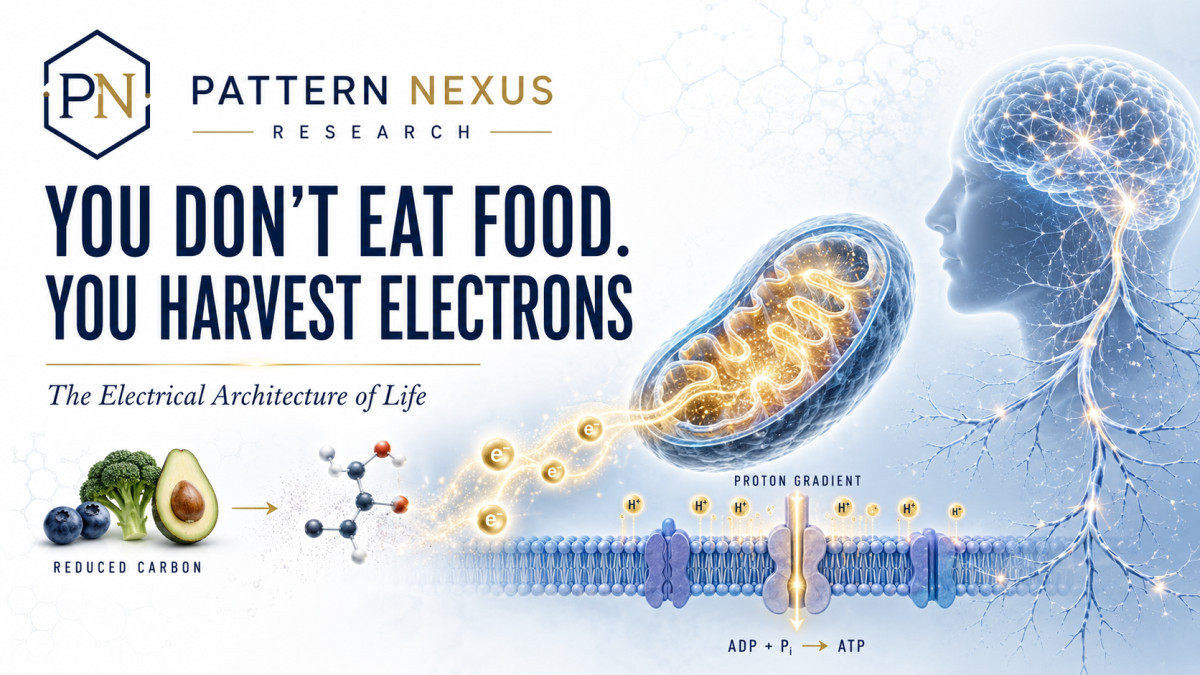
Food looks like matter. Metabolism looks like digestion. But underneath both is a controlled energy cascade: reduced molecules give up electrons, mitochondria convert electron flow into a proton gradient, ATP synthase turns that gradient into chemical work, and neurons spend that work maintaining the charged membranes that let you think, move, remember, and stay alive.
At the Energy Level, Eating Is Controlled Electron Harvesting
- The provocative version is directionally right. Much of the usable energy extracted from carbohydrate, fat and some amino acids comes from oxidation: controlled transfer of reducing power from food-derived molecules toward lower-energy acceptors. [1][2]
- NADH and FAD-linked carriers are electron-delivery systems. Metabolic pathways load them with reducing power and feed that power into mitochondrial respiration. [1]
- Mitochondria convert electron-transfer energy into voltage. Respiratory complexes pump protons across the inner mitochondrial membrane, creating an electrochemical proton-motive force. [2][3]
- ATP synthase is a molecular turbine. Proton flow through the enzyme drives rotary motion coupled to ATP synthesis. [4][5]
- Oxygen is the terminal electron acceptor in aerobic respiration. The electron stream ultimately ends at oxygen, which is reduced to water. [2]
- Your nervous system is electrical, but it is not wired with free-electron current. Action potentials arise from ionic currents and membrane conductance changes, especially involving sodium and potassium. [6]
- ATP pays to recharge the neural electrical system. Na+/K+-ATPase spends ATP restoring ion gradients after signaling. That energetic cost helps shape neuronal behavior and axonal design. [7][8]
- The literal statement “you only eat electrons” is false. Food also supplies the atoms and molecules used to build human tissue. Isotope studies directly measure dietary amino acids entering human protein synthesis. [9][10]
- The Pattern Nexus thesis: the body is a nested energy-routing architecture: redox potential feeds proton gradients, proton gradients feed ATP, ATP maintains ion gradients, and ion gradients support biological computation.
The Human Body Is a Redox Machine That Converts Electron Flow Into Organized Electrical Work
I keep coming back to one sentence because it sounds wrong until you follow the energy chain far enough:
That is not the same as saying your stomach fills with electrons or that free electrons travel from a steak to your brain. Biology is more elegant than that. Carbon-rich molecules are oxidized through networks of enzymes. Reducing equivalents are transferred into NADH, FAD-linked carriers and related systems. Those carriers feed respiratory machinery embedded in mitochondrial membranes. Electron transfer is coupled to proton pumping. The resulting proton-motive force is a real electrochemical potential across a membrane. ATP synthase sits in that membrane and uses proton flow as a rotary molecular engine to synthesize ATP. [1][3][4]
Then the system converts again. ATP powers ion pumps, molecular motors, biosynthesis and countless other processes. In neurons, ATP maintains the ionic gradients that allow membranes to hold voltage. When channels open, ions move down electrochemical gradients and generate the currents that constitute the action potential. [6][7]
The body is not one battery. It is a hierarchy of batteries constantly charging one another.
“You Only Eat Electrons” Is Wrong Literally—and Powerful at the Correct Level
The easiest way to ruin this idea is to defend the wrong version of it.
Your body absolutely consumes matter. The carbon atoms in dietary carbohydrate and fat can be stored, rearranged or oxidized. Amino acids from dietary protein cross into tissues and can be incorporated into new human proteins. Stable-isotope studies measure that incorporation directly. Minerals become part of bone, enzymes, blood and electrical gradients. Essential fatty acids become membranes and signaling molecules. Water becomes body water. Food is not an illusion wrapped around electrons. [9][10]
But there is a second accounting system operating at the same time: energy accounting.
In that accounting system, one of the central questions is not “what molecule entered the mouth?” It is “where is the reducing power, what acceptor can receive it, and how much free energy can the cell capture while moving electrons?”
Oxidation is electron loss and reduction is electron gain. Metabolism is full of controlled oxidation-reduction reactions that move reducing equivalents stepwise instead of releasing the entire free-energy drop at once as heat.
The difference between a fire and a mitochondrion is not that one oxidizes carbon and the other does something unrelated. Both ultimately move matter toward more oxidized states. The biological system inserts extraordinary machinery between fuel and final acceptor so that the free-energy drop can be captured in useful increments.
What Makes Food Valuable Is Not Merely Carbon. It Is Carbon in a Useful Electronic State.
A pile of carbon dioxide contains carbon. You cannot live on it.
That alone tells us that “calories are carbon” is incomplete. The carbon in glucose, fatty acids and amino-acid skeletons exists in more reduced chemical states than carbon in carbon dioxide. That difference matters because oxidation can move reducing power from those molecules into acceptors while releasing free energy.
Glycolysis begins rearranging and oxidizing glucose. Pyruvate is processed further. The citric-acid cycle continues removing reducing equivalents. Fatty-acid oxidation repeatedly shortens hydrocarbon chains while loading electron carriers. Amino-acid carbon skeletons can enter many of the same pathways after nitrogen handling.
The carbon is pushed toward a highly oxidized endpoint—carbon dioxide—while much of the captured reducing power has been transferred to NADH, FAD-linked carriers and related molecules.
Food molecules contain harvestable redox potential.
NADH and FAD-linked systems route reducing power toward respiration.
Enzymes release free energy in coupled steps instead of one destructive combustion event.
Carbon leaves predominantly as CO2 after its redox potential has been largely extracted.
The Electron Transport Chain Converts Redox Drop Into Membrane Voltage
Complex I provides one of the clearest windows into what the mitochondrion is doing. It contains an internal electron-transfer chain that delivers electrons through redox centers while coupling that transfer to proton pumping across the inner mitochondrial membrane. Electron movement is used to separate charge. [1]
In mammalian mitochondrial physiology, electrons from NADH-linked and other substrate pathways converge and then pass through downstream respiratory complexes toward oxygen. Complexes I, III and IV help generate the electrochemical proton potential across the inner mitochondrial membrane. [2]
The mitochondrion is therefore not converting “food into ATP” in one step. It is first converting a redox gradient into a membrane gradient.
That gradient has two components: a proton concentration difference and an electrical potential across the membrane. Together they form the proton-motive force.
This is not metaphorical electricity. A membrane potential is an electrical potential difference. Life deliberately spends chemical free energy to maintain separated charge across a nanometer-scale membrane.
You Breathe Oxygen Because the Electron Stream Needs Somewhere to End
We usually learn that humans breathe oxygen because cells need oxygen “for energy.” True, but incomplete.
In aerobic mitochondrial respiration, oxygen sits at the end of the electron-transfer chain as the terminal electron acceptor. Electrons pass through respiratory complexes and are ultimately transferred to oxygen, which is reduced to water. [2]
Food supplies reduced substrates. Metabolism extracts reducing equivalents. The respiratory chain needs an acceptor low enough in the redox hierarchy to keep the flow favorable. Oxygen provides that sink.
When oxygen delivery collapses, the terminal drain on the respiratory architecture is constrained. NADH oxidation, electron-transfer throughput, proton pumping and ATP production are affected together.
Life Stores the Electron Drop as a Proton-Motive Force
Active mitochondria sustain proton flows between respiratory pumps and ATP synthase. Experiments have measured local proton gradients inside mitochondrial cristae, while modern structural work resolves the machinery that consumes that gradient. [3][4]
The proton-motive force combines concentration and voltage. Protons are unequally distributed, and charge separation contributes an electrical component. The membrane stores free energy in electrochemical form.
This is the recurring pattern in biology: gradients are capital.
A concentration difference is stored potential. A voltage difference is stored potential. A redox difference is stored potential. Life survives by creating gradients faster than entropy erases them.
ATP Synthase Is a Rotary Engine Driven by an Ion Current
If the respiratory chain is the charging system, ATP synthase is the machine that cashes out the charge.
High-resolution structural work shows mitochondrial ATP synthase operating as a rotary molecular machine. Proton flow through the membrane-embedded portion drives rotation, and that motion is coupled to ATP synthesis in the catalytic portion of the complex. [4][5]
- A food molecule is oxidized.
- Reducing power is transferred to carriers.
- Electrons enter respiratory complexes.
- Electron-transfer energy pumps protons.
- The membrane stores electrochemical potential.
- Protons flow back through ATP synthase.
- A nanoscale rotor turns.
- ATP is synthesized.
Your Brain Is Electrical, but the Current Is Primarily Ionic
This is where the original idea needs its most important correction.
Your brain does not work like a copper circuit with conduction electrons streaming along axons. The classical Hodgkin-Huxley experiments established that action potentials emerge from voltage-dependent membrane conductances associated with ionic movement, especially sodium and potassium. [6]
The membrane acts as an electrical separator. Ion pumps create unequal concentrations. Ion channels act as controllable conductances. Voltage-gated proteins change state as membrane potential changes. Synapses control when and where currents flow.
The electrical signal is real, but its mobile charge carriers are mostly ions in water, not metallic electron conduction.
So where do the food-derived electrons enter the story?
Upstream. They paid to build and recharge the gradients that make the ionic current possible.
Thinking Has a Power Bill, and the Sodium-Potassium Pump Helps Pay It
An action potential spends gradient. Sodium moves inward. Potassium moves outward. Synaptic currents move ions. Calcium enters signaling pathways. Every useful electrical event nudges the system toward equilibrium.
Equilibrium is useless for computation. The neuron therefore has to reset.
Na+/K+-ATPase uses ATP to export sodium and import potassium against their electrochemical gradients. Experimental and modeling work shows that this restoration cost is a major component of neuronal energy demand and helps shape action-potential energetics and axonal design. [7][8]
A neuron firing is like a capacitor discharging through gated pathways. The pump is recharge infrastructure. Mitochondria supply much of the ATP. The respiratory chain recharges the mitochondria's proton battery. Food-derived reducing equivalents keep the respiratory chain supplied. Breathing supplies the terminal sink.
You experience the final output as sensation, memory, decision, language and consciousness.
The chain from dinner to thought is not poetic. It is biochemical infrastructure.
Food Is Also the Material You Rebuild Yourself From
The electron thesis becomes nonsense if we erase mass balance.
Your body is physically made from atoms, and many of those atoms arrived through food. Human tracer experiments show amino acids entering skeletal-muscle protein synthesis. Other isotope methods directly measure protein synthesis by following labeled amino acids into tissue proteins. [9][10]
A meal therefore follows multiple paths at once. Some molecules are oxidized for energy. Some are stored. Some become structural proteins, enzymes, neurotransmitter precursors, membrane lipids, nucleotides or cofactors.
Carbohydrate, Fat and Protein Enter the Grid Differently
Macronutrients are not interchangeable bags of calories.
Carbohydrates can feed glycolysis rapidly and supply pyruvate for mitochondrial oxidation. Fatty acids enter through beta-oxidation and generate substantial reducing power because hydrocarbon chains are highly reduced. Amino acids can be used structurally first, while excess or mobilized amino acids can be deaminated and their carbon skeletons routed into central metabolism.
The respiratory chain sees convergence downstream even though the upstream pathways differ.
Research in brain-supporting cells and synaptic systems also shows that lipid oxidation and stored triglycerides can contribute to neuronal energetic resilience under specific conditions. [11][12]
| Fuel class | Upstream route | Systems interpretation |
|---|---|---|
| Carbohydrate | Glycolysis → pyruvate → TCA / respiration | Rapid-access carbon and reducing power; also biosynthetic feedstock. |
| Fat | Fatty-acid oxidation → acetyl-CoA + reducing equivalents | Dense long-duration redox reservoir and structural lipid source. |
| Protein | Amino-acid use → biosynthesis or carbon-skeleton oxidation | Critical construction material that can also become metabolic fuel. |
A Power Grid That Moves Electrons Also Has Fault Currents
No conversion system is perfect. Electrons can react with oxygen outside the tightly controlled terminal pathway, contributing to reactive oxygen species. At controlled levels redox signaling is normal; excessive or misplaced reactive species can damage cellular components.
The organism therefore does not maximize electron flow. It regulates electron flow. Too little throughput means inadequate ATP production. Excessive reduction or poorly matched demand can increase unwanted side reactions.
Analysis of active mitochondria shows high thermodynamic efficiency in redox-driven proton translocation while coupling changes with mitochondrial energetic state. [13]
The Body Is a Cascade of Conversions, Not a Single Energy System
| Layer | Stored potential | Conversion |
|---|---|---|
| 1. Food chemistry | Reduced substrates | Enzymatic oxidation captures reducing equivalents. |
| 2. Electron carriers | NADH / FAD-linked reducing power | Electrons enter respiratory pathways. |
| 3. Respiratory chain | Redox difference to oxygen | Electron flow drives proton pumping. |
| 4. Mitochondrial membrane | Proton concentration + voltage | Proton flow drives ATP synthase. |
| 5. ATP | Chemical free energy | ATP drives pumps, motors and synthesis. |
| 6. Neuronal membrane | Na+, K+, Ca2+, Cl− gradients | Ion-channel currents generate electrical signaling. |
| 7. Neural network | Distributed membrane states and synaptic weights | Electrochemical signaling becomes behavior, memory and cognition. |
“The body runs on food” is correct in the same way “a data center runs on a power plant” is correct. It skips almost the entire operating system.
The important object is the conversion stack.
Life Is Matter Organized by Maintained Gradients
The reason this idea matters to me is not because “you eat electrons” is a clever line. It matters because it changes where you place the boundary of the system.
The normal story says: you eat food, your body turns it into energy, your brain uses the energy.
That is true and almost useless as a systems description.
The Pattern Nexus version looks different.
Food systems create reduced molecular structures. Digestion makes those structures accessible. Metabolism extracts reducing equivalents. Mitochondria route electrons toward oxygen. The redox drop charges a proton battery. The proton battery powers ATP synthase. ATP charges ion batteries. Ion batteries power neurons. Neurons form networks. Networks become perception, prediction, movement, language and self-model.
At every layer the same rule returns:
Life is one of the most sophisticated gradient-harvesting architectures we know.
And death, at the most abstract physical level, is what happens when the organism can no longer keep rebuilding the differences that organized life requires. Membranes depolarize. Ion distributions relax. ATP falls. Transport stops. Compartmentalization fails. The system moves toward equilibrium.
That is why the electron framing survives the correction.
You are not a bag of matter that occasionally needs calories. You are a continuously maintained nonequilibrium system whose structure, movement and information processing depend on controlled flows of matter, charge and chemical potential.
FAQ
Do humans literally eat electrons?
No. We eat molecules and matter. The energy insight is that oxidation of food-derived molecules transfers reducing equivalents through controlled redox reactions, and electron transfer is central to mitochondrial energy conversion.
Where do the electrons from food go?
Reducing equivalents are transferred through carriers such as NADH and FAD-linked systems into mitochondrial respiratory pathways. Electrons ultimately reach oxygen in aerobic respiration, reducing it to water. [1][2]
Does the electron transport chain directly make ATP?
Electron transport is coupled to proton pumping, which creates a proton-motive force across the inner mitochondrial membrane. ATP synthase uses that electrochemical gradient to synthesize ATP. [3][4]
Why is oxygen necessary?
In aerobic mitochondrial respiration, oxygen acts as the terminal electron acceptor and is reduced to water at the end of the respiratory chain. [2]
Are nerve impulses streams of electrons?
No. Action potentials are produced by ionic currents and changes in membrane conductance, especially involving sodium and potassium. [6]
What does ATP have to do with brain electricity?
ATP powers ion pumps including Na+/K+-ATPase. Those pumps maintain the electrochemical gradients that neurons spend when they signal. [7][8]
Does food become part of the body?
Yes. Dietary amino acids can be incorporated into human tissue proteins, and food supplies many atoms and molecules used for membranes, enzymes, storage, signaling and repair. [9][10]
What is the shortest accurate version?
You eat matter, but much of the energy you harvest from that matter is captured through controlled electron transfer. Mitochondria convert redox flow into proton motive force and ATP, and the nervous system spends ATP maintaining ion gradients that make bioelectric computation possible.
Sources
- D. R. Martin et al., Electron-transfer chain in respiratory complex I, Scientific Reports (2017).
- H. Lemieux et al., Remodeling pathway control of mitochondrial respiratory capacity by temperature in mouse heart: electron flow through the Q-junction in permeabilized fibers, Scientific Reports (2017).
- B. Rieger, W. Junge and K. B. Busch, Lateral pH gradient between OXPHOS complex IV and F0F1 ATP-synthase in folded mitochondrial membranes, Nature Communications (2014).
- L. Dietrich et al., In situ structure and rotary states of mitochondrial ATP synthase, Science (2024).
- B. J. Murphy et al., Rotary substates of mitochondrial ATP synthase reveal the basis of flexible F1-Fo coupling, Science (2019).
- A. L. Hodgkin and A. F. Huxley, A quantitative description of membrane current and its application to conduction and excitation in nerve, Journal of Physiology (1952).
- A. Hasenstaub et al., Metabolic cost as a unifying principle governing neuronal biophysics, Proceedings of the National Academy of Sciences (2010).
- Interactions among diameter, myelination, and the Na/K pump affect axonal resilience to high-frequency spiking, Proceedings of the National Academy of Sciences (2021).
- G. Biolo, R. Y. Declan Fleming and R. R. Wolfe, Physiologic hyperinsulinemia stimulates protein synthesis and enhances transport of selected amino acids in human skeletal muscle, Journal of Clinical Investigation (1995).
- H. Hsu et al., Measurement of muscle protein synthesis by positron emission tomography with L-[methyl-11C]methionine, Proceedings of the National Academy of Sciences (1996).
- B. Morant-Ferrando et al., Fatty acid oxidation organizes mitochondrial supercomplexes to sustain astrocytic ROS and cognition, Nature Metabolism (2023).
- M. Kumar et al., Triglycerides are an important fuel reserve for synapse function, Nature Metabolism (2025).
- M. Wikström et al., Thermodynamic efficiency, reversibility, and degree of coupling in energy conservation by the mitochondrial respiratory chain, Communications Biology (2020).
Source selection prioritizes primary research on mitochondrial electron transfer, proton gradients, ATP synthase structure, neuronal ion currents, neuronal metabolic cost, sodium-potassium pumping and human amino-acid incorporation. The systems synthesis and analogies are Pattern Nexus analysis.
మీ ప్రతిస్పందన ఏమిటి?
 ఇష్టం
0
ఇష్టం
0
 ప్రతికూలం
0
ప్రతికూలం
0
 ప్రేమ
0
ప్రేమ
0
 కలుకలు
0
కలుకలు
0
 అబ్బా
0
అబ్బా
0
 దురద
0
దురద
0
 కోపంగా
0
కోపంగా
0

Founder of Pattern Nexus. I research markets, macro, geopolitics, AI, history, ancient systems, and the patterns most people overlook. I’m also building Market Radar, a trading scanner designed to read pressure, risk, confirmation, and setup quality before chasing a move. Pattern Nexus is where I connect the dots between data, history, technology, and the bigger system playing out around us.
కామెంట్లు (0)