
Iran’s Decision Window: Blackout, Embassy Pullbacks, Airspace Closures, and the Retaliation Math (Jan 14, 2026)
Iran’s crackdown under an information blackout is colliding with U.S. strategic ambiguity and regional force-protection moves. Embassy pullbacks, base posture shifts, airspace restrictions, and maritime behavior reveal a decision window: this is now a control-systems contest across bandwidth, basing, shipping, and deterrence signaling.
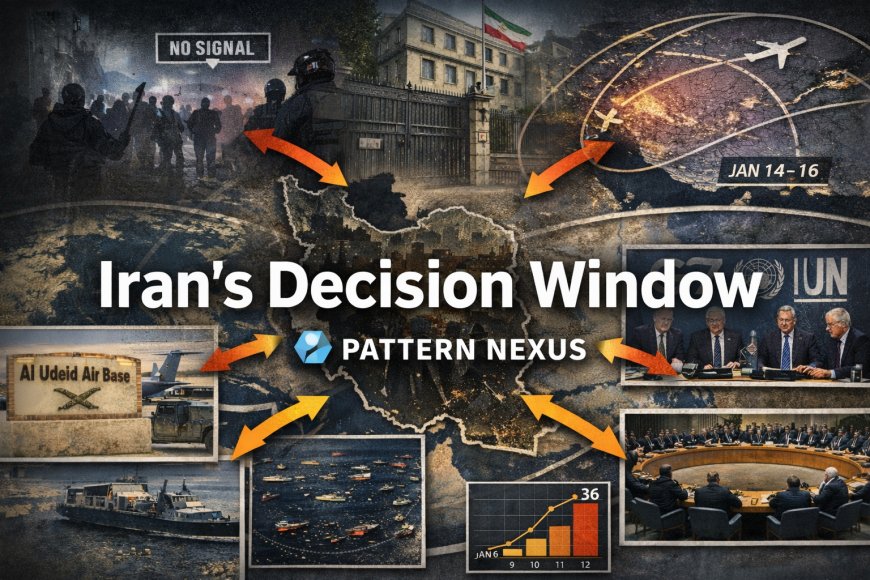
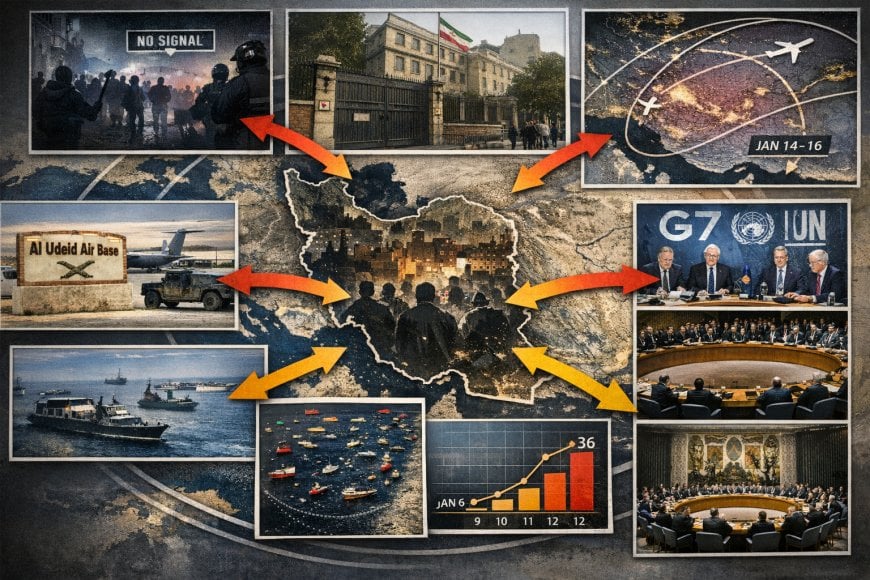
Posture beats rumor: base drawdowns, embassy pullbacks, airspace closures, and shipping behavior are higher-grade indicators than social-media “imminent” claims.
Retaliation math is the gate: the strike isn’t the hard part; managing counterstrikes against bases, hosts, shipping lanes, and regional stability is.
Bandwidth is terrain: blackouts are not “communications issues.” They are regime tools: coordination suppression and evidence denial.
Airspace closure is hygiene: it reduces misidentification risk when air defenses are on edge and rumors of strikes spread.
Ships price fear first: “port pauses” and GNSS interference warnings are the market front-running kinetic risk.
Biggest near-term danger: miscalculation. GNSS interference + closures + jumpy defenses raises incident probability even without intentional escalation.
Start Here: The Operating Picture (One Map, Five Layers)
Most readers are experiencing this as a fog. That’s normal. You are watching multiple systems coupling at once. Here’s the clean operating picture: Iran is running a crackdown under blackout conditions, and the outside world is responding through posture, not speeches. The higher-grade signals aren’t on cable news. They’re in embassies, bases, air corridors, ship routing, and trade policy.
Embassy pullbacks mean institutions repriced risk. Base exposure reduction means retaliation is being taken seriously. Airspace closures mean readiness hygiene and misidentification risk management. “Port pauses” mean shipping desks and captains are front-running kinetic risk.
Timeline: From Currency Shock to Blackout to Posture Moves
The timeline is not trivia. It’s how you identify regime phase changes and external decision windows. Protests began Dec 28 after a currency shock. Then the blackout hardens. Then the world reacts through posture.
The death toll reporting has widened over time: early Reuters reporting described dozens killed (early January), then hundreds, then an Iranian official told Reuters more than 2,000, while rights groups cite higher counts. The important thing for readers is not the exact number. It’s that the reported scale moved from “unrest” into “mass repression,” and that is what triggers the external decision stack.
In early phase, everyone issues statements. In late phase, the system pays real costs: flights reroute, ships pause, embassies go remote, bases reduce exposure, and trade policy hardens. This week, we are watching the system pay costs.
Iran Internals: What the Regime Is Doing and Why
Internally, Iran is behaving like a regime that believes it’s in an existential fight. That shows up in three moves: suppress coordination, suppress narrative export, and raise the personal cost of participation.
The judiciary signaling is part of the coercion package. Reporting indicates officials signaling fast trials and executions as a deterrent to participation. That matters because execution threats convert protests from “political” into “survival,” and those dynamics can harden both sides.
At the same time, state media and officials keep repeating the externalization narrative: unrest is framed as foreign-instigated terrorism. That is standard regime logic: convert domestic legitimacy loss into external defense.
Are there elite fractures inside the security establishment? Massive crowds matter, but real regime failure typically begins when the coercive apparatus splits. Absent that, regimes can sustain repression longer than most outsiders expect.
Diplomatic Weather: Embassies, Advisories, Evacuations
Diplomatic weather is institutional forecasting. It’s not emotional. It’s liability management. When embassies go remote and travel advisories harden, governments are telling you their internal risk model crossed a threshold.
Britain temporarily closed its embassy in Tehran and shifted to remote operations. That alone is a major posture tell. In parallel, multiple countries are publicly urging citizens to leave Iran using available means. This is how states communicate a real risk regime change without saying “war.”
The reader takeaway: if you are trying to understand “how close we are,” watch this layer. It’s the first layer that moves when policymakers see probabilities shifting.
Force Protection: Bases, Airspace, Maritime Risk
This is the layer that turns rhetoric into reality. Before any action, you reduce vulnerability. That is exactly what we are seeing: base posture changes, movement restrictions, airspace closures, and maritime risk behavior.
Reporting indicates some personnel at Al Udeid Air Base in Qatar were advised to leave, described as a posture change rather than an ordered evacuation. Qatar publicly characterized the steps as precautionary due to regional tensions. The U.S. is also withdrawing some personnel from key bases as a precaution.
Iran’s deterrence message is explicit: a senior Iranian official said Tehran warned neighbors hosting U.S. bases that those bases would be targeted in retaliation if the U.S. strikes. This is the core gating constraint. It turns “Iran vs U.S.” into “Iran vs the host network,” and it forces Gulf states into a containment role whether they want it or not.
Airspace closures are one of the clearest high-signal tells. Iran temporarily closed its airspace to most flights and extended the closure window, while international carriers rerouted, delayed, or canceled. Safe Airspace flagged the risk set explicitly: elevated security tensions can increase the chance of missile activity or misidentification.
Maritime behavior is the same risk repricing expressed in shipping language. Dozens of commercial ships have anchored outside Iranian port limits, a precaution shipping sources tied to tensions. At the same time, the U.S.-Navy-led Combined Maritime Forces warned of increased GNSS interference in the Gulf/Hormuz area, which raises incident risk and complicates navigation.
Trump’s Posture: Ambiguity, Credibility, and the Option Set
Trump’s messaging is intentionally dual-use. One side is moral and psychological: “keep protesting,” “help is on the way.” The other side is strategic: keep the response shape ambiguous so Tehran must defend across a wider surface area.
Reuters reporting captures the key dynamic: Trump says killings are subsiding and he believes there is no plan for large-scale executions, but he does not remove military action from the table. In parallel, analysts and diplomats warn that intervention could backfire by smothering protests, triggering retaliatory missile attacks on U.S. bases, or destabilizing a 90-million-person state with unsecured missile/nuclear assets in a collapse scenario.
Here is the detail readers need: Trump aides are reviewing a range of options, including limited strikes on symbolic military targets. That’s not confirmation of action. It’s confirmation that the decision menu is active.
When a president threatens action repeatedly, the threat becomes a credibility asset that must be protected. That doesn’t force immediate strikes, but it does narrow the room for doing nothing if repression escalates further.
One of the most revealing lines in Reuters reporting is regional mood: Gulf Arab governments “are freaking out” over possible U.S. strikes, and in conversations with both Americans and Iranians are asking everyone to calm down. That’s the host network trying to prevent becoming the battlefield.
Economic Coercion: The 25% Tariff Threat and Trade Partner Exposure
This is where the story moves from “Middle East crisis” into “global pressure system.” Trump threatened a 25% tariff on any country that does business with Iran. If enforced, that is a secondary sanctions tool redesigned as trade policy.
Reuters’ trade-partner breakdown is the key reader bridge. China is Iran’s largest trading partner; Reuters cited World Bank data showing Iranian exports to China of $22B in 2022, with fuels more than half. Reuters also cited Kpler data that in 2025 China bought more than 80% of Iran’s shipped oil. India, Turkey, Germany, South Korea, and Japan show up as additional reference points with varying exposure.
This mechanism shifts pressure from “Iran vs the West” into “Iran vs the global trade network.” It also risks reopening U.S.-China trade fractures because it directly targets the largest buyer of Iranian oil.
International Mood: G7, UN, Europe, Gulf, Turkey, China
The “international mood” is not a single opinion. It’s a stack of institutional behaviors that point in different directions simultaneously: condemnation, sanctions readiness, de-escalation pleas, and risk management.
The G7 foreign ministers issued a statement urging restraint, condemning repression, and signaling readiness to increase pressure. The UN human-rights layer has also pushed hard on the blackout dimension, framing internet access as a rights and accountability issue.
In Europe, you are seeing “sanctions language” plus “citizen protection posture” at the same time. In the Gulf, you are seeing the opposite: intense fear of escalation, because they host bases and infrastructure that become targets if deterrence fails.
Turkey is positioned as both neighbor and pressure valve. Reuters reporting shows Iranians arriving through the Kapikoy border crossing while Turkish officials call for diplomacy and dialogue with Iran’s foreign minister.
China is the hinge. It is Iran’s largest trade partner and the largest buyer of shipped Iranian oil. A tariff threat tied to Iran trade is not just “Iran policy,” it is also U.S.-China pressure reactivation.
Decision Tree: What the U.S. Can Do Next (and What Triggers It)
The public debate is stuck on a false binary: strike or no strike. The real U.S. menu includes financial disruption, cyber operations, diplomatic isolation, limited kinetic “punishment pulses,” and wider campaigns. Reuters reporting indicates aides are reviewing options that include limited strikes on symbolic military targets.
The most likely trigger isn’t “tension.” It’s credibility-forcing events: mass executions, mass-casualty incidents, attacks on U.S. personnel, or a regional spillover event that forces response. The constraint isn’t capability. It’s the retaliation envelope against bases and host states.
Iran is also signaling readiness. State media reported IRGC commanders pointing to increased missile stockpiles and “battle readiness.” These messages are deterrence signaling designed to raise perceived cost and deter intervention.
Indicator Dashboard: What to Watch in the Next 12–72 Hours
This is how you turn chaos into a readable system. These indicators update your probability model faster than commentary.
- Base posture expansion: not just Qatar. Watch Kuwait, Saudi, Bahrain, UAE for movement limits, drawdowns, and protective measures.
- Airspace closure pattern: single closure can be precaution; repeated/extended closures suggest sustained high readiness.
- Maritime risk: anchoring outside ports, war-risk premiums, and GNSS interference warnings (these tend to move before headlines).
- Diplomatic weather: additional embassy pullbacks, “leave now” advisories, emergency UNSC meeting outcomes.
- Economic pressure: tariff implementation language, carve-outs, enforcement signals, and how China responds.
- Trump language shift: from ambiguity to conditionality (explicit triggers) is a major tell.
- Iran escalation messaging: IRGC readiness + retaliation warnings against host states indicate deterrence tightening.
If you see posture widening across bases plus repeated airspace closures plus maritime disruption, the system is moving from “threat” into “execution-ready.” If posture stabilizes and diplomacy intensifies, you are in deterrence-without-action.
Pattern Nexus Lens
This is a control-systems event. Iran is throttling throughput (internet, narrative export, coordination). The U.S. is signaling optionality while shrinking its vulnerability window (bases, posture). The market is pricing risk through physical routing decisions (airspace, shipping). The global system is applying pressure through institutions (G7, UN) and trade instruments (tariffs).
The decision window exists because every side is now exposed to a credibility trap. Tehran cannot appear weak internally. Trump cannot threaten intervention endlessly without losing leverage. Gulf hosts cannot accept becoming targets. China cannot ignore tariffs without letting U.S. coercion rewrite trade terms.
The most dangerous phase is when nobody wants a regional war, but everyone is acting like they might have to fight. That’s when miscalculation becomes the spark: incidents, misidentification, navigation disruption, and accidental escalation.
FAQ
Is a U.S. strike imminent?
“Imminent” is usually a narrative word, not a timestamp. The better question is whether the system is strike-capable and strike-ready. The indicators are posture widening (bases), repeated airspace closures, maritime interference, and diplomatic rupture.
Why do embassies and base posture changes matter more than anonymous reports?
Because institutions accept cost only when their risk model changes. Anonymous claims can be early or wrong. Embassy pullbacks, airline reroutes, and base exposure reduction are expensive signals.
What is the single biggest escalation trigger?
Credibility-forcing events: executions, mass-casualty incidents, or attacks on U.S. personnel or major facilities. Those events compress decision time.
Why does airspace shut down in these windows?
Because it reduces misidentification risk when air defenses are high-alert and rumors of strikes surge. It is readiness hygiene and liability control.
Why is shipping behavior a leading indicator?
Shipping desks price risk before public narratives converge. Port pauses, war-risk premiums, and GNSS interference warnings are the real-world risk market talking.
Sources
Primary reporting and official statements supporting posture signals, diplomatic weather, airspace and maritime risk indicators, economic coercion, and the active U.S. option set.
- Reuters (Jan 14, 2026): Al Udeid posture change (personnel advised to leave)
- Reuters (Jan 14, 2026): Qatar confirms precautionary steps at Al Udeid
- Reuters (Jan 14, 2026): Iran closes airspace, airlines reroute/cancel
- Safe Airspace (Jan 14, 2026): NOTAM window and risk framing
- Reuters (Jan 14, 2026): Ships anchor outside Iranian ports; GNSS interference
- Reuters (Jan 14, 2026): UK closes embassy in Tehran, operates remotely
- Reuters (Jan 14, 2026): Italy urges citizens to leave; protective measures for forces
- Reuters (Jan 14, 2026): U.S. withdrawing some personnel from key bases
- AP (Jan 14, 2026): Al Udeid precaution; Kuwait movement limits; regional context
- AP (Jan 14, 2026): Fast trials/executions signaling; retaliation warnings
- Reuters (Jan 14, 2026): Trump remarks; Gulf concern; option set includes limited symbolic strikes
- Reuters (Jan 14, 2026): IRGC readiness and missile stockpile claims
- Reuters (Jan 13, 2026): Iran trade partners exposure (China/India/Turkey/Germany, etc.)
- Reuters (Jan 13, 2026): Tariff threat and China rift risk
- UK Government (G7 Statement on Iran)
- USNI News (Jan 12, 2026): Fleet tracker (carriers and strike group locations)
- Reuters (Jan 14, 2026): Iranians crossing into Turkey; Turkish calls for diplomacy
- UK Parliament (Jan 13, 2026): Foreign Secretary statement on Iran
คุณมีปฏิกิริยาอย่างไร?
 ชอบ
0
ชอบ
0
 ไม่ชอบ
0
ไม่ชอบ
0
 รัก
0
รัก
0
 ตลก
0
ตลก
0
 ว้าว
0
ว้าว
0
 เศร้า
0
เศร้า
0
 โกรธ
0
โกรธ
0

Founder of Pattern Nexus. I research markets, macro, geopolitics, AI, history, ancient systems, and the patterns most people overlook. I’m also building Market Radar, a trading scanner designed to read pressure, risk, confirmation, and setup quality before chasing a move. Pattern Nexus is where I connect the dots between data, history, technology, and the bigger system playing out around us.









ความคิดเห็น (0)