
New Glenn 9×4: Blue Origin’s Super-Heavy Engine for the Coming AI Space Economy
Blue Origin’s New Glenn 9×4 upgrades heavy-lift launch, space logistics, and habitats—laying the foundation for the first AI-driven industrial economy in orbit.
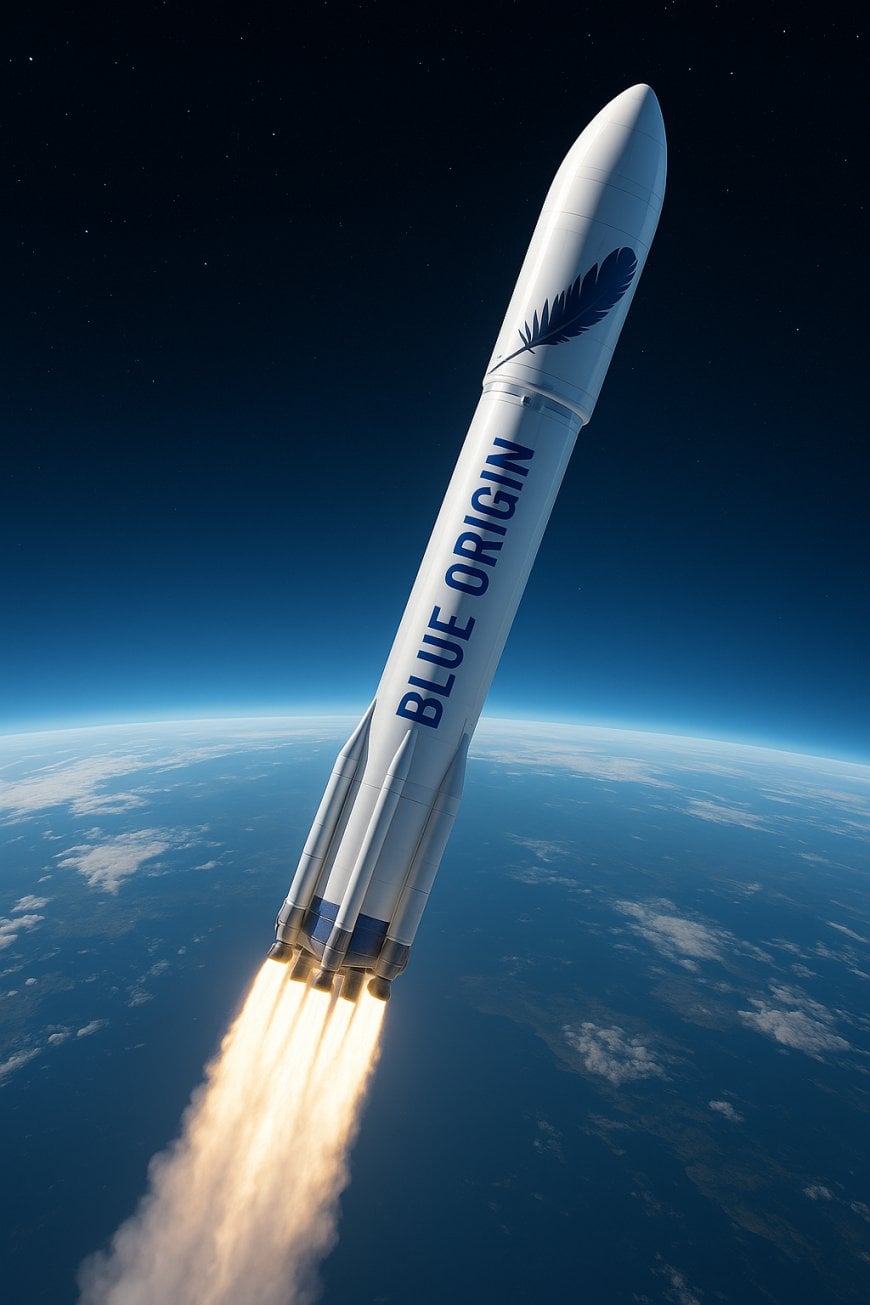
New Glenn 9×4: Blue Origin’s Heavy-Lift Engine for the AI Space Economy
Blue Origin’s upgraded New Glenn isn’t just a bigger rocket. It’s the front end of a stack: heavy-lift launch, in-space logistics, and commercial space habitats that can host the first wave of AI data centers and industrial infrastructure in orbit.

From Rocket Specs to Structural Shift
It’s the physical expression of a deeper bet: that the next marginal unit of AI and industrial growth won’t fit comfortably on Earth. It has to move into orbit.
On the surface, Blue Origin’s newly announced New Glenn 9×4 looks like a familiar story: more engines, more thrust, more tons to orbit. The baseline New Glenn was already a heavy-lift reusable rocket with seven BE-4 engines on its first stage and a beefy fairing aimed at large payloads. The 9×4 variant simply turns that dial past “heavy” and into “super-heavy.”
But the timing and the surrounding ecosystem matter more than the raw numbers. Blue Origin isn’t upgrading New Glenn in a vacuum. It’s doing it in parallel with Orbital Reef, a commercial space station designed as a mixed-use business park in low-Earth orbit, and Blue Ring, a multi-mission in-space logistics and cloud-compute platform.
Put those together and you don’t just get a bigger rocket. You get the scaffolding for something more important: a full-stack AI space industry—launch, logistics, habitat, and compute—designed to tap power, cooling, and vantage points that Earth alone can’t provide.
What’s Actually New About New Glenn 9×4
The original New Glenn architecture centered on a reusable first stage with seven BE-4 engines burning liquid oxygen and liquefied natural gas, paired with a high-energy upper stage and a large payload fairing. That baseline design already placed New Glenn in the heavy-lift class.
The new 9×4 variant builds on that heritage:
- 9×4 engine configuration: nine BE-4 engines on the first stage, four vacuum BE-3-class engines on the upper stage—two more engines per stage than the standard New Glenn.
- Super-heavy performance: over 70 metric tons to low-Earth orbit, more than 14 metric tons direct to GEO, and more than 20 metric tons to trans-lunar injection.
- Enlarged fairing: an ~8.7-meter-diameter payload fairing, widening the door for bulkier, integrated payloads—space-station modules, large solar arrays, space telescopes, and stacks of mega-constellation satellites.
- Reusability upgrades: phased changes to propulsion, structures, avionics, thermal protection, and recovery operations, starting with the NG-3 mission, designed to cut turnaround time and cost per flight.
In other words, New Glenn 9×4 is explicitly aimed at missions that need both mass and volume. That’s exactly the profile of payloads you’d expect from an AI space industry: dense compute racks, radiators, power systems, and pressurized modules built as commercial real estate in orbit.
Orbital Reef: The First Commercial Space Hab as “Business Park”
It’s designed from the ground up as a mixed-use business park in orbit—research labs, manufacturing bays, office space, and tourism all under one commercial roof.
While the rocket announcements grab headlines, the destination is where the real structural change happens. Orbital Reef, co-developed by Blue Origin and Sierra Space with partners like Boeing, Redwire, Genesis Engineering, and Arizona State University, is pitched as one of the first true commercial space stations: a free-flying “business park” in low-Earth orbit.
NASA is backing Orbital Reef as part of its Commercial LEO Destinations program, explicitly to seed a private replacement for the ISS and to catalyze a LEO economy that isn’t dominated by government budgets. The initial configuration is expected to support around six people, with room to grow beyond ten and hundreds of cubic meters of pressurized volume.
For an AI-space lens, the important part is the intentional zoning of this “hab”:
- Industrial and research tenants can lease space for microgravity manufacturing, biotech, optics, advanced materials, and on-site testing of new hardware.
- Data-intensive tenants can pair in-station operations with hosted payloads and nearby platforms—sensors, telescopes, or AI compute nodes parked in the same orbital neighborhood.
- Tourism and human presence provide the continuous human-in-the-loop oversight needed for complex infrastructure and high-value assets.
New Glenn 9×4 is the hauler that can lift the heavy modules. Orbital Reef is the space real estate where tenants can live, build, test, and maintain the first generation of space-native AI and industrial systems.
Blue Ring and the Birth of In-Space Cloud
The third leg of Blue Origin’s strategy is Blue Ring, a space mobility platform that looks a lot like an orbital Swiss Army knife. It’s designed to host and transport payloads, provide power and data relay, refuel clients, and maneuver across orbits from MEO out to cislunar space and even Mars-class missions.
The detail that matters for the AI-space narrative is simple and easy to miss: Blue Ring explicitly advertises an “in-space cloud computing” capability. That phrase effectively says the quiet part out loud:
It is positioning itself to host, power, connect, and compute in orbit — the same way terrestrial cloud providers host, power, connect, and compute on Earth.
Imagine a cluster of Blue Ring platforms positioned near Orbital Reef and other commercial stations. New Glenn 9×4 hoists up the dense hardware—AI racks, storage arrays, high-gain optical terminals, and radiator fields. Blue Ring provides the power, maneuvering, networking, and cloud interface. Orbital Reef provides human presence, servicing, and a base of operations.
That is a recognizable structure: it is the cloud-data-center model, lifted off the planet and reassembled as infrastructure in orbit.
AI Compute in Orbit: Why This Exists Now
The AI-space industry isn’t forming because rockets are cool. It’s forming because terrestrial constraints are hardening.
Training frontier-scale models and running persistent inference across billions of devices is pushing Earth’s grids, cooling systems, and land use to their limits. Data centers are now major power loads in multiple countries; new capacity is increasingly gated by grid build-out, local politics, and physical space for both facilities and renewables.
Meanwhile, a parallel track is quietly emerging:
- Research efforts like Google’s Project Suncatcher explore constellations of solar-powered satellites equipped with custom ML accelerators and optical interlinks—essentially a space-native TPU cloud tied together by lasers.
- Companies such as Starcloud and Crusoe are preparing to loft Nvidia H100-class AI data centers into orbit, exploiting constant solar power and the vacuum as a near-infinite heat sink to promise significantly lower energy costs per unit of compute.
- New entrants like Orbit AI talk openly about orbital cloud networks that merge compute, blockchain, and solar power above the atmosphere.
- China’s ADA Space is assembling an AI supercomputer in orbit—thousands of satellites linked by high-bandwidth laser communications doing local inference and data processing in space.
- Even at the narrative level, major players are saying the quiet part: in a world of terawatt-scale AI, space-based compute may become cheaper and more scalable than farming more data centers on Earth.
Against that backdrop, New Glenn 9×4 is not “just another super-heavy” and Orbital Reef is not “just another station concept.” Together with Blue Ring, they become a US-centric architecture for AI and industrial capacity in orbit.
The Emerging Stack: Launch → Logistics → Hab → AI
heavy-lift launch, in-space logistics, orbital real estate, and space-native cloud/compute.
When you stack New Glenn 9×4, Blue Ring, and Orbital Reef on top of each other, a clear pattern emerges:
- Heavy-lift launch (New Glenn + 9×4)
Moves bulk infrastructure—modules, trusses, solar arrays, tankage, radiators, and dense compute hardware—into orbit at scale, with reusability to keep marginal launch cost trending down over time. - In-space logistics and hosting (Blue Ring)
Repositions that hardware, provides power and communications, hosts payloads, and begins to abstract the underlying complexity into “services” — transportation, refueling, data relay, and cloud compute. - Commercial hab & real estate (Orbital Reef)
Gives tenants a place to live, work, assemble, repair, and iterate. It is literally commercial space real estate: labs, factories, offices, and hotel rooms, in orbit. - AI & industrial applications (ecosystem on top)
AI data centers in orbit. Earth-observation constellations integrated into real-time analytics pipelines. Microgravity manufacturing for chip substrates, optics, and exotic materials that feed back into Earth-side AI hardware supply chains.
That stack is the nucleus of an AI-space industrial flywheel: more orbital infrastructure enables more AI and industrial payloads; more AI and industrial payloads create more demand for launch and in-space services; higher cadence drives cost down; lower cost brings in more customers and applications.
Strategic Implications: Who Wins the AI-Space Race?
It’s a race to own the platform that AI, industry, and nations will use when they can’t grow easily on Earth anymore.
SpaceX has one architecture for this future: Starship as ultra-cheap mass-lift plus a rapidly iterating constellation platform. China has another: state-aligned AI constellations and space infrastructure built into broader industrial policy. Europe, Japan, and others are sketching their own versions.
Blue Origin’s answer is starting to sharpen:
- New Glenn 9×4 as the heavy-lift backbone for US-aligned commercial and national-security payloads.
- Blue Ring as an in-space logistics and cloud-compute layer that can be sold like a service.
- Orbital Reef as the anchor hab and business park in LEO, co-funded by NASA and opened to private tenants.
If the AI-space thesis is correct — if the world really cannot keep scaling AI and industrial systems inside the old terrestrial constraints — then the entities that own this stack will own a large slice of the next economy’s upper layer: the part that lives off-planet.
New Glenn 9×4 is a big rocket, yes. But more importantly, it’s a lever. It gives Blue Origin the ability to move the raw hardware of a space-native AI and industrial ecosystem into orbit. Blue Ring and Orbital Reef give that hardware somewhere to go and something to do.
It’s that, piece by piece, an AI-ready orbital economy is being engineered into existence — and New Glenn 9×4 is one of
Ano ang Iyong Reaksyon?
 Gusto
0
Gusto
0
 Hindi Gusto
0
Hindi Gusto
0
 Pag-ibig
0
Pag-ibig
0
 Nakakatawa
0
Nakakatawa
0
 Wow
0
Wow
0
 Malungkot
0
Malungkot
0
 Galit
0
Galit
0

Founder of Pattern Nexus. I research markets, macro, geopolitics, AI, history, ancient systems, and the patterns most people overlook. I’m also building Market Radar, a trading scanner designed to read pressure, risk, confirmation, and setup quality before chasing a move. Pattern Nexus is where I connect the dots between data, history, technology, and the bigger system playing out around us.
















Mga Komento (0)