 Editor-written summary
I showed how people on both sides react to an edited clip. Now apply the same test to AI, the humanoid robots going into workplaces, and the virtual worlds where I think a lot of people will end up.
Inside this report
- Who Decided What You Were Going to See?
- AI Has Been Here Longer Than You Think
- What the Curve Is Measuring
 Editor-written summary
UKMTO warnings said two outbound tankers were struck by unknown projectiles near Khasab, Oman, on November 21, one at the stern and another in the engine room. AP reported at least three tanker attacks in or near the Strait of Hormuz, including a separate Iranian state-media account of a tanker hitting a naval mine east of the strait. Iran International, citing UKMTO, reported Hormuz shipping was about 65% below pre-war levels in the week ending November 18, with six tanker attacks during that period.
Inside this report
- Khasab Turns Fresh Hormuz Tanker Strikes Into an Energy-Chokepoint Stress Test
- Quick Read
- Table of Contents
 Editor-written summary
Oracle said on November 20, 2026, that it has secured all funding needed to fulfill its OpenAI infrastructure contract, including the vendor-financing structure previously outlined to investors. The statement followed a roughly $20 billion stock-and-notes financing announced earlier in November and documented in an SEC Form 8-K. The immediate signal is not just that Oracle has capital for this cycle, but that AI infrastructure is becoming a test of funding capacity, vendor credit, debt tolerance, and future free cash flow.
Inside this report
- Austin Turns Oracle’s Fully Funded OpenAI Buildout Into an AI-Capex Solvency Test
- Quick Read
- Table of Contents
 Editor-written summary
Anthropic mathematician Levent Alpöge says he and Claude found a proof of the Riemann Hypothesis and formalized the argument in Lean. The claim remains unverified, with AP, Nature, Bloomberg Law, and Clay Mathematics Institute materials pointing to a long validation path. The systems story is that AI may be moving the bottleneck in science from generating candidate breakthroughs to verifying, explaining, and socially accepting them.
Inside this report
- San Francisco Turns Claude’s Riemann Claim Into an AI-Science Verification Test
- Quick Read
- Table of Contents
 Editor-written summary
The Fed is holding rates high and still buying Treasury bills. The purchase schedule, futures curve and metals selloff show where my earlier calls held up and where the numbers force a correction.
Inside this report
- How far is the Fed going to take this?
- The Fed is buying bills. Look at what it is replacing.
- Is the Fed actually tightening?
 Editor-written summary
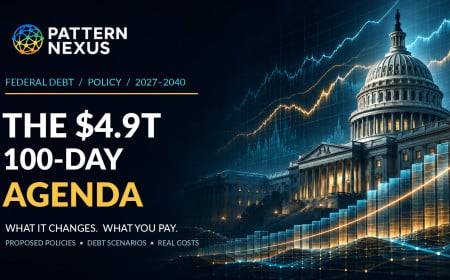
House Democrats outlined five first-100-day priorities for 2027. CRFB estimates $4.1 trillion in direct deficit effects and $4.9 trillion in additional borrowing including interest through 2037. Pattern Nexus examines the programs, household costs, both parties’ borrowing records, and an illustrative $85.8 trillion gross-debt stress scenario for 2040.
Inside this report
- The $4.9 Trillion First 100 Days: What Democrats Are Proposing, What You Pay, and the Debt Nobody Wants to Discuss
- The headline is real. The timeframe is being distorted. And the bills still have to be paid.
- I checked the $4.9 trillion headline. Here is what it actually says.
Federal Reserve Board releases results from survey of senior financial officers at banks about their strategies and practices for managing reserve balances
 Editor-written summary
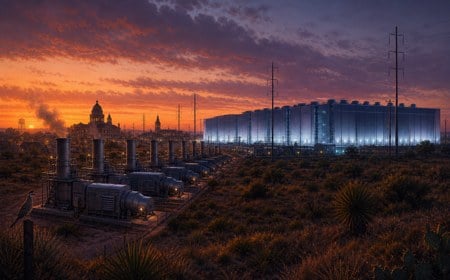
Texas has quickly moved from data-center recruitment engine to policy stress point for AI infrastructure. Prefiled bills for the 2027 legislative session target siting, grid-cost allocation, water reporting, cooling technology and tax incentives, with SB 296 proposing the most aggressive framework: a temporary moratorium and local-option elections for covered projects.
Inside this report
- Austin Turns Data-Center Moratorium Bills Into an AI-Grid Backlash Test
- Quick Read
- Table of Contents
 Editor-written summary
TCEQ authorized Space Exploration Technologies Corp.’s electric-generating-unit standard permit registration for the Boca Chica facility on November 16, 2026, covering 43 natural-gas-powered generators with 1,456.22 MW of listed generating capacity. Local and national reporting ties the power build to a proposed $24 billion super-compute/data-center and gas-plant project in Starbase, Texas. Cameron County commissioners then voted 3-2 to stop consideration of a county tax abatement, leaving SpaceX with state air authorization but a more contested local-incentive path.
Inside this report
- Starbase Turns SpaceX’s Gas-Powered AI Campus Into a Behind-the-Meter Power Test
- Quick Read
- Table of Contents
 Editor-written summary
The U.S. Senate voted 62-33 on November 19, 2026, to pass the Bipartisan American Affordability and Jobs Act, a broad permitting package covering energy and infrastructure projects including power plants, transmission lines, mines, pipelines and data centers. The bill now moves to the House. Its AI-economy significance is the cost-allocation test: if enacted, large new data centers would face stronger requirements to pay for the incremental grid and energy infrastructure needed to serve them.
Inside this report
- Washington Turns Senate Permitting Passage Into an AI-Grid Cost Test
- Quick Read
- Table of Contents
 Editor-written summary
California’s Department of Justice served Nvidia with an investigative subpoena on November 19, 2026, seeking information on whether advanced chips or confidential information may have gone to China and whether the company misled investors or the public. The move reframes the Nvidia-China controversy as a state securities and corporate-governance issue, not only a federal export-control fight. The next pressure points are document production, congressional interviews, Nvidia’s board response and any signs that state disclosure enforcement becomes a new front in AI-chip governance.
Inside this report
- Sacramento Turns Nvidia’s China Subpoena Into an AI-Chip Disclosure Test
- Quick Read
- Table of Contents
 Editor-written summary
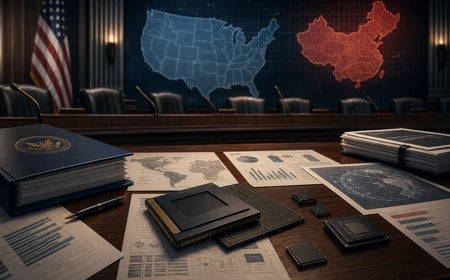
House Foreign Affairs Committee Chairman Brian Mast released export-control license information on November 19, 2026, saying Chinese buyers sought 3.4 million Nvidia and AMD AI chips and that the Bureau of Industry and Security approved more than 879,000. Reuters, SCMP and Anadolu reported the disclosure while noting that approvals do not necessarily prove completed shipments. The episode sharpens a core U.S.-China technology question: whether export controls can credibly restrict the AI compute layer when commercial incentives and national-security controls collide.
Inside this report
- Washington Turns 879,000 AI-Chip Licenses Into a China-Controls Credibility Test
- Quick Read
- Table of Contents

