 Editor-written summary
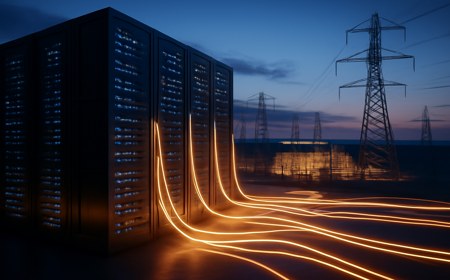
Google, Nvidia and Emerald AI have launched the AI Energy Management Alliance to promote flexible AI data centers that can adjust electricity demand in response to grid conditions. The coalition is pushing utilities, grid operators and regulators to treat verifiable flexibility as a reason to accelerate large-load interconnection. The Pattern Nexus read: AI compute demand is being converted from a fixed grid burden into a dispatchable power-market asset.
Inside this report
- Google and Nvidia Turn Flexible Load Into an AI-Data-Center Fast Lane
- Quick Read
- Table of Contents
 Editor-written summary
China has brought border control into the same strategic-security frame as chips, AI, export controls, state secrets and technology transfer. The new rules do not merely regulate passports; they create a legal channel for treating engineers, researchers, executives and sensitive-sector workers as part of the national-security perimeter. The system read is that talent mobility is becoming another control surface in U.S.-China technology competition.
Inside this report
- China Turns Exit Controls Into a Tech-Talent Firewall
- Quick Read
- Table of Contents
 Editor-written summary
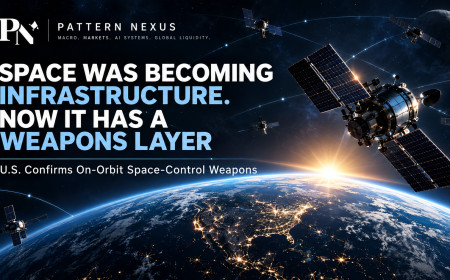
For the first time, the United States has publicly acknowledged that it operates "on-orbit space control weapons." The hardware remains classified, but the surrounding architecture is not: Space Force doctrine already defines orbital warfare, electromagnetic warfare, cyber operations, reversible denial, degradation and destruction as parts of space control; ground-based counterspace systems are already operational; and China, Russia and other states are developing the same wider capability stack. This Pattern Nexus report separates what is confirmed from what remains unknown, explains the Outer Space Treaty, maps the counterspace technology families, and ties the disclosure directly into earlier Pattern Nexus work on space infrastructure, "Launch. Control. Network.", cislunar logistics, and Control Stack 2.0. The central thesis: space becoming infrastructure was phase one; infrastructure becoming an explicitly armed control layer is phase two.
Inside this report
- The United States Did Not Announce a Future Program. It Acknowledged a Capability Already on Orbit.
- The First Is the Admission, Not the Beginning of Military Competition in Space
- The Space Force Told Us the Operating Logic in 2025
 Editor-written summary
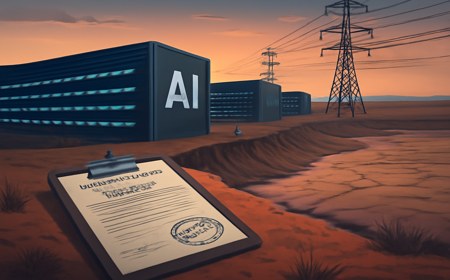
Texas is ordering the Texas Water Development Board to pursue penalties and legal consequences against major water users, including data centers, that fail to complete required water-use surveys. Abbott’s directive also links water reporting to TCEQ permitting and ERCOT coordination, making resource disclosure a practical gate for AI data-center expansion in the state.
Inside this report
- Texas Turns Data-Center Water Reporting Into a Permit-Blocking AI Infrastructure Test
- Quick Read
- Table of Contents
 Editor-written summary
EPA Administrator Lee Zeldin signed a final partial repeal of the 2024 Carbon Pollution Standards for fossil-fuel power plants and paired it with a proposal to rescind remaining greenhouse-gas standards for the sector under Clean Air Act Section 111. EPA frames the action as an energy-abundance and cost-saving measure worth more than $300 billion, while major news reports say environmental groups expect legal challenges. The AI angle is not that EPA regulated AI directly, but that rising data-center and industrial load is becoming a justification for fossil-basaload deregulation.
Inside this report
- EPA Turns AI Power Demand Into a Fossil-Baseload Deregulation Test
- Quick Read
- Table of Contents
 Editor-written summary
Trump dismissed AI catastrophe warnings as a hoax and framed pressure for AI guardrails as hostile to U.S. leadership, AI companies and data centers. The clash follows calls from Anthropic’s Dario Amodei, OpenAI’s Sam Altman and Elon Musk to pace frontier-model development and expand safety oversight. The bigger pattern is a political operating system that treats AI safety, permitting, energy demand and China competition as one acceleration problem.
Inside this report
- Trump Converts AI Safety Warnings Into a China-Race Doctrine
- Quick Read
- Table of Contents
 Editor-written summary
Episode 6 of the weekly Pattern Nexus audio-video series turns Part 6 of Cycles of Power into a shorter story about how liberalized capital flows, dollar borrowing, currency pegs, the Asian Financial Crisis, Russia, LTCM, the dot-com boom, and China's WTO entry created the modern global liquidity supercycle between 1994 and 2001.
Inside this report
- The Asian Liquidity Supercycle — Audio-Video Edition
- About this episode
- The leverage machine went global—and liquidity learned to reverse instantly
 Editor-written summary
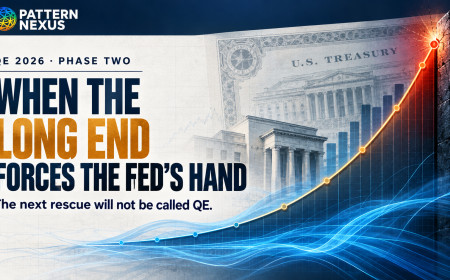
The Fed already ended QT and expanded Treasury holdings through bill-focused reserve-management purchases, but that repaired the reserve layer without suppressing the long end. With the 10-year Treasury at 4.95%, the 30-year at 5.37%, real long yields near the Pattern Nexus red zone, Treasury doubling long-end buybacks, and August CPI limiting conventional easing, this report calculates the probability that QE 2026 moves into a second phase. It maps the likely program, the names it may use, the dates when it could expand, and the exact yield, reserve, auction, repo, leverage, and credit conditions that could force direct duration absorption.
 Editor-written summary
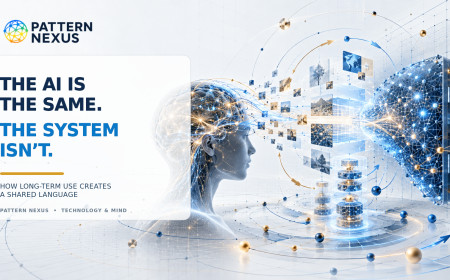
After a conversation moved from a media headline to political age limits, documented forecasts, cognitive bias, simulation theory, and finally language itself, a stranger system became visible: the AI was preserving continuity across ideas that were no longer fully restated in each message. This Pattern Nexus essay argues that sustained AI use can produce an emergent human–AI relationship that cannot be reduced to the base model alone. It separates contextual reconstruction from mind reading, interactional change from model retraining, and documented observation from metaphysical speculation. It also examines coadaptation, authorship, confirmation lock, dependency, platform control, and the social divide between transactional AI use and long-term system formation—while intentionally withholding the private shorthand and operating structure inside the author’s own system.
Inside this report
- The conversation was not wandering. It was drilling downward.
- The surface sentence is not the whole signal
- A shared language can exist without becoming a public dictionary
 Editor-written summary
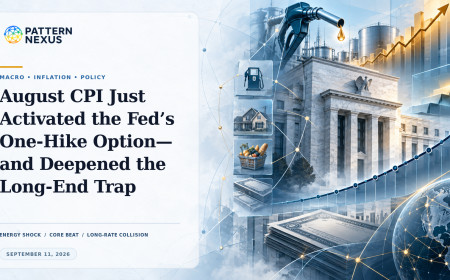
August CPI rose 0.4% on the month and 3.4% from a year earlier, while core CPI rose a hotter-than-expected 0.3% even as its annual rate eased to 2.4%. Pattern Nexus decomposes the report into an energy shock, a narrow communications-and-travel core impulse, and still-slow rent inflation. The result activates the Fed’s one-hike option for September, but it does not yet prove that a broad new inflation cycle has begun. This premium report maps the policy decision, the 80% PN September-hike probability, the long-end trap near 5%, the household cashflow squeeze, the rate-policy-versus-liquidity-plumbing contradiction, and the exact data that would confirm or invalidate the call.
Inside this report
- Headline met the forecast; core crossed the line
- Why the tenth matters
- One hot month is a warning; persistence is a regime
 Editor-written summary
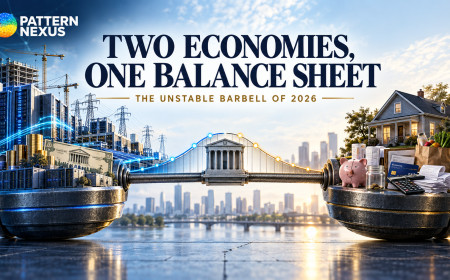
Reserve support has returned, but real long rates, fiscal supply, and an AI-energy capital wave are splitting the U.S. economy between capital strength and household fragility. This data-rich Pattern Nexus report maps the four feedback loops connecting Federal Reserve plumbing, Treasury duration, fiscal interest, housing lock-in, household credit, labor churn, AI infrastructure, power demand, dollar rails, and gold. It closes with four scenarios, a public-call audit, and a 90-day trigger dashboard.
 Editor-written summary
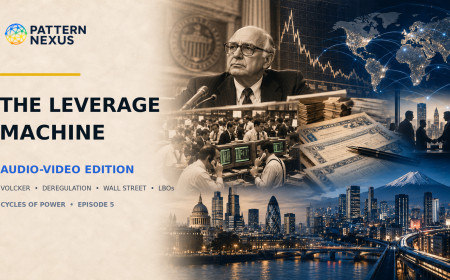
Episode 5 of the weekly Pattern Nexus audio-video series turns Part 5 of Cycles of Power into a shorter story about how the Volcker shock, Reagan–Thatcher deregulation, market-based credit, junk bonds, leveraged buyouts, securitization, derivatives, and electronic finance made leverage the central growth engine between 1979 and 1994.
Inside this report
- The Leverage Machine — Audio-Video Edition
- About this episode
- The dollar web gained discipline—and debt became its engine

