 Editor-written summary
U.S.-mediated Geneva talks put territory back at the center of the Russia–Ukraine negotiation, while sanctions enforcement tightens on Russian and Iranian oil. Markets are already trading the “peace premium”—and the unwind will be as political as it is financial.
Inside this report
- The Peace Premium: Geneva Talks,
- Sanctions Enforcement, and Why Oil Is Still a Weapon
- What the “Peace Premium” Really Is
 Editor-written summary
Repossessions are rising, subprime delinquencies are hitting cycle highs, and loan terms keep stretching. This is the stealth foreclosure wave on wheels—and it maps cleanly to the next phase of the household credit cycle.
Inside this report
- Auto Repos Are the New Foreclosures: The Household Stress Signal the Market Keeps Ignoring
- Why Autos Break Before Housing
- What the Fed Data Actually Says
 Editor-written summary
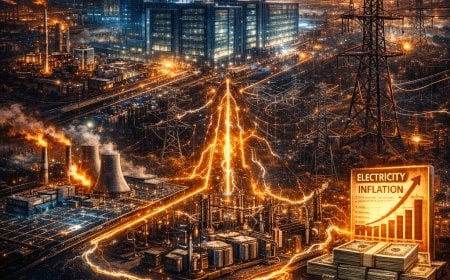
AI isn’t just a software story anymore. It’s a power story—capacity, interconnect queues, local resistance, and a new wave of private generation that quietly rewires inflation and industrial policy.
Inside this report
- AI Data Centers Are an Inflation Engine: The Race to Build a Private Grid
- Compute Becomes Baseload
- The Grid Bottleneck: Interconnect, Transmission, and Reality
 Editor-written summary
The GENIUS Act didn’t just “regulate crypto.” It formalized a new payments rail where private dollars can scale—and where reserve rules turn stablecoins into an indirect Treasury demand vector.
Inside this report
- The GENIUS Act and the Stablecoin State: How Private Dollars Become a Treasury Demand Engine
- What the GENIUS Act Actually Does
- Implementation Is the Real Battlefield
 Editor-written summary
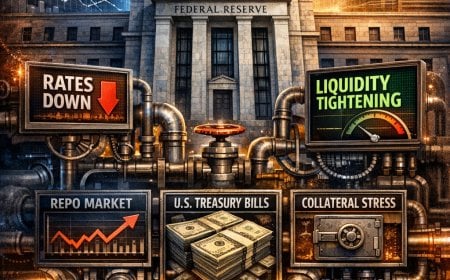
A Pattern Nexus systems read on the incoming Fed regime debate: floor vs corridor, repo backstops, Treasury supply, and why the balance sheet is the real rate.
Inside this report
- Warsh’s Fed and the Balance-Sheet War: Why “Rates Down” Can Still Mean “Liquidity Tight”
- Floor System Reality: The Balance Sheet Is the Rate
- The “Shrink It” Narrative Meets Treasury Supply
 Editor-written summary
A Pattern Nexus systems read on silica and quartz: why “sand” is abundant but ultra-high purity quartz is a strategic chokepoint for chips, solar, fiber, and the AI-industrial buildout.
Inside this report
- The Quartz Chokepoint
- Silica vs Quartz: Same Element, Different Reality
- Two Supply Chains: Bulk Silica and Hyper-Pure Quartz
 Editor-written summary
A Pattern Nexus control-systems read tying the yield curve, dollar regime, metals, crypto, and equities into one machine: why inversions lead recessions, why recessions can be strategically useful for policy, how 2020 proved direct household injection at scale, and why AI/robotics forces the system toward permanent transfer rails to stabilize demand.
Inside this report
- The Regime Reset Stack
- The thread: what you guys saw and why it matters
- Rates as strategy: the curve, conversions, term premium, and market function
 Editor-written summary
A Pattern Nexus systems read on an “ancient texts agree on five truths
Inside this report
- The Signal Under the Noise
- Why this video cuts through the noise
- Language is compression (why the ancients sounded “mystical”)
 Editor-written summary
Feb 11, 2026 market wrap plus an 11-day rewind: Dow tags 50,000, metals cool after the late-Jan vertical and violent margin-driven unwind, the dollar narrative turns into a control-systems debate, and the 10Y whips around while the index-level tape pretends it’s calm.
Inside this report
- Market Wrap: Dow 50K, Metals Cool, Yields Whip
- Today’s tape
- Indices: the wrapper looks calm
 Editor-written summary
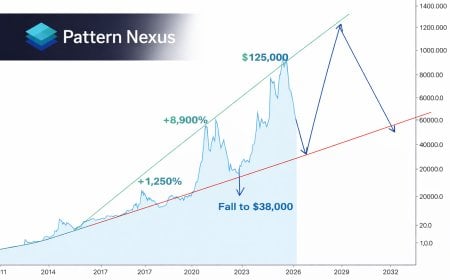
A Pattern Nexus structural breakdown of Bitcoin’s halving cycle, miner energy economics, difficulty adjustment, cycle-to-cycle drawdown math, and why a $38K reset can be mechanical—not catastrophic.
Inside this report
- Bitcoin’s Structural Halving Cycle
- Bitcoin Fundamentals (What People Keep Missing)
- Halving Cycle Mechanics (Issuance Shock)
 Editor-written summary
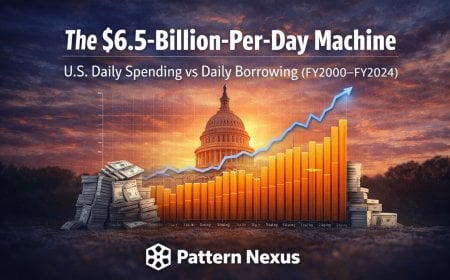
A Pattern Nexus structural read of U.S. federal average daily outlays versus average daily deficit financing since 2000 — and why persistent daily borrowing shows up in groceries, housing, metals, and equity valuations.
Inside this report
- U.S. Daily Spending vs Daily Borrowing: FY2000–FY2024
- What These Charts Actually Measure
- Chart 1: Average Daily Outlays (Line)
 Editor-written summary
A Pattern Nexus field guide to CDOs, CBOs, CDS, and modern “synthetic” exposure—what still exists, how big it is now, and why post-2008 reforms changed the failure mode rather than eliminating the risk.
Inside this report
- Synthetic Credit Didn’t Die, It Got Rewired
- What People Mean by “Synthetic”: CDO vs CDS vs Swaps
- The Numbers: How Big the Plumbing Still Is

