 Editor-written summary
TensorWave announced on November 16, 2026, that it will provide OpenAI with 457MW of dedicated AI infrastructure powered by AMD Instinct MI455X GPUs. The deal is framed as part of OpenAI’s previously announced AMD partnership and as TensorWave’s largest deployment contract to date. The system read is that OpenAI is testing whether an AMD-focused neocloud can deliver frontier-scale capacity outside the dominant Nvidia-hyperscaler channel.
Inside this report
- OpenAI Turns TensorWave’s 457MW AMD Deal Into a Non-Nvidia Compute-Scale Test
- Quick Read
- Table of Contents
 Editor-written summary
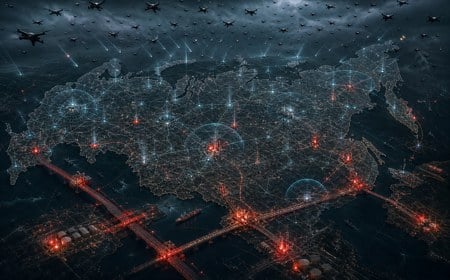
Russia’s Defense Ministry said air defenses downed 1,336 Ukrainian drones overnight across Russian regions, occupied Crimea, and nearby seas. Reuters and AP reported that the figure would make it Ukraine’s largest such attack since the full-scale invasion began, while other reports tied the barrage to disruption around the Crimean/Kerch Bridge and strikes on fuel-related infrastructure. The attack should be read less as a single raid than as a pressure test of Russia’s national-scale air-defense, logistics, and energy-security systems.
Inside this report
- Moscow Turns a Record Ukrainian Drone Swarm Into an Air-Defense Saturation Test
- Quick Read
- Table of Contents
 Editor-written summary
The USS Theodore Roosevelt has arrived in the Middle East, joining two other U.S. aircraft carriers already in the region amid the Iran war. The deployment coincides with renewed hazards around the Strait of Hormuz, including reported mine incidents and attacks on tankers. The move shifts the conflict from episodic maritime response toward a sustained coercive posture around the world’s most important oil chokepoint.
Inside this report
- Washington Turns a Third Carrier in the Middle East Into a Hormuz Escalation Test
- Quick Read
- Table of Contents
 Editor-written summary
The COP31 Presidency and the International Telecommunication Union officially launched the voluntary Antalya Artificial Intelligence Pledge on November 16, 2026, asking governments, companies and institutions to align AI growth with cleaner power, efficiency, lifecycle standards and environmental reporting. The launch arrived alongside Associated Press reporting on a Harvard/Nature Sustainability study estimating that 403 large U.S. data centers produced about 25.7 million metric tons of CO2 from May 2024 to April 2025. The result is a new test of whether AI’s physical footprint becomes measurable infrastructure governance or remains largely voluntary climate branding.
Inside this report
- Antalya Turns AI Data-Center Emissions Into a Climate-Disclosure Test
- Quick Read
- Table of Contents
 Editor-written summary
SK Telecom and Hyosung Heavy Industries signed a strategic partnership MOU on November 16, 2026, to support gigawatt-class AI data-center construction in South Korea. The agreement covers stable supply of core 345kV substation equipment, advance coordination on long-lead power gear, joint review and demonstrations of 800V DC distribution, and cooperation on operations, maintenance and future AI data-center business development. The larger signal is that AI scale-out is becoming a power-equipment and grid-delivery problem as much as a chip-procurement problem.
Inside this report
- Seoul Turns SKT-Hyosung Into an AI Power-Equipment Supply Test
- Quick Read
- Table of Contents
 Editor-written summary
Alibaba’s Qwen team introduced Qwen4-Max on November 16, positioning it as the first model in the Qwen4 family and a flagship for long-context, multimodal and agentic work. Reports from TechNode, The Next Web and Neural Brew corroborate the launch, the closed-weight status of the flagship, lower per-token API pricing versus Qwen3.8-Max and Alibaba’s plan to release smaller Qwen4 models with open weights.
Inside this report
- Alibaba Turns Qwen4-Max Into a China Model-Cost Pressure Test
- Quick Read
- Table of Contents
 Editor-written summary
The Geneva meeting runs from November 16 to 20, 2026, and will decide future work on lethal autonomous weapons systems under the CCW. Reuters and AFP report that the United States and Russia are expected to resist a push for legally binding negotiations, while a recent UN First Committee vote showed broad support for action and a small group of opponents including the U.S., Russia, Israel, North Korea and Belarus. The stakes are larger than arms-control procedure: the talks test whether systems that can select and engage targets are governed before they become ordinary battlefield infrastructure.
Inside this report
- Geneva Turns Autonomous Weapons Talks Into an AI Battlefield Governance Test
- Quick Read
- Table of Contents
 Editor-written summary
Japan’s Cabinet Office said real GDP was essentially unchanged in July–September 2026 but fell at a 0.1% annualized rate, with private consumption down 0.3%, imports up 2.5% and net exports subtracting 0.6 percentage point from growth. Independent reports from Reuters, AP and ChosunBiz tied the miss to higher living costs, oil and energy import pressure, weak-yen dynamics and poor weather, while noting that private non-residential investment rose 1.6%. The Pattern Nexus read: Japan’s problem is less a classic demand collapse than a terms-of-trade and purchasing-power squeeze that complicates Bank of Japan tightening.
Inside this report
- Tokyo Turns a Flat GDP Print Into an Energy-Import Stress Signal
- Quick Read
- Table of Contents
 Editor-written summary
Estonia says it plans to close road border crossings with Russia from December 1 after an alleged sabotage attempt against Threod Systems, an Estonian defense company that makes drones. Authorities attribute the operation to Russia's GRU military intelligence service, while local reporting says eight people were detained after an attempted break-in and arson plan. The move reframes a suspected attack on a defense supplier as a border-security and hybrid-warfare problem on NATO's eastern flank.
Inside this report
- Estonia Turns a Drone-Maker Sabotage Claim Into a Russia Border-Closure Test
- Quick Read
- Table of Contents
 Editor-written summary
Treasury Secretary Scott Bessent publicly urged Nvidia’s board to look outside the company for its next CEO and demanded answers on export-control compliance. The comments followed Nvidia’s November 12 CEO-transition filing and fresh AP reporting that Megaspeed says Alice Huang left the company in 2025 while outside lawyers conduct an internal probe. The verified facts do not establish wrongdoing by Nvidia, Jensen Huang, Alice Huang or Megaspeed; they show Washington is turning alleged AI-chip diversion into a governance and disclosure test.
Inside this report
- Bessent Turns Nvidia’s CEO Search Into an AI-Chip Export-Control Governance Test
- Quick Read
- Table of Contents
Federal Reserve Board announces approval of application by Peoples Bancorp Inc.
 Editor-written summary
Bahrain said on November 15, 2026, that its air-defense systems intercepted and destroyed several Iranian aerial attacks. Iran’s IRGC separately claimed it targeted a U.S. radar defense site at Al-Riffa with six drones, but available reporting does not independently confirm damage, casualties or a successful strike. The incident turns Bahrain into a live test of Gulf sensor coverage, warning systems and U.S.-linked basing resilience.
Inside this report
- Bahrain Turns Iranian Drone Interceptions Into a Fifth Fleet Air-Defense Stress Test
- Quick Read
- Table of Contents

