 Editor-written summary
October CPI exceeded consensus on both headline and core inflation. Eight earlier Pattern Nexus articles connect the oil and diesel shock, fertilizer risk, Fed tightening and refinancing pressure, with new Federal Reserve research and the November energy outlook.
Inside this report
- Hot CPI, Wrong Consensus: The Inflation Pressure Pattern Nexus Saw Coming
- Quick Read
- On This Page
 Editor-written summary
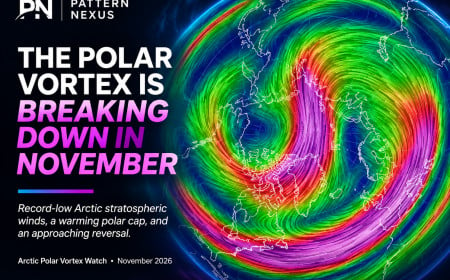
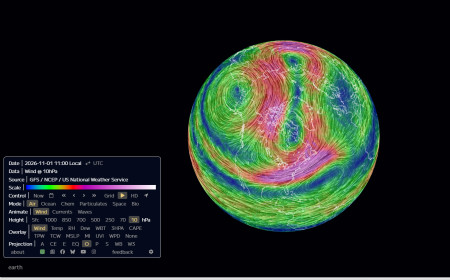
Eight consecutive record-low Arctic wind days, an exceptionally warm polar stratosphere and an early-November reversal forecast. What the measurements mean for winter weather.
Inside this report
- The circulation has moved beyond an unusual-looking image
- Eight consecutive records, and the vortex is nearly stationary in the zonal average
- The temperature record supports the dynamical signal
 Editor-written summary
Pattern Nexus applies historical Fed balance-sheet data, reserve-capacity accounting, out-of-sample forecasting models and GDP-scaled intervention episodes to estimate how much the Fed may have to expand through 2032. The no-crisis illustrative reserve-support path rises from $6.748 trillion to about $8.18 trillion; a separate conditional large-event scenario is roughly $3.74 trillion over 12 months. Includes four original charts, source links and full model limitations.
Inside this report
- Can we forecast the next forced expansion?
- The actual November 2026 starting balance sheet
- Twenty-four years of interventions are not a straight line
 Editor-written summary
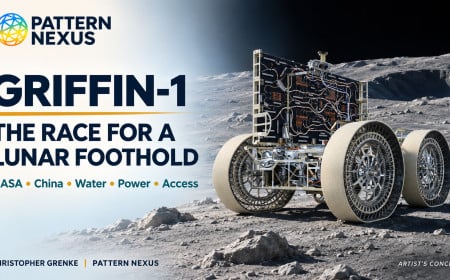
Griffin-1 and Astrolab’s FLIP rover could give NASA and its partners valuable experience at the lunar south pole. The larger competition with China runs through water, power, mobility, communications, and the ability to keep working after landing.
Inside this report
- A rover can change what comes after it
- The rocket, the lander and the rover do different jobs
- The valuable ground is where several advantages overlap
 Editor-written summary
People ask me what happens next. I want to know what they intend to do with the answer. A personal reflection on the research, the work, the systems we live inside, and the lives we are trying to build.
Inside this report
- What do you mean when you ask me what happens next?
- I can give you a prediction. Then what?
- I like finding out where I'm wrong
 Editor-written summary
A European orbiter has found an unusual HCl signal over cracks in the flank of a giant Martian volcano. The discovery adds a new atmospheric line of evidence to the case for a still-active interior—and forces a sharper separation between volcanic chemistry, underground habitability, and proof of life.
Inside this report
- The Red Planet May Have Lost Its Surface Climate Without Losing All of Its Internal Activity
- What Was Actually Detected: A Few HCl Molecules in a Billion
- How an Orbiter Finds a Gas That Barely Exists
 Editor-written summary
Where the historical relationship holds, where it breaks, and what the evidence says about housing. This November update extends the Pattern Nexus liquidity reconstruction with 37 charts, a reproducible workbook and the complete research package. It compares the published four-input liquidity index with an equal-weight audit, separates level relationships from return correlations, tests gold and Nasdaq positioning, and examines housing against mortgage rates, historical cohorts and a model frozen before the pandemic. The liquidity measures disagree on direction; the evidence does not establish a mechanical housing catch-up target.
 Editor-written summary
Episode 2 of The Next Normal examines resilience as an engineered capacity: how people and institutions absorb shocks, diagnose failure, rebuild stronger, reduce single points of failure, and transfer useful systems across generations.
Inside this report
- The Architecture of Resilience — Audio-Video Edition
- About this episode
- What cannot be taken is the capacity to reconstruct
 Editor-written summary
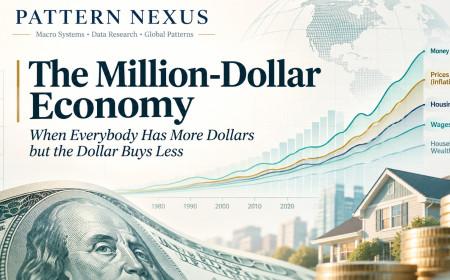
The U.S. money supply has expanded nearly fifteenfold since 1980, while consumer prices have quadrupled. Household wealth, wages, housing, and everyday expenses have followed very different trajectories. Using historical Federal Reserve, BLS, and Census data, I examine the expansion of nominal wealth and purchasing power, with an interactive dashboard modeling possible outcomes through 2037.
Inside this report
- The Million-Dollar Economy: When Everybody Has More Dollars but the Dollar Buys Less
- Quick Read
- On This Page
 Editor-written summary
Five September wind records have given way to an exceptionally weak Arctic circulation. PN checks 47 NASA autumns, the 1952 and 1968 warming benchmarks, ECMWF model disagreement, and the separate test of surface cold delivery.
Inside this report
- The seasonal anomaly has changed faster than the raw wind suggests
- The latest analyzed wind is weak, with a small daily recovery
- The November forecast is outside the historical envelope
 Editor-written summary
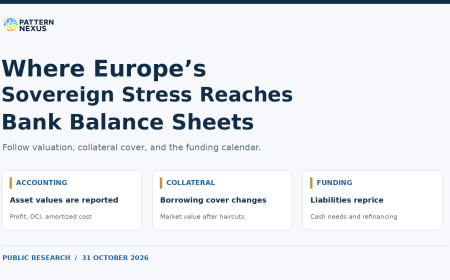
Government-bond repricing can reach a bank through accounting, collateral cover, and funding costs on different schedules. PN examines the latest sovereign-exposure data and follows one bond through those channels to identify where pressure could become a constraint.
Inside this report
- The fiscal numbers have changed
- Banks enter with capital and liquidity
- Read the country rows before ranking the risk
 Editor-written summary
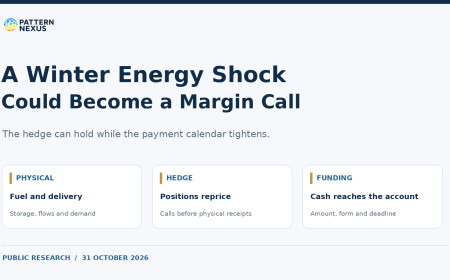
A winter price shock can demand cash before a hedge’s physical offset pays out. PN examines October gas inventories, clearing terms, and a worked producer example to trace how variation margin, collateral, and financing deadlines can transmit energy stress.
Inside this report
- The winter balance already has weak points
- America’s national inventory number has regional limits
- The hedge has a payment calendar

