

You’re offline. Open downloads
Chips
Automatically classified from article content.
Theses, forecasts, models, and paths
No published research objects yet
This topic is ready for editors to connect a thesis, forecast, model, or research path.
Latest articles
 Article · related
Sacramento Turns Nvidia’s China Subpoena Into an AI-Chip Disclosure Test
California’s Department of Justice served Nvidia with an investigative subpoena on November 19, 2026, seeking information on whether advanced chips or confidential information may have gone to China and whether the company misled investors or the public. The move reframes the Nvidia-China controversy as a state securities and corporate-governance issue, not only a federal export-control fight. The next pressure points are document production, congressional interviews, Nvidia’s board response and any signs that state disclosure enforcement becomes a new front in AI-chip governance.
Published Nov 19, 2026 Article · related
Washington Turns 879,000 AI-Chip Licenses Into a China-Controls Credibility Test
House Foreign Affairs Committee Chairman Brian Mast released export-control license information on November 19, 2026, saying Chinese buyers sought 3.4 million Nvidia and AMD AI chips and that the Bureau of Industry and Security approved more than 879,000. Reuters, SCMP and Anadolu reported the disclosure while noting that approvals do not necessarily prove completed shipments. The episode sharpens a core U.S.-China technology question: whether export controls can credibly restrict the AI compute layer when commercial incentives and national-security controls collide.
Published Nov 19, 2026 Article · related
Mountain View Turns Project Suncatcher’s New Glenn Booking Into an Orbital AI-Power Test
Google and Blue Origin confirmed a launch-services agreement for Project Suncatcher, with New Glenn targeted for a dedicated heavy-lift mission in Q1 2029. The satellites are planned to carry Google TPUs and roughly rack-scale compute capacity into sun-synchronous orbit. The system read is that AI infrastructure competition is widening from chips, data centers and grids into launch economics, orbital power, radiation hardening and thermal design.
Published Nov 19, 2026 Article · related
Washington Turns BIS’s Remote-Compute Rule Into an AI-Chip Containment Test
The Bureau of Industry and Security’s interim final rule, published in the Federal Register and effective November 19, 2026, restricts certain exports, reexports and in-country transfers of advanced semiconductors to overseas data centers that provide large-scale compute access to entities headquartered in Country Group D:5 or Macau. The rule also adds destination-based licensing requirements for Brazil, Indonesia, Malaysia, Singapore and Thailand, tightens oversight around advanced-node chip fabrication and packaging, and formally rescinds the Biden-era AI Diffusion Rule. The strategic shift is clear: Washington is moving from controlling boxes of chips to policing the operating layer of global compute.
Published Nov 19, 2026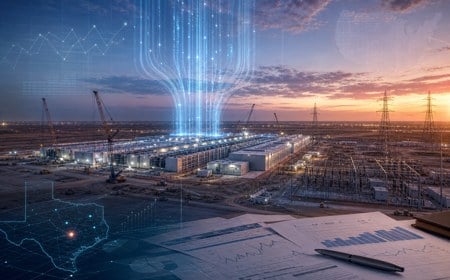 Article · related
Odessa Turns ChronoScale’s $7.5B AI Campus Into a Frontier-Compute Financing Test
ChronoScale announced definitive agreements with STN for a 50/50 Odessa, Texas AI data-center development partnership tied to a first deployment for a frontier AI lab. The company says the first phase carries up to $7.5 billion of expected total contract value over six years and is supported by up to $750 million of financing. The setup shifts the AI infrastructure story from chips alone to campus development, capital structure, HSR clearance, megawatt economics and delivery timing.
Published Nov 18, 2026 Article · related
Kuala Lumpur Turns U.S. AI-Chip Curbs Into a Data-Center Compliance Test
Malaysia’s trade minister said on November 18, 2026 that data-center operators using U.S.-origin GPUs must comply with new U.S. restrictions on advanced AI chips. The comments followed a BIS interim final rule that extends controls toward overseas data centers supplying significant compute to restricted users and adds license requirements for advanced chips bound for Malaysia and several other diversion-risk markets. The result is a shift from chip-shipment compliance to operating-level controls over data-center customers, remote access, GPU provenance and re-export risk.
Published Nov 18, 2026 Article · related
Taiwan Turns Texas Supplier Parks Into an AI-Hardware Onshoring Rail
Taiwan’s Ministry of Economic Affairs says it is working on U.S. industrial parks funded by private companies with government assistance, with each park estimated at about $2 billion to $4 billion. Reporting from Bloomberg, Focus Taiwan, UDN and DigiTimes points to Texas as the first site, designed to help smaller suppliers tied to Nvidia, TSMC and Foxconn establish U.S. operations. The system read is that AI onshoring is widening from chips and servers into the dense supplier base underneath them.
Published Oct 18, 2026 Article · related
Microsoft Turns Maia 300 Into a Multi-Gigawatt Inference Rail
Microsoft announced Maia 300 on October 12, 2026, saying Azure Maia will scale to multi-gigawatt deployments starting in 2027 and become the primary inference system for Microsoft products and services. The company says the system is aimed at long-context, latency-sensitive and agentic workloads, with 40% more tokens per megawatt than leading GPU-based systems. Reuters reported Microsoft may deploy more than one million custom AI chips next year as it tries to lower costs and reduce reliance on outside accelerators.
Published Oct 13, 2026 Article · related
Super Micro Contractor Turns Nvidia AI Servers Into a China Export-Control Guilty Plea
Ting-Wei “Willy” Sun, a contractor linked to Super Micro Computer, pleaded guilty on October 8, 2026, to four counts tied to an alleged scheme to illegally route AI servers containing advanced Nvidia chips to China. The Justice Department had previously alleged that the broader conspiracy involved about $2.5 billion worth of U.S. AI server technology. The plea is an enforcement signal for the U.S.-China compute-control regime: advanced AI servers are now being treated as traceable strategic infrastructure, not just commercial hardware.
Published Oct 11, 2026 Article · related
Wall Street Turns Broadcom-Anthropic Chips Into a $60B AI-Credit Test
Bank of America, Citigroup and Morgan Stanley have begun syndicating a record-sized financing package tied to Anthropic’s Broadcom-Google compute stack, according to multiple reports. The structure is reported to include roughly $42 billion of senior secured debt and $18 billion of junior financing, with Blackstone committing to a large part of the riskier tranche. The deal turns AI chips, leases, vendor support and future model revenue into a live credit-market test.
Published Oct 6, 2026 Article · related
Huawei Turns Qualcomm Patents Into a Sanctions-Resilient AI-IP Rail
Huawei and Qualcomm announced a broad multi-year patent license agreement on October 5, 2026, covering 5G, compute, AI and networking technologies. The deal includes cross-licenses and Qualcomm’s planned purchase of certain Huawei U.S. patents, subject to regulatory approvals. The bigger signal is that technology control is shifting from devices and chips toward standards-essential patents, licensing flows and ownership of foundational AI-era infrastructure IP.
Published Oct 5, 2026 Article · related
Amazon Turns Data-Center Backlash Into a $1B Community-Permit Rail
Amazon Web Services announced Built Together, a U.S. data-center community framework backed by more than $1 billion over five years, alongside a Data Center Commitment that includes ending NDAs with government agencies and publishing annual energy and water metrics. The verified facts point to a broader AI-infrastructure shift: local consent is becoming as important as chips, power contracts, and land. The Pattern Nexus read is that Amazon is trying to industrialize permission before moratoriums and transparency fights harden into a national brake on the AI buildout.
Published Oct 3, 2026 Article · related
DeepSeek Turns Huawei Ascend Tools Into a CUDA-Bypass Stack
DeepSeek said on September 30, 2026 that it partnered with Huawei to build programming infrastructure for Huawei Ascend chips, including open-source compute and communication libraries. The release includes DeepGEMM-Ascend, DeepEP-Ascend, and Ascend support around TileLang, with DeepGEMM-Ascend listing initial Ascend 950 support. The strategic signal is clear: China’s AI hardware bottleneck is becoming a software ecosystem contest against Nvidia’s CUDA-centered moat.
Published Oct 2, 2026 Article · related
Alibaba Turns Zhenwu V900 Into a 20-Gigawatt AI-Sovereignty Map
Alibaba announced a full-stack AI roadmap at its Apsara Conference on September 22, 2026, including the Zhenwu V900 AI processor, Qwen 4 training, future Qwen models planned at 5 trillion to 10 trillion parameters, and a target for Alibaba Cloud global data-center capacity to exceed 20GW by 2032. The verified facts point to a vertically integrated strategy spanning chips, cloud infrastructure, models and agents. The system read is that Alibaba is turning compute sovereignty into an operating layer for China’s AI industrial flywheel.
Published Sep 23, 2026 Article · related
China Turns Exit Controls Into a Tech-Talent Firewall
China has brought border control into the same strategic-security frame as chips, AI, export controls, state secrets and technology transfer. The new rules do not merely regulate passports; they create a legal channel for treating engineers, researchers, executives and sensitive-sector workers as part of the national-security perimeter. The system read is that talent mobility is becoming another control surface in U.S.-China technology competition.
Published Sep 16, 2026 Article · related
Alibaba Turns Hong Kong Equity Into an AI-Compute War Chest
Alibaba announced the pricing of a HK$80 billion placement of 710 million new ordinary shares at HK$112.70 each, with closing expected on August 26, 2026, subject to customary conditions. The company said 100% of net proceeds will go toward full-stack AI capabilities, including expansion and enhancement of AI infrastructure. Reuters, Bloomberg and South China Morning Post reported the deal as roughly US$10.2 billion and tied it to Alibaba’s broader push across chips, cloud infrastructure, AI models and applications.
Published Aug 23, 2026 Article · related
Google Turns Custom AI Chips Into a Marvell Equity-Control Deal
Marvell disclosed that it entered a July 29, 2026 commercial agreement with Google to develop custom semiconductor products tied to the TPU ecosystem. The August 19 filing also says Marvell issued Google a warrant for up to 58,970,907 shares at $206.58 per share, with most vesting tied to Custom Products revenue through Marvell’s fiscal 2033. The structure turns Google’s AI chip demand into a potential equity position while giving Marvell a long runway into TPU-adjacent infrastructure.
Published Aug 20, 2026 Article · related
Google Builds the Power Plant Into the AI Factory
Google and Intersect Power announced construction of the Meitner Energy Center in Gray and Roberts Counties, Texas, pairing a new Google data center with dedicated new energy generation. Independent reporting says the project includes more than 1 gigawatt of wind, solar, and battery storage, with some on-site gas for firming and air cooling to limit water use. The strategic read: the AI bottleneck is shifting from chips alone to controllable energy access.
Published Jun 7, 2026 Article · related
Spruce Pine Quartz: The Hidden Bottleneck Under Chips, AI, Solar, and the Modern World
Spruce Pine, North Carolina may be one of the most strategically important locations on Earth because its high-purity quartz sits underneath silicon wafers, semiconductor manufacturing, AI infrastructure, solar panels, optical fiber, and the modern digital control layer.
Published May 17, 2026 Article · related
The Quartz Chokepoint: Silica, Semiconductors, Solar, and the Quiet Resource That Runs the Modern Machine
A Pattern Nexus systems read on silica and quartz: why “sand” is abundant but ultra-high purity quartz is a strategic chokepoint for chips, solar, fiber, and the AI-industrial buildout.
Published Feb 16, 2026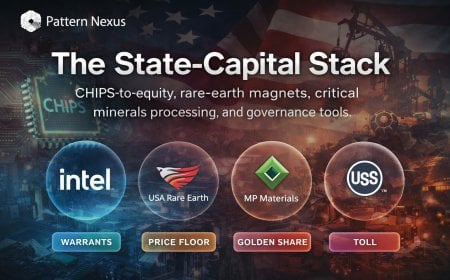 Article · related
The State-Capital Stack: CHIPS-to-Equity, Rare Earths, and the U.S. Ownership Turn
The Trump administration is turning industrial policy into cap-table leverage: converting CHIPS grants into equity, underwriting price floors and offtakes, and using governance instruments like golden shares and tolls. This is the state building rails and buying seats at chokepoints.
Published Jan 25, 2026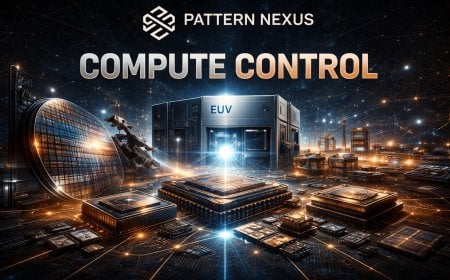 Article · related
Compute Control
Compute is a controllable chokepoint. Advanced chips require rare tools, rare know-how, and permissioned supply chains. Export controls, fab constraints, and cloud gates now throttle AI capabilities as a new layer of modern power.
Published Dec 26, 2025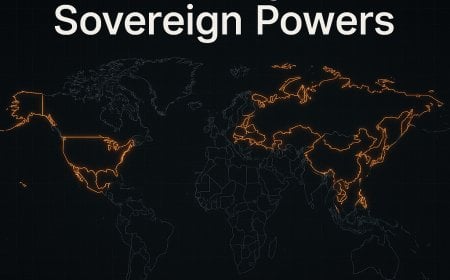 Article · related
Only Five Real Countries? Mapping De Facto Sovereignty in a 196-Flag World
On paper there are almost 200 sovereign states. In practice, a handful of “real countries” write the rules while everyone else lives inside their system. This Pattern Nexus long-form builds a sovereignty scorecard—money, guns, energy, chips, story, and institutions—to sort the U.S., China, Russia, UK, and France from near-poles like India, Iran, and Saudi Arabia, and from the client states and hedgers that orbit them.
Published Dec 8, 2025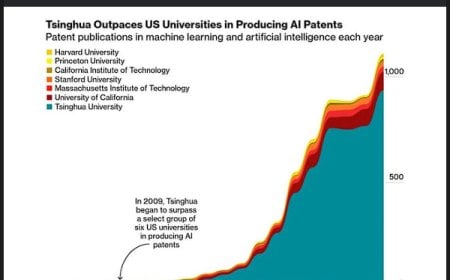 Article · related
The Patent Illusion: Why the U.S. Still Leads the AI Race (and Why That Tsinghua Chart Is Misleading)
This article breaks down why Tsinghua University’s surge in AI patents doesn’t mean China is winning the AI race. Patent charts measure universities—not compute, chips, cloud infrastructure, power, or frontier model leadership. Using real data, we explain why the U.S. still dominates the AI-industrial stack in 2025 and what pressure points actually matter.
Published Nov 20, 2025Join Pattern Nexus for premium research, the archive, and ad-free reading.