

You’re offline. Open downloads
Compliance
Automatically indexed from the existing article tag.
Theses, forecasts, models, and paths
No published research objects yet
This topic is ready for editors to connect a thesis, forecast, model, or research path.
Latest articles
 Article · related
Kuala Lumpur Turns U.S. AI-Chip Curbs Into a Data-Center Compliance Test
Malaysia’s trade minister said on November 18, 2026 that data-center operators using U.S.-origin GPUs must comply with new U.S. restrictions on advanced AI chips. The comments followed a BIS interim final rule that extends controls toward overseas data centers supplying significant compute to restricted users and adds license requirements for advanced chips bound for Malaysia and several other diversion-risk markets. The result is a shift from chip-shipment compliance to operating-level controls over data-center customers, remote access, GPU provenance and re-export risk.
Published Nov 18, 2026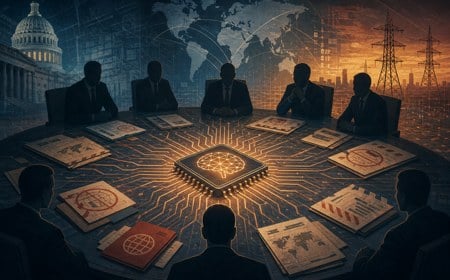 Article · related
Bessent Turns Nvidia’s CEO Search Into an AI-Chip Export-Control Governance Test
Treasury Secretary Scott Bessent publicly urged Nvidia’s board to look outside the company for its next CEO and demanded answers on export-control compliance. The comments followed Nvidia’s November 12 CEO-transition filing and fresh AP reporting that Megaspeed says Alice Huang left the company in 2025 while outside lawyers conduct an internal probe. The verified facts do not establish wrongdoing by Nvidia, Jensen Huang, Alice Huang or Megaspeed; they show Washington is turning alleged AI-chip diversion into a governance and disclosure test.
Published Nov 15, 2026 Article · related
Stablecoins Are Becoming the Dollar’s New Control Layer
Stanley Druckenmiller’s stablecoin call matters because it points to something bigger: stablecoins are evolving into a new dollar distribution and control layer built on Treasuries, compliance, and programmable rails.
Published Mar 13, 2026 Article · related
Escape Velocity: Where Control Breaks, Fractures, or Gets Redesigned
The master synthesis of The Age of Control Systems. This final chapter maps how modern power is enforced through rails, standards, energy, compute, data, compliance, supply chains, and algorithms—and the exact conditions under which those control layers fail, fracture, or get redesigned when legitimacy, redundancy, and incentives collide.
Published Jan 24, 2026 Article · related
The Debt-Free Illusion: How Personal Finance Cults Preserve the Consumer Class and Block Mobility
“Debt-free” is sold as freedom, but in a financialized economy it often functions as compliance: a behavioral cage that blocks asset ownership, leverage literacy, and class mobility.
Published Jan 24, 2026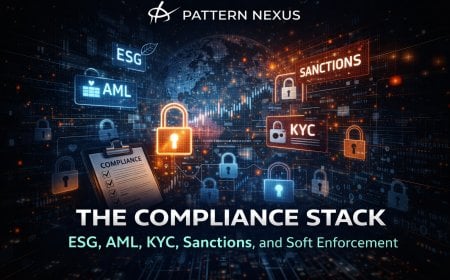 Article · related
The Compliance Stack - ESG, AML, KYC, Sanctions, and Soft Enforcement
Compliance has become an enforcement layer. ESG, AML, KYC, sanctions, and risk frameworks now operate as soft law—shaping capital flows, access, and survival without votes, courts, or overt coercion.
Published Dec 31, 2025 Article · related
Standards as Weapons
Standards are not neutral. ISO frameworks, accounting rules, settlement norms, and governance protocols act as invisible weapons—embedding power into interoperability, compliance, and market access without legislation.
Published Dec 18, 2025 Article · related
Money as Software
An in-depth systems analysis of how money evolved from a sovereign instrument into programmable infrastructure, where payment rails, compliance stacks, and settlement systems now function as primary mechanisms of power and enforcement. Modern money is no longer neutral currency—it is software. Payment rails, compliance layers, settlement systems, and financial risk controls now function as invisible governance, enforcing outcomes without legislation.
Published Dec 16, 2025 Article · related
Power Without Permission - Why Control Systems Replaced Sovereignty
An in-depth systems analysis of how modern power shifted from laws, borders, and coercion to invisible control systems—payment rails, standards bodies, energy flows, compliance regimes, and algorithmic authority—and why sovereignty now operates downstream of infrastructure.
Published Dec 13, 2025Join Pattern Nexus for premium research, the archive, and ad-free reading.