

You’re offline. Open downloads
Data
Automatically indexed from the existing article tag.
Theses, forecasts, models, and paths
No published research objects yet
This topic is ready for editors to connect a thesis, forecast, model, or research path.
Latest articles
 Article · related
Austin Turns Data-Center Moratorium Bills Into an AI-Grid Backlash Test
Texas has quickly moved from data-center recruitment engine to policy stress point for AI infrastructure. Prefiled bills for the 2027 legislative session target siting, grid-cost allocation, water reporting, cooling technology and tax incentives, with SB 296 proposing the most aggressive framework: a temporary moratorium and local-option elections for covered projects.
Published Nov 20, 2026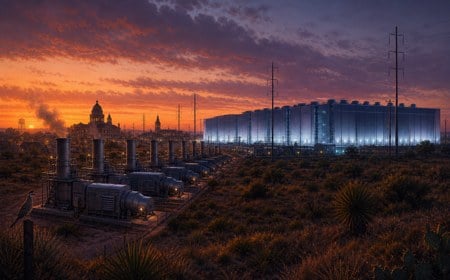 Article · related
Starbase Turns SpaceX’s Gas-Powered AI Campus Into a Behind-the-Meter Power Test
TCEQ authorized Space Exploration Technologies Corp.’s electric-generating-unit standard permit registration for the Boca Chica facility on November 16, 2026, covering 43 natural-gas-powered generators with 1,456.22 MW of listed generating capacity. Local and national reporting ties the power build to a proposed $24 billion super-compute/data-center and gas-plant project in Starbase, Texas. Cameron County commissioners then voted 3-2 to stop consideration of a county tax abatement, leaving SpaceX with state air authorization but a more contested local-incentive path.
Published Nov 20, 2026 Article · related
Washington Turns Senate Permitting Passage Into an AI-Grid Cost Test
The U.S. Senate voted 62-33 on November 19, 2026, to pass the Bipartisan American Affordability and Jobs Act, a broad permitting package covering energy and infrastructure projects including power plants, transmission lines, mines, pipelines and data centers. The bill now moves to the House. Its AI-economy significance is the cost-allocation test: if enacted, large new data centers would face stronger requirements to pay for the incremental grid and energy infrastructure needed to serve them.
Published Nov 19, 2026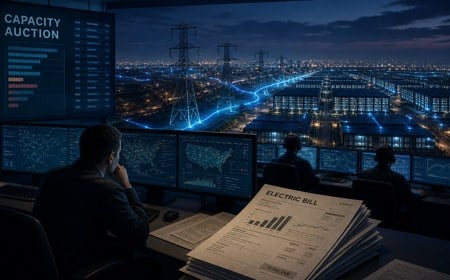 Article · related
PJM Turns AI Load Forecasts Into a Capacity-Cost Stress Test
State ratepayer advocates asked PJM’s board to seek FERC approval to postpone the December 9-15, 2026 capacity auction for the 2029/2030 delivery year until forecast data-center load is removed and handled through a separate reliability backstop process. The request leans on PJM’s Independent Market Monitor, which warned that data-center load already raised capacity costs by $29.4 billion and could add another $5 billion to $10 billion in the upcoming auction. PJM says delaying the auction this close to execution could destabilize the market and raise reliability risk.
Published Nov 19, 2026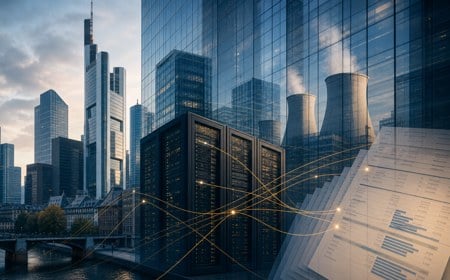 Article · related
Frankfurt Turns AI Data-Center Lending Into a Bank-Supervision Stress Test
ECB Banking Supervision Chair Claudia Buch said on November 19, 2026 that euro-zone banks’ direct data-center exposure is still small but growing quickly. Reuters reported that data centers account for about 1.2% to 1.3% of euro-zone banks’ corporate exposures and that 12 banks are materially exposed to AI-related private credit. The system signal is that AI infrastructure is becoming a supervisory credit-risk channel, not only an energy-demand or equity-valuation theme.
Published Nov 19, 2026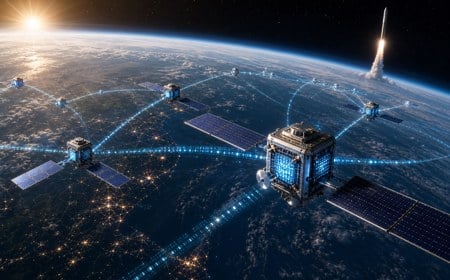 Article · related
Mountain View Turns Project Suncatcher’s New Glenn Booking Into an Orbital AI-Power Test
Google and Blue Origin confirmed a launch-services agreement for Project Suncatcher, with New Glenn targeted for a dedicated heavy-lift mission in Q1 2029. The satellites are planned to carry Google TPUs and roughly rack-scale compute capacity into sun-synchronous orbit. The system read is that AI infrastructure competition is widening from chips, data centers and grids into launch economics, orbital power, radiation hardening and thermal design.
Published Nov 19, 2026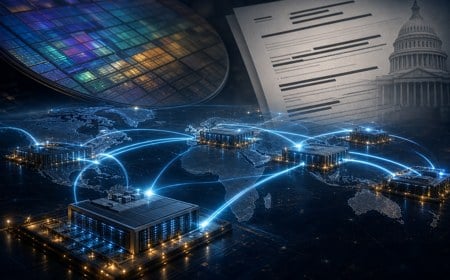 Article · related
Washington Turns BIS’s Remote-Compute Rule Into an AI-Chip Containment Test
The Bureau of Industry and Security’s interim final rule, published in the Federal Register and effective November 19, 2026, restricts certain exports, reexports and in-country transfers of advanced semiconductors to overseas data centers that provide large-scale compute access to entities headquartered in Country Group D:5 or Macau. The rule also adds destination-based licensing requirements for Brazil, Indonesia, Malaysia, Singapore and Thailand, tightens oversight around advanced-node chip fabrication and packaging, and formally rescinds the Biden-era AI Diffusion Rule. The strategic shift is clear: Washington is moving from controlling boxes of chips to policing the operating layer of global compute.
Published Nov 19, 2026 Article · related
Loudoun Turns Data Center Alley’s Pause Into an AI-Grid Bottleneck Test
Loudoun County, Virginia, said its Board of Supervisors voted on November 17, 2026, to pause action on legislative data-center and electrical-substation applications for up to 12 months, retroactive to September 15. The county says the move could affect 33 active legislative applications while leaving administrative reviews, new submissions and several exceptions in place. The decision turns Data Center Alley into a test case for how AI compute growth is increasingly constrained by local permitting, substations, transmission planning and ratepayer politics.
Published Nov 19, 2026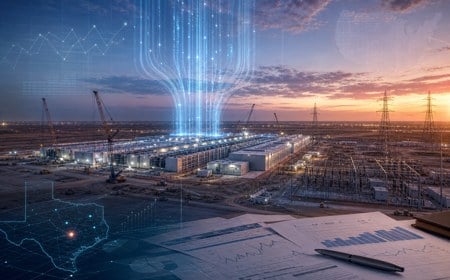 Article · related
Odessa Turns ChronoScale’s $7.5B AI Campus Into a Frontier-Compute Financing Test
ChronoScale announced definitive agreements with STN for a 50/50 Odessa, Texas AI data-center development partnership tied to a first deployment for a frontier AI lab. The company says the first phase carries up to $7.5 billion of expected total contract value over six years and is supported by up to $750 million of financing. The setup shifts the AI infrastructure story from chips alone to campus development, capital structure, HSR clearance, megawatt economics and delivery timing.
Published Nov 18, 2026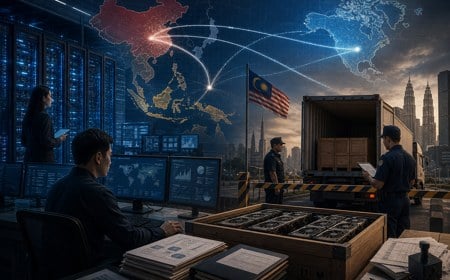 Article · related
Kuala Lumpur Turns U.S. AI-Chip Curbs Into a Data-Center Compliance Test
Malaysia’s trade minister said on November 18, 2026 that data-center operators using U.S.-origin GPUs must comply with new U.S. restrictions on advanced AI chips. The comments followed a BIS interim final rule that extends controls toward overseas data centers supplying significant compute to restricted users and adds license requirements for advanced chips bound for Malaysia and several other diversion-risk markets. The result is a shift from chip-shipment compliance to operating-level controls over data-center customers, remote access, GPU provenance and re-export risk.
Published Nov 18, 2026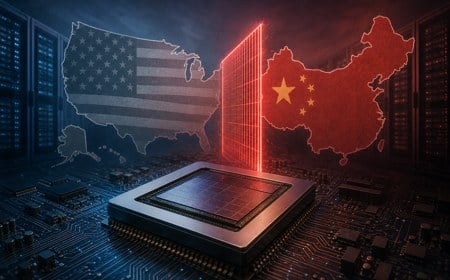 Article · related
Santa Clara Turns Nvidia’s China Shipment Halt Into an AI-Chip Decoupling Test
Nvidia said it sold $2.4 billion of licensed Hopper data-center products to China in its fiscal third quarter but is no longer shipping those products there. The company’s SEC-filed outlook for the fourth quarter assumes no Data Center compute revenue from China, making the prior licensing pathway look less like a stable compromise and more like a narrowing corridor. The signal is not just a China revenue issue; it is a live stress test for U.S. chip controls, allied supply chains and the geography of advanced AI compute.
Published Nov 18, 2026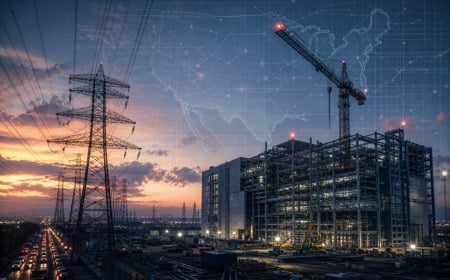 Article · related
America Turns a Data-Center Construction Drop Into an AI Buildout Bottleneck Test
Cleanview says U.S. developers began construction on 8.4 GW of data-center capacity across 65 buildings in Q3 2026, down 28% from 11.7 GW across 96 buildings in Q2. OPIS and Axios both reported the slowdown, with Axios and Cleanview pointing to political and permitting pressure as a key variable for the next phase of the AI buildout. The signal is not that AI demand has cracked; it is that physical deployment may be shifting from a GPU-constrained story to a power, permitting and local-consent story.
Published Nov 17, 2026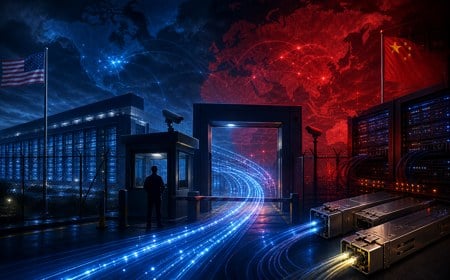 Article · related
Washington Turns Chinese Optical Transceivers Into an AI Data-Center Supply-Chain Test
Reuters reported on November 17, 2026, that the Trump administration plans to continue efforts to block imports of Chinese data-center equipment, including optical transceivers, despite opposition from Amazon, Google, Meta, CoreWeave, Cisco and Microsoft. The dispute is backed by an August ITI filing urging the FCC not to add optical transceivers broadly to the Covered List and a September bipartisan Senate bill targeting Chinese optical transceivers in sensitive federal systems. The strategic question is whether Washington can harden the AI data-center stack without constraining the infrastructure race it is trying to win.
Published Nov 17, 2026 Article · related
Nvidia Turns Rubin HPC Into a Scientific-AI Compute Roadmap Test
Nvidia announced Rubin HPC at SC26 on November 16, 2026, positioning the Vera Rubin-family GPU for simulation, data processing, science, engineering and analytics workloads. The company disclosed more than 50,000 CUDA cores, sparse-data acceleration, seventh-generation NVLink and expected 2028 availability. Independent technical coverage framed the move as a renewed push into HPC while noting that memory, power, pricing and full precision-performance details remain open.
Published Nov 17, 2026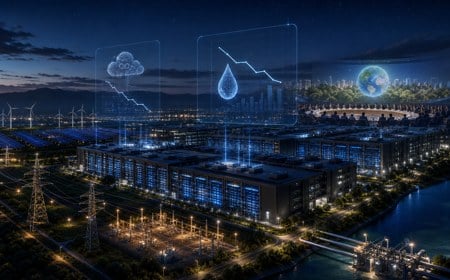 Article · related
Antalya Turns AI Data-Center Emissions Into a Climate-Disclosure Test
The COP31 Presidency and the International Telecommunication Union officially launched the voluntary Antalya Artificial Intelligence Pledge on November 16, 2026, asking governments, companies and institutions to align AI growth with cleaner power, efficiency, lifecycle standards and environmental reporting. The launch arrived alongside Associated Press reporting on a Harvard/Nature Sustainability study estimating that 403 large U.S. data centers produced about 25.7 million metric tons of CO2 from May 2024 to April 2025. The result is a new test of whether AI’s physical footprint becomes measurable infrastructure governance or remains largely voluntary climate branding.
Published Nov 16, 2026 Article · related
Seoul Turns SKT-Hyosung Into an AI Power-Equipment Supply Test
SK Telecom and Hyosung Heavy Industries signed a strategic partnership MOU on November 16, 2026, to support gigawatt-class AI data-center construction in South Korea. The agreement covers stable supply of core 345kV substation equipment, advance coordination on long-lead power gear, joint review and demonstrations of 800V DC distribution, and cooperation on operations, maintenance and future AI data-center business development. The larger signal is that AI scale-out is becoming a power-equipment and grid-delivery problem as much as a chip-procurement problem.
Published Nov 16, 2026 Article · relatedFed Turns AI Data-Center Leverage Into a Financial-Stability Warning
The Fed’s latest Financial Stability Report says AI was the top-cited near-term risk among market contacts, with 87% naming it in the fall survey, up from 50% in the spring. The report also details more than $680 billion of advanced-computing debt issuance by October 2026, more than $1 trillion of not-yet-started lease obligations, and more than $2 trillion of guarantees and contract commitments tied to the data-center buildout. Pattern Nexus reads the report as a shift: AI infrastructure is now a macro-financial transmission channel, not just a technology investment cycle.
Published Nov 14, 2026 Article · related
The Polar Vortex Is Breaking Down in November — What the Actual Data Show
Eight consecutive record-low Arctic wind days, an exceptionally warm polar stratosphere and an early-November reversal forecast. What the measurements mean for winter weather.
Published Nov 10, 2026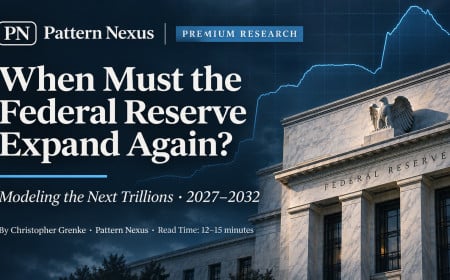 Article · related
When Must the Federal Reserve Expand Again? Modeling the Next $Trillions, 2027–2032
Pattern Nexus applies historical Fed balance-sheet data, reserve-capacity accounting, out-of-sample forecasting models and GDP-scaled intervention episodes to estimate how much the Fed may have to expand through 2032. The no-crisis illustrative reserve-support path rises from $6.748 trillion to about $8.18 trillion; a separate conditional large-event scenario is roughly $3.74 trillion over 12 months. Includes four original charts, source links and full model limitations.
Published Nov 9, 2026 Article · related
The Million-Dollar Economy: When Everybody Has More Dollars but the Dollar Buys Less
The U.S. money supply has expanded nearly fifteenfold since 1980, while consumer prices have quadrupled. Household wealth, wages, housing, and everyday expenses have followed very different trajectories. Using historical Federal Reserve, BLS, and Census data, I examine the expansion of nominal wealth and purchasing power, with an interactive dashboard modeling possible outcomes through 2037.
Published Nov 1, 2026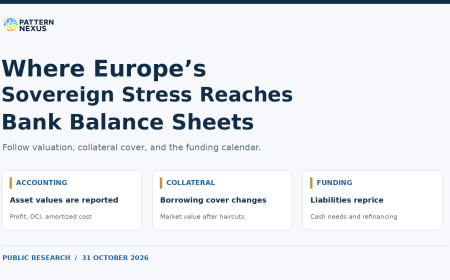 Article · related
Where Europe’s Sovereign Stress Reaches Bank Balance Sheets
Government-bond repricing can reach a bank through accounting, collateral cover, and funding costs on different schedules. PN examines the latest sovereign-exposure data and follows one bond through those channels to identify where pressure could become a constraint.
Published Nov 1, 2026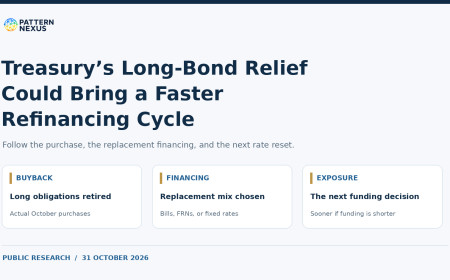 Article · related
Treasury’s Long-Bond Relief Could Bring a Faster Refinancing Cycle
Treasury’s larger long-end buybacks can improve trading today. PN follows the actual cash payments, September maturity data, and replacement-financing choices to test whether that relief could bring future interest-rate exposure forward.
Published Nov 1, 2026 Article · related
Ankara Turns Renewable Finance Into an AI Data-Center Sovereignty Rail
The Asian Development Bank said on October 22, 2026 that it signed a $75 million loan with Rönesans Holding to support renewable energy, battery storage by 2029 and a hybrid-renewable hyperscale data center in Türkiye. The financing follows Rönesans and Digital Realty’s Ankara data-center push, with the first phase planned for more than 22 MW of IT capacity by 2028. The pattern is larger than one campus: Türkiye is trying to convert geography, clean power and state incentives into sovereign AI and cloud infrastructure.
Published Oct 24, 2026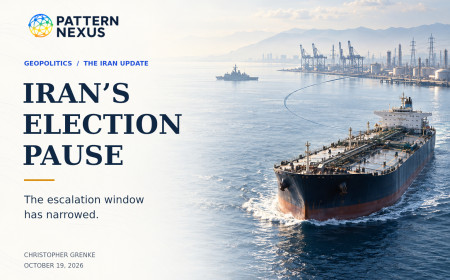 Article · related
Iran’s Election Pause: The Escalation Window Has Narrowed
The first follow-up to the October 8 Iran forecast confronts Trump’s election pause, checks actual naval posture, and follows the conflict through shipping, infrastructure, fuel and financing. The November 5 endpoint stays fixed. Four original figures, dated source notes and reproducible data are included.
Published Oct 20, 2026 Article · related
The Diesel Trap: Why the Oil War Is Bending Sanctions Before Winter
The October Russia-sanctions waiver adds a new policy chapter to the Pattern Nexus oil-war thesis. I connect the diesel bottleneck to emergency fuel commitments, uneven winter heating costs, the original Iran escalation window, household purchasing power and the next Fed financing test. Includes four dated figures and reproducible data.
Published Oct 20, 2026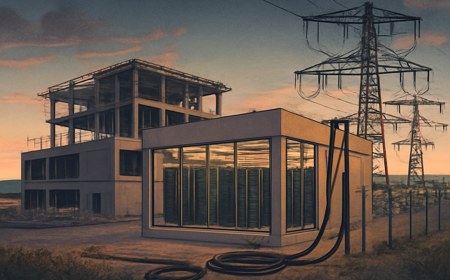 Article · related
Microsoft Turns Nscale’s Essex AI Campus Into a Grid-Delay Stress Test
Microsoft has pulled out of its planned role at Nscale’s Loughton, Essex AI data-center project, according to Reuters, the Guardian and BBC-backed reporting. The project had been announced in 2025 as a major UK AI supercomputer site for Azure services, with 50MW of initial AI capacity, scalability to 90MW and 23,040 Nvidia GB300 GPUs. Reports tie the reversal to power-supply delays that could push adequate grid connection into the 2030s, while Nscale says it remains committed to the site and that other Microsoft work is unaffected.
Published Oct 19, 2026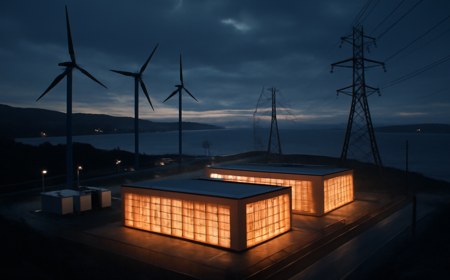 Article · related
Anthropic Turns Nova Scotia Wind Into a 420-Megawatt Claude Compute Rail
EverWind announced more than C$10 billion in planned private investment for a Point Tupper data-centre campus and Nova Scotia wind projects on October 16, 2026. Reuters identified the frontier AI tenant as Anthropic, while Canadian Press and Global News reported a long-term lease, a 95-megawatt first phase in late 2027, a 325-megawatt expansion, and 420 megawatts at full buildout. The project ties Claude-scale compute demand to local power, water, ratepayer, and data-sovereignty politics.
Published Oct 18, 2026 Article · related
The Recession Path: How Income, Investment and Credit Can Turn a Technology Boom Into an Economic Reset
A forward model links income, spending, investment and credit, then tests its forecasts against modern U.S. data and 150 years of macrohistory. Growth remains the baseline. The research quantifies the route into recession and the severe, persistent conditions required for a deeper economic reset.
Published Oct 17, 2026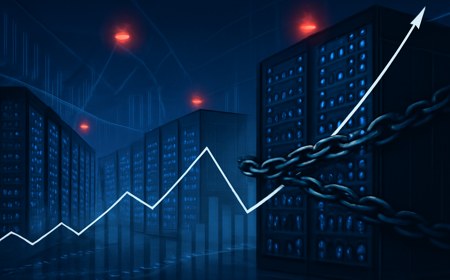 Article · related
CoreWeave Turns AI Data-Center Debt Into a Credit-Market Stress Test
CoreWeave shares and bonds came under pressure this week as investors repriced the leveraged neocloud model behind the AI data-center buildout. Axios reported CoreWeave bond yields above 15%, while Bloomberg reported credit-default pricing implying more than 60% odds of default within five years. The company’s own June 30, 2026 filing shows $35.6 billion of total indebtedness and $103.7 billion of remaining performance obligations, making CoreWeave a live test of whether AI demand can convert into enough cash flow to finance depreciation-heavy infrastructure.
Published Oct 16, 2026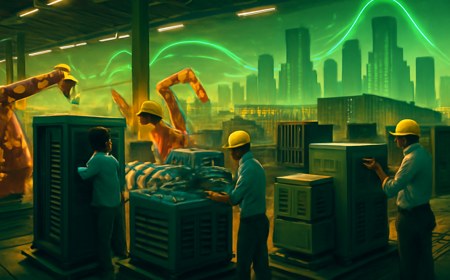 Article · related
Adani and Jabil Turn AI Data-Center Hardware Into a Made-in-India Supply Rail
Adani Enterprises and Jabil signed a non-binding MoU on October 13, 2026, setting out a proposed 50:50 joint venture to manufacture and assemble AI and data-center equipment in India. The companies describe a multi-gigawatt AI-rack manufacturing platform aimed at hyperscalers, neoclouds, data-center operators and enterprises. The deal still requires definitive agreements, approvals and customary conditions, but it signals how the AI buildout is shifting from chip access alone toward localized full-stack infrastructure supply chains.
Published Oct 13, 2026Join Pattern Nexus for premium research, the archive, and ad-free reading.