

You’re offline. Open downloads
fed
Automatically indexed from the existing article tag.
Theses, forecasts, models, and paths
No published research objects yet
This topic is ready for editors to connect a thesis, forecast, model, or research path.
Latest articles
 Article · related
What the Hell Is the Fed Doing? Rates, Treasury Bills and the Gold Selloff
The Fed is holding rates high and still buying Treasury bills. The purchase schedule, futures curve and metals selloff show where my earlier calls held up and where the numbers force a correction.
Published Nov 20, 2026 Article · related
Washington Turns Waller’s 50bp Warning Into an Inflation-Psychology Test
Federal Reserve Governor Christopher Waller said on November 18 that the Fed may need to act more aggressively against inflation, including a possible 50-basis-point move at the December 8-9 meeting or clearer communication that hikes will continue quickly into 2027. Reuters, Anadolu, Quartz, and NDTV Profit all reported the remarks from Waller’s CNBC appearance, while market coverage showed the comments landing into a fragile backdrop for futures, Treasury yields, and AI-linked risk appetite. The signal is not just hawkish Fed-speak; it is a repricing test for duration-heavy assets built around low discount rates.
Published Nov 18, 2026 Article · relatedFed Turns AI Data-Center Leverage Into a Financial-Stability Warning
The Fed’s latest Financial Stability Report says AI was the top-cited near-term risk among market contacts, with 87% naming it in the fall survey, up from 50% in the spring. The report also details more than $680 billion of advanced-computing debt issuance by October 2026, more than $1 trillion of not-yet-started lease obligations, and more than $2 trillion of guarantees and contract commitments tied to the data-center buildout. Pattern Nexus reads the report as a shift: AI infrastructure is now a macro-financial transmission channel, not just a technology investment cycle.
Published Nov 14, 2026 Article · related
Hot CPI, Wrong Consensus: The Inflation Pressure Pattern Nexus Saw Coming
October CPI exceeded consensus on both headline and core inflation. Eight earlier Pattern Nexus articles connect the oil and diesel shock, fertilizer risk, Fed tightening and refinancing pressure, with new Federal Reserve research and the November energy outlook.
Published Nov 10, 2026 Article · related
When Must the Federal Reserve Expand Again? Modeling the Next $Trillions, 2027–2032
Pattern Nexus applies historical Fed balance-sheet data, reserve-capacity accounting, out-of-sample forecasting models and GDP-scaled intervention episodes to estimate how much the Fed may have to expand through 2032. The no-crisis illustrative reserve-support path rises from $6.748 trillion to about $8.18 trillion; a separate conditional large-event scenario is roughly $3.74 trillion over 12 months. Includes four original charts, source links and full model limitations.
Published Nov 9, 2026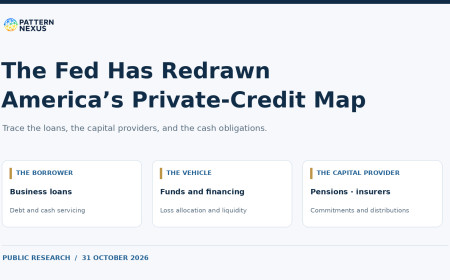 Article · related
The Fed Has Redrawn America's Private-Credit Map
New Federal Reserve tables connect private-credit loans with their vehicles and capital providers. PN follows pension and insurer ownership, fund borrowing, capital commitments, and the cash pressures that could shape the next lending cycle.
Published Nov 1, 2026 Article · related
The Diesel Trap: Why the Oil War Is Bending Sanctions Before Winter
The October Russia-sanctions waiver adds a new policy chapter to the Pattern Nexus oil-war thesis. I connect the diesel bottleneck to emergency fuel commitments, uneven winter heating costs, the original Iran escalation window, household purchasing power and the next Fed financing test. Includes four dated figures and reproducible data.
Published Oct 20, 2026 Article · relatedSeptember CPI: Inflation Is Running Hot—and the Oil Work Explains Why
September CPI rose 0.6% for the month and 3.7% over the year, with gasoline responsible for more than half the monthly increase. I connect the report to the earlier Pattern Nexus oil, inventory, diesel and fertilizer research, explain the damage to real wages, and update the Fed and liquidity sequence.
Published Oct 15, 2026 Article · related
Fed Turns Stablecoin Issuance Into a Treasury-Backed Bank Rulebook
The Federal Reserve requested public comment on two GENIUS Act proposals that would establish a regulatory framework for Board-supervised payment stablecoin issuers. The package would require full backing with permissible reserve assets such as short-term Treasury bills and other high-quality liquid assets, add capital and risk-management standards, set reserve-custody rules, and create an application process for banks seeking to issue stablecoins through subsidiaries.
Published Sep 25, 2026 Article · related
Goolsbee Turns AI Data Centers Into a Fed Reaction-Function Test
Chicago Fed President Austan Goolsbee said on September 21, 2026 that policymakers should watch whether AI data-center construction is spilling beyond its sector and pushing aggregate output above capacity. The significance is not that the Fed is targeting AI, but that AI capex is now being discussed as a possible demand shock with implications for inflation and interest-rate policy.
Published Sep 21, 2026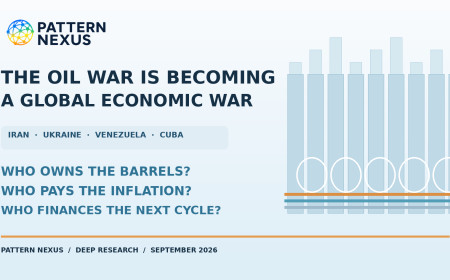 Article · related
The Oil War Is Becoming a Global Economic War
An extensive Pattern Nexus reconstruction linking the Iran/Hormuz disruption with Ukrainian refinery attacks, diesel shortages, Saudi pipeline damage, U.S. and Venezuelan supply, Cuba’s grid, the dollar system, Treasury financing, Fed tightening, public energy-stock disclosures and the next conditional liquidity cycle. Includes an auditable Pattern Nexus article timeline, four sourced charts and 36 primary/reporting references.
Published Sep 21, 2026 Article · related
They Put Human Neurons in a Data Center. Now the Servers Have to Be Fed.
Singapore now has a 20-unit computing rack built around living human neurons growing on electrode-fitted silicon. The cells receive software-defined electrical inputs, return spikes that can control a simulated environment, and require nutrient medium, gas balance, temperature control and waste filtration to remain alive. This Pattern Nexus investigation separates the real NUS–DayOne–Cortical Labs prototype from the viral version, explains the closed-loop mechanism from first principles, tests the energy and learning claims, examines the ethics, and connects the living rack to the fly-brain mind-uploading pipeline.
Published Sep 19, 2026 Article · relatedFed Just Hiked Into a 5% 10-Year: Why the Next Liquidity Cycle May Arrive Faster
The Federal Reserve just raised the federal-funds target to 3.75%–4.00% while the 10-year Treasury closed at 5.01%, the 30-year at 5.35%, and the real 30-year at 3.09%. Pattern Nexus correctly identified the September hike risk and the developing QE/liquidity cycle, but underestimated the Fed’s willingness to raise rates against an already enormous debt and refinancing burden. This report asks the question almost nobody asks after a rate decision: what does the hike eventually break? It connects the September decision to the $40-trillion-plus federal debt structure, more than $1 trillion of annual federal net interest expense, Treasury issuance, long-end buybacks, Federal Reserve reserve-management purchases, hedge-fund leverage, the Treasury basis trade, private credit, housing, commercial real estate, household cashflow and the 2019 repo-market precedent. The conclusion is not that the Fed has deliberately chosen to create a crash. It is that monetary architecture now allows the Fed to tighten the price of credit while separately protecting reserves and market plumbing. The hike therefore does not invalidate the Pattern Nexus QE thesis. If long rates remain near current levels, it accelerates the transmission mechanism that can eventually force the next phase of liquidity support.
Published Sep 17, 2026 Article · related
QE 2026, Phase Two: When the Long End Forces Duration Control
The Fed already ended QT and expanded Treasury holdings through bill-focused reserve-management purchases, but that repaired the reserve layer without suppressing the long end. With the 10-year Treasury at 4.95%, the 30-year at 5.37%, real long yields near the Pattern Nexus red zone, Treasury doubling long-end buybacks, and August CPI limiting conventional easing, this report calculates the probability that QE 2026 moves into a second phase. It maps the likely program, the names it may use, the dates when it could expand, and the exact yield, reserve, auction, repo, leverage, and credit conditions that could force direct duration absorption.
Published Sep 11, 2026 Article · related
August CPI Just Activated the Fed’s One-Hike Option—and Deepened the Long-End Trap
August CPI rose 0.4% on the month and 3.4% from a year earlier, while core CPI rose a hotter-than-expected 0.3% even as its annual rate eased to 2.4%. Pattern Nexus decomposes the report into an energy shock, a narrow communications-and-travel core impulse, and still-slow rent inflation. The result activates the Fed’s one-hike option for September, but it does not yet prove that a broad new inflation cycle has begun. This premium report maps the policy decision, the 80% PN September-hike probability, the long-end trap near 5%, the household cashflow squeeze, the rate-policy-versus-liquidity-plumbing contradiction, and the exact data that would confirm or invalidate the call.
Published Sep 11, 2026 Article · related
Warsh Turns Jackson Hole Into a Rate-Hike Liquidity Shock
Kevin Warsh’s Jackson Hole speech gave markets a hawkish Fed signal, with AP reporting a jump in the two-year Treasury yield after the remarks. Warsh tied the policy debate to persistent inflation, strong AI-related investment, and a less guidance-heavy central bank communication regime. Pattern Nexus reads the speech as a liquidity-regime shift: inflation credibility now sits above market comfort.
Published Aug 28, 2026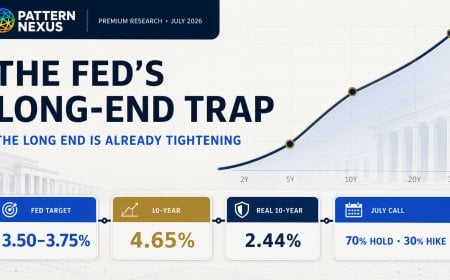 Article · related
The Fed’s Long-End Trap: Why a 4.65% 10-Year Is Already Doing the Tightening
A full July 2026 data reconstruction of the Federal Reserve’s next policy path, showing how a 4.65% nominal 10-year, 2.44% real 10-year, Treasury supply, oil risk and uneven liquidity conditions create a hawkish-hold trap.
Published Jul 27, 2026 Article · related
Hard Assets Follow Liquidity, Not Inflation? The Full Data Reconstruction — 2026 Update
A 2003–2026 reconstruction of Fed liquidity, gold, housing and NASDAQ data, plus an experimental stablecoin-augmented liquidity index. Meta tags: liquidity conditions index, hard assets, gold, Federal Reserve balance sheet, Treasury General Account, reverse repo, M2, stablecoins, tokenized Treasuries, housing, NASDAQ, PCA
Published Jul 26, 2026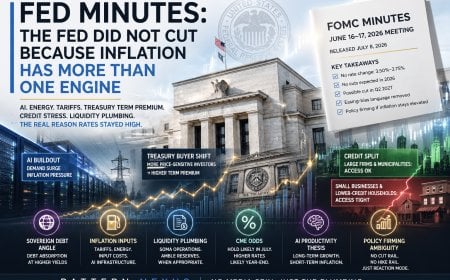 Article · related
Fed Minutes: The Cut Trade Broke Because Inflation Has More Than One Engine
The June 16–17 FOMC minutes, released July 8, show a Fed that held rates steady but removed the easy easing bias. The deeper signal is that inflation pressure is now coming from multiple rails at once: tariffs, Middle East energy shock risk, AI infrastructure demand, Treasury term premium, and uneven consumer credit stress.
Published Jul 8, 2026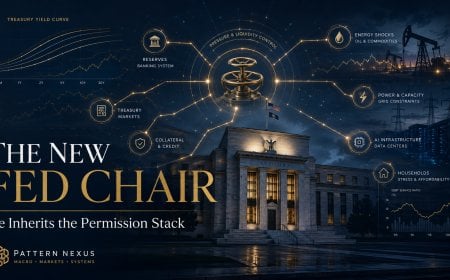 Article · related
The New Fed Chair Does Not Inherit an Economy. He Inherits the Permission Stack.
Kevin Warsh is not simply inheriting the Federal Reserve. He is inheriting the control layer where inflation, debt service, Treasury funding, energy shocks, AI infrastructure demand, repo plumbing, collateral stress, political pressure, and liquidity permission all collide. The public will debate whether the new Fed chair cuts, hikes, pauses, or changes the balance sheet. That is the surface story. The deeper Pattern Nexus story is that the Fed chair is now the public face of the permission stack. He helps decide where credit flows, where pain lands, which markets get oxygen, which sectors get squeezed, and what kind of crisis or cover event makes the next liquidity intervention politically acceptable. This is not a normal Fed transition. It is the next chapter in the liquidity-cover framework.
Published May 18, 2026 Article · related
Why I’ve Been Quiet
A Pattern Nexus analysis of Iran, markets, inflation, control structures, labor softness, AI disruption, and the broader geopolitical and economic pressure building beneath the surface.
Published Apr 11, 2026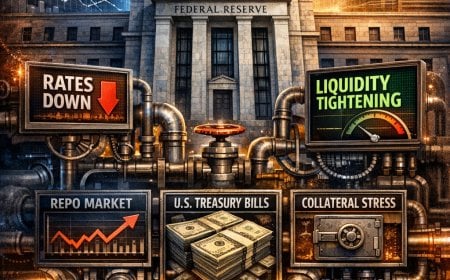 Article · related
Warsh’s Fed and the Balance-Sheet War: Why “Rates Down” Can Still Mean “Liquidity Tight”
A Pattern Nexus systems read on the incoming Fed regime debate: floor vs corridor, repo backstops, Treasury supply, and why the balance sheet is the real rate.
Published Feb 17, 2026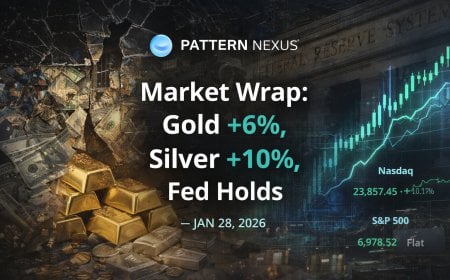 Article · related
Market Wrap: Gold +6%, Silver +10%, Fed Holds — Jan 28, 2026
Jan 28, 2026: The Fed held rates at 3.50–3.75% and the dollar firmed, yet gold ripped to ~5,423 (+5.90%) and silver to ~116.6 (+10.01%). Equities chopped around the 7,000 S&P level, yields rose, oil popped on storm-driven supply fears, and microcaps stayed in full volatility mode. Includes receipts + my delayed daily scalp recap (educational only).
Published Jan 28, 2026 Article · related
Week Ahead: The Reaction-Function Week (Fed Holds, Mega-Cap Earnings, Treasury Supply) — Jan 26–30, 2026
The Fed is expected to hold, but the week is not calm. Markets trade language, auctions, and mega-cap guidance while shutdown-delayed data drops (trade balance, factory orders, wholesale inventories, PPI). A Pattern Nexus preview of the catalysts, mechanics, and scenarios for Jan 26–30, 2026.
Published Jan 26, 2026 Article · related
Selling U.S. Assets” Won’t Collapse the Dollar — It Collapses Europe’s Dollar Plumbing
Viral claims say Europe could dump U.S. assets to trigger a dollar collapse. In the eurodollar system, that move is closer to setting your own house on fire: Europe is structurally tied to offshore dollar funding, collateral, and Fed backstops via swap lines.
Published Jan 20, 2026 Article · related
Fed Chair Odds as a Term-Premium Signal: Warsh Takes the Lead
Prediction markets are repricing Trump’s Fed chair pick toward Kevin Warsh. In the Pattern Nexus framework, this is not “personality politics.” It’s a term-premium and governance-risk signal that can move the long end, especially as allies fracture on trade blocs (Canada–China EV deal) and the U.S. deficit regime persists.
Published Jan 16, 2026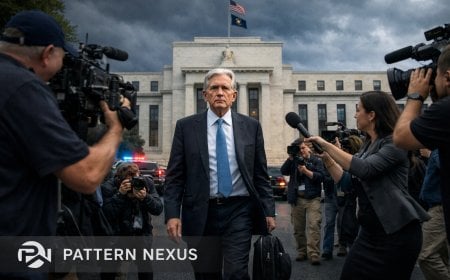 Article · related
The Powell Subpoena and the Liquidity Regime Transition
A subpoena against Powell over his Senate testimony signals institutional pressure toward rate suppression and liquidity convergence between Treasury, Fed, and industrial policy.
Published Jan 11, 2026 Article · related
Housing QE by Proxy: How Weaponizing Fannie and Freddie’s Buffers Turns the GSEs into Political Liquidity Machines
Floating the idea of using Fannie Mae and Freddie Mac’s capital buffers to buy mortgages is more than a housing tweak. It’s an attempt to run QE through the GSEs instead of the Fed, turning housing finance into a political liquidity machine and removing the crash pad when the cycle turns.
Published Jan 8, 2026 Article · related
The Financialization of Everything: A 2013 Wake-Up Post Rebuilt Through the Pattern Nexus Lens
A Pattern Nexus reconstruction of a 2013 blog post on long-run price levels, the Fed’s crisis interventions, dollar swap lines, and why “money printing” evolved into a durable control system rather than an immediate collapse.
Published Jan 4, 2026 Article · related
Why the Fed Will Try to Keep QE Small — and Why It Won’t Work in 2026
The Fed will try to keep QE “light” in 2026 to protect inflation credibility and avoid backlash. But modern market plumbing is nonlinear: undersized liquidity fails fast, forcing escalation into real QE.
Published Dec 27, 2025Join Pattern Nexus for premium research, the archive, and ad-free reading.