

You’re offline. Open downloads
📊Macro & Markets
Daily and weekly market intelligence decoding liquidity shifts, rates, yields, and the structural patterns driving global finance.
Theses, forecasts, models, and paths
No published research objects yet
This topic is ready for editors to connect a thesis, forecast, model, or research path.
Latest articles
 Article · primary
The Treasury Market Is Changing Its Gatekeepers
Treasury clearing deadlines are approaching. PN examines who gains from netting and cross-margining, how access and funding terms shape the benefits, and what would signal pressure through 2027.
Published Oct 31, 2026 Article · primary
Everything Bubble 3 — Markets Priced in Gold Reveal the Structural Melt-Up Ahead
Pricing markets in gold through October 29, 2026 exposes the dispersion beneath nominal records, near-record leverage, high-rate reserve support and a larger global debt structure.
Published Oct 30, 2026 Article · primary
The Interest Trap: Borrowing a Trillion Dollars to Service the Debt
The United States finished fiscal 2026 with a $1.992 trillion deficit. Net interest accounted for $1.052 trillion of it. I break down the budget, the refinancing cycle, and how borrowing to service debt creates another layer of future interest.
Published Oct 23, 2026 Article · primarySeptember CPI: Inflation Is Running Hot—and the Oil Work Explains Why
September CPI rose 0.6% for the month and 3.7% over the year, with gasoline responsible for more than half the monthly increase. I connect the report to the earlier Pattern Nexus oil, inventory, diesel and fertilizer research, explain the damage to real wages, and update the Fed and liquidity sequence.
Published Oct 15, 2026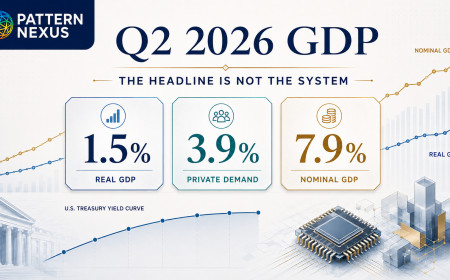 Article · primary
GDP Slowed to 1.5%—But the U.S. Economy Did Not Weaken the Way the Headline Implies
Real GDP slowed to a 1.5% annual rate in Q2 2026, but the private domestic economy accelerated to 3.9% while nominal GDP grew 7.9%. This Pattern Nexus analysis separates the headline from the internal economy and explains what consumer spending, business investment, capital-goods imports, inflation, government accounting, Federal Reserve policy, and the 10-year Treasury signal actually mean.
Published Aug 4, 2026 Article · primary
The Oil Inventory War Machine: How Long the Global Buffer Can Hold
A full Pattern Nexus reconstruction of U.S. and global oil inventories from the 1970s through the 2026 war shock, including original regressions, depletion scenarios, strategic reserves, refinery constraints, inflation, growth, rates and the path forward. Meta keywords: oil inventory, global oil stocks, U.S. crude inventories, Strategic Petroleum Reserve, SPR, Strait of Hormuz, Iran war, oil shock, petroleum products, diesel inventories, refinery capacity, inflation, CPI, recession, Treasury yields, liquidity, war economy, energy security, Pattern Nexus
Published Aug 2, 2026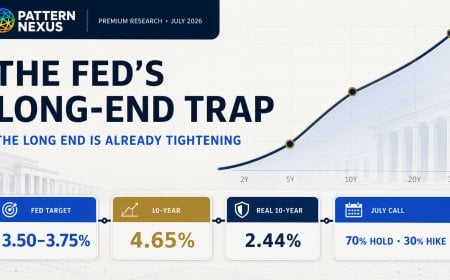 Article · primary
The Fed’s Long-End Trap: Why a 4.65% 10-Year Is Already Doing the Tightening
A full July 2026 data reconstruction of the Federal Reserve’s next policy path, showing how a 4.65% nominal 10-year, 2.44% real 10-year, Treasury supply, oil risk and uneven liquidity conditions create a hawkish-hold trap.
Published Jul 27, 2026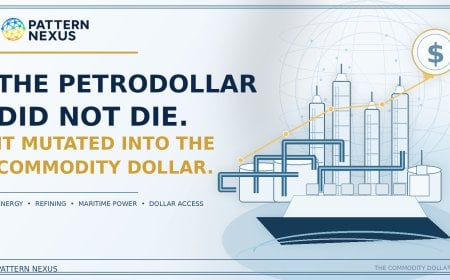 Article · primary
The Petrodollar Did Not Die. It Mutated Into the Commodity Dollar
The old petrodollar was built around imported oil, dollar invoicing, military protection, and the recycling of global surpluses into American assets. The emerging commodity-dollar system is more direct: the United States produces record volumes of oil and gas, operates enormous refinery and export infrastructure, protects strategic waterways, controls critical financial rails, and can restrict access to global markets through sanctions, insurance, banking regulation, export controls, and maritime enforcement.
Published Jul 18, 2026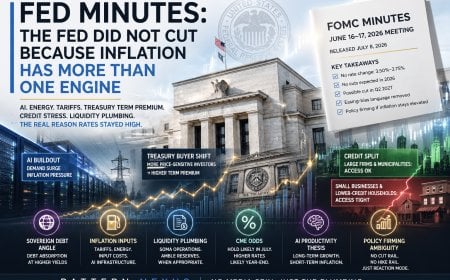 Article · primary
Fed Minutes: The Cut Trade Broke Because Inflation Has More Than One Engine
The June 16–17 FOMC minutes, released July 8, show a Fed that held rates steady but removed the easy easing bias. The deeper signal is that inflation pressure is now coming from multiple rails at once: tariffs, Middle East energy shock risk, AI infrastructure demand, Treasury term premium, and uneven consumer credit stress.
Published Jul 8, 2026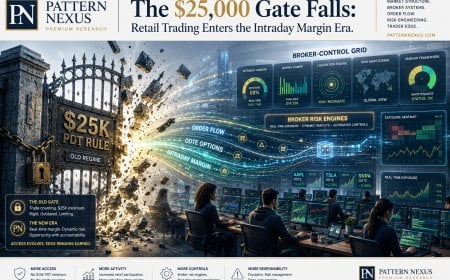 Article · primary
The $25,000 Gate Falls: PDT Rule Changes, Retail Day Trading, and the New Intraday Margin Control System
The Pattern Day Trader rule is being replaced across brokers, removing the old $25,000 account minimum and day-trade counting system. But the real story is not simply “more freedom.” The old hard gate is being replaced by a live broker-controlled intraday margin system that changes who can trade, how small accounts behave, how brokers manage risk, and how retail order flow may move through the market.
Published Jun 3, 2026 Article · primary
The Oil Cushion Is Breaking: Hormuz, Inventories, and the Liquidity Shock Hiding Inside Energy
Oil Crisis, Strait of Hormuz, Hormuz, Energy Shock, Inflation, Brent Crude, WTI Crude, Strategic Petroleum Reserve, SPR, Oil Inventories, Global Oil Supply, Gasoline Prices, Diesel Prices, Refining, Crack Spreads, Federal Reserve, Liquidity, Recession Risk, Macro, Geopolitics, Pattern Nexus
Published Jun 1, 2026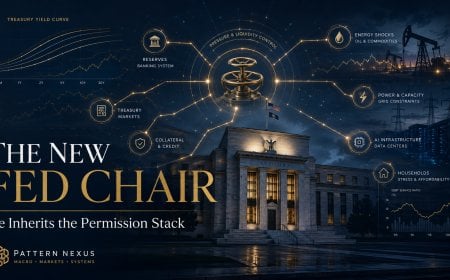 Article · primary
The New Fed Chair Does Not Inherit an Economy. He Inherits the Permission Stack.
Kevin Warsh is not simply inheriting the Federal Reserve. He is inheriting the control layer where inflation, debt service, Treasury funding, energy shocks, AI infrastructure demand, repo plumbing, collateral stress, political pressure, and liquidity permission all collide. The public will debate whether the new Fed chair cuts, hikes, pauses, or changes the balance sheet. That is the surface story. The deeper Pattern Nexus story is that the Fed chair is now the public face of the permission stack. He helps decide where credit flows, where pain lands, which markets get oxygen, which sectors get squeezed, and what kind of crisis or cover event makes the next liquidity intervention politically acceptable. This is not a normal Fed transition. It is the next chapter in the liquidity-cover framework.
Published May 18, 2026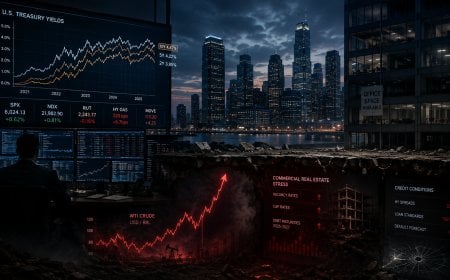 Article · primary
Interest Rates, Recession, and the Current Environment
A Pattern Nexus deep research analysis on interest rates, recession risk, energy-led inflation, commercial real estate stress, private credit, AI labor pressure, and why the current environment feels like 2006 without being a direct replay of 2008.
Published May 5, 2026 Article · avenueFederal Reserve Board releases results from survey of senior financial officers at banks about their strategies and practices for managing reserve balances
Federal Reserve Board releases results from survey of senior financial officers at banks about their strategies and practices for managing reserve balances
Published Nov 20, 2026 Article · avenue
Washington Turns Senate Permitting Passage Into an AI-Grid Cost Test
The U.S. Senate voted 62-33 on November 19, 2026, to pass the Bipartisan American Affordability and Jobs Act, a broad permitting package covering energy and infrastructure projects including power plants, transmission lines, mines, pipelines and data centers. The bill now moves to the House. Its AI-economy significance is the cost-allocation test: if enacted, large new data centers would face stronger requirements to pay for the incremental grid and energy infrastructure needed to serve them.
Published Nov 19, 2026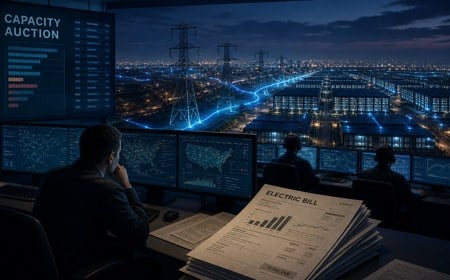 Article · avenue
PJM Turns AI Load Forecasts Into a Capacity-Cost Stress Test
State ratepayer advocates asked PJM’s board to seek FERC approval to postpone the December 9-15, 2026 capacity auction for the 2029/2030 delivery year until forecast data-center load is removed and handled through a separate reliability backstop process. The request leans on PJM’s Independent Market Monitor, which warned that data-center load already raised capacity costs by $29.4 billion and could add another $5 billion to $10 billion in the upcoming auction. PJM says delaying the auction this close to execution could destabilize the market and raise reliability risk.
Published Nov 19, 2026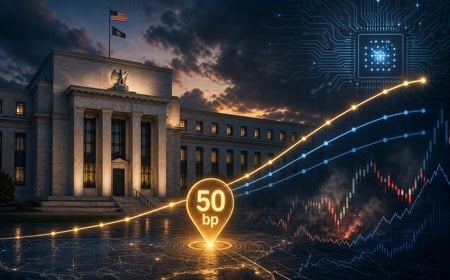 Article · avenue
Washington Turns Waller’s 50bp Warning Into an Inflation-Psychology Test
Federal Reserve Governor Christopher Waller said on November 18 that the Fed may need to act more aggressively against inflation, including a possible 50-basis-point move at the December 8-9 meeting or clearer communication that hikes will continue quickly into 2027. Reuters, Anadolu, Quartz, and NDTV Profit all reported the remarks from Waller’s CNBC appearance, while market coverage showed the comments landing into a fragile backdrop for futures, Treasury yields, and AI-linked risk appetite. The signal is not just hawkish Fed-speak; it is a repricing test for duration-heavy assets built around low discount rates.
Published Nov 18, 2026 Article · avenue
Tokyo Turns a Flat GDP Print Into an Energy-Import Stress Signal
Japan’s Cabinet Office said real GDP was essentially unchanged in July–September 2026 but fell at a 0.1% annualized rate, with private consumption down 0.3%, imports up 2.5% and net exports subtracting 0.6 percentage point from growth. Independent reports from Reuters, AP and ChosunBiz tied the miss to higher living costs, oil and energy import pressure, weak-yen dynamics and poor weather, while noting that private non-residential investment rose 1.6%. The Pattern Nexus read: Japan’s problem is less a classic demand collapse than a terms-of-trade and purchasing-power squeeze that complicates Bank of Japan tightening.
Published Nov 15, 2026 Article · avenueFederal Reserve Board announces approval of application by Peoples Bancorp Inc.
Federal Reserve Board announces approval of application by Peoples Bancorp Inc.
Published Nov 15, 2026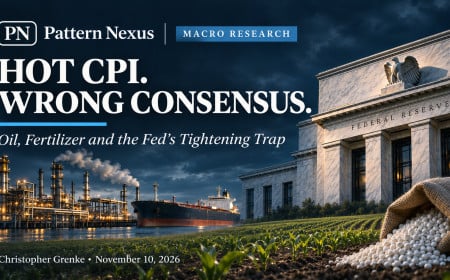 Article · avenue
Hot CPI, Wrong Consensus: The Inflation Pressure Pattern Nexus Saw Coming
October CPI exceeded consensus on both headline and core inflation. Eight earlier Pattern Nexus articles connect the oil and diesel shock, fertilizer risk, Fed tightening and refinancing pressure, with new Federal Reserve research and the November energy outlook.
Published Nov 10, 2026 Article · avenue
Treasury’s Long-Bond Relief Could Bring a Faster Refinancing Cycle
Treasury’s larger long-end buybacks can improve trading today. PN follows the actual cash payments, September maturity data, and replacement-financing choices to test whether that relief could bring future interest-rate exposure forward.
Published Nov 1, 2026 Article · avenue
Ample Reserves, Uneven Liquidity
Aggregate reserves can support rate control while funding conditions differ by institution. PN examines October research, overnight-rate distributions, Treasury cash, reserve management, and settlement timing to identify the next constraints to watch.
Published Oct 31, 2026 Article · avenue
Who Actually Gets the Tariff Refund?
Tariff refunds can pass through importers to claim buyers, vendors, and employees. PN follows the cash and accounting in three company disclosures to test how much new operating relief the refund cycle creates.
Published Oct 31, 2026 Article · avenue
Senate Turns Permitting Reform Into an AI-Grid Cost Allocation Deal
Senate energy and environment leaders introduced the Bipartisan American Affordability and Jobs Act on September 30, 2026, a permitting package aimed at faster federal reviews for energy, transmission, and infrastructure projects. The bill would strengthen FERC transmission-siting authority and require data centers to pay associated transmission costs instead of shifting those costs to households and smaller businesses. A Senate vote is not expected until after the November 3 midterm elections.
Published Oct 1, 2026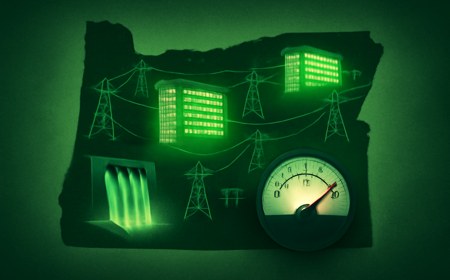 Article · avenue
Oregon Turns Data Centers Into a Quarter-Grid AI Infrastructure Test
A new ECOnorthwest and University of Virginia assessment, reported by Oregon outlets and presented to state advisers, puts Oregon data centers at about 23% of statewide retail electricity sales in 2025. The state is now treating the sector as a systemic planning challenge, with a Data Center Advisory Committee taking public comment through October 24, 2026 and POWER Act implementation shifting large-load grid costs toward data centers.
Published Sep 20, 2026 Article · avenueFed Just Hiked Into a 5% 10-Year: Why the Next Liquidity Cycle May Arrive Faster
The Federal Reserve just raised the federal-funds target to 3.75%–4.00% while the 10-year Treasury closed at 5.01%, the 30-year at 5.35%, and the real 30-year at 3.09%. Pattern Nexus correctly identified the September hike risk and the developing QE/liquidity cycle, but underestimated the Fed’s willingness to raise rates against an already enormous debt and refinancing burden. This report asks the question almost nobody asks after a rate decision: what does the hike eventually break? It connects the September decision to the $40-trillion-plus federal debt structure, more than $1 trillion of annual federal net interest expense, Treasury issuance, long-end buybacks, Federal Reserve reserve-management purchases, hedge-fund leverage, the Treasury basis trade, private credit, housing, commercial real estate, household cashflow and the 2019 repo-market precedent. The conclusion is not that the Fed has deliberately chosen to create a crash. It is that monetary architecture now allows the Fed to tighten the price of credit while separately protecting reserves and market plumbing. The hike therefore does not invalidate the Pattern Nexus QE thesis. If long rates remain near current levels, it accelerates the transmission mechanism that can eventually force the next phase of liquidity support.
Published Sep 17, 2026 Article · avenue
EPA Turns AI Power Demand Into a Fossil-Baseload Deregulation Test
EPA Administrator Lee Zeldin signed a final partial repeal of the 2024 Carbon Pollution Standards for fossil-fuel power plants and paired it with a proposal to rescind remaining greenhouse-gas standards for the sector under Clean Air Act Section 111. EPA frames the action as an energy-abundance and cost-saving measure worth more than $300 billion, while major news reports say environmental groups expect legal challenges. The AI angle is not that EPA regulated AI directly, but that rising data-center and industrial load is becoming a justification for fossil-basaload deregulation.
Published Sep 15, 2026 Article · avenue
August CPI Just Activated the Fed’s One-Hike Option—and Deepened the Long-End Trap
August CPI rose 0.4% on the month and 3.4% from a year earlier, while core CPI rose a hotter-than-expected 0.3% even as its annual rate eased to 2.4%. Pattern Nexus decomposes the report into an energy shock, a narrow communications-and-travel core impulse, and still-slow rent inflation. The result activates the Fed’s one-hike option for September, but it does not yet prove that a broad new inflation cycle has begun. This premium report maps the policy decision, the 80% PN September-hike probability, the long-end trap near 5%, the household cashflow squeeze, the rate-policy-versus-liquidity-plumbing contradiction, and the exact data that would confirm or invalidate the call.
Published Sep 11, 2026 Article · avenue
Two Economies, One Balance Sheet: The Unstable Barbell of 2026
Reserve support has returned, but real long rates, fiscal supply, and an AI-energy capital wave are splitting the U.S. economy between capital strength and household fragility. This data-rich Pattern Nexus report maps the four feedback loops connecting Federal Reserve plumbing, Treasury duration, fiscal interest, housing lock-in, household credit, labor churn, AI infrastructure, power demand, dollar rails, and gold. It closes with four scenarios, a public-call audit, and a 90-day trigger dashboard.
Published Sep 9, 2026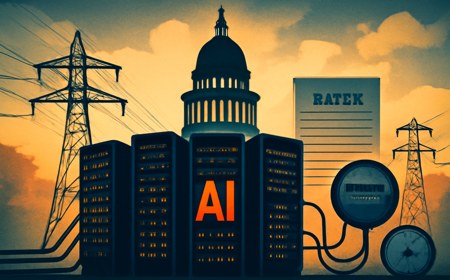 Article · avenue
California’s AI Data Center Fight Moves to the Utility Bill
California lawmakers reached a late-August compromise on data-center energy legislation as AI infrastructure growth collides with utility-bill politics. Official Aug. 28 amendments to SB 886 and AB 2383 show the core mechanism: CPUC tariffs and updated electric rules for large participating data-center customers, with cost-shift protections for nonparticipating ratepayers. The bills remain active, not enacted, and the next fight is how the CPUC would translate legislative guardrails into actual interconnection, generation, and demand-response rules.
Published Aug 30, 2026Join Pattern Nexus for premium research, the archive, and ad-free reading.