

You’re offline. Open downloads
System Stress Signals (🚨🩸)
A running analysis of cracks forming under the system: collateral shortages, liquidity dislocations, volatility anomalies, and funding stress.
Theses, forecasts, models, and paths
No published research objects yet
This topic is ready for editors to connect a thesis, forecast, model, or research path.
Latest articles
 Article · primary
Frankfurt Turns AI Data-Center Lending Into a Bank-Supervision Stress Test
ECB Banking Supervision Chair Claudia Buch said on November 19, 2026 that euro-zone banks’ direct data-center exposure is still small but growing quickly. Reuters reported that data centers account for about 1.2% to 1.3% of euro-zone banks’ corporate exposures and that 12 banks are materially exposed to AI-related private credit. The system signal is that AI infrastructure is becoming a supervisory credit-risk channel, not only an energy-demand or equity-valuation theme.
Published Nov 19, 2026 Article · primary
Washington Turns Java4Shell Into a Critical-Software Patch-Rush Test
CISA urged organizations on November 17, 2026, to immediately patch CVE-2026-114938, a Java memory-corruption flaw known as Java4Shell. Oracle, CERT-EU and Tencent Cloud issued related guidance, while Reuters reported parallel warnings from U.S., South Korean, German and British authorities. The larger signal is a resilience test for software inventories, cloud workloads, vendor-bundled runtimes and patch governance under shrinking response windows.
Published Nov 18, 2026 Article · primary
New Orleans Turns a Tanker Crash Into a Port-Control Litigation Test
The Port of New Orleans has filed a federal maritime lawsuit after the Atlantic Asphalt tanker struck the docked American Heritage river cruise vessel on November 13, 2026. Multiple outlets reported that everyone aboard survived, while officials said injuries, terminal damage, fuel removal and vessel recovery remain active issues. The incident has become a port-control and maritime-liability test rather than a mass-casualty disaster.
Published Nov 14, 2026 Article · primaryFed Turns AI Data-Center Leverage Into a Financial-Stability Warning
The Fed’s latest Financial Stability Report says AI was the top-cited near-term risk among market contacts, with 87% naming it in the fall survey, up from 50% in the spring. The report also details more than $680 billion of advanced-computing debt issuance by October 2026, more than $1 trillion of not-yet-started lease obligations, and more than $2 trillion of guarantees and contract commitments tied to the data-center buildout. Pattern Nexus reads the report as a shift: AI infrastructure is now a macro-financial transmission channel, not just a technology investment cycle.
Published Nov 14, 2026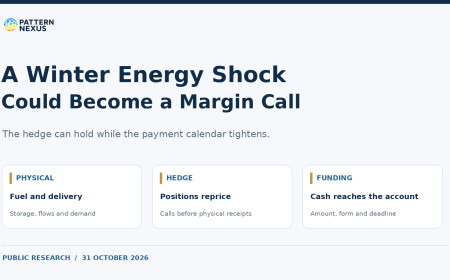 Article · primary
A Winter Energy Shock Could Become a Margin Call
A winter price shock can demand cash before a hedge’s physical offset pays out. PN examines October gas inventories, clearing terms, and a worked producer example to trace how variation margin, collateral, and financing deadlines can transmit energy stress.
Published Nov 1, 2026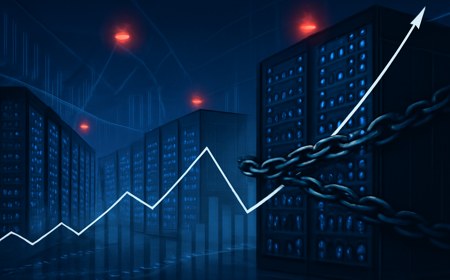 Article · primary
CoreWeave Turns AI Data-Center Debt Into a Credit-Market Stress Test
CoreWeave shares and bonds came under pressure this week as investors repriced the leveraged neocloud model behind the AI data-center buildout. Axios reported CoreWeave bond yields above 15%, while Bloomberg reported credit-default pricing implying more than 60% odds of default within five years. The company’s own June 30, 2026 filing shows $35.6 billion of total indebtedness and $103.7 billion of remaining performance obligations, making CoreWeave a live test of whether AI demand can convert into enough cash flow to finance depreciation-heavy infrastructure.
Published Oct 16, 2026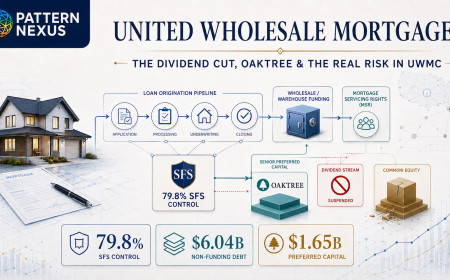 Article · primary
United Wholesale Mortgage: The Dividend Cut, the Ishbia Structure, Oaktree, and the Real Risk in UWMC
I rebuilt the UWM panic from the ownership structure outward: who actually received the distributions, what the dividend suspension retains, why the $451.9 million quarterly loss does not describe the core origination business, what the $603.2 million failed-deal hedge did to equity, how the Oaktree preferred recapitalization changes the common stock, and what would actually have to happen for a bankruptcy thesis to become real.
Published Aug 8, 2026 Article · primary
Auto Repos Are the New Foreclosures: The Household Stress Signal the Market Keeps Ignoring
Repossessions are rising, subprime delinquencies are hitting cycle highs, and loan terms keep stretching. This is the stealth foreclosure wave on wheels—and it maps cleanly to the next phase of the household credit cycle.
Published Feb 17, 2026 Article · primary
Silver Cracks $90: Mint Repricing, Retail Limits, and the Physical Supply Shock
Silver didn’t just hit $90+—it hit the distribution layer. The U.S. Mint’s repricing warning, “Not Available” grids, authorized purchaser minimums, retailer purchase throttles, and CME margin controls reveal where the real stress lives: logistics, allocation, and control of the pipe.
Published Jan 14, 2026 Article · primary
Happy New Year 2026: Rate Cuts, Yield Control, Asset Rotation, and the Next Phase of Managed Liquidity
Pattern Nexus 2026 outlook: 4–6 rate cuts (100–275 bps), slower second-half easing, rising probability of yield control, bond-market resistance beyond 3Y, real estate rotation, AI-driven labor compression, accelerating gray-zone instability, and why tokenized reserve rails arrive faster after a liquidity shock.
Published Dec 31, 2025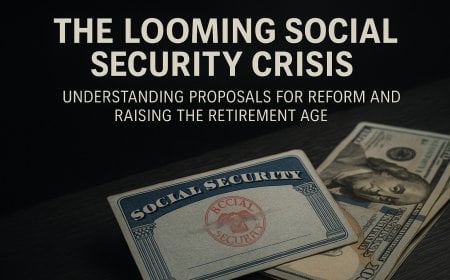 Article · primary
The Looming Social Security Crisis: Understanding Proposals for Reform and Raising the Retirement Age
Social Security reform is essential but often misunderstood. This comprehensive analysis explores the mechanics of the program's solvency problem, the range of policy proposals, the impacts on various age cohorts, and the likelihood of meaningful reform. We debunk political framing, emphasize structural issues, and offer a data-driven view of what needs to be done.
Published Dec 15, 2025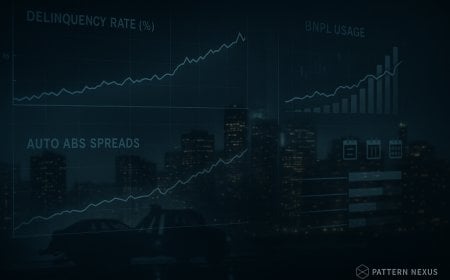 Article · primary
Subprime Autos, Buy-Now-Pay-Later, and Bank Stress: Cracks at the Edge of the Consumer Balance Sheet
As of December 4, 2025, subprime auto borrowers and Buy-Now-Pay-Later users are showing rising strain. This Pattern Nexus deep dive maps where the real risk sits, how much of it flows back into banks, and whether these “buy more, pay more later” rails are the real source of bank stress.
Published Dec 4, 2025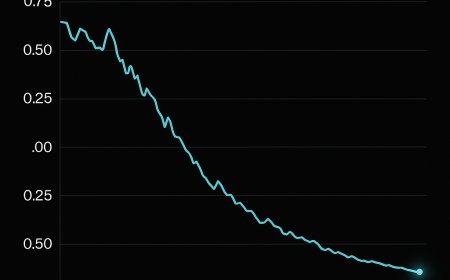 Article · primary
ECB Financial-Stability Warning: Why Near-Zero CISS Is Dangerous
The ECB just issued a financial-stability warning while its systemic stress index (CISS) sits near zero. This report breaks down what the ECB really sees, how bank–nonbank linkages, dollar funding, stablecoins and sovereign risk fit together, and why this “calm” looks like the pre-fracture phase of the next global liquidity cycle.
Published Nov 29, 2025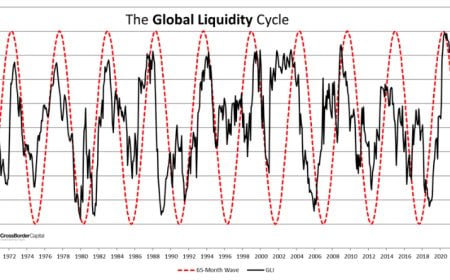 Article · primary
Recessions Aren’t the Crisis — They’re the Trigger
Recessions are not the catastrophe — they’re the mechanical pivot that flips the modern dollar system from contraction back into liquidity expansion. A deep dive into why doom prophets misread the cycle, why 2026 is structurally important, and how the funding plumbing actually drives markets.
Published Nov 27, 2025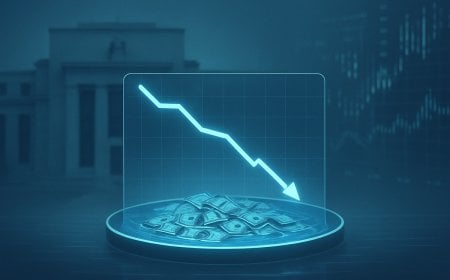 Article · primary
QT Ends, Liquidity Returns: Why 2026 Is Almost Certainly the Next Balance-Sheet Expansion Cycle
Quantitative Tightening ends December 1st, and the plumbing shows reserves are already near scarcity. This article explains why 2026 is shaping up to be the next major liquidity-injection cycle, driven by heavy Treasury issuance, reserve demand, and Fed policy shifts.
Published Nov 25, 2025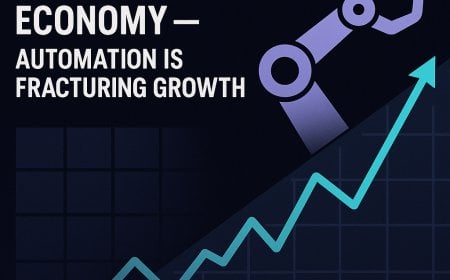 Article · primary
The Two- (or Three-) Speed Economy: Automation Is Fracturing Growth — Why MMT-Style Tools Become Inevitable
Inflation cools, rents slip, unemployment edges up—yet productivity rises. Automation is splitting the economy into winners and the automated-away. Here’s why the social contract must evolve, why millions of robots are coming online, and how MMT-style policy can stabilize the transition.
Published Nov 12, 2025 Article · primary
Unwinding the Yen Carry Trade: The $20 Trillion Question and the Coming Dollar Shockwave
The yen carry trade is the hidden leverage machine behind decades of global liquidity. Now, as Japan exits negative rates, up to $20 trillion in leveraged positions risk unwinding — triggering forced liquidations, global volatility, and a potential dollar spike driven by repatriation flows. This article explores how the unwind works, why it matters, and how dedollarization narratives collide with the coming dollar squeeze.
Published Nov 5, 2025 Article · primary
The Pattern Nexus Master Brief: CBDCs, BRICS, Energy Corridors, and the Next Security Era
A Pattern Nexus master brief on the new security era: CBDCs, tokenized treasuries, BRICS trade, carrier posture, GPS warfare, and why money, energy, and narrative now move as one system.
Published Oct 31, 2025Join Pattern Nexus for premium research, the archive, and ad-free reading.