

You’re offline. Open downloads
U.S. Strategic Posture (🦅🇺🇸)
Analysis of U.S. global strategy — defense positioning, naval power, alliance networks, and long-term geopolitical doctrine.
Theses, forecasts, models, and paths
No published research objects yet
This topic is ready for editors to connect a thesis, forecast, model, or research path.
Latest articles
 Article · primary
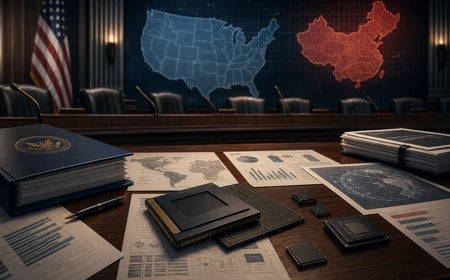
Washington Turns 879,000 AI-Chip Licenses Into a China-Controls Credibility Test
House Foreign Affairs Committee Chairman Brian Mast released export-control license information on November 19, 2026, saying Chinese buyers sought 3.4 million Nvidia and AMD AI chips and that the Bureau of Industry and Security approved more than 879,000. Reuters, SCMP and Anadolu reported the disclosure while noting that approvals do not necessarily prove completed shipments. The episode sharpens a core U.S.-China technology question: whether export controls can credibly restrict the AI compute layer when commercial incentives and national-security controls collide.
Published Nov 19, 2026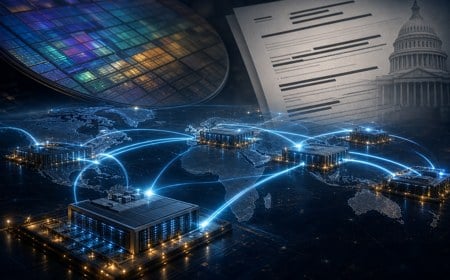 Article · primary
Washington Turns BIS’s Remote-Compute Rule Into an AI-Chip Containment Test
The Bureau of Industry and Security’s interim final rule, published in the Federal Register and effective November 19, 2026, restricts certain exports, reexports and in-country transfers of advanced semiconductors to overseas data centers that provide large-scale compute access to entities headquartered in Country Group D:5 or Macau. The rule also adds destination-based licensing requirements for Brazil, Indonesia, Malaysia, Singapore and Thailand, tightens oversight around advanced-node chip fabrication and packaging, and formally rescinds the Biden-era AI Diffusion Rule. The strategic shift is clear: Washington is moving from controlling boxes of chips to policing the operating layer of global compute.
Published Nov 19, 2026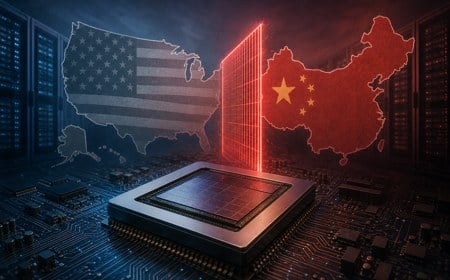 Article · primary
Santa Clara Turns Nvidia’s China Shipment Halt Into an AI-Chip Decoupling Test
Nvidia said it sold $2.4 billion of licensed Hopper data-center products to China in its fiscal third quarter but is no longer shipping those products there. The company’s SEC-filed outlook for the fourth quarter assumes no Data Center compute revenue from China, making the prior licensing pathway look less like a stable compromise and more like a narrowing corridor. The signal is not just a China revenue issue; it is a live stress test for U.S. chip controls, allied supply chains and the geography of advanced AI compute.
Published Nov 18, 2026 Article · primary
Washington Turns Chinese Optical Transceivers Into an AI Data-Center Supply-Chain Test
Reuters reported on November 17, 2026, that the Trump administration plans to continue efforts to block imports of Chinese data-center equipment, including optical transceivers, despite opposition from Amazon, Google, Meta, CoreWeave, Cisco and Microsoft. The dispute is backed by an August ITI filing urging the FCC not to add optical transceivers broadly to the Covered List and a September bipartisan Senate bill targeting Chinese optical transceivers in sensitive federal systems. The strategic question is whether Washington can harden the AI data-center stack without constraining the infrastructure race it is trying to win.
Published Nov 17, 2026 Article · primary
Manila Turns Trump’s Quad Stop Into an Indo-Pacific Posture Test
Trump is in Manila on Nov. 17 for Quad, ASEAN, and trade-related meetings before traveling to Shenzhen for APEC. Verified schedules and reporting show a compressed diplomatic stop involving Quad leaders, a U.S.-Thai trade deal signing, ASEAN engagement, and discussions tied to security, digital transformation, supply chains, AI, and maritime stability. The system read: Manila is being used as the staging ground for Washington’s broader Indo-Pacific posture before Trump faces China on its home summit terrain.
Published Nov 16, 2026 Article · primary
Iran’s Election Pause: The Escalation Window Has Narrowed
The first follow-up to the October 8 Iran forecast confronts Trump’s election pause, checks actual naval posture, and follows the conflict through shipping, infrastructure, fuel and financing. The November 5 endpoint stays fixed. Four original figures, dated source notes and reproducible data are included.
Published Oct 20, 2026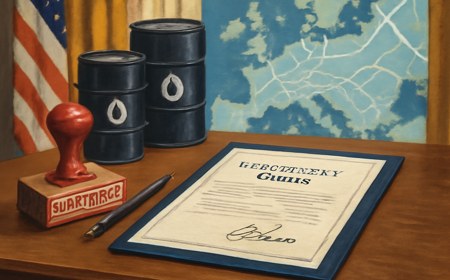 Article · primary
Washington Turns Russia Sanctions Into an Energy-Price Waiver Fight
President Trump signed an executive order on October 16 waiving major sanctions, restrictions, and duties under the Lindsey O. Graham Sanctioning Russia and Iran Act of 2026, just before implementation was due. The move drew congressional criticism and a public appeal from Ukrainian President Volodymyr Zelenskyy, while independent reports connected the pause to a broader energy-price and Russia-Ukraine posture fight. The strategic question is whether secondary sanctions remain a coercive tool or become a discretionary valve for managing fuel-market pressure.
Published Oct 17, 2026 Article · primary
Super Micro Contractor Turns Nvidia AI Servers Into a China Export-Control Guilty Plea
Ting-Wei “Willy” Sun, a contractor linked to Super Micro Computer, pleaded guilty on October 8, 2026, to four counts tied to an alleged scheme to illegally route AI servers containing advanced Nvidia chips to China. The Justice Department had previously alleged that the broader conspiracy involved about $2.5 billion worth of U.S. AI server technology. The plea is an enforcement signal for the U.S.-China compute-control regime: advanced AI servers are now being treated as traceable strategic infrastructure, not just commercial hardware.
Published Oct 11, 2026 Article · primary
Washington Turns a Third Carrier Into an Iran-War Escalation Option
The United States is dispatching the USS Theodore Roosevelt carrier strike group and the Makin Island amphibious ready group toward the Middle East, according to multiple reports citing U.S. officials. The deployment could briefly put three U.S. aircraft carriers in the region, depending on timing, as President Donald Trump weighs further pressure or renewed strikes against Iran. The strategic signal is not just military: it lands in an energy system already strained by Hormuz disruption, low distillate inventories, and elevated oil-price risk.
Published Oct 2, 2026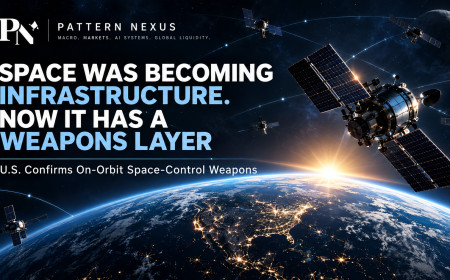 Article · primary
Space Was Becoming Infrastructure. Now It Has a Weapons Layer: The U.S. Confirms On-Orbit Space-Control Weapons
For the first time, the United States has publicly acknowledged that it operates "on-orbit space control weapons." The hardware remains classified, but the surrounding architecture is not: Space Force doctrine already defines orbital warfare, electromagnetic warfare, cyber operations, reversible denial, degradation and destruction as parts of space control; ground-based counterspace systems are already operational; and China, Russia and other states are developing the same wider capability stack. This Pattern Nexus report separates what is confirmed from what remains unknown, explains the Outer Space Treaty, maps the counterspace technology families, and ties the disclosure directly into earlier Pattern Nexus work on space infrastructure, "Launch. Control. Network.", cislunar logistics, and Control Stack 2.0. The central thesis: space becoming infrastructure was phase one; infrastructure becoming an explicitly armed control layer is phase two.
Published Sep 15, 2026 Article · primary
Federal Court Turns Anthropic’s Pentagon Blacklist Into an AI-War Powers Test
A U.S. District Court judge ruled for Anthropic after the Pentagon labeled the company a supply-chain risk over its refusal to permit unrestricted military uses of Claude. The decision found the government’s actions unlawful and framed the dispute as a constitutional, procurement, and AI-safety fight. The Pattern Nexus read: the ruling does not settle whether the military may demand more permissive AI systems, but it limits how national-security procurement tools can be used against vendors that publicly resist those demands.
Published Aug 28, 2026 Article · primary
Iran Turns America’s Missile Stockpile Into a Two-Theater Deterrence Gap
Fresh reporting and defense analysis point to a widening U.S. magazine-depth problem. The Iran war has drawn heavily on long-range strike weapons and missile-defense interceptors, while replacement timelines for Tomahawk, THAAD and Patriot stocks are measured in years, not weeks. The strategic risk is that Russia and China do not need classified inventory data if they can observe which theaters are being stripped and how slowly the U.S. reloads.
Published Aug 8, 2026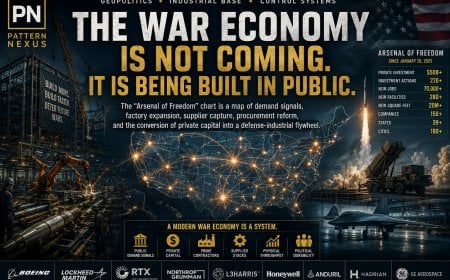 Article · primary
The War Economy Is Not Coming. It Is Being Built in Public.
The Arsenal of Freedom chart is not just a defense graphic. It shows the United States shifting from peacetime procurement into a public-private war economy built around factories, missiles, suppliers, and long-term demand signals.
Published May 14, 2026 Article · primary
Weeks Where Decades Happen: January 2026 Acceleration Log
January 2026 did not ease into the decade; it detonated into it. From Venezuela’s regime shock and the Greenland tariff crisis to Iran’s crackdown, Syria’s realignment, the UN High Seas Treaty, demographic shifts, IMF revisions, and industrial pivots, this is a log of weeks where decades happen.
Published Jan 19, 2026 Article · primary
The Silent Currency War: Containment, Collateral, and the 2030 Regime Window
The United States and China have entered a silent currency war layered on top of maritime containment, commodity dependencies, and financial plumbing. The next phase will determine whether the dollar system evolves, resets, or fragments into parallel rails.
Published Jan 13, 2026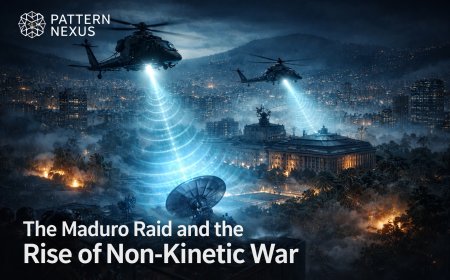 Article · primary
The Maduro Raid and the Rise of Non-Kinetic War
The Caracas raid that captured Maduro triggered a second battle: a fast-spreading claim that the U.S. used a “mystery” sonic or directed-energy device to incapacitate defenders. Confirmed or not, the narrative signals where warfare and state power are heading.
Published Jan 10, 2026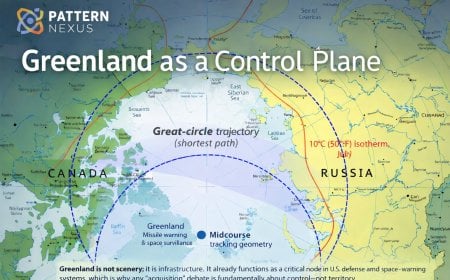 Article · primary
Greenland as a Control Plane: COFA Talk, Arctic Basing, and the Real Levers
Reuters reports Trump advisers are discussing multiple pathways for Greenland, including a Compact of Free Association. Pattern Nexus breaks the story into control layers: basing, missile-warning infrastructure, fiscal support, and alliance risk.
Published Jan 6, 2026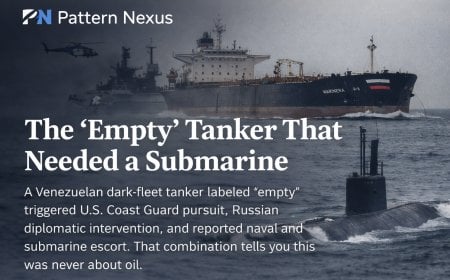 Article · primary
The “Empty” Tanker That Needed a Submarine
An “empty” Venezuelan tanker drew U.S. Coast Guard pursuit, Russian diplomatic pressure, and reported naval and submarine escort. Pattern Nexus breaks down what’s confirmed, what’s claimed, and why this isn’t about oil.
Published Jan 6, 2026 Article · primary
The New Monroe Doctrine: How the 2025 National Security Strategy Confirms the Western Hemisphere Pivot, Digital Dollar Realignment, and the Coming Global Reordering
The 2025 National Security Strategy marks the most dramatic U.S. strategic pivot in decades—re-centering the Western Hemisphere, reviving a modern Monroe Doctrine, accelerating digital-dollar rails, and redefining global power competition around AI, liquidity systems, and stablecoin-backed economic dominance. This Pattern Nexus master-framework integrates geopolitics, macro liquidity, digital assets, and statecraft into a unified thesis.
Published Dec 7, 2025 Article · primary
Port Alpha vs the Shipyard Graveyard: How a Three-Year-Old Startup Is Trying to Rebuild the U.S. Navy With Autonomous Warships
The U.S. Navy is collapsing under delays, cost overruns, and a shrinking shipbuilding workforce. Programs slip years, budgets balloon, and the fleet flatlines while China’s shipyards pump out steel like an industrial firehose. Into that mess steps Saronic, a 2022 startup backed by hundreds of millions in venture capital, promising to build autonomous warships faster and cheaper from a new complex called Port Alpha. This isn’t just a cool drone story. It’s a quiet attempt to reboot American sea power through a startup shipyard.
Published Dec 3, 2025 Article · primary
Trump Orders Immediate Resumption of U.S. Nuclear Weapons Testing — I Didn’t See This Coming
President Donald Trump has directed the Pentagon to immediately resume U.S. nuclear weapons testing, citing Russia and China. What happened, why it matters, key risks, and what to watch next.
Published Oct 29, 2025 Article · primary
Domestic Theater vs. Global Projection: Why Americans Misread Geopolitics
Americans see politics through a left–right lens, but the world engages the United States as a single strategic actor. Ilhan Omar’s abroad defense of Trump—and bipartisan efforts like repealing the Patriot Act—reveal how national interest overrides partisan theater on the world stage.
Published Oct 27, 2025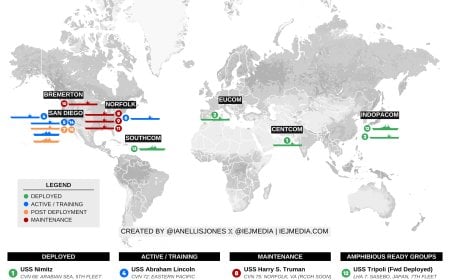 Article · primary
Consolidating Power: The Global Carrier Pattern and the Caribbean Surge
U.S. carrier strike groups are on the move — from the Ford in the Mediterranean to the Iwo Jima Amphibious Ready Group now under SOUTHCOM in the Caribbean. The pattern points to global force consolidation and strategic readiness for simultaneous regional pressure events — not mere exercises. Consolidating Power, Carrier Strike Groups, U.S. Navy, SOUTHCOM, Iwo Jima ARG, Venezuela, Trump, Amphibious Assault, Global Deployment, Deterrence Strategy, Geopolitics, Military Buildup, U.S. Defense Posture, Pattern Nexus, Foreign Policy
Published Oct 23, 2025 Article · primary
Global Power Shifts in 2025: U.S. Foreign Policy, Regional Flashpoints, and a World on the Brink
A deep dive into global geopolitics in late 2025: Trump clashes with Colombia’s Petro, U.S. pressure on Venezuela and Ukraine, China cyberclaims, Middle East unrest, a Pakistan-Afghanistan ceasefire, BRICS expansion, Arctic rivalry, and a humorous take on a mysterious object possibly being an alien spaceship.
Published Oct 19, 2025Join Pattern Nexus for premium research, the archive, and ad-free reading.