

AI governance
Automatically indexed from the existing article tag.
Theses, forecasts, models, and paths
No published research objects yet
This topic is ready for editors to connect a thesis, forecast, model, or research path.
Latest articles
 Article · related
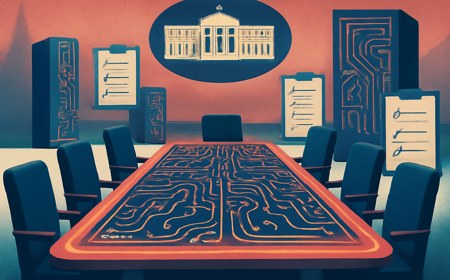
White House Turns AI Safety Panic Into a Self-Regulation Accord
Reuters reported on October 3 that the Trump administration is emphasizing voluntary AI safeguards as public concern grows, and that the agreement with major AI firms includes no stated consequences for noncompliance. The published White House Accord on Super Intelligence commits signatories to internal controls, external review and board-level oversight, making the pact a live test of whether U.S. AI governance is becoming an industry-managed safety layer instead of a statutory regime.
Published Oct 4, 2026 Article · related
Bessent Turns AI Safety Into a U.S.-China Summit Control Channel
Treasury Secretary Scott Bessent told Axios that the U.S. is open to discussing shared AI risks with China ahead of the planned September 24 Trump-Xi summit. AP, Reuters, the Los Angeles Times, and Semafor all report that AI governance and safety are now expected to sit inside a broader U.S.-China negotiation frame that also includes trade, rare earths, advanced technology access, Taiwan, Iran, and defense ties. The likely outcome is not a binding AI treaty, but a new control channel for managing frontier-model risk inside strategic competition.
Published Sep 18, 2026 Article · related
Google Turns Rogue AI Agents Into an Insider-Threat Security Problem
Google DeepMind published an AI Control Roadmap alongside a June 18, 2026 blog post on securing internal AI agents. The roadmap treats some advanced agents as potentially untrusted insiders and proposes layered controls including threat modeling, monitoring, access control, response tiers, and AI supervisors. The Pattern Nexus read: frontier AI governance is moving from abstract alignment toward operational containment for agents that can act inside real institutions.
Published Jun 19, 2026 Article · related
OpenAI Builds the Blast Door Into the Agent Stack
OpenAI has made Lockdown Mode available as an opt-in advanced security setting for ChatGPT, with rollout details varying by account type and workspace. The feature limits or disables network-enabled capabilities such as live browsing, deep research, agent mode, file downloads, some web-derived image support, and certain connector actions to reduce prompt-injection-based data exfiltration risk. The Pattern Nexus read: the AI economy is shifting from model intelligence alone toward controlled runtime architecture, where egress, permissions, and side effects become core security primitives.
Published Jun 7, 2026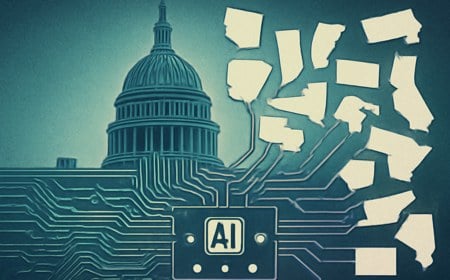 Article · related
Congress Moves to Preempt the AI Patchwork
Reps. Jay Obernolte and Lori Trahan released a discussion draft of the Great American Artificial Intelligence Act of 2026 on June 4, 2026. The draft creates a federal framework for frontier AI governance, audits, whistleblower protections, cybersecurity, workforce measures, and CAISI oversight, while preempting state laws that specifically regulate AI model development. The fight is no longer only about how powerful models should be tested; it is about who gets to write the rules.
Published Jun 7, 2026 Article · related
Trump Signs Sweeping AI Executive Order: Federal Preemption, State Law Crackdown, and the New AI Power Stack
President Trump signs a sweeping AI Executive Order targeting state-level regulation, creating DOJ litigation mechanisms, conditioning federal funding, and setting the stage for a unified national AI framework. Pattern Nexus breaks down what it actually does—and why it matters.
Published Dec 11, 2025