

ancient Egypt
Automatically indexed from the existing article tag.
Theses, forecasts, models, and paths
No published research objects yet
This topic is ready for editors to connect a thesis, forecast, model, or research path.
Latest articles
 Article · related
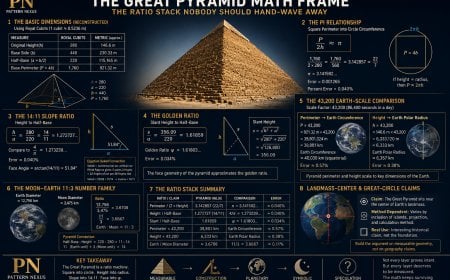
The Great Pyramid Math Frame: The Ratio Stack Nobody Should Hand-Wave Away
The Great Pyramid argument is strongest when the math comes first. Using the common reconstructed dimensions of 280 royal cubits high and 440 royal cubits per base side, the structure produces a repeatable ratio stack: 22/7 as a pi approximation, the 14:11 slope ratio, a golden-ratio face relationship, a 43,200 Earth-scale comparison, and the Moon-Earth 11:3 number family. This does not automatically prove every theory attached to the pyramid, but it does show why the geometry should not be casually dismissed.
Published Jun 18, 2026 Article · related
The Water That Would Not Drain: The Osireion, the Osiris Shaft, and the Ancient Hydrology Pattern Hiding Under Civilization
The Osireion at Abydos and the Osiris Shaft at Giza are usually treated as Egyptian mysteries, but the deeper pattern is global. Ancient builders repeatedly placed sacred architecture at the boundary between visible water and hidden water: aquifers, shafts, springs, subterranean channels, artificial islands, pressure systems, and ritual wells. This Pattern Nexus research piece separates evidence from exaggeration, examines the real dewatering problem at Abydos, corrects the stronger viral claim around the Osiris Shaft, and then maps the same hydrological intelligence across Petra, Dholavira, Mohenjo-daro, Nasca, Palenque, Angkor, Tiwanaku, Persian qanats, Indian stepwells, and Nuragic Sardinia.
Published May 22, 2026