

balance sheets
Automatically indexed from the existing article tag.
Theses, forecasts, models, and paths
No published research objects yet
This topic is ready for editors to connect a thesis, forecast, model, or research path.
Latest articles
 Article · related
The Capital Ladder: Where $100 to $1 Trillion Places You in the Global and American Wealth System
A deep Pattern Nexus regression and data analysis mapping where net worth levels from $100 to $1 trillion place an individual within the global and American wealth distributions. The research separates actual net worth from liquidity, accessible credit, gross capital control, leverage, and daily capital-producing capacity. Where do you actually sit within the global wealth system—and how does that position change when we measure not only what you own, but how much capital you can access? This research maps wealth levels from $100, $500, and $1,000 through $1 million, $1 billion, $100 billion, and the theoretical $1 trillion threshold. Global and American wealth distributions are analyzed separately using regression models, percentile estimates, Federal Reserve household data, international wealth-distribution research, and 17 original charts and visualizations. The analysis distinguishes net worth from liquid wealth, available credit, collateral-backed borrowing capacity, and gross capital controlled. It then models how productive leverage can accelerate wealth growth, how destructive leverage can erase equity, and how much daily capital output different levels of wealth may generate. Net worth measures ownership. Liquidity measures deployability. Credit measures reach. Leverage amplifies the result. Capital efficiency determines whether that amplification creates wealth or debt.
Published Jul 10, 2026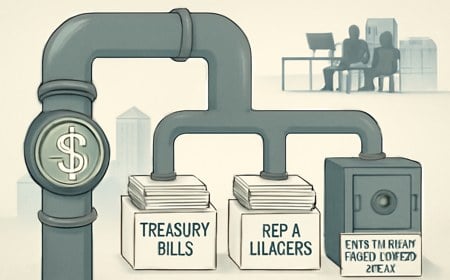 Article · related
Wall Street Turns Stablecoin Reserves Into a Money-Market Collateral Stack
Fidelity has entered the stablecoin-reserve business with a money-market vehicle designed around GENIUS Act-eligible assets, according to SEC filings and Fidelity’s institutional fund table. The move follows State Street’s June 16 launch of a similar GENIUS Act-aligned government money-market fund, with State Street Bank and Anchorage Digital named as initial investors. The signal is that stablecoin backing is migrating from crypto balance sheets into traditional cash-management infrastructure controlled by large asset managers, banks, and federally regulated crypto institutions.
Published Jun 19, 2026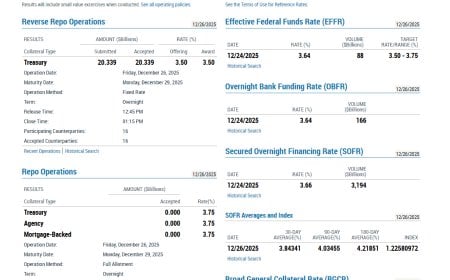 Article · related
Orderly Stress: Why Repo Stability Is Masking Deeper Collateral Strain
Repo markets remain orderly even as settlement fails and benchmark collateral strain emerge. This analysis explains why stable SOFR, modest ON RRP and MBS repo usage, and limited Fed operations can coexist with deeper stress in collateral mobility and dealer balance sheets.
Published Dec 26, 2025 Article · related
Ukraine Is the Fault Line: NATO Expansion, Dollar Custody Warfare, and Russia’s Forced Pivot to China
Ukraine is not a regional war. It is the convergence point where NATO’s post-1991 security architecture, the U.S.-led financial control stack (custody, sanctions, settlement), and Russia’s failed integration into the Western order collided. This deep-dive traces the chain from 1990 assurances and NATO expansion through 2008 Bucharest, 2014–2021 freeze failures, the 2022 system shift, and today’s locked endgame. The core mechanism is precedent: territory, security guarantees, sanctions sequencing, and reserve legitimacy must all unwind together or nothing settles. This is the war behind the headlines: buffers, balance sheets, payment rails, collateral, energy, and credibility.
Published Dec 15, 2025 Article · related
Can You Print Money? How Money Creation Really Works
Every swipe, signature, and settlement: a systems-level tour of modern money creation—from bank balance sheets and credit lines to the Fed’s monopoly on the base layer.
Published Oct 29, 2025