

ChatGPT
Automatically indexed from the existing article tag.
Theses, forecasts, models, and paths
No published research objects yet
This topic is ready for editors to connect a thesis, forecast, model, or research path.
Latest articles
 Article · related
OpenAI Turns False-Front Personas Into an AI Information-Warfare Map
OpenAI said on October 8, 2026 that it banned two covert influence operations originating in Russia and Iran that used ChatGPT to support false-front entities and media-placement workflows. Independent reports from The Record, Channel NewsAsia, and Anadolu Agency corroborated the core claims, including a Latin America-focused fake research platform, fake journalist personas, and nearly 100 articles tied to the Iran-origin operation. The larger signal is that AI is lowering the cost of credibility laundering, not merely increasing propaganda volume.
Published Oct 9, 2026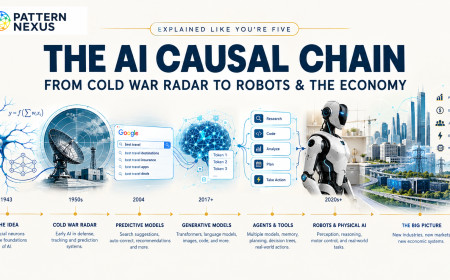 Article · related
The AI Causal Chain Explained Like You're Five: From Cold War Radar to Robots and the Economy
AI did not begin with ChatGPT. This accessible, fully sourced Pattern Nexus research map follows the 1943 artificial-neuron paper, Cold War radar computers, predictive internet systems, transformer models, agents, embodied AI and humanoid robots into the real questions about jobs, energy, productive ownership, wages and the economy.
Published Sep 23, 2026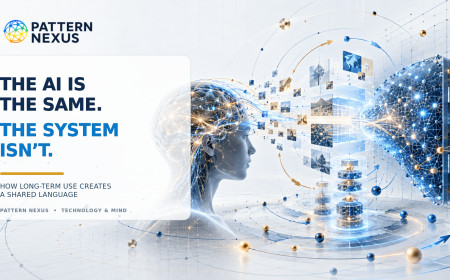 Article · related
The AI Is the Same. The System Isn’t: How Long-Term Use Creates a Shared Language
After a conversation moved from a media headline to political age limits, documented forecasts, cognitive bias, simulation theory, and finally language itself, a stranger system became visible: the AI was preserving continuity across ideas that were no longer fully restated in each message. This Pattern Nexus essay argues that sustained AI use can produce an emergent human–AI relationship that cannot be reduced to the base model alone. It separates contextual reconstruction from mind reading, interactional change from model retraining, and documented observation from metaphysical speculation. It also examines coadaptation, authorship, confirmation lock, dependency, platform control, and the social divide between transactional AI use and long-term system formation—while intentionally withholding the private shorthand and operating structure inside the author’s own system.
Published Sep 11, 2026 Article · related
OpenAI Turns Atlas Shutdown Into an Embedded-Agent Browser Strategy
OpenAI says ChatGPT Atlas is scheduled to stop working on August 9, 2026, and tells users to export bookmarks and save tabs or history because those assets will not automatically transfer. Independent reports from TechRadar, The Register and MacRumors describe the move as a sunset of the standalone AI browser while OpenAI folds browser-based agentic work into ChatGPT, ChatGPT Work and Codex. The shift suggests the control point for AI web automation is moving from standalone browsers to embedded workspace agents.
Published Aug 9, 2026 Article · related
OpenAI Builds the Blast Door Into the Agent Stack
OpenAI has made Lockdown Mode available as an opt-in advanced security setting for ChatGPT, with rollout details varying by account type and workspace. The feature limits or disables network-enabled capabilities such as live browsing, deep research, agent mode, file downloads, some web-derived image support, and certain connector actions to reduce prompt-injection-based data exfiltration risk. The Pattern Nexus read: the AI economy is shifting from model intelligence alone toward controlled runtime architecture, where egress, permissions, and side effects become core security primitives.
Published Jun 7, 2026