

climate
Automatically indexed from the existing article tag.
Theses, forecasts, models, and paths
No published research objects yet
This topic is ready for editors to connect a thesis, forecast, model, or research path.
Latest articles
 Article · related
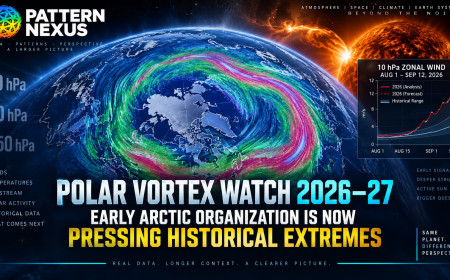
Polar Vortex Watch 2026–27: Early Arctic Organization Is Now Pressing Historical Extremes
What started as an unusual late-August structural signal is becoming something much harder to dismiss. The 10-hPa Arctic winds have moved above the historical 90th percentile, the September 12 projection reaches 10.22 m/s against a date-matched historical maximum of 10.29 m/s, organization is now visible lower in the stratosphere near 70 hPa, and the broader 250-hPa jet is showing a strongly wrapped Arctic pattern. This is a full Pattern Nexus rerun of the wind, temperature, geometry, vertical structure, historical rarity, and active solar backdrop.
Published Sep 6, 2026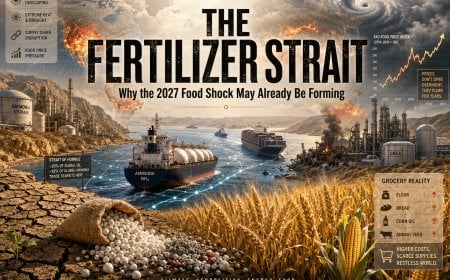 Article · related
The Fertilizer Strait: Why the 2027 Food Shock May Already Be Forming
Fertilizer prices, Persian Gulf disruption, a potentially historic El Niño, expanding drought risks, weak currencies, and fragile food-import systems are converging ahead of the 2027 growing cycle. This extended Pattern Nexus analysis examines more than 50 years of population, grain production, fertilizer, energy, climate, inventory, and food-price data to determine whether the world is approaching another major food-inflation and political-instability cycle.
Published Jul 24, 2026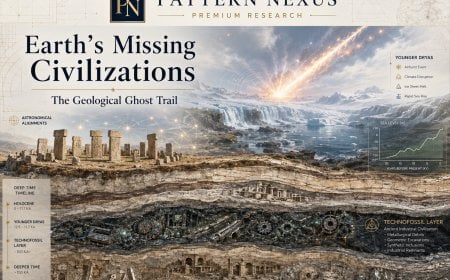 Article · related
Earth’s Missing Civilizations: The Silurian Hypothesis, Younger Dryas Shock, and the Ghost Trail of Human Deep Time
A deep Pattern Nexus investigation into the possibility of earlier civilizations on Earth, using the Silurian Hypothesis, the Younger Dryas climate reversal, impact-marker research, Göbekli Tepe interpretations, sea-level rise, submerged landscapes, and the limits of geological evidence. The real question is not whether ancient humans had modern technology. The deeper question is whether Earth’s surface is capable of preserving the kind of civilization we would expect to find.
Published Jun 4, 2026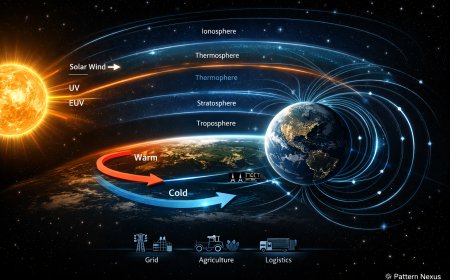 Article · related
Earth’s Climate Is a Control System, Not a Thermostat
Climate risk is dominated by circulation stability, not surface averages. This analysis maps solar spectral variability, geomagnetic forcing, stratosphere–troposphere coupling, and AMOC heat transport into a single control-system model that explains why volatility and regional cold shocks can rise even in a warming mean.
Published Dec 20, 2025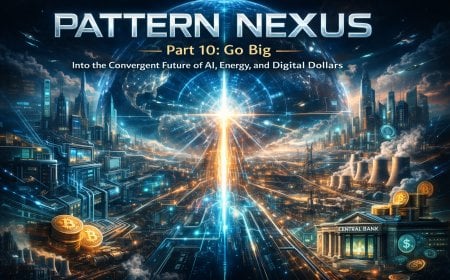 Article · related
The Convergence: AI, Energy, and the Final Liquidity Regime (2020–2045?)
The last 150 years built an industrial machine, a dollar fortress, offshore dollar webs, a global leverage cycle, and a QE-driven digital dollar stack. Part 10 of the Pattern Nexus megaseries ties the arc together and maps where it’s likely heading next: an AI–energy industrial core, programmable dollars, hard-asset politics, and a final liquidity regime that decides who gets to adapt — and who gets left behind.
Published Dec 10, 2025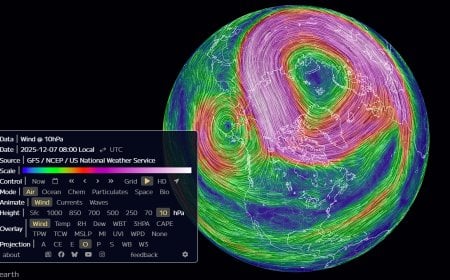 Article · related
The Polar Vortex Is Stretching to the Breaking Point: Why Late December Could Turn Brutal
The polar vortex is undergoing rapid deformation between December 7–11, 2025, with stratospheric winds elongating into a classic pre-collapse pattern. This Pattern Nexus deep dive explains what the vortex evolution means, how the cold propagates downward, and why North America may be the bullseye for a severe late-December cold outbreak.
Published Dec 7, 2025