

Compute
Automatically indexed from the existing article tag.
Theses, forecasts, models, and paths
No published research objects yet
This topic is ready for editors to connect a thesis, forecast, model, or research path.
Latest articles
 Article · related
Super Micro Contractor Turns Nvidia AI Servers Into a China Export-Control Guilty Plea
Ting-Wei “Willy” Sun, a contractor linked to Super Micro Computer, pleaded guilty on October 8, 2026, to four counts tied to an alleged scheme to illegally route AI servers containing advanced Nvidia chips to China. The Justice Department had previously alleged that the broader conspiracy involved about $2.5 billion worth of U.S. AI server technology. The plea is an enforcement signal for the U.S.-China compute-control regime: advanced AI servers are now being treated as traceable strategic infrastructure, not just commercial hardware.
Published Oct 11, 2026 Article · related
Washington Turns Tech Compute Credits Into a Federal AI-Science Operating System
On October 8, 2026, the White House announced $2.4 billion in super-intelligence science tools and compute credits from 11 industry partners for the Genesis Mission Consortium. Nvidia, Anthropic and AWS separately detailed commitments that turn private AI infrastructure into usable research capacity for federal agencies, national laboratories and partner institutions. The system read: Washington is not merely buying compute; it is organizing a quasi-public AI-science operating layer around private infrastructure.
Published Oct 9, 2026 Article · related
National Compute Turns Idle GPUs Into an AI-Access Grid
National Compute launched the National Compute Grid on October 7, 2026, with a plan to pool AI compute across clouds, labs, providers and chip architectures through a shared scheduler. Vultr says it has joined as a founding consortium member and will contribute capacity to the Grid Exchange, while the network is targeting 2 GW of pooled capacity by 2030. The key caveat: early capacity figures mix resources already connected with capacity still only “in sight,” so the operational scale remains to be proven.
Published Oct 7, 2026 Article · related
Wall Street Turns Broadcom-Anthropic Chips Into a $60B AI-Credit Test
Bank of America, Citigroup and Morgan Stanley have begun syndicating a record-sized financing package tied to Anthropic’s Broadcom-Google compute stack, according to multiple reports. The structure is reported to include roughly $42 billion of senior secured debt and $18 billion of junior financing, with Blackstone committing to a large part of the riskier tranche. The deal turns AI chips, leases, vendor support and future model revenue into a live credit-market test.
Published Oct 6, 2026 Article · related
Huawei Turns Qualcomm Patents Into a Sanctions-Resilient AI-IP Rail
Huawei and Qualcomm announced a broad multi-year patent license agreement on October 5, 2026, covering 5G, compute, AI and networking technologies. The deal includes cross-licenses and Qualcomm’s planned purchase of certain Huawei U.S. patents, subject to regulatory approvals. The bigger signal is that technology control is shifting from devices and chips toward standards-essential patents, licensing flows and ownership of foundational AI-era infrastructure IP.
Published Oct 5, 2026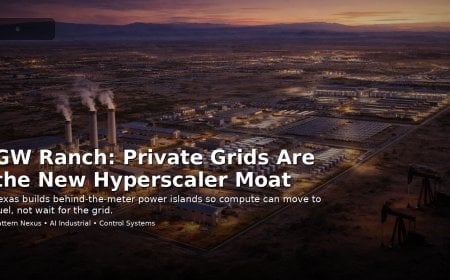 Article · related
GW Ranch: Texas Builds Private Grids for the AI Flywheel
Pacifico Energy’s 7.65 GW permitted GW Ranch marks the shift to off-grid hyperscale power islands in West Texas. In the Pattern Nexus framework, this is permission-stack infrastructure: fuel optionality → electrons → compute → governance leverage. A deep dive into ERCOT’s large-load queue, emissions politics, and what to watch through 2031.
Published Jan 31, 2026 Article · related
The Permission Stack: Narrative, Rails, Standards, Identity, and Continuity in the Age of Control Systems
A full Pattern Nexus systems paper on how narrative, money rails, standards, compute, and digital identity converge into a permission layer—while infrastructure fragility and tail risks force civilizations to choose between resilience and legitimacy.
Published Jan 24, 2026 Article · related
Escape Velocity: Where Control Breaks, Fractures, or Gets Redesigned
The master synthesis of The Age of Control Systems. This final chapter maps how modern power is enforced through rails, standards, energy, compute, data, compliance, supply chains, and algorithms—and the exact conditions under which those control layers fail, fracture, or get redesigned when legitimacy, redundancy, and incentives collide.
Published Jan 24, 2026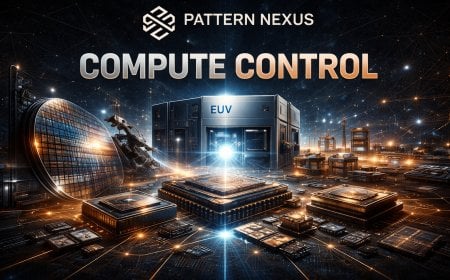 Article · related
Compute Control
Compute is a controllable chokepoint. Advanced chips require rare tools, rare know-how, and permissioned supply chains. Export controls, fab constraints, and cloud gates now throttle AI capabilities as a new layer of modern power.
Published Dec 26, 2025 Article · related
The Command Line: How Cold War Compute, Early AI, and Silicon Valley’s Birth Turned Information Into Power (1956–1969)
From the Dartmouth AI workshop and the invention of the integrated circuit to ARPA, SAGE, and Fairchild Semiconductor, the late 1950s and 1960s quietly birthed the first compute–military–industry complex. This chapter tracks how information itself became a strategic asset — and why the AI boom of 2025–2035 is its direct descendant.
Published Dec 4, 2025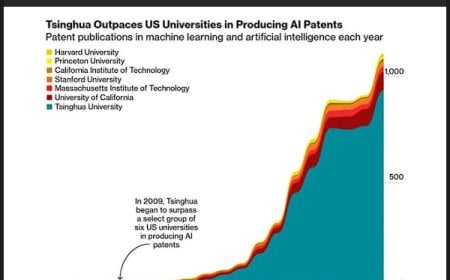 Article · related
The Patent Illusion: Why the U.S. Still Leads the AI Race (and Why That Tsinghua Chart Is Misleading)
This article breaks down why Tsinghua University’s surge in AI patents doesn’t mean China is winning the AI race. Patent charts measure universities—not compute, chips, cloud infrastructure, power, or frontier model leadership. Using real data, we explain why the U.S. still dominates the AI-industrial stack in 2025 and what pressure points actually matter.
Published Nov 20, 2025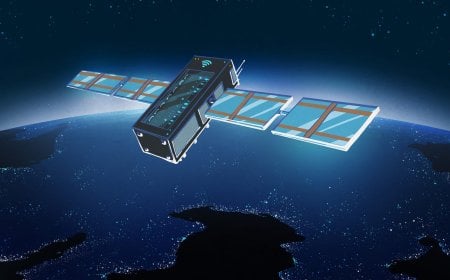 Article · related
Google’s Space-Based AI Data Center Gambit: Project Suncatcher and the New Compute Frontier
Google just revealed plans to build the first space-based AI data-center constellation — a solar-powered orbital compute cluster designed to escape Earth’s power limits. This breakdown explores the engineering, physics, grid implications, and how this fits directly into the AI-Industrial Flywheel.
Published Nov 16, 2025 Article · related
AI Compute and Power Infrastructure in 2025 — The New Industrial Backbone
A deep Pattern Nexus investigation into the 2025 AI industrial build-out — tracking every major compute deal, hyperscaler expansion, and the rebirth of nuclear power as the energy backbone for machine intelligence. Covers global capacity timelines, regional grid stress, economic spillovers, and the new “AI industrial complex” forming across tech and energy.
Published Nov 12, 2025 Article · related
Tokenized Reserve Era: AI Industrial Dominance and the New Operating System of the World Economy (1980–2040)
IMF baselines through 2024 combined with S-curve tokenization, AI industrial concentration, demographic drag, and reserve plumbing reveal the most realistic map of global power through 2040 — a world where programmable dollars and compute-shielded AI industry become the new operating system of the global economy.
Published Nov 8, 2025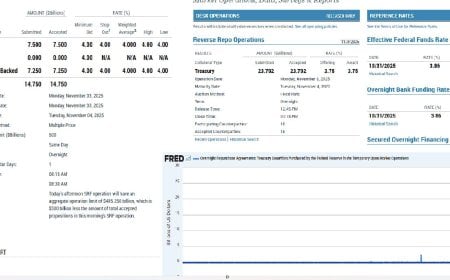 Article · related
The Quiet Repo Surge: $14.75B SRF Tap + $30B Liquidity Pulse Signals the New Regime
In three trading days, the Fed silently pushed nearly $45B through the repo window — including a $14.75B SRF tap and a ~$30B overnight repo spike. This wasn’t panic. It was collateral lubrication for America’s reindustrialization cycle — compute, power, copper, grid. The new liquidity regime is here.
Published Nov 3, 2025