

Data Centers
Automatically indexed from the existing article tag.
Theses, forecasts, models, and paths
No published research objects yet
This topic is ready for editors to connect a thesis, forecast, model, or research path.
Latest articles
 Article · related
CoreWeave Turns AI Data-Center Debt Into a Credit-Market Stress Test
CoreWeave shares and bonds came under pressure this week as investors repriced the leveraged neocloud model behind the AI data-center buildout. Axios reported CoreWeave bond yields above 15%, while Bloomberg reported credit-default pricing implying more than 60% odds of default within five years. The company’s own June 30, 2026 filing shows $35.6 billion of total indebtedness and $103.7 billion of remaining performance obligations, making CoreWeave a live test of whether AI demand can convert into enough cash flow to finance depreciation-heavy infrastructure.
Published Oct 16, 2026 Article · related
Adani and Jabil Turn AI Data-Center Hardware Into a Made-in-India Supply Rail
Adani Enterprises and Jabil signed a non-binding MoU on October 13, 2026, setting out a proposed 50:50 joint venture to manufacture and assemble AI and data-center equipment in India. The companies describe a multi-gigawatt AI-rack manufacturing platform aimed at hyperscalers, neoclouds, data-center operators and enterprises. The deal still requires definitive agreements, approvals and customary conditions, but it signals how the AI buildout is shifting from chip access alone toward localized full-stack infrastructure supply chains.
Published Oct 13, 2026 Article · related
Microsoft Turns Maia 300 Into a Multi-Gigawatt Inference Rail
Microsoft announced Maia 300 on October 12, 2026, saying Azure Maia will scale to multi-gigawatt deployments starting in 2027 and become the primary inference system for Microsoft products and services. The company says the system is aimed at long-context, latency-sensitive and agentic workloads, with 40% more tokens per megawatt than leading GPU-based systems. Reuters reported Microsoft may deploy more than one million custom AI chips next year as it tries to lower costs and reduce reliance on outside accelerators.
Published Oct 13, 2026 Video · related
The Convergence — Audio-Video Edition
The finale of the Pattern Nexus Cycles of Power audio-video series connects 150 years of industrial, monetary, computing, energy, and liquidity history to the emerging convergence of AI infrastructure, fiscal dominance, programmable dollars, hard-asset politics, and competing paths from 2030 to 2045.
Published Oct 12, 2026 Article · related
Samsung Turns AI Memory Scarcity Into a 107.4-Trillion-Won Profit Signal
Samsung Electronics said it expects about 195 trillion won in consolidated third-quarter sales and 107.4 trillion won in consolidated operating profit, up sharply from 86.06 trillion won in sales and 12.17 trillion won in operating profit a year earlier. Independent coverage from Reuters, Bloomberg-linked reporting and Korean market media tied the surge to AI-driven demand for memory, including high-bandwidth memory, DRAM and NAND. The muted share reaction shows the other side of the AI memory boom: expectations are already high, and investors are watching whether scarcity economics can last.
Published Oct 8, 2026 Article · related
National Compute Turns Idle GPUs Into an AI-Access Grid
National Compute launched the National Compute Grid on October 7, 2026, with a plan to pool AI compute across clouds, labs, providers and chip architectures through a shared scheduler. Vultr says it has joined as a founding consortium member and will contribute capacity to the Grid Exchange, while the network is targeting 2 GW of pooled capacity by 2030. The key caveat: early capacity figures mix resources already connected with capacity still only “in sight,” so the operational scale remains to be proven.
Published Oct 7, 2026 Article · related
Amazon Turns Data-Center Backlash Into a $1B Community-Permit Rail
Amazon Web Services announced Built Together, a U.S. data-center community framework backed by more than $1 billion over five years, alongside a Data Center Commitment that includes ending NDAs with government agencies and publishing annual energy and water metrics. The verified facts point to a broader AI-infrastructure shift: local consent is becoming as important as chips, power contracts, and land. The Pattern Nexus read is that Amazon is trying to industrialize permission before moratoriums and transparency fights harden into a national brake on the AI buildout.
Published Oct 3, 2026 Article · related
Senate Turns Permitting Reform Into an AI-Grid Cost Allocation Deal
Senate energy and environment leaders introduced the Bipartisan American Affordability and Jobs Act on September 30, 2026, a permitting package aimed at faster federal reviews for energy, transmission, and infrastructure projects. The bill would strengthen FERC transmission-siting authority and require data centers to pay associated transmission costs instead of shifting those costs to households and smaller businesses. A Senate vote is not expected until after the November 3 midterm elections.
Published Oct 1, 2026 Article · related
Alibaba Turns Zhenwu V900 Into a 20-Gigawatt AI-Sovereignty Map
Alibaba announced a full-stack AI roadmap at its Apsara Conference on September 22, 2026, including the Zhenwu V900 AI processor, Qwen 4 training, future Qwen models planned at 5 trillion to 10 trillion parameters, and a target for Alibaba Cloud global data-center capacity to exceed 20GW by 2032. The verified facts point to a vertically integrated strategy spanning chips, cloud infrastructure, models and agents. The system read is that Alibaba is turning compute sovereignty into an operating layer for China’s AI industrial flywheel.
Published Sep 23, 2026 Article · related
Seoul Turns Texas Gas Power Into an AI-Compute Alliance Rail
South Korea has identified a Texas gas-fired power project as the first investment under its $350 billion U.S. package, according to Yonhap, KBS, Kyunghyang and Reuters reporting. The project is tied to rising Texas electricity demand from AI data centers and semiconductor facilities, while Seoul is also discussing U.S. nuclear and Alaska LNG follow-ons. The system read: tariff diplomacy is being converted into firm-power infrastructure for the AI industrial stack.
Published Sep 23, 2026 Article · related
Texas Turns Data-Center Permits Into a Grid-Audit Gate
On September 21, 2026, Governor Greg Abbott directed the Texas Commission on Environmental Quality to halt permits sought by data centers until ERCOT completes its audit. The order broadens Texas’s data-center slowdown from grid connections into environmental and water approvals, making AI infrastructure growth conditional on state findings about reliability, water use, local impacts, ownership, tax incentives, and who pays for supporting infrastructure.
Published Sep 22, 2026 Article · related
Goolsbee Turns AI Data Centers Into a Fed Reaction-Function Test
Chicago Fed President Austan Goolsbee said on September 21, 2026 that policymakers should watch whether AI data-center construction is spilling beyond its sector and pushing aggregate output above capacity. The significance is not that the Fed is targeting AI, but that AI capex is now being discussed as a possible demand shock with implications for inflation and interest-rate policy.
Published Sep 21, 2026 Article · related
Oregon Turns Data Centers Into a Quarter-Grid AI Infrastructure Test
A new ECOnorthwest and University of Virginia assessment, reported by Oregon outlets and presented to state advisers, puts Oregon data centers at about 23% of statewide retail electricity sales in 2025. The state is now treating the sector as a systemic planning challenge, with a Data Center Advisory Committee taking public comment through October 24, 2026 and POWER Act implementation shifting large-load grid costs toward data centers.
Published Sep 20, 2026 Article · related
Google and Nvidia Turn Flexible Load Into an AI-Data-Center Fast Lane
Google, Nvidia and Emerald AI have launched the AI Energy Management Alliance to promote flexible AI data centers that can adjust electricity demand in response to grid conditions. The coalition is pushing utilities, grid operators and regulators to treat verifiable flexibility as a reason to accelerate large-load interconnection. The Pattern Nexus read: AI compute demand is being converted from a fixed grid burden into a dispatchable power-market asset.
Published Sep 16, 2026 Article · related
Texas Turns Data-Center Water Reporting Into a Permit-Blocking AI Infrastructure Test
Texas is ordering the Texas Water Development Board to pursue penalties and legal consequences against major water users, including data centers, that fail to complete required water-use surveys. Abbott’s directive also links water reporting to TCEQ permitting and ERCOT coordination, making resource disclosure a practical gate for AI data-center expansion in the state.
Published Sep 15, 2026 Article · related
Trump Converts AI Safety Warnings Into a China-Race Doctrine
Trump dismissed AI catastrophe warnings as a hoax and framed pressure for AI guardrails as hostile to U.S. leadership, AI companies and data centers. The clash follows calls from Anthropic’s Dario Amodei, OpenAI’s Sam Altman and Elon Musk to pace frontier-model development and expand safety oversight. The bigger pattern is a political operating system that treats AI safety, permitting, energy demand and China competition as one acceleration problem.
Published Sep 14, 2026 Article · related
SLB Turns Data-Center Cooling Into a $4.1 Billion AI-Industrial Beachhead
SLB said on August 31, 2026 that it agreed to acquire Kelvion, a German thermal-management and heat-exchange company, for about $3.4 billion in cash plus roughly $0.7 billion of assumed debt. The deal expands SLB’s Data Center Solutions business and positions cooling, modular construction and industrial reliability as core bottlenecks in the AI buildout.
Published Aug 31, 2026 Article · related
Amazon Turns Nvidia GPUs Into a 2028 AI-Factory Supply Line
AWS and Nvidia plan to deploy 2 million additional Nvidia GPUs across AWS global infrastructure in 2027 and 2028, including Blackwell Ultra, Rubin, and Rubin Ultra systems. The collaboration also reaches into Vera CPUs, NVLink Fusion with Nvidia custom high-bandwidth memory for Trainium, U.S. government AI factories with 100,000 GPUs, and physical-AI tooling for robotics. The Pattern Nexus read: AWS is converting GPU access into a control layer across cloud, federal, and embodied AI markets.
Published Aug 27, 2026 Article · related
Nvidia Turns Powered Land Into a Grid-Responsive AI Factory Pipeline
Lancium announced a strategic collaboration with Nvidia on August 24, 2026, including an undisclosed Nvidia investment and planned deployment of Nvidia’s full-stack AI factory platform across Lancium campuses. The portfolio includes 4 GW of leased capacity and a development pipeline exceeding 15 GW of powered land. The Pattern Nexus signal is that Nvidia is attaching its platform and capital to power-ready sites while DSX MaxLPS and DSX Flex position power utilization and grid responsiveness as part of the AI factory stack.
Published Aug 25, 2026 Article · related
RUM Group Turns AI Compute Into a Penny-Warrant Financing Test
RUM Group disclosed a six-year GPU-services agreement with an unaffiliated U.S.-based cloud customer, tied to its Maysville, Georgia site that is still under development. The contract carries an approximately $13.7 billion three-tranche order value and is paired with a warrant for up to 50,808,408 Class A shares at $0.01 per share. The key Pattern Nexus signal is that AI compute demand is being converted into equity-linked financing and dilution risk before the underlying data-center capacity exists.
Published Aug 25, 2026 Article · related
AI Data Centers Turn Into a Midterm Control Surface
AI data centers are moving from economic-development trophy to midterm liability. AP reported that President Donald Trump continues to champion data centers as strategic infrastructure while candidates in competitive races back away from the issue. Axios and The Washington Post separately show the backlash spreading across states and campaigns, making power, water and ratepayer protection a new control surface for AI industrial policy.
Published Aug 21, 2026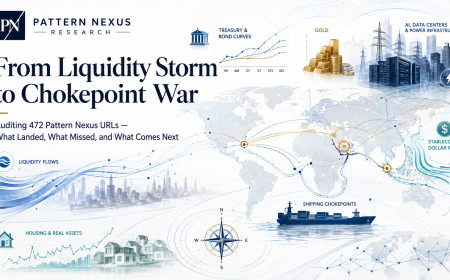 Article · related
From Liquidity Storm to Chokepoint War: Auditing 472 Pattern Nexus URLs — What Landed, What Missed, and What Comes Next
I audited the public Pattern Nexus record across 472 unique URLs and the saved full-text article export, then rebuilt the major calls from the original wording. This long-form report scores the liquidity/QT pivot, gold, the sub-3% 10-year miss, housing, stablecoin/Treasury rails, Venezuela, Iran/Hormuz, China/Taiwan, Greenland, AI power, robotics and the war economy, and finishes with a falsifiable map of what comes next.
Published Aug 20, 2026 Article · related
PJM Turns AI Data Centers Into Interruptible Grid Load
PJM’s proposed Interim Resource Adequacy Service framework would treat some new 50 MW-plus data centers and other large loads as curtailable unless they secure qualifying capacity. The move follows a 6,831 MW capacity shortfall for the 2028/2029 delivery year and rising forecasts for large-load demand across PJM’s footprint. The system read: AI compute is being recast from passive load growth into a reliability obligation.
Published Aug 19, 2026 Article · related
Nvidia Turns AI Compute Into a Wall Street Collateral Machine
Nvidia announced on August 10, 2026 that it had signed memorandums of understanding with Apollo, BlackRock, Blackstone, Brookfield, Goldman Sachs and KKR to establish AI compute infrastructure financing platforms designed to mobilize more than $500 billion of third-party capital over time. Axios reported that the effort could move through GPU securitizations, spreading exposure to AI compute across insurers, pensions, sovereign wealth funds and other long-duration capital pools. The verified fact is the financing push; the system read is that Nvidia is helping turn compute from purchased hardware into financeable collateral.
Published Aug 12, 2026 Article · related
The Universal Intelligence Economy: AI, Robotics, Jobs, Money, and the 2030–2035 Transition
AI companies are assembling a cognitive-and-physical labor system designed to outscale human work. This forecast maps the 6–18 month robotics crossover, three displacement paths, the break in wage-based demand, and the monetary architecture required if machine output replaces labor income.
Published Aug 10, 2026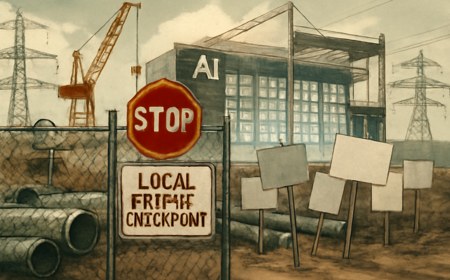 Article · related
AI Data Centers Hit the Consent Bottleneck
AI data-center buildout is moving from a power-and-capex story into a political-consent story. Local opposition has delayed or blocked projects, New York has imposed a statewide pause on large facilities, and developers now face a fourth bottleneck: permission to operate. The Pattern Nexus read is that ratepayer protection, water use, zoning legitimacy and community benefits are becoming financial variables in the AI industrial flywheel.
Published Aug 9, 2026 Video · related
The First AI Age — Pattern Nexus Audio-Video Edition
The first weekly Pattern Nexus audio-video turns the 1870–1914 industrial supercycle into a concise narrated story—and shows why the AI, data-center, energy, and liquidity buildout of 2025–2035 rhymes with it.
Published Aug 8, 2026 Article · related
Virginia Turns AI Data-Center Power Lines Into a User-Pays Tariff
Virginia’s State Corporation Commission ordered Dominion Energy to develop a tariff framework that assigns more transmission costs directly to data centers and other large-load customers when upgrades are built for them. The move follows Gov. Abigail Spanberger’s push for a cost-causation, or “but-for,” approach and is being framed by state officials as a ratepayer-protection measure. The deeper signal is that AI infrastructure is entering a new regulated-cost phase, where grid access, tariff design, and political tolerance may matter as much as GPUs and land.
Published Aug 7, 2026 Article · related
Texas Turns AI Data Centers Into a Grid-Admission Audit
Texas Gov. Greg Abbott directed PUCT and ERCOT on August 3, 2026 to conduct a comprehensive verification and audit of data centers advancing through ERCOT’s interconnection process before those projects move forward. The order lands amid roughly 474 gigawatts of large-load requests to connect to the Texas grid, with the governor’s office saying about 90% of new power requests are data centers. The move reframes AI-era data centers as strategic infrastructure applicants rather than ordinary load growth.
Published Aug 7, 2026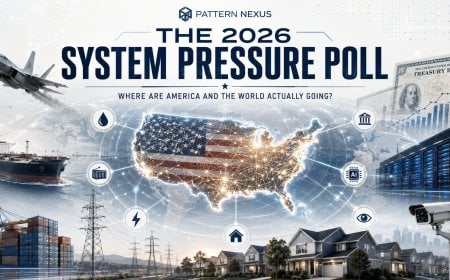 Poll · related
The 2026 System Pressure Poll: Where Are America and the World Actually Going?
This is not another left-versus-right approval poll. The Pattern Nexus System Pressure Poll examines the deeper structures shaping current events: war, energy, shipping corridors, debt, interest rates, tariffs, artificial intelligence, surveillance, housing, automation, institutional trust, and the emerging global order. The daily headlines are downstream. The objective is to identify which systems people believe are actually driving events—and where those systems are taking the United States and the rest of the world.
Published Jul 24, 2026