

debt
Automatically indexed from the existing article tag.
Theses, forecasts, models, and paths
No published research objects yet
This topic is ready for editors to connect a thesis, forecast, model, or research path.
Latest articles
 Article · related
CoreWeave Turns AI Data-Center Debt Into a Credit-Market Stress Test
CoreWeave shares and bonds came under pressure this week as investors repriced the leveraged neocloud model behind the AI data-center buildout. Axios reported CoreWeave bond yields above 15%, while Bloomberg reported credit-default pricing implying more than 60% odds of default within five years. The company’s own June 30, 2026 filing shows $35.6 billion of total indebtedness and $103.7 billion of remaining performance obligations, making CoreWeave a live test of whether AI demand can convert into enough cash flow to finance depreciation-heavy infrastructure.
Published Oct 16, 2026 Article · related
Wall Street Turns Broadcom-Anthropic Chips Into a $60B AI-Credit Test
Bank of America, Citigroup and Morgan Stanley have begun syndicating a record-sized financing package tied to Anthropic’s Broadcom-Google compute stack, according to multiple reports. The structure is reported to include roughly $42 billion of senior secured debt and $18 billion of junior financing, with Blackstone committing to a large part of the riskier tranche. The deal turns AI chips, leases, vendor support and future model revenue into a live credit-market test.
Published Oct 6, 2026 Article · related
SLB Turns Data-Center Cooling Into a $4.1 Billion AI-Industrial Beachhead
SLB said on August 31, 2026 that it agreed to acquire Kelvion, a German thermal-management and heat-exchange company, for about $3.4 billion in cash plus roughly $0.7 billion of assumed debt. The deal expands SLB’s Data Center Solutions business and positions cooling, modular construction and industrial reliability as core bottlenecks in the AI buildout.
Published Aug 31, 2026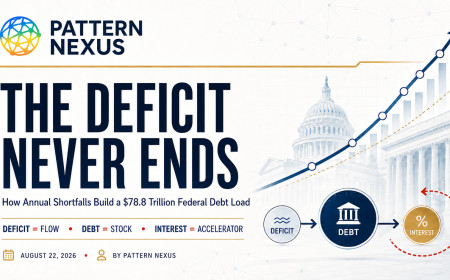 Article · related
The Deficit Never Ends: How Annual Shortfalls Build a $78.8 Trillion Federal Debt Load
Most people use “deficit” and “debt” as if they mean the same thing. They do not. This report uses two Pattern Nexus infographics and official CBO and Treasury data to map the annual federal deficit and total federal debt from 2020 through 2040, explain why interest creates a self-reinforcing feedback loop, and show why the 10-year and 30-year Treasury yields—not a political debt-clock slogan—are the market constraint that matters.
Published Aug 22, 2026 Article · related
Pattern Nexus Macro Archive: 328 Timestamped Articles, October 2025–July 2026
A guided public index of 328 timestamped Pattern Nexus articles covering Federal Reserve liquidity, interest rates, the dollar, gold and silver, housing, real estate, markets, debt, banking, energy, trade, industrial buildout, and geopolitical transmission. Each section explains what readers will find, what they will learn, and where to begin.
Published Jul 30, 2026 Article · related
The Capital Ladder: Where $100 to $1 Trillion Places You in the Global and American Wealth System
A deep Pattern Nexus regression and data analysis mapping where net worth levels from $100 to $1 trillion place an individual within the global and American wealth distributions. The research separates actual net worth from liquidity, accessible credit, gross capital control, leverage, and daily capital-producing capacity. Where do you actually sit within the global wealth system—and how does that position change when we measure not only what you own, but how much capital you can access? This research maps wealth levels from $100, $500, and $1,000 through $1 million, $1 billion, $100 billion, and the theoretical $1 trillion threshold. Global and American wealth distributions are analyzed separately using regression models, percentile estimates, Federal Reserve household data, international wealth-distribution research, and 17 original charts and visualizations. The analysis distinguishes net worth from liquid wealth, available credit, collateral-backed borrowing capacity, and gross capital controlled. It then models how productive leverage can accelerate wealth growth, how destructive leverage can erase equity, and how much daily capital output different levels of wealth may generate. Net worth measures ownership. Liquidity measures deployability. Credit measures reach. Leverage amplifies the result. Capital efficiency determines whether that amplification creates wealth or debt.
Published Jul 10, 2026 Article · related
The New Fed Chair Does Not Inherit an Economy. He Inherits the Permission Stack.
Kevin Warsh is not simply inheriting the Federal Reserve. He is inheriting the control layer where inflation, debt service, Treasury funding, energy shocks, AI infrastructure demand, repo plumbing, collateral stress, political pressure, and liquidity permission all collide. The public will debate whether the new Fed chair cuts, hikes, pauses, or changes the balance sheet. That is the surface story. The deeper Pattern Nexus story is that the Fed chair is now the public face of the permission stack. He helps decide where credit flows, where pain lands, which markets get oxygen, which sectors get squeezed, and what kind of crisis or cover event makes the next liquidity intervention politically acceptable. This is not a normal Fed transition. It is the next chapter in the liquidity-cover framework.
Published May 18, 2026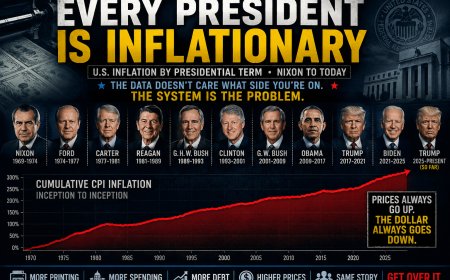 Article · related
Every President Is Inflationary: The Inflation Chart Both Parties Do Not Want to Read
A Pattern Nexus breakdown of U.S. inflation by presidential term from Nixon to today, showing why the argument over which party “caused inflation” misses the deeper system. Every modern president has governed inside an inflationary debt-based dollar structure. Some periods were worse than others, but the larger pattern is not partisan. It is monetary, fiscal, energy-driven, debt-driven, and structural.
Published May 15, 2026 Article · related
The Debt-Free Illusion: How Personal Finance Cults Preserve the Consumer Class and Block Mobility
“Debt-free” is sold as freedom, but in a financialized economy it often functions as compliance: a behavioral cage that blocks asset ownership, leverage literacy, and class mobility.
Published Jan 24, 2026 Article · related
Debt Is Not Income: How Asset-Based Living Legally Escapes the Tax Trap
The tax system taxes transactions, not wealth. Learn how borrowing against appreciated assets allows individuals to legally fund their lives without triggering income or capital gains taxes—and why this is a structural feature of modern finance, not a loophole.
Published Dec 25, 2025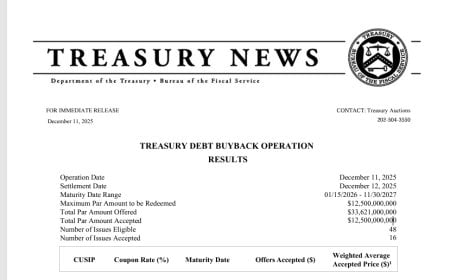 Article · related
Treasury Buyback Confirms the New Liquidity Regime
Treasury retires $12.5B in debt in a single buyback operation, confirming the shift into a post-QT, Treasury-driven liquidity regime.
Published Dec 12, 2025 Article · related
Oracle Financial Health & Collapse Risk – December 2025
Detailed analysis of Oracle’s financial stress as of December 2025, including stock performance, debt risk, CDS surge, AI spending, and expert warnings.
Published Dec 11, 2025 Article · related
The Fiscal-Monetary Fusion: Pandemic Money, Inflation Whiplash, and the Militarized Liquidity Regime (2020–2025)
COVID didn’t just trigger stimulus — it fused fiscal and monetary policy into a single war machine. Between 2020 and 2025, governments and central banks ran coordinated mega-deficits, bought their own debt at scale, ignited the first real inflation shock of the QE era, and then slammed rates higher into a fragile, over-financialized system — all while AI, energy constraints, and a new cold war turned liquidity into an explicit weapon.
Published Dec 8, 2025 Article · related
When $38 Billion Was a Crisis And $38 Trillion Is a Shrug
A plain-language Pattern Nexus breakdown of how U.S. federal debt went from tens of billions to tens of trillions in a century, why a billion dollars used to move history, and why most people today can’t feel the weight of trillion-dollar policy anymore.
Published Dec 8, 2025 Article · related
Half-Century Mortgages and Fantasy Car Loans: How Ultra-Long Debt Turns Households Into Cashflow Collateral
The Trump administration’s 50-year mortgage proposal, paired with viral rumors of 15-year car loans, is being sold as “affordability.” In reality, ultra-long debt structures double the interest burden, trap low-income households in lifetime payments, and weaponize credit against an already fragile workforce.
Published Dec 5, 2025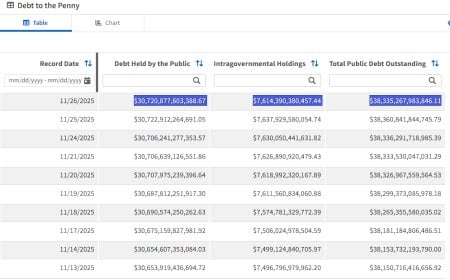 Article · related
The Overburdened Debt Economy: How a $1 Trillion Surge Tightens the Noose on Households, Businesses, and Growth
The U.S. added $1T in new debt in just 82 days. Here’s how rising federal, household, business, and state debts are overloading the economy and pushing rates higher.
Published Nov 29, 2025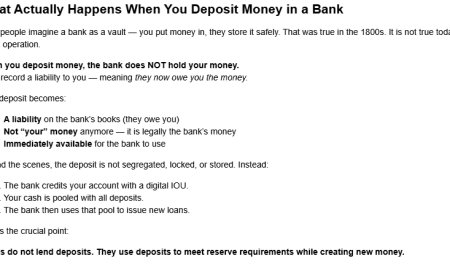 Article · related
Money Is Not What You Think: Debt, Time, Energy & the Hidden Mechanics of Power
Most people have no idea how money actually works. This long-form Pattern Nexus deep dive breaks down the real mechanics behind deposits, credit creation, debt expansion, leverage, and the hidden energy system that powers the global economy. Once you see how money is created, controlled, and weaponized, you can never unsee it.
Published Nov 24, 2025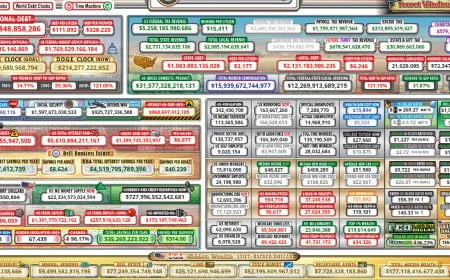 Article · related
Debt Without a Cliff: What the US Debt Clock Really Shows
A 35-year walkthrough of the US Debt Clock—from 1990 to 2029—showing how debt, GDP, and government spending really scale, why there is no magic “debt cliff,” and how this ties into CBDCs and tokenised Treasuries.
Published Nov 15, 2025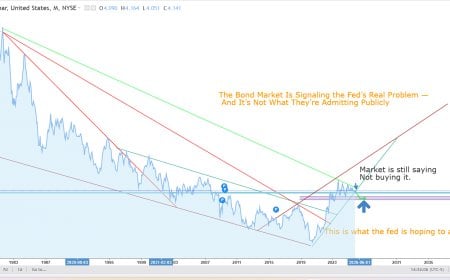 Article · related
The Bond Market Is Exposing the Fed’s Real Problem — And It’s Not Inflation
The 10-year yield reveals the Fed’s real challenge: a shrinking debt-sustainability corridor the market refuses to accept. Here’s why the system can’t stay here.
Published Nov 14, 2025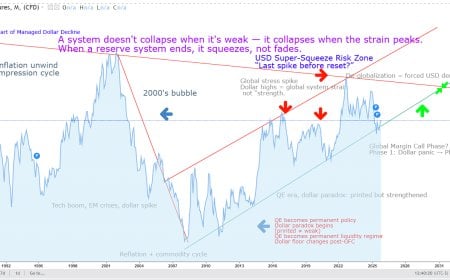 Article · related
The Dollar’s Last Stand: Why the System Squeezes Before It Breaks
The dollar doesn’t collapse when it’s weak — it spikes under maximum strain. This is the final squeeze phase of the global monetary system before transition. When reserve systems end, they don’t fade — they compress, surge, and then reset. Inside: charts, cycle mechanics, and how this ties into gold, housing, QE, sovereign debt, and de-globalization.
Published Nov 4, 2025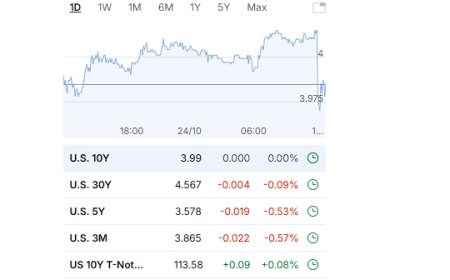 Article · related
Inflation at 3.0%: The Illusion of Stability and the Inevitable Liquidity Pivot
"3% CPI isn’t stability—it’s controlled volatility in a debt-saturated system, forcing the Fed toward rate cuts and stealth QE to keep credit flowing.
Published Oct 24, 2025 Article · related
The Myth of Collapse: Why the Future Doesn’t End Like the Past
Every “Final Crisis” narrative tries to force pre-digital history onto a post-digital civilization. Debt, fiat, gold, and markets aren’t dying—they’re re-architecting into programmable, tokenized, and socially aware systems. This isn’t apocalypse; it’s evolution under pressure.
Published Oct 19, 2025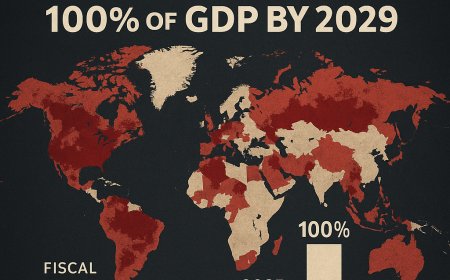 Article · related
🧭 IMF Warns Global Debt Could Exceed 100% of GDP by 2029
The IMF’s latest Fiscal Monitor warns that world public debt could climb beyond 100 percent of GDP by 2029 — a threshold unseen since the aftermath of World War II. Behind the numbers lies a structural problem: modern economies are addicted to debt-funded growth, and the world’s fiscal architecture is entering a critical phase.
Published Oct 18, 2025 Article · related
The Fracturing World Order: From Unipolar Dominance to Economic Multipolarity
The post–Cold War world promised stability through American dominance. Instead, it produced dependency through debt and energy control. Three decades later, that system is cracking — replaced by a network of regional powers, resource alliances, and digital financial blocs. This analysis examines how power is fragmenting, why liquidity defines modern empire, and what the next monetary architecture may look like.
Published Oct 18, 2025