

Housing
Automatically indexed from the existing article tag.
Theses, forecasts, models, and paths
No published research objects yet
This topic is ready for editors to connect a thesis, forecast, model, or research path.
Latest articles
 Article · related
The World I’ve Been Mapping Is Taking Shape
I connect the developments now taking shape across AI infrastructure, private power, critical minerals, the Iran energy shock, digital dollars, machine commerce, robotics and productive ownership. The article explains the mechanisms for readers joining the discussion now, carries the research into September and October, and connects the later housing, Greenland, space, neural-computing and polar-vortex work. Includes links to 46 earlier Pattern Nexus articles, 53 numbered external sources, a practical watch list and six reader questions.
Published Oct 5, 2026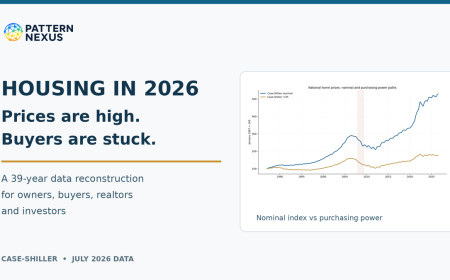 Video · related
Housing in 2026: Prices Are High, but the Market Is Barely Moving
The July Case-Shiller index reached another nominal high, but inflation, financing costs and weak sales tell a different story for the marginal buyer. Pattern Nexus reconstructs national prices from 1987, tests pre-2008 and 2019 inventory baselines, separates vacant homes for sale from rental vacancies, compares a 2019 and 2026 purchase payment, checks credit and construction, maps metro divergence and scores earlier PN housing claims. Includes 18 original charts and a practical guide for housing stakeholders.
Published Sep 30, 2026 Video · related
The Housing Collateral Engine — Audio-Video Edition
Episode 7 of the weekly Pattern Nexus audio-video series turns Part 7 of Cycles of Power into a shorter story about how China's WTO entry, global reserve recycling, low interest rates, mortgage securitization, repo funding, derivatives, and shadow banking transformed American housing into the central collateral engine of the global dollar system between 2001 and 2008.
Published Sep 19, 2026 Article · related
From Liquidity Storm to Chokepoint War: Auditing 472 Pattern Nexus URLs — What Landed, What Missed, and What Comes Next
I audited the public Pattern Nexus record across 472 unique URLs and the saved full-text article export, then rebuilt the major calls from the original wording. This long-form report scores the liquidity/QT pivot, gold, the sub-3% 10-year miss, housing, stablecoin/Treasury rails, Venezuela, Iran/Hormuz, China/Taiwan, Greenland, AI power, robotics and the war economy, and finishes with a falsifiable map of what comes next.
Published Aug 20, 2026 Article · related
The Sun, Liquidity, and Financial Turning Points: The Regression Missed the Regime
A corrected Pattern Nexus analysis of solar cycles, liquidity, recessions, and financial tops from January 1987 through July 2026. The first monthly regression rejected a short-horizon trading signal. The properly specified regime test found that all four U.S. recession onsets in the sample occurred within twelve months of an official solar maximum or minimum, recession months were sharply concentrated around those extrema, and M2 growth was faster on official solar rising legs.
Published Aug 10, 2026 Article · related
Pattern Nexus Macro Archive: 328 Timestamped Articles, October 2025–July 2026
A guided public index of 328 timestamped Pattern Nexus articles covering Federal Reserve liquidity, interest rates, the dollar, gold and silver, housing, real estate, markets, debt, banking, energy, trade, industrial buildout, and geopolitical transmission. Each section explains what readers will find, what they will learn, and where to begin.
Published Jul 30, 2026 Article · related
Hard Assets Follow Liquidity, Not Inflation? The Full Data Reconstruction — 2026 Update
A 2003–2026 reconstruction of Fed liquidity, gold, housing and NASDAQ data, plus an experimental stablecoin-augmented liquidity index. Meta tags: liquidity conditions index, hard assets, gold, Federal Reserve balance sheet, Treasury General Account, reverse repo, M2, stablecoins, tokenized Treasuries, housing, NASDAQ, PCA
Published Jul 26, 2026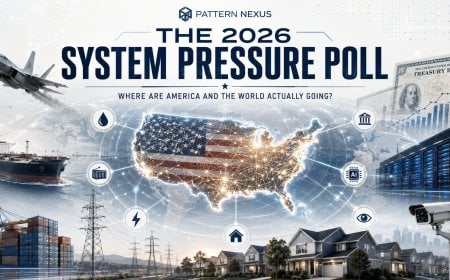 Poll · related
The 2026 System Pressure Poll: Where Are America and the World Actually Going?
This is not another left-versus-right approval poll. The Pattern Nexus System Pressure Poll examines the deeper structures shaping current events: war, energy, shipping corridors, debt, interest rates, tariffs, artificial intelligence, surveillance, housing, automation, institutional trust, and the emerging global order. The daily headlines are downstream. The objective is to identify which systems people believe are actually driving events—and where those systems are taking the United States and the rest of the world.
Published Jul 24, 2026 Article · related
The System Repriced in 30 Days: Dual Chokepoints, Tariff Inflation, AI Cash Burn, and the Return of the War Economy
In thirty days, the operating assumptions underneath the global system changed. Two maritime chokepoints came under pressure, the United States expanded war financing and rebuilt its tariff architecture, inflation moved back upstream, long-term yields repriced, AI infrastructure crossed into cash-burn territory, strategic minerals became permissioned leverage, and political command structures began cracking. This Pattern Nexus analysis maps those events as one connected system rather than separate headlines.
Published Jul 24, 2026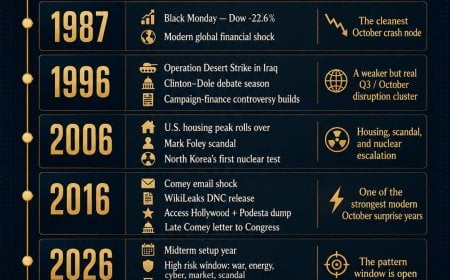 Article · related
The Sixes Are Never Good: Q3, October Surprises, and the Pattern Window Opening in 2026
The number is not the mechanism. The window is. Across 1976, 1987, 1996, 2006, and 2016, major shocks kept clustering around Q3 and October: currency pressure, regime transition, market crashes, military strikes, housing rollover, political scandal, nuclear escalation, cyber leaks, and election-season institutional stress. This Pattern Nexus research piece maps the “sixes are never good” pattern as a late-cycle stress window, then applies the same framework to the open 2026 midterm year.
Published Jun 6, 2026 Video · related
Pattern Nexus Framework: How to See the Hidden Architecture of the Modern World
Pattern Nexus is not just a news site, market blog, or opinion page. It is a framework for reading the modern world as a layered system of liquidity, energy, infrastructure, incentives, control rails, technology, markets, and human behavior. This article explains the Pattern Nexus lens, why it matters, how to use it, and where to begin if you are new to the site.
Published May 29, 2026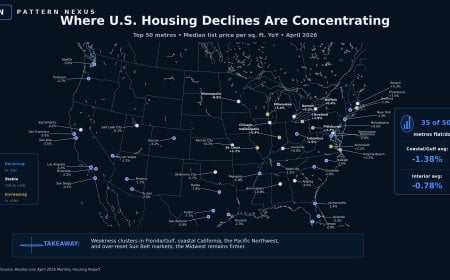 Article · related
The Coastal Housing Repricing Map: Where the U.S. Housing Plateau Is Starting to Crack
The U.S. housing market is not crashing everywhere. It is repricing where the affordability stack broke first: coastal price towers, insurance-stressed Florida and Gulf markets, high-rate West Coast metros, and over-reset Sun Belt cities where sellers are finally forced to meet buyers where they are. Realtor.com’s April 2026 top-50 metro data shows 35 of 50 major metros flat or down on median list price per square foot. Case-Shiller confirms the same slowdown through repeat-sales data. Pattern Nexus called this structure months ago: not a clean 2008-style collapse, but a fragmented housing plateau where geography, rates, insurance, taxes, liquidity, and cash-flow math decide which markets hold and which markets reprice.
Published May 26, 2026 Article · related
2026 Landlord Outlook: Cautious Optimism, Multifamily Strength, and the New Housing Map
A Pattern Nexus breakdown of Innago’s 2026 landlord survey showing cautious optimism, portfolio expansion plans, multifamily dominance, Midwest and South rotation, and rising AI adoption in rental ownership.
Published Mar 11, 2026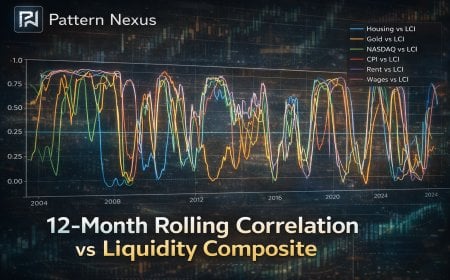 Article · related
The Plumbing Update (2003–2025) Q4 2025 + Jan 26
A full rebuild of the Pattern Nexus liquidity framework using end-of-month data, z-scores, and a PCA composite (WALCL, TGA, RRP, M2). If you want to understand housing, gold, and tech, stop arguing CPI and start watching the pipes.
Published Feb 27, 2026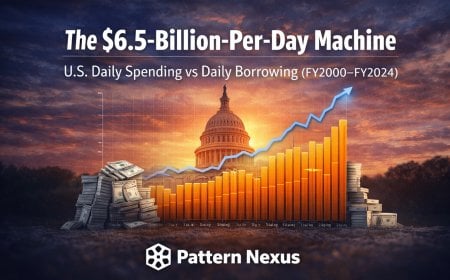 Article · related
The $X-Billion-Per-Day Machine: U.S. Daily Spending vs Daily Borrowing (FY2000–FY2024)
A Pattern Nexus structural read of U.S. federal average daily outlays versus average daily deficit financing since 2000 — and why persistent daily borrowing shows up in groceries, housing, metals, and equity valuations.
Published Feb 11, 2026 Article · related
The World We Woke Up In: January 2026 and the End of Shared Reality
Ten days into 2026, narrative and reality have decoupled. This briefing maps the structural signals—energy repricing, state-corporate capital steering, agentic AI + robotics, and job-market decoupling—and explains why societies bifurcate when they fail to adapt.
Published Jan 10, 2026 Article · related
Housing Is the Target: The 2026 Mortgage-Rate Compression Play
Trump’s directive for Fannie and Freddie to buy $200B in mortgage bonds, alongside a still-easing rate backdrop, signals an explicit attempt to compress mortgage spreads and support housing. This framework maps the plumbing, the limits, and what would have to break for home prices to stop grinding higher.
Published Jan 8, 2026 Article · related
Housing QE by Proxy: How Weaponizing Fannie and Freddie’s Buffers Turns the GSEs into Political Liquidity Machines
Floating the idea of using Fannie Mae and Freddie Mac’s capital buffers to buy mortgages is more than a housing tweak. It’s an attempt to run QE through the GSEs instead of the Fed, turning housing finance into a political liquidity machine and removing the crash pad when the cycle turns.
Published Jan 8, 2026 Article · related
The Wall Street Single-Family Ban: The Action, the Housing Math, and Where the Ownership Actually Sits
Trump says he will ban large institutional investors from buying single-family homes. Here’s the real housing inventory math, what share institutions actually control, where the concentration sits, and what would need to change for affordability to move.
Published Jan 7, 2026 Article · related
Pending Home Sales Confirm the Hard-Asset Rotation — Not a Housing “Surprise”
November pending home sales rose 3.3% month over month and 2.6% year over year, confirming a liquidity-driven rotation within hard assets. This analysis explains why housing strength can coincide with gold and silver weakness, and why “housing is overvalued” misunderstands credit, currency, and easing dynamics.
Published Dec 29, 2025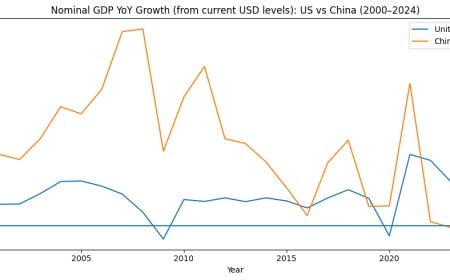 Article · related
Scale Is Destiny: Why China Didn’t Pass the U.S. — and Why That Matters
A data-driven breakdown of U.S. versus China economic growth from 2000–2024, showing why China failed to overtake the United States despite years of projections. Using GDP levels, growth rates, and scale mathematics, this report explains how demographics, housing collapse, trade regimes, and financial infrastructure reshaped the outcome — and why marginal U.S. growth now moves the global system.
Published Dec 24, 2025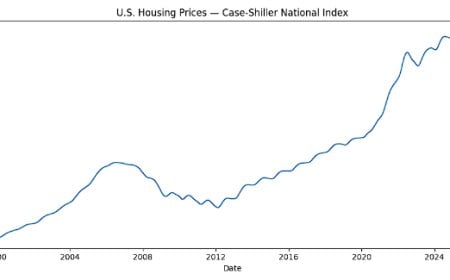 Article · related
Gold Didn’t Just Reprice — It Quietly Cut Housing in Half
Gold’s 2025 repricing didn’t happen in isolation. Measured in gold, U.S. housing has quietly lost 40–50% of its value without a nominal crash. This article breaks down the hard-asset divergence, why it can’t persist, and how housing may reprice despite poor affordability.
Published Dec 22, 2025 Article · related
The Leverage Stack: Collateral, Credit, and Control (2008–2030)
A Pattern Nexus system map of leverage from households to the Fed. How collateral, funding, maturity, and liquidity couple together across consumers, business, corporations, housing, markets, government, and the shadow system—why leverage is power, and why liquidity is the constraint (2008–2030).
Published Dec 14, 2025 Article · related
The Housing Collateral Engine: How Shadow Banking, China, and the Fed Turned Mortgages Into Global Money (2001–2008)
After the dot-com crash, the world didn’t deleverage — it rewired. Between 2001 and 2008, China’s WTO entry, Asian reserve accumulation, low Fed rates, and an explosive securitization boom turned U.S. housing into the core collateral engine of the global dollar system. When that engine failed, shadow banking imploded and central banks crossed the Rubicon into unlimited liquidity.
Published Dec 6, 2025 Article · related
Half-Century Mortgages and Fantasy Car Loans: How Ultra-Long Debt Turns Households Into Cashflow Collateral
The Trump administration’s 50-year mortgage proposal, paired with viral rumors of 15-year car loans, is being sold as “affordability.” In reality, ultra-long debt structures double the interest burden, trap low-income households in lifetime payments, and weaponize credit against an already fragile workforce.
Published Dec 5, 2025 Article · related
NAR’s 2026 Housing Boom Fantasy: Why a 14% Rebound Requires a Liquidity Intervention
The National Association of Realtors is projecting a 14% rebound in existing-home sales for 2026 — but their forecast depends on a fragile monetary backdrop, a controlled collapse in mortgage rates, and a hidden liquidity intervention. This Pattern Nexus deep dive breaks down the real mechanics behind the “housing comeback” narrative.
Published Dec 1, 2025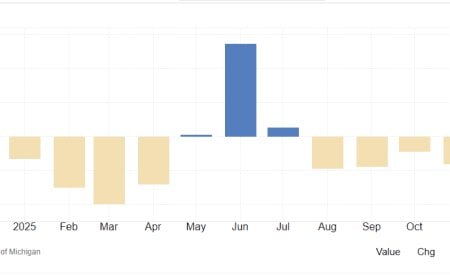 Article · related
Morning Macro Report: Confidence Falls, Housing Cools, Inflation Splits, and Labor Weakens
morning-macro-report-confidence-housing-inflation-labor-2025-11-25
Published Nov 25, 2025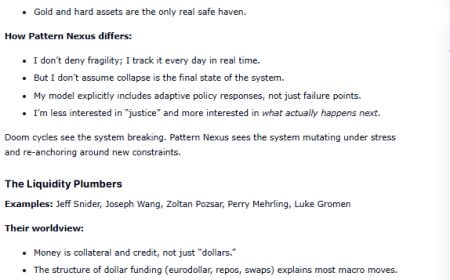 Article · related
Why Pattern Nexus Exists: The Missing Lens for Macro, AI, and Markets
Pattern Nexus isn’t just another macro or real-estate blog. It’s a systems-level lens that links AI, power, liquidity, housing, and geopolitics into one machine. This longform explains why there’s “no one else like this on the internet,” how it differs from names like Schiff, Colombo, Pozsar, Dalio, Balaji, Zeihan, and more, and how to use this framework to navigate the 2020s.
Published Nov 20, 2025 Article · related
QE 2026, AI, and the Cost of Everything: Why Your Life Is Getting More Expensive
A deep, plain-language breakdown of how QE, fiscal policy, and the rising AI-industrial build-out are quietly pushing up the cost of housing, cars, power, and everyday life — and why prices never come back down even when inflation cools.
Published Nov 19, 2025 Article · related
The Quiet Crisis: Rising Foreclosures, Falling Rents, and the Stress Building Beneath the U.S. Housing Market
Foreclosures are quietly rising, rents are softening, and household budgets are breaking. A deep Pattern Nexus analysis of October 2025 foreclosure data, tenant stress, and the Great Housing Plateau.
Published Nov 17, 2025