

Inflation
Automatically indexed from the existing article tag.
Theses, forecasts, models, and paths
No published research objects yet
This topic is ready for editors to connect a thesis, forecast, model, or research path.
Latest articles
 Article · related
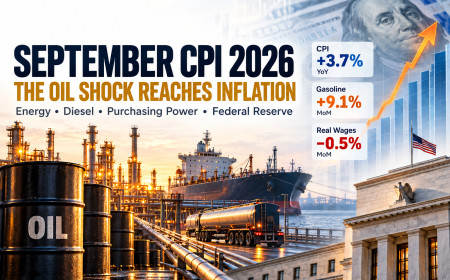
September CPI: Inflation Is Running Hot—and the Oil Work Explains Why
September CPI rose 0.6% for the month and 3.7% over the year, with gasoline responsible for more than half the monthly increase. I connect the report to the earlier Pattern Nexus oil, inventory, diesel and fertilizer research, explain the damage to real wages, and update the Fed and liquidity sequence.
Published Oct 15, 2026 Video · related
The Fiscal-Monetary Fusion — Audio-Video Edition
Episode 9 of the weekly Pattern Nexus audio-video series turns Part 9 of Cycles of Power into a shorter story about how pandemic stimulus fused fiscal and monetary policy, inflation forced a violent rate reversal, bank stress produced a new collateral-protection template, and sanctions, AI infrastructure, stablecoins, and tokenized Treasuries transformed liquidity into both operating system and geopolitical weapon between 2020 and 2025.
Published Oct 5, 2026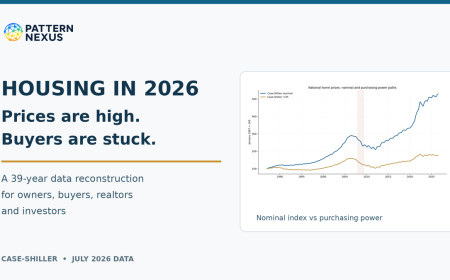 Video · related
Housing in 2026: Prices Are High, but the Market Is Barely Moving
The July Case-Shiller index reached another nominal high, but inflation, financing costs and weak sales tell a different story for the marginal buyer. Pattern Nexus reconstructs national prices from 1987, tests pre-2008 and 2019 inventory baselines, separates vacant homes for sale from rental vacancies, compares a 2019 and 2026 purchase payment, checks credit and construction, maps metro divergence and scores earlier PN housing claims. Includes 18 original charts and a practical guide for housing stakeholders.
Published Sep 30, 2026 Article · related
Goolsbee Turns AI Data Centers Into a Fed Reaction-Function Test
Chicago Fed President Austan Goolsbee said on September 21, 2026 that policymakers should watch whether AI data-center construction is spilling beyond its sector and pushing aggregate output above capacity. The significance is not that the Fed is targeting AI, but that AI capex is now being discussed as a possible demand shock with implications for inflation and interest-rate policy.
Published Sep 21, 2026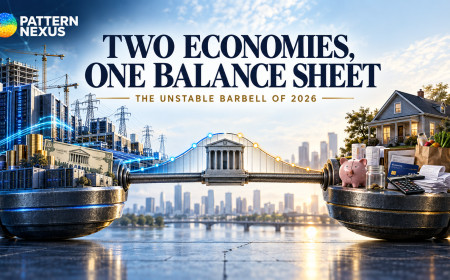 Article · related
Two Economies, One Balance Sheet: The Unstable Barbell of 2026
Reserve support has returned, but real long rates, fiscal supply, and an AI-energy capital wave are splitting the U.S. economy between capital strength and household fragility. This data-rich Pattern Nexus report maps the four feedback loops connecting Federal Reserve plumbing, Treasury duration, fiscal interest, housing lock-in, household credit, labor churn, AI infrastructure, power demand, dollar rails, and gold. It closes with four scenarios, a public-call audit, and a 90-day trigger dashboard.
Published Sep 9, 2026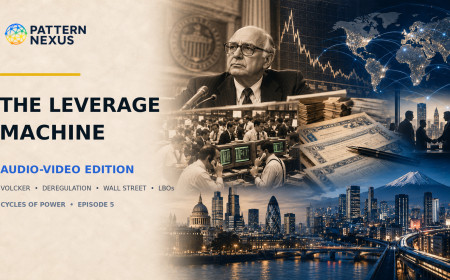 Video · related
The Leverage Machine — Audio-Video Edition
Episode 5 of the weekly Pattern Nexus audio-video series turns Part 5 of Cycles of Power into a shorter story about how the Volcker shock, Reagan–Thatcher deregulation, market-based credit, junk bonds, leveraged buyouts, securitization, derivatives, and electronic finance made leverage the central growth engine between 1979 and 1994.
Published Sep 7, 2026 Article · related
Warsh Turns Jackson Hole Into a Rate-Hike Liquidity Shock
Kevin Warsh’s Jackson Hole speech gave markets a hawkish Fed signal, with AP reporting a jump in the two-year Treasury yield after the remarks. Warsh tied the policy debate to persistent inflation, strong AI-related investment, and a less guidance-heavy central bank communication regime. Pattern Nexus reads the speech as a liquidity-regime shift: inflation credibility now sits above market comfort.
Published Aug 28, 2026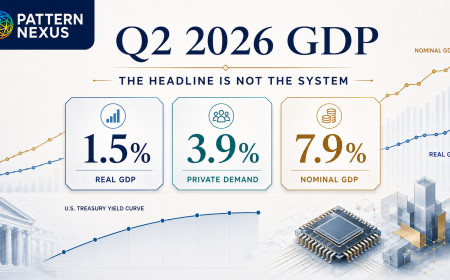 Article · related
GDP Slowed to 1.5%—But the U.S. Economy Did Not Weaken the Way the Headline Implies
Real GDP slowed to a 1.5% annual rate in Q2 2026, but the private domestic economy accelerated to 3.9% while nominal GDP grew 7.9%. This Pattern Nexus analysis separates the headline from the internal economy and explains what consumer spending, business investment, capital-goods imports, inflation, government accounting, Federal Reserve policy, and the 10-year Treasury signal actually mean.
Published Aug 4, 2026 Article · related
The Oil Inventory War Machine: How Long the Global Buffer Can Hold
A full Pattern Nexus reconstruction of U.S. and global oil inventories from the 1970s through the 2026 war shock, including original regressions, depletion scenarios, strategic reserves, refinery constraints, inflation, growth, rates and the path forward. Meta keywords: oil inventory, global oil stocks, U.S. crude inventories, Strategic Petroleum Reserve, SPR, Strait of Hormuz, Iran war, oil shock, petroleum products, diesel inventories, refinery capacity, inflation, CPI, recession, Treasury yields, liquidity, war economy, energy security, Pattern Nexus
Published Aug 2, 2026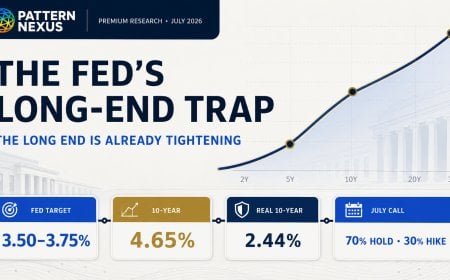 Article · related
The Fed’s Long-End Trap: Why a 4.65% 10-Year Is Already Doing the Tightening
A full July 2026 data reconstruction of the Federal Reserve’s next policy path, showing how a 4.65% nominal 10-year, 2.44% real 10-year, Treasury supply, oil risk and uneven liquidity conditions create a hawkish-hold trap.
Published Jul 27, 2026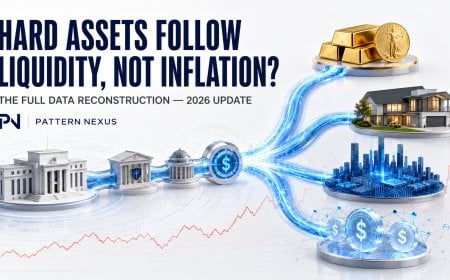 Article · related
Hard Assets Follow Liquidity, Not Inflation? The Full Data Reconstruction — 2026 Update
A 2003–2026 reconstruction of Fed liquidity, gold, housing and NASDAQ data, plus an experimental stablecoin-augmented liquidity index. Meta tags: liquidity conditions index, hard assets, gold, Federal Reserve balance sheet, Treasury General Account, reverse repo, M2, stablecoins, tokenized Treasuries, housing, NASDAQ, PCA
Published Jul 26, 2026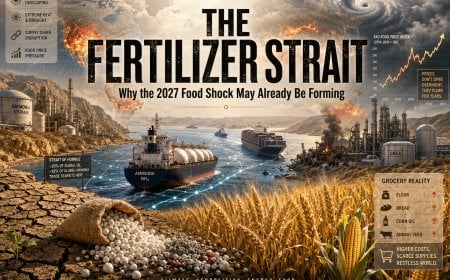 Article · related
The Fertilizer Strait: Why the 2027 Food Shock May Already Be Forming
Fertilizer prices, Persian Gulf disruption, a potentially historic El Niño, expanding drought risks, weak currencies, and fragile food-import systems are converging ahead of the 2027 growing cycle. This extended Pattern Nexus analysis examines more than 50 years of population, grain production, fertilizer, energy, climate, inventory, and food-price data to determine whether the world is approaching another major food-inflation and political-instability cycle.
Published Jul 24, 2026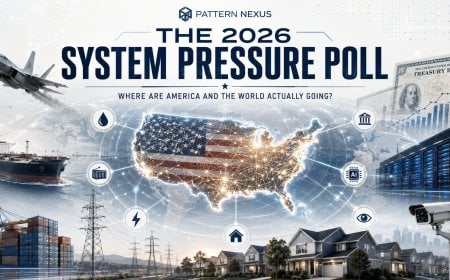 Poll · related
The 2026 System Pressure Poll: Where Are America and the World Actually Going?
This is not another left-versus-right approval poll. The Pattern Nexus System Pressure Poll examines the deeper structures shaping current events: war, energy, shipping corridors, debt, interest rates, tariffs, artificial intelligence, surveillance, housing, automation, institutional trust, and the emerging global order. The daily headlines are downstream. The objective is to identify which systems people believe are actually driving events—and where those systems are taking the United States and the rest of the world.
Published Jul 24, 2026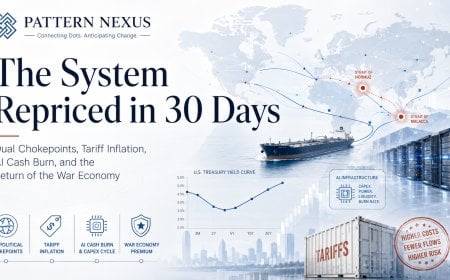 Article · related
The System Repriced in 30 Days: Dual Chokepoints, Tariff Inflation, AI Cash Burn, and the Return of the War Economy
In thirty days, the operating assumptions underneath the global system changed. Two maritime chokepoints came under pressure, the United States expanded war financing and rebuilt its tariff architecture, inflation moved back upstream, long-term yields repriced, AI infrastructure crossed into cash-burn territory, strategic minerals became permissioned leverage, and political command structures began cracking. This Pattern Nexus analysis maps those events as one connected system rather than separate headlines.
Published Jul 24, 2026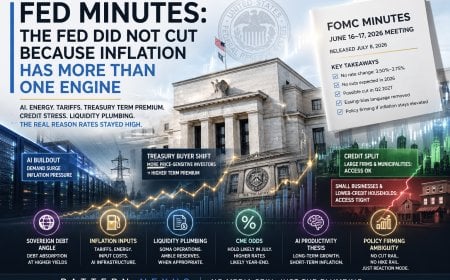 Article · related
Fed Minutes: The Cut Trade Broke Because Inflation Has More Than One Engine
The June 16–17 FOMC minutes, released July 8, show a Fed that held rates steady but removed the easy easing bias. The deeper signal is that inflation pressure is now coming from multiple rails at once: tariffs, Middle East energy shock risk, AI infrastructure demand, Treasury term premium, and uneven consumer credit stress.
Published Jul 8, 2026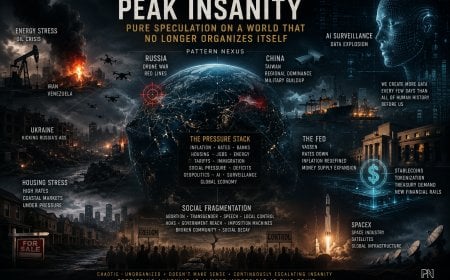 Article · related
Peak Insanity: Pure Speculation on a World That No Longer Organizes Itself
This is not a prediction article. It is not a clean thesis. It is a speculative Pattern Nexus thought-run through the pressure stack building across 2026: Venezuela, Iran, oil, banks, inflation, rates, Russia, Ukraine, China, AI, energy, surveillance, social fragmentation, and the possibility that the modern world has entered a period where the pattern itself is chaotic escalation.
Published Jun 19, 2026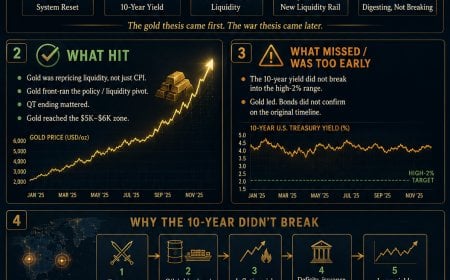 Article · related
Gold Was Right. The 10-Year Was Early. The War Premium Changed the Rate Path.
The original Pattern Nexus gold call hit the structural move: gold was not just trading inflation, it was repricing liquidity, policy failure, and the collateral stack. The miss was the 10-year yield. It did not break into the high-2% range because two wars changed the inflation, oil, shipping, deficit, and term-premium path after the gold call was already made.
Published Jun 14, 2026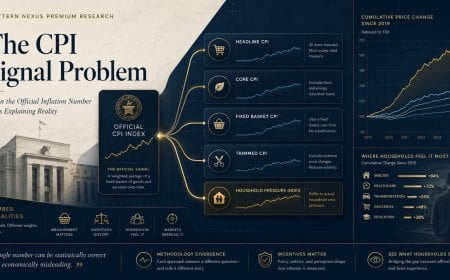 Article · related
The CPI Signal Problem: When the Official Inflation Number Stops Explaining Reality
A Pattern Nexus data analysis audit using official BLS CPI data from 1960 through April 2026 to compare headline inflation against fixed-basket, current-method, and trimmed-basket frameworks.
Published Jun 10, 2026 Article · related
The Oil Cushion Is Breaking: Hormuz, Inventories, and the Liquidity Shock Hiding Inside Energy
Oil Crisis, Strait of Hormuz, Hormuz, Energy Shock, Inflation, Brent Crude, WTI Crude, Strategic Petroleum Reserve, SPR, Oil Inventories, Global Oil Supply, Gasoline Prices, Diesel Prices, Refining, Crack Spreads, Federal Reserve, Liquidity, Recession Risk, Macro, Geopolitics, Pattern Nexus
Published Jun 1, 2026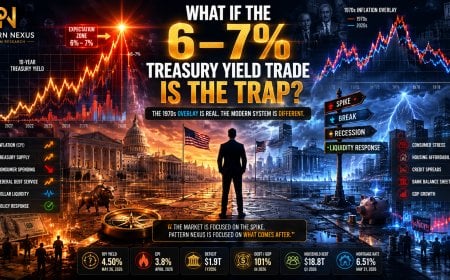 Article · related
What If the 6–7% Treasury Yield Trade Is the Trap?
A lot of smart money is starting to position for a 1970s-style inflation repeat where the 10-year Treasury yield spikes toward 6% or 7%. The chart overlay looks convincing. Inflation today can be lined up against the 1970s if the data is shifted and framed the right way. But Pattern Nexus looks at the system constraint, not just the chart. The question is not whether yields can spike. They can. The question is whether the modern economy, the federal refinancing structure, the consumer balance sheet, and the dollar-based global liquidity system can actually survive a sustained 6–7% long-rate environment. This article argues that the more dangerous trade may be the obvious one: expecting the 1970s to repeat cleanly when the system may instead force a spike, break, recession, emergency response, and renewed liquidity cycle.
Published May 27, 2026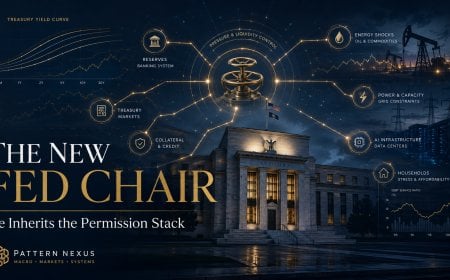 Article · related
The New Fed Chair Does Not Inherit an Economy. He Inherits the Permission Stack.
Kevin Warsh is not simply inheriting the Federal Reserve. He is inheriting the control layer where inflation, debt service, Treasury funding, energy shocks, AI infrastructure demand, repo plumbing, collateral stress, political pressure, and liquidity permission all collide. The public will debate whether the new Fed chair cuts, hikes, pauses, or changes the balance sheet. That is the surface story. The deeper Pattern Nexus story is that the Fed chair is now the public face of the permission stack. He helps decide where credit flows, where pain lands, which markets get oxygen, which sectors get squeezed, and what kind of crisis or cover event makes the next liquidity intervention politically acceptable. This is not a normal Fed transition. It is the next chapter in the liquidity-cover framework.
Published May 18, 2026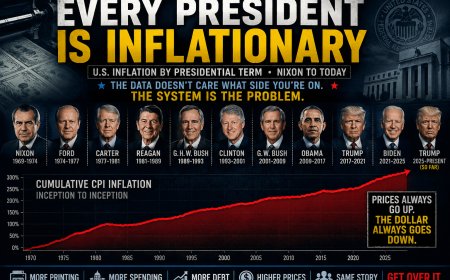 Article · related
Every President Is Inflationary: The Inflation Chart Both Parties Do Not Want to Read
A Pattern Nexus breakdown of U.S. inflation by presidential term from Nixon to today, showing why the argument over which party “caused inflation” misses the deeper system. Every modern president has governed inside an inflationary debt-based dollar structure. Some periods were worse than others, but the larger pattern is not partisan. It is monetary, fiscal, energy-driven, debt-driven, and structural.
Published May 15, 2026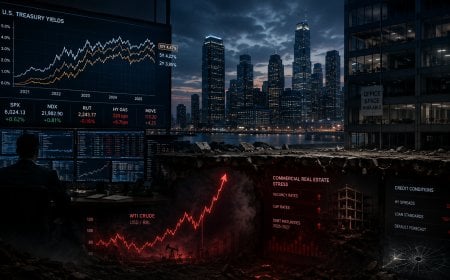 Article · related
Interest Rates, Recession, and the Current Environment
A Pattern Nexus deep research analysis on interest rates, recession risk, energy-led inflation, commercial real estate stress, private credit, AI labor pressure, and why the current environment feels like 2006 without being a direct replay of 2008.
Published May 5, 2026 Article · related
Why I’ve Been Quiet
A Pattern Nexus analysis of Iran, markets, inflation, control structures, labor softness, AI disruption, and the broader geopolitical and economic pressure building beneath the surface.
Published Apr 11, 2026 Article · related
March Ends With the System Showing Its Seams
A Pattern Nexus end-of-March 2026 master analysis on Hormuz, oil repricing, liquidity stress, inflation pressure, AI infrastructure, Moon Base acceleration, sovereignty, domestic pass-through, and why the system is showing its architecture again.
Published Mar 31, 2026 Article · related
2026 Food Price Outlook: Supply Chains Stabilize, Consumers Still Feel the Pinch
Grocery inflation cools to 2.5% in 2026, while dining out rises 3.7%. We examine what categories are driving food prices, how supply chains are healing, and why energy, labor and AI matter.
Published Feb 27, 2026 Article · related
AI Data Centers Are an Inflation Engine: The Race to Build a Private Grid
AI isn’t just a software story anymore. It’s a power story—capacity, interconnect queues, local resistance, and a new wave of private generation that quietly rewires inflation and industrial policy.
Published Feb 17, 2026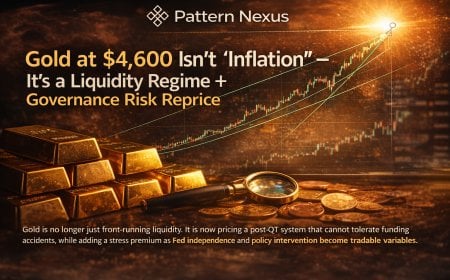 Article · related
Gold at $4,600 Isn’t “Inflation” — It’s a Liquidity Regime + Governance Risk Reprice
Open the published research article.
Published Jan 12, 2026 Article · related
The Liquidity-Gated Economy: Why Central Banks Control Flow, Not Prosperity
A structural framework explaining modern economies as liquidity-gated systems where central banks regulate monetary flow between upstream credit creation and downstream prices, assets, and inflation.
Published Dec 30, 2025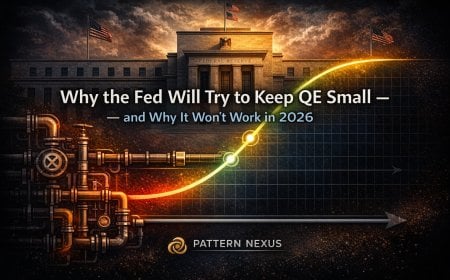 Article · related
Why the Fed Will Try to Keep QE Small — and Why It Won’t Work in 2026
The Fed will try to keep QE “light” in 2026 to protect inflation credibility and avoid backlash. But modern market plumbing is nonlinear: undersized liquidity fails fast, forcing escalation into real QE.
Published Dec 27, 2025