

Iran war
Automatically indexed from the existing article tag.
Theses, forecasts, models, and paths
No published research objects yet
This topic is ready for editors to connect a thesis, forecast, model, or research path.
Latest articles
 Article · related
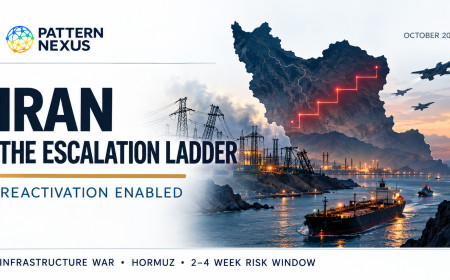
Iran: Escalation Ladder — Reactivation Enabled
The Iran escalation ladder is active again. I examine the October strike risk, the infrastructure-war danger, rising tanker attacks alongside recovering exports, the Gulf defense response, financial isolation, current oil inventories and the Federal Reserve’s position. My working window is October 22–November 5. The article connects the latest evidence to the Pattern Nexus research trail from January through October.
Published Oct 8, 2026 Article · related
Washington Turns a Third Carrier Into an Iran-War Escalation Option
The United States is dispatching the USS Theodore Roosevelt carrier strike group and the Makin Island amphibious ready group toward the Middle East, according to multiple reports citing U.S. officials. The deployment could briefly put three U.S. aircraft carriers in the region, depending on timing, as President Donald Trump weighs further pressure or renewed strikes against Iran. The strategic signal is not just military: it lands in an energy system already strained by Hormuz disruption, low distillate inventories, and elevated oil-price risk.
Published Oct 2, 2026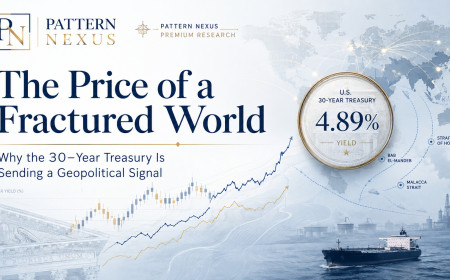 Article · related
The Price of a Fractured World: Why the 30-Year Treasury Is Sending a Geopolitical Signal
Something about the global system feels uncomfortable, and the last month of data suggests that feeling has a measurable foundation. The U.S. 30-year Treasury has pushed above 5.3%, real long-term yields are above 3%, the Strait of Hormuz remains severely constrained, U.S. missile inventories are being consumed across multiple theaters, Russia and Ukraine are attacking the commercial infrastructure of the Black Sea, China continues pressure around Taiwan and the South China Sea, new regional defense blocs are forming, tariffs are fragmenting trade, and governments and AI companies are simultaneously competing for enormous amounts of capital. This Pattern Nexus investigation asks whether the long end of the Treasury market is becoming one of the cleanest aggregate prices of a more fragmented world—and separates that thesis from the much weaker claim that the Treasury market itself is failing.
Published Aug 18, 2026 Article · related
Washington Turns the Jones Act Waiver Into an Iran-War Fuel Bypass
President Trump extended a Jones Act waiver for another 90 days, with the new window taking effect on August 17, 2026, after the prior waiver period expired on August 16. The waiver allows foreign-flagged vessels to move covered energy and agricultural commodities between U.S. ports as the Iran war and Strait of Hormuz disruption keep pressure on fuel logistics. The policy is now a live energy-security workaround, but maritime-state lawmakers and domestic shipping advocates warn it could weaken the U.S.-flag fleet and shipbuilding base.
Published Aug 17, 2026 Article · related
The Lincoln Trap: 265+ Days Deployed, an Indefinite Iran War, and a Carrier Gap in the Pacific
USS Abraham Lincoln was supposed to return home in May. More than 265 deployment days later, the Navy is pulling USS George Washington—the only forward-deployed U.S. carrier in the Pacific—west to relieve it. The rotation exposes the real limit of American carrier readiness: eleven hulls do not equal eleven available carriers, and an open-ended Iran mission is transferring the readiness gap from the Middle East to the Pacific.
Published Aug 14, 2026 Article · related
Iran Turns America’s Missile Stockpile Into a Two-Theater Deterrence Gap
Fresh reporting and defense analysis point to a widening U.S. magazine-depth problem. The Iran war has drawn heavily on long-range strike weapons and missile-defense interceptors, while replacement timelines for Tomahawk, THAAD and Patriot stocks are measured in years, not weeks. The strategic risk is that Russia and China do not need classified inventory data if they can observe which theaters are being stripped and how slowly the U.S. reloads.
Published Aug 8, 2026 Article · related
The Fertilizer Strait: Why the 2027 Food Shock May Already Be Forming
Fertilizer prices, Persian Gulf disruption, a potentially historic El Niño, expanding drought risks, weak currencies, and fragile food-import systems are converging ahead of the 2027 growing cycle. This extended Pattern Nexus analysis examines more than 50 years of population, grain production, fertilizer, energy, climate, inventory, and food-price data to determine whether the world is approaching another major food-inflation and political-instability cycle.
Published Jul 24, 2026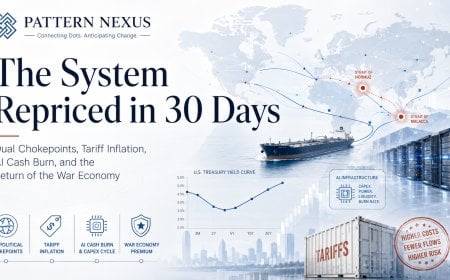 Article · related
The System Repriced in 30 Days: Dual Chokepoints, Tariff Inflation, AI Cash Burn, and the Return of the War Economy
In thirty days, the operating assumptions underneath the global system changed. Two maritime chokepoints came under pressure, the United States expanded war financing and rebuilt its tariff architecture, inflation moved back upstream, long-term yields repriced, AI infrastructure crossed into cash-burn territory, strategic minerals became permissioned leverage, and political command structures began cracking. This Pattern Nexus analysis maps those events as one connected system rather than separate headlines.
Published Jul 24, 2026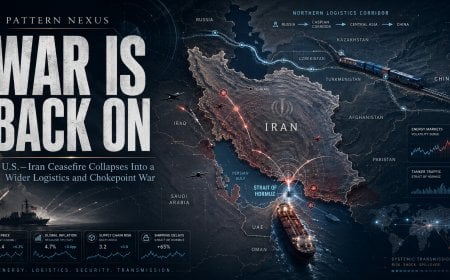 Article · related
War Is Back On: The U.S.–Iran Ceasefire Has Collapsed Into a Wider Logistics and Chokepoint War
The United States is striking Iranian military, port, power, transportation, and logistics infrastructure. Iran is retaliating against the American Gulf basing network. Israel is ready to reenter. The conflict is evolving from a Hormuz chokepoint war into a wider campaign over Iran’s maritime and Eurasian connections.
Published Jul 9, 2026