

Market Cycles
Automatically indexed from the existing article tag.
Theses, forecasts, models, and paths
No published research objects yet
This topic is ready for editors to connect a thesis, forecast, model, or research path.
Latest articles
 Article · related
The Sun, Money and the Global Core: What Survived a 375-Year Test
I rebuilt the solar-recession thesis around the dominant global financial core instead of a modern U.S. sample: Amsterdam and the guilder, London and sterling, then New York and the dollar. Across 375 years, the data reveal a narrow combined turning-year anomaly and a strange six-year lead. The deeper pass separates minima from maxima, tests six contraction thresholds and shock exclusions, reconstructs 54 reserve handoffs, deletes every historical block and contraction event, and adds lagged liquidity-interaction models. The effect is not a solar-minimum law, disappears for severe contractions, concentrates in 1850–1899, and does not validate through crops, famine or liquidity interactions. Solar timing may overlay a vulnerable system. Liquidity remains the engine.
Published Aug 17, 2026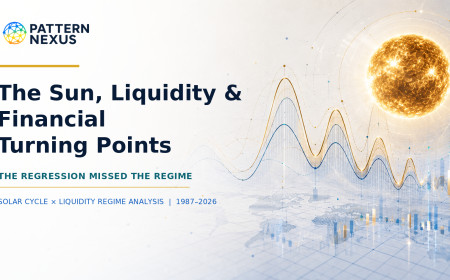 Article · related
The Sun, Liquidity, and Financial Turning Points: The Regression Missed the Regime
A corrected Pattern Nexus analysis of solar cycles, liquidity, recessions, and financial tops from January 1987 through July 2026. The first monthly regression rejected a short-horizon trading signal. The properly specified regime test found that all four U.S. recession onsets in the sample occurred within twelve months of an official solar maximum or minimum, recession months were sharply concentrated around those extrema, and M2 growth was faster on official solar rising legs.
Published Aug 10, 2026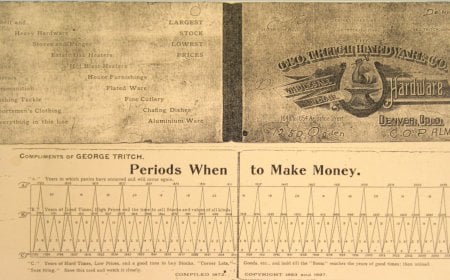 Article · related
Why a 150-Year-Old Market Chart Still Haunts Modern Finance
A deep Pattern Nexus breakdown of Samuel Benner’s 19th-century market cycle chart and why it still aligns with modern financial stress windows. This article explains the mechanics behind the “2026 crash chart,” why it appears accurate, what it gets wrong, and how to use it correctly as a risk-regime lens rather than a prediction tool.
Published Dec 21, 2025 Article · related
The Next Recession: What Outperforms and Why (2026–2030 Analysis)
A deep institutional analysis of how the next recession will unfold, what sectors historically outperform, and how AI industrialization and tokenized rails shape 2026–2030.
Published Nov 10, 2025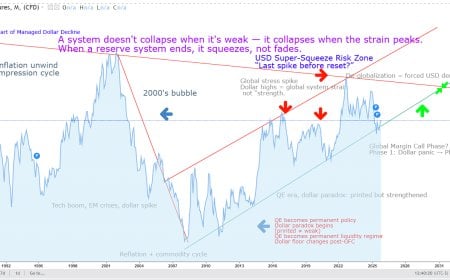 Article · related
The Dollar’s Last Stand: Why the System Squeezes Before It Breaks
The dollar doesn’t collapse when it’s weak — it spikes under maximum strain. This is the final squeeze phase of the global monetary system before transition. When reserve systems end, they don’t fade — they compress, surge, and then reset. Inside: charts, cycle mechanics, and how this ties into gold, housing, QE, sovereign debt, and de-globalization.
Published Nov 4, 2025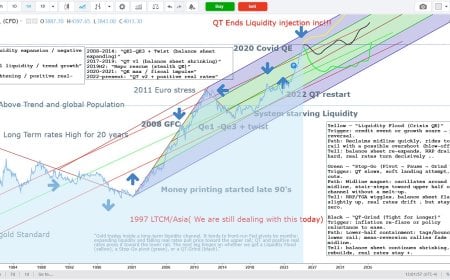 Article · related
Gold Didn’t Moon — It Front-Ran Liquidity (Again)
Gold didn’t spike randomly — it front-ran liquidity, real-rate pivots, and QT stress exactly like we’ve been discussing. Here’s the long-term channel, why it happened, and the three paths forward as the Fed hits its next liquidity decision point.
Published Nov 1, 2025