

repo
Automatically indexed from the existing article tag.
Theses, forecasts, models, and paths
No published research objects yet
This topic is ready for editors to connect a thesis, forecast, model, or research path.
Latest articles
 Video · related
The Housing Collateral Engine — Audio-Video Edition
Episode 7 of the weekly Pattern Nexus audio-video series turns Part 7 of Cycles of Power into a shorter story about how China's WTO entry, global reserve recycling, low interest rates, mortgage securitization, repo funding, derivatives, and shadow banking transformed American housing into the central collateral engine of the global dollar system between 2001 and 2008.
Published Sep 19, 2026 Article · related
QE 2026, Phase Two: When the Long End Forces Duration Control
The Fed already ended QT and expanded Treasury holdings through bill-focused reserve-management purchases, but that repaired the reserve layer without suppressing the long end. With the 10-year Treasury at 4.95%, the 30-year at 5.37%, real long yields near the Pattern Nexus red zone, Treasury doubling long-end buybacks, and August CPI limiting conventional easing, this report calculates the probability that QE 2026 moves into a second phase. It maps the likely program, the names it may use, the dates when it could expand, and the exact yield, reserve, auction, repo, leverage, and credit conditions that could force direct duration absorption.
Published Sep 11, 2026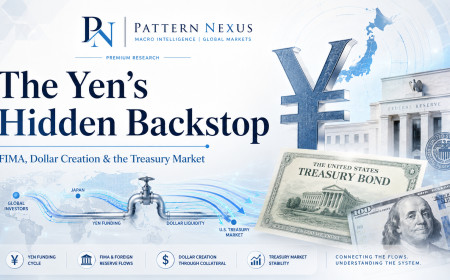 Article · related
The Yen's Hidden Backstop: FIMA, Dollar Creation and the Treasury Market
Japan's 2026 yen intervention was enormous, but Federal Reserve balance-sheet data show FIMA was not used to fund it. That may be the more important finding. FIMA sits behind the global dollar system as a mechanism allowing approved foreign monetary authorities to temporarily turn U.S. Treasury collateral into newly supplied dollars instead of selling those Treasuries into the market. This report examines what FIMA actually does, why it is a form of temporary central-bank dollar creation rather than QE, what Japan's reserve structure looks like, and why another serious yen crisis could migrate directly into U.S. Treasury-market plumbing.
Published Aug 19, 2026 Article · related
Wall Street Turns Stablecoin Reserves Into a Money-Market Collateral Stack
Fidelity has entered the stablecoin-reserve business with a money-market vehicle designed around GENIUS Act-eligible assets, according to SEC filings and Fidelity’s institutional fund table. The move follows State Street’s June 16 launch of a similar GENIUS Act-aligned government money-market fund, with State Street Bank and Anchorage Digital named as initial investors. The signal is that stablecoin backing is migrating from crypto balance sheets into traditional cash-management infrastructure controlled by large asset managers, banks, and federally regulated crypto institutions.
Published Jun 19, 2026 Article · related
The New Fed Chair Does Not Inherit an Economy. He Inherits the Permission Stack.
Kevin Warsh is not simply inheriting the Federal Reserve. He is inheriting the control layer where inflation, debt service, Treasury funding, energy shocks, AI infrastructure demand, repo plumbing, collateral stress, political pressure, and liquidity permission all collide. The public will debate whether the new Fed chair cuts, hikes, pauses, or changes the balance sheet. That is the surface story. The deeper Pattern Nexus story is that the Fed chair is now the public face of the permission stack. He helps decide where credit flows, where pain lands, which markets get oxygen, which sectors get squeezed, and what kind of crisis or cover event makes the next liquidity intervention politically acceptable. This is not a normal Fed transition. It is the next chapter in the liquidity-cover framework.
Published May 18, 2026 Article · related
The Headline Is Late: How Pattern Nexus Mapped the Chokepoint War Before Hormuz Became Visible
The Iran-Hormuz crisis did not create the Pattern Nexus framework. It exposed it. For months, Pattern Nexus had already been mapping the deeper system beneath the headlines: liquidity plumbing, QT, reverse repo, QE 2026, AI power demand, stablecoin rails, Treasury collateral, Western Hemisphere force posture, energy chokepoints, China’s routing vulnerability, and the shift from globalization to permission. This long-form analysis uses the video transcript as an alignment test, then ties it back into the Pattern Nexus archive to show the real timeline: the headline arrived late because the structure moved first.
Published May 7, 2026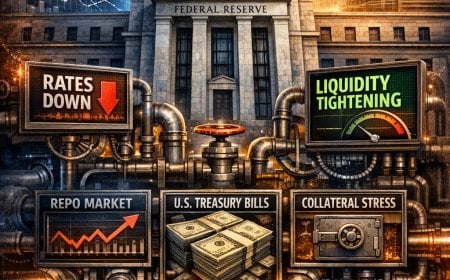 Article · related
Warsh’s Fed and the Balance-Sheet War: Why “Rates Down” Can Still Mean “Liquidity Tight”
A Pattern Nexus systems read on the incoming Fed regime debate: floor vs corridor, repo backstops, Treasury supply, and why the balance sheet is the real rate.
Published Feb 17, 2026 Trivia Quiz · related
Do You Understand Bank Reserves — or Just the Headline Version?
Most people think banks lend deposits. That’s not how the system works. Test your understanding of reserves, collateral, and Grade-A assets.
Published Jan 4, 2026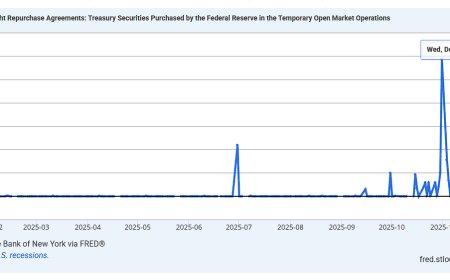 Article · related
Repo Usage Is Expanding Again
Overnight repo operations have shifted from dormant to persistent over the past several weeks. This article documents the expansion in repo usage, what it signals about short-term funding conditions, and what to watch next — without overinterpretation.
Published Jan 2, 2026 Article · related
Repo Is Back: Late-2025 Looks Like Late-2019
Open the published research article.
Published Dec 29, 2025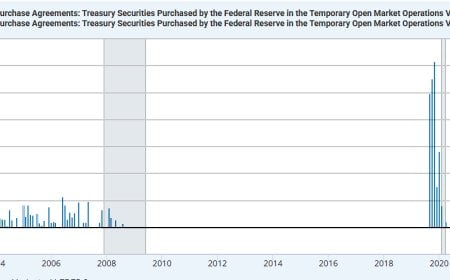 Article · related
The 10-Year Treasury Pattern and the Return of Repo Operations
The 10-Year Treasury has repeatedly stalled near long-cycle resistance while overnight repo operations have quietly returned after QT. This analysis examines how funding markets, balance-sheet capacity, and rate control interact beneath headline narratives.
Published Dec 29, 2025 Article · related
Why the Fed Will Try to Keep QE Small — and Why It Won’t Work in 2026
The Fed will try to keep QE “light” in 2026 to protect inflation credibility and avoid backlash. But modern market plumbing is nonlinear: undersized liquidity fails fast, forcing escalation into real QE.
Published Dec 27, 2025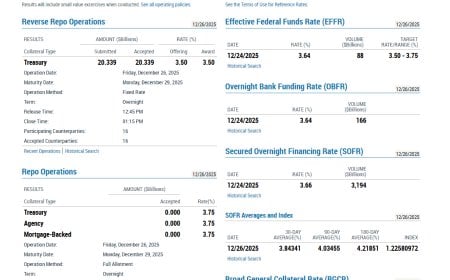 Article · related
Orderly Stress: Why Repo Stability Is Masking Deeper Collateral Strain
Repo markets remain orderly even as settlement fails and benchmark collateral strain emerge. This analysis explains why stable SOFR, modest ON RRP and MBS repo usage, and limited Fed operations can coexist with deeper stress in collateral mobility and dealer balance sheets.
Published Dec 26, 2025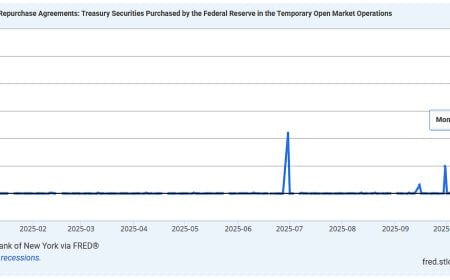 Article · related
The Day QT Died and QE Began: December 1, 2025 — The Quiet Restart of the Liquidity Engine
QT officially ended on December 1, 2025 — but the real story happened in the plumbing. With the RRP buffer nearly gone, SOFR volumes exploding, and the Standing Repo Facility pulling in Treasuries, agencies, and MBS, the Fed quietly shifted from balance-sheet tightening to balance-sheet backfilling. This was the moment the liquidity regime flipped.
Published Dec 2, 2025 Article · related
QT Ends, Liquidity Returns: Why 2026 Is Almost Certainly the Next Balance-Sheet Expansion Cycle
Quantitative Tightening ends December 1st, and the plumbing shows reserves are already near scarcity. This article explains why 2026 is shaping up to be the next major liquidity-injection cycle, driven by heavy Treasury issuance, reserve demand, and Fed policy shifts.
Published Nov 25, 2025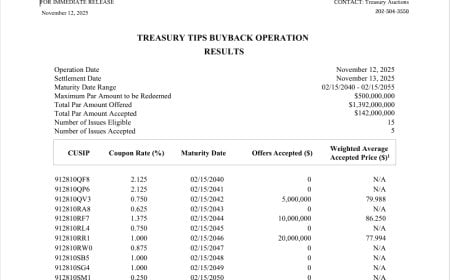 Article · related
Treasury Retires $142 Million in TIPS — Quiet Confirmation of the Buyback Era
The U.S. Treasury retired $142 million in TIPS on Nov 12, 2025 — a direct confirmation of the buyback-driven liquidity cycle we've been tracking. Here’s what the operation reveals about collateral stress, pre-QE interventions, and the evolving monetary plumbing.
Published Nov 12, 2025 Article · related
The Hidden Liquidity Crunch: Repo Stress, QT’s End, and the Dollar’s Trap
A systems-level map of the liquidity squeeze beneath the dollar: repo stress, falling reserves, structural deficits, and the QT halt—why the next policy turn likely means balance-sheet expansion, inflation risk, and a distributional regime shift.
Published Nov 12, 2025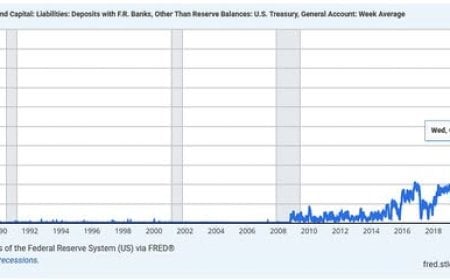 Article · related
The Silent War-Chest: Why the Fed & Treasury Are Hoarding Cash — And Preparing to Control Yields
Overnight repo usage jumps. The TGA surges toward $1T. Washington isn’t “saving.” It’s loading ammunition — to defend the bond market and seize control of yields when disorder hits.
Published Nov 5, 2025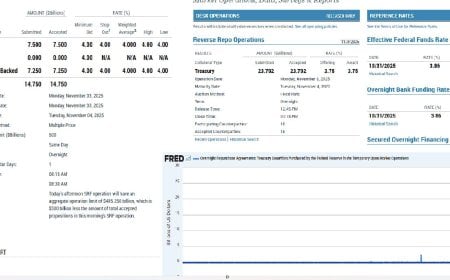 Article · related
The Quiet Repo Surge: $14.75B SRF Tap + $30B Liquidity Pulse Signals the New Regime
In three trading days, the Fed silently pushed nearly $45B through the repo window — including a $14.75B SRF tap and a ~$30B overnight repo spike. This wasn’t panic. It was collateral lubrication for America’s reindustrialization cycle — compute, power, copper, grid. The new liquidity regime is here.
Published Nov 3, 2025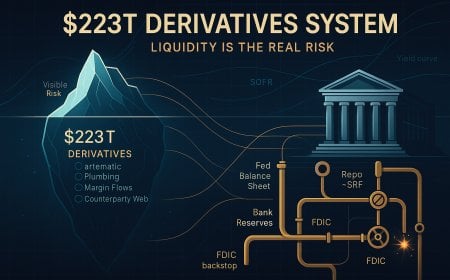 Article · related
$223T Derivatives System: The Hidden Liquidity Fragility Beneath U.S. Banking
The U.S. banking system sits on top of $223 trillion in derivatives — but the real risk isn’t the notional value. It’s liquidity. This deep-dive breaks down how margin calls, collateral chains, FDIC limits, repo plumbing, and Federal Reserve backstops tie together — and why liquidity shocks, not headlines, trigger systemic stress. Includes beginner-friendly breakdowns, research links, historical case studies, and charts.
Published Nov 2, 2025 Article · related
The Reverse Repo Trap: How the Fed Quietly Controls Liquidity & Markets
A deep dive into the Federal Reserve’s overnight reverse repo facility — why trillions parked at the Fed aren't “normal,” how it secretly tightens liquidity, affects Treasury auctions, impacts markets, and signals systemic fragility. Everyone sees the headlines — few see the plumbing.
Published Oct 31, 2025 Article · related
The Calm Before the Liquidity Storm
After Powell’s quiet remarks in Philadelphia about ending Quantitative Tightening (QT), subtle tremors are building across the repo and collateral markets. The system is whispering before it screams — and all signs suggest the next liquidity cycle is approaching.
Published Oct 18, 2025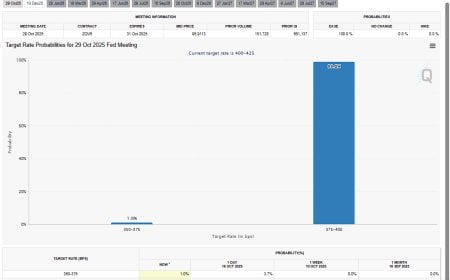 Article · related
Fed’s October Pivot: Liquidity Cycles, History, and the Digital Dollar Frontier
Markets now expect another 25 bps rate cut at the Fed’s Oct 28–29 meeting as unemployment rises and repo-market strains flicker. Powell signaled QT’s end is “coming into view,” Waller endorsed another cut, and Musalem said he could support one if inflation risks stay contained. This post connects those signals to the longer liquidity cycle and to where the next easing wave is headed: tokenized Treasuries, stablecoins, and programmable liquidity.
Published Oct 18, 2025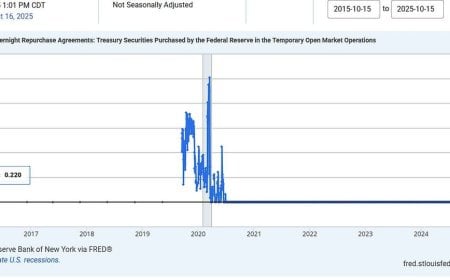 Article · related
The Calm Before the Liquidity Storm: QE 2026 and the Digital Evolution of Money
Federal Reserve Chair Jerome Powell’s recent comments on ending Quantitative Tightening signal that the liquidity cycle is turning again. With repo market stress quietly building, QE 2026 may arrive sooner than most expect. This time, the easing won’t just involve printed dollars — it will merge with the rise of tokenized assets, digital Treasuries, and programmable money.
Published Oct 17, 2025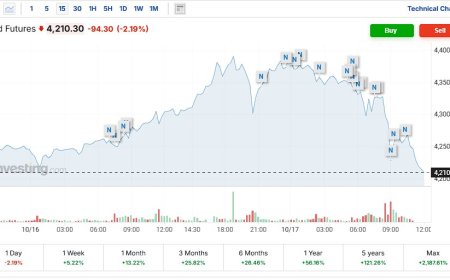 Article · related
Gold’s Rough Day Doesn’t Change the Bigger Picture: A Natural Correction in a Structural Bull Market
Gold is pulling back to $4,210 after its record-breaking rally above $4,400, but this retracement is part of the natural rhythm of the market. Behind the short-term volatility, the long-term structural forces driving gold higher — liquidity stress, repo tightening, QE speculation, and collateral repricing — remain firmly intact.
Published Oct 17, 2025 Article · related
The Liquidity Crunch Nobody’s Talking About: How Repo Stress, Bank Failures, and a “False Surplus” Are Fueling Gold’s Breakout
A hidden liquidity crisis is forming under the surface of global markets. Repo markets are flashing stress, regional banks are reporting fraud-related losses, and gold is breaking all-time highs. This analysis connects the dots — showing how the system is quietly rebalancing through emergency liquidity, fiscal illusion, and a global flight to hard collateral.
Published Oct 17, 2025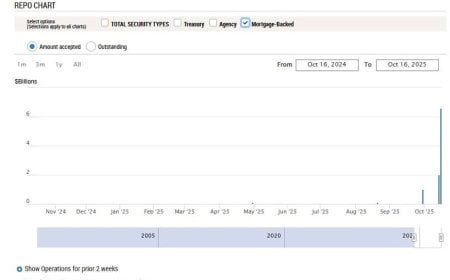 Article · related
🚨 The Fed Just Tapped the MBS Repo Valve — Why That Matters More Than People Think
The Federal Reserve quietly conducted nearly $9 billion in mortgage-backed repo operations after months of inactivity — signaling early liquidity strain in U.S. funding markets. Historically, this is how quantitative easing begins: the Fed provides collateral support before publicly announcing policy shifts. This article examines the data, the 2019 precedent, the QE connection, and what it could mean for 2026.
Published Oct 17, 2025