

reserve currency
Automatically indexed from the existing article tag.
Theses, forecasts, models, and paths
No published research objects yet
This topic is ready for editors to connect a thesis, forecast, model, or research path.
Latest articles
 Video · related
The Monetary Break — Audio-Video Edition
Episode 4 of the weekly Pattern Nexus audio-video series turns Part 4 of Cycles of Power into a shorter story about how silver redemption, the Nixon Shock, floating currencies, Eurodollars, oil shocks, petrodollar recycling, and offshore banking transformed the gold-linked dollar fortress into a global dollar web between 1968 and 1979.
Published Aug 30, 2026 Article · related
The Sun, Money and the Global Core: What Survived a 375-Year Test
I rebuilt the solar-recession thesis around the dominant global financial core instead of a modern U.S. sample: Amsterdam and the guilder, London and sterling, then New York and the dollar. Across 375 years, the data reveal a narrow combined turning-year anomaly and a strange six-year lead. The deeper pass separates minima from maxima, tests six contraction thresholds and shock exclusions, reconstructs 54 reserve handoffs, deletes every historical block and contraction event, and adds lagged liquidity-interaction models. The effect is not a solar-minimum law, disappears for severe contractions, concentrates in 1850–1899, and does not validate through crops, famine or liquidity interactions. Solar timing may overlay a vulnerable system. Liquidity remains the engine.
Published Aug 17, 2026 Video · related
The Dollar Fortress — Audio-Video Edition
Episode 2 of the Pattern Nexus Audio-Video series explains how Bretton Woods, the Marshall Plan, capital controls, the IMF, the World Bank, and the 1951 Treasury–Federal Reserve Accord forged the first dollar-liquidity regime between 1947 and 1953.
Published Aug 16, 2026 Article · related
The Dollar Fortress: How Bretton Woods, the Marshall Plan, and the 1951 Accord Forged the First Dollar Liquidity Regime (1947–1953)
After World War II, the Bretton Woods system, the Marshall Plan, and the 1951 Treasury–Fed Accord fused into a single architecture: the dollar anchored to gold, capital controls, and state-directed credit. Between 1947 and 1953, this “Dollar Fortress” quietly set the rules of global liquidity that still shape markets today.
Published Dec 2, 2025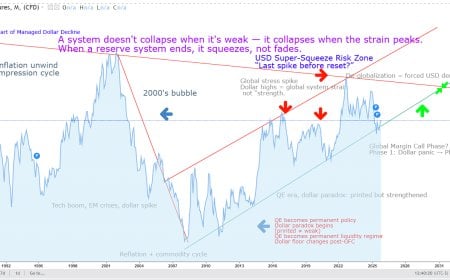 Article · related
The Dollar’s Last Stand: Why the System Squeezes Before It Breaks
The dollar doesn’t collapse when it’s weak — it spikes under maximum strain. This is the final squeeze phase of the global monetary system before transition. When reserve systems end, they don’t fade — they compress, surge, and then reset. Inside: charts, cycle mechanics, and how this ties into gold, housing, QE, sovereign debt, and de-globalization.
Published Nov 4, 2025