

You’re offline. Open downloads
U.S.-China technology competition
Automatically classified from article content.
Theses, forecasts, models, and paths
No published research objects yet
This topic is ready for editors to connect a thesis, forecast, model, or research path.
Latest articles
 Article · related
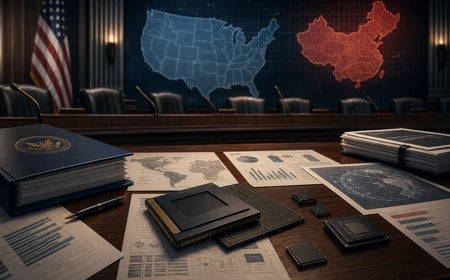
Washington Turns 879,000 AI-Chip Licenses Into a China-Controls Credibility Test
House Foreign Affairs Committee Chairman Brian Mast released export-control license information on November 19, 2026, saying Chinese buyers sought 3.4 million Nvidia and AMD AI chips and that the Bureau of Industry and Security approved more than 879,000. Reuters, SCMP and Anadolu reported the disclosure while noting that approvals do not necessarily prove completed shipments. The episode sharpens a core U.S.-China technology question: whether export controls can credibly restrict the AI compute layer when commercial incentives and national-security controls collide.
Published Nov 19, 2026 Article · related
Washington Turns Chinese Optical Transceivers Into an AI Data-Center Supply-Chain Test
Reuters reported on November 17, 2026, that the Trump administration plans to continue efforts to block imports of Chinese data-center equipment, including optical transceivers, despite opposition from Amazon, Google, Meta, CoreWeave, Cisco and Microsoft. The dispute is backed by an August ITI filing urging the FCC not to add optical transceivers broadly to the Covered List and a September bipartisan Senate bill targeting Chinese optical transceivers in sensitive federal systems. The strategic question is whether Washington can harden the AI data-center stack without constraining the infrastructure race it is trying to win.
Published Nov 17, 2026 Article · related
Beijing Turns a Trump-Xi-Putin Summit Into a Nuclear-Order Reset Test
China’s foreign ministry says Xi Jinping will hold a China-Russia-U.S. summit with Vladimir Putin and Donald Trump in Shenzhen on November 19. AP, AFP and CNA reporting frame the meeting as an unprecedented three-way encounter among the leaders of the largest nuclear powers, with nuclear stockpiles, Iran and broader strategic tensions expected to shape the agenda. The summit’s importance is less a likely breakthrough than the operating model it may preview: a compact leader-level channel where security, technology and regional wars are bargained together.
Published Nov 15, 2026Join Pattern Nexus for premium research, the archive, and ad-free reading.