

United States
Automatically indexed from the existing article tag.
Theses, forecasts, models, and paths
No published research objects yet
This topic is ready for editors to connect a thesis, forecast, model, or research path.
Latest articles
 Article · related
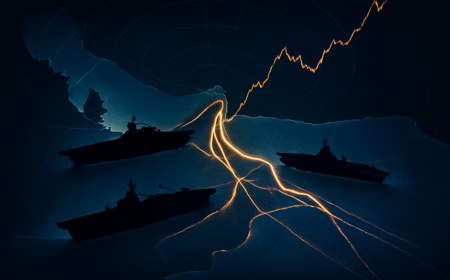
Washington Turns a Third Carrier Into an Iran-War Escalation Option
The United States is dispatching the USS Theodore Roosevelt carrier strike group and the Makin Island amphibious ready group toward the Middle East, according to multiple reports citing U.S. officials. The deployment could briefly put three U.S. aircraft carriers in the region, depending on timing, as President Donald Trump weighs further pressure or renewed strikes against Iran. The strategic signal is not just military: it lands in an energy system already strained by Hormuz disruption, low distillate inventories, and elevated oil-price risk.
Published Oct 2, 2026 Article · related
Tehran Turns Hormuz Reopening Into a Seven-Day Energy-Security Bargain
Iranian Foreign Minister Abbas Araghchi says Tehran has sent Washington a seven-day roadmap through Qatar that would reopen the Strait of Hormuz and restart nuclear talks if U.S. conditions are met. AP, Al Jazeera, Reuters and The National reporting indicate the offer is tightly conditional, contains no near-term Iranian nuclear concession and is now colliding with Western efforts to build parallel maritime-security pressure at the UN.
Published Sep 26, 2026 Article · related
One System, Many Flags: Ukraine, Iran, North Korea and the Illusion of Separate Wars
The United States can arm Ukraine while temporarily easing pressure on Russian oil, convert stockpile transfers into new procurement, court North Korea while Pyongyang supplies Russia, and fight Iran while Russia and China-linked systems help Tehran. The contradictions resolve when the wars are mapped as one connected system of energy, munitions, intelligence, shipping, sanctions and leverage.
Published Aug 22, 2026 Poll · related
The 2026 System Pressure Poll: Where Are America and the World Actually Going?
This is not another left-versus-right approval poll. The Pattern Nexus System Pressure Poll examines the deeper structures shaping current events: war, energy, shipping corridors, debt, interest rates, tariffs, artificial intelligence, surveillance, housing, automation, institutional trust, and the emerging global order. The daily headlines are downstream. The objective is to identify which systems people believe are actually driving events—and where those systems are taking the United States and the rest of the world.
Published Jul 24, 2026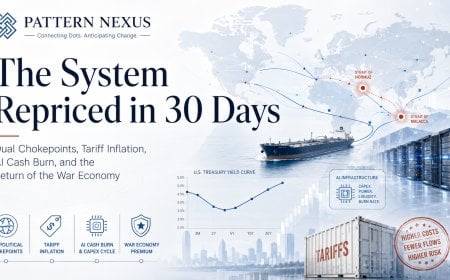 Article · related
The System Repriced in 30 Days: Dual Chokepoints, Tariff Inflation, AI Cash Burn, and the Return of the War Economy
In thirty days, the operating assumptions underneath the global system changed. Two maritime chokepoints came under pressure, the United States expanded war financing and rebuilt its tariff architecture, inflation moved back upstream, long-term yields repriced, AI infrastructure crossed into cash-burn territory, strategic minerals became permissioned leverage, and political command structures began cracking. This Pattern Nexus analysis maps those events as one connected system rather than separate headlines.
Published Jul 24, 2026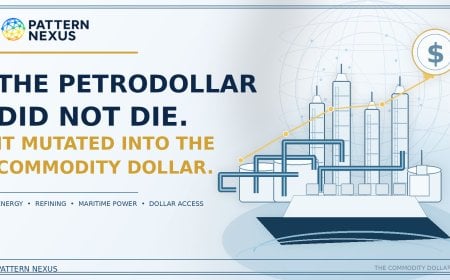 Article · related
The Petrodollar Did Not Die. It Mutated Into the Commodity Dollar
The old petrodollar was built around imported oil, dollar invoicing, military protection, and the recycling of global surpluses into American assets. The emerging commodity-dollar system is more direct: the United States produces record volumes of oil and gas, operates enormous refinery and export infrastructure, protects strategic waterways, controls critical financial rails, and can restrict access to global markets through sanctions, insurance, banking regulation, export controls, and maritime enforcement.
Published Jul 18, 2026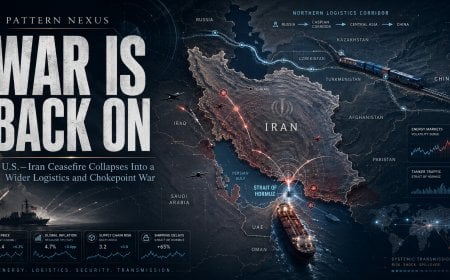 Article · related
War Is Back On: The U.S.–Iran Ceasefire Has Collapsed Into a Wider Logistics and Chokepoint War
The United States is striking Iranian military, port, power, transportation, and logistics infrastructure. Iran is retaliating against the American Gulf basing network. Israel is ready to reenter. The conflict is evolving from a Hormuz chokepoint war into a wider campaign over Iran’s maritime and Eurasian connections.
Published Jul 9, 2026 Article · related
Hormuz Ceasefire Breaks Into Direct U.S.-Iran Strike Cycle
The United States launched strikes on Iranian targets near the Strait of Hormuz after the loss of a U.S. Army Apache helicopter, while Iran reported retaliatory attacks against U.S.-linked targets in Jordan and the Gulf. AP reported that the exchange again tested a two-month ceasefire, and Reuters-linked oil coverage showed crude rising as the flare-up renewed supply-risk concerns. The strategic signal is a maritime-energy choke point turning into a repeat escalation loop.
Published Jun 10, 2026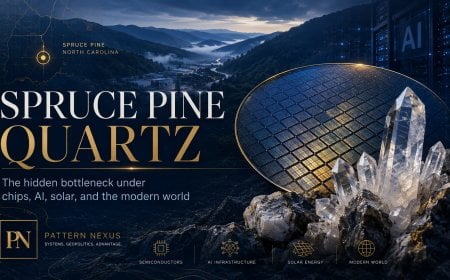 Article · related
Spruce Pine Quartz: The Hidden Bottleneck Under Chips, AI, Solar, and the Modern World
Spruce Pine, North Carolina may be one of the most strategically important locations on Earth because its high-purity quartz sits underneath silicon wafers, semiconductor manufacturing, AI infrastructure, solar panels, optical fiber, and the modern digital control layer.
Published May 17, 2026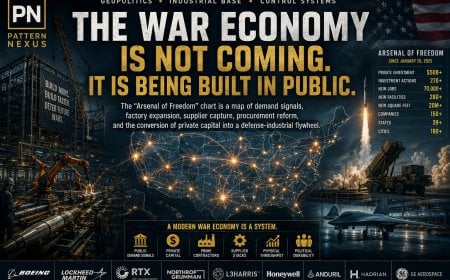 Article · related
The War Economy Is Not Coming. It Is Being Built in Public.
The Arsenal of Freedom chart is not just a defense graphic. It shows the United States shifting from peacetime procurement into a public-private war economy built around factories, missiles, suppliers, and long-term demand signals.
Published May 14, 2026 Article · related
The Nuclear Renaissance: 2026’s Drive for a 400 GW Grid and the Control Layers of Energy
In 2026 the United States announced plans to quadruple its nuclear power capacity to 400 GW by 2050, investing billions in domestic enrichment and small modular reactors. This article explores how the nuclear renaissance reshapes energy, geopolitics and control systems.
Published Mar 3, 2026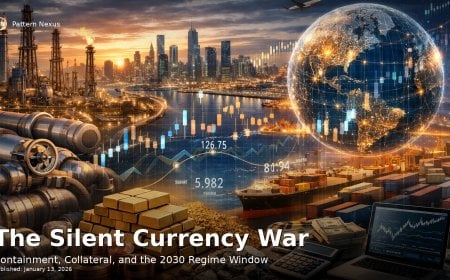 Article · related
The Silent Currency War: Containment, Collateral, and the 2030 Regime Window
The United States and China have entered a silent currency war layered on top of maritime containment, commodity dependencies, and financial plumbing. The next phase will determine whether the dollar system evolves, resets, or fragments into parallel rails.
Published Jan 13, 2026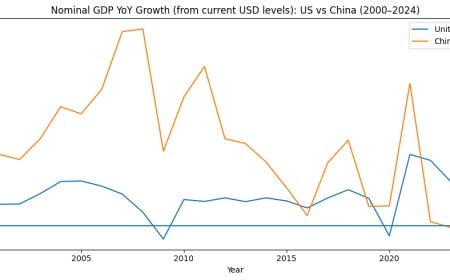 Article · related
Scale Is Destiny: Why China Didn’t Pass the U.S. — and Why That Matters
A data-driven breakdown of U.S. versus China economic growth from 2000–2024, showing why China failed to overtake the United States despite years of projections. Using GDP levels, growth rates, and scale mathematics, this report explains how demographics, housing collapse, trade regimes, and financial infrastructure reshaped the outcome — and why marginal U.S. growth now moves the global system.
Published Dec 24, 2025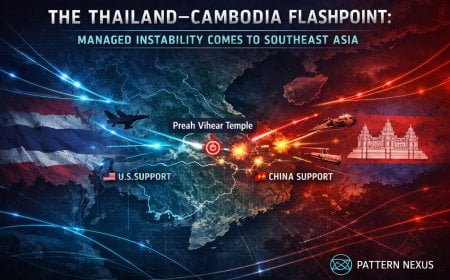 Article · related
The Thailand–Cambodia Flashpoint: Managed Instability Comes to Southeast Asia
The Thailand–Cambodia border conflict is not a local anomaly. It is a repeatable flashpoint where alliance hedging, great-power leverage, and managed instability intersect. A Pattern Nexus systems-level analysis.
Published Dec 16, 2025 Article · related
The New American Crypto Order: How Trump’s Executive Actions, Treasury Strategy, and Federal Reserve Alignment Are Rewiring the Dollar System
The United States has quietly shifted from restricting crypto to absorbing it. Trump’s Strategic Bitcoin Reserve, the Digital Asset Stockpile, the GENIUS Act, Treasury acquisition strategies, and Federal Reserve integration signal the construction of a sovereign digital asset regime designed to reinforce the Dollar Superstructure.
Published Dec 2, 2025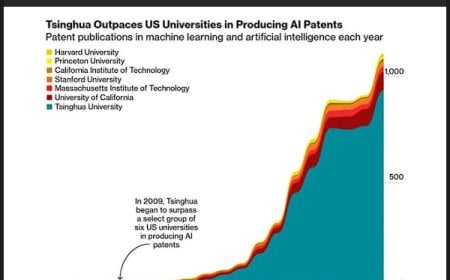 Article · related
The Patent Illusion: Why the U.S. Still Leads the AI Race (and Why That Tsinghua Chart Is Misleading)
This article breaks down why Tsinghua University’s surge in AI patents doesn’t mean China is winning the AI race. Patent charts measure universities—not compute, chips, cloud infrastructure, power, or frontier model leadership. Using real data, we explain why the U.S. still dominates the AI-industrial stack in 2025 and what pressure points actually matter.
Published Nov 20, 2025 Article · related
Domestic Theater vs. Global Projection: Why Americans Misread Geopolitics
Americans see politics through a left–right lens, but the world engages the United States as a single strategic actor. Ilhan Omar’s abroad defense of Trump—and bipartisan efforts like repealing the Patriot Act—reveal how national interest overrides partisan theater on the world stage.
Published Oct 27, 2025