
When Crime Becomes Content: The Influencer Economy and the Collapse of Social Deterrence
People are now filming themselves committing crimes, harassing strangers, faking public threats, humiliating the vulnerable, provoking foreign countries, and turning legal consequences into the next stage of the content cycle. This is not just stupidity. It is a structural failure. The attention economy has created a class of people who treat the real world like a stage, strangers like props, and punishment like branding. Jail and fines only work when people still fear shame, loss, or social exclusion. But what happens when the punishment itself becomes content?
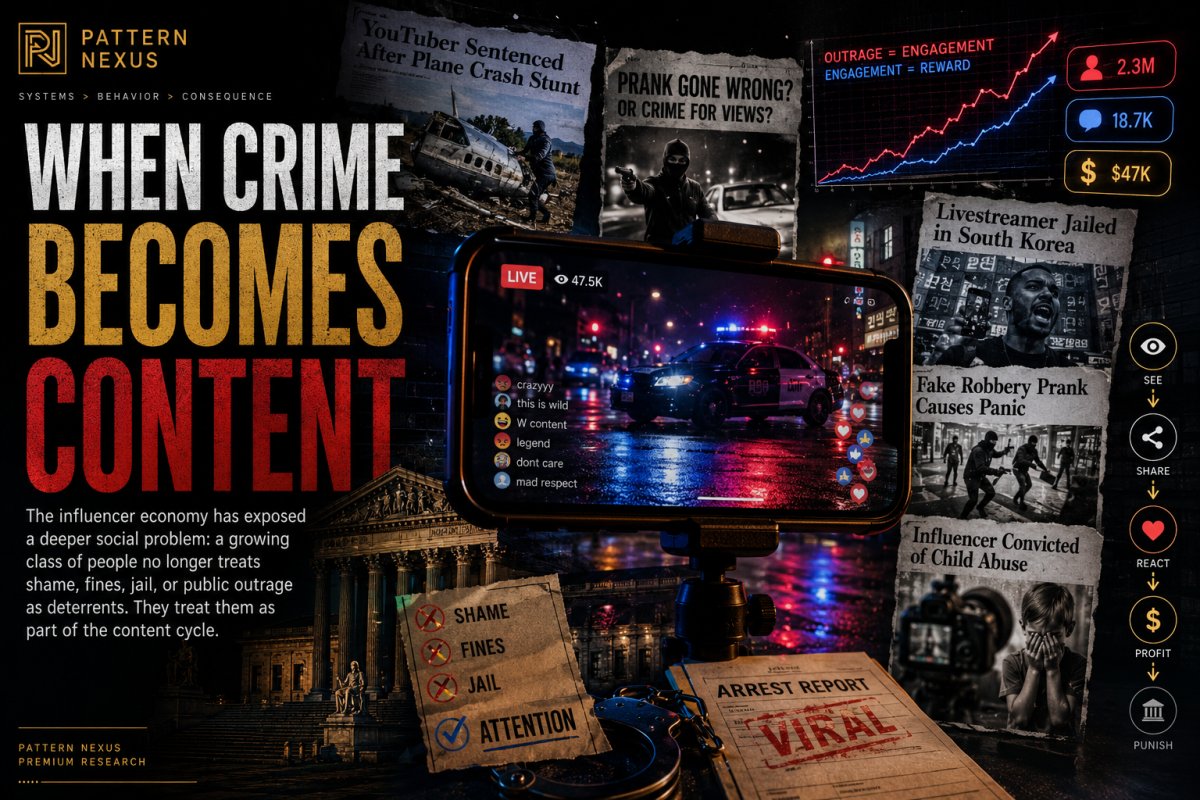
There is a specific kind of social decay that does not look like collapse at first. It looks like a prank video. It looks like a livestream. It looks like someone walking into a stranger’s home, faking a robbery, harassing people in public, crashing a plane for views, humiliating the vulnerable, or disrespecting a foreign country until the courts finally step in.
The issue is not just that some creators are stupid. The deeper issue is that modern attention systems have created a new reward structure. Crime, humiliation, public disorder, provocation, and even legal punishment can now be converted into visibility, donations, followers, sympathy, audience identity, and money.
That creates a problem because the old punishment stack assumes people still fear consequences. Fines are supposed to hurt. Jail is supposed to deter. Shame is supposed to correct behavior. But what happens when the person is not ashamed, cannot pay the fine, does not care about the fine, turns jail into branding, or uses the arrest itself as the next viral arc?
This is not a gossip article about dumb influencers. That version is too small. The larger story is that society has built a digital incentive system where antisocial behavior can be rewarded before the legal system ever has time to respond.
The creator violates a boundary. The clip spreads. The outrage expands reach. The audience turns the person into a character. Donations, followers, subscriptions, interviews, sympathy, and notoriety follow. Then the court system arrives downstream, after the attention economy has already paid out.
That is the Pattern Nexus value here: not just identifying the people who crossed the line, but mapping the system that keeps producing them. Fake robberies, hostile livestreams, deadly stunts, harassment pranks, public panic videos, family-abuse content, political influencer investigations, and online defense-fund fandom all sit inside the same larger shift.
The old social contract assumed people feared shame, loss, exclusion, fines, and jail. The new content economy can convert each of those consequences into attention. That means deterrence itself is being hacked.
Crime becoming content is not an accident.
It is what happens when the attention rail moves upstream of the punishment rail.
The platform rewards the spike first. The audience rewards the spectacle second. The monetization layer converts the spectacle into value third. The legal system arrives fourth. By then, the behavior has often already produced what it was designed to produce: attention.
That is why fines and jail do not solve the whole problem. They still matter, but they are downstream tools. They punish after the public boundary has already been turned into content.
The deeper crisis is not only criminal behavior. It is the collapse of social deterrence in a society where disgrace can be monetized.
This Is Not Just Stupidity
It is easy to look at these cases and laugh. Some of them are so absurd that the first reaction is almost involuntary. Someone crashes a plane for YouTube. Someone fills Oreos with toothpaste and gives them to a homeless man. Someone pretends to rob a bank and drags an unsuspecting Uber driver into the middle of it. Someone harasses people in another country until that country finally decides to make an example out of him.
But underneath the comedy is a much darker social signal.
These are not isolated cases of bad judgment. They are symptoms of a culture where attention has become a parallel currency, and the people chasing that currency are learning that the fastest way to get it is often to violate boundaries.
That matters because civilization depends on invisible restraint. Most people do not walk into strangers’ homes. Most people do not fake robberies in public. Most people do not harass random workers, mock memorials, terrorize crowds, abuse children for views, or create fake emergencies because there is an assumed social boundary around those behaviors.
The influencer economy breaks that boundary by inserting a camera between the person and the consequence. Once the camera is there, the act is no longer experienced as normal behavior. It becomes “content.” The victim becomes a prop. The public becomes a stage. The police become part of the storyline. The court case becomes a second season.
The camera does not merely record the collapse of restraint. It can become the excuse for the collapse.
That is the disturbing part. In many of these cases, the creator is not acting despite the camera. They are acting because of the camera. The recording device becomes a permission structure. It creates distance between the person and the real-world harm. It turns another person’s fear, confusion, humiliation, or danger into a product.
That is not just bad taste. That is a social operating system problem.
The Attention Rail Is Upstream From Punishment
The old model of public order assumes punishment comes after wrongdoing and teaches society not to repeat the behavior. But the attention economy changed the timing.
Today, the reward can arrive before the punishment.
The clip spreads before the court date. The views arrive before the sentence. The followers arrive before the fine. The donations arrive before the trial. The memes arrive before the public has processed what actually happened. The creator may be legally losing while socially winning.
That is the key systems shift.
Bad behavior produced shame, exclusion, fines, jail, and reputational damage.
Bad behavior can produce clips, reach, donations, followers, identity, and audience capture.
The legal system punished the act after society had already condemned it.
The audience can reward the act before the legal system ever reaches it.
This does not mean jail and fines no longer matter. They do. But they are no longer the only consequence rail. There is now a competing rail: attention.
And when attention becomes money, punishment becomes complicated.
If a creator can turn legal trouble into a comeback video, a martyr narrative, a subscriber surge, a documentary arc, a defense fund, a merch drop, or a new audience identity, then punishment becomes part of the content pipeline. The court may still punish the body, but the internet may reward the brand.
That is why this problem feels bigger than people doing dumb things online. The legal system is designed to punish acts. The attention system is designed to amplify signals. When the same act becomes both criminal evidence and viral signal, the systems collide.
The Content-Crime Loop
The pattern is not complicated. A creator does something mildly obnoxious. It gets attention. The audience reacts. The creator learns the formula. Then the next video has to be louder, riskier, meaner, stranger, or more illegal.
That creates a basic escalation loop.
This is where the legal system starts running into a new kind of problem. Traditional punishment assumes the person wants to avoid being publicly humiliated, arrested, fined, sued, deported, or jailed. But many creators do not experience consequence the same way normal people do. They experience it as proof that the content worked.
That is why the social decay angle matters. The issue is not just that people are committing crimes on camera. The issue is that large audiences often reward the act, defend the act, meme the act, fund the act, and then treat the legal consequence as entertainment.
The result is a public-order inversion. The behavior that should isolate the offender can instead connect them to a larger audience.
The Platform Incentive Layer
The reason this keeps happening is not mysterious. The platforms did not invent human stupidity, but they created a distribution system where stupidity can be rewarded at industrial scale.
Before social media, a person could still do something reckless, cruel, or criminal in public. The difference was that the reward structure was local. Maybe a few people laughed. Maybe the person got a reputation in the neighborhood. Maybe the police got called. The feedback loop was slower, smaller, and more attached to real-world consequence.
The platform changed the scale. A single act can now be clipped, reposted, stitched, reacted to, argued about, monetized, demonetized, remonetized somewhere else, defended by one subculture, condemned by another, and then recycled for weeks through commentary channels, livestreams, shorts, reaction videos, podcasts, and news coverage.
The platform does not need to approve of the behavior to profit from the reaction to the behavior.
That is the key. The modern feed rewards intensity. It does not care whether the emotional spike comes from admiration, disgust, fear, outrage, sympathy, hatred, or disbelief. It only sees engagement. And when engagement becomes the first filter, the system naturally selects for behavior that normal human communities used to suppress.
This is how a creator can become rational inside an irrational system. From the outside, the behavior looks insane. From inside the attention economy, it may look strategic. The creator is not always chasing approval. Often, they are chasing reaction. Approval is one route. Outrage is another. Fear is another. Hate-watching is another. The system converts all of them into signal.
That is why platform culture keeps producing the same archetype: the creator who is not funny enough to build an audience through skill, not original enough to build an audience through insight, and not disciplined enough to build an audience through quality, so they build an audience through violation.
That violation can take different forms. Public harassment. Fake crimes. Family humiliation. Dangerous stunts. Foreign-country disrespect. Livestreamed trespass. Political spectacle. Courtroom branding. The format changes, but the underlying trade is the same: break a boundary, harvest the reaction.
When Strangers Become Props
The ugliest part of this economy is not always the creator. It is the way the creator’s target gets reduced to a content function.
A homeless man becomes a reaction shot. A child becomes an emotional trigger. A worker becomes an obstacle. A stranger in a mall becomes a panic response. An Uber driver becomes collateral risk. A foreign country becomes a backdrop. Police become part of the scene. The court becomes the final episode.
That is the hidden moral collapse: the creator treats other people as raw material.
Retail clerks, security guards, delivery drivers, restaurant staff, and airport workers become involuntary actors inside someone else’s monetized performance.
Homeless people, children, elderly people, and socially isolated targets are easier to exploit because they have less power to refuse the frame.
Crowds absorb panic and disorder even when the creator later says it was fake, scripted, or “just a prank.”
Police, courts, immigration systems, and regulators are forced to clean up behavior that was produced for private attention profit.
This is why the consent issue matters. A normal film set requires consent, staging, releases, safety protocols, and controlled risk. The prank economy often bypasses all of that by using the public as unpaid, uninformed labor. The target is not just being filmed. They are being used.
Once the target reacts, that reaction becomes the product. Fear becomes content. Anger becomes content. Confusion becomes content. Humiliation becomes content. And when that content spreads, the target loses control over their own public image while the creator keeps control over the edit.
That is not harmless. That is social extraction.
Media Board: The Content Evidence Layer
The article is stronger with media because the entire point is that these incidents were not abstract. They became visible because they were filmed, broadcast, clipped, or reported as spectacle. The videos below should be treated as reference material, not entertainment. They show the same operating pattern from different angles: stunt escalation, fake crime, family exploitation, nuisance streaming, and legal consequence.
The previous embeds were too fragile because some of the source videos either had bad IDs, shorts-only links, or publisher-level embed restrictions. These replacement blocks use the same simple YouTube iframe structure as the working video at the top of the article, plus a direct fallback link under every card. If YouTube later disables embedding on a specific publisher video, the reader still gets a clean source path instead of a dead block.
Note: YouTube embeds can still fail later if the publisher disables embedding or removes a video. The direct YouTube/source link under each block prevents the article from breaking even if a video owner changes settings.
Case Files: When Content Crossed the Legal Line
The cases below are not all identical. Some involve federal obstruction. Some involve public panic. Some involve harassment. Some involve family abuse. Some involve political activism colliding with sanctions law. Some involve deadly stunts. The point is not to flatten them into one category. The point is to show how many different ways the content economy now collides with real-world law.
Robbery pranks, fake threats, public panic, and staged emergencies.
Plane crashes, fireworks, weapons, fatal experiments, and reckless spectacle.
Turning vulnerable people, children, workers, and strangers into reaction props.
Creators acting as if the platform grants immunity until courts, police, or foreign states draw the line.
Trevor Jacob: Crashing a Plane for Views
Trevor Jacob is one of the clearest examples of the content economy crossing into federal consequence. He intentionally crashed a small airplane, parachuted out, uploaded the video, then destroyed the wreckage and lied to investigators. The U.S. Department of Justice said he did it to gain online views and make money. He was sentenced to six months in federal prison for obstructing the investigation. [1]
This case matters because it shows the scale of escalation. This was not a fake argument in a store. This was aviation, a crash site, federal investigators, and a staged disaster converted into monetized content.
The deeper signal is that even a plane crash could be processed through the logic of the feed. A crash becomes a thumbnail. A federal investigation becomes a subplot. The wreckage becomes a liability only after it has served its purpose as spectacle.
ReSet: Humiliating the Vulnerable
Kanghua Ren, known online as ReSet, gave a homeless man Oreos filled with toothpaste in Barcelona and filmed it as a prank. A Spanish court sentenced him to 15 months in prison, ordered him to pay damages, and reportedly restricted his social media activity. [2]
The deeper signal here is not just cruelty. It is the conversion of another person’s vulnerability into content. The homeless man was not treated as a person. He was treated as a reaction source.
This is one of the ugliest parts of the prank economy. It often selects people who have less power to resist: workers, homeless people, children, elderly people, strangers in public, people who do not know they are part of a monetized performance. The creator gets the clip. The target gets the humiliation.
Trollstation: Fake Crime as Public Panic
The British YouTube prank collective Trollstation staged fake robberies and fake art heists in major London galleries. The stunts caused panic, with members of the public fleeing and one woman reportedly passing out. Several members were jailed. [3]
This is the public-order version of the same problem. A fake crime is not harmless when bystanders do not know it is fake. The body reacts before the explanation arrives. Panic is real even when the script was fake.
That distinction matters because prank logic is written from the creator’s point of view. The creator knows there is a camera. The public does not. The creator knows the robbery is fake. The public does not. The creator experiences the situation as content. The public experiences it as danger.
The Stokes Twins: Fake Bank Robbery Content
Alan and Alex Stokes pleaded guilty after fake bank robbery pranks in California. One of the incidents involved an unsuspecting Uber driver who was reportedly held at gunpoint by police because officers believed they were responding to a real crime. The brothers avoided jail but received probation, community service, restitution obligations, and a court order not to make similar criminal-behavior videos. [4]
This case shows how content exports risk onto people who never consented to be part of the act. The creator gets the footage. The bystander gets the gun pointed at him.
That is the moral inversion. The risk is distributed onto strangers while the reward is concentrated onto the creator. The person filming controls the frame. Everyone else has to live through the consequences of not knowing it is a bit.
Mizzy: Boundary Violation as Brand
Bacari-Bronze O’Garro, known as Mizzy, became known for public prank content that crossed into harassment and intrusion. He was later jailed for 18 weeks in a young offender institution after breaching a court order that prohibited him from sharing footage of people without consent. [5]
Mizzy matters because the pattern was not one isolated act. It was repeated boundary violation even after the system attempted a lower-level correction.
That is the deterrence problem in miniature. The court order was supposed to stop the behavior. But when the behavior itself is the brand, the order becomes part of the attention field. The creator can turn defiance, restriction, punishment, and outrage into identity.
Monalisa Perez and Pedro Ruiz: The Deadly Stunt
Monalisa Perez pleaded guilty to second-degree manslaughter after shooting Pedro Ruiz during a YouTube stunt where they believed a book would stop the bullet. Ruiz died. Perez received a 180-day jail sentence under the plea agreement, with part of the sentence served behind bars and part in home confinement. [6]
This is the tragic endpoint of content logic. The stunt needed to be extreme enough to be noticed. The risk became the hook. Reality did not care that it was supposed to be a video.
The camera does not suspend physics. It does not suspend ballistics. It does not suspend injury, trauma, death, or grief. But the attention system can make people behave as if real-world risk is secondary to the clip.
DaddyOFive / FamilyOFive: Abuse Hidden as Pranks
Michael and Heather Martin, associated with the DaddyOFive / FamilyOFive prank channels, were sentenced to five years of probation after child-neglect convictions tied to the treatment of children in their videos. YouTube later banned the FamilyOFive channels after the child-abuse conviction. [7]
This case is important because it shows how family life itself can be turned into a content mine. When the algorithm rewards conflict, humiliation, and emotional reaction, children can become unwilling performers inside an adult monetization machine.
This is not normal family conflict. This is the extraction of emotional reaction from children inside a public monetized environment. The home becomes a set. The parent becomes the producer. The child becomes the content source.
Baked Alaska: Livestreaming the Crime Scene
Anthime Gionet, known online as Baked Alaska, livestreamed from inside the U.S. Capitol during January 6 and was later sentenced to 60 days in prison. CBS reported that the judge described his history as a troubling pattern of profiting from petty crimes. [8]
This is a different category from prank content, but it belongs in the same article because the camera changes the behavior. The act is not only committed. It is performed, broadcast, archived, clipped, and monetized through identity and audience.
The livestream turns the event into a participatory signal. Viewers are not just watching after the fact. They are watching the person perform inside the moment, which can intensify the incentive to keep going.
Alex Choi: Fireworks, Helicopters, and Federal Charges
Automotive YouTuber Alex Choi, whose legal name is Suk Min Choi, was arrested in 2024 and federally charged after a video showed fireworks being shot from a helicopter at a Lamborghini. The DOJ said he was charged with causing the placement of an explosive or incendiary device on an aircraft. [9]
This is another version of escalation economics. When ordinary car content is not enough, the spectacle has to become more dangerous, more expensive, and more legally exposed.
The content economy constantly pressures creators to exceed their last signal. Cars become supercars. Supercars become helicopters. Helicopters become explosives. The stunt escalates until reality, regulation, or criminal law finally pushes back.
Timothy Wilks and Tanner Cook: When the Public Responds Before the Joke Lands
In Nashville, Timothy Wilks was shot and killed while allegedly filming a robbery prank involving butcher knives. Police said the shooter stated he did not know it was a prank and acted in self-defense. In Virginia, YouTuber Tanner Cook was shot while filming a prank at Dulles Town Center; a jury later acquitted the shooter of the main aggravated malicious wounding charge. [10]
These cases show the limit of “it was just a prank.” The target of the prank does not live inside the creator’s script. They live inside the real world, where a fake threat can be processed as a real threat before anyone has time to explain the bit.
This is where prank culture becomes physically dangerous. A creator may think he is creating a reaction. The target may think he is facing a threat. The body reacts faster than the explanation. Once fear becomes real, the content frame collapses.
Johnny Somali and the Foreign-State Boundary
Johnny Somali, whose real name is Ramsey Khalid Ismael, is one of the clearest modern examples of nuisance streaming colliding with a foreign legal system. In April 2026, a South Korean court sentenced him to six months in prison after finding him guilty of multiple charges, including obstruction of business and distributing fabricated sexually explicit content. Reporting also described public outrage over offensive stunts, including conduct around a statue commemorating wartime sex slaves. [11]
This case matters because South Korea did something the internet often does not expect: it treated the content behavior as real behavior.
It did not matter that the acts were performed for a stream. It did not matter that outrage was part of the business model. The country drew a line around public order, cultural memory, and legal authority.
The influencer assumes the world is a platform. The state reminds him the world is still jurisdictional.
That is where the Pattern Nexus angle becomes obvious. A livestream can cross borders instantly, but the body holding the phone is still standing somewhere. That somewhere has laws, courts, memory, norms, and a population that does not exist to be farmed for reactions.
There is a larger point here: many of these creators operate as if social media has created a universal permission layer. They behave as if having an audience grants them temporary immunity from local rules. Johnny Somali’s South Korea case is the correction to that illusion. The platform may reward provocation, but a foreign court does not have to.
This is also why foreign-country nuisance streaming often hits differently from domestic prank content. It is not only one person harassing another person. It can become a symbolic insult to a society’s memory, laws, and collective dignity. The streamer treats the country like a set. The country treats the streamer like a defendant.
Vitaly and the Deportation Boundary
Johnny Somali is not the only example of foreign states pushing back against nuisance-streaming logic. Vitaly Zdorovetskiy belongs in the same broader category, not because his case is identical, but because it shows another jurisdiction refusing to treat livestream harassment as harmless internet behavior.
Philippine immigration authorities announced in January 2026 that Zdorovetskiy had been deported to Russia after being declared an undesirable alien. The Philippine News Agency reported that the deportation order stemmed from complaints that he harassed and disrespected Filipinos, disrupted public peace and safety, and committed acts considered contrary to morals, good customs, and public policy. [14]
This is the same pattern in another form. The creator assumes the country is scenery. The audience assumes the stream is the primary reality. But the state reads the conduct differently. It sees public disturbance, immigration violation, harassment complaints, safety risk, and reputational insult.
A platform can make the behavior global. A border can still make the consequence local.
That is the foreign-state correction. The creator can be famous online and still removable in the real world. The stream can reach millions and still be subordinate to immigration law, criminal process, public-order rules, and the host country’s patience.
This is likely to become a larger pattern. As nuisance streamers travel across borders looking for new reaction environments, more countries will decide whether they are dealing with tourism, entertainment, harassment, or public disorder. The answer will not always come from the platform. Sometimes it will come from immigration custody, prosecution, deportation, or blacklisting.
Where Hasan Fits — and Where He Does Not
Hasan Piker should not be jammed into the same category as prank-crime YouTubers. That would be inaccurate. The recent Hasan story is not “creator commits public nuisance stunt and gets jailed.” It is a different kind of content-state collision.
Recent reporting says Hasan Piker and CodePink co-founder Medea Benjamin were subpoenaed by the U.S. Treasury Department’s Office of Foreign Assets Control as part of an inquiry into whether a Cuba aid convoy violated U.S. sanctions rules. The reporting describes a March 2026 humanitarian convoy to Cuba and a broader investigation involving multiple Americans. [12]
That belongs in this article only because it shows another side of the same age: highly visible internet personalities now operate at the edge of politics, sanctions, travel rules, activism, foreign policy, and state scrutiny.
Hasan’s case is not about prank criminality. It is about political content becoming entangled with federal enforcement rails.
The category matters. Johnny Somali is nuisance streaming and public-order collision. Trevor Jacob is aviation stunt and federal obstruction. Mizzy is harassment and court-order violation. Hasan is political-influencer visibility colliding with sanctions inquiry and state scrutiny.
That distinction matters because a serious Pattern Nexus argument cannot survive sloppy categories. The broader pattern is not “all creators are the same.” The broader pattern is that creator visibility now pushes people into contact with legal systems that were not built for attention-economy behavior.
Some collide with local police. Some collide with courts. Some collide with foreign governments. Some collide with federal agencies. Some collide with platform moderation. Some collide with payment processors, donors, and legal-defense markets. The common layer is visibility turning conduct into a system-level event.
Why Fines and Jail Are Losing Deterrent Power
The deeper problem is that society still relies on an older punishment model. That model assumes people are socially attached enough to fear disgrace, financially stable enough to fear fines, and future-oriented enough to fear jail.
But many of these cases expose a different psychology.
The creator does not always fear shame because shame becomes engagement. The creator does not always fear fines because fines become part of the brand story, or because they cannot pay anyway. The creator does not always fear jail because jail can be converted into credibility, martyrdom, sympathy, or the next content arc.
This is not just about influencers. It reflects a broader societal divide that often goes unspoken.
Some people still operate inside the old trust system. They assume reputation matters. They assume public behavior matters. They assume legal consequences are something to avoid. Other people have moved into a different incentive stack. For them, attention can outweigh reputation, legal exposure can become branding, and antisocial behavior can be rational if it produces audience growth.
A fine hurts when the person has assets, income, credit, reputation, or future stability to protect.
Jail deters when the person fears removal, shame, lost opportunity, and damaged identity.
Shame works when the person belongs to a moral community whose judgment matters.
If attention replaces reputation, punishment can be converted into brand energy.
That is where the social system starts to break. Laws can punish after the fact, but they cannot fully replace internal restraint. A healthy society does not need a police officer standing behind every person with a phone. It relies on people knowing where the line is before the court has to explain it.
Once that internal line weakens, the state has to substitute external force for social restraint. That means more arrests, more litigation, more platform bans, more criminal charges, more public disorder, more insurance cost, more security, and more general distrust.
In other words, the cost of failed restraint does not stay with the creator. It spreads across society.
Crowdfunding, Sympathy Markets, and Criminal Celebrity
The same pattern appears outside the prank world. In high-profile criminal cases, online communities can quickly form around defendants, suspects, or convicted figures. Sometimes this is framed as due process and legal-defense support. That distinction matters because every person has a right to a defense.
But the cultural problem begins when support turns into celebrity, merch, memes, romanticization, identity politics, and social belonging.
The Luigi Mangione case shows this tension clearly. Mangione, who has pleaded not guilty in multiple cases connected to the killing of UnitedHealthcare CEO Brian Thompson, has received major online support. His GiveSendGo legal defense fund has raised more than $1.5 million according to the campaign page, while GoFundMe’s terms prohibit fundraisers for the legal defense of financial and violent crimes, including murder, robbery, assault, battery, and sex crimes. [13]
This is not an argument against due process. It is an argument about what happens when the internet turns criminal accusation into fandom.
A defense fund is one thing. A cult of personality around violence, criminality, or public disorder is something else.
The danger is that online society increasingly creates sympathy markets around people who break the social contract.
Some become antiheroes. Some become memes. Some become political symbols. Some become “content.” And once that happens, punishment no longer operates cleanly. The consequence can become fuel.
This is one of the reasons the social divide feels so sharp. Many people still see criminality as disgrace. Others see it as resistance, entertainment, identity, spectacle, or proof that someone is “real.” That divide is not always stated out loud, but it shapes how people respond to arrests, shootings, riots, fraud, harassment, and public disorder.
Once criminal accusation becomes fandom, justice becomes harder to discuss. The person is no longer evaluated as a defendant, suspect, victimizer, or accused individual. They become a symbol. And symbols are much harder to punish because audiences do not experience punishment as correction. They experience it as confirmation.
The Deterrence Stack Is Breaking
Deterrence is not just jail. It is a stack.
At the bottom is internal conscience. Above that is family correction. Above that is peer pressure. Above that is community shame. Above that is employment consequence. Above that is platform consequence. Above that is civil liability. Above that is criminal punishment.
A healthy society does not need to use the top of the stack constantly because the lower layers catch most behavior early.
The problem now is that several lower layers are failing at once.
The attention economy can invert this stack. A person’s family may be embarrassed, but the audience cheers. The community may condemn them, but the platform spreads them. Employers may avoid them, but donations replace income. A fine may be imposed, but the controversy funds the next move. Jail may remove them temporarily, but the story waits for their release.
That is why “just fine them” or “just jail them” is not enough. Those tools still matter, but they are not designed to repair the lower social layers.
The lower layers have to matter again. Reputation has to matter. Shame has to matter. Public trust has to matter. Consent has to matter. The right not to be turned into someone else’s monetized reaction has to matter.
When Platforms, Courts, and States Collide
The strangest part of this new era is that platform fame can push people into legal systems they do not understand.
A creator thinks in terms of views. A platform thinks in terms of engagement. An audience thinks in terms of entertainment or identity. But the state thinks in terms of jurisdiction, public order, evidence, and law.
That mismatch is where the collisions happen.
In the United States, a fake robbery can become a police response. A stunt crash can become a federal aviation investigation. A livestream inside a restricted building can become criminal evidence. A prank involving weapons can become a shooting. A harassment video can become a court order. Abroad, nuisance streaming can become deportation, blacklisting, prosecution, or imprisonment.
The creator may feel like they are inside an online game. The court does not.
The platform compresses distance. Jurisdiction restores it. The livestream crosses borders instantly, but the person holding the phone is still standing under a specific legal authority.
This is why the Johnny Somali case matters so much. It shows that the global internet does not erase local law. It only gives people the illusion that local law is secondary to global visibility.
That illusion is going to keep breaking. More creators will learn that the audience is not sovereign. The platform is not sovereign. The stream chat is not sovereign. The court is.
When Court Becomes Content
The final stage of the loop is when the legal process itself becomes part of the show.
At that point, the creator is no longer only making content out of the original act. They are making content out of the arrest, mugshot, indictment, trial date, apology video, prison sentence, deportation order, probation condition, platform ban, or comeback announcement. The consequence becomes a narrative asset.
This is why the old deterrence model has trouble adapting. The legal system is built to impose costs. The attention system is built to convert events into visibility. If the creator can convert the cost into visibility, then the punishment still punishes, but it may not deter.
The arrest becomes proof that the creator “went too far,” which can be repackaged as authenticity or rebellion.
The case becomes episodic content, with each hearing producing commentary, clips, donations, and audience debate.
The sentence can become either shame or martyrdom, depending on the audience’s relationship to the creator.
The return becomes a redemption arc, a rage arc, or a proof-of-sacrifice arc that keeps the machine moving.
The deeper problem is that the court system cannot easily control how its own consequences are interpreted by audience subcultures. A judge may intend a sentence as deterrence. A fanbase may interpret it as persecution. A platform may treat it as news. A commentary ecosystem may treat it as reusable material. A donation platform may turn it into a funding event.
This is how punishment becomes content. Not because the punishment is fake, but because the meaning of the punishment is captured by the attention system.
Pattern Nexus Lens
The influencer crime pattern is not random. It is a system failure produced by several layers interacting at once.
Layer one is the attention rail. Platforms reward emotional spikes, outrage, shock, conflict, humiliation, novelty, danger, and public disorder.
Layer two is the monetization rail. Attention can be converted into revenue, donations, subscriptions, sponsorships, merch, legal-defense funds, and status.
Layer three is the audience rail. Viewers reward the creator not only with views, but with identity. The creator becomes a character in a story.
Layer four is the punishment rail. Police, courts, fines, jail, deportation, probation, and platform bans arrive after the behavior has already generated attention.
Layer five is the martyrdom rail. Once punishment arrives, the creator or audience can repackage consequence as proof of importance, persecution, rebellion, censorship, courage, or authenticity.
That is the control system: the legal system is trying to deter behavior after the platform has already rewarded it.
Society is trying to impose consequences after the audience has already converted the act into status. The old punishment rail is downstream from the new attention rail.
This is why the problem feels bigger than “dumb YouTubers.” It is bigger. It is a sign that the social operating system is fragmenting. One part of society still believes public trust, restraint, and consequence matter. Another part has learned that if you can generate enough attention, even disgrace can be monetized.
The question is not whether these people are ridiculous. Many of them are. The real question is what kind of society produces a market for this behavior, rewards it before punishing it, and then acts surprised when the next creator goes further.
When people film themselves committing crimes, harassing strangers, humiliating the vulnerable, provoking police, disrespecting foreign cultures, or turning legal trouble into brand identity, the issue is not only individual stupidity. It is a signal that social deterrence is weakening.
A fine only works if the person has something to lose. Jail only works if the person fears being removed from society. Shame only works if the person still belongs to a moral community that can shame them.
But when the internet builds a parallel reward system around antisocial behavior, the punishment stack starts to fail. The creator may lose in court and still win online. They may be fined and still gain followers. They may be jailed and still become more famous. They may be condemned by normal society and still become a hero to a broken subculture.
That is the Pattern Nexus point: this is not just content. It is a feedback loop between decay, attention, punishment, and monetization. And if the loop keeps rewarding the behavior faster than society can punish it, the behavior will keep escalating.
Sources
- U.S. Department of Justice — Trevor Jacob sentenced to six months in federal prison
- YouTube — Trevor Jacob sentencing media reference
- The Guardian — YouTube prankster ReSet sentenced over toothpaste Oreo prank
- YouTube — ReSet toothpaste Oreo case media reference
- The Guardian — Trollstation members jailed after fake art heist prank
- YouTube — Trollstation fake-heist case media reference
- The Verge — Stokes Twins plead guilty over fake bank robbery prank
- YouTube — Stokes Twins fake bank robbery case media reference
- The Guardian — Mizzy jailed for breaching court order
- YouTube — Mizzy court-order breach media reference
- The Guardian — Monalisa Perez sentenced after fatal YouTube stunt
- YouTube — Monalisa Perez sentencing media reference
- The Guardian — FamilyOFive banned after child-abuse conviction
- YouTube — FamilyOFive removal media reference
- CBS News — Baked Alaska sentenced to 60 days in jail
- YouTube — Baked Alaska sentencing media reference
- U.S. Department of Justice — Alex Choi charged over helicopter fireworks video
- Associated Press — Jury acquits man of main charge in shooting of YouTube prankster Tanner Cook
- Alaska’s News Source / Gray — Timothy Wilks killed during alleged robbery prank
- YouTube — Timothy Wilks prank-robbery shooting media reference
- YouTube — Tanner Cook shooting case media reference
- CBS News — Johnny Somali sentenced in South Korea
- The Korea Herald — Johnny Somali gets jail time in South Korea
- YouTube — Johnny Somali South Korea sentencing media reference
- Fox News — Hasan Piker and Medea Benjamin subpoenaed over Cuba trip inquiry
- The Jerusalem Post — U.S. subpoenas Hasan Piker and Medea Benjamin over Cuba trip
- The Guardian — Hasan Piker says he was detained and questioned by CBP in 2025
- GiveSendGo — Luigi Mangione Official Legal Fund
- GoFundMe Terms of Service — Prohibited legal-defense fundraisers for violent/financial crimes
- Philippine News Agency — Russian vlogger Vitaly Zdorovetskiy deported after harassment complaints
- Philippines Bureau of Immigration — Vitaly deported
- YouTube — CBS LA Stokes Twins fake bank robbery case media reference
- YouTube — Mizzy court-order breach media reference
- YouTube — FamilyOFive removal media reference
- YouTube — Alex Choi helicopter fireworks case media reference
- YouTube — Timothy Wilks local news media reference
Pattern Nexus Note: The point is not that every viral creator is criminal, or that every legal-defense fund is wrong. The point is that modern society has built a feedback loop where antisocial behavior can be rewarded before it is punished. Once that happens, punishment stops being the end of the story. It becomes part of the machine.
Frequently Asked Questions
آپ کا ردعمل کیا ہے؟
 پسند کریں
0
پسند کریں
0
 نہ پسند
0
نہ پسند
0
 محبت
0
محبت
0
 مزاحیہ
0
مزاحیہ
0
 واہ
0
واہ
0
 اداس
0
اداس
0
 غصہ
0
غصہ
0

Founder of Pattern Nexus. I research markets, macro, geopolitics, AI, history, ancient systems, and the patterns most people overlook. I’m also building Market Radar, a trading scanner designed to read pressure, risk, confirmation, and setup quality before chasing a move. Pattern Nexus is where I connect the dots between data, history, technology, and the bigger system playing out around us.

The Unspoken Social Divide
There is an unspoken divide forming in society.
On one side are people who still operate under the old assumption that public behavior matters. They believe you do not harass strangers. You do not fake threats. You do not use children as content props. You do not humiliate vulnerable people for laughs. You do not treat foreign countries like theme parks for rage-bait. You do not turn crime into a career path.
On the other side are people who increasingly behave as if the only real rule is whether something produces attention.
That is not only a moral divide. It is an operating-system divide.
Reputation, restraint, shame, family name, community judgment, and future opportunity shape behavior.
Views, reaction, virality, donations, followers, clout, and controversy shape behavior.
These systems produce different humans.
The old trust system produces people who avoid disgrace because disgrace costs them something. The new attention system can produce people who seek disgrace because disgrace makes them visible.
That is the deeper social decay. Not just that bad behavior exists. Bad behavior has always existed. The problem is that bad behavior can now be formatted, clipped, monetized, defended, memeified, and fed back into the person’s identity.
That means the old social immune system is weaker. Public condemnation does not always isolate the bad actor. Sometimes it advertises them. Outrage does not always punish the act. Sometimes it distributes the act. Media coverage does not always expose the problem. Sometimes it promotes the brand.
That is why the correct response cannot just be “ignore them.” Ignoring them is often impossible once platforms have already amplified them. But feeding them outrage also strengthens the loop. The culture is stuck between silence and amplification because the platform layer monetizes both.