
Google’s CO2 Battery Bet: Why AI Data Centers Are Pulling Long-Duration Storage Out of the Lab and Onto the Grid
Google and Energy Dome are scaling 10-hour CO2-based long-duration energy storage (20MW/200MWh-class) to close the renewables-to-AI reliability gap. Here’s the thermodynamics, the grid role, the economics, and what “LDES as infrastructure” really means.
This is not a story about batteries. It is a story about timing, reliability, and what happens when artificial intelligence turns the power grid into an industrial constraint rather than a background utility.
The Core Thesis
Google’s move into CO₂-based long-duration energy storage is not a climate branding exercise. It is a response to a structural problem that emerges once renewable generation dominates marginal supply while AI-driven data centers dominate marginal demand.
When generation becomes abundant but poorly timed, and demand becomes constant, inflexible, and industrial in nature, the grid stops being an energy problem and becomes a timing problem. Storage is no longer optional. Duration becomes the constraint.
PN Core Point: Long-duration energy storage is not a battery category. It is a reliability category. If your system must deliver power for 8–12 hours regardless of weather, you are solving an infrastructure problem, not an optimization problem.
Why Google Needs This Now
AI workloads do not behave like traditional commercial electricity demand. They persist continuously, scale rapidly, cluster geographically, and carry uptime requirements that tolerate neither curtailment nor volatility.
Google’s data centers increasingly resemble industrial facilities in their power profile, but they are being deployed into grids that are simultaneously retiring dispatchable fossil capacity and leaning harder on intermittent renewable generation.
Annual renewable matching was sufficient when grid slack was abundant. Hourly matching becomes mandatory when load is continuous and margins are thin. That shift forces storage to move from optional to structural.
What Google Is Actually Building
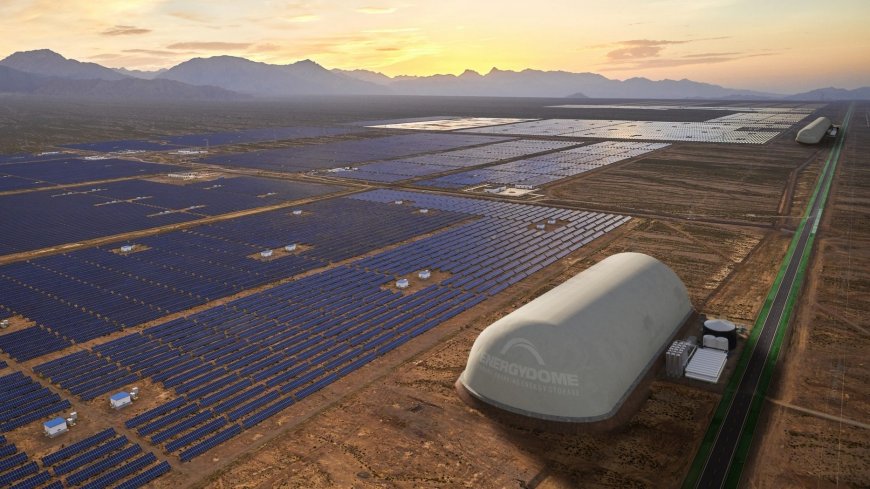
This is the physical reality of what Google is backing. The CO₂ battery is not a containerized asset or modular rack system. It is a dedicated industrial facility consisting of a large flexible dome, compression systems, heat exchangers, turbines, and balance-of-plant infrastructure.
The dome itself acts as a low-pressure gas holder for carbon dioxide, while the surrounding equipment handles compression, liquefaction, heat capture, and power generation. In scale and complexity, these installations resemble small power plants rather than batteries.
The systems Google is backing through Energy Dome are industrial-scale long-duration energy storage plants. These are not containerized batteries stacked behind a fence. They are designed to deliver multi-hour firm power on demand.
A standard installation operates at roughly 20 megawatts of output with approximately 200 megawatt-hours of storage capacity. That equates to about ten hours of continuous full-power discharge.
That duration is the point. It allows renewable overproduction to be shifted cleanly through evening demand peaks without invoking gas peakers or emergency grid imports.
How the CO₂ Battery Works
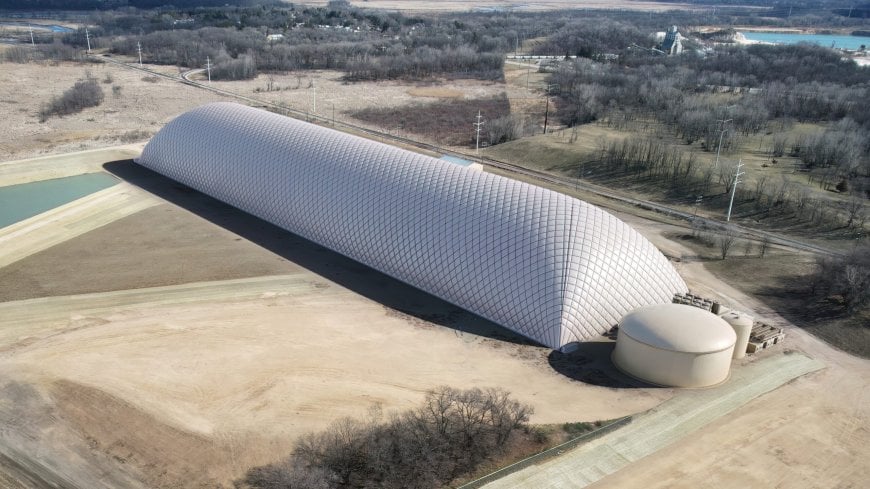
At ground level, the system is dominated by conventional industrial hardware. Compressors, piping, thermal storage units, and turbines are arranged around the dome, emphasizing that this is a mechanical energy system built from mature industrial components.
This reliance on known equipment is intentional. It reduces material risk, avoids exotic supply chains, and allows the system to be scaled using established industrial engineering practices rather than experimental chemistry.
The CO₂ battery is a closed-loop thermomechanical storage system. Carbon dioxide is used as a working fluid because of its favorable thermodynamic properties and deep industrial familiarity.
During charging, excess electricity compresses CO₂ into a dense liquid state while capturing compression heat. During discharge, the liquid CO₂ is evaporated using stored heat and expanded through a turbine to generate electricity.
Nothing is burned. Nothing is emitted. The system behaves like a reversible power plant built from compressors, turbines, heat exchangers, and storage vessels rather than chemical cells.
Why Lithium Breaks at Long Duration
Lithium-ion batteries excel at fast response and short-duration discharge. They dominate frequency regulation and sub-four-hour applications.
At longer durations, costs scale linearly with added hours, degradation accumulates, thermal management becomes complex, and site-level fire risk becomes non-trivial.
Mechanical and thermal systems compete effectively beyond eight hours because they scale through physical capacity rather than electrochemical replication.
Materials vs Mechanics: Long-duration storage rewards durability and repeatability over energy density. This is why turbines have anchored grids for a century.
Scale, Projects, and Deployment Reality
In the United States, Energy Dome’s projects are being integrated directly into utility-owned sites rather than isolated demonstration campuses. This reflects a shift from pilot deployments toward grid-facing infrastructure designed to operate under regulatory oversight.
These facilities are intended to absorb excess renewable generation and return it during peak demand windows, reducing reliance on gas peakers while maintaining system reliability during stressed hours.
Commercial-scale CO₂ battery installations are already operating and moving into replication mode. U.S. projects approved in the Midwest are scheduled to begin construction in 2026 with completion timelines extending into 2027.
For Google, the strategic value is repeatability. Once a design can be standardized, financed, permitted, and interconnected with predictable performance, it becomes infrastructure rather than experimentation.
Where This Fits in the Grid Stack
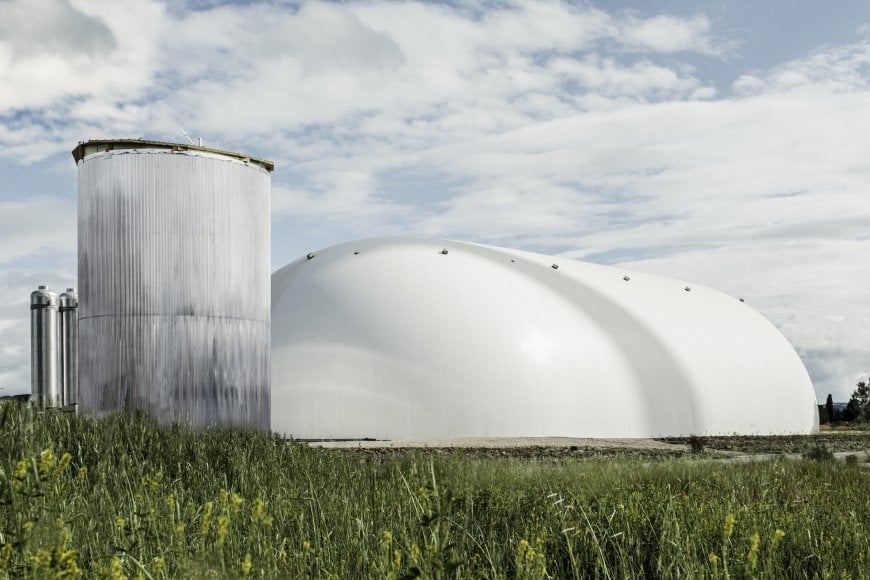
Placed near substations and transmission corridors, CO₂ batteries function as timing buffers within the grid. They do not replace generation. They reshape when energy is delivered.
This placement allows them to directly intercept renewable overproduction and re-inject power at the most economically and operationally valuable hours, particularly during evening ramps and overnight demand persistence.
- Seconds to minutes: frequency response and power quality
- 1–4 hours: ramp smoothing and peak shaving
- 8–12 hours: evening and overnight firming
- Multi-day: still largely unsolved at scale
CO₂-based storage targets the most economically painful gap in renewable-heavy grids: the long evening ramp.
Risks, Constraints, and Failure Modes
Large domes are visually intrusive. Permitting can become political. Interconnection queues remain a bottleneck. Performance must be proven across climates and sustained cycling regimes.
PN Reality Check: Long-duration storage fixes timing mismatches, not structural undersupply. It buys time. That time must be used wisely.
FAQ
Is this carbon capture or sequestration?
No. Carbon dioxide is used as a closed-loop working fluid. The system does not remove or store carbon from the atmosphere.
How long can a CO₂ battery discharge?
Standard installations are designed for approximately ten hours of full-power discharge, placing them firmly in the long-duration category.
Why is Google investing instead of utilities?
AI workloads create firm demand that utilities alone may not be able to serve reliably in renewable-heavy grids. Hyperscalers are increasingly internalizing reliability.
Does this replace lithium batteries?
No. It complements them. Lithium remains optimal for fast response and short-duration needs.
Pattern Nexus Lens
AI accelerates demand. Renewables reshape supply. Storage becomes the timing broker between the two.
Google’s CO₂ battery bet signals a shift where reliability is pulled inside corporate balance sheets rather than outsourced entirely to utilities.
The domes rising near substations are not futuristic ornaments. They are markers of a grid adapting to a world where energy abundance no longer guarantees energy availability.
Sources
- Google Sustainability Blog – Long-Duration Energy Storage and 24/7 Carbon-Free Energy
- Energy Dome – CO₂ Battery Technology Overview
- Energy Dome – Strategic Commercial Agreement with Google
- Energy Dome – First U.S. Contract with Alliant Energy (20MW/200MWh Standard Frame)
- Alliant Energy – Columbia Energy Storage Project
- Alliant Energy – PSC Approval Announcement (Columbia LDES)
- Wisconsin Public Service Commission – Regulatory Filings and Dockets
- IEEE Spectrum – CO₂-Based Long-Duration Energy Storage Takes Off
- Energy-Storage.news – Google Partners with Energy Dome on CO₂ Battery LDES
- Energy-Storage.news – Energy Dome’s 10-Hour Wisconsin CO₂ Battery Approved
- Utility Dive – Alliant’s CO₂-Based Long-Duration Storage Project
آپ کا ردعمل کیا ہے؟
 پسند کریں
0
پسند کریں
0
 نہ پسند
0
نہ پسند
0
 محبت
0
محبت
0
 مزاحیہ
0
مزاحیہ
0
 واہ
0
واہ
0
 اداس
0
اداس
0
 غصہ
0
غصہ
0

Founder of Pattern Nexus. I research markets, macro, geopolitics, AI, history, ancient systems, and the patterns most people overlook. I’m also building Market Radar, a trading scanner designed to read pressure, risk, confirmation, and setup quality before chasing a move. Pattern Nexus is where I connect the dots between data, history, technology, and the bigger system playing out around us.
















تبصرے (0)